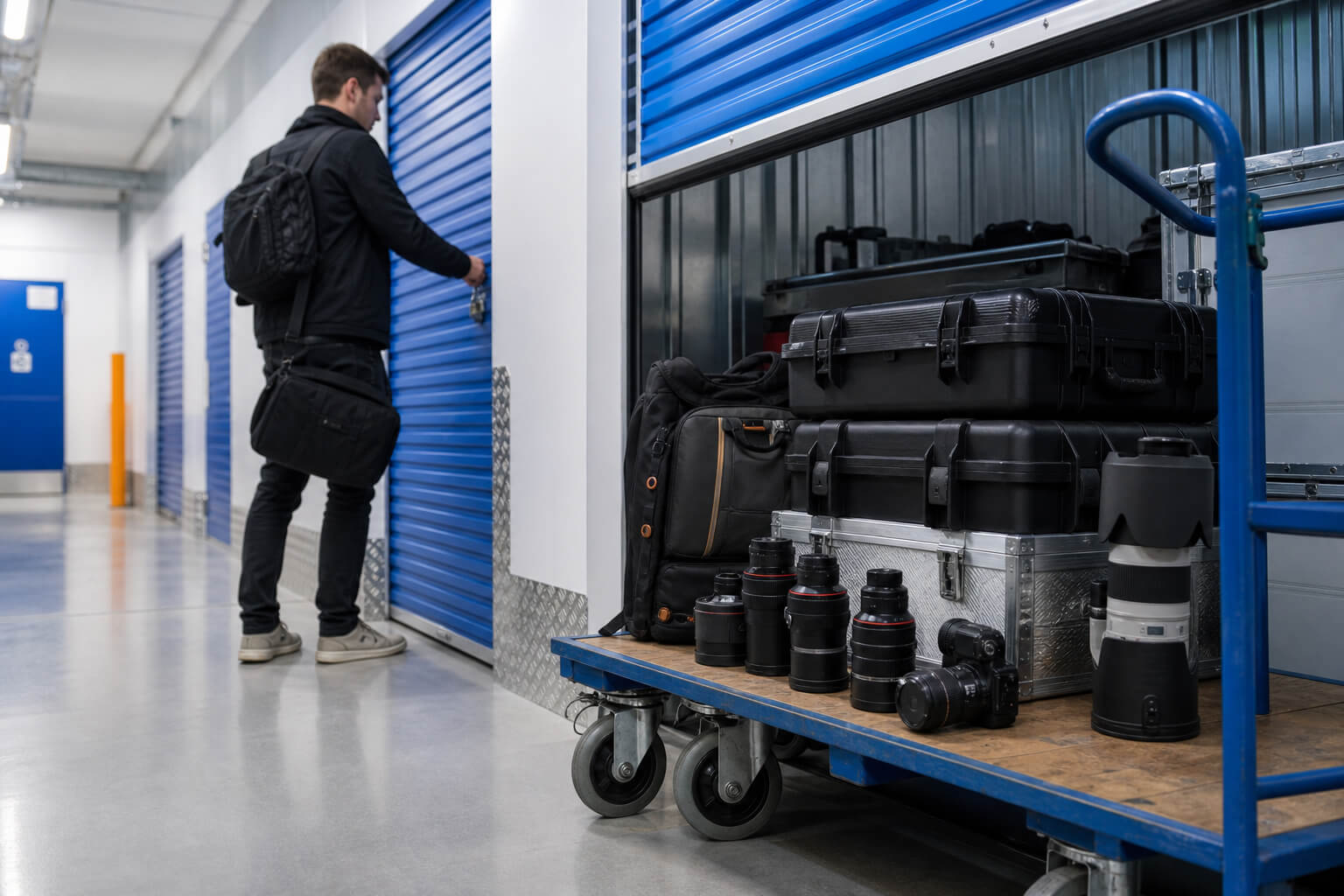
Tool Theft From Vans Why Self Storage Costs Less Than Your Insurance Premium

Walked out at half six to a van door that isn’t quite shut?

Most tradespeople know the feeling before they even get to the van. You walk out at half six, coffee in hand, and something about the street looks different. The side door is not quite shut. There is glass on the kerb. And then you know, before you even open it, that your morning has changed completely.

It happens to sole traders up and down the country. An electrician loses a set of Milwaukee drivers and a cable stripper. A plumber finds the van wiped clean overnight: everything from the channel bender to the crimping kit. A joiner who has spent fifteen years building up a set of Festool gear drives to site with hire tools and a sick feeling in his stomach. The tools were insured. That part is fine. What nobody tells you before it happens is everything else that comes with it.

This page does the sum that the renewal letter never shows you. Not a scare. A plain comparison, done honestly, so you can decide at the kitchen table whether a self storage unit pencils out for how you work.

If you have just had tools taken:
Your first call is your insurer to log the claim. While you are waiting, write down everything that was taken: model numbers, approximate replacement values, any serial numbers you have. Then come back here for the longer-term thinking.

If your renewal just arrived and it has gone up again:
The section for you is “The cost comparison” below. That is where the numbers live.

Not sure a unit suits how you work?
“Does a unit actually suit how you work?” is where Wigwam names the honest catch on access times. Read that first if you are the type who could get a call-out at midnight.

Why the van is the weak point

A van loaded with tools is not a mystery to anyone standing on a residential street at 11pm. The outline of a drill case, the shape of a pipe cutter through the panel, the SDS rattling when the door was not shut quite right: a working van tells you what is inside it without any help. That is the problem.

When it happens, and who it happens to

Overnight breaks happen most often when a van is parked away from its usual yard, on a residential street, without lighting. Sole traders and small firms are targeted more than large fleets because the kit is identifiable and the security is typically lighter. A single van, parked on the road, is the softest target in the street. The tools inside are worth real money: most working tradespeople carry five thousand to twenty thousand pounds of equipment as a matter of course, and that kit is what they use to earn.

Trade bodies including the Federation of Master Builders and NFU Mutual have reported on the scale of tool theft affecting UK contractors (check their current publications for recent figures before citing specific numbers). What every tradesperson who has been through it will tell you is the same thing: they saw it coming. They just had nowhere else to put the tools.

What a break-in actually costs (not just the tools)

Here is where it gets wider than most people expect. A van break-in is not one cost. It is usually four.

First there is the tool replacement: whatever the policy pays out, less any wear-and-tear adjustment, less the excess. Then there is the excess on the van’s own policy, typically somewhere between two hundred and fifty and five hundred pounds, for the damaged door or window. Then there are the hire-tool costs for the days you are waiting for replacements to arrive: even a few days of hired kit adds up quickly. And then there are the cancelled jobs, the customers who have to wait, and in some cases the subcontractor day rates you have to pass on because you cannot complete the work yourself.

Those are the costs of a single incident. The fifth cost, which does not show up in that week’s accounting, is what we cover in the next section.

The two real options, honestly compared

Here is the choice as it actually sits. Two options, both real, both worth considering depending on how you work. Neither is right for everyone.

An external unit for overnight storage

The external unit is the option that removes the target entirely. If there are no tools in the van, there is nothing to take. You drop the kit on the way home, pick it up before the first job in the morning, and drive an empty van overnight. It suits the tradesperson who starts and ends each day at the same base, whether that is home, a yard, or a site within a sensible radius of a storage location.

At a Wigwam unit you get an individually alarmed space, clean, dry and secure, with smart entry between six in the morning and ten at night, seven days a week. There are no staff on site, which means you are in and out on your own time. The footprint of a small unit is usually enough for hand tools, power tools, fixings, ladders, and site equipment without taking up more space than you need.

A bolted-in van vault, and where it falls short

The van vault, products like the Van Vault 2 or the Armorgard TuffBank, is the option for the tradesperson who needs kit with them across multiple sites during the day and cannot drop everything at a fixed base each evening. It slows a casual thief and resists an opportunistic raid. The better ones are bolted to the van floor and take time to remove.

The honest limit is this: the vault is still inside the vehicle. A determined thief with time, a decent grinder, and a quiet street can get through most of them. And if the van itself goes, everything inside it goes with it. The vault reduces the risk of a quick smash-and-grab. It does not cap the downside in the way a unit does, because the tools are still in the van.

The cost comparison: storage vs your insurance premium
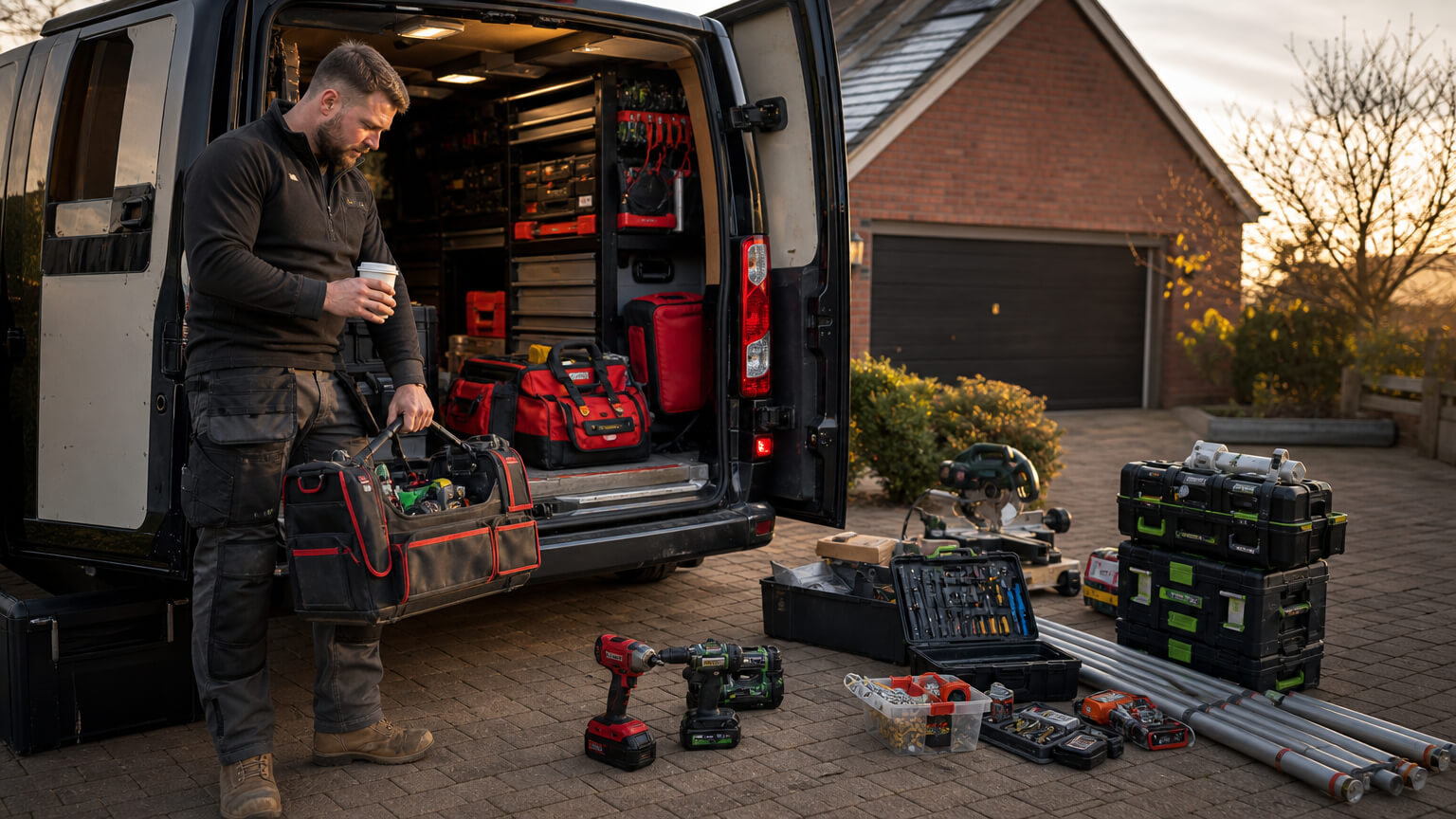
The renewal letter shows you one number. What it does not show you is the four components that number is trying to cover, or what happens to it after you make a claim.

The four costs of a single break-in

Write these out on a piece of paper and the comparison becomes clearer.

One: the tools themselves. Your policy covers replacement, but check whether that is new-for-old or adjusted for age and condition, and check what the excess is before you assume the payout is what the tools are worth.

Two: the van damage excess. When the side door has been jemmied, that is a separate claim on the van’s own policy. Typical excesses run from two hundred and fifty to five hundred pounds, sometimes more on older vehicles. That comes straight out of your pocket.

Three: hire tools. If you are waiting for replacement kit, you are either hiring or not working. A week of hired gear for a busy sole trader adds up to several hundred pounds, depending on what you need.

Four: the cancelled jobs. The customers who rebook, the ones who do not. The lost day rate for a sole trader who cannot get to site is real money. Often it is money that cannot be recovered.

Soften all of these to “typically” and “often” when you do your own sums. Your actual figures depend on your policy, your excess, and your kit. But name them all, because the renewal letter only addresses one of them.

Why a claim follows you: the premium ratchet

The cost of a claim does not end when the cheque clears. A van insurance claim reduces your no-claims bonus, which moves you onto a higher premium at renewal. Make another claim in the following years, or fail to rebuild the no-claims discount before the next incident, and the premium ratchets again. Many sole traders are paying significantly more on their van policy than they were three or four years ago, and a history of tool theft claims is one reason.

The precise effect on your premium depends on your policy and your insurer. If you are wondering whether storing tools out of the van might lower what you pay, that is a question worth asking your insurer directly: they can tell you whether your policy pricing changes if the overnight tool risk is removed. Wigwam cannot advise on that; your insurer can.

A fixed monthly cap vs a rising annual risk

Here is the reframe. The van risk is variable. Some years nothing happens. One year everything happens at once, and the cost lands on you in a single week. That variability is hard to plan around.

A self storage unit is a fixed monthly line. You know what it costs. You can put it in the accounts and forget it. Whether or not the van gets hit that year is no longer the question that keeps you up. The tools are off the van.

We do not list prices on this page because unit size and location affect the figure. You can see what a unit costs in your area at our pricing guide. Most sole traders need a small unit. The comparison is worth making.

Ready to run the numbers for your town?
See what a unit costs near you at quote.wigwamstorage.co.uk.

Does a unit actually suit how you work?

A self storage unit is not the right answer for every tradesperson, and Wigwam will say that plainly because the alternative is a customer who signs up, finds it does not fit, and does not come back. The fit depends on two things: your working pattern and your hours.

One base vs multiple sites

A unit works for the tradesperson who starts and ends each day at a consistent base. You drive to the unit on the way home, unload, lock up, drive home. You come back before the first job, load what you need for the day, and go. It is a five-minute habit when the unit is nearby.

It does not work well if you are driving from a compound to five different sites and need the angle grinder at site three at two in the afternoon, because you loaded it at seven in the morning and it is not in the van. If your working day is genuinely multi-site with kit moving between locations, a vault in the van is more practical than a unit you have to return to.

For a sole trader with a regular yard start, a predictable run of jobs, and tools that go on and come off the van each day anyway, a unit near home or the yard is a simple fit.

Access is 6am to 10pm, not 24-hour

This is the catch. Say it plainly.

Access at Wigwam is by smart entry, six in the morning to ten at night, seven days a week. That covers most of the working day for trades that start at a base. If you are on site by seven, you can load at six thirty without a problem.

What it does not cover is a midnight emergency call-out where you need a tool you left in the unit. If your work regularly takes you back out after ten at night, a unit is not the right answer for overnight kit access. That is an honest thing to say, and it is worth knowing before you sign up rather than after.

If your day starts at six or seven from a home base, the access window fits without much adjustment to how you already work.

What to look for in a tool storage unit

Not all storage is the same. These are the things worth checking before you commit to any provider.

Individually alarmed units, not just perimeter CCTV

There is a difference between a site with a camera on the gate and a site where every individual unit has its own alarm. A perimeter camera records what happened after the event. A per-unit alarm triggers on the door, which means the moment someone interferes with your space, the site knows about it.

At Wigwam, units are individually alarmed. Clean, dry and secure is the standard: no climate control is implied or offered, just a proper, weathertight space that keeps tools in the condition they left in. Smart entry handles access without needing staff on site.

Low commitment matters when you are testing a new habit

The minimum stay is two weeks. If you try it and find that the habit does not fit how you work, or the location is not convenient enough, you give fourteen days’ notice and leave. Any unused days are refunded. The deposit is refundable once you have vacated and the account is settled; it is returned after the notice period has run.

That is not a long commitment for something you are testing. A lot of tradespeople who try it for a month to see whether it suits them are still there two years later, because the habit turns out to be easier than they expected and the van drives quieter in the evening.

Sites are unmanned, which means you come and go without waiting for staff. If you are expecting a delivery to the unit, someone from your own business needs to be present to receive it; Wigwam does not sign for or accept deliveries on your behalf.

What you can and cannot store
What goes in without question

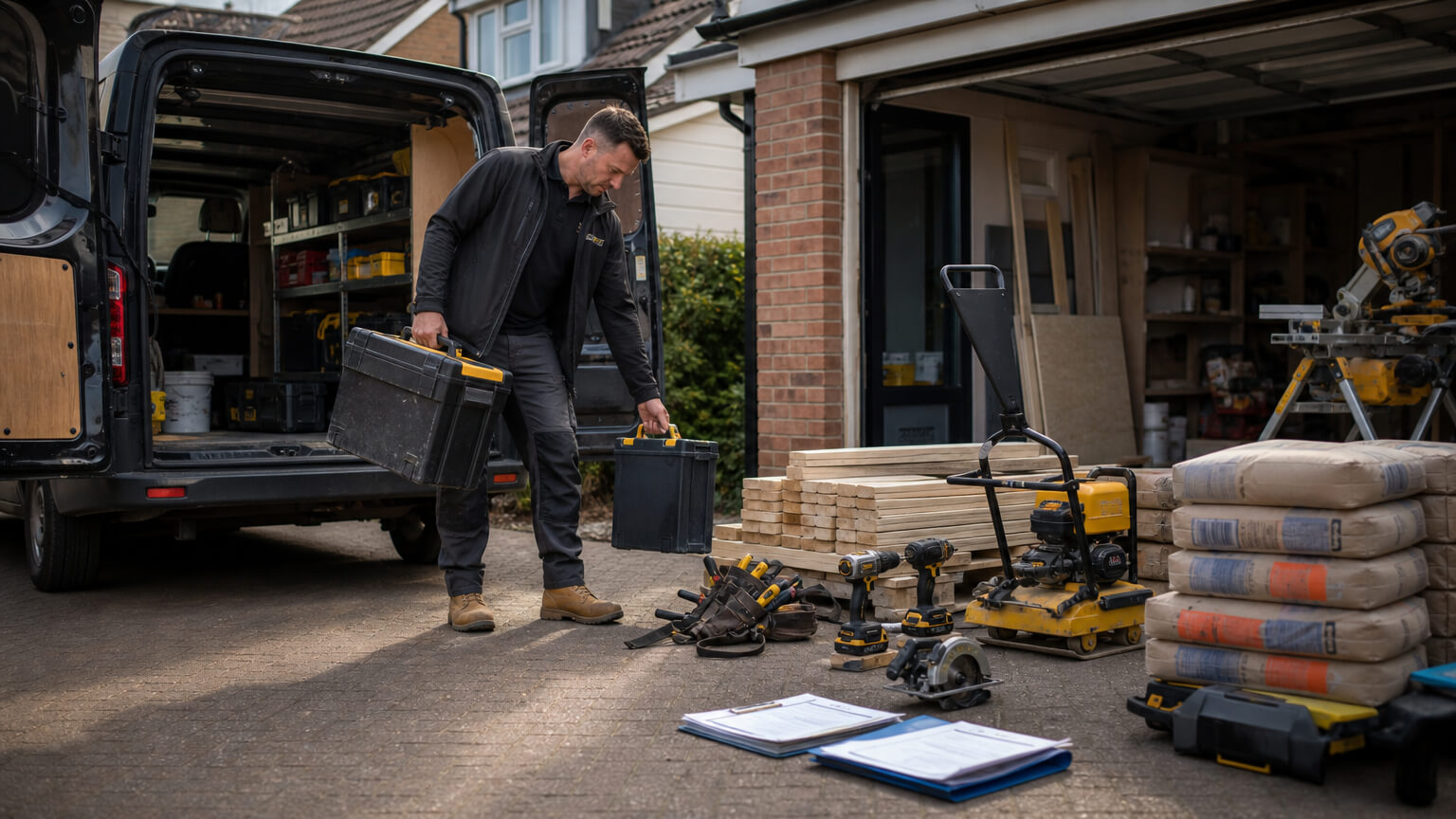
Hand tools, power tools, charged and uncharged batteries (check your specific unit policy on lithium batteries, as some sites have guidance on this), ladders, fixings, site equipment, and spare materials all go in without issue. If you are also between houses or clearing a property, household goods are welcome alongside the trade kit. The unit is your space.

What stays out, and why it matters

No fuel. No gas bottles. No paint thinners, solvents, or flammable liquids. Not because Wigwam is being unnecessarily awkward, but because these materials are a fire risk that could put every other customer’s stored goods at risk, and their presence would invalidate insurance cover for the whole block.

No vehicles. The unit is for tools, not the van. Wigwam does not offer vehicle storage.

No hazardous materials.

The full terms are at wigwamstorage.co.uk/terms-conditions.

Rules on hazardous goods storage and how exclusions interact with your policy can differ in Scotland and Northern Ireland. If you are in either jurisdiction, check your policy wording and speak to your insurer or a solicitor with commercial insurance experience in your area. The guidance here applies to England and Wales.

If you still need some tools in the van overnight
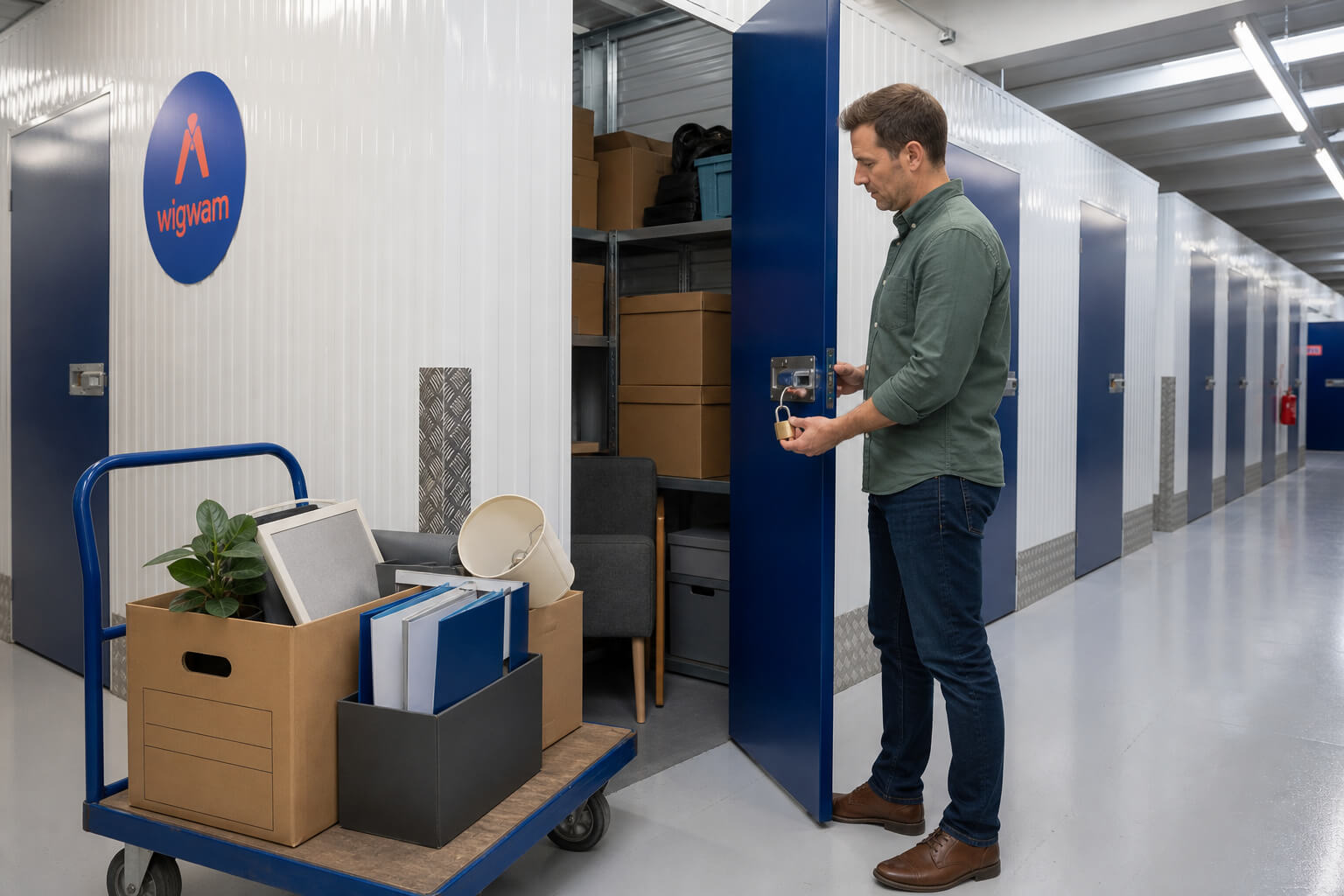
Not every tradesperson can clear the van completely every evening. Sometimes the job is two hours from the yard and driving back is not realistic. Sometimes the kit is too bulky to load and unload daily. This section is for when the unit is not the whole answer.

Reduce the target value: park smart and mark your kit

Park doors-to-wall or boot-to-wall wherever you can. A solid wall or building against the loading door means the most common entry point is blocked. Lit areas are harder to work in than dark ones. If you can avoid residential streets and use a commercial car park with CCTV, do so.

Remove anything visible from the cab window. The outline of a tool bag on the back seat is an invitation. An empty-looking cab is less interesting.

Record serial numbers for every significant piece of kit. Write them down somewhere you will find them if you need to make a claim. Mark tools with postcode-coded engraving: trade bodies report that marked tools are recovered at higher rates than unmarked ones (verify the current figure with your trade association before citing it). Even if the tools never come back, marked kit is harder to sell on, which reduces the incentive for theft.

What an in-van vault actually protects against, and what it does not

A bolted-in vault, whether that is a Van Vault 2 or an Armorgard TuffBank, is a real deterrent for an opportunistic thief. A casual raider who does not have the tools or the time to deal with a welded steel box will move on. That is a genuine advantage.

What it does not protect against is a determined thief with time, the right equipment, and a quiet street. And if the van is taken, the vault goes with it. The vault caps the downside of a quick raid. It does not cap the downside of a clean-out or a vehicle theft. That is the honest distinction.

Layering the two is an option for some trades: a unit for the kit you do not need overnight, a vault for the tools you genuinely cannot move each day.

Protecting the value of what you store: contents cover

The unit is only as good as the cover behind it. This section is signposting, not advice: speak to your insurer for anything specific to your situation.

Declare the real replacement value, not what you paid five years ago

When you take out contents protection for a storage unit, declare the full current replacement value of everything inside. Not what you paid for the tools when you bought them. Not a rough estimate. The figure it would cost you to replace them today, new-for-old.

The reason is underinsurance. If the declared value is below the actual replacement cost, a claim is typically settled proportionally: you bear part of the loss yourself in the same proportion as the underinsurance. Declare accurately, so that if something does happen, the cover is real rather than partial.

Wigwam offers RSA “Self Storage Customers’ Goods” contents protection as an opt-in. The policy is New-for-Old, with an excess of fifty pounds. You can also prove your own cover if your existing commercial policy extends to stored goods at a third-party location. Details are at wigwamstorage.co.uk/contents-protection.

Do not quote premium rates from this page; they are not listed here and depend on the value you declare. Speak to Wigwam or check the contents protection page for current figures.

Theft from a storage unit: how it differs from van theft

A theft from a van almost always involves forced entry. The door is jemmied, the window is broken, the lock is defeated. That is the normal trigger for a van insurance claim.

The RSA contents protection for a storage unit works on a similar principle: theft cover applies after forcible entry to the unit. Given that units are individually alarmed and the site uses smart entry, forced entry to a Wigwam unit is harder to pull off than forced entry to a van on a residential street. The alarm triggers on the unit door. The access system logs entries. That is a meaningfully different risk profile from a van parked overnight.

For anything specific to how a claim would be assessed in your circumstances, speak to your insurer. See the full terms at wigwamstorage.co.uk/terms-conditions.

Insurance policy terms and how claims are assessed can vary across the UK. If you are based in Scotland or Northern Ireland, speak to your broker or a solicitor with commercial insurance experience in your area before relying on the England-and-Wales framing here.

Take the tools off the van

The sum is not complicated. A van break-in costs more than most people account for before it happens: the tools, the van excess, the hire kit, the lost days, and then the premium that climbs afterward. A self storage unit converts that unpredictable cluster of costs into a single flat monthly figure you can see and plan around.

It works for trades that start and end each day at a base. Access is six in the morning to ten at night, which covers the working day for most. The minimum stay is two weeks, and unused days are refunded if you leave early. The deposit is refundable once you have given fourteen days’ notice, vacated, and settled the account. There is no long-term commitment to worry about while you are testing whether the habit fits.

If you are ready to see what a unit costs in your town, a quote takes two minutes.

Get a quote at quote.wigwamstorage.co.uk.

Find your nearest location at wigwamstorage.co.uk/self-storage-locations. If you are in Lincolnshire, Wigwam Self Storage Lincoln is one of our market-town locations. In Somerset, Wigwam Self Storage Bath covers the area. For other towns, the locations hub will show you what is closest.

Frequently Asked Questions

Will moving my tools out of the van overnight actually lower my insurance premium, or just my risk?

The honest answer is that it lowers your risk for certain, and it may lower your premium, but only your insurer can confirm the second part, so ask them directly. Removing the tools from the van overnight removes the single most common loss event for a tradesperson, the overnight break-in on a residential street, and that genuinely changes your exposure. Whether it changes what you pay depends entirely on how your particular policy is rated. Some insurers price the overnight tool risk separately and will adjust if you can demonstrate the kit is stored elsewhere; others bundle it and may not move the number much. The way to find out is a specific question to your insurer or broker: “If my tools are not in the van overnight and are kept in a secured, alarmed storage unit, does that change my premium or my cover terms?” Be ready to describe the storage, individually alarmed unit, smart entry access, forced-entry-based theft cover, because that detail is what they will assess. We cannot advise on your premium; that sits with your insurer, and pretending otherwise would be giving insurance advice we are not qualified to give. What we can say plainly is that the unpredictable cluster of costs from a break-in, the tools, the van excess, the hire kit, the lost days, and the premium climb that follows, becomes a single flat monthly figure when the tools are off the van. Even if the premium itself does not fall, the risk you are carrying does, and that is worth a conversation with your insurer before your next renewal.

Can I store lithium-ion tool batteries in the unit, and how should I look after them?

You can store ordinary cordless tool batteries, but check your specific unit’s policy on lithium batteries first, because some sites give particular guidance and the rules around quantity and condition matter. The general principle is that the everyday batteries for drills, drivers and saws are fine in normal numbers, what is excluded across the board is bulk fuel, gas bottles, solvents and flammable liquids, which are a fire risk to the whole block. Lithium batteries sit in a sensible-precautions category rather than a banned one, so treat them with a bit of care:

  • Store them charged to roughly half rather than fully flat or fully full, which is kinder to the cells over a long idle period.
  • Keep them dry; the units are clean and dry, but pack batteries in a box rather than leaving them loose on the floor.
  • Do not store visibly damaged, swollen, or fire-damaged batteries, which are a genuine hazard.
  • Keep terminals from shorting against metal by leaving them on the tool, in their case, or with terminal caps on.

There is no climate control, meaning no managed temperature, but a dry, secure unit is well within what tool batteries tolerate over the kind of overnight-and-weekend cycle most trades use. If you are storing a large quantity, or anything beyond ordinary tool packs, raise it with the team so you are clear on that site’s guidance. When in doubt, ask before you store rather than assume, and check the terms and conditions, which set out what is and is not permitted.

If my tools are stolen from the unit, how does a claim differ from a claim on a van break-in?

The mechanics are similar, theft cover hinges on forced entry, but the risk profile of a unit is meaningfully better than a van on the street, which changes the picture. On a van, theft almost always means forced entry: a jemmied door, a broken window, a defeated lock, and that is the normal trigger for a van insurance claim. The RSA “Self Storage Customers’ Goods” contents protection works on the same principle: theft cover applies where there is evidence of forcible entry to the unit. The difference is how much harder forced entry is to achieve at a unit. Each unit is individually alarmed, so the alarm triggers on your specific door rather than just a perimeter camera recording after the fact, and the smart entry system logs access. That is a different proposition from a van parked overnight on an unlit residential road, which is the softest target on the street. For a claim, the practical steps are the same discipline you would apply to any loss: report it, document what was taken with model and serial numbers, and provide evidence of the forced entry. The single most important thing you control in advance is the declared value, declare the full current replacement cost of your kit, because under-insurance is settled proportionally and you carry the shortfall yourself. The policy settles New-for-Old with a fifty-pound excess. For exactly how a claim would be assessed in your circumstances, speak to your insurer; we provide the secure space and signpost the cover, we do not assess claims or give insurance advice.

Does my existing commercial or tools-in-transit policy cover the kit while it sits in a storage unit?

Do not assume it does, because many tools-in-transit and van policies cover the kit while it is on you, in the van, or on site, and stop at the door of a third-party storage unit. This is exactly why contents cover at the unit is a condition of storing rather than an optional extra. You have two routes. First, take Wigwam’s RSA “Self Storage Customers’ Goods” policy, which is built for goods in a unit and settles New-for-Old with a fifty-pound excess. Second, prove your own cover, but only if your existing commercial policy genuinely extends to goods stored at a third-party location, which is the specific wording to check. A lot of tradespeople discover at claim stage that their tools-in-transit cover lapsed the moment the kit went into storage, leaving a gap nobody intended. So the practical move before you book is a direct question to your insurer or broker: “Does my current policy cover my tools while they are stored overnight in a third-party self storage unit, and if so, up to what value and on what terms?” If the answer is yes, you can present proof of that cover. If it is no or unclear, the unit’s own contents protection closes the gap. Whichever you choose, declare the full replacement value, because claims settle in proportion to what you declare and under-insurance leaves you carrying part of the loss. We give information and signpost only; whether your own policy is adequate is a question for your insurer, not for us, and a phone call now is far cheaper than a shortfall later.

What if my van gets a midnight call-out and the tool I need is locked in the unit?

That is the honest catch, and it is worth facing squarely before you commit: access runs 6am to 10pm, seven days, by smart entry, and it is not 24-hour. If your work regularly takes you back out after ten at night for emergency call-outs, a unit is not the right place for the kit you might need at 2am, because you genuinely cannot get into the unit in those hours and there is no member of staff to let you in, the sites are unmanned. For most trades that start and end the day at a base, this is not a problem: you load before the first job and unload on the way home, all comfortably inside the window. The pattern that does not fit is the emergency electrician or plumber on call through the night who could need a specific tool at any hour. There are two sensible responses. One, split your kit: store the bulk of your gear in the unit, where it is off the van and out of harm’s way, and keep the small set of genuine call-out essentials in a bolted-in van vault for out-of-hours work. That caps the overnight theft risk on the bulk while keeping the emergency kit reachable. Two, if almost all your work is unpredictable night call-outs, accept that a unit with stated hours may not suit overnight kit access at all, and a vault is the more practical primary answer. Either way, knowing the window is 6am to 10pm before you book means you build the right habit rather than discovering the limit at the worst possible moment.

Can I store household goods alongside my tools if I am also moving house or clearing a property?

Yes, the unit is your space and there is no rule that it has to hold only trade kit, household goods are welcome alongside the tools. This suits the common situation where a sole trader is both running a business and between homes, or clearing a parent’s property, and would rather not pay for two separate units. Furniture, boxes, kitchen equipment, the ordinary contents of a home all sit happily next to hand tools, power tools, fixings and site equipment. A few practical points keep it sensible. Pack so that heavy tool cases are not stacked on top of boxes holding breakables, and keep anything you need regular access to, daily tools, for instance, near the front so you are not shifting the household side every morning. The exclusions are the same whatever the mix: no fuel, gas bottles, solvents or flammable liquids, because they endanger the whole block and would invalidate cover; no vehicles of any kind, the unit is for tools and goods, not the van; and no hazardous materials. The units are clean, dry and secure, individually alarmed, which suits both furniture and tools, there is no climate control, but the ordinary contents of a home and a working kit do not need it. One thing to get right on the cover side: declare the full replacement value of everything in the unit, tools and household goods together, not just one or the other, because the contents protection settles proportionally against what you declared. If the mix changes significantly during your stay, update the declared value to match.


Storing First Deciding Later The Self Storage Decluttering Trick That Works

Started the declutter, then froze the moment the decisions got big?

There is a particular kind of stuck that nobody warns you about. You have started. You have pulled things out of cupboards, carried boxes into the hall, lined up bags along the landing. And then you have stopped. Not because you ran out of time or energy, but because the decisions started to feel too big for an ordinary afternoon. That chair your mother liked. The box of photographs from a house you sold twenty years ago. The children’s things you kept meaning to pass on. Each one asks something of you, and by mid-morning you are sitting in the middle of it wondering where to begin.

Most decluttering advice will tell you to push through. Keep, donate, bin. Decide now. Move on. But for a lot of people – and this is nothing to be ashamed of – that order of operations is exactly what causes the stall. You are being asked to make a permanent, irreversible decision at the same moment you are physically handling something that matters. That is genuinely hard. It is not a personality failing.

This piece is about a different order of operations. Move the things you cannot decide about yet out of the house first. Get the calm of a cleared room immediately. Then take your time over each box, without the skip waiting on the drive or the weight of the whole job pressing on every single choice.

Why Decluttering Stalls Before It Is Finished

Most people who stall mid-declutter are not lazy, and they are not hoarders. They have been asked to do two different things at the same moment, and the combination is too much.

The Two-Simultaneous-Decisions Trap

The standard advice runs like this: pick an item up, decide whether to keep it, and if not, put it straight in the donation bag or the bin. The logic is clean. The reality is that the decision (“do I still want this?”) and the farewell (“if not, it leaves today”) land at exactly the same time, with no gap between them.

For things that carry no weight, this works fine. An old phone charger, a box of dried-up pens: decide, gone. But when you pick up a set of china that belonged to someone you loved, or a piece of furniture that has moved house with you three times, the decision and the farewell both need more room than a single afternoon can offer. So you put it back down. And then you put the next thing back down. And then you stop entirely.

That Reddit thread asking whether off-site storage is just delayed hoarding? It is asking exactly the right question. The answer depends on whether the storing has a built-in end date. More on that below.

Why the “Not Sure Yet” Pile Is Not a Failure

Every serious declutterer ends up with a pile of things they cannot decide about. If you ask people what is hardest to let go of, the answers are always the same: things connected to people no longer here, things from a chapter that has closed, things that carry the evidence of a life lived a certain way. These are not easy calls, and they do not become easier under pressure.

The “not sure yet” pile is not evidence that you are avoiding the job. It is honest uncertainty. And honest uncertainty deserves a process, not a deadline of today.

The mistake is treating the “not sure yet” pile as a failure state. It is actually the most important pile of the three. It is the one that needs the most care.

The Order of Operations That Changes Everything

Here is the shift that makes the method work. You do not clear the “not sure yet” pile last, after you have made all the other decisions. You move it out first.

The keep pile stays in the house. The let-go pile goes straight to a charity collection or the boot of the car. And the “not sure yet” pile goes into a small self storage unit – today, before you have had to wrestle with a single decision. You wake up the next morning to a cleared room. And then, one box at a time, on your own schedule, without any pressure, you make the decisions you could not make on the spot.

That is the store-first method. And it works because it separates the physical move from the emotional decision. You do not have to say goodbye on the same day you let go.

The Store-First Method, Step by Step

Three steps. The unit is a waiting room, not a final destination. The goal throughout is to empty it.

Step 1: Make Three Piles – Keep, Let Go, Not Sure Yet

Start the sort at home, exactly as you normally would. The keep pile is straightforward: things you want in your life and your home, you know it immediately. The let-go pile is things you are clear about – ready to donate, sell, or pass to someone specific. Clear it out as you would normally: charity shops, a local donation service, a family member’s car.

The “not sure yet” pile is the third category, and it gets full recognition here as a legitimate one. Not a failure pile. Not a “deal with this later” dumping ground. A pile of things that genuinely need more time, and that you are going to give more time to, properly, with a date attached.

A note on the frameworks you may have heard of: the 5-5-5 rule, the 50 percent rule, the 90-90 rule. All of these are useful. All of them work better when you are calm and not in the middle of a skip-hire deadline. The store-first method does not replace any of them; it gives you the breathing room to use them properly, one box at a time, at the unit.

Step 2: Move Only the “Not Sure Yet” Pile Into a Small Unit

Only the “not sure yet” pile goes into storage. Not the whole house, not everything you think you might want to review one day. Just the uncertain pile.

This keeps the unit small – which matters for cost – and it keeps it purposeful, which matters for motivation. When every item in the unit is genuinely uncertain rather than simply deferred, visiting the unit to sort through it feels manageable rather than overwhelming. You know why each thing is there. You know what question you are answering.

The keep pile stays home. The let-go pile is already moving on. The unit holds only what needs a little more time.

Step 3: Set a Review Date So the Unit Empties

This is the step that every competitor misses, and it is the most important one.

Without a review date, storing first becomes storing indefinitely. The unit fills up. The review visit never happens. A few months become a year. The Reddit fear – is this just delayed hoarding? – becomes justified. The method only works when it has a built-in end.

Set a date to make the first visit. Not to clear the whole unit in one go; a handful of boxes per trip is fine. But the date needs to exist before you drive away from the unit on day one. Write it in your diary. Three weeks from now. Four weeks. Whatever gives you enough distance from the pressure of the sort without being so far off that it drifts.

Wigwam’s terms are structured to make finishing easy rather than penalise it. The minimum stay is two weeks. If you finish ahead of your next payment date, unused days are refunded. The deposit is refundable too, returned after you give 14 days’ notice, vacate, and settle the account. The maths reward you for emptying the unit, not for extending the stay.

Get a quick sense of what a small unit costs near you. Head to quote.wigwamstorage.co.uk – it takes two minutes and you are not committing to anything.

How the Store-First Method Sits Next to the 5-5-5, 50 Percent and 90-90 Rules

Each of these frameworks asks a different version of the same question: would you really miss this?

The 5-5-5 rule asks: would losing this item matter in five days, five weeks, five years? The 50 percent rule suggests letting go of half the items in a given space. The 90-90 rule asks: have you used this in the last 90 days, and will you use it in the next 90?

All three are good tools. None of them work well when you are standing in a hallway with a skip outside and someone waiting for the van. The store-first method buys you the calm to sit with one box at a time in a quiet unit and actually work through these questions. You may find that most of the “not sure yet” pile becomes clear within a week of the initial sort. The decision you could not make under pressure turns out to be easy once the pressure lifts.

What Goes Into Storage, and What Should Stay Home

The store-first method works best when the unit holds the right things. Over-fill it and the review visits become overwhelming. Under-use it and the cleared space at home fills up again.

Good Candidates for the “Not Sure Yet” Unit

The items that work best in a short-term declutter unit tend to share one quality: you know what they are and roughly what they mean to you, but you are not yet sure what should happen to them.

Seasonal equipment you only use occasionally. Spare furniture from a room you are reconfiguring. Boxed books you have not opened in years but cannot bring yourself to let go of without checking what is in there. Bulky items you may want back in a few months – a cot that a grandchild might use, a spare sofa for a room that does not exist yet. Items from an inherited room where you have not had time to go through things properly. Pieces of furniture with practical value but no obvious home in the current layout.

These are all fair candidates. The unit is not a museum; it is a holding space while you make considered decisions rather than panicked ones.

The Hardest Items: Sentimental and Inherited Things

The items from a bereavement, a dissolved household, or a chapter that has closed are exactly the things the store-first method was designed for. The difficulty with inherited belongings in particular is that you are making decisions on behalf of someone else’s history as well as your own. That is not a decision you should be rushing.

For these items, give yourself a longer review window. There is no rule that says the “not sure yet” pile for a set of inherited china has to be decided by the same date as the spare lamp from the guest room. Some things need a year. Some need a conversation with a sibling or a cousin first. Some need a little more distance before the right answer becomes obvious.

Units at Wigwam Self Storage Bath and Wigwam Self Storage Lincoln – and across our UK market-town locations – are clean, dry and secure, and individually alarmed. The things in there are safe while you take the time you actually need.

What We Cannot Take

Wigwam stores household goods and business goods. We do not store vehicles, caravans, motorhomes, or boats.

One practical note on documents: a self storage unit is a space you control and access directly, not a managed records or archive service. For anything you might need to produce at short notice – legal papers, financial documents, medical records, identification – keep those at home, not in a unit. A unit is for things you can afford not to have immediate hand access to during the declutter period. For everything else, it is the right tool.

How Small a Unit Do You Actually Need

The first fear most people have is that they will need a very large, expensive unit to make the store-first method work. In almost every case, they need less space than they think.

A Rough Guide from a Few Boxes to a Single Room of Overflow

A typical “not sure yet” pile from one or two rooms – the sort of things you have pulled out of cupboards, cleared from a landing, or assembled from a spare bedroom – usually fits comfortably in a small unit. Think of a small locker-size space for a few large boxes and a lamp, right up to a room the size of a small bedroom for furniture, rugs, and a few dozen boxes from a larger sort.

Most declutters sit at the smaller end of that range. The method actively encourages this: because only the “not sure yet” pile goes in, not everything in the house, the unit tends to be smaller and the cost more manageable than people anticipate. For full size guidance, the Wigwam pricing page sets out what different sizes look like.

Why Most Declutterers Over-Rent, and How to Right-Size

The temptation is to take a slightly bigger unit than you think you need, just in case. For a store-first declutter, this is usually a mistake in terms of both cost and method. A constraint is actually useful here: a small unit that you fill to a reasonable level is easier to work through at the review visit than a large unit with things spread out with room to spare.

Start with the smallest unit that fits your pile, not the size that gives you comfortable empty space. If you need a second small unit later – because the first sort reveals more uncertain items than you expected – that is a real option. But in practice, most people find the opposite: once the initial pile is in and the room is cleared, the review visits move faster than expected, and the unit empties in a few weeks rather than a few months.

The quote tool at quote.wigwamstorage.co.uk will show you the options at your nearest location. No commitment required.

What It Costs and How the Terms Protect You

The financial shape of a store-first declutter is shorter and simpler than most people assume. Understanding the terms properly also means you can see the exit clearly before you start.

Two Weeks Minimum, Unused Days Refunded, and the Deposit

The minimum stay is two weeks. If your declutter resolves faster than expected and you empty and vacate the unit before your next payment date, any unused days are refunded. You are not locked in to a month-long commitment for a two-week job.

There is a deposit. It is refundable. Once you have given 14 days’ notice, vacated, and settled the account, it comes back to you. Those are two separate steps – the notice period, and then the completion – and they are worth understanding clearly before you start. The full terms are at wigwamstorage.co.uk/terms-conditions.

Taken together, these terms mean the store-first method has a real financial exit built in. You are not committing to indefinite payments. You are renting a waiting room for as long as the waiting is genuinely useful, and not a day longer.

Contents Protection – Get This Right Before You Load the Van

Before anything goes into the unit, sort out your contents cover.

Wigwam requires every customer to have contents protection in place. You can take Wigwam’s own policy or demonstrate that your existing cover extends to goods in self storage – check with your home insurer before you assume it does. Either way, declare the full replacement value of what you are storing. If the value you declare is lower than the actual value of what you have stored and something goes wrong, any claim is settled in proportion to the shortfall.

Wigwam’s policy is RSA-backed and New-for-Old, which matters if you are storing sentimental or quality items. The details are at wigwamstorage.co.uk/contents-protection. Read the policy rather than relying on a summary; this is not advice, it is a signpost to the right place to understand your cover.

How Wigwam Keeps Your “Not Sure Yet” Pile Safe

Security and access are the two practical questions that matter most once the unit is loaded.

Clean, Dry and Secure Units, Individually Alarmed

Every unit at Wigwam is clean, dry and secure. Each one is individually alarmed – not a site-wide alarm system, but an alarm on your unit specifically. That matters when the unit holds things of sentimental as well as practical value.

What Wigwam does not offer is climate control. The AI Overview from several competitors references temperature and humidity management for sentimental items. Wigwam’s honest claim is clean, dry and secure. If you are storing items that genuinely require specialist environmental conditions – archive-grade documents, artworks, instruments – the right place for those is a specialist facility with the relevant certification. For the household goods that make up a typical declutter “not sure yet” pile, clean, dry and secure is exactly what is needed.

Smart Entry, 6am to 10pm, Seven Days – On Your Schedule

Access to your unit is by smart entry, from 6am to 10pm, seven days a week. You go when it suits you. There is no booking system, no appointment, no need to fit around anyone else’s hours.

Sites are unmanned. You access your own unit directly. This is how the store-first review visits actually work: you come when you have an hour, you work through a few boxes, you take home the things you have decided to keep, you arrange donation or collection for the things you are letting go. It happens at your pace, not at the pace of a clearance team or a skip-hire slot.

One practical point: if a removals firm or courier is delivering or collecting on your behalf, someone from your household needs to be present. Wigwam does not sign for or receive deliveries. If you are using a man-and-van service to move things into or out of the unit, plan to be there yourself.

Access is 6am to 10pm. Not 24 hours. If you need to check before booking, that is the honest figure.

Find Your Nearest Wigwam Location

The store-first method works best when the unit is close enough to visit without it being a project in itself. A unit you can reach in 20 minutes means a box or two on a Tuesday afternoon, not a planned day trip.

Wigwam operates across UK market towns, which means units in the kinds of places where most of the sorting actually happens – not on the edge of a motorway network, but close to the homes and high streets where Diana and Sienna are working through their belongings.

Wigwam Self Storage Bath serves Bath and the surrounding Somerset area. Wigwam Self Storage Lincoln covers Lincoln and Lincolnshire. The full list of our UK market-town locations is at wigwamstorage.co.uk/self-storage-locations.

Once you know your nearest location, getting a price takes two minutes. Head to quote.wigwamstorage.co.uk, pick your location and the size you think you need, and you will have a figure to work with. No commitment at that stage, just a clear number so you can plan.

Where to Go Next

If You Are Decluttering as Part of a House Move

The store-first method overlaps with the moving use case: a unit that bridges between your old home and your new one while you work out what fits where. If that is your situation, our house-move self storage guide covers the specific shape of that kind of move (verify link resolves before publishing).

If You Are Handling Inherited Belongings or a Family Clearance

Inherited goods and probate clearances bring their own pressures and timelines, and the emotional stakes are different from a straightforward home declutter. If you are working through a family home after a bereavement, our guide to self storage for downsizing and estate clearance may be a better starting point (verify link resolves before publishing).

Frequently Asked Questions

Can a friend or family member help me sort through the unit?

They can, but the access runs through you. Only the account holder holds the smart entry credentials, and only they can open the unit. The sites are unmanned, so there is no one here to let a helper in or hand anything over on your behalf. In practice this is no obstacle for a sorting session: you meet your friend or relative at the unit within the 6am to 10pm window, you open it together, and you work through the boxes side by side. For the kind of “not sure yet” pile that includes things you find hard to decide on alone, a second pair of eyes on the day is often exactly what gets a box resolved.

What you cannot do is send someone to the unit to sort while you are not there, because they would have no way in and we do not give access to anyone who is not on the account. The same applies if you bring in a man-and-van to shift the keep items home or the let-go items to a charity: someone from your side has to be present, because we do not sign for or supervise on your behalf. So make the sorting a thing you do together, in person, on a visit. Bring the help, open up, work through a few boxes, lock up. The decisions feel lighter with company, and the access side is simple as long as you are the one there.

What happens if I decide I want to keep almost everything?

Then the unit has done its job, and the next move is to take those things home and close the unit, not to keep paying to store them indefinitely. The whole point of the store-first method is that it is a waiting room, not a final destination. If the calm of a few weeks’ distance leads you to realise you genuinely want most of the pile back in your life, that is a perfectly valid outcome. Move the keep items home as you reach each decision, and once the unit is empty, give your 14 days’ notice and vacate.

The terms are built to reward exactly this. The minimum stay is two weeks, and if you finish ahead of your next payment date, the unused days are refunded. The deposit comes back once you have given notice, vacated and settled the account. So deciding to keep things does not cost you a long commitment; it just brings the exit forward. The one thing to avoid is the drift where “keep almost everything” quietly becomes “leave it all in the unit and stop visiting,” which is the slide into indefinite storage the method is designed to prevent. If you are keeping it, take it home. The unit empties, the account closes, the job is done.

Can I sell or arrange a charity collection for items straight from the unit?

You can stage the let-go items at the unit and load them into your own car to take to a charity shop or a buyer, and that is how most people handle it. What does not work is having a charity van or a courier collect directly from the unit while you are not there, because the sites are unmanned and we do not release goods, sign for collections, or supervise handovers on anyone’s behalf. If a collection service is taking things away, someone from your side has to be present at the unit to hand them over within the 6am to 10pm access window.

The clean way to run it during a store-first declutter is to keep the let-go pile separate inside the unit, then on a visit either load it into your boot for the charity shop or be there in person when a collection is scheduled. The unit is a space you control and access directly; it is not a managed dispatch point or a collection counter. For selling, the same rule holds: a buyer cannot simply turn up and collect, so arrange to meet them yourself or move the item out first. None of this is a burden once it is in the routine. It just means the handovers happen when you are there, which fits the way the review visits work anyway.

What if I need something back from the unit urgently mid-review?

Then you go and get it, on your own schedule. Access is by smart entry, 6am to 10pm, seven days a week, with no booking, no appointment, and no need to fit around anyone else’s hours. The sites are unmanned, so the unit is genuinely yours to reach whenever you need it within that window. If you packed with a bit of thought, the urgent item is quick to find: a clear aisle, boxes labelled on more than one side, and a short inventory note inside a lid turn a panicked search into a two-minute stop.

This is one of the real advantages of a unit over a skip or a clearance service. With a skip, once it is gone, it is gone. With the store-first method, nothing is irreversible until you decide it is. The “not sure yet” pile stays accessible throughout the review period, so if you suddenly need that spare lamp or a particular box of papers, it is ten minutes down the road, not lost. Just bear in mind the access is 6am to 10pm, not 24 hours, so an item you might need in the small hours is one to keep at home rather than in the unit. For everything within the day, it is there when you want it.

Is a storage unit a safe place for valuables or important documents during a declutter?

For ordinary household goods, yes: the unit is clean, dry and secure, and individually alarmed, which is exactly what a typical “not sure yet” pile needs. But it is not a managed archive or a records service, and there are two categories worth keeping out of it. The first is anything you might need to produce at short notice, legal papers, financial documents, medical records, identification, which belong at home where you have immediate hand access, not in a unit you visit occasionally. A unit is for things you can afford not to reach instantly during the declutter.

The second is anything that genuinely requires specialist environmental conditions, such as archive-grade documents, artworks or instruments. We do not offer climate control; the honest claim is clean, dry and secure, and we will not imply temperature or humidity management we do not provide. For items that truly need those conditions, a specialist facility with the relevant certification is the right home. For sentimental household items of value, the unit is fine, and the right step before they go in is your contents cover: declare the full replacement value, because under-insurance is settled in proportion to the shortfall. The detail is on the contents protection page. We are signposting, not advising; check your own cover with your insurer.

What Makes Wigwam Self Storage Different Local Honest Fairly Priced

Every firm says it’s the best — so which one actually answers the checklist?

Choosing a storage company feels a bit like homework you never asked for. There are the national names you recognise from the roadside, a handful of local operators you have never heard of, and a pile of “top 5 things to check” articles that give you a checklist without ever answering it for themselves.

This page does the opposite. It takes the standard checklist, the same five questions that come up in every comparison guide and every AI summary, and answers each one plainly for Wigwam. Including the parts where the answer is no.

If you end up choosing someone else, that is fine. But at least you will know exactly what we are, and what we are not, before you decide.

How most people choose a storage company, and what they actually worry about

Most people start with sensible practical questions and end up wondering whether the company they are looking at is even straight with them. That second question is the one worth answering first.

The five things every guide tells you to check

The guides are right. Security, location and access, unit size, cost and hidden fees, reputation and standards. These are the right criteria. They are what the AI summaries and comparison articles return when you search “how to choose a self-storage company UK,” and they are a reasonable filter.

The problem is that every guide hands you the list and then leaves. None of them sit with you and answer it for a specific company, at a specific site, with the things that company gets right and the things it does not offer at all.

That is what the rest of this page does.

The question the guides leave out: is this company being straight with me?

There is a thread on Reddit that ranks near the top of results for “how to choose self storage UK.” Someone posted asking whether self-storage businesses are legitimate or fronts. It got plenty of replies, and the fact that it ranks at all tells you something: a meaningful number of people choosing storage are carrying genuine suspicion into the search.

The answer to “is this company legit?” is not a certificate or a badge. It is a company that will tell you what it does not offer, what the deposit situation is, what the access hours actually are, and what happens if a courier turns up. A front does not volunteer its own limits. An honest operator does.

Local, not national: why your town matters more than a head office

The national chains have one genuine advantage over us: they have more locations. If you need storage in a major city or close to a motorway junction, they may be the right choice. But Wigwam’s locations are in the market towns where people actually live, work and move house.

Our UK market-town locations: what that phrase actually means

Wigwam Self Storage Bath in Bath, Somerset. Wigwam Self Storage Lincoln in Lincoln, Lincolnshire. And across our other UK market-town locations, you will find similar things: towns with a high street, a community, a local economy. Not retail parks on the outskirts of a city that you only ever drive past.

You can find your nearest Wigwam location on the locations page. Each site is in a town where people actually need storage for the kind of reasons people have always needed it: a house move, a growing business, a period of change.

The “market town” framing is not marketing language. It describes where we have chosen to be, and why. When your storage site is in the same town as your home or your business, it changes the relationship. You can reach it easily. The people running it know the area. If something goes wrong, you are not calling a national helpline.

Sites you can reach in minutes, run by people who know the area

Our team members, people like Selina and others you will meet through the enquiry and move-in process, are local to the areas where the sites operate. They know which roads get busy on market day. They can tell you how long it takes to get to the site from the station.

Reviews help here too. Real customers from your town, saying what the experience was actually like, are worth more than a star rating aggregated across a hundred sites nationally. We would rather you read our reviews and make up your own mind than take our word for it.

Honest: what we do, and what we deliberately do not

Let us be plain about how our sites work. Not because there is anything to apologise for, but because knowing the operating model before you book means there are no surprises once you do.

Access on real hours: 6am to 10pm by smart entry

You can reach your unit seven days a week, from 6am to 10pm, using our smart entry system. That covers most people’s practical needs: early morning before work, evenings after a long day, weekends during a house move.

What it does not cover is access outside those hours. We are not 24-hour. We have chosen not to be. If you have a specific need for late-night or early-morning access beyond 10pm, we are probably not the right fit, and it is better to know that now than after you have booked.

Unmanned sites: you reach your own goods, and what that means for deliveries

Our sites are unmanned. You have your own unit, your own access, and you come and go within the access hours. There is no staff member on site during the day managing a reception desk.

This works well for most customers. You are not waiting on anyone else’s schedule. You arrive, open your unit, and get on with it.

For deliveries, it matters. If you are expecting a courier to drop something at your unit, someone from your own side needs to be there to receive it. Wigwam does not sign for goods, receive deliveries on your behalf, or manage incoming stock. If you need a managed goods-in service, that is a different kind of operation, and we are not it. Plan your deliveries around your own availability.

What we do not offer

No climate-controlled storage. Our units are clean, dry and secure. That is the honest description of what you are getting. We do not manage temperature or humidity levels, and we do not market the service as climate-controlled because it is not.

For most household goods, clean, dry and secure is exactly what is needed. For specialist items that require controlled conditions, a different provider would serve you better.

No vehicle storage, either. Wigwam stores household goods and business goods. We do not store cars, caravans, motorhomes, boats or any leisure vehicles. If that is what you need, we are not the answer, and there are operators who specialise in exactly that.

Naming these limits is not reluctance. It is the clearest proof we can offer that what we do say we offer is accurate.

Fairly priced: what you actually pay and what you get back

The anxiety around storage pricing is mostly about surprises. People worry less about the headline rate than about what turns up later. Here is how the money works at Wigwam, plainly.

A refundable deposit and a 14-day notice period

There is a deposit. It is refundable. When you are ready to leave, you give 14 days’ notice, vacate your unit and settle your account. Once that process is complete, the deposit comes back to you, less anything owed.

We do not hide the deposit or pretend it does not exist. The terms are available to read at our terms and conditions page before you book anything. There is no administration fee for getting it back. If your account is settled and the unit is empty, it returns.

Refund of unused days and a two-week minimum stay

The minimum stay is two weeks. If your move runs to plan and you only need a few days beyond the minimum, you are still in for the two-week block. If you need to leave after the minimum and there are days remaining in the period you have paid for, those unused days are refunded.

Move dates slip. Completion gets delayed. Builders take longer than expected. The refund-of-unused-days model exists because we know how moves actually go. Two weeks is enough runway for most situations; if you need longer, you carry on paying for what you use.

Where to see current prices

No prices in this article. Storage pricing varies by location, unit size and availability, and quoting figures here would be out of date before long. The right place to see what self storage actually costs is the pricing page. See what self storage costs across our UK locations and work from there.

Ready to find out what a unit would cost you?
Get a quote at quote.wigwamstorage.co.uk

Security you can see

Security is the first thing on every checklist, and rightly so. Here is what it looks like at a Wigwam site.

Individually alarmed units and smart entry

Every unit is individually alarmed. Not just the building, not just the perimeter, but each unit separately. If your unit is tampered with, the alarm is specific to yours.

Access to the site is controlled by the smart entry system, which operates from 6am to 10pm. You use it to enter the site; only authorised customers can get in during access hours. Outside those hours, the site is secured.

Clean, dry and secure: in plain terms

Clean means the units are in good condition and regularly maintained. Dry means you are not storing your furniture in a damp environment. Secure means the site has alarms, controlled access and physical security measures.

That is the complete description. We do not add “climate controlled” or “temperature managed” because neither of those things is part of what we offer. If a storage company uses those terms, ask them what they mean precisely. At Wigwam, the answer to “what are the conditions like?” is clean, dry and secure. For household goods and business goods, that is the right answer for most people.

If you are storing something that genuinely requires controlled temperature or humidity, speak to a specialist operator. We would rather you know now than discover it later.

Cover that protects your things

Contents protection is mandatory at Wigwam. You cannot store goods without cover in place. That is a condition of the agreement, and it protects you as much as it protects anyone else.

You have two paths. You can take out Wigwam’s RSA “Self Storage Customers’ Goods” policy, or you can provide evidence of your own cover. Either works; what is not an option is leaving your goods uncovered.

Full details are on our contents-protection page. The RSA policy runs on a New-for-Old basis, which means a like-for-like replacement rather than a depreciated payout for most categories of goods.

Use our RSA goods policy or prove your own

If you plan to use your own home or business contents insurance for your stored goods, check your policy wording before you assume it covers items held in a separate storage unit. Many home policies do not, or they cover it only with conditions. Your insurer or broker can confirm whether your existing policy extends to stored goods off-premises.

If it does not, or you are not certain, the Wigwam RSA policy is there for that purpose.

Why declaring the right value matters

Declare the replacement value of everything you are putting in the unit. Not the price you paid for it originally, not a rough guess, but what it would actually cost to replace it now.

The reason matters: under-insurance is settled proportionally. If your goods are worth twice what you have declared, a claim is likely to pay out proportionally less than the full loss. Declare low, and any settlement reflects that. Speak to your broker if you are uncertain about valuation.

The terms covering this are set out in our terms and conditions.

A note on jurisdiction: The contract terms governing contents protection are subject to English and Welsh law. If you are storing from Scotland or Northern Ireland, your legal position in the event of a dispute may differ. For guidance specific to your situation, speak to your own solicitor or insurance broker.

What catches people out, and how we avoid it

Most storage problems are avoidable. The three that come up most often are hidden fees, the wrong unit size, and access surprises on moving day.

Hidden fees, over-sizing, and access surprises

The industry has a reputation for fees that appear after you have signed. Administration charges, price-escalation clauses that trigger earlier than expected, mandatory add-ons that were not clear at the point of booking. This is what the “hidden fees” search query is really asking about.

The Wigwam model is straightforward: a deposit you get back, a notice period that is stated upfront, and a minimum term of two weeks. The full terms are on our terms and conditions page and available to read before you book anything. We do not hide the deposit, and the notice period is 14 days, not buried in small print.

On unit size, the most common mistake is paying for more space than you need. The best way to avoid it is to get a proper guide at the quote stage. When you request a quote, you will be asked what you are storing, which gives us the information to help you choose the right size rather than the biggest available. Our sizing information is part of the quote process; use it. Paying for space you are not using is a straightforward waste.

On access and deliveries: we covered the unmanned sites point earlier, but it is worth repeating here in the context of moving day. If you have removals booked, they can access the site during opening hours and load your unit directly. If you are also expecting couriers, someone from your own household or business needs to be on site to receive them. Wigwam does not hold keys, manage incoming deliveries or sign for goods. That is not an oversight; it is how unmanned sites work. Plan for it and it is no problem at all. Assume someone else will handle it, and you will have a problem.

How to choose: in one honest summary

You have now seen through every pane of the window, to use the old shopkeeper’s image. Security, access hours, what we do and do not offer, how the money works, what cover looks like, and where the common mistakes happen.

Wigwam is not the right answer for everyone. If you need 24-hour access, we cannot offer that. If you need climate control for specialist goods, you need a different kind of operator. If you need vehicle or leisure storage, we do not do it. Other providers serve those needs well, and we would rather you find the right one than book with us and be disappointed.

If what you need is clean, dry, secure storage for household or business goods, in a UK market town you can reach easily, with a plain terms model and a local team, then you are in the right place. Find your nearest Wigwam location and take it from there.

Get a quote at quote.wigwamstorage.co.uk

Frequently Asked Questions

If your sites are unmanned, how do I get help when I have a question?

You phone or email the support team, and you get a person who knows storage. Unmanned means there is no one sitting at a reception desk on the site itself. It does not mean you are on your own. The team handles sizing, availability, access, pricing, invoicing and booking, and they are the people to call if you are stuck on the day or unsure what unit you need.

The distinction worth drawing is between site presence and support. A manned site has someone physically there during opening hours, which sounds reassuring until you realise it usually also means shorter access hours and a higher rate to pay for the staffing. We chose the other model: you access your own unit by smart entry from 6am to 10pm, and the support you need comes through the phone and the booking process rather than a desk you have to catch before it closes.

There is one boundary worth naming. The support team are a storage team. They will help you work out whether a 50 or a 75 square foot unit suits what you are moving, when you can get in, and what it costs. They are not business consultants. If you are running a growing business and want someone to talk through your forecasts or expansion plans, that is not their lane. Ask them anything about the unit, the access or the account, and you will get a straight, quick answer from someone local.

How does Wigwam compare to a national chain on price once everything is added up?

The honest answer is that you have to compare the whole package, not the headline weekly rate. We do not quote prices on this page because they vary by location and unit size, and you should see current figures for your nearest site rather than a number that goes stale. But the thing that actually decides value is what is included and what is not.

Here is what to check on any quote, ours or anyone else’s:

What to checkWhy it matters
Deposit and whether it is refundableA refundable deposit comes back; an admin fee does not
Notice periodOurs is 14 days, stated upfront, not buried
Minimum stayOurs is two weeks, with unused days refunded if you leave early
InsuranceMandatory everywhere; check it is in the quoted figure or added on top
Price-rise clausesSome operators escalate the rate after a few months

National chains can look cheaper on the banner rate and then carry charges that close the gap or overtake it. A “from” price is rarely the price you pay. Our position is that the quote you get is the figure you pay, the deposit returns when you leave properly, and there is no fine print designed to catch you. Run the same checklist against every quote and you will see the real comparison rather than the marketing one. The pricing page shows the Wigwam range for your nearest market town.

Do I have to use Wigwam’s insurance, or can I use my own home contents policy?

You can use your own cover if it genuinely extends to goods in a separate storage unit. What you cannot do is store with no cover at all. Contents protection is mandatory, and you have two routes: take our RSA “Self Storage Customers’ Goods” policy, or show us evidence that your own policy covers the goods while they are in the unit.

The catch most people miss is that many home contents policies do not automatically cover belongings stored off the premises, or they cover them only under specific conditions and often for a limited period. Before you assume your home policy does the job, read the wording or ask your insurer directly: does this policy cover my goods while they are held in a self-storage unit away from my home, and for how long? If the answer is yes, in writing, you are set. If it is no, or only partly, the RSA policy is there for exactly that gap.

I will not advise you on which to choose, because that is your insurer’s job and not mine. What I can be clear on is the principle: declare the full replacement value of what you store, because under-insurance is settled proportionally. Declare half the value and you recover half the loss. That is true whichever route you take. The contents-protection page sets out how the RSA policy works, and your own insurer or broker can confirm whether your existing cover reaches stored goods.

I need to store something with sentimental value. Is “clean, dry and secure” enough, or do I need climate control?

For the overwhelming majority of household and family items, clean, dry and secure is the right environment. That covers furniture, boxed belongings, books, pictures, clothing and the ordinary contents of a home. We do not offer climate control and we do not market it, because it is not part of what we do. So the real question is whether your particular item needs controlled temperature or humidity, and that depends on the item.

Most sentimental things people worry about, photographs in albums, a wooden dresser, boxes of letters, ordinary paintings, sit perfectly well in a clean, dry, secure unit. The risk with these items is not our environment; it is moisture coming in with the item itself. Pack them dry, use breathable covers rather than sealed plastic against wood or leather, and they will be fine for months.

Where I would be straight with you is the genuinely climate-sensitive category: fine art of real value, certain musical instruments, wine, anything a conservator would tell you needs a regulated environment. For those, a specialist facility that controls temperature and humidity is the right home, and we are not it. I would rather tell you that now than have you assume a regular unit manages conditions it does not. If you are unsure where your item sits, describe it when you ask for a quote and we will give you an honest view, including pointing you elsewhere if that is the better call.

Can I switch to a bigger or smaller unit partway through if I get the size wrong?

Yes. Changing unit size is a practical conversation with the team, not a penalty or a problem. People misjudge size all the time, usually by over-estimating, and the model is built to flex rather than trap you. If you arrive and find the unit is tighter than you expected, or you realise a month in that you are paying for space you are not using, tell us and we will look at moving you.

This is one of the quiet advantages of the way we work. Because the minimum stay is two weeks and the deposit is refundable, you are never locked into a year of the wrong size. A move to a different unit is subject to what is available at your site at the time, so it helps to ask sooner rather than later, especially around the busy spring and autumn periods when units fill up. But the principle is that the size decision is reversible.

My honest advice is to get the size roughly right at the quote stage to save yourself the shuffle. When you request a quote you will be asked what you are storing, and that is the point to lean on the team rather than guessing. Tell them the rooms you are clearing and any large items, and they will steer you to a sensible size. Get it close at the start and you will probably never need to switch. But if you do, it is a phone call, not a fight.

Self Storage For Home Staging Clearing Clutter To Sell Your House Faster

Is your house too full to show, rather than too small to sell?

The living room has good bones. The fireplace is lovely. But there are two sofas, a shelving unit full of board games, a basket of dog toys and three coats over the banister, and the agent is coming tomorrow to take the photographs. Not a bad room. Just too full.

Most houses are not too small to sell. They are too full to show. That distinction matters, because it tells you what the actual job is. You are not renovating. You are not decorating. You are shifting enough of your life out of the way so that a stranger can walk through and picture theirs.

One storage unit, a clear weekend, and the room-by-room plan below. That is what this article is for.

Why a storage unit is a staging tool, not just a box room

A self-storage unit does one thing a box room cannot: it takes the surplus entirely out of the house. You cannot stage around a pile. You can arrange a cleared room. The difference in how a property photographs is immediate and, for buyers scrolling through listings on a phone, it is often the difference between a second look and a scroll past.

The agent’s eye and the three-to-five-foot rule

Estate agents and property photographers talk about breathing space. The idea is simple: every piece of furniture needs clear floor around it so the eye can travel across the room rather than snagging on edges. Roughly three to five feet of clear floor between the main pieces is the rough working principle, not a rigid formula, but a useful test. If you cannot walk a relaxed line between your sofa and the bookcase, a buyer’s eye will not be able to either. Move the bookcase out. The sofa stays.

Photographs taken in a cleared room come back looking bigger. That is not a trick of the lens. It is what happens when the camera can see the wall behind the chair.

Depersonalise so a buyer can picture themselves in the space

This is the part that feels odd. You are removing the evidence that you live there: the family photographs lining the hallway, the children’s drawings on the fridge, the sports trophies in the study. None of these things are wrong. They just make it harder for a buyer to imagine the house as their own.

The storage unit gives you somewhere safe and dignified to put these things. They are not in a bin bag. They are not crammed into a wardrobe. They are in an individually alarmed, clean, dry and secure unit that you can get into from 6am to 10pm, seven days, if you need something back. That matters when the photograph on the mantelpiece is irreplaceable.

One note: this page is about clearing your own belongings so rooms show better. If your agent suggests bringing in rented staging furniture or props, that is a separate question and a different cost. We are talking here about what you own.

What to clear first (the room-by-room list)

Start with the rooms that photograph worst and clear them in this order: living room, master bedroom, hallway. These three spaces form the buyer’s first impression and they are almost always the most burdened.

Bulky and surplus furniture that eats floor space

The second sofa. The spare dining chairs stacked in the corner. The exercise bike that has been in the bedroom since January. The large bookcase blocking the bay window. These are the pieces that shrink a room in a photograph and crowd it on viewing day.

Large furniture needs more unit space than boxes of belongings, and that affects cost. Signpost your own calculation early: what size unit do you need for furniture versus boxes and bags? The Wigwam pricing page gives you a starting reference, and the team at your nearest location can help you size the job.

Personal photos, collections and everyday clutter

We know this step feels uncomfortable. Removing the family photographs can feel like you are pretending you do not live there. You do live there. But the buyer needs to live there in their imagination first, and a wall of unfamiliar faces makes that harder than a neutral wall does.

Pack these items carefully and box them properly. The unit is alarmed, clean, dry and secure. You can get in from 6am if you want something back before a school run. The photographs are not gone. They are waiting somewhere safe, and you control when you go.

Fragile or treasured items you want out of harm’s way during viewings

Viewings are busy and slightly chaotic. People open wardrobes, peer into cupboards, let children into rooms. Fine china, artwork, musical instruments and anything genuinely fragile is safer out of the house during the sales period.

Wigwam units are individually alarmed and kept clean, dry and secure. We do not offer climate control, and we will not tell you otherwise. For items that are sensitive to temperature or humidity, good packing is the honest answer: double-wrap, use appropriate boxes, and protect surfaces with furniture blankets or wrapping. More on packing technique in the section below.

How much space you actually need

Most sellers staging a four-bedroom family home need a medium-sized unit, roughly the floor space of a small single garage. The honest answer is: it depends on what you are moving out.

Boxes and decor only, versus large furniture

There are two common scenarios.

The first is a seller who is clearing soft furnishings, boxes of belongings, personal items and small pieces. A smaller unit handles this comfortably. Think of it as a bootload or two: the kind of thing you could shift in a couple of estate car runs.

The second is a seller moving large pieces out: a second sofa, a large dining table with extra leaves, a wardrobe or a chest of drawers. A larger unit is needed, and the cost reflects that.

What you do not need is a precise square-footage calculation before you call. The pricing page gives you a sense of scale and cost, and the team at your nearest location can talk you through it based on a short description of what you want to store. Bring a rough list of the large pieces and they can steer you to the right size from the start.

A sizing guide (“what unit do I need”) is something we cover separately if you want to read it alongside this one.

When to move things out (the listing timeline)

The agent’s photographs are the hard deadline. Everything else follows from that. Miss the photo shoot with a cluttered room and you are fighting that first impression for the rest of the listing.

Before the agent’s photographs, then before the first viewings

Think in three phases.

Phase one: the heavy clear. Do this one to two weeks before the photographer arrives. The big furniture, the boxes, the personal items. This is the bulk of the work. A unit close to home means you can do this in several car runs over a week, rather than one pressured day.

Phase two: the final tidy. The day before the photographer and before the first viewing, walk every room and check the sight lines. Is every surface clear? Is the hallway free of shoes and coats? This phase is about polish, not clearing, because the bulk is already in the unit.

Phase three: the ongoing access window. The sales period lasts weeks, sometimes months. You will want things back. Smart entry from 6am to 10pm means you can retrieve something before work, or drop a new load in after an evening viewing, on your own schedule without asking anyone’s permission.

If you are also thinking about the move itself, what happens at completion and after exchange, that is a separate planning question and worth reading through separately when the time comes. This page is focused on the listing and staging phase while you are still living in the property.

Living in a show-ready home (and survey day)

The hardest part of staging is not the clear-out. It is the six weeks of keeping it that way while you still live there. This is where most staging plans quietly fall apart.

Keeping a small daily-use caddy

The practical solution is a caddy, or a dedicated bag or box, of the things you use every single day. Phone charger, keys, the children’s school bags, the dog lead, the morning coffee things. Everything else goes into the unit or into a designated out-of-sight place in the property. When a viewing is called, the caddy comes with you. The house stays show-ready with almost no effort.

This sounds minor. It is not. A show-ready home that takes twenty minutes of frantic tidying before every viewing will exhaust you within a fortnight. A show-ready home that takes five minutes because the daily clutter has a home does not.

The unit is central to this. Your 6am to 10pm smart-entry window means you can make small adjustments throughout the sales period, moving things in and out as the sale progresses.

Keeping access clear for viewings, valuations and surveys

A surveyor needs to see the loft hatch, the meter cupboard, the boiler, the garage, the utility area. These need to be accessible and clearly reachable. Do not store boxes in front of the loft hatch or stack furniture against the meter cupboard. Keep these points clear throughout the sales period.

The storage unit handles your belongings; your property is your own business. For any specific questions about what a surveyor needs to access or what you are obliged to disclose, your estate agent or solicitor is the right person to ask. If you are selling in Scotland or Northern Ireland, conveyancing processes differ from England and Wales, and your solicitor will guide you on the specifics.

Ready to move the first load out? Get a quote at quote.wigwamstorage.co.uk and find your nearest market-town Wigwam location. Two-week minimum, unused days refunded, smart entry 6am to 10pm.

Packing so nothing arrives damaged

The most common regret we hear from sellers is packing too fast the night before and finding a broken lamp three weeks later. Slow packing once beats fast packing twice. Block a proper afternoon, get the right materials, and pack in order of what you are least likely to need back first.

What to double-wrap and how to stack it

Mirror boxes and picture boxes are worth buying, not borrowing. A flat-pack mirror box keeps glass supported on all four edges rather than leaning against a wall in a unit. For hanging clothes, wardrobe boxes let you transfer items from rail to box without folding them, which matters for anything you will want to wear during the sales period.

Large furniture pieces should be covered with furniture blankets before moving. Surfaces scratch in transit more easily than you expect. Legs and corners are the most vulnerable points; wrap them first.

When you stack the unit, heavy items at the bottom and lighter boxes on top. Leave a clear path to the things you are most likely to want back during the sales period. If the box with the children’s school certificates is buried behind the second sofa, getting it out requires moving the sofa. Plan that before you load.

What the unit gives you (and what it does not)

The unit is individually alarmed, clean, dry and secure. That is an honest description, and it is the right description for a family’s furniture, boxes and personal items during a sale.

We do not offer climate control. For most household furniture and belongings packed well, that is not a gap. For items that are genuinely sensitive to temperature or humidity, such as antique veneers, certain artworks, or instruments, the right answer is proper packing, not a false promise from a storage operator who is telling you what you want to hear.

Contents protection is mandatory at Wigwam. You can take our policy or prove your own cover. Either way, you need to declare the full replacement value of what you are storing. Under-insurance is settled proportionally, which means if you declare half the value and something happens, you recover half of what you are owed. Read the full details at wigwamstorage.co.uk/contents-protection/ before you book, and speak to your insurer if you have questions about your own policy. Note that insurance terms and obligations may differ if you are based in Scotland or Northern Ireland; your insurer is the right person to ask.

What it costs and whether it is worth it

The honest answer to “is it worth it?” is almost always yes, if the house sells even a few days faster than it otherwise would have. Time on market costs money in mortgage payments, holding costs and the energy of keeping a home permanently show-ready. A unit that shortens that window pays for itself quickly in most cases.

What drives the cost and where to look it up

Two things drive the cost: the size of the unit and how long you keep it. Duration is harder to predict in a sale, which is exactly why a two-week minimum with unused days refunded on early departure makes sense for a seller. You are not locked into a three-month contract while you wait for completion.

There is also a refundable deposit. When you give 14 days’ notice, vacate the unit, and settle the account, the deposit is returned to you. The terms are set out in full at wigwamstorage.co.uk/terms-conditions/. Read them before you book. We do not quote prices on this page because unit size, location and current availability all affect the number; the pricing page gives you a reliable starting point.

Cheaper alternatives, honestly considered

Friends’ garages and parents’ lofts are free, and for a small amount of stuff they work fine. The practical limit is volume. A staged family home typically needs to clear a van-load of furniture and several dozen boxes. A friend’s garage rarely has that space, rarely has good conditions for furniture storage, and involves owing someone a favour for several weeks.

A garden storage unit or shed handles garden furniture and tools but not indoor furniture at any useful scale.

The honest comparison is this: a Wigwam unit near your home is clean, dry, individually alarmed and accessible on your own schedule from 6am to 10pm. A friend’s garage is none of those things. If the volume is small and the friend is willing, use the garage. If you are clearing a family home for sale, the unit is the practical answer.

Find your nearest Wigwam

Wigwam has storage in UK market towns, chosen specifically so that a repeat journey to the unit during the staging weeks is a short drive, not a mission. You should not be spending forty minutes each way to move a carload.

Find the location nearest to you at wigwamstorage.co.uk/self-storage-locations/. If you are in Somerset, Wigwam Self Storage Bath is on that page. If you are in Lincolnshire, Wigwam Self Storage Lincoln is there too. For other towns, the locations hub has the full list.

One practical note: our sites are unmanned. You access your own unit with your own smart entry. There is no manager to let you in or out. This is by design: it keeps costs down and means access is entirely on your own schedule. If you are using a removals firm or courier to deliver items to the site, someone from your side needs to be present to receive them. Wigwam does not sign for deliveries or receive goods on your behalf.

Ready to clear the decks?

You have the list, the timeline and the packing guidance. The next step is a quote.

Visit quote.wigwamstorage.co.uk to get a quote for your nearest location. Two-week minimum stay. Unused days refunded if you leave early. Smart entry 6am to 10pm, seven days. Individually alarmed unit, clean, dry and secure. Refundable deposit returned after your 14-day notice, once you have vacated and your account is settled.

The house will not stage itself. But one clear weekend, a unit close to home, and the room-by-room plan above gets you most of the way there.

Frequently Asked Questions

What happens to the unit if my sale falls through and I have to relist?

You keep it, and nothing changes. A fall-through is one of the most common reasons a staging unit ends up running longer than first planned, so the arrangement is built to absorb it without penalty. There is no fixed end date you committed to and no fresh contract to sign when the sale collapses. You simply carry on month to month, with the same two-week minimum already long behind you.

That matters because a fall-through usually means a fast relist. The house needs to go back on the market show-ready, and the last thing you want is to have moved everything back in only to clear it out again. If your belongings are still in the unit, you are ready for new photographs and viewings in a day, not a fortnight. Many sellers in a chain choose to hold the unit right through to completion for exactly this reason: the cost of keeping it a few extra weeks is small set against the cost of staging the whole house twice.

When the sale finally does complete, you give 14 days’ notice, clear the unit, and the refundable deposit comes back once the account is settled, less anything owed. Unused days from your paid period are refunded if you leave partway through. So holding the unit as insurance against a wobble in the chain does not commit you to paying for time you do not end up using.

Should I move things into storage before the valuation, or only before the photographs?

Before the photographs is the firm deadline; before the valuation is optional but often worth it. The two appointments serve different purposes. A valuation is the agent forming a view of the house and the asking price. The photographs are what buyers actually see, so a cluttered photo shoot is the one that costs you viewings.

If you have the time and energy, doing the heavy clear before the valuation has a quiet benefit: an agent walking through rooms that already breathe tends to price with more confidence, because they can see the space rather than guessing at it through your furniture. But this is a softer gain, and not every seller can clear a house twice over. If you can only manage one big push, time it for the week before the photographer arrives.

A practical middle path is to clear the obvious bulk, the second sofa, the surplus chairs, the boxes in the hallway, ahead of the valuation, then do the final detailed tidy before the photos. Your smart-entry access from 6am to 10pm, seven days, means you can move loads in stages across a week rather than in one exhausting day. The point is not to do everything at once. It is to have the right rooms cleared by the moment that matters most, which is the camera.

Can the removals firm drop my staged furniture at the unit if I am at work?

No. Someone from your own side has to be at the unit to receive anything, because Wigwam sites are unmanned. There is no member of staff on site to let a removals crew in, sign for the load, or accept goods on your behalf. We do not hold spare keys or open units for third parties.

In practice this is straightforward to plan around. You access the unit with your own smart entry, so you, a partner, a family member or a friend simply meets the removals firm there during the access window of 6am to 10pm. Many sellers find an early slot works best: the crew loads at the house first thing, you drive over, let them in, and they unload while you direct where things go. It rarely adds more than the time it takes to point at a corner.

If you cannot be there yourself, arrange for the person who can to hold your access and be present for the drop. What you cannot do is book a delivery to an empty site and expect the unit to be opened or the goods received. Make this clear to your removals firm when you book them, so they schedule the drop for a time someone from your side will be there. It saves a wasted journey and an awkward phone call on the day.

Do I need a bigger unit if I am storing a sofa and a mattress rather than boxes?

Usually yes, because large soft furniture packs far less efficiently than boxes, and it is the awkward shape rather than the weight that drives the space you need. A stack of well-packed boxes uses the full height and footprint of a unit neatly. A three-seater sofa, a mattress on its side and a wardrobe leave dead air around them that you cannot easily fill.

A rough way to think about it:

  • Boxes, soft furnishings and small decor only: a smaller unit, the kind of load you could shift in a couple of estate-car runs.
  • Add a sofa, a mattress, a wardrobe or a large dining table: step up to a medium unit, roughly the floor space of a small single garage.
  • A full house of surplus furniture: larger again, and worth describing to the team before you book.

If you are hovering between two sizes, take the larger one. A unit you can walk into and reach the back of is far easier to live with over a sale that lasts weeks than one packed solid to the door. Bring a rough list of the big pieces when you get a quote, and the team at your nearest location can steer you to the right size from the start. The pricing page gives you a sense of scale before you call.

Is it safe to keep paperwork like deeds or my mortgage file in the unit during the sale?

Important documents are physically secure in a unit that is individually alarmed, clean, dry and secure, but the better question is whether storage is the right place for them during an active sale. The honest answer is usually no, for a practical reason rather than a security one: you will need those papers at short notice, and a buried box behind the second sofa is the wrong place for something your solicitor might ask for at a day’s notice.

If you do store paperwork, pack it properly. Use a sealed, rigid box rather than a flimsy one, keep it well away from the floor, and put it at the very front of the unit where you can reach it without moving furniture. Label it clearly. A dry unit protects paper well, but documents are vulnerable to handling and to being mislaid more than to the unit itself.

For the conveyancing file specifically, most sellers are better keeping the live paperwork at home or with their solicitor, and using the unit only for archive material they will not touch during the sale. On anything to do with what you must disclose, retain or hand over as part of the transaction, your solicitor or estate agent is the right person to ask. This page is about storing your belongings while the house shows well; it does not give legal advice on the sale itself.

Self Storage For A Parents Belongings When They Move Into Care

A parent’s just moved into care — must the house be cleared straight away?

The first week after a parent moves into a care home is one of the busiest many families ever face. There is a room to sort, a house to deal with, utilities and accounts to notify, and paperwork waiting in every drawer. And underneath all of it, the quiet weight of a situation no one really planned for.

Storage will not sort any of that for you. But it will stop the house clearance from happening before the family is ready. That matters more than it might sound.

This page is for the adult child managing the practical side of things. It covers what storage actually does for a family in this position, how the terms work, what to expect on the day, and how to get started without having everything figured out first.

When the house has to be cleared but the family is not ready

Most care home rooms hold a bed, one comfortable chair, a small chest of drawers, and a few personal items from home. A photograph on the windowsill. A familiar lamp. Maybe a small bookcase if the room is generous. That is roughly it.

Everything else, and in most cases that means a full house, needs somewhere to go.

Why a care room takes so little

The care home manager will tell you exactly what your parent’s room can hold and what is not permitted. That is always the right first call. What they will almost always say is that the room is smaller than expected, furniture tends to be provided by the home, and only a few meaningful personal items can come in.

That is not a policy designed to make things hard. It is a practical reality of a residential setting. But it does mean that a family coordinating a parent’s move is suddenly facing the contents of a three-bedroom house, or a two-bedroom flat, or a lifetime of accumulated things, and needing somewhere for all of it to go.

The belongings that need somewhere else to go

The furniture, the boxes of photographs, the books, the china your parent would be upset to lose, the papers in the filing cabinet that nobody has gone through yet. These are not things to skip into a bin. They are things that take time to think about properly.

Some will go to children or grandchildren. Some will be sold or donated when the moment is right. Some will turn out to matter more than anyone realised once the dust settles. But you cannot know which is which in the first fortnight. A storage unit gives those things a home while the family works it out.

The gap between the timeline and the family’s readiness

Care home moves rarely come with much notice. The house may need to be vacated before siblings have even had a chance to talk. That is where storage earns its place: not as a permanent solution, but as a bridge between the timeline the process imposes and the one the family actually needs.

What a storage unit actually changes about this process

A unit does not make the decisions for you. What it does is change when you have to make them.

Without somewhere to put things, a family’s sorting window is whatever days or weekends can be scraped together before the house must be cleared. With a storage unit, the sorting window becomes weeks or months. The emotional pressure drops. The conversations that need to happen can happen at a pace that is bearable rather than frantic.

Converting a deadline into a sorting window

Once the belongings are in the unit, the charity runs, the gifting to grandchildren, the things that end up going to auction, the things that come home with you in the end: all of that happens on a human schedule. You can come back to the unit on a Saturday morning, or a Tuesday afternoon, or whenever you and your siblings are ready to take the next box home.

That is the specific thing storage changes in this situation. Not the size of the task. The clock.

Keeping siblings and wider family in the loop

Families managing a care home move are rarely doing it alone. There is usually a sibling group, sometimes spread across different towns, each with their own sense of what should be kept and what should go. A storage unit gives everyone access to the same belongings, at a time that suits them, without any single person having to be the one who makes all the calls alone.

Wigwam units are individually alarmed and locked by you. You control who has the access details. That means the whole family can be involved in the sorting without anyone feeling bypassed.

Probate and estate matters at a pace that works

Some families need storage not just for weeks, but for months. If the family home is being sold, if there is an estate to settle, if probate is involved, the admin can run for a long time alongside the practical business of sorting belongings.

Wigwam’s terms support that. There is no fixed-year contract. Storage can run month by month for as long as the family needs.

A note on jurisdiction: estate administration and probate timelines in England and Wales are different from those in Scotland and Northern Ireland, where separate legal frameworks apply. This page does not give legal or probate advice. If you have questions about the estate, the right person to speak to is your solicitor.

How much space you will need

Most families overestimate this, which is worth saying out loud. The contents of a care home clear tend to feel enormous when you are standing in the middle of them, but they compress well into a properly sized unit.

Roughly speaking, the contents of a one-bedroom flat will fit into a small unit, and a three-bedroom house into a medium one. Those are genuinely rough guides. The right size depends on what is going in, how it is packed, and whether large furniture is included.

From a few boxes to a full house clearance

If you are storing the contents of a single room, or a flat, a smaller unit is often enough. If you are clearing a full family house including furniture, beds, sofas and wardrobes, a larger unit gives you room to move things around as the sorting progresses.

The team can help you work out a likely size once you have a sense of what you are storing. You do not need a precise inventory. A rough description of the property and what is going in is enough to get started. See the pricing page for indicative costs, and use the quote tool to get a proper recommendation for your situation.

What to do if you are not sure yet

You do not need to have this worked out before you call. The team has helped families through this kind of move before and can suggest a unit size based on a straightforward conversation. If you need more space further down the line, that can be arranged. Start with a quote at quote.wigwamstorage.co.uk and go from there.

Keeping heirlooms, antiques and important paperwork safe

Your parent’s belongings will be clean, dry and secure. That is a plain statement of what the units are, not a marketing phrase.

What the units are actually like

Every Wigwam unit is individually alarmed. You set the lock. Wigwam does not hold a key to your unit. Access is by smart entry, available from 6am to 10pm seven days a week, so the family can come and go on weekday afternoons, weekend mornings, or whenever works.

The units are clean and dry. That matters for paperwork, for photographs, for books, for clothing stored in boxes. It means your parent’s things are not sitting in a damp outbuilding or a garage susceptible to weather.

One thing to be clear about: Wigwam units are not climate controlled. If you are storing antique oil paintings, delicate wooden furniture, or other items sensitive to atmospheric changes, the unit will protect against theft and weather, but not against fluctuations in temperature or humidity. For anything you are particularly concerned about, take specialist advice.

A word on contents protection

Contents cover is required for everything stored with Wigwam. You have two options: take out the Wigwam RSA Self Storage Customers’ Goods policy, which is a New-for-Old policy with a £50 excess, or provide proof of your own cover.

Whichever route you take, declare the full replacement value of what you are storing. If something is claimed and the declared value was lower than the actual replacement cost, the settlement will be proportional. The RSA policy excludes climatic and atmospheric damage, which is worth knowing if the contents include items sensitive to humidity.

This is a signpost, not insurance advice. The full details are at wigwamstorage.co.uk/contents-protection/. For questions about insuring estate items or items you hold under a power of attorney, speak to your insurer or solicitor.

How long you can stay and what the terms look like

There is no lock-in here. The terms are designed to be honest and straightforward, which matters especially when a family is already managing a great deal.

Two-week minimum, then flexible month by month

The minimum stay is two weeks. After that, storage runs month by month with no fixed end date. Families often keep belongings in storage for several months while the estate is being settled, the house sale completes, or siblings find the right moment to come and collect things. The terms support that.

If the situation resolves sooner than expected and you empty the unit early, any unused days are refunded.

What happens when you are ready to leave

When the family is ready to close the unit, give 14 days’ notice. Once the unit is vacated and the account is settled, the deposit is returned. There are no hidden charges. The full terms are at wigwamstorage.co.uk/terms-conditions/, and the team is happy to walk you through them if anything is unclear.

Selina and the wider team are real people who answer the phone. The sites are unmanned, which means you access your own unit independently, but there is a team behind Wigwam who can answer questions about the terms, help with a unit size, or talk through the logistics of a move.

Ready to get a quote? Tell us roughly what you need to store and which market town is nearest, and the team will come back to you quickly. quote.wigwamstorage.co.uk

How the move works on the day

The logistics of a care home clear can feel complicated when everything is already emotionally charged. Here is what actually happens.

Coordinating a removals firm and the storage unit

Many families arrange a removals firm to clear the house and deliver straight to the storage unit. This works well, and is one of the most common ways families use Wigwam in this situation.

The sites are unmanned, so someone from your side needs to be present when the removals crew arrives. That might be you, a sibling, or another trusted person. Wigwam does not sign for deliveries or accept goods on a customer’s behalf. Book the removals van for a time that falls within access hours (6am to 10pm), and make sure whoever is meeting them has the access details for the unit.

Access hours and how smart entry works

Smart entry gives you access from 6am to 10pm, seven days a week. That is enough for a Saturday morning removals slot, a weekday afternoon sorting session, or an early start if you need to be somewhere else by midday. The family can visit as often as they need within those hours.

Say “smart entry” when you describe it to the removals firm. It is the same secure electronic access you would use yourself.

Finding storage near home

Wigwam operates across UK market-town locations, which means there is often a site close to either the parent’s old home or to wherever the coordinating sibling lives.

Wigwam Self Storage Bath serves families in Bath and the wider Somerset area, including those whose parents are moving into care homes around Bristol and north Somerset. Wigwam Self Storage Lincoln covers Lincolnshire and the surrounding area. Across the network, there are Wigwam locations in Cheltenham, Warminster, Dorking, Marlow, Leatherhead, Reading, Tewkesbury, Burton upon Trent, Bromsgrove and more.

For families coordinating between siblings in different towns, it is worth checking whether there is a Wigwam close to the parent’s old home, close to the care home, or close to wherever a sibling lives. The locations hub lists all sites.

Getting started when you are ready

You do not have to have everything figured out to take the first step.

You do not need to know the exact unit size. You do not need a precise inventory. You do not need to have decided how long you will need the storage for. A quote starts a conversation, and the team can help you work out the rest from there.

For an idea of likely costs, the pricing page gives a clear picture of how storage is priced across UK market towns.

When you are ready, or when the family is nearly ready, the team at quote.wigwamstorage.co.uk is there. There is no pressure and no rush. That is rather the point.

Frequently Asked Questions

Whose name should the unit be in if my parent has moved into care?

In almost every case the unit is rented in the name of the family member managing things, usually the adult child coordinating the move, rather than the parent. That is the practical reality when a parent has moved into care: they are unlikely to be visiting the unit, paying the account or dealing with the logistics, so the person doing all of that is the natural account holder. The account holder is the one who holds the smart-entry access, settles the account and gives notice at the end. If you are acting under a Lasting Power of Attorney for your parent, you may prefer to keep the storage clearly connected to their affairs, paying from their funds and recording it as part of managing their estate. That is a sensible way to handle it, but how you account for the cost, and whether it is paid from your parent’s money or your own, is a matter for you and your solicitor rather than for us. We simply need a named account holder who is responsible for the unit. Our team handles storage matters only, sizing, access, terms and invoicing, and cannot advise on power of attorney, estate accounting or what you may or may not do with a parent’s assets. For anything touching their finances or legal position, your solicitor is the right person. What we can do is provide a clear rental agreement and invoices, which is exactly the documentation that helps when you are keeping a record of how a parent’s affairs are being managed.

What happens to the stored belongings if my parent passes away while they are in storage?

The unit and its terms do not change, but the belongings become part of the estate, so the person dealing with probate takes over the decisions. This is a hard but common situation, and the honest answer is that storage is designed to give you exactly the breathing room it is needed at such a time. Mechanically, nothing dramatic happens to the unit. It continues on the same month-by-month basis with no fixed end date, so there is no scramble to clear it during an already difficult period. When the family is ready, the unit is cleared, 14 days’ notice is given, the account is settled and the deposit returned, just as it would be at any other time. The change is in who has authority over the contents. The belongings form part of the estate, and decisions about them sit with the executor or administrator handling probate. If the account holder and the executor are the same person, that is straightforward. If they are different people, it is worth making sure everyone is clear on who is authorising the clearance and the distribution of items. We cannot advise on probate, estate administration or the legal handling of a deceased person’s belongings, and timelines differ across UK jurisdictions, so your solicitor is the right person for that. What we can do is keep the unit secure and available for as long as the estate needs, and provide whatever documentation of the storage arrangement helps the probate file.

How can several siblings share access to the unit safely?

The account holder controls the access details and can share them with siblings, which lets everyone help with the sorting without anyone having to be the gatekeeper. The whole value of storage in a care-home move is that it turns a frantic deadline into a sorting window the family can work through at a human pace, and that only works if more than one person can get to the belongings. Practically, the unit is rented by one named account holder who holds the smart-entry access. That person can share the access details with siblings or other trusted family so they can visit on a Saturday morning or a weekday afternoon, within the 6am to 10pm access hours, to take the box that is theirs or to help with a charity run. A few sensible habits keep it calm. Agree as a family who is holding the account and who has the access details, so there is no confusion. Keep a shared list, even a simple note on a phone, of what has been taken and by whom, which heads off the most common source of friction when siblings are spread across different towns. And be mindful that the access credential is the key to the unit, so share it only with people the family trusts. We cannot mediate family disagreements about belongings, but we can make sure the access itself is simple, so the family’s energy goes into the decisions rather than the logistics.

Can we move to a smaller unit as we gradually clear the belongings?

Yes. As the sorting progresses and belongings leave the unit for children, grandchildren, charity or auction, it often makes sense to move down to a smaller, cheaper unit, and the team can help you arrange that. A care-home clearance usually starts large, a full house compresses into a medium or larger unit, and then steadily empties over the weeks and months as the family works through it. There is no sense in paying for space you are no longer using. When the contents have reduced enough that a smaller unit would comfortably hold what is left, speak to the team about availability and moving across. It is a practical step rather than a complicated one, though it does mean a moving session to shift the remaining items, so it is worth doing when there is a clear drop in volume rather than chasing every box. The terms support this kind of gradual wind-down: there is a two-week minimum at the start, then a month-by-month arrangement with no fixed end date, and unused days are refunded if you leave a unit early after giving notice. So the cost can taper as the task does. When you reach the point where only a few treasured boxes remain and they have found their permanent homes, you give your 14 days’ notice, clear the unit, and the deposit is returned once the account is settled. Storage shrinks to fit the job as the job shrinks.

What should I do with the paperwork and personal documents found during the clearance?

Keep the important documents with you, not in the unit, and handle the sensitive ones with care, because a house clearance always turns up paperwork that matters. As you sort, you will find things like the deeds, financial records, pension and insurance paperwork, the will, medical records, old correspondence and photographs. The practical rule is that anything legally or financially important, or anything the solicitor handling your parent’s affairs or estate might need, should come home with you and be kept safely to hand, rather than being boxed and put into storage where it is harder to reach. A storage unit is clean, dry and secure, which is a sound environment for boxes of older papers and photographs you want to keep but do not need regularly. But the live, important documents are better kept accessible. For sensitive material you are discarding, old bank statements, anything with account numbers or personal details, shred it rather than binning it whole, to protect your parent from identity theft. We cannot advise on what paperwork is legally significant or what you must retain, and questions about wills, probate or a parent’s financial affairs are for your solicitor. What we would gently suggest is that you separate paperwork into three piles early in the clearance: keep accessible, keep but store, and securely destroy. Doing that at the start saves hunting through stored boxes later for a document the solicitor suddenly needs.

Self Storage To Make Room For A Baby Clearing The Spare Room

Turning the spare room into a nursery before the baby arrives?

You know the moment. You are standing in the spare room, the one that has been quietly gathering everything you did not know where to put, and you are working out how it becomes a nursery by the time the baby arrives. The sofa bed is in there. The wardrobe. Three boxes you have not opened since you moved in. There is no obvious answer about where any of it goes.

The good news is that there is more time than it probably feels like right now. The part nobody tends to mention is that the nursery does not actually have to be finished before your due date. It can wait. The baby cannot wait, obviously, but the room can.

That is what this piece is about. Clearing the spare room without throwing out the things you want to keep, finding somewhere clean and accessible for the furniture, and doing it at a pace that suits a real family, not a removal deadline.

There is no rush (the part nobody tells you)

Most people feel a quiet pressure to have the nursery finished, painted, furnished, and perfect before the baby comes home. That pressure is real but it is not backed by the evidence. The practical situation is more generous than the nesting instinct suggests.

Safe sleep and the first six months

The NHS and The Lullaby Trust both advise that babies sleep in the same room as their parents for at least the first six months of life. This is widely recommended guidance on safer sleep, and it means that a newborn does not need a fully fitted nursery on day one. They need you, and the cot or Moses basket beside your bed.

That single fact reframes the whole job. If the spare room will only be used as a nursery from around six months in, you have that time to clear it, decorate it, and furnish it without a hard deadline pressing on every decision. (For the current guidance in full, see the NHS safer sleep pages and The Lullaby Trust website. We are not giving medical advice here, only pointing to the source that confirmed what many new parents find genuinely reassuring.)

Clear the room at your own pace

Because the window is real, the job is a plan rather than a panic. One room, cleared in stages, with the displaced furniture going somewhere clean and reachable rather than into a skip or the back of a van to your parents’ house. You can decide what stays, what goes into storage, and what you are genuinely done with, without doing it all in a weekend under pressure. That kind of unhurried sorting tends to produce better decisions.

What to store and what to keep at home

Before you think about unit sizes, it helps to do the sort. Three piles is enough.
The keep, store, let-go decision

Keep at home the things you reach every day or need in the first few weeks: the Moses basket or bedside crib, the nappy bin, the bouncy chair, the monitor. Anything the baby or you will want in the first months stays in the house.
Store the things you want to keep but do not need daily: the spare bed or sofa bed, the wardrobe, the chest of drawers, seasonal clothes, boxes of things you are not ready to decide about. A unit that is a short drive away and open from 6am to 10pm means “stored” does not mean “lost forever.”

Let go the things you genuinely know you will not want again. That is entirely your call, and nobody should be making you feel guilty about it. This piece is not going to try.

The third pile is often smaller than people expect once they have thought it through calmly.

Storing for the next one: hand-me-downs, the cot, keepsakes

This is the part where the cot comes up. Many parents keep the cot from baby number one, the pram, the newborn clothes, the small things that accumulate meaning quickly. These are worth keeping, and a clean, dry, individually alarmed unit is the right place for them while you wait for the next time they are needed.

“Clean, dry and secure” is the honest description of what a Wigwam unit provides. We do not offer climate control and we will not imply it. What we do offer is a facility that is maintained, swept, individually alarmed, and dry, which is what hand-me-downs and keepsakes actually need. The pram stays in good condition. The cot flatpacks neatly. The baby clothes, well wrapped, will be ready when the second baby arrives.

Keeping these things is not hoarding. It is forward planning. The difference between a family that stores sensibly and one that throws everything out is usually a few hours of sorting and a reasonably priced unit.

When there is no spare room

Not every home has a dedicated room to convert. If you are in a flat, a smaller terrace, or a house where the “spare room” is more of a cupboard with aspirations, the nursery might be a corner of the main bedroom, a partitioned box room, or a section of the living room for the first year.

Self storage still helps here. The furniture and boxes that cannot fit anywhere inside the house have somewhere to go, and you get back the space you need without permanently losing what is in it. The unit becomes the overspill that every small home eventually needs.

Smart storage at home (what you do not need to send away)

Not everything in the spare room needs to go into a unit. Part of keeping costs sensible is using the space you have at home more cleverly before you rent anything at all.

Vertical space, under-cot baskets, and toy rotation

Wall shelving above head height holds a surprising amount. Under-cot baskets and drawer systems are purpose-built for nurseries with limited floor space. Vacuum storage bags compress seasonal clothes and spare bedding down to almost nothing. A simple rotation system, one box of toys in the nursery and one in the unit, means the nursery stays uncluttered without anything being thrown away permanently.

These small moves can reduce what you need to store outside the house by a meaningful amount, which keeps the unit smaller and the monthly cost lower. We would rather you rented the right size than a larger one you do not need.

What the unit holds that the home cannot

The home holds the things you reach every day. The unit holds everything else. The spare bed for when the grandparents stay over. The pram in the months between the baby fitting in the sling and needing the buggy again. The wardrobe of clothes to grow into. The boxes you want to revisit at six months when you have more headspace.

Smart entry runs from 6am to 10pm, seven days a week. If you need the travel system for a weekend away, or the Moses basket because you are going to stay with family, you collect it yourself when it suits you. Access is on your schedule, not ours.

What size unit you need

The honest answer for most new parents clearing one spare room is somewhere between 25 and 50 square feet. Here is a straightforward guide.

Sizing table

Unit sizeFits roughlyTypical new-parent use
25 sq ftA few boxes, small furniture, keepsakes, baby clothes, toysClearing clutter and keepsakes from one wardrobe or corner
35 to 50 sq ftSpare bed or sofa bed, wardrobe, pram, cot, chest of drawersEmptying a whole spare room or home office to become the nursery

If you are in doubt, size up by one. Moving things twice because you underestimated costs more than the slight extra on a bigger unit from the start.

If you are not sure, start with a quote

The easiest way to size a unit is to describe what you are clearing. When you request a quote, tell us what is coming in and we will suggest the right size. There is no obligation in getting a number, and it is quicker than trying to measure the sofa bed.

Ready to see what a unit near you costs? Get a quote at quote.wigwamstorage.co.uk – no commitment, just a number.

How long, and how much

The cost of storage is one of the things people worry about most and look up least. This section covers the terms plainly and points you to where the pricing actually lives.

Flexible stays and the two-week minimum

The minimum stay at Wigwam is two weeks. That is genuinely short for a life-event hire, and it means you are not committing to months of storage while you are still working out what you want to do. After the minimum, the tenancy runs month by month. If your situation changes, or the nursery takes less time to clear than you expected, the tenure adjusts with it.

If you leave before the end of a billing period, unused days are refunded. You pay for what you use.

The refundable deposit

There is a deposit when you take on a unit. It is refundable. After a 14-day notice period, once you have vacated the unit and your account is settled, the deposit is returned, less anything outstanding on the account. That is the full picture.

We say this plainly because some storage providers do not, and we think you should know what you are agreeing to before you sign anything. The full terms are at our terms and conditions page.

Where to find the pricing

We do not list prices on this page because they vary by location, unit size, and time of year. The clearest place to see what storage costs across our UK market-town locations is the how much is self storage in the UK page. It will give you a realistic range before you commit to anything.

What happens to your things while they are in storage

Clean and dry matters when you are storing a cot, a wardrobe, and boxes of things you care about. Here is what that actually looks like in practice.

Clean, dry and secure: what that means in practice

Our units are individually alarmed, maintained, and on or near the high street in our UK market-town locations. We use “clean, dry and secure” because that is what we can honestly say. We do not offer climate control, we will not imply it, and any page that promises to regulate temperature or humidity for your stored keepsakes is overstating what standard self storage does.

What “dry” means in this context is that our facilities are maintained and not damp. What it does not mean is a controlled environment with guaranteed humidity levels. If you have specific concerns about very valuable or moisture-sensitive items, a conversation with a specialist storage provider or your insurer will give you a clearer picture than we can.

Contents protection: the honest picture

Contents cover is a requirement, not an option. You can take the Wigwam contents policy, which is underwritten by RSA under the Self Storage Customers’ Goods scheme, or you can bring proof of your own equivalent cover. Either way, cover is in place before your goods go in.

The most important thing to know about any storage insurance is to declare the full replacement value of what you are storing. Under-insurance is settled in proportion, which means if you declare half the value and make a claim, you recover roughly half of your loss. Declare the real figure. The contents protection page sets out the full detail of the policy available through us.

For keepsakes with high sentimental or financial value, jewellery, irreplaceable documents, or anything unusual, we would point you to your home insurer or an independent broker. We are not giving insurance advice, only being clear about what our policy covers and what responsible declaration looks like.

Unmanned sites and self-access

Our sites are unmanned. That is not a limitation; it is how the model works. You use smart entry to access your own unit from 6am to 10pm, seven days a week. You are in control of when you go in and what you move.

The one practical point to be aware of: if you are having something delivered directly to the storage site, whether a pram, a piece of furniture, or anything else, someone from your side needs to be there to receive it. Wigwam does not sign for couriers or accept deliveries on your behalf. This is worth knowing in advance so you can plan accordingly. The access hours give you a wide window; you just need to be the one there.

Why local self storage works for a new parent

There is a difference between a national storage brand on a ring-road industrial estate and a market-town facility a short drive from where you live. The difference matters more when you are a new parent.

Near where you live, open when you need it

Wigwam Self Storage Bath and Wigwam Self Storage Lincoln are examples of the kind of locations we have. Market-town sites, accessible from 6am to 10pm, in towns where families actually live rather than in an out-of-town warehouse complex. For all of our UK market-town locations, the locations page will show you what is nearest to you.

Short distances matter when you have a newborn at home and a narrow window to collect something. Being ten minutes away rather than forty changes whether a trip to the unit is something you do or something you put off indefinitely.

No jargon, no pressure

The honest truth is that most storage providers talk about their units in terms of promotions, lock-in deals, and competitor comparisons. We tend not to do that. The people who enquire with us are usually at a practical decision point, and they want a straight answer about size, cost, and access, not a sales pitch.

If you are a new parent clearing a spare room, you have enough going on. The right answer for you might be a 25 sq ft unit for six months while you sort through what you want to keep. It might be a 50 sq ft unit for a year while the house adjusts to a new person living in it. It might be that storage is not the right move at all and the loft or a family member’s garage serves you better. We will tell you which, and we will not push you into a unit size or a tenure that does not suit you.

Getting started when you are ready

When the time feels right, the process is straightforward. Pick a location near you, get a quote that tells you what the right size unit costs, and move in what you want to keep safe. Your things are accessible from 6am, seven days, whenever you need them.

The room that was full of a sofa bed and three years of accumulated life becomes the nursery when you are ready for it to. Not on anyone else’s schedule. Not before the baby needs it. The things that belong in that room will be there, in a clean, dry unit nearby, waiting alongside you.

If you are still weighing the decision, the two-week minimum and the refundable deposit mean you are not locked into anything long-term. Try it for the short stretch you need. If the room clears faster than expected, you vacate, give 14 days’ notice, and the deposit comes back once the account is settled.

Find a Wigwam location near you and get a quote at quote.wigwamstorage.co.uk. No commitment, no pressure.

Frequently Asked Questions

When is the best time to clear the spare room, before or after the baby arrives?

Before, if you can, and ideally in the calmer middle stretch of the pregnancy rather than the last few weeks. The honest reason is energy and logistics. Once the baby is here, you have a newborn, broken sleep, and very little appetite for hauling a sofa bed out of a room. Sorting, packing and moving furniture is far easier while you still have two free hands and a reasonable night’s rest. If you are going to clear the room at all, the second trimester tends to be the sweet spot: the early tiredness has usually eased and you are not yet at the heavy, unwieldy stage.

That said, do not let “before” tip into panic. As the article explains, the room itself does not need to be a finished nursery on day one, because safer-sleep guidance has the baby in with you for the first months anyway. So the realistic plan is to do the heavy clearing before the birth, move the furniture you are keeping into storage, and then decorate and set the room up at a gentler pace over the following months. If the baby arrives before you have managed to clear it, that is genuinely fine, the room can wait, and you can move the furniture out when you have a free weekend and some help. The two-week minimum and refundable deposit mean you are not committing to a long stretch, so you can take a unit whenever the clearing actually happens rather than booking early and paying for empty weeks. Get the quote when you are ready to move things, not before.

How do I store a cot and baby furniture so it is safe to reuse for the next baby?

Store it clean, fully dry, and protected from knocks, and it will be ready when you need it again. The two real risks to baby furniture in storage are damp getting into it and physical damage from being stacked badly, and both are avoidable with a bit of care at the packing stage. Our units are clean, dry and secure, which is the right environment for this, but how you prepare the items matters just as much as where they go.

A few practical steps:

  • Clean everything first. Wipe down the cot, the changing unit and any plastics, and make sure fabric items like a Moses basket liner or cot bumper are washed and completely dry before they go in. Anything stored slightly damp can develop a smell or mould over months.
  • Flatpack the cot if you can. A dismantled cot takes far less space, is less likely to get knocked out of true, and is easier to stack safely. Keep all the bolts and fittings in a labelled bag taped to one of the panels so nothing goes missing before reassembly.
  • Bag soft items properly. Vacuum bags or sealed boxes keep newborn clothes, blankets and the mattress clean and dry. Store the cot mattress flat and off the floor, not folded.
  • Label by what is inside. “Cot fittings”, “newborn 0 to 3 months”, “pram parts”, so you are not opening every box when the next baby comes.

One thing worth flagging on the mattress specifically: safer-sleep guidance is cautious about reusing cot mattresses, so when the time comes, check the current NHS and Lullaby Trust advice on whether to reuse or replace it. We are not giving medical advice, only pointing you to where the proper guidance lives. The furniture and the keepsakes store and reuse happily; the mattress is the one item worth a fresh look before the next baby uses it.

Can I store the pram or travel system and still get it out for occasional use?

Yes, and a lot of new parents do exactly this, because a pram or travel system spends real chunks of its early life unused. Between the baby fitting happily in a sling and then needing the buggy again, or in the gap before a second child arrives, the travel system is bulky and in the way at home but you do not want to part with it. Storing it and fetching it when you need it is a sensible middle path. Smart entry runs from 6am to 10pm, seven days a week, so collecting it for a weekend at the grandparents’ or a holiday is a quick errand you fit around your day.

The thing to plan for is that you are the one who collects it. Our sites are unmanned, so there is no one to fetch it out for you or have it waiting at a desk; you go in yourself by smart entry and get it. That is easy enough if you pack with retrieval in mind: keep the pram near the front of the unit rather than buried behind the wardrobe, and store it assembled or part-assembled so you are not rebuilding it in a cold unit before a trip. If you think you will be in and out for the pram regularly, mention that when you get a quote, because it can be worth a slightly more accessible unit layout. Store it clean and dry, keep it reachable, and the occasional in-and-out is no trouble within the 6am to 10pm window.

Is it worth storing baby things “just in case” if we are not sure about a second child?

That is a personal call, but storage can buy you time to decide rather than forcing the decision now, which is often the real value for parents who are genuinely unsure. The mistake people regret most is giving everything away in the exhausted first months, only to find a second baby on the way two years later and the cot, pram and clothes long gone and expensive to replace. Storing the core, reusable items, the cot, the pram, the better-quality clothes and the things that hold meaning, keeps the option open without cluttering the house. You are not committing to a second child; you are simply not closing the door while you are too tired to think clearly about it.

The way to keep this sensible rather than open-ended is to be honest about cost and selectivity. You do not need to store every babygro and broken rattle “just in case”. Store the things that are genuinely worth keeping and genuinely expensive or annoying to replace, and let go of the cheap or worn-out items now. A smaller unit holding the worthwhile core costs less than a larger one holding everything, and we would rather size you to what you actually need. The two-week minimum and refundable deposit mean you can revisit the decision whenever you like: if you reach a firm “no” on a second child later, you give 14 days’ notice, clear the unit, and the deposit comes back. If you reach a “yes”, everything is ready and waiting. Storage turns an irreversible decision into a reversible one, which for an undecided family is often exactly what is needed.

Does decluttering for a baby count as the kind of storage your contents cover protects?

Yes. Whatever the reason you are storing, household goods cleared from a spare room for a nursery included, the same contents-cover requirement and the same policy apply. There is no special category for “baby” storage; it is ordinary household contents, and ordinary household contents stored with us must be covered, either by Wigwam’s RSA “Self Storage Customers’ Goods” policy or by proof of your own equivalent cover. So a cot, a sofa bed, a wardrobe and boxes of clothes are covered on exactly the same terms as any other furniture and belongings.

The point worth dwelling on for a new parent is honest valuation, because baby items are easy to under-value in your head. A travel system, a good cot, a nearly-new mattress and a wardrobe of barely-worn clothes can add up to a surprising replacement figure, and the policy settles claims in proportion to the value you declare. If you declare half of what your stored items are actually worth to replace and then make a claim, you recover roughly half. So when you declare the value, price the items at what it would cost to buy them new today, not what you paid or what they would fetch second-hand. For high-value or sentimental pieces, jewellery, irreplaceable keepsakes or anything unusual, it is worth a word with your own home insurer or a broker, because those can need handling beyond a standard goods-in-storage policy. We can point you to the contents protection page for what our policy covers, but we do not give insurance advice; for valuation questions on your specific items, your insurer or broker is the right person to ask.

Self Storage For Students A Guide For University Accommodation Teams

Can you comfortably point your students at this storage company?

Every summer, just before the end of term, the same question arrives at accommodation offices up and down the country. Students are leaving halls, heading home, going abroad, taking a gap year, and they need somewhere local to put their belongings. They ask you because they trust your office and because they have no other anchor.

This guide is written for you, not for them. It is a plain explanation of how Wigwam Self Storage works and what our terms actually mean, so you can decide whether we are the kind of recommendation you can comfortably make. Read it, ask us anything, and if it stands up to scrutiny, pass the link on.

That is the only pitch we are making.

Why accommodation teams get asked about student storage every summer

The question comes in every year without fail, and it is not going away. Students in university halls are required to vacate at the end of each academic term, often on tight deadlines. Some are heading home for summer. Some are spending the next year abroad. Some have deferred their return because of gap-year plans or uncertain start dates. In every case, the problem is the same: their belongings cannot go with them, and they need somewhere local they can trust.

They ask you because the accommodation office is the one part of the university that feels permanent when everything else is in flux.

The end-of-term timing problem

The structural difficulty is that student term dates do not map neatly onto standard storage contracts. A student finishing in mid-June who returns in late September needs somewhere between 14 and 18 weeks. A student going abroad for a full year needs 12 months. A student who gets an early release date needs to be in and out in under two weeks. Standard storage providers with monthly or six-month minimum stays are a poor fit for this kind of irregular demand.

Wigwam’s minimum stay is two weeks. If a student leaves before their end date, unused days are refunded. That flexibility matters in a context where no two students have exactly the same term end date, and where year-abroad programmes finish at wildly different times.

Why the recommendation matters more than the price

When an accommodation officer recommends a storage provider, they are not choosing a coffee shop. They are lending the institution’s credibility to a third party, and the student’s parents will hold the institution to account if something goes wrong. The fear is not the storage itself. It is the rebound: a confused phone call from a parent about a charge they did not expect, a student locked out at the wrong hour, a deposit that turned out to be less refundable than advertised.

The question this guide answers is not “is this cheap?” It is “is this the kind of recommendation I can stand behind?”

What accommodation teams actually need from a storage provider

From the accommodation team’s point of view, the implicit checklist is short. Is the site actually local, somewhere near the campus students are leaving from? Are the terms plain enough that a first-year student and their parent will understand them? Is there a real physical location they can visit, not just a website? And is there anyone to contact if something goes wrong?

Wigwam is a locally-run UK market-town operator, not a faceless national brand. Our sites are in real market towns near real regional campuses. The rest of this guide goes through the detail.

What students typically need to store, and how to think about unit size

The unit size question is almost always the first practical question after “how much does it cost?” Most students do not know what they need until someone helps them think through it. Here is a simple frame you can pass on.

A few boxes versus a full student bedroom

Students in halls typically fall into two categories. The first category is boxes-and-suitcases: two or three boxes of books, kitchen items, and personal effects, plus a suitcase or two. A small locker-size unit of around 10 to 16 square feet handles this comfortably. The second category is full bedroom contents: a desk, a lamp, a small wardrobe’s worth of hanging clothes, a bike (see the note below), bedding, and several boxes. A unit closer to 25 square feet suits a full room.

The honest answer is that unit size depends on what the student actually counts up when they stand in their room. The best way to get an accurate size is to use the quote tool at quote.wigwamstorage.co.uk, which gives a specific unit recommendation based on the items listed. Signpost students there rather than to a general guide, because generic size charts tend to over-promise.

Wigwam units are clean, dry and secure. They are not climate-controlled, and we do not market them as such. For the vast majority of household goods a student would store, clean, dry and secure is exactly what is needed.

What Wigwam units are (and are not) for

This is worth being direct about, because it avoids a realistic conversation-stopper when a student asks the question.

Wigwam stores household and personal goods. We do not store vehicles of any kind: no cars, no motorbikes, no bicycles stored as a vehicle, no caravans, no motorhomes, no leisure craft. If a student asks about storing a moped or a bicycle as a standalone item, the answer is no. We also do not offer climate-controlled storage; our units are clean, dry and secure, and that is what we say.

This is not a drawback. It is clarity, and clarity is exactly what a duty-of-care recommendation requires.

How long students can store, and what the terms actually mean

Students and their parents most often want to know two things about terms: how long they have to commit to, and what happens when they want to leave. Both have plain answers.

Two-week minimum, summer breaks, and year abroad

Wigwam’s minimum stay is two weeks. There is no pressure to take a six-month or annual contract for a summer’s storage. A student leaving in June who returns in October signs up for those months and nothing more.

The flexibility extends in both directions. If a student’s plans change and they need to vacate earlier than expected, they give notice and unused days beyond the 14-day notice period are refunded. This matters for year-abroad students in particular, whose return dates are often subject to university-side changes they cannot control. The two-week minimum and the refund of unused days mean that an unexpected early return does not cost them a full month’s rent.

For students going abroad for a full academic year, the same terms apply on a longer timescale. There is no penalty structure for long stays; the rate is agreed at the point of booking, and the terms remain consistent.

Giving notice and getting the deposit back

The deposit is refundable. That is the whole of the answer, but the detail matters if a parent is going to be reassured.

When a student is ready to vacate, they give 14 days’ notice. Once the notice period has run, the unit is cleared and vacated, and the account is settled with nothing outstanding, the deposit is returned. It is not retained as an administrative fee, and it is not held as a penalty. The 14 days is a notice period, not a cooling-off mechanism. Unused days beyond that notice period are refunded separately.

Full terms are on our Terms and Conditions page. We encourage accommodation teams and parents to read them before recommending or booking; plain as they are, they are the governing document.

Ready to pass this to your students? Get a quote at quote.wigwamstorage.co.uk.

How student storage is priced, and what to actually compare

Price is always the first question and usually the least useful one to answer in isolation. Here is an honest explanation of how to think about it.

Why we do not quote a weekly price here

Unit pricing at Wigwam varies by size, location and duration. Quoting a generic weekly figure here would either be misleading (too low for a larger unit in a higher-demand location) or off-putting (too high for a student who only needs a small locker). Neither serves the student or the accommodation team.

The pricing reference page gives a full explanation of how UK self-storage is priced and what factors affect the rate. For a personalised figure, the quote tool at quote.wigwamstorage.co.uk gives a specific price based on unit size, location and dates. That is the number worth passing to a student.

We do not currently advertise a student discount programme. If a student asks, be honest with them: the quote is the starting point, and the terms around deposit, notice and refund are where the real value comparison lives.

What students should compare beyond the headline weekly rate

A GBP 3-a-week headline with a non-refundable deposit and a one-month minimum stay is often a worse deal than a straightforward arrangement at a slightly higher rate, once a student realises they have paid for weeks they did not use.

The honest comparison is: what is the deposit, and is it refundable? What notice do I need to give, and what do I get back if I leave early? Is contents cover included, or is it an add-on I need to think about? These are the questions that determine the actual cost of a summer’s storage, not the weekly rate on the website.

Wigwam’s answers to all three are in this guide.

Getting goods in and out: the practical side

The practical logistics of move-in and move-out are where the most common student problems arise. This section gives you the information to brief students properly before they arrive.

Smart entry access and what that means day to day

Access to a Wigwam unit is via smart entry, available from 6am to 10pm, seven days a week. Students control their own access. Units are individually alarmed.

Two things are worth stating clearly here. First, access is not 24 hours. 6am to 10pm covers almost every realistic moving scenario, but a student planning a very late-night move or a very early start should know the hours in advance. Second, when we say smart entry, we mean smart entry: there is no physical desk, no member of staff to check in with on arrival. Students arrive, access their unit, and go about their business independently.

That independence is what makes Wigwam a genuinely self-storage operation rather than a staffed storage facility. It also means a few things follow from it.

Couriers, van hire, and the self-access model

Wigwam sites are unmanned. There is no site manager on duty to receive a delivery or sign for a parcel on a student’s behalf.

This is important to brief clearly, because the realistic failure mode is a student who books a man-with-van or a courier service to drop goods at the unit on a day they cannot be present. If a student arranges for a courier or removal company to deliver to their unit, someone from the student’s own side must be present to receive and manage those goods. Wigwam cannot and does not accept deliveries on a customer’s behalf, and no member of staff will be there to let a courier in.

Students using self-hire vans or their own transport manage their own move entirely. That is the model, and it works well for the large majority of students who treat it as the self-managed system it is. The advice to pass on is simple: plan to be there yourself, or make sure someone you trust is.

Local Wigwam sites near your campus or town

Real local sites are what make this a referral worth making. We are not a national brand with a click-and-collect depot somewhere outside the ring road; we are a market-town operator with locations in the kinds of places students actually study.

Market-town locations near regional student campuses

Wigwam Self Storage Bath serves students at the University of Bath and Bath Spa University, both of which draw students from a wide area who need local storage between academic years. Bath is one of our established locations, and it is the kind of compact city where a local site matters.

Wigwam Self Storage Lincoln is a natural fit for students at the University of Lincoln, a growing campus-based university in the city centre with a significant proportion of students who stay in the region between terms.

We also have sites in Reading, Cheltenham, Leatherhead, Dorking, and across our wider UK market-town network. For a full list of our current locations, the locations hub is the right place to start. If you are not sure whether we cover the town your students are leaving from, that page gives the clearest answer.

We do not state a fixed number of locations here because that figure reflects the position at the time of writing; the hub is always current.

What makes a local site easier to recommend

A local site is one your students can visit before they commit, in a town they already know, run by an operator who is accountable to the local community in the way a national chain is not.

Wigwam sites are operated by a small team with real local knowledge. When students or parents have a question, there is a person to speak to: our team includes members like Selina, who handle customer queries directly. We are not a call centre operation.

For the accommodation officer, the relevant reassurance is this: the site is real, it is local, and we have been running it with the same plain terms for some time. A recommendation to Wigwam is a recommendation to something that exists and can be verified, not a referral to an anonymous booking engine.

Protecting students’ belongings during storage

Contents cover is a straightforward requirement at Wigwam, and understanding it will save the accommodation team from receiving a confused call from a parent down the line.

How contents cover works at Wigwam

Contents cover is mandatory. A student storing at Wigwam must either take our policy or provide evidence of their own equivalent cover. Neither route is optional.

Our available policy is underwritten by RSA and is specifically the Self Storage Customers’ Goods policy. It operates on a New-for-Old replacement basis, with a GBP 50 excess per claim. The student is required to declare the full replacement value of the goods they are storing; under-insurance is settled proportionally, which means a student who declares GBP 500 worth of goods but stores GBP 1,000 worth may receive less than the full value of a claim.

Two exclusions are worth knowing in advance: theft claims require evidence of forced entry to the unit, and damage caused by climatic events is excluded from cover.

Full details are on our contents protection page. This is a signpost, not insurance advice, and it is not a recommendation to take any particular policy. Students with specific questions about their coverage should speak to their own insurer.

Jurisdiction note: Insurance terms in this section refer to the policy as it operates in England and Wales. The position in Scotland and Northern Ireland may differ. Students storing in those jurisdictions, or with questions about how their own policy applies, should speak to their own insurer or solicitor.

How to recommend Wigwam to your students

The accommodation team has now read the terms, understood the practicalities, and decided whether this is a referral they can make. Here is how to pass it on.

Getting a quote to pass on

The quote tool is at quote.wigwamstorage.co.uk. A student enters their location, the items they need to store, and their dates, and the tool returns a specific unit size and price. That is the figure to book against, not a generic weekly rate.

For a broader sense of how UK self-storage is priced before going to the quote, the pricing reference page gives context on what affects cost and how to compare providers honestly.

We do not offer a verified student discount rate. If students ask, we recommend the quote tool as the most accurate starting point.

What to tell students to expect before they book

This is the summary you can read aloud at an end-of-term briefing or paste into a handout:

Wigwam Self Storage is a UK market-town operator with sites in Bath, Lincoln, Reading, Cheltenham and other locations. The minimum stay is two weeks. There is a refundable deposit; you give 14 days’ notice when you want to leave, and the deposit is returned once you have vacated and your account is settled, with unused days refunded separately. Access is by smart entry from 6am to 10pm, seven days a week; it is not 24-hour. Units are individually alarmed, and the premises are clean, dry and secure. Contents cover is mandatory: either take Wigwam’s RSA policy or show equivalent cover of your own. Sites are unmanned; if you are sending a courier or van to your unit, you or someone from your side must be present to manage the goods. Start with the quote at quote.wigwamstorage.co.uk.

That is everything a student needs to know before booking. Plain terms, no surprises, a real local site.

Get a quote to pass to your students at quote.wigwamstorage.co.uk, or browse our UK market-town locations at wigwamstorage.co.uk/self-storage-locations/.

Frequently Asked Questions

Can two students share one unit to split the cost?

Yes, and it is a sensible way to keep the price down, but there is one thing to think through before you suggest it. The contract sits with one named account holder. That person is the one who books, who is responsible for the rent, and whose deposit is held. If two friends split a unit, one of them is the customer in our records and the other is, in practical terms, their guest. We do not split a single account between two payers or run two separate billing lines on one unit.

What that means in practice is straightforward. The named student controls the smart entry access and is responsible for clearing the unit and giving notice at the end. If the friendship cools or one of them goes abroad early, the named account holder is still the one we deal with. The honest advice to pass on is this: sharing works well between students who trust each other and are clear from the start about who is named, who pays, and how they will settle up between themselves. That side of it is a private arrangement we are not party to. If both want to be named and protected separately, two smaller units are cleaner, even if it costs a little more. Either way, the quote at quote.wigwamstorage.co.uk will price both options so they can compare.

What happens to a student’s belongings if they stop paying while abroad?

The short answer is that nothing dramatic happens overnight, but it is a situation worth heading off before it starts, especially with a year-abroad student who may be hard to reach. A storage account that falls into arrears does not get cleared out the next morning. There is a process, the account holder is contacted, and there is time to put it right before anything serious follows. That said, an unpaid account cannot run indefinitely, and the full position is set out in our terms and conditions, which is the governing document on this.

The practical brief for an accommodation officer is about prevention. A student heading abroad for a year should set up payment that does not depend on them remembering to act from a different time zone. They should make sure the email and phone number on the account are ones they will actually check while away, not a halls address they have left behind. And they should nominate someone at home, a parent or a trusted friend, who can step in if a card expires or a message needs answering. We would far rather a student set this up properly at booking than discover a problem six months later. If a parent wants to understand the arrears process in detail before a child goes abroad, point them at the terms and conditions page or ask them to contact the team directly.

Do you offer anything for international students arriving before halls open?

Yes, the same units and the same terms apply, and this is a more common need than people realise. International students often land a week or two before their accommodation contract starts, either because flights were cheaper or because they wanted a buffer before the term began. They arrive with everything they own in two suitcases and nowhere to put it. A short storage booking covers that gap neatly.

The thing to brief them on is the model, because it differs from a left-luggage desk at a station. A Wigwam unit is self-access by smart entry from 6am to 10pm, seven days a week, not a staffed counter where someone hands your bags over. The student gets their own access and manages their own goods. Our sites are unmanned, so there is no one to receive luggage on their behalf or hold it at a desk. They also need to factor in the two-week minimum stay, which for a gap of a few days means paying for the fortnight rather than the exact number of nights. For most international arrivals that is still cheaper and far less stressful than a hotel that charges for luggage. Contents cover is mandatory whatever the length of stay, so a short booking still needs either our RSA policy or proof of their own. The quote tool will set out the cost for the exact dates.

Is a bicycle ever allowed if it is stored as an item rather than ridden in?

No, and this one trips students up, so it is worth being precise about. The line is not about whether the bike is ridden on site. It is that Wigwam stores household and personal goods, not vehicles, and a bicycle falls on the vehicle side of that line as a standalone item. We do not store bikes, mopeds, motorbikes, cars, caravans, motorhomes or any leisure craft. A student asking “can I just leave my bike in the unit over summer” is asking about something we do not take, and the honest answer is no.

This matters more for students than for most customers, because a bike is often the single most awkward thing they own and the first thing they want to offload over the holidays. Setting the expectation early saves a frustrating conversation at the unit door. If a student needs somewhere for a bike over the summer, the practical routes are a bike-specific storage service, a parent’s garage, or a cycling shop that offers winter storage. What we can take is the rest of their room: boxes, books, kitchen kit, bedding, a desk, a small wardrobe of clothes. The clean, dry and secure description applies to all of that. The bike is the exception, and it is better flagged in your end-of-term briefing than discovered on the day.

Who can the accommodation office call if a former student has gone quiet and left a unit behind?

The honest answer is that we can only deal with the named account holder, not the university, and that is a boundary worth understanding before you find yourself in the situation. Data protection and the terms of the contract mean we cannot discuss a student’s account, their balance, or the contents of their unit with a third party, including the accommodation office that made the referral, unless that student has authorised it. The recommendation may have come from you, but the contract is between the student and Wigwam.

What the office can usefully do is help us re-establish contact. If you have a current email or phone number for a student who has gone quiet, sharing a general “please contact your storage provider” message through your own channels is genuinely helpful and stays the right side of confidentiality. You are not relaying account detail, you are simply nudging a former student to get in touch with us directly. The cleaner fix is upstream: encourage students at the point of referral to keep their contact details current with us and to nominate a backup contact, so a quiet patch never becomes a lost-student problem. Our support team handles storage matters only, sizing, access, pricing, notice and billing, so route any query through that lens. For anything touching a former student’s personal data, the student themselves has to authorise it.

Do You Really Need Climate Controlled Storage An Honest Uk Answer

Is the climate-controlled upsell even written for a British winter?

You have probably seen the question come up in your research. Half the results tell you climate-controlled storage is essential. The other half want to rent you one. Most of what you have read was written for somewhere with Texas summers and Minnesota winters, and quietly assumes your main enemy is a 40-degree temperature swing. It is not.

Here is a plain answer from a company that does not sell climate-controlled storage and therefore has absolutely no reason to push it on you: for most UK households, a clean, dry and secure unit is enough. You do not need to pay extra. What you need is the right unit, packed sensibly, in a place that actually stays dry. Let us explain why, and what the exceptions look like.

The Short Honest Answer: For Most UK Households, No

For most people storing furniture, white goods, everyday clothes and household belongings in a UK market town, a standard clean, dry and secure unit is all they need. You do not need climate control. What you need is a unit that stays genuinely dry, seals properly, and keeps pests out. That is what we offer. Here is why we can say that without any conflict of interest, and what it means in practice for your things.

Why We Are Telling You This When We Do Not Sell It

Wigwam does not offer climate-controlled storage. We do not have units with thermostats or humidity regulators. Which means we have nothing to gain by telling you that you need it, and nothing to gain by telling you that you do not.

That is the point. A company that sells only one type of storage and tells you it is usually the right choice is not giving you advice. It is giving you a pitch. We are giving you the honest answer, because that is the only thing we have on offer here: the plain truth about what UK households actually need, from people who run storage sites in real UK market towns and see what happens to people’s belongings when they are stored properly.

What Climate-Controlled Storage Actually Is

Climate-controlled storage keeps a unit within a fixed temperature and humidity band, typically somewhere between 15 and 21 degrees Celsius and 30 to 50 percent relative humidity. It was developed for climates that regularly swing from extreme cold to intense heat, where a metal container can freeze pipes one month and bake electronics the next.

Temperature and Humidity Control: and Why the US Sets the Tone Online

The product makes sense for its original context. If you are storing belongings in Phoenix, Arizona in August, or in Minneapolis, Minnesota in January, a thermostat matters. The problems those climates create for stored goods are real and the product addresses them.

The difficulty is that when you search for information about climate-controlled storage in the UK, the results are dominated by American operators, American forums, and American frames of reference. The AI overview defaults to Fahrenheit. The top organic results cite Extra Space Storage, Guardian Storage, and Reddit threads from Houston. Climate control is discussed as though every storage unit sits between a desert and a snowfield. None of that applies to Wigwam Self Storage Lincoln, Lincolnshire or Wigwam Self Storage Bath, Somerset. You are searching an American question on a British problem. That is worth knowing before you spend more than you need to.

The UK Climate Is Not Extreme: It Is Damp

The UK climate is genuinely mild. Our winters rarely drop below freezing for sustained periods. Our summers rarely reach temperatures that would stress stored goods in a sealed unit. What the UK does reliably is damp. Persistent, low-grade, year-round moisture in the air. Condensation in cold corners. Soft mould on neglected surfaces.

That is a different problem. And the solution to damp is not a thermostat. It is a unit that stays clean, properly sealed, and genuinely dry when you move in. A climate-control system does not fix a poorly maintained unit. A well-maintained dry unit handles UK damp without one. The market towns where we operate, from Lincoln, Lincolnshire to Bath, Somerset, have damp British winters, not Arizona summers. The product sold for Arizona summers does not need to come with you to Cheltenham, Gloucestershire.

The Three Questions That Actually Decide It

Three questions settle this for almost every UK customer. What are you storing? How long for? And where are you? Work through them in order and the answer becomes clear.

What Are You Storing?

Standard household furniture, white goods, clothes, books and kitchenware are all fine in a clean, dry standard unit. We see people store sofas, dining tables, washing machines, fridges, boxes of clothes and crates of kitchenware in our market-town sites every day. Packed properly, they come out in exactly the condition they went in.

The small number of items that genuinely deserve extra thought are listed further down this page in the “when to take extra care” section. They include fine art, solid-wood antiques, certain musical instruments, vinyl records, and original irreplaceable documents in very long-term storage. If your list is mostly furniture and boxes, you can stop worrying about climate control.

How Long For: A Few Months or a Few Years?

Duration matters, but perhaps not in the way you expect. For a short stay, from a few weeks to around six months, damp has very little time to act in a properly sealed unit. This covers almost every house move, renovation project, and temporary relocation. Standard storage is the right call and the only sensible one at this timescale.

For longer stays, over a year, the answer is still usually standard storage. What changes is how much care goes into the packing. Airtight boxes matter more. Off-floor racking matters more. A moisture absorber in the unit makes sense. Good packing is a more effective and far cheaper response to time than a climate-control premium.

Where: Does a UK Market Town Change the Answer?

It does. A UK market town in a damp British winter is not the same environment as a US climate that inspired the product. The borrowed American question, the one that dominates your search results, was never about your belongings in your local market town. It was about a different climate, different temperature extremes, and different seasonal swings.

When you strip away the American framing, the UK answer becomes obvious. Damp is the real risk. Sealed, dry storage handles damp. The thermostat is solving a problem you do not have.

When Standard Storage Is Plainly Fine: Most of the Time

If you are moving house and need somewhere dry and secure for your furniture and boxes for a few months, the answer is straightforward: a standard unit is fine. Most of what British households own was built to sit in a wardrobe, a garage or a shed for years at a time. A clean, dry, sealed unit is at least as good as any of those, and better than most garages.

House Moves and Short Stays

The typical house-move scenario plays out like this. The chain is moving slowly. The new place is not ready. You need somewhere to put everything between completion dates. A standard unit handles this without any drama. Furniture, appliances, boxes of household kit, seasonal items, the contents of a loft or garage cleared for renovation. All of it can sit comfortably in a dry, secure unit for weeks or months.

Renovation Robert, period-property owner and protective of his furniture, will want to know about antiques and wooden pieces specifically. The answer is in the “extra care” section below. For everything else in a renovation clearout, standard storage is the right home.

Everyday Furniture, White Goods and Household Kit

Sofas, beds and dining tables do well in storage when they are covered. Dust sheets or plastic wrap keep surfaces clean. Mattresses should stand upright rather than flat. Fridges and washing machines should be clean and dry before they go in, doors left slightly open if possible to prevent any mustiness.

None of this is complicated and none of it requires a thermostat. It is the same care you would take in a garage or a utility room. White goods are built for British conditions and a clean, dry storage unit in a UK market town is not a hostile environment for them.

Clothes and Textiles: Packed Properly

Clothes and textiles respond almost entirely to how they are packed, not to what kind of storage unit holds them. Vacuum bags are the simplest option for bulky items like duvets, coats and cushions. Airtight plastic boxes work well for folded clothes and soft furnishings. A few moth sachets placed inside give extra peace of mind for wool and natural fibres.

Sentimental Sienna, storing children’s keepsakes and treasured items, will find that airtight boxes are her best friend here. This is a packing question, not a storage-grade question. Pack carefully, and climate control becomes irrelevant.

When to Take a Little Extra Care

There is a short, honest list of items that genuinely benefit from more controlled conditions. If your storage plan includes any of these, read this section before you decide.

The Short Honest List

Fine art. Oils and watercolours on canvas or paper are sensitive to humidity fluctuations over long periods. For museum-quality pieces or anything irreplaceable, specialist art storage is the right answer. We are honest about that.

Antiques with veneer or inlay. Solid wood handles British conditions well when packed properly. Veneered or inlaid pieces, particularly those with thin decorative surfaces on Victorian or Georgian furniture, are more sensitive to sustained damp. Wrapping wooden surfaces in breathable protective material and elevating pieces off the floor covers most of the risk.

Musical instruments. Bowed string instruments, solid-wood acoustic guitars, and woodwind instruments with cork or skin components are genuinely sensitive to humidity changes over time. If the instrument has real value or sentimental importance, take specialist advice.

Vinyl records. In good airtight sleeves inside a sealed box, vinyl does well. Stored loose and stacked in conditions that allow moisture, it warps. The solution is storage rather than a thermostat: proper sleeves, upright orientation, sealed container.

Irreplaceable original documents. Copies of documents are fine in a standard unit in airtight containers. Originals that cannot be replaced, old deeds, family documents, photographic negatives, deserve archival-quality boxes and are worth handling with more care.

Some high-specification electronics in very long-term storage. Most consumer electronics are fine in a dry unit. High-end audio equipment or precision instruments in storage of over twelve months are worth wrapping well and protecting from any moisture. A silica gel pack in the box handles the practical risk.

Our clean, dry and secure units are the right choice for 95 percent of what UK households store. For the 5 percent on this list, we would rather tell you that now than after the event. We do not offer specialist art storage or climate-regulated facilities, and if those are what your collection needs, we will say so plainly.

One more honest note on insurance. Atmospheric and climatic damage is excluded under the RSA Self Storage Customers’ Goods policy that customers can take out through us. This is another reason to pack carefully rather than assume that cover will handle what a thermostat would have. See contents protection details for the full policy terms.

Insurance is regulated in the UK by the Financial Conduct Authority. Policy terms are subject to UK law. For questions about claims or exclusions in Scotland or Northern Ireland, where legal remedies can differ from England and Wales, speak to the insurer or an independent adviser directly.

What to Do Instead of Paying for Climate Control

For most of the items on that list, the honest answer is that good packing makes a bigger difference than a thermostat. Silica gel packs absorb ambient moisture. Archival-quality airtight boxes protect documents and vinyl. Breathable furniture wrap handles wooden surfaces. Off-floor racking keeps anything from contact with concrete. Bubble wrap for fragile surfaces, proper instrument cases for instruments.

Most of the items on that list respond better to ten minutes of careful packing than to a 20 to 50 percent monthly premium. Packing costs a few pounds. Climate control does not.

For truly irreplaceable pieces, including museum-quality art and fine instruments, specialist storage is the right answer and we will not pretend otherwise. Our job is to be honest about what we offer and what we do not.

What “Clean, Dry and Secure” Really Protects Against

In UK conditions, the things most likely to damage stored belongings are damp, dust, pests, and theft. A clean, dry, secure unit addresses all four. A thermostat addresses none of them.

Damp, Dust and Pests: The Real UK Risks

Condensation in a cold, poorly maintained unit is a genuine risk. Dust ingress in a poorly sealed unit coats surfaces over time. Rodents and insects in units that are not properly sealed will find their way to cardboard and fabric. These are the actual UK risks. They are real, and they are what our units are designed to prevent.

A Wigwam unit is clean and dry when you move in. It is sealed properly. Your unit has its own individual alarm: if the door is forced, an alert triggers. You are not sharing an alarm system with twelve other customers. Yours is specific to your unit.

The climate-control conversation assumes you are in Dallas. You are in a UK market town. The product being sold on that American SERP was built for conditions that do not apply here. A well-maintained, properly sealed, individually alarmed dry unit is the right answer for the UK climate. That is what we run, across our UK market-town locations.

Not sure which unit size or type suits your items? Get a straight answer without the sales pressure. Get a quote at quote.wigwamstorage.co.uk

The Cost Question: Is Climate Control Worth the Extra?

Climate-controlled units typically cost more than standard storage. Industry-wide, the uplift is significant, and if you are storing items that do not need it, you are paying a premium for a problem you do not have in the UK climate.

The Cost Gap Weighed Against Sensible Packing

The right comparison for most UK households is not “standard unit versus climate-controlled unit.” It is “standard unit plus good packing materials versus a monthly climate-control premium.” Airtight boxes, a few rolls of furniture wrap, some silica gel packs and a dust sheet will cost you a fraction of a single month’s difference in tariff. They also handle the actual UK risk, which is damp, far more directly than a thermostat does.

If your items are furniture, white goods, clothes, books and everyday household kit, the sensible packing route is cheaper and more effective. If your items include the specific categories in the “extra care” section above, the cost question looks different. But even then, good packing is usually the first answer.

See Real UK Storage Prices

We do not quote storage prices on this page. Prices depend on unit size, location, and how long you need it. You can see real UK self-storage prices and work out what a unit would cost at our pricing page.

How We Keep Things Safe at Wigwam: Without Climate Control

Here is what you actually get when you store with Wigwam. Clean, dry units that have been prepared before you arrive. An individual alarm on your unit. Smart entry so you can reach your belongings from 6am to 10pm, seven days a week.

The Unit, the Alarm, the Access

Your unit is clean and dry when you move in. We do not hand over a damp or dusty space and expect you to sort it out. The unit is sealed, and your alarm is specific to your unit, not shared across a block. If someone forces access to your unit, an alert triggers. Your belongings are not relying on a passive deterrent.

Smart entry means you can access your unit from 6am to 10pm, seven days, without needing to arrange anything with us in advance. Your things are available when you need them, and locked behind your own alarm when you do not.

Our sites are unmanned. You access your own goods. If you are expecting a delivery while your items are in storage, someone from your side needs to be present at the site to handle it. Our sites are not staffed to sign for parcels or receive goods on your behalf.

Terms That Reinforce the Honest Stance

The deposit is refundable. It is returned after you give 14 days’ notice, once you have vacated and the account is settled. If you leave before your agreed period is up, unused days are refunded. The minimum stay is two weeks.

These terms are part of the same honest story as everything else on this page. We do not lock you in, and we do not hold your deposit without reason. You can see our full terms if you want to read the detail before you commit.

Contents Protection: What the RSA Policy Covers and What It Does Not

Contents cover is mandatory when you store with Wigwam. You can take out our RSA Self Storage Customers’ Goods policy or prove that your own cover extends to your stored belongings. Either is fine. What is not fine is storing your belongings without cover.

If you take the RSA policy, settlement is on a New-for-Old basis. There is a £50 excess. Declare the full replacement value of what you are storing. If you declare less and make a claim, under-insurance is settled in proportion, not in full.

One thing the RSA policy does not cover is atmospheric or climatic damage. If damp gets to your belongings because they were packed without care, the policy will not make that right. This is one more reason to pack properly rather than rely on a product, whether a thermostat or an insurance policy, to fix what good packing would have prevented.

For the full policy terms and what is included, see contents protection details.

Insurance products are subject to UK regulatory requirements. Policy terms apply. For questions about coverage in Scotland or Northern Ireland, where legal remedies differ from England and Wales, speak directly to the insurer or an independent financial adviser.

Ready to Store? Find a Unit Near You

The honest answer, for most UK households, is that a clean, dry and secure unit is enough. Pack carefully, choose a site that is properly maintained and individually alarmed, and your belongings will be fine.

If you have items on the short list above and you want to talk it through before you decide, we are straightforward to reach. We will not push you toward something you do not need.

See our UK market-town locations to find a site near you, or get a straight quote without any obligation at quote.wigwamstorage.co.uk.

Frequently Asked Questions

Can I run a dehumidifier or plug in a moisture device inside my unit?

No, units are not set up for you to run mains-powered appliances, and you do not need to. There is no power supply inside a storage unit for you to plug a dehumidifier into, and running electrical equipment unattended in a closed unit would not be appropriate in any case. The good news is that for the UK damp problem, a plug-in dehumidifier is not the right tool anyway. The thing that actually keeps your belongings safe is a unit that is genuinely dry and well sealed to begin with, combined with sensible packing.

The practical alternatives are simple, passive and effective. Disposable moisture absorbers, the tub-style ones sold in any supermarket and hardware shop, sit quietly in the unit and pull ambient moisture out of the air without any power. Silica gel sachets tucked into boxes do the same job at item level, which is ideal for electronics, documents and anything in a sealed container. Off-floor racking or a couple of pallets keep boxes away from contact with the concrete. None of these needs electricity, none needs supervision, and together they handle ordinary UK conditions comfortably. If you are storing for a long period, replace or dry out the absorbers periodically when you visit. The honest position is that a dry, sealed unit plus a few pounds of passive moisture control does more for your belongings than any powered gadget would, which is exactly why we do not build power points into units or pretend you need a climate system.

If I bring items in from a cold van on a damp day, will condensation form on them in the unit?

It can, briefly, which is why how you pack and move things matters more than the unit’s temperature. Condensation forms when a cold surface meets warmer, moister air, the same reason a cold drink sweats on a summer afternoon. If you bring a cold metal filing cabinet or a glass-topped table straight in from a freezing van and the unit air is slightly warmer, a thin film of moisture can settle on those surfaces for a short while as they equalise. This is normal physics, not a fault with the unit, and it is easily managed.

The way to avoid any problem is in the preparation rather than the storage. Make sure everything going in is dry to start with: a fridge or washing machine should be fully dried out with the door left ajar, garden furniture should be wiped down, and anything that has been outdoors should be allowed to reach room temperature before it is sealed into a box. Wrap metal and glass surfaces in breathable material rather than airtight plastic, because trapping a film of moisture against a cold surface is worse than letting it breathe and dry. Leave a small gap around stacked items so air can move. A couple of moisture absorbers in the unit will deal with any transient dampness as things settle to a stable temperature. Within a day or two everything reaches equilibrium with the unit and stays there. A thermostat would not change any of this; careful, dry packing does.

Whose responsibility is it if mould or damp damage occurs, and would insurance cover it?

Responsibility for packing your goods sensibly sits with you, and the contents-protection policy specifically does not cover atmospheric or climatic damage, so this is worth understanding before you store anything sensitive. We provide a unit that is clean and dry when you move in, properly sealed and individually alarmed. What we cannot control is what you put in, how you pack it, and whether it was already damp when it arrived. A wet rug sealed into a plastic box will grow mould regardless of how good the unit is, and that is a packing issue, not a building issue.

On the insurance side, the position is clear and honest. The RSA “Self Storage Customers’ Goods” policy that customers can take through us excludes atmospheric and climatic damage. So if damp reaches your belongings, that is not a claim the policy will pay. This is not a quirk; it is standard across storage contents cover, and it is precisely why we keep telling people to pack well rather than rely on either a thermostat or an insurance certificate to rescue careless packing. The practical takeaways are: store only dry items, use breathable wrap on furniture and silica gel in sealed containers, keep boxes off the floor, and add a moisture absorber for long stays. Contents cover remains mandatory, and you must either take the RSA policy or prove your own equivalent cover, declaring the full replacement value either way. For anything irreplaceable, read the policy wording on the contents protection page and speak to your insurer. We signpost the cover; we do not give insurance advice.

Are there any times of year when standard storage is more of a risk?

The genuine UK risk is moisture rather than temperature, and that is fairly steady through the year rather than spiking in one season. The British climate does not give you the brutal summer heat or hard, sustained winter freeze that climate control was invented to handle. What it gives you is persistent dampness in the air, more noticeable in the cooler, wetter months from late autumn through winter, when condensation is most likely to form on cold surfaces in any building. Summer brings warmer air that can hold more moisture, but the swings are mild by international standards and a sealed, dry unit handles them without difficulty.

The practical implication is not to avoid storing at any particular time of year, but to pack with the damp months in mind whatever the season, because a long stay will pass through them anyway. If you are moving things in during a cold, wet spell, take extra care that nothing goes in wet and give cold items time to reach the unit temperature before sealing them up. If you are storing across a winter, a moisture absorber and off-floor racking earn their keep. None of this requires a controlled environment. The same approach that protects against UK damp in January protects equally in July: dry goods, breathable wrapping, sealed boxes for vulnerable items, and a unit that stays genuinely dry. The season changes the air a little; it does not change the right answer, which remains a clean, dry, secure unit packed with a bit of thought.

Can I check the condition of my belongings myself, and how often should I?

Yes, you have full access to your own unit and can check on your belongings whenever it suits you within access hours. Smart entry runs from 6am to 10pm, seven days a week, and because the sites are unmanned you do not need to book a slot or wait for anyone to let you in. For a long stay, a periodic visit is a sensible habit and a good substitute for the reassurance some people imagine a climate-controlled unit would give them. There is nothing to stop you popping in to look things over, air a box, or top up a moisture absorber.

A reasonable rhythm for a long-term store is a quick check every couple of months. On each visit, glance over the unit for any sign of moisture on surfaces, lift a lid or two on sealed boxes containing anything vulnerable, and replace or dry out any moisture absorbers that have done their work. If you want hard data rather than a feel for it, a cheap humidity gauge, the small battery hygrometers sold for a few pounds, can sit in the unit and tell you the relative humidity when you visit. That gives you the same visibility a controlled unit’s readout would, at a fraction of the cost. If you ever find something you are not happy with, you can act straight away: rewrap an item, add absorbers, or move a vulnerable piece to better packing. The point of having your own access is exactly this kind of control. You are not handing your belongings to a sealed facility and hoping; you can see them, check them, and look after them yourself whenever you choose.

Self Storage Vs A Lock Up Garage Cost And Security Compared

A lock-up’s half the price — but is it safe enough for the good stuff?

There is usually a moment, somewhere between booking the plasterers and realising the house will be uninhabitable for three months, when someone spots a lock-up advertised on the council notice board or a local Facebook group. It is half the price of a self storage unit. It is round the corner. The maths look obvious.

Then you think about your grandmother’s dresser. The sash windows you had restored last summer. The stack of original tongue-and-groove you pulled from the back bedroom and cannot replace if something happens to it. And the question shifts from “which is cheaper?” to “which will give these things back to me in the same condition I left them in?”

That is the question this page tries to answer honestly. A lock-up is the right call sometimes. A self storage unit is the right call other times. The deciding factor is rarely the weekly rate.

The Quick Answer

Here it is, plainly: a lock-up garage can genuinely be the cheaper option and, for the right job, the sensible one. A self storage unit costs more per week, but it gives you something a padlocked garage on a council estate usually cannot: an individually alarmed unit, a clean and dry environment, and written terms that protect your deposit and your goods. The honest answer depends on what you are storing and how much you can afford to lose if it goes wrong.

When a lock-up genuinely wins

If cost is the primary driver and the goods are robust, a lock-up is worth serious consideration. Garden equipment, bikes, tools in hard cases, non-perishable trade materials where damp is not going to cause lasting damage: a basic lock-up handles all of that without fuss. And if you need to store a car, a motorbike, a caravan or a boat, a lock-up or a specialist vehicle storage site is where you should look, because that is a job we do not do at Wigwam. For Tradesman Tom weighing whether to upgrade from a council garage for his tools, the honest answer is: it depends on how exposed those tools are and how much is at stake if they are stolen or damp gets into the cases.

When a self storage unit is the better call

Period fittings, upholstered furniture, archived paperwork, mattresses, clothing, salvaged woodwork: anything that cannot afford three months in a damp brick box is in different territory. When the goods are irreplaceable, or when you need reliable access outside daylight hours, or when you want written terms that tell you exactly what happens to your deposit and what you get back if you leave early, a self storage unit changes the comparison. The weekly rate is higher, but the rate is only part of the total cost picture.

Cost Compared

The two options are not as far apart as the advertised headline prices suggest, once you factor in what each arrangement actually includes.

What a UK lock-up typically costs

Council lock-ups in the UK tend to run from around £15 to £40 per week for a single garage, depending on location, though figures quoted in trade press vary and council pricing changes regularly. Private lock-up arrangements cover a wide range from informal landlord deals to commercial lock-up parks, and the prices move accordingly. The catch, beyond the price, is supply: council waiting lists for lock-ups in towns where demand is high can run to months, which means you may need to pay for alternative storage while you wait anyway. Private arrangements are easier to find but rarely come with anything written down.

How self storage pricing works and where to check

Self storage is priced weekly, with the rate set by unit size. The smaller the unit, the lower the rate; the bigger the town centre, typically the higher the price. There is no one universal rate, and comparing sticker prices between providers is tricky without checking like-for-like sizes. For a clear picture of how self storage pricing works, our pricing page sets out what affects the weekly cost and how to work out the right size for your job.

What the weekly rate does not tell you on its own is the full terms picture. At Wigwam, you pay a refundable deposit when you move in, give 14 days’ notice when you are ready to leave, and once you have vacated and the account is settled, the deposit is returned less anything owed. If you leave before your expected end date, unused days are refunded. The minimum stay is two weeks. That is what the written terms look like. Compare that to a council tenancy or a private arrangement with no paperwork, and the two options are not really like-for-like on cost at all.

The costs a cheap lock-up does not show upfront

A padlocked garage on a shared site, with no individual alarm and no CCTV, carries a theft exposure that does not appear in the weekly rate. If a determined thief cuts a padlock, there is no unit-level alert, no record of who entered, and often no guarantee of recovery. For furniture, period fittings or anything with significant replacement value, that gap matters.

Damp is the second hidden cost. Many older council garages and private brick lock-ups are not sealed or maintained to a standard that protects upholstered furniture or wooden fittings over a period of months. The weekly saving looks different once you are factoring in the cost of replacing a warped door or a mildewed sofa.

And if there is no written agreement with a refund clause, there is no guaranteed route to get your deposit back if the relationship with the landlord sours, or any entitlement to a pro-rata refund if you leave early. That is a cost too, even if it does not appear on a weekly invoice.

Ready to see what a Wigwam unit would cost for your job?
Get a no-obligation quote at quote.wigwamstorage.co.uk

Security Compared

The security comparison is where the two options diverge most clearly, and it is worth being specific about what that means in practice.

A padlock on a shared site versus an individually alarmed unit

Most lock-ups offer a padlock on a metal door. That is the security provision. Some sites have perimeter fencing; some have CCTV at the entrance; very few have any alarm system that is specific to individual units. If someone forces the door on your lock-up, the alert, if there is one at all, is a general site alarm that does not identify your unit from anyone else’s.

Wigwam’s units are individually alarmed. A breach of your specific unit triggers an alert. That is a meaningful difference for anyone storing goods with significant monetary or sentimental value, and it is not something a basic padlocked garage can replicate without a significant additional cost.

Clean, dry and secure: what that actually means

The framing most self storage providers reach for is climate control, with references to controlled temperature and humidity management. That is not what we are claiming at Wigwam, and it is worth being clear about why. Our sites are clean, dry and secure. That means a maintained, weather-tight environment where the floor is not damp concrete, the walls are not weeping brick, and the unit is not open to the elements. It does not mean a thermostat.

For most household goods, that distinction matters less than the general storage industry suggests. Upholstered furniture, wooden period fittings, archived documents and clothing do not need a temperature-controlled laboratory. They need a clean, dry and secure space where damp cannot get at them over three or six months. The damp problem in older brick lock-ups is real and it is the condition risk that most people do not think about when they are comparing weekly prices. A clean, dry unit that does not let water in is the honest answer to that risk, without overstating what we offer.

If your goods genuinely require controlled temperature or humidity, such as fine art, wine or specialist electronics, a climate-controlled facility is the right route and they do exist in the market. That is not a gap we fill.

Access and Convenience

Access is the third variable in the comparison, and it is one where the two options behave quite differently.

Wigwam access hours and smart entry

Access to a Wigwam unit is 6am to 10pm, seven days a week, by smart entry. We are honest that this is not 24-hour access: if you need to be loading a van at 2am, a self storage unit is not currently the right option for that. But 6am to 10pm covers most practical renovation and moving scenarios comfortably. An early contractor start at 7am is within hours. An evening run after work to collect something you need the next day is within hours. Smart entry means you do not need to arrange key collection from a keyholder or coordinate with a site manager. You use the access system and go.

Our sites are unmanned. You access your own unit and your own goods. If you are expecting a delivery, someone from your side needs to be present to receive it; Wigwam does not sign for goods on your behalf and cannot receive deliveries in your absence.

What that means for a renovation or a phased move

A manual-key lock-up gives you access when you have the key, which in practice often means when the landlord is available, or when the site is open, or when you can arrange a handover. For a renovation that runs on a building site’s schedule, that rigidity creates friction. You need to move a piece of furniture on a Sunday morning before the plasterers arrive: a manual key arrangement may or may not accommodate that. Smart entry at 6am on a Sunday morning does.

For those working in or around specific locations, we have a number of UK market-town sites within reasonable reach. Wigwam Self Storage Bath and Wigwam Self Storage Lincoln are two verified examples. For the full list, see our UK market-town locations; there is a reasonable chance a Wigwam site is a sensible drive from where the renovation is.

What Goes Where: Matching the Option to Your Goods

The simplest way to approach this is by item type, rather than by provider first.

Things a lock-up handles well

Robust garden tools, power tools in hard carry cases, garden equipment, bikes with reasonable locks, non-perishable trade materials like off-cut timber or fixings in sealed containers: these tolerate a lock-up environment without much risk, as long as the site is not actively waterlogged. If the goods are replaceable, the risk is proportionate to the replacement cost. For Tradesman Tom with a set of professional tools, the right question is the insurance position and what the actual theft exposure is on the site in question, not just the weekly rate.

Vehicles, caravans and boats belong in a lock-up or specialist vehicle storage facility. Wigwam does not store any of these, and that is worth knowing before you commit to a unit.

Things that belong in a self storage unit

Upholstered furniture, wooden period fittings, sash windows, original doors, fireplaces, mattresses, archived documents and files, clothing, bedding and anything that will be damaged by damp or affected by prolonged cold and wet: these belong in a clean, dry and secure unit.

Contents protection is mandatory at Wigwam. You either take out Wigwam’s own contents cover or you evidence that your existing insurance extends to goods held at a self storage site. You declare the full replacement value of what you are storing; if the declared value is lower than the actual value, any claim is settled proportionally. The details of Wigwam’s policy, including what is covered and what is excluded, are set out at Wigwam’s contents protection policy. We signpost you there rather than summarise the terms here, because insurance is something to read in full rather than in a paragraph.

A Note on Vehicles and Climate Control

Two questions come up regularly in this comparison and both deserve a direct answer, even though neither answer favours Wigwam.

Wigwam does not store cars, motorbikes, caravans or boats. If vehicle storage is what you need, a lock-up or a specialist vehicle storage provider is the right route. We say that plainly, because the honest answer is more useful to you than a vague deflection.

Wigwam does not offer climate control. We do not manage temperature or humidity in our units. The correct description of what we offer is clean, dry and secure: a weather-tight, maintained environment that does not let damp in. For the majority of household goods, that is the protection that actually matters. For goods that genuinely need controlled temperature or humidity, a specialist climate-controlled facility is worth seeking out. Several operate in the UK; we are not going to name competitors, but they are not difficult to find.

These two honest admissions are, in our experience, more useful to a comparison searcher than a list of features. They also mean that when we say a Wigwam unit is the right call for your period fittings, you can trust that we have given you the full picture.

How to Decide

The decision comes down to three variables: what you are storing, how much you can afford to lose, and how much the written terms matter to you.

If what you are storing is robust, damp is not a realistic risk, theft exposure is proportionate to the replacement value, and cost is the primary driver: a lock-up is worth a serious look. Check the site condition, ask about security, confirm there is at least a basic written agreement, and price it properly including any deposit.

If you have household goods, irreplaceable period pieces, upholstered furniture, archived documents or anything where condition matters over months rather than weeks, the individually alarmed unit, the clean and dry site, and the transparent written terms change the calculation. The weekly rate is higher, but the rate is only part of what you are buying.

The written terms matter more than most people expect before they need them. A refundable deposit returned after 14-days’ notice on vacating, a refund of unused days if you leave early, a minimum of two weeks: those terms are in writing and they are clear. A council garage tenancy or an informal private arrangement rarely offers equivalent protection. If you want to read the detail before you decide, see Wigwam’s full terms.

The moment that tells you whether the decision was right is not the day you carry things in. It is the day your things come out. A lock-up that looked fine in September can look very different in January once the damp has had three months to work its way into a walnut chest of drawers that belonged to someone’s grandfather. The saving on weekly rent is real. So is the loss.

If you are ready to see what a unit would cost for your specific job, a no-obligation quote is the quickest way to get a number.

Get a quote at quote.wigwamstorage.co.uk

What to Read Next

If you want to compare costs in detail before making a decision, the how self storage pricing works page sets out how weekly rates are structured and what affects the price. For the location nearest to you, our UK market-town locations lists all current sites. If you are unsure what size unit you need for your job, our unit size guide covers how to estimate the right size; reference that page in the navigation rather than guessing from this one.

Frequently Asked Questions

Will my home insurance cover goods in a lock-up garage the same way it would in a storage unit?

Probably not, and this is the gap most people miss when a cheap lock-up looks tempting. Standard home contents policies cover your belongings at the insured address, your house. The moment goods leave that address for a lock-up or any off-site space, many policies stop covering them, or cover them only under a limited “away from home” extension that may not stretch to long-term storage in a garage you rent. The result is that the lock-up’s headline saving can come with no cover at all on what is inside it, which for furniture or period fittings is a serious exposure.

The honest position is the same for both options: do not assume, check the wording. If you are leaning towards a lock-up, ring your home insurer and ask plainly whether your contents are covered while stored in a garage you rent away from your property, and under what conditions. Get the answer in writing if you can. With a Wigwam unit the requirement is built in rather than left to chance: contents cover is mandatory, so you either take our RSA “Self Storage Customers’ Goods” policy or evidence your own cover before anything goes in. That is not us being awkward; it means there is no scenario where your goods sit uninsured. A lock-up does not impose that discipline, so the responsibility falls entirely on you to arrange and confirm cover. We can point you to the contents protection page for what our policy covers, but for your own home policy and how it treats a lock-up, your insurer or broker is the right person to ask, not us.

What happens to my belongings in a lock-up if the landlord wants the garage back or the arrangement ends?

This is the risk that does not show on the weekly rate, and it is worth thinking through before the saving wins you over. A private lock-up arrangement is often informal, sometimes with nothing written down, which means the certainty of your tenure rests on the landlord’s goodwill. If they decide to sell the property, reclaim the garage, or simply end the arrangement, you can find yourself needing to move a unit’s worth of belongings at short notice, possibly mid-renovation when you have nowhere else to put them. A council lock-up is more formal, but its own terms govern notice and there may be a waiting list pressure behind you. The point is that the exit is not always in your hands.

Compare that to written storage terms. At Wigwam the arrangement is set out plainly: a refundable deposit, a two-week minimum, and when you choose to leave you give 14 days’ notice, vacate, settle the account, and the deposit comes back less anything owed. The decision to end it is yours, on a known notice period, with a known process. You are not at the mercy of a landlord changing their mind. That predictability is part of what you are paying the higher weekly rate for. If certainty of tenure matters for your job, say a renovation of uncertain length where being told to clear out at two weeks’ notice would be a real problem, that is a strong mark in favour of written terms over an informal garage. For robust goods on a short, low-stakes basis where you could move them easily if you had to, the informality matters less.

Can I run a lock-up and a storage unit at the same time to split my belongings by type?

Yes, and for some jobs it is genuinely the smartest way to keep costs sensible without compromising on the things that matter. The logic follows the article’s central point: match the option to the goods. Robust, damp-tolerant items, garden tools, off-cut timber, fixings in sealed containers, kit in hard cases, can sit happily in a cheaper lock-up. The vulnerable items, upholstered furniture, period fittings, archived paperwork, anything damp or theft would ruin, go in a clean, dry, individually alarmed storage unit. Splitting them means you are not paying storage-unit rates to keep a lawnmower dry, and you are not risking a walnut chest in a damp brick garage.

A few practical points if you go this route. Size the storage unit only for the vulnerable goods, because that is where the per-week cost is higher, and let the bulky robust stuff take the cheap space. Keep your contents cover straight: a Wigwam unit requires cover on what is inside it, and you will need to satisfy yourself separately about insurance on the lock-up contents, which your home insurer may or may not extend to. And remember the vehicle line, since people splitting storage often have a project car or a trailer in mind: Wigwam does not store vehicles, caravans or boats of any kind, so anything on wheels belongs in the lock-up or a specialist vehicle facility, never the unit. Done thoughtfully, the split gets you the security where it counts and the saving where it is safe. Done carelessly, you end up paying for two arrangements and managing two sets of keys for no real gain, so it is worth a quick sum first.

Is a lock-up or a storage unit easier to access in winter, when damp and cold are at their worst?

A storage unit, on both counts, and winter is precisely when the difference between the two shows up. The damp point is the one the article keeps returning to: older brick lock-ups are often unsealed and unheated, so through a cold, wet winter, condensation and ground damp work into anything absorbent over weeks. A Wigwam unit is clean, dry and secure, a maintained, weather-tight space where the floor is not damp concrete and the walls are not weeping brick. That is not climate control, and we do not claim it is, but it does mean your goods are not sitting through the worst of the weather in the conditions that warp doors and mildew sofas.

Access is the second half. A manual-key lock-up gives you access when you can get the key and when you can physically reach it, which in winter can mean an icy shared yard, a frozen padlock, and reliance on a landlord being around. A Wigwam unit runs on smart entry from 6am to 10pm, seven days a week, so a dark winter evening run after work, within those hours, is no different from a summer one: you use the access system and go, no waiting for a keyholder. The honest caveat is the access window itself, it is 6am to 10pm, not overnight, so a 2am winter visit is not possible at either option in practice and certainly not at a unit. But for the realistic comparison, the unit holds up better against cold and damp and is more reliable to get into when the weather is against you. That is exactly the season when a slightly higher weekly rate earns its keep.

How do I price a lock-up and a storage unit on a like-for-like basis so the comparison is fair?

Put both on a total-cost-of-the-whole-job footing rather than comparing two weekly headline numbers, because the weekly rate alone hides most of what actually separates them. The honest way to do it is to add up everything each option costs you over the full length you need it, and to put a realistic figure on the risks the cheap option carries. A like-for-like comparison includes the things that do not appear on a lock-up’s advert.

A fair comparison adds up, for each option:

FactorLock-up garageWigwam unit
Weekly or periodic rent over the full jobOften lowerHigher
DepositMay be non-refundable or undocumentedRefundable, returned on a correct exit
Refund if you leave earlyRarely offeredUnused days refunded
Contents coverUsually arrange and pay separately, if your insurer will even extendMandatory, included in the arrangement either via our policy or your own proof
Damp risk to goodsReal in older brick lock-ups, cost of replacementClean, dry and secure, far lower
Theft exposurePadlock only, no unit alarmIndividually alarmed unit
Certainty of tenureDepends on landlord or council termsWritten terms, your notice

Once you total those, the gap between the two narrows sharply, and sometimes reverses, because the lock-up’s lower rent is offset by uninsured exposure, possible damp replacement costs, and a deposit you might not get back. The test the article keeps coming back to is the right one: not “who is cheapest this week” but “who charges me what they quoted, what do I pay when I leave, and what is it costing me if something goes wrong”. For a current Wigwam figure to put in the table, the pricing page sets out how rates work by size, and a no-obligation quote gives you a real number for your specific job. Price the whole thing, including the risks, and the comparison becomes honest.