Self Storage For Forces Families Flexible Terms For Postings And Deployments

Posting order in, dates set by someone else — how do you store around that?

A posting order lands and the timeline shifts immediately. The quarter needs to be cleared, furniture needs somewhere to go, and the dates were set by the chain of command, not by you. If the serving member is already on exercise or getting ready to ship out, the whole thing falls to whoever is left holding the keys.

This is not an unusual situation. It is the ordinary shape of a forces family move. What makes it harder than a civilian house move is that the usual storage question, when do I need it and for how long, often does not have a clean answer. You might know the move-in date but not the move-out. You might know the rough tour length but not whether it runs long or cuts short.

This page explains how Wigwam’s terms work in that kind of uncertainty. What the deposit does and when it comes back. What happens to days you have paid for if the posting ends early. Where our nearest units are to the Warminster in Wiltshire garrison area, and what to expect from a quiet, unmanned market-town site you can use on your own schedule.

Why self storage and a posting go together

The practical fit is simple: a posting produces a gap between homes, and self storage fills it. But the version that actually works for a forces family is one where the terms are as flexible as the posting is unpredictable.

The quarter has to be cleared, whatever else is happening

When a posting order comes through, the married quarter typically has to be cleared by a fixed date. That date is not negotiable and it often arrives faster than expected. You need somewhere for the furniture, the boxes, the things that do not travel with you to the next location, and you need it to be ready quickly.

Self storage sits well here because it starts when you need it to start. There is no lead time tied to a removal company’s schedule or a new tenancy. You take a unit, you start moving things in, and the belongings wait for you. Clean, dry, individually alarmed. Nothing ties the start date to anything except the day you begin.

For the partner managing the clear while the serving member is already elsewhere, this matters more than it sounds. One fewer variable in a week that has too many.

Unaccompanied tours, deployments, and the gap in between

An unaccompanied tour might run six weeks or eighteen months. A deployment might be extended at short notice. The gap between one posting and the next permanent address can be a few weeks or the best part of a year.

Wigwam’s terms do not ask you to guess how long you will need the unit. You start when you need to start, and you leave when you are ready to leave, with two weeks’ notice. Whether the storage runs for two months or two years, the mechanics are the same. You pay for what you use. Nothing more is tied up than needs to be.

The partner managing the move without backup

This one comes up more often than providers acknowledge. The serving member is gone, or going, or already on the ground somewhere else. The partner is managing the clear, the removals firm, the handover, the new school, and the storage, all at the same time.

Our market-town sites are quiet and local. Smart entry means you do not need anyone to open the site for you. You arrive, you get in, and you work at your own pace. Between 6am and 10pm, every day of the week, it is yours to use without assistance. If you are fitting access around a school run or a working day, you have the hours to do it.

The terms that matter when dates are not yours to control

Wigwam’s contract bends to military dates rather than the other way around. The deposit comes back, unused days are refunded, and the minimum stay and notice period are both two weeks. Here is exactly what each of those means.

The deposit comes back – here is exactly how

You pay a refundable deposit when you take the unit. That deposit is not a fee and it is not lost if dates change. When you are ready to leave, you give two weeks’ notice, you clear the unit, and the account is settled. Once that is done, the deposit is returned to you. Nothing is held back unless there is something outstanding on the account.

For a forces family managing a move on someone else’s timeline, knowing the deposit comes back is not a small thing. It is the difference between committing to storage feeling financially exposed and committing knowing there is no penalty for leaving when the posting says to leave. Full terms are at wigwamstorage.co.uk/terms-conditions/.

Unused days refunded if you leave early

If your return date moves forward – the tour ends early, the next posting comes through ahead of schedule, the circumstances change – you do not pay for days you have not used. If you have paid to the end of a month and you clear the unit halfway through, the unused days are refunded.

This is the single term that matters most to forces families. Every provider says “flexible.” Wigwam’s version of flexible means you actually only pay for what you use. If the posting runs short, the storage cost runs short with it.

Two weeks minimum, two weeks notice – and nothing longer

The minimum stay is two weeks. The notice period is two weeks. That is the full extent of the commitment. There is no rolling six-month contract, no annual tie-in, no penalty for ending the storage sooner than planned.

In practice this means you do not need a confirmed end date to start. You take the unit when you need it, and you leave it when you are ready, with two weeks’ warning. If dates firm up later, the plan firms up with them. If dates shift again, the two-week notice is all you owe.

Ready to see what a unit would cost for your posting? Get a quote at quote.wigwamstorage.co.uk. No commitment, no long form.

What to put in store before you go

A Wigwam unit holds household goods well. Furniture, boxes, appliances, books, personal effects. The honest standard is clean, dry and secure. Here is what that means for what goes in, and what does not.

Furniture, boxes and the things you cannot take on a posting

The things that typically fill a forces family unit: sofas, beds, wardrobes, dining tables, kitchen equipment, the childrens’ toys and books, the things accumulated across a family home that have no business travelling on a posting. Clothes in wardrobe boxes, books in small boxes, fragile items well-packed.

What you need to know is that we do not offer climate control. We do not manage temperature or humidity. What we offer is clean, dry and secure, which is what furniture and packed boxes need for the months they are with us. If you have items that require controlled conditions, you will need a specialist facility for those. For the standard household contents of a forces family home, a Wigwam unit is the practical and honest choice.

What we do not store (vehicles, caravans, boats)

We store household goods. We do not store vehicles, caravans, motorhomes, motorbikes or boats. If a vehicle is part of what you need to sort before a posting, you will need a specialist vehicle or leisure storage provider for that. We will not be the right fit, and we would rather tell you plainly than have you arrive and find out.

Deliveries and removals – what to know about an unmanned site

Our sites are unmanned. That is by design: it keeps costs down and it means smart entry gives you direct access without needing anyone to be there. But it does mean one thing to plan for when a removals firm is involved.

If a removals company or courier is delivering goods to your unit, someone from your own side needs to be present to receive them. We do not sign for deliveries and we do not manage goods arriving on your behalf. If you are using a removals firm, coordinate with them so that you or someone you arrange is there when the van arrives. It is a simple thing to plan for, and worth confirming before the move day.

How much space you will need

Unit sizing depends on what you are clearing and how much of it you are putting in store rather than taking with you.

From a studio flat to a full family home – a rough guide

A rough starting point: a studio or one-bedroom flat typically fits into one of our smaller units. A two- or three-bedroom house needs something in the mid-range. A larger family home with a full set of furniture, appliances and packed belongings will need a bigger unit still.

These are rough guides. The variables that matter most are how much furniture you are putting in whole versus flat-packed, how densely you can stack boxes, and whether there is anything large and awkward that takes up more floor space than its weight would suggest. If you are unsure, err on the side of slightly more space rather than less. You will find it easier to fit and retrieve things in a unit that is not crammed.

Our storage sizes guide (reference it by name in the quote flow) gives more detail on what fits where.

Where to check current prices

We do not list prices on this page because they vary by location and unit size. The current pricing page is at wigwamstorage.co.uk/how-much-is-self-storage-in-the-uk and gives a clear picture of what to budget before you get a quote.

Keeping your belongings secure while you are away
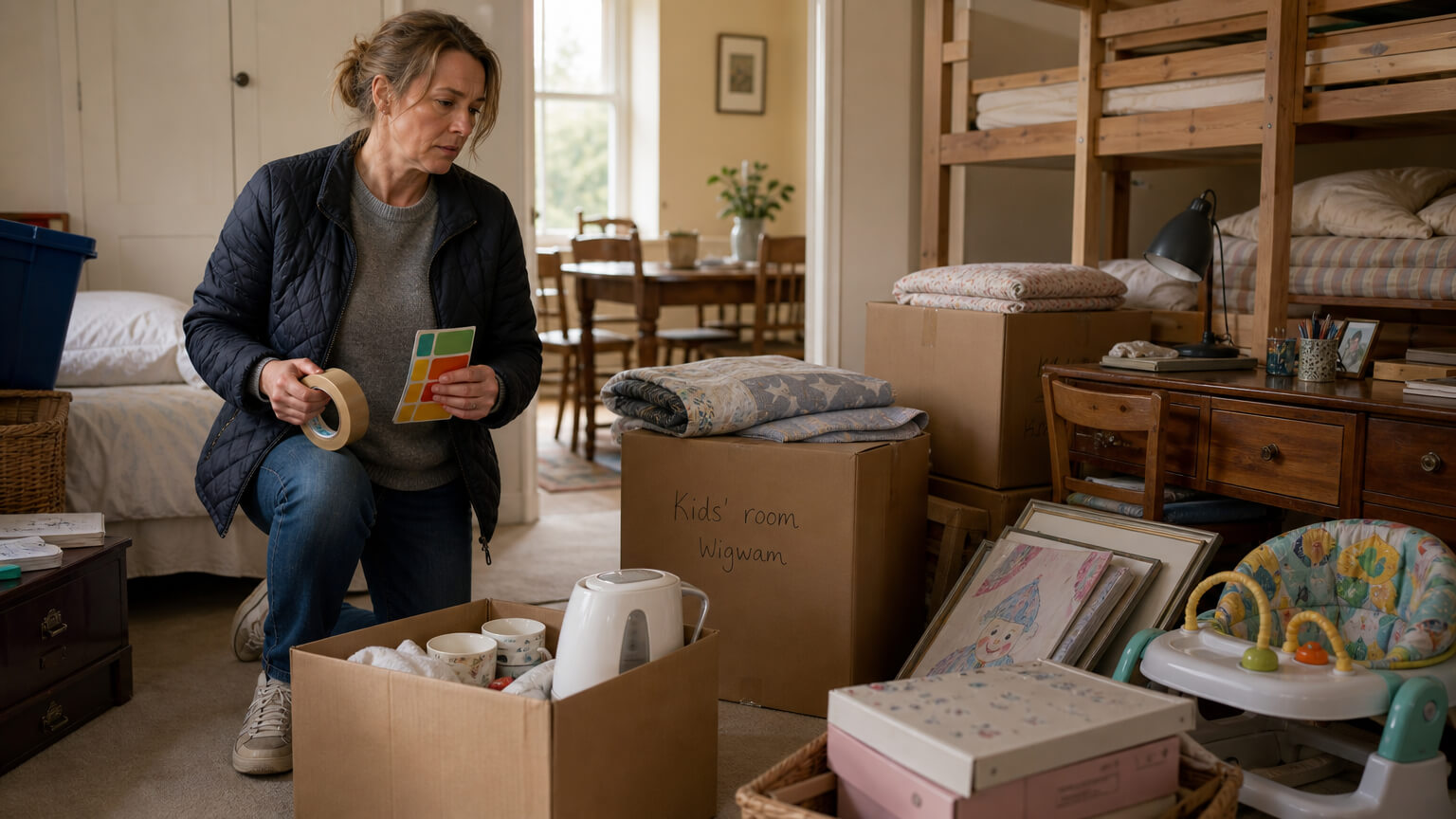
The security question matters more for a forces family than for most. You are not popping in every few weeks to check. The goods may be in store for months with no one from your side anywhere near. The setup needs to hold without needing you to monitor it.

Individually alarmed units, clean, dry and secure

Every unit at Wigwam has its own alarm. This is not site-level security alone – it is unit-level. If someone opens a unit that is not theirs, it triggers. Your unit is not part of a communal space that relies on a perimeter being unbroken. Its alarm is specific to it.

The units are clean and dry. We maintain that standard because it is what furniture and belongings need. No damp, no debris, no evidence of previous use left behind. What goes in should come out in the same condition.

We do not offer climate control. There is no temperature management, no humidity regulation. What we offer is the honest baseline: secure, clean, dry, and individually alarmed. For most household goods, that is what matters.

Smart entry, 6am to 10pm, every day – on your schedule

Access is by smart entry, seven days a week, between 6am and 10pm. It is not 24-hour. That is a plain fact worth knowing before you book.

The access hours are broad enough to fit around most schedules. If a partner is running the move around work and a school run, there is plenty of time before and after. If a removal van is arriving at 7am, access is open. If a late-evening retrieval is needed, there is time for that too.

“Smart entry” is the right term for how the access works. You do not need to call ahead, you do not need anyone on site to let you in, and you do not need to fit your visit around staffed hours. You arrive, you access your unit, and you leave.

Cover for your goods while the unit is closed for months

Contents protection is mandatory at Wigwam. You cannot store with us without it. That is a condition of storage, not a recommendation. Here is how it works.

The RSA Self Storage Customers’ Goods policy, or prove your own

There are two routes. You can take the RSA Self Storage Customers’ Goods policy, which is available through Wigwam and is specific to goods held in a storage unit. Or you can demonstrate that an existing policy of your own extends to cover goods in a storage facility. If you go the second route, you will need to confirm it in writing.

Whichever route you take, you need to declare the full replacement value of everything in the unit. Under-insurance is not a grey area: if you declare half the value and make a claim, you recover half the loss, no more. Declare what it would actually cost to replace the contents, not what you paid for them originally or what you think they are worth now.

Full details of the cover options are at wigwamstorage.co.uk/contents-protection/.

Declaring the right value – why it matters

For a forces family with a full household in store for a long tour, the total replacement value can be more than it first appears. Add up the furniture, appliances, clothing, personal items, and anything else in the unit, room by room if that helps, and declare the total at replacement cost.

If you have questions about what your cover includes, what a claim process looks like, or whether your existing policy extends to a storage unit, speak to the insurer directly or to an independent broker. Wigwam can signpost but cannot advise on insurance. If your policy covers goods in England and Wales, be aware that cover terms and rules in Scotland and Northern Ireland can differ. Check with your insurer for the position that applies to your specific policy and location.

Our market-town locations, including Warminster in Wiltshire

Wigwam Self Storage operates across our UK market-town locations. These are quiet, local sites in towns rather than industrial edge-of-city facilities, which matters for a partner managing access alone without a long drive.

Warminster in Wiltshire – near the garrison, in the town

Wigwam Self Storage Warminster is well-placed for families connected to the garrison at Warminster. It is a market-town site, local and accessible, not a large out-of-town facility. If you are clearing a quarter in the area or need somewhere within reach of the garrison for the duration of a posting, it is the nearest Wigwam location to that part of Wiltshire.

A specific page for Warminster is being confirmed – in the meantime, the full locations hub lists all current sites and lets you check what is nearest to you. (Verify the Warminster-specific slug before publishing – do not invent it.)

Bath, Lincoln, and our wider network of market towns

Forces families based further afield will find sites across our UK market-town network. Wigwam Self Storage Bath serves the Bath and wider Somerset area. Wigwam Self Storage Lincoln covers Lincolnshire, a county with a long military presence. For the full list and to find the nearest site to your posting area, the locations hub is the right starting point.

Getting a quote for your posting

Getting a quote is straightforward and does not lock you into anything.

What to have ready when you ask for a quote

Two things help: a rough sense of how much you are putting in store – a flat’s worth, a house’s worth, or a specific set of items – and a start date, even if the end date is uncertain. That is enough to get a realistic quote. You do not need exact measurements and you do not need a confirmed departure date before you make contact.

Start at quote.wigwamstorage.co.uk.

If your dates are not fixed yet

The two-week minimum means you do not need a confirmed posting end date before you take a unit. You can start when you need to, and when the return date firms up, the notice period is two weeks from whenever that is. The plan can stay loose until the posting lets it firm up.

If the order is likely but not yet official, it still makes sense to ask for a quote. Knowing what a unit would cost and what sizes are available in your nearest location means you are ready to move the moment you need to.

When the order lands, we are here. Get a quote at quote.wigwamstorage.co.uk.

Frequently Asked Questions

Can the serving member’s partner or a family member manage the unit if the serving member is deployed?

Yes, and for most forces families that is exactly how it works, because the move is often run by whoever is left holding the keys while the serving member is already elsewhere. The account is held by a named renter, and that does not have to be the person who is away. The partner managing the clear can hold the account, take the unit, move things in, access it, and close it when the time comes, all without the serving member being present.

A couple of points are worth settling at the start so there are no snags later. Decide who holds the account and who needs access, and raise it with the support team at quote stage; the formal position on access arrangements is in the terms and conditions. Because the sites are unmanned and entry is by smart entry, the person managing the unit uses their own authorised access and does not need anyone to let them in, which is the whole point for a partner fitting a move around a school run and a job. If the serving member is the named holder but is deployed when the unit needs closing, sort the access arrangement before they go, rather than trying to fix it from overseas. The practical reality is that one fewer dependency on the absent person is one fewer thing to go wrong in a week with too many moving parts. Set it up so the person actually on the ground can do everything the unit requires, and the deployment stops being an obstacle to managing the storage at all.

What if the posting is cancelled or changed after I have already taken a unit?

You are not stuck with it, because nothing about the unit is tied to the posting going ahead. If the order is cancelled, brought forward, or changed entirely, the storage flexes the same way it does for everything else: you give two weeks notice whenever you need to, clear the unit, settle the account, and the refundable deposit comes back. There is no fixed term you are locked into and no penalty for the plan changing under you, which it does often enough in service life.

The detail that matters most here is the refund of unused days. If you have paid to the end of a period and the situation changes so you clear the unit partway through, you are refunded for the days you did not use. So a cancelled posting does not leave you paying for storage you no longer need; you only ever pay for the time your things were actually with us. Equally, if the posting is merely delayed rather than cancelled, you can simply keep the unit running until the new dates firm up, since there is no upper limit on how long you stay. The two-week minimum is the only floor, and it does not compound with the two-week notice; they are separate things, the shortest stay and the warning you give to leave. This is the part that takes the financial worry out of committing before dates are confirmed. You can take a unit on a likely posting that has not yet been made official, knowing that if it falls through, closing the unit costs you nothing beyond the time you actually used it. The contract bends to the order, not the other way round.

Does Wigwam offer a forces or military discount, and how does that compare to the flexible terms?

We do not run a published forces discount, and we would rather be straight about that than imply otherwise. What we offer instead is the set of flexible terms described throughout this page, and for a service family those terms are usually worth more in practice than a headline percentage off. The reason is simple: the cost that hurts a forces move is not the rate, it is paying for storage you cannot use because the dates moved.

Consider what the terms actually do. Unused days are refunded if a tour ends early or a posting comes through ahead of schedule, so a shortened stay costs less, not the same. There is no long tie-in, no rolling annual contract, and no penalty for leaving sooner than planned, so a changed posting does not cost you a cancellation charge. The refundable deposit comes back in full when you give notice and clear the unit. And the two-week minimum means you can start the moment the quarter has to be cleared, without committing to a fixed period you cannot predict. A flat discount applied to a contract that punishes early exit or ties you in for a year would often leave you worse off than fair terms that simply charge you for the time you use and refund the rest. If your circumstances mean a particular rate question is worth asking, ask at quote stage and you will get a straight answer. But the honest position is that the flexibility is the benefit built for service life, and it is available to everyone without needing to prove eligibility.

How does storage interact with the official MOD removals and disturbance allowance process?

This is a question for your unit’s admin staff or the relevant MOD removals process, not for us, and it is important to keep the two things separate. Wigwam provides the unit and a clear invoice for what you pay; we cannot advise on entitlements, what the MOD will or will not fund, or how disturbance allowance and official removals arrangements apply to your move. Those rules sit with the service, change over time, and depend on the type of move and your individual circumstances, so the only reliable source is the official process and the people who administer it for you.

What we can do is make the paperwork side easy for whatever that process requires. You will get a proper invoice for the rental, and the terms, the deposit arrangement and the notice period are all set out plainly in the terms and conditions, so if the official process needs documentation or a clear statement of costs, it is straightforward to provide. The sensible order of operations is to check what is funded or claimable through the official channel before you commit, so you take the unit knowing where it sits against any entitlement. If the official removals contractor is delivering goods to the unit, remember the site is unmanned, so you or someone you arrange must be present to receive them; we cannot sign for a contractor’s delivery on your behalf. Beyond supplying the space and the paperwork, the entitlement questions genuinely belong with your admin staff. Ask them first, take the unit second, and the two fit together without surprises.

Can I store firearms, ammunition or regulated military kit in a unit?

No. A self storage unit is not a lawful or suitable place for firearms, ammunition, or regulated military equipment, and you should not store any of it with us. Firearms and ammunition are governed by strict legal requirements about secure storage, certification and who may hold them, and a self storage unit does not meet those requirements; the proper arrangements run through licensed channels and the relevant authorities, not a storage provider. Regulated or issued military kit is subject to its own service rules about how and where it is held, and those rules, not a storage contract, govern it.

More broadly, units are for ordinary household goods only. Alongside firearms and ammunition, that rules out other hazardous or prohibited items, and it is always better to ask before you book than to arrive with something that cannot go in. The honest list of what a Wigwam unit is for is furniture, boxes, appliances, books, clothing and the everyday contents of a family home, stored clean, dry and secure. It does not extend to weapons, ammunition, anything explosive or hazardous, or controlled equipment that the law or the service requires to be held in a specific way. If part of what you need to sort before a posting involves regulated kit or firearms, that is a conversation for your unit’s armoury or the appropriate licensing authority, who can direct you to the lawful storage route. We would rather tell you plainly that we are not the right place for it than have you assume otherwise. For everything else a forces family home contains, the unit is exactly the practical, secure answer it is meant to be.


Self Storage For Sentimental Things Not The Loft Not The Skip

Not the loft, not the skip — so where do the keepsakes actually go?

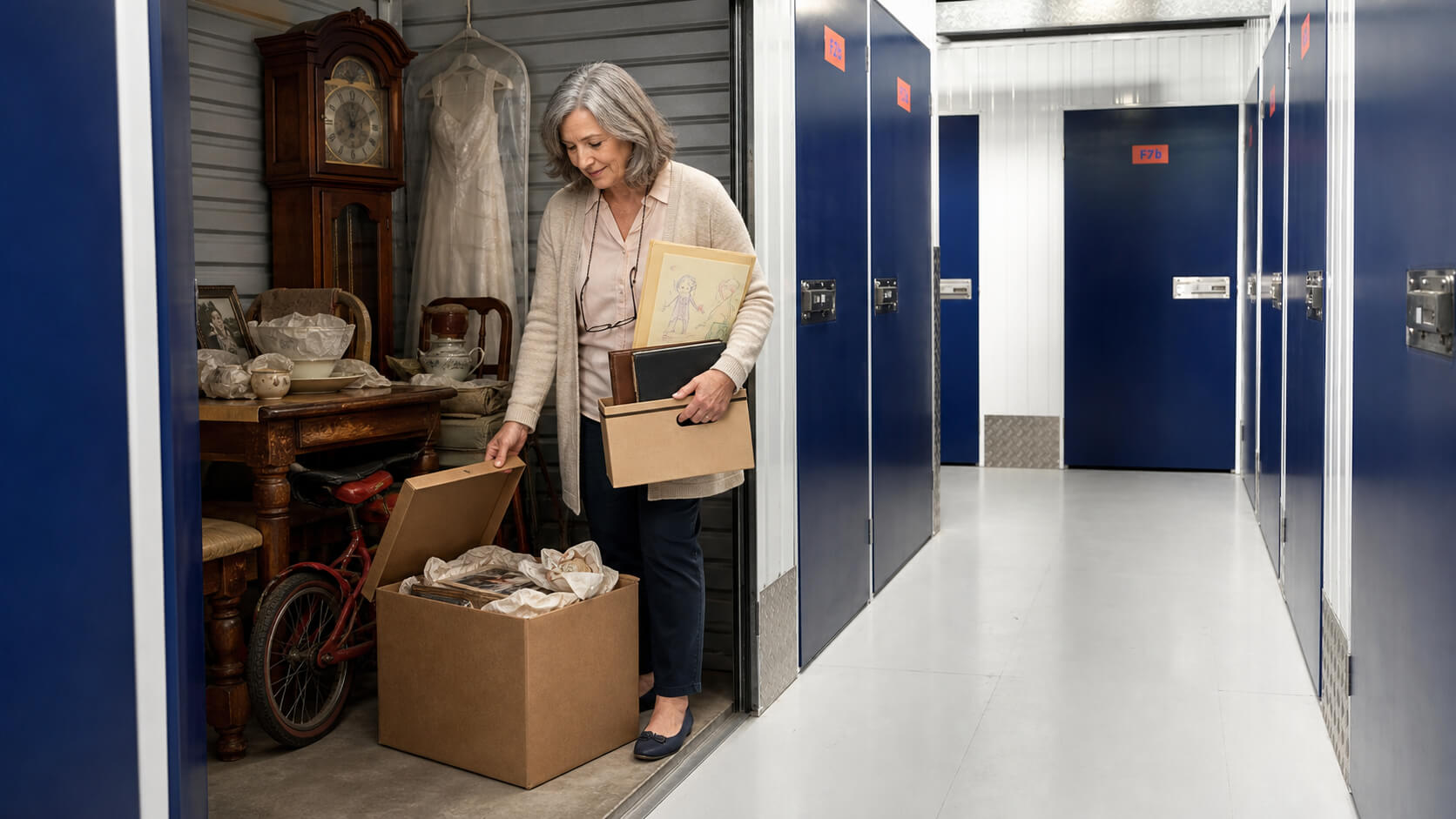
There is a particular kind of box that nobody can open and nobody can throw away. It sits at the back of the loft, or on the landing, or pushed under a spare bed. Inside are things that belong to someone you loved, or to a version of yourself you are not ready to let go of. You know they are there. You do not know what to do with them.

Most people end up doing one of two things. They push the box further back into the loft and try not to think about it. Or they feel the pressure build until one afternoon they carry it out to the skip, and regret it for years. Neither of those is the right answer, and somewhere underneath the guilt and the indecision, you probably already know that.

There is a third option. It is not dramatic. It is just a small, clean, dry, secure place that is yours to control, close to where you live, sized to what you actually have. This piece is about how that works, what protects sentimental things and what does not, and how to decide what you are keeping before you decide where it goes.

The loft is just a slower skip

The loft feels safe because things go up there and stay up there. Out of the way, out of the decision. But a loft in a UK house is not a controlled environment. It is cold in winter, warmer in summer, and it breathes moisture up from the roof. Most loft spaces are not insulated against that movement. Things do not disappear up there. They degrade, slowly and invisibly, until one day you open the box and find that the photographs have stuck together, the paper has gone brown and spotted at the edges, and the fabric smells of something you cannot fix.

Why a cold, damp loft quietly ruins photographs, paper and wood

The damage is not from temperature. That is the common assumption, and it is the reason every storage advertisement reaches for “climate control” as its proof word. But in the context of a UK loft, the real enemy is damp, and specifically the condensation that forms when temperature changes cause moisture to move through uninsulated spaces.

Photographs suffer what archivists call foxing: the red-brown spots that appear on paper that has been exposed to humid conditions over time. The emulsion on older photographic prints can separate from the base layer when it absorbs moisture and then dries out repeatedly. Documents develop the same speckled browning. Paper warps and buckles. Wooden objects and furniture swell when they take on moisture and crack when they give it back. Textiles develop mildew that is very difficult to remove without damaging the fabric.

None of that requires a flood. It just requires a cold loft, a few winters, and the moisture that is already in the air of a British house. Clean, dry and secure storage interrupts that process honestly, without overpromising. That is the test that matters.

Why the skip feels final, and why you do not have to reach for it

There is a strand of advice that has spread through decluttering communities that says: if you want to keep a sentimental object but are not sure why, take a photograph of it and then let it go. The idea is that you keep the memory without the physical weight. It is not wrong, exactly. But it does not understand grief, and it does not understand the particular weight of objects that connect you to people you have lost.

The keeper is not being irrational. She is being responsible. These objects are not clutter in the ordinary sense. They are the physical evidence of people, relationships, and moments that deserve to be treated with some care. The pressure to “just sort it out” often comes from people who do not understand what is being asked of her when she is told to make that decision quickly, or on someone else’s terms.

You do not have to choose between the loft and the skip. You can choose to keep the things that matter, properly, in a place that looks after them. The question is how to do that without filling an entire room you do not have.

You can keep the things that matter, the defined-space way

Keeping sentimental things well is not the same as keeping everything you have ever accumulated. The difference is intention. A defined space, decided in advance, gives you permission to keep without guilt, because you have chosen what goes in it rather than just avoiding the decision. That is the keeper doing the job well, not hoarding.

One memory trunk and a set number of archive boxes, not a room

The image worth holding onto is the trunk. One physical container for the things that are truly irreplaceable: the letters, the small heirlooms, the photographs of people who are gone. Beside it, a defined set of archive boxes, three or four at most to start with, for the wider category of things you are not ready to part with but that do not all need to live in the trunk. Together, that is a very small storage unit. It is not a wing. It is not a room. It is a deliberate, contained home for what matters.

This is where the idea of right-sizing begins to be practical rather than abstract. A 10 or 16 square foot unit is enough for a memory trunk and several archive boxes. A 25 square foot unit suits those boxes plus a few pieces of furniture you are holding from a family home. The point is that the physical container defines the category. You are not storing everything. You are storing the things that made it into the trunk and the boxes.

The 90/90 question, used gently, not as a rule to throw things away

You may have come across the 90/90 rule: have you used this item in the last 90 days, and will you use it in the next 90 days? If the answer to both is no, the rule says let it go. It is a useful question for a coat or a kitchen gadget. For a box of letters from your grandmother or the tea set from a marriage that no longer exists, it is the wrong tool, and applying it too strictly can lead you somewhere you will regret.

Will Stowe’s version is gentler: would it change something if this were gone? Would losing it be a loss you could not later undo? If the answer is yes, it belongs in the trunk. The 90/90 question can still help you decide what goes into the archive boxes rather than the trunk, and what you are perhaps ready to let go of. But it is a prompt, not a verdict. You do not have to follow it to the letter to feel like you are doing this right.

How to store sentimental things so they survive

Getting the items into a clean, dry, secure unit is most of the work. The packing matters too, and the principles are simple. The aim is to limit the movement of moisture and prevent physical damage from compression, contact and poor materials.

Packing photos and documents

Photographs should be stored upright, not flat, in rigid boxes that will not flex under the weight of whatever is stacked on top. Do not put them in plastic bags: sealed plastic can trap condensation from the items themselves, particularly if they were not fully acclimatised before packing. Archival interleaving paper or acid-free tissue between prints prevents the emulsion from sticking to the surface above or below. Acid-free boxes and folders slow the natural deterioration of photographic paper and documents over time. Label each box clearly on the outside so you can find what you want without having to move everything to get to it.

Clothing and textiles

Clean the items before they go into storage. Any moisture, body oils or food residue left in a fabric will cause damage over time, and can encourage mildew if conditions change. Items need to be fully dry before they are packed. Use acid-free tissue to wrap individual pieces, and store in breathable boxes or cotton covers rather than sealed plastic containers. Vacuum-seal bags compress fabrics under pressure and can cause creasing that becomes permanent. They can also trap any residual moisture or off-gas from the bag material itself. Breathable is better.

Metals, silverware and small heirlooms

Silver tarnishes when it is exposed to sulphur compounds in the air. Anti-tarnish cloth wrapping or anti-tarnish strips placed in the storage box slow that process significantly. Wrap each piece individually so that surfaces are not in contact with each other. Note that silver can react with rubberised shelf liners, so if you are using shelves in your unit, lay a neutral cloth or acid-free tissue down first. Keep small valuables in a clearly labelled, sealed box where you can find them without disturbing everything else.

Furniture and wood

Breathable dust covers protect wooden surfaces from dust and from contact damage without trapping moisture against the wood. Plastic sheeting does trap moisture, which is the opposite of what you want. If the piece can be disassembled, do that before moving it into the unit: it protects joints under load and makes the most of a compact space. Elevate furniture off a concrete floor on boards or pallets, because concrete can transfer ground moisture upward. Clean the piece thoroughly and make sure it is dry before it goes in.

What actually damages keepsakes in storage, and what does not

Here is the honest version of an answer that most storage guides avoid giving, because most storage operators want to sell you climate control.

Damp is the enemy, not temperature: clean, dry and secure is the real test

Climate control in self-storage means maintaining a unit within a narrow temperature and humidity band year-round. It is expensive, it is energy-intensive, and for the vast majority of household keepsakes stored in a UK self-storage unit, it is more than the problem requires. The specific risk that ruins photographs, paper, wooden pieces and textiles in UK storage is damp: condensation from temperature change, moisture from packed-while-damp items, and humidity that has nowhere to go.

A clean, dry and secure unit, with individually alarmed access and a building that is properly maintained, addresses that risk directly. Wigwam does not offer climate control, and this is where that honesty matters: we are not a luxury product, and you do not need a luxury product for a memory trunk and four archive boxes. What you need is genuinely dry, genuinely clean, and genuinely secure. That is what we offer.

The practical things that make the biggest difference are within your control: bring items in dry, use breathable rather than sealed packing, place silica gel sachets in boxes to absorb residual moisture, and do not overpack so tightly that air cannot move. Damp arrives with the items more often than it arrives from the unit itself.

What does not belong in a unit at all

Honest limits are part of the service, so here they are. Perishable food does not belong in a self-storage unit. Hazardous or flammable materials do not belong in one. Living things cannot be stored. Wigwam sites are unmanned and not set up for animals of any kind. Vehicles, caravans and boats are not something Wigwam offers storage for. If you are clearing a family home and have items in those categories, those need separate arrangements.

This is not a long list, and it is not meant to be alarming. Most keepsakes, heirlooms, household textiles, furniture, documents and photographs are fine. The boundary is simply around the categories that create safety or legal risks in a shared, unmanned facility.

When you are ready to see what size unit suits what you have and get a quote, start here: quote.wigwamstorage.co.uk

How much space you actually need

One of the things that holds people back from getting a unit is the assumption that it will cost more than it is worth, or that they will end up with a room they cannot fill and cannot justify paying for. The short answer is: for a memory trunk and a set of archive boxes, you probably need less space than you think, and the cost per month is likely to be considerably less than the guilt of leaving things in the wrong place for another year.

A few boxes versus a roomful: right-sizing so cost does not spiral

A 10 square foot unit fits a memory trunk and several archive boxes with room to access them comfortably. A 16 square foot unit gives you a bit more room around the trunk, or accommodates a couple of smaller pieces of furniture alongside the boxes. A 25 square foot unit is appropriate when you are also holding furniture from a family home: a chest of drawers, a bedside table, chairs wrapped and stacked. These are illustrative sizes; current dimensions and pricing are on the Wigwam pricing and size guide, which is worth checking before you book.

The right-sized unit is the one that fits what you actually have, with room to get in and find things, rather than the largest available on the assumption that you will fill it eventually. The defined-space approach means you already know roughly how much space the trunk and the boxes will need. That clarity makes the booking straightforward.

A two-week minimum stay and a refund of unused days if plans change

The minimum stay at Wigwam is two weeks. If you need to leave early after that, unused days are refunded. There is a refundable deposit, which is returned after a 14-day notice period once you have vacated and the account is settled, less anything owed. The full terms are at wigwamstorage.co.uk/terms-conditions.

For someone who is unsure how long they will need the space, that flexibility matters. If you are clearing a parent’s house and holding things while the family makes decisions, you are not locked in to a year-long commitment. If circumstances change and you need the items back sooner than expected, the financial exposure is limited. That is worth knowing before you decide whether this makes sense for your situation.

Keeping them safe and keeping them close

Security in self-storage is not just about the site perimeter. The meaningful question is whether your specific unit, with your specific things in it, is properly protected. Wigwam’s answer to that is individual alarm on each unit rather than shared site-level security alone.

Individually alarmed units, smart entry, access 6am to 10pm

Each unit at Wigwam has its own alarm. If your unit is accessed without your smart entry, the alarm is specific to your unit, not a general building alert. Access is via smart entry from 6am to 10pm, seven days a week. That is not 24-hour access, and if late-night access is a firm requirement for your situation, that is worth knowing before you book rather than after.

Wigwam sites are unmanned. You access your own goods directly. If you are arranging for items to be delivered to your unit, note that someone from your own party needs to be present to receive them. Wigwam does not sign for or receive deliveries on your behalf.

Visiting your things: storage does not mean out of your life

The keeper motif is important here. One of the fears that runs underneath the question of storage is that it becomes a form of abandonment: you put the things away and then you never see them again, and in five years you feel worse rather than better because they are in a box somewhere you have not visited.

That is not what storage has to mean. Six in the morning to ten at night, seven days a week, means you can go on a Saturday morning to find your grandmother’s tea set for a birthday. You can go in November to retrieve the box of Christmas things before the school holidays. You can add a new box of letters when a parent passes, and take the time to sit with the older ones if you need to. The unit is not a warehouse where things disappear. It is a place you chose, close to where you live, that you can visit whenever suits you. The keeper is still keeping.

Cover for the irreplaceable

Before we get to locations, there is one more thing to address, because it is the question that tends to arrive late in the decision and then feel urgent.

Why you insure stored goods, and where to read the policy yourself

Contents cover is a requirement for storage at Wigwam. You can take Wigwam’s RSA “Self Storage Customers’ Goods” policy, or you can provide evidence that your own policy covers goods in self-storage. This is not optional, and it is worth taking seriously for sentimental items precisely because they are irreplaceable.

The key facts about the Wigwam policy are these, stated plainly so you can read them against your own situation: it is a New-for-Old replacement policy; there is a £50 excess; you must declare the full replacement value of your goods, and any claim is settled in proportion to the value declared (so under-declaring the value reduces your payout accordingly); theft is only covered if there is evidence of forced entry to your unit; and atmospheric or climatic damage is excluded. Those terms may affect your decision about which cover to take, and they are set out in full at wigwamstorage.co.uk/contents-protection.

For items of significant monetary or sentimental value, read the policy carefully. If you are unsure whether the cover is right for your specific situation, speak to your own insurance adviser. This is information, not advice, and the policy document is the right place to start.

Where to keep them, close to home

The practical final question is where. A unit that is an hour’s drive away is not the same as one that is part of your town.

Market-town locations and how to get a quote

Wigwam is in UK market towns. That is the deliberate choice: not the industrial estate on the edge of a city, but the town you live in or near, where you can stop in on the way back from the farmers’ market or on a Sunday morning when you want to spend half an hour going through the boxes. Wigwam Self Storage Bath and Wigwam Self Storage Lincoln are two of those locations. For the full list, our UK market-town locations has every site with directions.

The quote is straightforward. It asks you for your postcode and a rough sense of what you have. It does not commit you to anything. It just gives you a number to work from so you can decide whether this makes sense. When you are ready: quote.wigwamstorage.co.uk.

Frequently Asked Questions

Some of my things already show damp damage or a musty smell. Should I still store them?

Yes, but deal with the damage and the moisture first, because storing a damp or musty item alongside dry ones risks spreading the problem rather than containing it. A clean, dry, secure unit interrupts further deterioration, which is exactly what you want for something that has already suffered in a cold loft. But the unit cannot reverse damage that has happened, and a piece that is still carrying moisture or active mould needs attention before it goes in, not after.

The honest approach depends on the item. Anything visibly mouldy or genuinely wet should not be packed straight into a box, because sealed in, the moisture has nowhere to go and the mildew keeps working. Let things dry out fully and air properly first. For textiles, that often means a gentle clean and complete drying before wrapping in breathable cotton or acid-free tissue. For paper and photographs, the damage from foxing or sticking is frequently beyond a home fix, and forcing apart stuck prints can destroy them.

For anything of real monetary or sentimental value that is already showing damage, the right call is to speak to a conservator before you do anything irreversible, rather than guessing. A specialist can advise on whether a piece can be stabilised and how to handle it. Once items are clean, fully dry and properly packed, breathable wrapping, silica gel sachets in the boxes, nothing sealed in plastic, a dry, individually alarmed unit gives them a far better future than the loft that damaged them in the first place. The packing section above sets out the method.

How will I know the unit is staying dry, and how often should I check on my things?

You manage this mostly through good packing and the occasional visit, rather than relying on any monitoring system, because a Wigwam unit is a clean, dry and secure space, not a climate-controlled one with humidity readouts. The building is maintained to stay dry, and that, combined with sensible packing, is what protects keepsakes from the damp that ruins them in a loft. What you bring to it is preparation and the habit of looking in now and then.

A few practical signals are worth knowing on a visit. A musty smell, any sign of condensation on surfaces, or boxes that feel damp to the touch are the things to notice. In practice, the moisture that causes trouble usually arrives with the items rather than from the unit itself, which is why bringing things in dry, using breathable rather than sealed packing, and placing silica gel sachets inside boxes matters so much. Refreshing or replacing those sachets is a good reason to drop in.

As for how often, there is no rule, and it depends on what you are storing and how settled your mind is. Some people visit every few weeks, partly to check and partly because the things still matter to them; others look in a couple of times a year. Smart entry from 6am to 10pm, seven days a week, means you can go whenever suits without booking ahead. For genuinely precious or fragile items, a check every few months to refresh silica gel and reassure yourself is sensible. The unit is not a place where things vanish; it is a place you chose, close to home, that you can keep an eye on.

Can I add new boxes to the trunk and the archive over time, or is the unit fixed once I set it up?

You can keep adding, and most people do, because life keeps producing things that belong in the trunk. A unit is not sealed once you set it up; it is your space to come and go from within the 6am to 10pm window, seven days a week, by smart entry. You can bring a new box of letters when a parent passes, add the order of service from a funeral, or fold in the small inherited things that arrive as an estate is settled, whenever you are ready.

The thing to plan for is space. The defined-space approach in this piece, one memory trunk and a set number of archive boxes, works best when you allow a little room to grow rather than packing the smallest possible unit solid on day one. If you expect to add over the years, it is worth choosing a size with some give in it, so a new box does not mean a unit move. A 16 square foot unit, for instance, gives more room around the trunk than the smallest locker, and a step up again accommodates a few pieces of furniture alongside.

If you do outgrow the space, changing to a larger unit is straightforward: you take the new size and clear the old one, with the two-week minimum and the refundable deposit applying per unit. There is no penalty for resizing as your needs change. The practical tip is to keep the archive ordered as you add to it, label every new box on the outside, and put the things you visit most near the door, so the unit stays a place you can find things in rather than a pile that grows past the point of usefulness.

What actually makes something belong in the memory trunk rather than the archive boxes or the let-go pile?

The trunk is for the irreplaceable: the things whose loss could never be undone. That is the test worth holding onto, and it is gentler and more useful than the 90/90 rule, which was written for coats and kitchen gadgets, not for a box of letters. The question to ask of each item is the one in this piece: would it change something if this were gone, and would losing it be a loss you could not later recover? If the answer is yes, it goes in the trunk.

The archive boxes are for the wider category: things you are not ready to part with, that have meaning but are not singular and irreplaceable. Duplicate photographs, the bulk of a collection, things connected to a memory but not the only evidence of it. The 90/90 question works gently here, as a prompt rather than a verdict, to help you decide what stays in the archive and what you might, in time, feel able to let go.

The let-go pile is for what you are keeping out of habit or guilt rather than meaning, and there is no rush to fill it. The whole point of a defined space is that you do not have to decide everything at once. Things can sit in the archive while you make up your mind, and a unit held on a flexible stay, two-week minimum, no maximum, unused days refunded if you leave early, means there is no deadline forcing the choice. Many people find the trunk fills quickly with the obvious irreplaceable things, the archive takes the maybes, and the let-go pile grows slowly and honestly over later visits, once the pressure is off.

Is there an option smaller than your smallest unit if I only have a single box or two?

The smallest unit is a small locker, and it is already modest, roughly the interior of a garden shed, but it is sized to hold a good deal more than one or two boxes. There is not a sub-locker tier below it, so if you genuinely have only a box or two, the honest position is that the smallest locker will have room to spare, and you are paying for a little space you will not fill. For most people that is still a sensible trade, because the alternative is leaving irreplaceable things in a damaging loft.

There is a practical upside to the spare room, though. A small locker that is not packed solid is easier to access, you can reach the box you want without unstacking everything, and it leaves room to add to over time, which sentimental collections tend to do. A single box today is rarely a single box in five years. So the locker that feels slightly large now often turns out to be the right size as letters, photographs and the occasional inherited keepsake accumulate.

If the cost of even a small locker feels out of proportion to one box, it is worth thinking about whether you can sensibly combine. Many people in this position are holding a memory trunk plus a few archive boxes rather than truly just one, once they gather everything scattered around the house. Pulling it all together often justifies the locker comfortably. For current sizes and what they cost, the pricing and size guide is the place to look, and a no-obligation quote at quote.wigwamstorage.co.uk gives you the figure for your nearest market-town location.

Self Storage For Emigrating Without Selling Up An Open Return

Moving abroad but not ready to sell everything you own?

There is a particular kind of move abroad where you do not burn the boats. The contract is for two years, or the adventure has no fixed end date, and the last thing you want is to sell the sofa, the books and the things that took a decade to collect, only to start from scratch if you come back. That is a different kind of move from emigrating for good, and it deserves a different kind of answer.

Storing rather than selling is how you keep the door open. It is how you stay the sort of person who could come home. This page is for you: someone going abroad with a UK base they want to mothball, not dismantle.

What follows is a plain account of how long-term self storage works for that situation, what it costs, how your things stay safe while you are thousands of miles away, and how you close the account cleanly when you are ready to come back, whether that is sooner than you planned or later.

Why store instead of sell or ship

Selling everything before a move abroad means buying it all again if you come back. For an open-ended absence, storing is often the cheaper and less final choice, and it keeps your options open in a way that a clearance sale does not.

When the move is open-ended or reversible

Some moves have a fixed end date. Most do not, not really. A two-year contract becomes three. A sabbatical turns into a life chapter. An adventure that was supposed to last twelve months stretches pleasantly into two. If you are honest with yourself, you are not sure when you are coming home, and you are not sure you want to commit to a date yet.

That is exactly the kind of move that self storage is built for. You are not being indecisive. You are being practical about a genuinely uncertain timeline. Storing what matters, rather than selling it at a loss under pressure, is the sensible call for anyone who wants to leave a door open behind them.

The cost of selling and rebuying

Think about what it would cost to replace a household from scratch. A decent sofa, a bed, a dining table, the accumulated kitchen equipment of years, the bookshelves, the art, the seasonal things you only need a few months a year. You would not get good money selling them in a hurry before a move, and you would pay full price to replace them when you came back.

Storing is not always cheaper than selling, but for a household that took years to build and would cost a great deal to rebuild, the arithmetic usually points in one direction. We do not quote prices here, but you can check what a unit costs on Wigwam’s pricing page and decide for yourself.

Freeing the house for tenants without a full clearance

Some people going abroad rent their home furnished and only need to move personal, sentimental or seasonal items into storage while tenants are in. Others clear the house completely before it goes to market or is let unfurnished. Both work. A storage unit gives you a place for whatever the house cannot hold in the meantime, whether that is a handful of boxes of irreplaceable things or the entire contents of a four-bedroom semi.

What to store, what to sell, what to ship

Not everything is worth storing for a year or more. Here is a plain way to sort the decision, based on what tends to be worth keeping and what tends to be cheaper to let go.

Worth storing: furniture, books, sentimental and seasonal items

Solid furniture, a good mattress, bookshelves and their contents, art, sentimental objects that cannot be replaced, musical instruments, sporting equipment you use seasonally, kitchen equipment that took time to accumulate, family documents and photographs. These are things that are either hard to replace, expensive to replace, or simply yours in a way that has nothing to do with money.

If you would feel the loss of it, it is probably worth storing.

Often worth selling: bulky low-value items you would replace cheaply

Flat-pack furniture that has been assembled and disassembled once too often, exercise equipment that was optimistic in the first place, large appliances in a property you are vacating, garden equipment if there is no garden to come home to. These are things that are straightforward to replace at modest cost and awkward to store efficiently. A good rule: if you can replace it for less than a year’s storage fee for the space it takes, let it go.

This is a heuristic, not a rule. Only you know what your things are worth to you.

Shipping is a separate decision: we store, we do not ship

If you want to take furniture or household goods abroad rather than leaving them behind, that is a decision for an international removals or shipping firm, not a self storage provider. Wigwam stores your UK household goods in the UK. We do not ship internationally, we do not advise on it, and we would not want to give you the wrong steer on something as significant as an international move. Find a reputable international removals company for that part of the conversation.

Ready to get a quote? Visit quote.wigwamstorage.co.uk to find your size and check availability at your nearest Wigwam location.

How long can you keep things in storage

There is a two-week minimum stay at Wigwam. There is no upper limit. Stay as long as you need.

The two-week minimum and no fixed upper limit

The shortest stay we offer is two weeks. Beyond that, there is no fixed end date and no pressure to commit to one. Your account runs for as long as you need it to, month by month, without penalties for an open timeline. If you know you are going for two years, fine. If you genuinely do not know, that is fine too.

This is not common across the industry. Some providers have minimum terms of a month or more, or expect you to commit to a fixed period. We do not, because we know that the nature of an open-ended move is that the end date is not yet known.

Why an open timeline suits an open return

The billing model is straightforward: you pay for the time your things are with us, and when you give notice, we return your deposit and refund any unused days. You do not have to decide how long you will be gone before you leave. The account simply runs until you are ready to close it.

That matters for someone going abroad without a fixed return date. You are not locked into anything. The unit is there, holding what you left behind, until the day you are ready to come home. It is the same principle as leaving the light on.

How Wigwam keeps it safe while you are away

Each unit is individually alarmed, and the buildings are clean, dry and secure. Here is what that means in practice, and what it does not mean.

Individually alarmed units, clean, dry and secure

Every unit at Wigwam has its own alarm. Not a shared corridor alarm, not a building-wide system that covers everything roughly. Your unit has its own alarm, so if it is opened without authorisation, that triggers its own response. The buildings are clean, dry and secure: maintained, well-lit, and built to keep your things in the condition you left them.

We do not offer climate control. We will not pretend to. The honest line is clean, dry and secure, and for household goods, books, furniture and the usual contents of a home, that is the right environment. If you need controlled temperature and humidity for something specialist, you need a provider that offers that; we do not.

Smart entry: access 6am to 10pm, seven days

Access to your unit is by smart entry, seven days a week, from 6am to 10pm. That covers most practical needs for you or for a person in the UK you trust with access.

We do not offer 24-hour access. You will see that claim from competitors, and it sounds reassuring. We think it is more useful to tell you the actual hours. If someone you nominate needs to collect something from your unit at 6pm on a Sunday, they can. If they need to get in at 3am, they cannot, and we would rather you knew that before you relied on it.

Unmanned sites: you control your own goods

Our sites are unmanned. That means there is no on-site team managing access or watching over units during the day. You, or a person you have authorised, access your own unit directly. That is the model.

It has one practical implication that is important to understand before you go abroad: if you are expecting a courier delivery to your unit, or if you need a courier to collect something from it, someone from your own household or business needs to be there in person to facilitate that. Wigwam does not sign for deliveries, accept parcels on your behalf, or manage courier access. The site is unmanned, so nobody can.

If you are managing a unit from overseas and you intend to have things delivered or collected, your nominated UK contact needs to be present for it. Plan for that before you fly.

What Wigwam does not offer: and why that matters

We do not offer climate-controlled storage. We do not offer 24-hour access. We do not store vehicles, caravans, motorhomes, motorbikes or boats. Sites are unmanned and we do not sign for couriers.

We tell you these things plainly because you are making a decision from a distance, and you deserve to know exactly what you are getting before you commit. A provider who tells you only the good things is not a provider you want to trust with your household goods for two years while you are on the other side of the world. Honest limitation is the trust signal. If any of those things matter to you, know now rather than after you have left.

Managing a unit from overseas

Running a storage account from another country is straightforward when you set it up properly before you go. Three things to sort before you fly.

Photograph and log what you store before you leave

Before the unit is loaded, take a room-by-room photograph of everything that is going in. Then write a brief inventory: a list by category is enough, you do not need a spreadsheet. Keep a copy in cloud storage or on a device you carry with you.

This serves two purposes. It gives you a record for the insurance declaration. And it answers the question you will inevitably ask yourself from abroad, usually at 11pm: did I actually pack that thing? A photograph log is simple to make and very useful to have.

Set up a Direct Debit before you go

The simplest way to run a storage account from overseas is to set up a Direct Debit before you leave and let it run. No manual payments to remember, no risk of a lapse because you forgot what time zone the bank operates in.

If your banking arrangements change while you are abroad, update the Direct Debit promptly. A lapsed payment is the one thing that can complicate an otherwise straightforward long-term account. Sort it before you go.

Nominating someone in the UK to access the unit

You can nominate a person in the UK to access your unit on your behalf. A family member, a trusted friend, a solicitor. If you need someone to check on things, retrieve an item, or facilitate a collection, they can do it.

Two things to be clear on before you set this up. First, your nominated person needs their own access authorisation; check the terms and conditions for how that works. Second, and this follows from the unmanned-site point above: if a courier or delivery is involved, your nominated person needs to be present in person. They cannot call ahead and ask Wigwam to take in a parcel. Plan any deliveries or collections around someone being physically there.

Insurance for goods you leave behind

Contents protection is not optional at Wigwam. You either take the policy Wigwam offers or prove you have your own cover. Here is what the Wigwam policy covers, and what you need to know before you declare a value.

The RSA Self Storage Customers’ Goods policy: opt in or prove your own

The policy in place at Wigwam is the RSA Self Storage Customers’ Goods policy. When you start your rental, you either take that policy or demonstrate that you have equivalent cover in place through your own insurer. You cannot store without one of those two in place.

The full detail of what the policy covers and how to take it is on Wigwam’s contents protection page. Read it. We signpost it; we do not advise on it.

New-for-Old, the £50 excess, and declaring full replacement value

The RSA policy operates on a New-for-Old basis, which means a valid claim is settled at the cost of replacing the item new, not its second-hand value. The excess on any claim is £50.

The critical thing to understand about the policy is how underinsurance works. You must declare the full replacement value of everything you store. If you declare less than the true replacement value, and you need to make a claim, the settlement is reduced proportionally to reflect the gap between what you declared and what the items were actually worth. Declare honestly, based on what it would cost to replace everything new. This is how the policy works; it is not advice.

What the policy covers and what it does not

Theft is covered following forcible entry to the unit. Atmospheric or climatic damage is excluded. This is consistent with the fact that Wigwam does not offer climate control: the policy reflects the actual storage environment honestly, just as the service description does.

For the full list of what is covered and what is excluded, go to the contents protection page. Read the policy document, not just the summary.

A note on jurisdiction: This page describes self storage and insurance practice in England and Wales. Scottish and Northern Irish law and consumer contract practice differ in some respects. If you have any doubt about how these matters apply to your situation, speak to a solicitor or independent insurance broker in the relevant jurisdiction. We do not give legal or insurance advice.

What long-term storage costs

The cost depends on the size of the unit you need and how long you store. Wigwam does not list prices here, but the pricing page shows current rates.

How size and duration drive the price

Unit size is the main driver of cost. The larger the unit, the higher the fee. Duration works differently here than at some providers: there is no discount for committing to a longer term upfront, and there is no penalty for a shorter stay than planned. You pay for the time your things are there, and if you come home earlier than expected, unused days are refunded.

For current pricing by unit size, go to Wigwam’s pricing page. Take a look before you get a quote, so you have a sense of what size you need and what to expect.

Coming home, or moving on

When you are ready to leave the unit, whether that is sooner than you planned or later, the process is straightforward. Give notice, settle the account, collect your things, and the deposit comes back to you.

Give 14 days notice and your deposit comes back

To close your account, give 14 days written notice. Once you have vacated the unit and the account is settled, with nothing outstanding, your refundable deposit is returned to you. That is the full sequence: notice, vacate, settle, deposit returned.

This is worth dwelling on for a moment. When you take out a unit and pay a deposit, you are not losing that money. It is held and returned to you at the end. The deposit is refundable. That is the honest version of a claim you will see some providers make in a less accurate way.

Refund of unused days if you return early

If you return home earlier than you planned, you do not pay for the days you do not use. Any unused days past your notice period are refunded.

This is the open return made concrete. The reason to commit to a storage unit rather than sell everything is that the decision is reversible, and the billing model confirms it. Come back in six months instead of two years and the account closes cleanly. You are not penalised for coming home. That is the point.

Whenever you are ready, get a quote at quote.wigwamstorage.co.uk and find your nearest Wigwam location.

Where you can store with Wigwam

Wigwam has self storage locations in UK market towns across England. If you are looking for a base that is genuinely local, not a warehouse on a ring-road outside a city, that is the kind of place we operate.

Our market-town locations

We have units in towns including Wigwam Self Storage Bath and Wigwam Self Storage Lincoln. For a full list of our UK market-town locations, including Reading, Berkshire, go to the locations hub.

Name a place you know and there is a reasonable chance we are nearby. And when you come home, the location you stored with is the same one you left. The same town, the same building, the same door. That matters when you are making a decision from the other side of the world.

Frequently Asked Questions

Can I pay for my storage from a foreign bank account or in a foreign currency?

The cleanest answer is to set up a UK Direct Debit before you leave, and the most reliable way to run an account from abroad is to keep a UK bank account open and let the payment run from it automatically. Sorting the payment method while you are still in the country, with full access to your bank, avoids the single most common complication of a long-distance account: a payment that lapses because the arrangement was harder to manage than expected once you had flown.

If you cannot keep a UK account, this is worth raising with the support team before you go, because they can tell you what payment methods the account accepts and how to keep it current from overseas. What they cannot do is advise on foreign exchange, the cost of international transfers, or your banking arrangements, because that is well outside storage and into territory only your bank or a financial adviser can properly cover. A few practical habits protect you whichever route you use. Set the payment up before you leave rather than after you arrive. Keep the contact details on the account current so any reminder reaches an inbox you actually read. And if your banking changes while you are away, update the payment promptly, because a lapsed payment is the one thing that can turn a quiet long-term account into a problem. The storage side is simple and predictable; the money side is yours to keep flowing. Settle it before you fly and it looks after itself.

What happens to my unit if I cannot return on the date I planned?

Nothing, because there is no date you are committed to in the first place. The account has no fixed end and no upper limit on how long you stay, so a return that slips from two years to three, or a plan that changes shape entirely, does not create a problem at the storage end. The unit simply keeps running, month by month, holding what you left until you are ready, whenever that turns out to be. An open-ended move is exactly what the terms are built for.
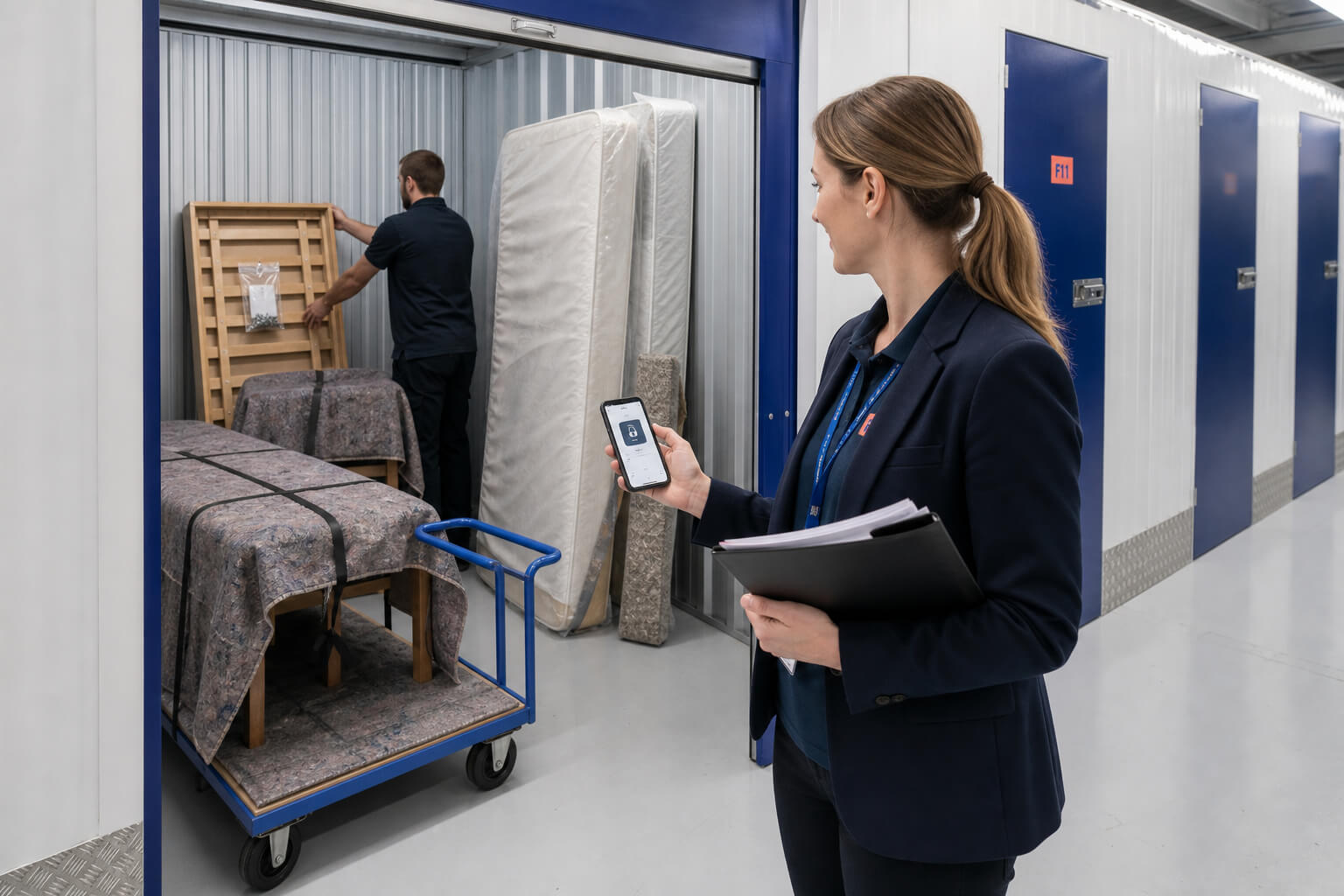
The mechanics are worth knowing from a distance. You only ever owe two weeks notice to close the account, given whenever your real return date firms up. The minimum stay is two weeks at the start, which has long since passed by the time an overseas absence is in question, and it does not compound with the notice period; they are separate things. The two practical risks to manage from abroad are both about keeping the account live, not about timing. Keep the payment running, ideally by Direct Debit, so an extended stay never trips over a missed payment. And keep your contact details current so we can reach you. If your return is delayed indefinitely, the account carries on as normal; if it is brought forward, you give your notice, your nominated UK contact or you clears the unit, and any unused days you have already paid for are refunded. The deposit comes back once the unit is empty and the account is settled. So a changed return date costs you nothing in penalties. You pay for the time your things were actually with us, and not a day more.

Can someone access or empty my unit on my behalf if I am still abroad when the lease ends?

Yes, provided you have set it up properly before you go. You can nominate someone in the UK, a family member, a trusted friend, a solicitor, to access the unit on your behalf, and that person can check on things, retrieve an item, or clear the unit entirely when the time comes. The arrangement has to be made in advance, because the same security that protects your goods means nobody gets in without authorised access. Your nominated person needs their own access authorisation set up on the account; the terms and conditions explain how that works, and it is worth confirming with the support team before you fly.

Two things follow from how the sites work, and both matter when you are managing this from overseas. First, the sites are unmanned, so there are no staff to let your nominee in or to hand goods over. They access the unit directly with their own authorised entry, within the access window of 6am to 10pm, seven days a week. Second, and this is the one people overlook, if a removal firm or courier is involved in emptying the unit, your nominated person must be physically present to let them in and oversee it. We do not sign for or release goods to a third party on your instruction alone, and we do not hold spare keys. So if you intend to have the unit cleared while you are still abroad, line up a UK contact with proper access, brief them on what is inside, and make sure they can be there in person for any collection. Get that in place before you leave, and closing the account from the other side of the world becomes a phone call and a visit rather than a problem.

How do I keep contents cover valid on goods stored for two years or more while I am overseas?

Keep the policy live and the declared value honest, and review it if the contents change. Contents cover is mandatory throughout the let, not just at the start, so over a long absence the thing to avoid is letting it lapse. If you take the RSA Self Storage Customers’ Goods policy through Wigwam, it runs alongside the rental, so keeping the rental payment current keeps the cover current too, which is another reason a Direct Debit set up before you leave is the sensible default. If instead you are relying on your own insurer, the responsibility to keep that policy in force, and to confirm it genuinely covers goods in self storage over a long period, is yours, and it is worth checking with your insurer that a multi-year storage situation does not breach any condition.

The value you declare is the part that quietly matters most over a long store. You must declare the full replacement value of everything in the unit, because under-insurance is settled proportionally: declare half the true value and a claim pays out roughly half the loss. Replacement cost is what it would take to buy the items new today, which for a household built up over years is usually more than people first estimate, so add it up room by room rather than guessing. Over two years, prices drift and the contents may change if your nominated contact adds or removes items, so it is worth a mental review if anything significant alters. Wigwam can tell you what the policy covers and point you to the contents-protection page for the detail, but we cannot advise on your insurance position or whether the cover suits your circumstances; for that, speak to your insurer or an independent broker before you leave. Keep it paid, keep the value true, and the cover holds for as long as the unit does.

Will damp or the British climate damage my furniture over a long store if there is no climate control?

For ordinary household goods, no, provided they go in clean and dry, because the unit is clean, dry and secure, which is the right environment for furniture, books and the usual contents of a home over a long period. The honest framing matters here: we do not offer climate control, and we will not pretend to. There is no managed temperature or humidity. What protects your things over a long absence is a dry, secure, individually alarmed unit combined with sensible packing, and for the vast majority of households that is exactly what is needed.

The risk to manage is moisture you bring in yourself, not the unit. Anything packed slightly damp, cushions, a mattress put away after a wet move, will sit in that state for as long as it is stored, so let everything dry fully before it goes in. Lift furniture and boxes off the floor on a pallet or boards, leave a little air around larger pieces rather than sealing them tight in plastic, and use breathable covers rather than wrapping wood in sheet plastic that traps condensation against the finish. This is consistent with the policy, where atmospheric and climatic damage is excluded, which is the honest reflection of an environment that is dry rather than conditioned. If you own something genuinely sensitive that needs a regulated temperature and humidity range, a specialist instrument or a fine antique, that needs a provider offering climate control, and we would rather tell you that plainly than imply we can do something we cannot. But for the furniture, books, kitchen equipment and seasonal things of a normal home, packed dry and stored sensibly, a clean, dry unit holds them in good order for two years just as well as for two months.

Secure Self Storage For Florists Stylists And Hire Companies

Has the garage finally stopped being enough for all the kit?

There is a specific moment every florist, stylist and hire firm recognises. The arch came back from Saturday’s wedding and there is nowhere to put it. The rails are in the hallway again. The box of plinths is behind the car and someone is going to trip over it before the week is out. The garage was always a temporary answer, and it stopped being enough around the same time the bookings started coming in properly.

You have built a real business. The kit reflects that: arches, rails, lighting stands, backdrops, vintage chairs, ribbon stock, props that took years to collect. None of it is cheap to replace, and all of it needs to be clean, findable and ready to load by six on a Friday morning. What it needs is a proper home between jobs.

This is a plain account of what self storage does for kit-based trade businesses, what it does not do, and how Wigwam works in practice. No brochure language. Just the honest version.

When the garage stops being enough

The moment this becomes a storage problem rather than a clutter problem is when the kit starts costing you time. You spend twenty minutes the night before a job finding the velvet arch you know is in the garage somewhere. The rails are tangled. The lighting stand has been leaned against the wall at an angle that means the bag no longer zips properly. The kit is fine; the system is not.

A unit gives you back the system. Everything has a place it goes back to after the job. You load the van on the day from an organised space, not from three different rooms.

Florists: vases, arches, plinths, dry stock and ribbon

For a florist, the dry side of the business has nowhere good to live. Arches and plinths are bulky and awkward indoors. Vases stack but take up floor space. Ribbon, wire and oasis stock needs somewhere clean and dry, away from damp, away from the kitchen and away from the dog.

A self-storage unit handles all of that well. The units at Wigwam are clean, dry and secure. They suit dry floristry stock, props and decorative kit exactly. What they do not do is cold storage. If you need a cool room for fresh blooms, that is a different facility entirely. For everything that lives around the flowers rather than in the bucket, a storage unit is the right answer.

The unit is also where the business stops looking like a hobby. When the arches have a home and the stock is organised, you arrive at the venue looking like the professional operation you already are.

Stylists and photographers: rails, props, lighting and backdrops

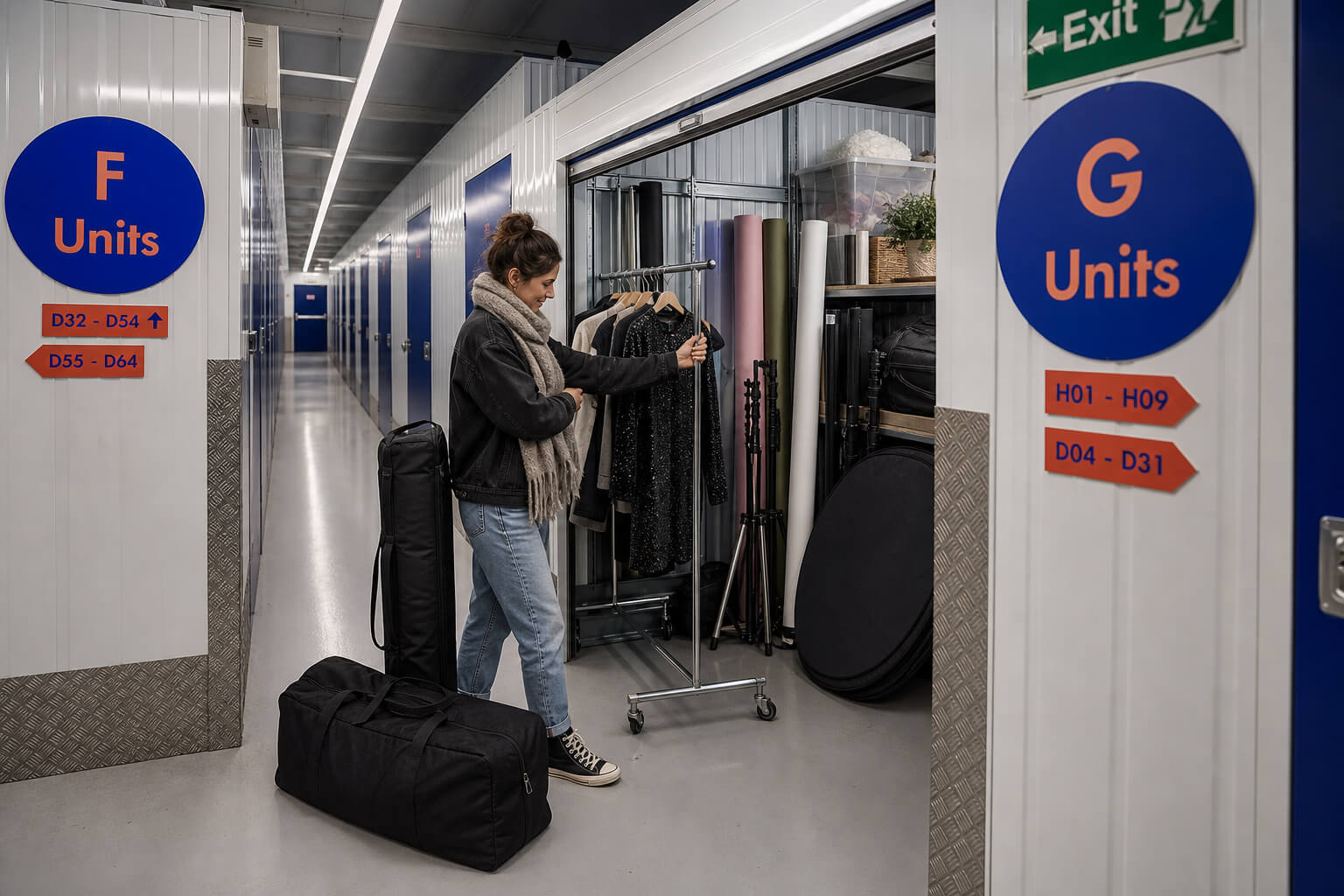
A rail of sample clothing takes up a surprising amount of floor space. Two rails take up the spare room. Add lighting stands, a backdrop roll, prop boxes and a reflector bag and you have the contents of a small studio living in a domestic space that was never designed for it.

The unit becomes the studio the lease never justified. Rails can be hung properly. Equipment bags stand upright. Props are grouped by shoot type rather than wherever they fitted when you came home at midnight after a job. The next morning, the kit is ready.

A stylist told us once that the unit changed the morning. Not the job itself, just the morning before it. Everything was where it should be. That is the whole point.

Event and party hire: chairs, decor, seasonal stock

Event and party hire businesses live by the season. June and July are relentless. January is quiet. A long commercial lease does not bend with that rhythm. A storage unit does.

Chairs, trestle tables, backdrops, centrepieces, fairy-light canopies, seasonal props that earn their price in one quarter and sit idle the rest of the year: a unit lets you hold the inventory you need for the busy season without paying commercial premises rates all year round. You can upsize when you need the room and give notice when you do not. That flexibility is the thing the national brands rarely explain clearly. We will come back to the terms later in this article.

What the unit is for, and what it is not

Self storage suits a kit-based trade business well. But it is not a workshop, not a shopfront, and not a cold room. Knowing the honest shape of it before you commit saves everyone time.

Store and access, your own goods, on your schedule

You hold the padlock on your unit. Nobody else opens it. You access your goods between 6am and 10pm, seven days a week, via smart entry. You organise the space the way your working rhythm demands. That might mean rails on the left, boxes on the right, the arch nearest the door so it loads first. You decide.

What the unit is not is a place to trade from. You cannot open the unit as a shopfront, run a workshop from it, or have clients visit. The site is unmanned. It is a secure base for your equipment, not a commercial premises.

For most florists, stylists and hire firms, that distinction does not matter at all. You collect your kit, load the van, do the job, come back and put everything away. The unit never needs to be anything other than a well-organised home for the gear.

What does not suit a storage unit

The units are clean, dry and secure. They do not offer cold storage or any form of temperature or humidity control. If any part of your stock requires a specific temperature range, the unit is not the right solution for that stock. Fresh blooms, anything perishable, or anything that needs refrigeration belongs in a different facility.

Everything else from the dry side of a floristry business, a stylist’s kit, a hire inventory of props and furniture, fits well.

The sites are also unmanned. That means you cannot have a courier deliver to the unit in your absence. If you need to receive or dispatch stock through the unit, someone from your own business must be there. Wigwam does not sign for deliveries or hold goods on your behalf. Plan your collections and dispatches accordingly. For a trade business running kit in and out on a schedule you control, this is straightforward to work around.

Access and how it works day to day

The access window is 6am to 10pm, seven days a week. Smart entry handles the gate. You do not need to book a slot, call ahead or work around staffed hours.

Smart entry, 6am to 10pm, seven days

If you need to load the van before a venue call, the unit is available from six in the morning. If you are coming back late after a wedding or event, you have until ten at night to unload. That window fits the working rhythm of most event and trade businesses without any adjustment.

The access is not 24-hour. We say so plainly, because some providers imply more than they deliver. For the businesses this article is written for, the 6am to 10pm window handles the job. The arch goes in, the arch comes out, the arch goes back in, on the schedule you actually keep.

Deliveries and collections: someone from your business must be present

The sites are unmanned. That is how the costs stay sensible and the access stays clean. It also means that for any courier collection or drop-off at the unit, you or someone from your business needs to be there to handle the handover. Wigwam does not receive deliveries, sign for parcels or manage goods on your behalf.

For most kit-based businesses this is not a complication. You are already there when the kit moves, because you are the one loading the van. But if you are planning to build in unmanned collections, factor in the need for a member of your team to be present for any handover.

Choosing your unit size

A rough guide gets you to the right ballpark before you talk to us. The exact recommendation depends on how your kit is shaped, how densely you can pack and whether you need floor space to move around.

A florist holding arches, plinths, a few rails of soft goods and a run of vase stock typically starts around 25 to 50 square feet. If the props collection is substantial, a 50 square foot unit or larger gives you room to work without unpacking everything to get to the bottom.

A stylist or photographer with multiple rails, background rolls, several bags of lighting and a box run of props is usually comfortable from 50 square feet upward. A lighting stand needs height as well as floor space; the units at Wigwam accommodate that.

An event and party hire business holding chairs, trestle tables, backdrops and a seasonal prop inventory is usually looking at 75 square feet or more, depending on how much runs out on the same weekend. If the inventory grows with the season, flexible terms mean you can change the size without being locked in.

These are starting points, not decisions. The quote tool at quote.wigwamstorage.co.uk will give you a tailored recommendation based on what you actually have.

Security and condition

The units are clean, dry and individually alarmed. That is the complete account of what you get in terms of condition and security, and it is the right account.

Clean and dry matters more than it sounds when the kit is valuable. A rack of sample jewellery, a set of vintage chairs, a backdrop that cost several hundred pounds to commission: these do not respond well to damp, dust or disorder. The units are maintained. What goes in in good condition comes out in good condition.

Individually alarmed means each unit has its own alarm, not a site-wide system that treats the whole building as one zone. Your unit is your unit.

There is no climate control, no dehumidifier and no temperature regulation. The “clean, dry and secure” description is precise. For dry floristry stock, fabric and textile props, lighting equipment, resin and paper goods, wooden furniture and general trade inventory, these conditions are exactly what is needed. For anything that requires a controlled environment, a Wigwam unit is not the right fit.

Terms that suit a seasonal business

The reason self storage works for a seasonal trade business is that the terms are designed to flex, not lock.

Two-week minimum and refundable deposit

The minimum stay is two weeks. There is a refundable deposit when you start. The deposit comes back to you after your 14-day notice period, once you have vacated the unit and the account is settled, less anything owed. It is a deposit in the straightforward sense: money held while you are a customer, returned when you leave.

That structure is worth understanding clearly before you start, because it is different from a commercial lease where a longer notice period and a non-refundable element are common. The deposit here is a protection, not a penalty.

14-day notice and refund of unused days

When you are ready to leave, you give 14 days’ notice. If your business is seasonal, that matters: you are not paying through January for space you filled in June. If you leave before the end of a paid period, the unused days come back to you.

A florist who takes a unit in March for the spring wedding season and gives notice in late July is not locked in through December. That kind of flexibility is the whole point for a business where the income does not arrive at a uniform monthly rate.

Full terms are at wigwamstorage.co.uk/terms-conditions.

Ready to find the right unit? Get a quote tailored to your kit at quote.wigwamstorage.co.uk. For a guide to what self storage costs across our UK market-town locations, see our pricing reference page.

Insuring your equipment

Contents cover is required. That is not a soft recommendation; it is a condition of storing with Wigwam. You can take out the RSA “Self Storage Customers’ Goods” policy through Wigwam, or you can provide evidence of your own contents insurance that covers goods in storage.

Either way, declare the full replacement value. If you insure for less than the kit is worth and something happens, the settlement is proportional to what you declared. A hire company with ten thousand pounds of prop inventory insured for four thousand pounds recovers four thousand pounds in proportion, not the full amount. Declare accurately.

For the details of the RSA policy and to understand what coverage applies, see the contents protection page. This article is a signpost, not advice. For questions about how your specific equipment or business is covered, speak to your insurer or a qualified broker.

A note on jurisdiction: the self-storage insurance framework described here applies under the law of England and Wales. If you are based in Scotland or Northern Ireland, the rules around insurance claims, business records retention and tenant rights in storage may differ. Take guidance from your own solicitor or insurer for jurisdiction-specific questions.

Our market-town locations

Wigwam serves UK market towns rather than city-centre commercial zones. The locations are close to where trade businesses actually operate: not a long drive on a wedding morning, not a diversion that adds an hour to the day.

Wigwam Self Storage Bath in Somerset and Wigwam Self Storage Lincoln in Lincolnshire are two of our locations. For the full list of our UK market-town locations, the locations page has everything.

If you are unsure which location suits your working route best, the quote tool will ask. The unit that saves you the most time is the one that sits between your home, your suppliers and your venues without adding a detour. For most customers, one of our locations lands in that zone.

Find your nearest location and get a quote at quote.wigwamstorage.co.uk.

Frequently Asked Questions

What do I do if kit comes back wet from an outdoor event?

Dry it before it goes back in the unit, because the unit keeps things clean and dry but it is not a drying room. After a rainy marquee wedding or a muddy festival, the worst thing you can do is stack a damp backdrop, wet linen or a soaked arch base straight into storage and close the door. Trapped moisture against fabric and timber is how you get mould, musty smells and ruined props, and a clean, dry, secure unit cannot undo damp that you sealed in yourself.

The practical routine is the same one good trade businesses already use. Lay wet kit out to dry properly first, at home, in a workshop, or wherever you have airflow and a bit of warmth, and only return it to the unit once it is genuinely dry to the touch. Wipe down metal stands and frames so they do not sit wet and start to spot with rust. Let linen and soft props air rather than bagging them damp. If you are turning kit around fast between back-to-back weekends, build that drying time into your schedule rather than treating the unit as the place things dry out, because it is not ventilated for that. There is no climate control, no dehumidifier and no temperature regulation; the description is clean, dry and secure, and that is exactly what protects kit that goes in dry. Get the drying done first and the unit does its job perfectly.

How do I protect fabric props and soft furnishings from moths and dust over a quiet season?

The clean, dry, secure conditions do most of the work, and a few simple habits handle the rest, particularly over a long quiet stretch when kit sits untouched for months. Moths and dust are the two things that quietly spoil fabric backdrops, drapes, cushions, table linen and soft props between busy seasons, and both are manageable without any special equipment.

A simple routine for dormant fabric kit

  • Store everything clean. Moths are drawn to fabric carrying food, drink or body residue from an event, so launder or air soft furnishings before they go into a quiet-season layup.
  • Box or cover textiles rather than leaving them open. Lidded plastic totes or breathable garment covers keep dust off and make casual pest access harder.
  • Keep fabric off the concrete floor on a pallet or shelf, so nothing sits against a cold surface where condensation could form.
  • Check on it. The body of this article notes you can access by smart entry from 6am to 10pm, seven days a week, so dropping in once during a long quiet spell to air things and look for any problem costs nothing but the trip.

It is worth remembering what the cover does and does not stretch to: the RSA contents policy excludes climatic damage, and pest damage is the kind of thing good housekeeping prevents rather than something to lean on insurance for. Store it clean, keep it covered and off the floor, look in occasionally, and a quiet season does no harm to the kit.

Can two of us share one unit to split the cost?

You can, but the account, the access and the responsibility sit with one named account holder, so go in with that clear between you. Two florists, a stylist and a photographer who often work together, or a couple of small hire businesses splitting a unit to keep costs down is a sensible idea when neither of you fills a unit alone. The practical reality is that one person takes the unit in their name, becomes the account holder, and is the one responsible for the contract, the deposit and the contents-cover declaration.

A few things follow from that. Access is for the account holder’s authorised people, so the sharing partner needs to be set up as an authorised contact to come and go with smart entry; it is not a free-for-all where anyone can wander in. Contents cover is mandatory and declared by the account holder, so you both need to be honest about the full replacement value of everything stored, because the unit is insured as one lot and a claim is settled against the declared figure, in proportion if it is under-declared. And you will want a clear, informal agreement between yourselves about whose kit is whose and who pays what, because as far as the contract is concerned there is one customer, not two. None of that is difficult, and sharing is a genuinely good way for small kit-based businesses to get a properly secure base without each carrying a full unit. Just decide the account-holder question and the insurance declaration up front, not after something goes missing.

Can I store the chemicals and foam that come with floristry and event kit?

Dry consumables are fine; flammable liquids and pressurised cans are not, so separate the two before you load. A florist’s dry side and an event firm’s kit involve plenty that stores perfectly well: floral foam and oasis, wire, ribbon, tape, paper, dry decorative materials, and the general run of props and fittings. Those belong in a clean, dry unit without any issue and are exactly what the space suits.

What does not belong in any storage unit is the hazardous end: aerosol spray paints and adhesives, solvent-based glues, fuel for fire effects, gas canisters for portable heaters, and anything flammable, corrosive or under pressure. These are easy to overlook because they travel around with event kit, but they are not appropriate for a storage unit and should be kept out. If you use spray adhesives, paint cans or fuel as part of your work, store those separately and bring only the dry materials into the unit. The same goes for anything that needs to stay cool: there is no climate control here, so nothing temperature-sensitive should go in. The simple test is whether an item is a stable, dry, solid material or a volatile liquid, gas or pressurised product. The first is welcome; the second is not. Keeping the hazardous items out is both a safety matter and good practice for everything else stored alongside.

Can I upsize the unit partway through the season as my inventory grows?

Yes, and for a growing or seasonal kit business that flexibility is one of the main reasons self storage works better than a fixed lease. As the body of this article notes, an event and hire inventory that grows with the season is not locked to a fixed footprint. If your prop collection expands, you book a peak run that needs more space, or you simply outgrow the unit you started in, you can move to a larger one, and the team can talk you through what is available at your location.

There are two ways this usually goes. Either you move into a single larger unit, or you take a second unit alongside the first for the busy stretch and hand one back when things quieten down. The terms make both straightforward: above the two-week minimum the arrangement rolls on with no long tie-in, and when you give up a unit you give 14 days notice, vacate, and the deposit on it comes back once the account is settled, with any unused days refunded. So scaling up for a busy summer and scaling back for a quiet winter does not penalise you, which is the whole point for a business whose income does not arrive at a flat monthly rate. Two practical notes: if you upsize, remember to update your contents-cover declaration so the full value of the larger inventory is still accurately declared, and use the quote tool to size the next step rather than guessing. The space is meant to track your season, not fight it.

Self Storage When Youre Moving Abroad Or Travelling Long Term

Away for a year or more — will the unit look after itself while you’re gone?

You have a departure date. You have a house full of things. And somewhere between the flight booking and the packing boxes, you hit a wall: what actually happens to all of it while you are gone?

The guides all say vacuum bags and a good padlock. They skip the bit that keeps you up at 2am. You will not be here. You might be away for a year. Maybe longer. And you need to know that the unit is safe, the payment will not quietly lapse, and someone you trust can get in if something needs checking. That is the part nobody writes about properly.

This piece is for that part. We will walk through the store-sell-ship decision honestly, including the cases where selling genuinely is the right call, and then explain the plain mechanics of running a storage unit from the other side of the world. No features borrowed from US warehouses. Just the calm, reversible answer.

Already decided to store? Get a quote at quote.wigwamstorage.co.uk

Want to check what a unit costs? See what long-term storage costs

Need to know how insurance works while you’re away? Read about how your belongings are insured

Not sure yet? Read on.

Store, sell or ship: the honest decision

Most people reading this are not sure whether to store. So here is the honest version of that decision, before we say anything about ourselves.

When storing makes sense

If you have a planned return date, or even a rough one, storing is almost always the right call. Furniture, electronics, a good sofa, books, artwork, anything that took years to collect or would cost more to replace than to store, these are worth keeping. The maths are straightforward: a year of storage at a modest monthly rate will come in far below what it would cost to replace what you own, especially if you are coming back to a UK home that still needs furnishing.

The same logic applies if you are letting your UK property while you are away. You will need to clear it for tenants. Storage is the buffer: the contents go in, the tenants go in, and when your lease ends your belongings are waiting for you. It is a clean solution to a situation where selling would leave you starting from scratch on return.

There is also an identity dimension here, though it sounds grander than it is. Keeping your things is a way of keeping the door open. If there is any chance you are coming back, storage is the reversible choice. Selling is not.

When selling is the smarter call

There are situations where selling really does make more sense, and it would not be honest to pretend otherwise.

If you are making an open-ended move, no return date, no guarantee you will be back, and your destination comes fully furnished, storing a living room’s worth of furniture for two or three years at your own cost starts to look like sentiment rather than sense. If the items are cheap to replace, bulky to store, and something you would probably update anyway on return, sell them. You will save the monthly outlay and arrive lighter.

The honest answer is: it depends on what you own, how long you will be away, and how certain you are of coming back. We would rather you make the right decision than book a unit you will end up paying for longer than you needed.

Why shipping it all is rarely worth it

International shipping for a household’s worth of possessions is expensive, slow, and complicated by customs, import duty, and the size and fragility of the things that matter most. We do not offer international removals or shipping. If you are weighing up a full container move, you need a specialist international remover; Pickfords and similar firms handle this and can give you an accurate quote. Our role is the UK end: the safe, clean, affordable place where your belongings wait while you are away.

How long will you be away? Matching storage to your trip

How long you will be gone changes what you need from a storage unit, and what you should expect to pay. The mechanics are the same whether you are away for three months or three years, but the planning looks different.

A few months (sabbatical, extended travel)

Three to six months is the most common duration for sabbaticals, extended travel, or a long-haul trip that started as a holiday and kept extending. If that sounds like you, the most important thing to know is that our minimum stay is two weeks. That is the floor. There is no fixed upper limit, and if you come back earlier than expected, unused days are refunded.

For a trip of a few months you probably need a smaller unit, lighter contents, and the confidence that it is genuinely easy to get in and out of the contract. It is. The entry point is low, and the exit is clear.

A long posting or a year-plus abroad

A twelve to eighteen month absence changes the shape of the problem. The practical risk is not the unit itself. A well-packed, individually alarmed unit in a clean, dry, secure market-town site is fine for a long period of non-access. The risk is the payment lapsing, or something arising that you cannot deal with from abroad.

The answer to both is preparation before you leave. Set up a UK Direct Debit and the payment runs itself. Nominate someone you trust, a friend, a family member, your letting agent, and register them for smart entry access. They can check the unit on your behalf without needing you to be involved from Singapore or Sydney.

We have helped customers manage this from all over the world. One household stored the full contents of their Bath home, Wigwam Self Storage Bath, during a fifteen-month corporate secondment to Singapore. The Direct Debit ran without a hitch. Their nominated friend checked the unit twice during the year. They came home, gave notice, and moved everything back in. That is the whole story.

Open-ended, “we’ll see how it goes”

Some moves do not come with a return date. You go, you see how it feels, and you decide later.

This is where the reversibility of storage matters most. There is no long-term lock-in. When you are ready to end the contract, give us fourteen days’ notice. Once the unit is empty and your account is settled, the deposit is returned to you. If plans change and you decide to extend, you keep paying by Direct Debit and nothing changes on our side. The unit stays as it is. Your options stay open.

What to store and what to leave behind

A self-storage unit is not a skip. Being clear about what goes in makes the rest of the decision easier, and it affects the unit size you need.

Furniture, electronics, books and the things worth keeping

The core candidates are solid furniture (disassemble flat-pack where you can), boxed electronics, books, artwork wrapped and padded, sentimental items, and anything that would cost more to replace than to store over your expected absence. Clothing and bedding take up more space than people expect; vacuum bags help here.

For sizing guidance, our pricing page sets out the unit options without you having to call us first. A one-bedroom flat’s worth of contents and a three-bedroom house are very different problems, and the pricing page gives you an honest steer on which unit fits what.

Our units are individually alarmed, clean, dry and secure. That is the Wigwam standard, and it is the right standard for a long, unattended absence.

What not to put in storage

Perishables, flammables, hazardous materials, and anything that could harm other customers’ goods are not permitted. The full list is in our terms and conditions, and it is worth a read before you pack.

One question we get regularly from people heading abroad: can you store a car, caravan, motorhome or boat? No. We store household goods and business goods. We do not have vehicle bays and we are not adding them. If you have a vehicle or leisure craft to store during a long absence, you will need a specialist facility. This is not a gap we fill, and we would rather be honest about it than have you arrive with a car and find out on the day.

Packing for a long, unattended absence

A unit you will not open for twelve months needs different packing to one you might pop into on a rainy Saturday. The principles are simple: protect against pressure, protect against moisture, and make sure you will remember what is where.

Sturdy boxes, vacuum bags, breathable covers

Use rigid boxes rather than soft bags for anything breakable. For flat-pack furniture and large items, proper wrapping matters more when nobody will check on them. Vacuum bags are genuinely worth it for textiles and bedding; they compress the volume and protect against any incidental contact with dust.

Breathable covers on upholstered furniture are better than sealed plastic for a long period. Sealed plastic can trap any residual moisture inside the cover itself. Let the fabric breathe.

Label every box on the outside with its contents. Not “bedroom stuff.” Contents.

A simple inventory: a photo log of every box

Before you seal each box, take a photograph of what is inside. Store the photos on your phone, or in cloud storage. It takes twenty minutes and it is the single most practical thing you can do for an overseas absence.

The reason is partly peace of mind and partly practical: if you ever need to make a contents insurance claim, you will need to show evidence of what was in the unit. A clear photo record is the simplest evidence you can produce. We mention this in the insurance section below; the two pieces connect.

A note on damp: clean, dry and secure means just that

Our units are clean, dry and secure. This is not climate control or humidity regulation; we do not offer those, and we do not market them. What it means in practice is a well-maintained, individually alarmed unit in a UK market town, not a leaky barn or an outdoor container.

For the vast majority of household goods, properly packed, the practical risk of long-term storage in a unit like ours is low. If you have items that are genuinely humidity-sensitive, wine collections, archival documents, museum-quality art, specialist storage with climate control is what you need. We are the right choice for your furniture, books, electronics, and household contents. We are honest about where our answer ends and a specialist’s begins.

Running a Wigwam unit from abroad

Here is exactly how a Wigwam unit works when you are not in the country. No assumptions, no surprises.

How the refundable deposit and notice period work

There is a deposit. It is refundable. This is the most important thing to get clear before you sign anything, with us or with anyone else.

When you are ready to leave, give us fourteen days’ notice. Once the unit is empty and your account is fully settled, the deposit comes back to you. That is the whole mechanism. It is the plain answer to “what if my plans change while I’m abroad”: you give notice, you clear the unit, and your money comes back. The full terms are here.

We say this because older Wigwam materials sometimes described things differently. The current position is clear: there is a deposit, it is refundable, and the notice period is fourteen days. Do not let any version of “no deposit” language from older sources confuse the picture.

Two-week minimum and a refund of unused days

The minimum stay is two weeks. That is the floor. There is no fixed maximum.

If you come home earlier than planned, or your circumstances change partway through, unused days are refunded. You will not pay for time in the unit you have not used. For someone heading abroad on an open-ended trip, this matters: the commitment is genuinely low, and the exit is clean.

Paying from overseas without missing a payment

Set up a UK Direct Debit before you leave. This is the single most practical thing you can do.

Direct Debit runs automatically from your UK bank account. You do not need to log in from abroad and make a manual payment each month. The risk of a missed payment, and the complications that follow, disappears. If the trip extends, the payments keep running. If you come back and give notice, the final payment is settled and that is it.

Selina and the team are reachable if something does need sorting, but for most customers abroad for a year or more, the Direct Debit means there is genuinely nothing to manage month to month.

Smart entry and nominating someone you trust

Access to our sites is by smart entry, between 6am and 10pm, seven days a week. Our sites are unmanned; there is no Wigwam member of staff on site day to day. Customers access their own units directly.

You can nominate a trusted person, a friend, a family member, a letting agent, to access the unit using the registered smart entry on your behalf. They can check that everything is in order, retrieve something if you need it posted on to you, or deal with any practical matter that comes up while you are abroad.

One important note: our sites do not receive deliveries. If you need a courier or delivery handled at the unit, someone from your own arrangement must be present. Wigwam staff will not be there to sign for parcels or receive goods on your behalf. Plan accordingly before you leave.

Ready to book a unit? Get a quote at quote.wigwamstorage.co.uk or find your nearest Wigwam location.

Insurance while you are away

Contents cover is not optional with Wigwam. You either take our policy or you provide evidence of your own. This is a condition of storing with us, not an add-on.

The cover you need and what it does not cover

We use an RSA Self Storage Customers’ Goods policy. It is New-for-Old cover, with a GBP 50 excess. When you take out the policy, you declare the full replacement value of what you are storing. If you underinsure, any claim is settled in proportion to the shortfall. Declare accurately; it protects you.

Theft is covered, but only where there is evidence of forced entry. Atmospheric and climatic damage is excluded from the policy.

This is where the photo inventory from the packing section pays off. A box-by-box record of what you stored is the most straightforward evidence you can produce if you ever need to make a claim. Keep it somewhere accessible from abroad.

If you believe your own contents insurance covers goods held in a UK storage unit while you are abroad, check directly with your insurer before relying on it. Do not take our word for it. Policies vary significantly, and the details of what is and is not covered in a storage context are not always obvious in the policy wording.

Full details of the Wigwam cover are at our contents protection page.

A note on jurisdiction: This article is written for readers in England and Wales. Insurance rules, policy norms, and legal frameworks differ in Scotland and Northern Ireland. If you are based in Scotland or Northern Ireland, or if your goods are stored or your contract is governed there, please confirm the position with your own insurer or solicitor rather than relying on the information here.

Postings, secondments and sabbaticals

If you are heading overseas for a forces posting, a corporate secondment or a structured sabbatical year, the mechanics of storage are the same. What is usually different is that you have a clearer timeline, which makes the planning simpler.

Forces postings and overseas work

Forces personnel and corporate secondees often know their departure date, their destination, and a rough return window before anyone else does. That clarity helps. You can set up the Direct Debit before you go, confirm your nominated access contact, and leave knowing the unit will run itself for twelve or eighteen months without needing you to touch it.

For personnel based at or near Salisbury Plain, our location in Warminster Wiltshire is the closest Wigwam site. You can find it and our other UK market-town locations here. Wigwam Self Storage Lincoln and our other locations across England are also well placed for customers relocating from regional postings.

The exit from a long posting is clean. When you are back, give fourteen days’ notice, empty the unit, and the deposit is returned. No long exit process, no cleaning charges beyond leaving the unit as you found it.

When you come back

The exit from a Wigwam unit is as straightforward as the entry. That is by design.

Getting your unit and your deposit back

When you know you are coming home, or you are confident enough of your return date, give us fourteen days’ notice by phone or email, whichever suits you. Make sure the unit is empty and your account is settled. The deposit comes back.

There is no complicated exit process. No inspection fee. No cleaning requirement beyond leaving the unit as you found it. The notice period is fourteen days, and after that you are done.

What we see fairly often is customers who stored because they were not sure how long they would be away, and who are quietly surprised by how smoothly it all worked. The payment ran. The unit was fine. Nothing happened, which is exactly the right outcome for a twelve-month absence. Keeping your things in storage was, in hindsight, the sensible, reversible call. The goods were there when they came back. So were we.

Storing with Wigwam while you are abroad is a way of keeping your options open. It is not dramatic. It is just the calm, practical choice for the home you are leaving behind for a while.

Get a quote for long-term storage at quote.wigwamstorage.co.uk or find your nearest Wigwam location.

Frequently Asked Questions

What happens if my Direct Debit fails while I am abroad?

The simplest answer is to set the Direct Debit up against a UK bank account before you leave, because that is the arrangement least likely to fail in the first place. A UK Direct Debit pulls the payment automatically from a UK account in sterling, so there is no currency conversion, no foreign card to expire, and nothing for you to log in and do each month from the other side of the world. For most customers abroad for a year or more, that means there is genuinely nothing to manage.

If a payment does miss, the thing to know is that we are reachable. Selina and the team can be contacted by phone or email to sort out a failed payment, update bank details, or talk through anything that has gone wrong. A bounced Direct Debit is usually something simple, a card linked to the account expiring, a bank closing or changing an account, and it is fixable once you get in touch. The worst outcome is letting it drift unaddressed, so the practical safeguard is to check the account is funded before you go and to keep our contact details somewhere you can reach from abroad.

This is also where nominating a trusted UK contact earns its keep. A friend or family member who can pick up a call, check post, or step in if something administrative needs a UK presence takes the pressure off you entirely. The support team handles the storage account, the booking, the payment, the access, but they will not manage your wider finances or banking, so keeping a UK bank account live and funded for the duration is your side of the arrangement.

Can I have a single item retrieved and posted to me while I am overseas?

Not by us directly, because our sites are unmanned and we do not enter customers’ units, handle their goods, or run a packing-and-posting service. But you can absolutely arrange it through the trusted person you nominate. This is one of the main reasons to set up a nominated contact before you leave: they can use the registered smart entry to access the unit, find the item, and post it on to you wherever you are.

The mechanics are worth thinking through in advance. Register your nominated person for smart entry access before you go, so they can reach the unit between 6am and 10pm, seven days a week, without needing you to authorise anything from abroad. Pack and label the unit so that anything you might plausibly want sent on, documents, a particular box, a piece of kit, is reachable near the front rather than buried at the back. That photo inventory you took while packing pays off here too: you can point your contact straight to the right box rather than describing it down a crackly line.

One thing to be clear about: deliveries and collections at the site need someone from your side present, because we do not sign for or handle parcels. So if a courier is collecting the item to post on, your nominated person arranges and oversees that, not us. Set this up properly before departure and a single retrieval from abroad becomes a quick favour for your contact rather than a logistical headache.

Can I extend my storage remotely if my return is delayed?

Yes, and there is very little to do. There is no fixed maximum stay, so an extension is really just the absence of an ending. If your return slips, you do nothing: the Direct Debit keeps running, the unit stays exactly as it is, and your things keep sitting in a clean, dry, individually alarmed space. You do not need to re-sign anything, re-book, or notify us that you are staying longer. The arrangement simply continues for as long as you keep paying.

This is the reversibility that makes storage the right call for an open-ended trip. You only act when you want to leave. At that point you give us 14 days notice, by phone or email, from wherever you are. Once the unit is empty and the account is settled, the refundable deposit comes back to you, less anything owed. So a delayed return costs you the extra time at the normal rate, nothing more, and an early return after the two-week minimum means unused days are refunded.

The one thing worth checking before you leave is that the funding behind the Direct Debit will hold for longer than your planned absence, in case the trip extends. A UK account with enough headroom, or a nominated person who can top it up or update details if needed, covers you for a return date that moves. Beyond that, an extension genuinely is the easy case: you keep the unit by doing nothing, and you end it with a single fourteen-day notice when you are ready.

Who can actually get into my unit while I am away?

Only you and anyone you have specifically nominated and registered for smart entry. Nobody else has access to your unit, including us. The sites are unmanned, there is no member of staff on site day to day, and we do not hold spare keys to individual units or enter them. Your unit is individually alarmed and reached by your own smart entry credentials. That is the whole point of the design: the fewer people with cause to be in your space, the more secure it is.

For an overseas absence, this cuts both ways and both are good. It means you can leave for a year confident that no one is wandering through your stored belongings. And it means that if you do want someone to be able to check the unit, you have to set that up deliberately by nominating them and registering their access before you go. A friend, a family member, or your letting agent can be given smart entry access to look in on the unit, retrieve something, or deal with a practical matter on your behalf. Without that registration, even people you trust cannot get in, which is exactly the protection you want.

Two related points. We do not receive deliveries, so anything dropped at the site needs your nominated person present to take it in. And our support team’s role is the storage account, sizing, access, payments, not entering or inspecting your unit for you. If you want eyes on your goods while you are abroad, the answer is a nominated contact with registered access, arranged before departure.

Does my unit need checking while I am away, or can I genuinely leave it for a year?

For properly packed household goods, you can genuinely leave it untouched for a year or more. A well-packed, individually alarmed unit in a clean, dry, secure market-town site does not need regular checking the way a damp garage or an outdoor container might. The risk in a long absence is almost never the unit itself. It is the administrative side, a payment lapsing or something arising you cannot deal with from abroad, and both are handled by preparation before you leave rather than by visits during.

That said, many people feel easier having the unit looked in on once or twice over a long absence, which is exactly what a nominated contact is for. A friend or family member with registered smart entry can check everything is in order without you needing to be involved at all. One household stored the full contents of their Bath home during a fifteen-month secondment to Singapore; the Direct Debit ran without a hitch and their nominated friend checked the unit twice in the year. They came home, gave notice, and moved everything back in. That is the whole story, and it is the normal one.

The packing is what makes long, unattended storage safe. Rigid boxes rather than soft bags for anything breakable, vacuum bags for textiles, breathable covers rather than sealed plastic on upholstered furniture so no moisture is trapped, and a label on every box. Take a photo of the contents of each box before you seal it, both for peace of mind and as the simplest evidence you could produce for a contents claim. Bear in mind the units are clean, dry and secure, not climate-controlled, so genuinely humidity-sensitive items, wine, fine art, archival documents, belong with a specialist. For furniture, books, electronics and household contents, properly packed, a year of non-access is a non-event.

Records Retention For Solicitors And Accountants A Self Storage Guide For Documents

Closed files stacking up faster than the retention clock runs down?

A practice manager we know in Lincoln told us she could not see the far wall of the back room. Not because anything had gone wrong. The files were exactly where they should be, properly boxed and labelled, waiting for the legal clock to run down on each one. The room was simply full, and the firm was still taking on new work.

That is the problem this page addresses. Not a compliance failure. Not poor records management. Just the structural reality of running a regulated practice in the UK: closed matters do not disappear when you finish them. They join a queue. The queue is measured in years, and it grows.

There is a straightforward answer for most firms, and this guide sets it out plainly. We will cover how long UK solicitors and accountants are required to keep records, whether a self storage unit is a legitimate home for those boxes, how to pack and index them sensibly, and where Wigwam fits into that picture. We will also tell you where a self storage unit is not the right tool, because that honesty is worth more than a sales pitch.

Why professional firms run out of file space

Most law and accountancy firms have the same problem. Closed matters do not go away. They join a queue measured in years, not weeks, and the queue grows every year the firm takes on new clients.

The closed-file problem

The cycle is the same across most regulated practices. A matter closes. The file is boxed and labelled. It sits in a queue for the retention period, whether that is five years, six years, fifteen years, or longer depending on matter type. Then, and only then, can it be reviewed for destruction. Until that date arrives, the box stays. You cannot bin it, you cannot delete it, and your regulator may ask for it at any point.

This is not a sign of poor organisation. It is a structural feature of running a practice under legal and regulatory obligations. A growing firm with a healthy caseload will accumulate closed-matter boxes faster than it destroys them, year on year, for as long as it operates. The back room fills up because the firm is doing its job properly.

Why the office cannot solve it

Office space is expensive. The back room, the storage cupboard, the spare desk stacked with boxes: all of that is rented at your office rate per square foot, which is almost certainly the most expensive filing cabinet you will ever own. At a certain point, the cost and the inconvenience of retrieving a file from a wall of boxes tips the balance. Off-site storage becomes the practical answer, not a last resort.

For current unit sizes and pricing across our UK market-town locations, the pricing reference page gives a useful starting point. Most practices make the move within the first few years, once the volume of closed matters reaches a certain mass.

The mixed-format problem

Most firms still hold a mix. Scanned PDFs live on the practice management system. But the original signed documents, physical title deeds, wills held on behalf of clients, and correspondence that predates the digital transition: these are physical and they need physical space for the retention period. Scanning does not make the originals disappear, and many originals carry legal weight that a digital copy cannot replace.

A self storage unit is a straightforward answer for the physical layer while the digital records stay on your system. The two solutions do not compete; they complement each other.

How long must UK solicitors and accountants keep records?

The rules differ by professional category, matter type and which regulator applies. The table below is a starting point, not professional advice. Always confirm the period with your own regulator and your firm’s retention policy.

Jurisdiction caveat: The retention periods set out in this section apply in England and Wales. Scotland and Northern Ireland operate under different rules in some areas. If your practice is based in Scotland or Northern Ireland, check with your own regulator and, if needed, your solicitor.

Accountant and tax records

The period depends on how the business is structured.

Limited companies are required to keep accounting records for six years from the end of the accounting period, under the Companies Act 2006 and HMRC rules. Sole traders and partnerships must keep records for five years after the 31 January self-assessment deadline for the relevant tax year, under HMRC self-assessment rules. VAT records carry a six-year minimum requirement from HMRC.

These are the standard minimums. If HMRC opens an investigation, the practical position is that records should be retained until the investigation closes, regardless of what the standard period says. Your own accountant or tax adviser can confirm what applies to your specific situation; Wigwam signposts the rules but does not give tax advice.

Solicitor and legal files

The baseline across most matter types is a minimum of six years, derived from the Limitation Act 1980, which sets the general limitation period for most civil claims. Beyond that, the period depends on matter type.

Conveyancing and title deeds carry a longer retention period. The Council for Licensed Conveyancers (CLC) file-storage code references a 15-year longstop under section 14B of the Limitation Act 1980. If you work in conveyancing, assume the longer period applies and check the current CLC guidance directly.

Litigation and personal injury files typically require retention for seven years or more, or until the end of any proceedings, whichever is later. Wills and probate matters are more variable; best practice is to retain until the estate is fully administered and, where there is any prospect of dispute, longer still. The SRA and CLC both issue guidance on matter-specific periods. That guidance, not this article, is your authoritative reference.

When a complaint, claim or investigation extends the clock

The periods above are minimums. They can be extended by circumstances the firm cannot always anticipate. A pending SRA complaint, an open ICO inquiry, live litigation, or an HMRC investigation all override the standard periods. The file cannot be destroyed while any of these are open, and your professional indemnity insurer may also specify retention minimums that exceed the statutory floor.

For files in either of these situations, a self storage unit is a clean holding solution. The boxes sit in the unit until the matter is resolved and the regulatory position is clear. For definitive guidance on your own position, check your PI policy and speak to your regulator. Do not rely on this article alone.

Is a self storage unit the right home for your records?

For the bulk of a professional firm’s closed files, a self storage unit you control is a practical, compliant solution. It is not the right tool for everything, and it is worth being clear about where the boundary sits before you go any further.

A unit you control versus a managed records service

A managed records service, the kind offered by large archive operators, gives you indexed retrieval. You call them, identify the specific file you need, and they pull it and courier it to you. You never visit the facility yourself. The trade-off is cost, and for most closed-matter files, it is a trade-off that does not make sense.

A self storage unit works differently. You hold access. You visit the unit yourself, between 6am and 10pm, seven days a week, with no need to book in advance. You retrieve what you need, usually a box at a time. The unit is the right tool when your retrieval pattern is occasional and bulk rather than frequent and single-file. For a firm reviewing closed-matter boxes for destruction once a year, or retrieving a box because a former client has made contact, that pattern fits a self storage unit well.

There are honest limits to state. Our sites are unmanned. You access your own goods; there is no member of staff present to assist. If a document-shredding firm visits the unit to collect boxes for destruction, someone from your own practice must be present. Wigwam does not manage, index, retrieve or sign for documents. The key, in every sense, stays with you.

Confidentiality, GDPR and the “is self storage risky?” question

Some managed-archive providers argue that self storage is risky for confidential records. It is worth meeting that argument directly rather than sidestepping it.

The “risky” argument assumes a shared or poorly secured space is handling your files. Wigwam units are individually alarmed. The unit is accessed only by the firm, or by whoever the firm authorises. No third-party handler touches the files between visits. The key does not leave your pocket.

Under the UK GDPR and the Data Protection Act 2018, your firm remains the data controller. The storage unit is infrastructure, not a data processor with independent access to your clients’ information. Your firm’s own access controls, packing standards and destruction procedure form the compliance layer. A well-managed unit with a clear retention log and a sensible access policy can sit within a compliant records management approach. For guidance specific to your firm’s circumstances, the ICO’s records management guidance for professional organisations is the appropriate starting point.

Two things are worth being clear about. Units are clean, dry and secure. That is the honest standard we operate to. There is no managed temperature or humidity control, and the contents protection policy excludes climatic damage. For paper records, good packing practice matters: sealed archive-standard boxes, off the floor where possible, and a consistent stacking arrangement. If you are storing original documents of particular significance, it is worth discussing appropriate storage conditions with a records management professional rather than relying on general self storage standards.

Ready to get your closed files off the office floor?

Get a quote at quote.wigwamstorage.co.uk. Tell us your approximate box count and your nearest Wigwam town, and we will suggest the right unit size.

How to pack and index your records for storage

Good packing does more for your compliance position than the unit specification alone. Here is a simple starting approach that most practices follow.

Boxing, labelling and a basic retention log

Use standard archive boxes. Uniform size means they stack reliably, take up predictable space, and give you a rough sense of how many will fit in a given unit. On each box, record at minimum:

  • The matter reference or ledger year
  • The date the matter was last active
  • The earliest date destruction is permitted
  • The category of contents (tax, conveyancing, litigation, wills, or similar)

Keep a simple retention log, even a spreadsheet, in the office. The log maps each box to its location in the unit and its permitted destruction date. This log is your audit trail if a regulator or insurer asks how you manage your off-site records. Keep the log in the office; do not store it solely in the unit.

What goes in and what stays out

The unit is the right home for: closed-matter box files, old ledgers and accounts files, historic client correspondence, and original signed documents whose retention period has not yet expired.

What stays in the office: active matter files, the retention log, the firm’s own insurance and regulatory documents, and any original documents held on behalf of a current client. If your firm holds original wills or title deeds on behalf of clients, consider whether moving those to an off-site unit changes anything in your client care letter or the SRA’s expectations. That is a question for your compliance officer, not for Wigwam.

Destruction review and secure disposal

Review the unit contents annually. Check the retention log against each box. When a box has passed its destruction date and no extending circumstances apply, the next step is secure shredding.

Several document-shredding firms offer collect-and-shred or on-site services. If a shredding firm visits the unit, remember that the site is unmanned: someone from your practice must be present. Wigwam cannot receive, supervise or sign for contractors on your behalf. After destruction, update the retention log to reflect what has left the unit. Over time, as the clock runs down on older matters, the unit should get smaller, not larger.

What a Wigwam unit gives a professional firm

The short answer is a private, individually alarmed room a few miles from your office, open 6am to 10pm, seven days a week, that only your firm can enter.

Security and access

Each Wigwam unit is individually alarmed. Access is by smart entry, available from 6am to 10pm every day of the year. The authorised account holder enters using their own access code. No third party handles your files between visits. Sites are unmanned, which means the space is entirely yours, without staff walking past the unit door.

The physical standard is clean, dry and secure. That is what we deliver and what we claim. We do not offer or market climate-controlled storage, and no temperature or humidity promises are made or implied.

Contents protection is mandatory. You can take Wigwam’s RSA Self Storage Customers’ Goods policy, or you can bring evidence of your own equivalent cover. Either way, cover is required. If you take Wigwam’s policy, declare the full replacement value of what you are storing; any under-insurance claim is settled in proportion to the value declared. Note that the policy excludes climatic damage. Full details are on the contents protection page.

Flexibility and commitment

The minimum stay is two weeks. If you leave early, unused days beyond the minimum are refunded. A refundable deposit is taken when you start; it is returned after a 14-day notice period, once you have vacated the unit and the account is settled. There is no long-term contract and no managed-service lock-in.

For a practice that expects its archive volume to change over time, as boxes come in and destruction reviews take boxes out, these terms give flexibility to scale up or down without financial penalty. For current unit pricing, see the pricing reference page. We do not quote prices within this guide because they vary by size, location and availability.

Choosing a unit near your office

Wigwam’s market-town locations mean that most practices in the areas we serve are within a short drive of a unit, rather than a city-centre journey. That matters when you are retrieving a box before a court hearing or dropping off six months of closed matters on a Saturday morning.

Unit sizes for professional file storage

A standard archive box takes up roughly 0.05 cubic metres. As a rough starting guide:

  • A small unit (around 25 sq ft) holds approximately 40 to 50 standard archive boxes
  • A medium unit (around 50 sq ft) holds approximately 80 to 100

For a starting estimate, count the boxes already waiting in the back room, add two years of projected closed-matter volume, and use that as the floor size. If the volume grows, transferring to a larger unit is straightforward. For current sizes and an up-to-date size guide, check the pricing and locations pages; specifications can change and we want you to have the current figures.

Finding your nearest location

Wigwam Self Storage Lincoln in Lincolnshire and Wigwam Self Storage Bath in Somerset are two of our market-town locations. For practices in Reading (Berkshire), Cheltenham (Gloucestershire) and elsewhere across our network, the locations hub lists our full range of UK market-town locations. We do not use city-centre vaults; our sites are in the towns where the practices are.

Cost and getting a quote

We do not publish prices in this guide because they vary by unit size, location and availability. The pricing reference page gives you current starting points. The terms and conditions page sets out the deposit, notice period and refund rules in full.

What affects the cost

The main variables are unit size and location. The two-week minimum stay means the initial outlay is modest. A refundable deposit is taken at the start, returned after the 14-day notice period once the unit is vacated and the account is settled. If you leave earlier than expected, any unused days beyond the minimum are refunded.

For most practices, a small or medium unit covers the initial requirement. As the destruction review process reduces the box count over time, you can downsize or close the account with the standard notice.

Getting a quote

If you know roughly how many boxes you have and which of our locations suits, a quote takes about two minutes.

Get a quote at quote.wigwamstorage.co.uk

Tell us your approximate box count and your nearest Wigwam town, and we will suggest the right unit size. No pressure, no obligation, and no hidden fees to unpick.

When the retention period ends: secure disposal

A self storage unit for professional records is not a permanent arrangement. Most boxes have a destruction date. The unit should get smaller over time, not larger.

Reviewing and destroying records correctly

An annual review against the retention log is the simplest system. Work through the log, identify every box whose destruction date has passed, and confirm that no extending circumstances apply: no open complaint, no live investigation, no pending litigation, no PI insurer requirement that overrides the standard period.

When a box is cleared for destruction, arrange secure shredding. As boxes leave, you can downsize to a smaller unit or close the account when the last box goes. Closing the account requires the 14-day notice, full vacation of the unit and settlement of the account. The terms and conditions cover the process in full.

Regulatory confirmation before destruction

Before destroying any professional file, confirm the retention period with your firm’s own regulator (SRA, CLC, HMRC as appropriate) and with your professional indemnity insurer. Do not rely solely on the table in this article; it is general guidance, not a regulatory ruling on your firm’s specific position.

A brief file note recording that destruction was authorised by the compliance officer, with the date and the basis for the decision, is good practice. It creates a record if the decision is ever queried. Wigwam does not issue destruction certificates; that responsibility stays with the firm and its contracted shredding provider.

If your back room is looking full and the boxes are not going anywhere for a few years yet, we have units near you. A plain quote takes two minutes. Get one at quote.wigwamstorage.co.uk and we will suggest the right size.

Frequently Asked Questions

How quickly can I retrieve a file if a client makes a subject access request?

That is entirely in your hands, which is both the advantage and the responsibility of a self storage unit over a managed archive. There is no retrieval service to call and no turnaround time to wait on: access runs 6am to 10pm, seven days a week, by smart entry, with no need to book in advance. If a subject access request lands and the file is in your unit, an authorised member of the practice can drive over, pull the box, and have the documents back at the office the same day. For the statutory timescales that apply to a subject access request under data protection law, that immediacy is genuinely useful, because the clock on responding is yours to manage, not a third party’s. The catch, and it is the whole reason indexing matters, is that fast retrieval depends entirely on knowing which box holds the file. A unit you can reach in twenty minutes is no help if you then spend two hours opening boxes to find the right one. This is where the retention log earns its keep. A log that maps each box to its position in the unit and its contents turns retrieval into a quick, targeted trip. Keep that log at the office, not in the unit, so you can identify the box before you set off. The managed-archive trade-off is the mirror image: they do the finding for you but on their timescale and at their cost. For a practice that indexes its own boxes properly, self storage gives faster, cheaper, same-day retrieval under your own control. The data protection obligations of responding to the request itself remain your firm’s, and the ICO’s guidance is the authority on those, not this article.

Who is liable if a box of client files is lost or damaged in storage?

Start from the legal reality: your firm remains the data controller and the custodian of those records regardless of where they are physically stored. The storage unit is infrastructure, not a party that takes over responsibility for your clients’ files. That distinction shapes the whole answer. Wigwam provides a secure, individually alarmed room that only your firm accesses, and no third party handles the files between your visits, which is precisely the point of the self-access model for confidential records. But the duty to manage, account for, and protect those records sits with the practice. Two layers of protection back this up, and they are different things. The physical layer is the unit: clean, dry and secure, individually alarmed, sole access by your firm. The financial layer is contents protection, which is mandatory; you either take Wigwam’s RSA “Self Storage Customers’ Goods” policy or prove your own equivalent cover. That policy stands behind the replacement value of what you store, subject to its terms, with theft claims requiring evidence of forced entry and climatic damage excluded. What contents protection does not do is indemnify the regulatory or professional consequences of losing client records, which is a matter for your professional indemnity insurer and your regulator. So the honest, layered answer is: the unit keeps the files physically secure, the contents policy addresses the value of the goods, and the professional and data-protection responsibility stays with your firm throughout. For the cover detail see the contents protection page, and for your firm’s specific liability position, your PI insurer and compliance officer are the right authorities. We signpost; we do not advise.

Can I scan everything and shred the originals instead of storing paper?

Sometimes, but not always, and the line is a legal and regulatory one rather than a storage question, so the useful answer is where to draw it and who to ask. For a great deal of routine material, a properly made and indexed scan can satisfy the retention obligation, and many firms run a scan-and-shred policy for correspondence and standard file content to reduce physical volume. But originals are not all equal. Some documents carry legal weight that a copy cannot replace: original signed deeds, wills held on behalf of clients, certain title documents, and instruments where the original itself has standing. Shredding those because you hold a scan can be a serious mistake. The safe approach is to separate your file content into what can be digitised and destroyed versus what must be retained in original form, and to take that classification from your regulator’s guidance and your firm’s own retention policy, not from a general rule of thumb. The SRA, the CLC, and HMRC all have positions relevant to different parts of this, and your professional indemnity insurer may have a view too. Where a scan-and-shred policy is appropriate, the secure destruction of the originals still has to be done correctly through a certificated shredding provider, with the destruction recorded against your retention log. Where originals must be kept, that physical layer is exactly where a self storage unit earns its place: the digitised records live on your system, the originals that genuinely must survive sit in a secure, indexed unit for their retention period, and the two complement rather than compete. Wigwam stores the physical layer; it does not advise on which documents you may digitise and destroy. That classification belongs with your compliance officer and your regulator.

Does my professional indemnity insurer have requirements about where files are stored?

Quite possibly, and it is worth checking your policy before you move a single box, because PI insurers sometimes specify conditions about the retention and security of client records that go beyond the statutory minimums. Some policies set minimum retention periods that exceed the regulatory floor. Some take an interest in how and where confidential records are kept, particularly for matter types with a long tail of potential claims, such as conveyancing or probate. The honest position is that I cannot tell you what your specific policy requires, because PI wordings vary considerably between insurers and between firms; that is a question for your policy document and your broker. What I can tell you is what a Wigwam unit offers so you can check it against whatever your insurer asks for. Each unit is individually alarmed and accessed only by your firm through smart entry, with no third-party handling of the files between visits and no site staff with access to your unit. The physical standard is clean, dry and secure. Contents protection is mandatory, through the RSA policy or your own equivalent cover. Those are concrete, verifiable controls you can point to if your insurer wants to know how off-site records are secured, and a clear retention log kept at the office demonstrates the management layer on top. The sensible sequence is: read your PI policy’s requirements on records, confirm whether off-site self storage is acceptable and on what conditions, and then check those conditions against what the unit provides. If there is any doubt, raise it with your broker before committing. Wigwam does not advise on insurance; the policy and your broker are the authority.

What if two partners want to store their own firms’ files in one unit to save money?

Keep them separate. The instinct to split a unit and halve the cost is understandable, but for two distinct regulated practices it creates problems that outweigh the saving. The core issues are access control and accountability, both of which matter far more for confidential client files than for ordinary goods. A unit is rented under one account with access controlled by that account holder through smart entry. If two separate firms share a single unit, you have two firms’ confidential client records behind one point of access, one account, and one contents protection declaration, which muddies the data-controller responsibilities, the confidentiality position, and any later claim. Each firm is its own data controller with its own duty over its own clients’ files, and that responsibility is cleaner to demonstrate when each firm controls its own locked, alarmed space. There is also the practical confidentiality point that one firm’s authorised person would, in a shared unit, have physical access to the other firm’s client files, which is exactly the kind of arrangement a regulator or a PI insurer would question. The cleaner and barely-more-expensive answer is a unit each, sized to each firm’s volume, at the same site. Both firms get the proximity and the flexible terms, both control their own access, and both keep their own contents declaration and retention log clean and separate. The cost difference between two smaller units and one shared one is usually modest, and it buys you a defensible records management position rather than a tangled one. If cost is the driver, talk to the team about right-sizing each unit to the actual box count; that is where the real saving sits, not in sharing a space that should not be shared.

Long Term Self Storage Flexible Terms For An Open Ended Stay

Need somewhere to leave things when you can’t pin down a return date?

Some things you cannot fit into a timeline. You know you are going, and you know you will come back, but the date in between is anyone’s guess. Maybe it is a year abroad. Maybe it is a house move that keeps shifting. Maybe it is a period of life that simply refuses to be scheduled. Whatever the reason, you need somewhere to leave your belongings while you are away, and you need to know the terms will not punish you for not having a return date pinned to the calendar.

That is the honest shape of a long-term storage arrangement. Not a contract built around a fixed end date, but a set of plain promises you can hold onto while you are gone. A deposit that comes back. A two-week minimum, so you are never locked into more than you need. Fourteen days’ notice whenever you are finally ready to leave. And a refund of the days you do not use if life brings you back sooner than expected.

Those four things are what open-ended storage looks like at Wigwam. Not a marketing phrase. A set of named terms you can read before you hand anything over.

What “long-term” means at Wigwam (and why we do not put a clock on it)

The honest answer is that we do not have a threshold. Three months, a year, two years: all of these are welcome. “Long-term” at Wigwam means however long your situation requires, and nothing more.

Three months, a year, or “until I am ready”: all of these are welcome

The industry tends to define long-term storage as anything over three months. We do not use that definition, because it does not help anyone. If you need a unit for fourteen weeks, or fourteen months, or for a stretch that you cannot currently name, the terms are the same. The floor is low; the ceiling does not exist. What matters is that you have a unit that suits your needs, at a price you can see clearly, with terms you understand before you sign.

There is no maximum stay and no fixed contract end date

You keep the unit for as long as you need it. There is no maximum stay. There is no date at which your contract automatically renews into something more expensive, and no penalty for staying longer than you first imagined. The arrangement is open-ended in the real sense of the phrase. When your situation changes and you are ready to leave, you give fourteen days’ notice, settle the account, and the deposit comes back. That is the whole shape of it.

How the two-week minimum keeps things honest

The two-week minimum is there because it is the practical floor for any storage arrangement, not a mechanism to trap you. Even a stay that turns into two years is, at its core, a choice you keep making month by month. There is no long contract that locks you in from the start. The minimum is simply the shortest time we can offer a clean, workable arrangement, and everything above it belongs to you.

How an open-ended stay actually works

When people ask us about long-term storage, what they are really asking is: what happens in practice? How does it start, how does it run, and how does it end? The mechanics are straightforward, and we would rather you understood them before you moved a single box.

The refundable deposit, and why it comes back when you leave

There is a deposit when you start. It is refundable, which means it is yours throughout the stay. When you are ready to leave, you give fourteen days’ notice, vacate the unit, and settle any outstanding balance on the account. The deposit is then returned. It does not disappear into the arrangement. It does not carry a condition that requires you to have stored for a minimum length of time. It comes back at the end, once the account is clear.

The full terms, including the deposit conditions, are at wigwamstorage.co.uk/terms-conditions/. We recommend reading them before you book. They are written to be read, not to be filed away.

Fourteen days’ notice, whenever life finally settles

When you are ready to leave, you give fourteen days’ notice. That is the whole commitment. It does not matter whether you have been with us for three months or three years. Fourteen days is a short, named period that gives us time to close the account properly and prepare the deposit return. It is not a rolling renewal or an open-ended obligation. You choose the day; we work from there.

A refund of unused days if you come back sooner than planned

Open-ended means the end date is unknown at the start. It also means the end date sometimes arrives earlier than expected. If you return sooner than planned and leave before the current payment period closes, you will be refunded the days you have paid for but will not use. You will not be charged for time you have not occupied. Billing stops when you leave and the account is settled, not on some future calendar date.

Ready to get started? Get a quote at quote.wigwamstorage.co.uk

Who stores with us for the long haul

The people who store with us for a long period share one thing in common. They are stepping away from a chapter of life without closing the door on it. The circumstances differ; the underlying need is the same.

Living abroad or travelling for an open-ended stretch

Some of our long-term customers are leaving the country. A job overseas, a period of travel that might last a year or might stretch further, a temporary move that turned into something less temporary. They need their belongings held by someone they can trust, and they will not be physically present to check on them. The terms have to be something they can hold onto from a distance. A refundable deposit and a fourteen-day notice period do not require you to be in the same country to make them work.

Downsizing, and not ready to part with everything

Reducing your living space is rarely a clean decision. You may know what you are leaving; you may not yet know what you want to keep. A long-term unit is a holding space while that picture becomes clearer. It is not a permanent solution, and we do not try to sell it as one. It is a breathing space. When you are ready to retrieve what matters and let go of what does not, you give notice and leave. The unused days come back.

Between homes, between chapters

Some of the goods that come through our doors are not just furniture and boxes. They carry identity, memory, belonging. Things that need to wait while life settles into its next shape. A long-term unit for those belongings is not about bulk; it is about care. Clean, dry, secure storage in a place you can trust while you work out what comes next.

What to think about before a long stay

A long-term storage arrangement raises a few practical questions that a short stay does not. These are the things we find ourselves discussing most often with customers who are planning to be away for a while.

Protecting your goods: how contents cover works

Contents cover is mandatory for anyone storing with us. You can either take our policy, which is the RSA Self Storage Customers’ Goods policy, or demonstrate that your own existing insurance covers goods in commercial storage. Either way, you need cover in place before you store.

If you take our policy, or if you are reviewing your own, the key point on a long stay is that you should declare the full replacement value of everything in the unit. Under-insurance is settled proportionally, which means if you declare half the value, you will receive up to half a valid claim. On a long stay, where values can drift in your mind, it is worth being deliberate about this at the start.

More detail is at wigwamstorage.co.uk/contents-protection/.

A note on jurisdiction: Insurance rules, policy interpretation, and claim settlement procedures can differ across the UK nations. This page covers England and Wales. If you are storing from Scotland or Northern Ireland, the position may differ and you should speak to your own insurance adviser before relying on anything stated here.

What we keep clean, dry and secure (and what we do not store)

Our units are clean, dry and secure. Each one is individually alarmed. That is the honest description of the condition your goods will be in for the length of the stay.

We do not offer climate-controlled storage. There is no temperature regulation and no humidity control in our units. If you are storing goods that require a controlled environment, you would need a specialist facility for those items. For the vast majority of household and business goods, clean, dry and secure is the right environment for a long stay.

We also do not store vehicles, caravans, motorhomes or boats. If those are part of what you need to move on, you will need a different kind of facility for them.

Access hours and visiting your unit during a long stay

Our sites use smart entry, and access is available from 6am to 10pm, seven days a week. It is not 24-hour access, and we want to be clear about that.

Our sites are unmanned. You have your own access to your own unit. There is no on-site team to sign for deliveries or receive items on your behalf. If a courier needs to deliver to your unit, someone from your side needs to be there in person. Wigwam does not accept deliveries and will not sign for them.

For most long-term customers who are away, this means the site access is less relevant during the stay than it is at the beginning and end. But it is worth knowing the shape of it before you start.

What a long stay costs

Cost is usually the second question, right after terms. We would rather answer it honestly than give you a headline rate that does not reflect what you will actually pay.

Why a longer stay tends to be steadier

A long-term arrangement at Wigwam does not involve a countdown-discount structure, and it does not involve a low introductory rate that climbs after a few months. What you see is what you pay. The predictability of a longer stay is itself part of the value: you know roughly what the arrangement costs, it does not move around on you, and there are no surprise increases hidden in the terms.

Whether long-term storage works out cheaper per day than a short stay depends on the unit size and location. We would rather you compared real figures than relied on a general claim.

Where to see current pricing

We do not quote prices on this page because they vary by size and location and can change. Current indicative pricing is at wigwamstorage.co.uk/how-much-is-self-storage-in-the-uk. That page shows you what to expect before you request a quote.

Choosing your market town

Wigwam is a network of UK market-town locations, not a national chain. The sites are real, local, and named. If you are looking for long-term storage near you, here is where to start.

Our UK market-town locations

We have locations across England. Two you can link to directly:

Wigwam Self Storage Bath in Somerset and Wigwam Self Storage Lincoln in Lincolnshire both offer the same open-ended terms described on this page. Bath and Lincoln are the same arrangement: individually alarmed units, smart entry 6am to 10pm, clean dry and secure, refundable deposit, fourteen-day notice.

For the full list of our UK market-town locations, including Reading in Berkshire, Cheltenham in Gloucestershire, Warminster in Wiltshire and others, see the locations hub.

What to expect at any of our sites

Whichever market town you choose, the experience is consistent. Individually alarmed units. Smart entry from 6am to 10pm, seven days a week. Clean, dry and secure throughout the stay. Sites are unmanned, so you access your own unit directly.

If you have a question during a long stay, the support team is the human point of contact. Selina and her colleagues are available even though they are not on-site. That is the difference between an unmanned site and an unmanaged one. The site is not staffed for walk-up access, but the arrangement is looked after.

Reading the terms before you commit

The terms for any open-ended stay are straightforward, and we want you to read them before you commit. Not because they contain anything unexpected, but because knowing exactly what you are agreeing to is the right way to start a long arrangement.

Where the full terms live

The full terms and conditions are at wigwamstorage.co.uk/terms-conditions/. They are written plainly. The deposit mechanics, the notice period, the billing structure, the conditions for the unused-days refund: it is all there. Take the time to read it before you book.

Questions the terms page does not answer

Some situations are specific. A long stay from overseas, a business storing stock for an uncertain period, a probate arrangement that might take longer than expected: if your situation does not map neatly onto what the page covers, the support team is the right first call.

For questions that touch on legal matters, such as a probate arrangement or a business tenancy, or on insurance cover for a specific type of goods, the terms page and the contents-protection page will take you to the relevant ground. Beyond that, your own solicitor or insurance adviser is the right person. We do not give legal or financial advice, and this page does not cover Scotland or Northern Ireland, where some rules differ.

Getting started

You know the terms. You know the towns. You know there are no surprise conditions buried in the arrangement. The next step is a quote.

How to get a quote for a long-term unit

Go to quote.wigwamstorage.co.uk, tell us what you need and where, and we will come back to you with a price. There is no commitment at the quoting stage. You are not booking a unit by asking for a number.

What happens after you get a quote

Once you have a quote and you are happy with it, the process is straightforward. You choose a start date, the deposit is taken, and the unit is yours from that day. There is no long sign-up process. The arrangement starts simply because you decided it was the right time.

One last thing: the deposit and how it ends

When the time comes to leave, whenever that is, the process is the same regardless of how long you have been with us. Give fourteen days’ notice. Vacate the unit. Settle the account. The deposit is returned once everything is clear. If you leave before the end of a paid period, the unused days are refunded. The arrangement ends cleanly, without a penalty for having stayed longer than you expected or left sooner than planned.

Ready when you are. Get a quote at quote.wigwamstorage.co.uk

Frequently Asked Questions

How does paying work over a long stay, especially if I am abroad and my card expires?

Payment runs on a regular billing cycle, and the main thing to manage from a distance is keeping the payment details current so a stay does not stumble over an expired card. This is the kind of small administrative point that quietly causes problems for people who are away for a year or more: the card on file expires, the payment fails, and an account that was perfectly healthy starts to drift simply because nobody updated the details. Set a reminder for yourself, or update the card as soon as a new one arrives.

The practical answer if you are going to be hard to reach is to sort this before you leave. Make sure the contact details on the account are ones you will still see from abroad, an email you check rather than a phone you are leaving behind, and agree with the support team how you would prefer to be contacted if anything needs your attention. They handle invoicing and the storage account, so a quick conversation before you go saves a lot of remote firefighting later.

For the exact billing mechanics and what the agreement says about payment, the terms and conditions are the place to look, and they are written to be read before you commit rather than filed away. If a payment does fail while you are away, the sooner you or the team can put it right the better, which is why current contact details matter so much on a long stay. Keep the account reachable and the long arrangement looks after itself.

Can I update my declared insurance value as the years pass?

Yes, and on a long stay you should treat the declared value as something to revisit rather than set once and forget. Contents cover is mandatory with us: you take the RSA Self Storage Customers’ Goods policy or prove your own insurance covers goods in storage, and either way you declare the full replacement value of what is in the unit. The catch on a multi-year stay is that replacement costs drift upward over time, so a figure that was accurate when you packed can quietly fall behind what your goods would actually cost to replace.

This matters because of how under-insurance is settled: in proportion. If your declared value has slipped well below the true replacement cost and you make a claim, the settlement reflects that shortfall, so you could recover noticeably less than you expected. Deliberately reviewing the declared figure every so often, and at the very least being honest about it at the start, protects you against that gap widening unnoticed across a long stay. It is one of the few things a long-term customer genuinely needs to keep an eye on.

How to revise the declared value, and what your own policy requires if you are insuring elsewhere, sits with the policy terms and your insurer rather than with me. We signpost rather than advise. The contents protection page sets out the Wigwam policy, and for your own cover your insurer or broker is the right person to confirm how and when to update a declared sum. The principle holds either way: keep the figure current, because it determines what any claim is worth.

If I am living abroad, can I authorise someone to access the unit for me?

Yes, but arrange it deliberately before you go, because access is by smart entry tied to the account holder. The credentials belong to you as the named account holder, not to whoever happens to need to get into the unit, and the sites are unmanned, so there is no member of staff to admit a visitor or supervise a handover. If a relative or friend might need to retrieve something while you are away, that has to be set up properly in advance rather than improvised from another country.

The practical step is to tell the support team at the outset who, if anyone, you want to be able to act on the account, and to agree how access would be arranged for them. The notice to leave and the account settlement still run in your name as the account holder, but a nominated person can carry out the physical side, collecting an item, or eventually clearing the unit, once access has been set up for them. Leaving this until a need arises mid-stay, when you are abroad and hard to reach, is exactly how people get stuck.

Beyond that, for most long-term customers who are away, the site access genuinely matters more at the beginning and the end of the stay than in the middle. Your goods sit in a clean, dry, secure, individually alarmed unit while you are gone, and there is rarely a need to visit. But if there is any chance someone will need to get in on your behalf, sort the authority before you leave the country, and the arrangement holds steady from a distance.

Is open-ended storage suitable for a probate or estate situation, where the timeline is genuinely uncertain?

The storage side suits it well, because open-ended terms are built for exactly the kind of timeline you cannot pin to a calendar, but a probate arrangement also raises legal questions that sit beyond storage. On the storage itself, the fit is good: there is no maximum stay, no fixed end date, a two-week minimum, 14 days notice whenever the estate is finally settled, and a refund of unused days if matters resolve sooner than expected. The deposit is refundable on a clean exit. You are not forced to predict a date that, in probate, often cannot be predicted.

That said, an estate situation carries its own complications that a storage provider cannot advise on: who has authority to deal with the goods, how the account should be held, what the will or the executors require. Those are legal questions for the solicitor or executor handling the estate, and for anything touching authority over the deceased’s belongings, that is the right first call rather than us. We do not give legal advice, and the terms page and the support team can only speak to the storage arrangement.

What the support team can do is help with the storage practicalities of an uncertain timeline: the right size, the access, how notice and the deposit work, and how to set the account up sensibly. For the rest, your solicitor is the authority. A long-term unit gives an estate a calm, secure holding space, clean, dry and individually alarmed, while the legal process takes whatever time it takes, which is often exactly what a family in that situation needs.

Will the price change over a multi-year stay?

There is no countdown-discount or low introductory rate that climbs after a few months, so the arrangement is built to be steady rather than to spring an increase on you, but prices across any service do move over time and the terms and conditions are where the position is set out. What we deliberately avoid is the trick some operators use, a cheap first few months that quietly escalates once you are settled in. What you see is what you pay, and the predictability of that is part of the value of a long stay.

Over a genuinely long arrangement, several years, it is reasonable to expect that pricing across the storage market may shift, as it does for most things. The honest way to handle that is to read the terms, which set out the basis of your arrangement, and to keep the account contactable so any notification reaches you, particularly if you are abroad. We would always rather you compared real figures than relied on a blanket promise that nothing ever changes.

Where to check the current position is the pricing page on the website, which shows indicative rates by size and location, and the terms and conditions for how your specific arrangement works. The support team can talk you through what applies to your unit. They handle the storage account and are glad to be straight with you about cost; what they will not do is discuss your wider finances. For the figures and the terms, the website and the team are the right places to look before and during a long stay.

Self Storage For A Parents Belongings When They Move Into Care

A parent’s just moved into care — must the house be cleared straight away?

The first week after a parent moves into a care home is one of the busiest many families ever face. There is a room to sort, a house to deal with, utilities and accounts to notify, and paperwork waiting in every drawer. And underneath all of it, the quiet weight of a situation no one really planned for.

Storage will not sort any of that for you. But it will stop the house clearance from happening before the family is ready. That matters more than it might sound.

This page is for the adult child managing the practical side of things. It covers what storage actually does for a family in this position, how the terms work, what to expect on the day, and how to get started without having everything figured out first.

When the house has to be cleared but the family is not ready

Most care home rooms hold a bed, one comfortable chair, a small chest of drawers, and a few personal items from home. A photograph on the windowsill. A familiar lamp. Maybe a small bookcase if the room is generous. That is roughly it.

Everything else, and in most cases that means a full house, needs somewhere to go.

Why a care room takes so little

The care home manager will tell you exactly what your parent’s room can hold and what is not permitted. That is always the right first call. What they will almost always say is that the room is smaller than expected, furniture tends to be provided by the home, and only a few meaningful personal items can come in.

That is not a policy designed to make things hard. It is a practical reality of a residential setting. But it does mean that a family coordinating a parent’s move is suddenly facing the contents of a three-bedroom house, or a two-bedroom flat, or a lifetime of accumulated things, and needing somewhere for all of it to go.

The belongings that need somewhere else to go

The furniture, the boxes of photographs, the books, the china your parent would be upset to lose, the papers in the filing cabinet that nobody has gone through yet. These are not things to skip into a bin. They are things that take time to think about properly.

Some will go to children or grandchildren. Some will be sold or donated when the moment is right. Some will turn out to matter more than anyone realised once the dust settles. But you cannot know which is which in the first fortnight. A storage unit gives those things a home while the family works it out.

The gap between the timeline and the family’s readiness

Care home moves rarely come with much notice. The house may need to be vacated before siblings have even had a chance to talk. That is where storage earns its place: not as a permanent solution, but as a bridge between the timeline the process imposes and the one the family actually needs.

What a storage unit actually changes about this process

A unit does not make the decisions for you. What it does is change when you have to make them.

Without somewhere to put things, a family’s sorting window is whatever days or weekends can be scraped together before the house must be cleared. With a storage unit, the sorting window becomes weeks or months. The emotional pressure drops. The conversations that need to happen can happen at a pace that is bearable rather than frantic.

Converting a deadline into a sorting window

Once the belongings are in the unit, the charity runs, the gifting to grandchildren, the things that end up going to auction, the things that come home with you in the end: all of that happens on a human schedule. You can come back to the unit on a Saturday morning, or a Tuesday afternoon, or whenever you and your siblings are ready to take the next box home.

That is the specific thing storage changes in this situation. Not the size of the task. The clock.

Keeping siblings and wider family in the loop

Families managing a care home move are rarely doing it alone. There is usually a sibling group, sometimes spread across different towns, each with their own sense of what should be kept and what should go. A storage unit gives everyone access to the same belongings, at a time that suits them, without any single person having to be the one who makes all the calls alone.

Wigwam units are individually alarmed and locked by you. You control who has the access details. That means the whole family can be involved in the sorting without anyone feeling bypassed.

Probate and estate matters at a pace that works

Some families need storage not just for weeks, but for months. If the family home is being sold, if there is an estate to settle, if probate is involved, the admin can run for a long time alongside the practical business of sorting belongings.

Wigwam’s terms support that. There is no fixed-year contract. Storage can run month by month for as long as the family needs.

A note on jurisdiction: estate administration and probate timelines in England and Wales are different from those in Scotland and Northern Ireland, where separate legal frameworks apply. This page does not give legal or probate advice. If you have questions about the estate, the right person to speak to is your solicitor.

How much space you will need

Most families overestimate this, which is worth saying out loud. The contents of a care home clear tend to feel enormous when you are standing in the middle of them, but they compress well into a properly sized unit.

Roughly speaking, the contents of a one-bedroom flat will fit into a small unit, and a three-bedroom house into a medium one. Those are genuinely rough guides. The right size depends on what is going in, how it is packed, and whether large furniture is included.

From a few boxes to a full house clearance

If you are storing the contents of a single room, or a flat, a smaller unit is often enough. If you are clearing a full family house including furniture, beds, sofas and wardrobes, a larger unit gives you room to move things around as the sorting progresses.

The team can help you work out a likely size once you have a sense of what you are storing. You do not need a precise inventory. A rough description of the property and what is going in is enough to get started. See the pricing page for indicative costs, and use the quote tool to get a proper recommendation for your situation.

What to do if you are not sure yet

You do not need to have this worked out before you call. The team has helped families through this kind of move before and can suggest a unit size based on a straightforward conversation. If you need more space further down the line, that can be arranged. Start with a quote at quote.wigwamstorage.co.uk and go from there.

Keeping heirlooms, antiques and important paperwork safe

Your parent’s belongings will be clean, dry and secure. That is a plain statement of what the units are, not a marketing phrase.

What the units are actually like

Every Wigwam unit is individually alarmed. You set the lock. Wigwam does not hold a key to your unit. Access is by smart entry, available from 6am to 10pm seven days a week, so the family can come and go on weekday afternoons, weekend mornings, or whenever works.

The units are clean and dry. That matters for paperwork, for photographs, for books, for clothing stored in boxes. It means your parent’s things are not sitting in a damp outbuilding or a garage susceptible to weather.

One thing to be clear about: Wigwam units are not climate controlled. If you are storing antique oil paintings, delicate wooden furniture, or other items sensitive to atmospheric changes, the unit will protect against theft and weather, but not against fluctuations in temperature or humidity. For anything you are particularly concerned about, take specialist advice.

A word on contents protection

Contents cover is required for everything stored with Wigwam. You have two options: take out the Wigwam RSA Self Storage Customers’ Goods policy, which is a New-for-Old policy with a £50 excess, or provide proof of your own cover.

Whichever route you take, declare the full replacement value of what you are storing. If something is claimed and the declared value was lower than the actual replacement cost, the settlement will be proportional. The RSA policy excludes climatic and atmospheric damage, which is worth knowing if the contents include items sensitive to humidity.

This is a signpost, not insurance advice. The full details are at wigwamstorage.co.uk/contents-protection/. For questions about insuring estate items or items you hold under a power of attorney, speak to your insurer or solicitor.

How long you can stay and what the terms look like

There is no lock-in here. The terms are designed to be honest and straightforward, which matters especially when a family is already managing a great deal.

Two-week minimum, then flexible month by month

The minimum stay is two weeks. After that, storage runs month by month with no fixed end date. Families often keep belongings in storage for several months while the estate is being settled, the house sale completes, or siblings find the right moment to come and collect things. The terms support that.

If the situation resolves sooner than expected and you empty the unit early, any unused days are refunded.

What happens when you are ready to leave

When the family is ready to close the unit, give 14 days’ notice. Once the unit is vacated and the account is settled, the deposit is returned. There are no hidden charges. The full terms are at wigwamstorage.co.uk/terms-conditions/, and the team is happy to walk you through them if anything is unclear.

Selina and the wider team are real people who answer the phone. The sites are unmanned, which means you access your own unit independently, but there is a team behind Wigwam who can answer questions about the terms, help with a unit size, or talk through the logistics of a move.

Ready to get a quote? Tell us roughly what you need to store and which market town is nearest, and the team will come back to you quickly. quote.wigwamstorage.co.uk

How the move works on the day

The logistics of a care home clear can feel complicated when everything is already emotionally charged. Here is what actually happens.

Coordinating a removals firm and the storage unit

Many families arrange a removals firm to clear the house and deliver straight to the storage unit. This works well, and is one of the most common ways families use Wigwam in this situation.

The sites are unmanned, so someone from your side needs to be present when the removals crew arrives. That might be you, a sibling, or another trusted person. Wigwam does not sign for deliveries or accept goods on a customer’s behalf. Book the removals van for a time that falls within access hours (6am to 10pm), and make sure whoever is meeting them has the access details for the unit.

Access hours and how smart entry works

Smart entry gives you access from 6am to 10pm, seven days a week. That is enough for a Saturday morning removals slot, a weekday afternoon sorting session, or an early start if you need to be somewhere else by midday. The family can visit as often as they need within those hours.

Say “smart entry” when you describe it to the removals firm. It is the same secure electronic access you would use yourself.

Finding storage near home

Wigwam operates across UK market-town locations, which means there is often a site close to either the parent’s old home or to wherever the coordinating sibling lives.

Wigwam Self Storage Bath serves families in Bath and the wider Somerset area, including those whose parents are moving into care homes around Bristol and north Somerset. Wigwam Self Storage Lincoln covers Lincolnshire and the surrounding area. Across the network, there are Wigwam locations in Cheltenham, Warminster, Dorking, Marlow, Leatherhead, Reading, Tewkesbury, Burton upon Trent, Bromsgrove and more.

For families coordinating between siblings in different towns, it is worth checking whether there is a Wigwam close to the parent’s old home, close to the care home, or close to wherever a sibling lives. The locations hub lists all sites.

Getting started when you are ready

You do not have to have everything figured out to take the first step.

You do not need to know the exact unit size. You do not need a precise inventory. You do not need to have decided how long you will need the storage for. A quote starts a conversation, and the team can help you work out the rest from there.

For an idea of likely costs, the pricing page gives a clear picture of how storage is priced across UK market towns.

When you are ready, or when the family is nearly ready, the team at quote.wigwamstorage.co.uk is there. There is no pressure and no rush. That is rather the point.

Frequently Asked Questions

Whose name should the unit be in if my parent has moved into care?

In almost every case the unit is rented in the name of the family member managing things, usually the adult child coordinating the move, rather than the parent. That is the practical reality when a parent has moved into care: they are unlikely to be visiting the unit, paying the account or dealing with the logistics, so the person doing all of that is the natural account holder. The account holder is the one who holds the smart-entry access, settles the account and gives notice at the end. If you are acting under a Lasting Power of Attorney for your parent, you may prefer to keep the storage clearly connected to their affairs, paying from their funds and recording it as part of managing their estate. That is a sensible way to handle it, but how you account for the cost, and whether it is paid from your parent’s money or your own, is a matter for you and your solicitor rather than for us. We simply need a named account holder who is responsible for the unit. Our team handles storage matters only, sizing, access, terms and invoicing, and cannot advise on power of attorney, estate accounting or what you may or may not do with a parent’s assets. For anything touching their finances or legal position, your solicitor is the right person. What we can do is provide a clear rental agreement and invoices, which is exactly the documentation that helps when you are keeping a record of how a parent’s affairs are being managed.

What happens to the stored belongings if my parent passes away while they are in storage?

The unit and its terms do not change, but the belongings become part of the estate, so the person dealing with probate takes over the decisions. This is a hard but common situation, and the honest answer is that storage is designed to give you exactly the breathing room it is needed at such a time. Mechanically, nothing dramatic happens to the unit. It continues on the same month-by-month basis with no fixed end date, so there is no scramble to clear it during an already difficult period. When the family is ready, the unit is cleared, 14 days’ notice is given, the account is settled and the deposit returned, just as it would be at any other time. The change is in who has authority over the contents. The belongings form part of the estate, and decisions about them sit with the executor or administrator handling probate. If the account holder and the executor are the same person, that is straightforward. If they are different people, it is worth making sure everyone is clear on who is authorising the clearance and the distribution of items. We cannot advise on probate, estate administration or the legal handling of a deceased person’s belongings, and timelines differ across UK jurisdictions, so your solicitor is the right person for that. What we can do is keep the unit secure and available for as long as the estate needs, and provide whatever documentation of the storage arrangement helps the probate file.

How can several siblings share access to the unit safely?

The account holder controls the access details and can share them with siblings, which lets everyone help with the sorting without anyone having to be the gatekeeper. The whole value of storage in a care-home move is that it turns a frantic deadline into a sorting window the family can work through at a human pace, and that only works if more than one person can get to the belongings. Practically, the unit is rented by one named account holder who holds the smart-entry access. That person can share the access details with siblings or other trusted family so they can visit on a Saturday morning or a weekday afternoon, within the 6am to 10pm access hours, to take the box that is theirs or to help with a charity run. A few sensible habits keep it calm. Agree as a family who is holding the account and who has the access details, so there is no confusion. Keep a shared list, even a simple note on a phone, of what has been taken and by whom, which heads off the most common source of friction when siblings are spread across different towns. And be mindful that the access credential is the key to the unit, so share it only with people the family trusts. We cannot mediate family disagreements about belongings, but we can make sure the access itself is simple, so the family’s energy goes into the decisions rather than the logistics.

Can we move to a smaller unit as we gradually clear the belongings?

Yes. As the sorting progresses and belongings leave the unit for children, grandchildren, charity or auction, it often makes sense to move down to a smaller, cheaper unit, and the team can help you arrange that. A care-home clearance usually starts large, a full house compresses into a medium or larger unit, and then steadily empties over the weeks and months as the family works through it. There is no sense in paying for space you are no longer using. When the contents have reduced enough that a smaller unit would comfortably hold what is left, speak to the team about availability and moving across. It is a practical step rather than a complicated one, though it does mean a moving session to shift the remaining items, so it is worth doing when there is a clear drop in volume rather than chasing every box. The terms support this kind of gradual wind-down: there is a two-week minimum at the start, then a month-by-month arrangement with no fixed end date, and unused days are refunded if you leave a unit early after giving notice. So the cost can taper as the task does. When you reach the point where only a few treasured boxes remain and they have found their permanent homes, you give your 14 days’ notice, clear the unit, and the deposit is returned once the account is settled. Storage shrinks to fit the job as the job shrinks.

What should I do with the paperwork and personal documents found during the clearance?

Keep the important documents with you, not in the unit, and handle the sensitive ones with care, because a house clearance always turns up paperwork that matters. As you sort, you will find things like the deeds, financial records, pension and insurance paperwork, the will, medical records, old correspondence and photographs. The practical rule is that anything legally or financially important, or anything the solicitor handling your parent’s affairs or estate might need, should come home with you and be kept safely to hand, rather than being boxed and put into storage where it is harder to reach. A storage unit is clean, dry and secure, which is a sound environment for boxes of older papers and photographs you want to keep but do not need regularly. But the live, important documents are better kept accessible. For sensitive material you are discarding, old bank statements, anything with account numbers or personal details, shred it rather than binning it whole, to protect your parent from identity theft. We cannot advise on what paperwork is legally significant or what you must retain, and questions about wills, probate or a parent’s financial affairs are for your solicitor. What we would gently suggest is that you separate paperwork into three piles early in the clearance: keep accessible, keep but store, and securely destroy. Doing that at the start saves hunting through stored boxes later for a document the solicitor suddenly needs.

Self Storage For Students A Guide For University Accommodation Teams

Can you comfortably point your students at this storage company?

Every summer, just before the end of term, the same question arrives at accommodation offices up and down the country. Students are leaving halls, heading home, going abroad, taking a gap year, and they need somewhere local to put their belongings. They ask you because they trust your office and because they have no other anchor.

This guide is written for you, not for them. It is a plain explanation of how Wigwam Self Storage works and what our terms actually mean, so you can decide whether we are the kind of recommendation you can comfortably make. Read it, ask us anything, and if it stands up to scrutiny, pass the link on.

That is the only pitch we are making.

Why accommodation teams get asked about student storage every summer

The question comes in every year without fail, and it is not going away. Students in university halls are required to vacate at the end of each academic term, often on tight deadlines. Some are heading home for summer. Some are spending the next year abroad. Some have deferred their return because of gap-year plans or uncertain start dates. In every case, the problem is the same: their belongings cannot go with them, and they need somewhere local they can trust.

They ask you because the accommodation office is the one part of the university that feels permanent when everything else is in flux.

The end-of-term timing problem

The structural difficulty is that student term dates do not map neatly onto standard storage contracts. A student finishing in mid-June who returns in late September needs somewhere between 14 and 18 weeks. A student going abroad for a full year needs 12 months. A student who gets an early release date needs to be in and out in under two weeks. Standard storage providers with monthly or six-month minimum stays are a poor fit for this kind of irregular demand.

Wigwam’s minimum stay is two weeks. If a student leaves before their end date, unused days are refunded. That flexibility matters in a context where no two students have exactly the same term end date, and where year-abroad programmes finish at wildly different times.

Why the recommendation matters more than the price

When an accommodation officer recommends a storage provider, they are not choosing a coffee shop. They are lending the institution’s credibility to a third party, and the student’s parents will hold the institution to account if something goes wrong. The fear is not the storage itself. It is the rebound: a confused phone call from a parent about a charge they did not expect, a student locked out at the wrong hour, a deposit that turned out to be less refundable than advertised.

The question this guide answers is not “is this cheap?” It is “is this the kind of recommendation I can stand behind?”

What accommodation teams actually need from a storage provider

From the accommodation team’s point of view, the implicit checklist is short. Is the site actually local, somewhere near the campus students are leaving from? Are the terms plain enough that a first-year student and their parent will understand them? Is there a real physical location they can visit, not just a website? And is there anyone to contact if something goes wrong?

Wigwam is a locally-run UK market-town operator, not a faceless national brand. Our sites are in real market towns near real regional campuses. The rest of this guide goes through the detail.

What students typically need to store, and how to think about unit size

The unit size question is almost always the first practical question after “how much does it cost?” Most students do not know what they need until someone helps them think through it. Here is a simple frame you can pass on.

A few boxes versus a full student bedroom

Students in halls typically fall into two categories. The first category is boxes-and-suitcases: two or three boxes of books, kitchen items, and personal effects, plus a suitcase or two. A small locker-size unit of around 10 to 16 square feet handles this comfortably. The second category is full bedroom contents: a desk, a lamp, a small wardrobe’s worth of hanging clothes, a bike (see the note below), bedding, and several boxes. A unit closer to 25 square feet suits a full room.

The honest answer is that unit size depends on what the student actually counts up when they stand in their room. The best way to get an accurate size is to use the quote tool at quote.wigwamstorage.co.uk, which gives a specific unit recommendation based on the items listed. Signpost students there rather than to a general guide, because generic size charts tend to over-promise.

Wigwam units are clean, dry and secure. They are not climate-controlled, and we do not market them as such. For the vast majority of household goods a student would store, clean, dry and secure is exactly what is needed.

What Wigwam units are (and are not) for

This is worth being direct about, because it avoids a realistic conversation-stopper when a student asks the question.

Wigwam stores household and personal goods. We do not store vehicles of any kind: no cars, no motorbikes, no bicycles stored as a vehicle, no caravans, no motorhomes, no leisure craft. If a student asks about storing a moped or a bicycle as a standalone item, the answer is no. We also do not offer climate-controlled storage; our units are clean, dry and secure, and that is what we say.

This is not a drawback. It is clarity, and clarity is exactly what a duty-of-care recommendation requires.

How long students can store, and what the terms actually mean

Students and their parents most often want to know two things about terms: how long they have to commit to, and what happens when they want to leave. Both have plain answers.

Two-week minimum, summer breaks, and year abroad

Wigwam’s minimum stay is two weeks. There is no pressure to take a six-month or annual contract for a summer’s storage. A student leaving in June who returns in October signs up for those months and nothing more.

The flexibility extends in both directions. If a student’s plans change and they need to vacate earlier than expected, they give notice and unused days beyond the 14-day notice period are refunded. This matters for year-abroad students in particular, whose return dates are often subject to university-side changes they cannot control. The two-week minimum and the refund of unused days mean that an unexpected early return does not cost them a full month’s rent.

For students going abroad for a full academic year, the same terms apply on a longer timescale. There is no penalty structure for long stays; the rate is agreed at the point of booking, and the terms remain consistent.

Giving notice and getting the deposit back

The deposit is refundable. That is the whole of the answer, but the detail matters if a parent is going to be reassured.

When a student is ready to vacate, they give 14 days’ notice. Once the notice period has run, the unit is cleared and vacated, and the account is settled with nothing outstanding, the deposit is returned. It is not retained as an administrative fee, and it is not held as a penalty. The 14 days is a notice period, not a cooling-off mechanism. Unused days beyond that notice period are refunded separately.

Full terms are on our Terms and Conditions page. We encourage accommodation teams and parents to read them before recommending or booking; plain as they are, they are the governing document.

Ready to pass this to your students? Get a quote at quote.wigwamstorage.co.uk.

How student storage is priced, and what to actually compare

Price is always the first question and usually the least useful one to answer in isolation. Here is an honest explanation of how to think about it.

Why we do not quote a weekly price here

Unit pricing at Wigwam varies by size, location and duration. Quoting a generic weekly figure here would either be misleading (too low for a larger unit in a higher-demand location) or off-putting (too high for a student who only needs a small locker). Neither serves the student or the accommodation team.

The pricing reference page gives a full explanation of how UK self-storage is priced and what factors affect the rate. For a personalised figure, the quote tool at quote.wigwamstorage.co.uk gives a specific price based on unit size, location and dates. That is the number worth passing to a student.

We do not currently advertise a student discount programme. If a student asks, be honest with them: the quote is the starting point, and the terms around deposit, notice and refund are where the real value comparison lives.

What students should compare beyond the headline weekly rate

A GBP 3-a-week headline with a non-refundable deposit and a one-month minimum stay is often a worse deal than a straightforward arrangement at a slightly higher rate, once a student realises they have paid for weeks they did not use.

The honest comparison is: what is the deposit, and is it refundable? What notice do I need to give, and what do I get back if I leave early? Is contents cover included, or is it an add-on I need to think about? These are the questions that determine the actual cost of a summer’s storage, not the weekly rate on the website.

Wigwam’s answers to all three are in this guide.

Getting goods in and out: the practical side

The practical logistics of move-in and move-out are where the most common student problems arise. This section gives you the information to brief students properly before they arrive.

Smart entry access and what that means day to day

Access to a Wigwam unit is via smart entry, available from 6am to 10pm, seven days a week. Students control their own access. Units are individually alarmed.

Two things are worth stating clearly here. First, access is not 24 hours. 6am to 10pm covers almost every realistic moving scenario, but a student planning a very late-night move or a very early start should know the hours in advance. Second, when we say smart entry, we mean smart entry: there is no physical desk, no member of staff to check in with on arrival. Students arrive, access their unit, and go about their business independently.

That independence is what makes Wigwam a genuinely self-storage operation rather than a staffed storage facility. It also means a few things follow from it.

Couriers, van hire, and the self-access model

Wigwam sites are unmanned. There is no site manager on duty to receive a delivery or sign for a parcel on a student’s behalf.

This is important to brief clearly, because the realistic failure mode is a student who books a man-with-van or a courier service to drop goods at the unit on a day they cannot be present. If a student arranges for a courier or removal company to deliver to their unit, someone from the student’s own side must be present to receive and manage those goods. Wigwam cannot and does not accept deliveries on a customer’s behalf, and no member of staff will be there to let a courier in.

Students using self-hire vans or their own transport manage their own move entirely. That is the model, and it works well for the large majority of students who treat it as the self-managed system it is. The advice to pass on is simple: plan to be there yourself, or make sure someone you trust is.

Local Wigwam sites near your campus or town

Real local sites are what make this a referral worth making. We are not a national brand with a click-and-collect depot somewhere outside the ring road; we are a market-town operator with locations in the kinds of places students actually study.

Market-town locations near regional student campuses

Wigwam Self Storage Bath serves students at the University of Bath and Bath Spa University, both of which draw students from a wide area who need local storage between academic years. Bath is one of our established locations, and it is the kind of compact city where a local site matters.

Wigwam Self Storage Lincoln is a natural fit for students at the University of Lincoln, a growing campus-based university in the city centre with a significant proportion of students who stay in the region between terms.

We also have sites in Reading, Cheltenham, Leatherhead, Dorking, and across our wider UK market-town network. For a full list of our current locations, the locations hub is the right place to start. If you are not sure whether we cover the town your students are leaving from, that page gives the clearest answer.

We do not state a fixed number of locations here because that figure reflects the position at the time of writing; the hub is always current.

What makes a local site easier to recommend

A local site is one your students can visit before they commit, in a town they already know, run by an operator who is accountable to the local community in the way a national chain is not.

Wigwam sites are operated by a small team with real local knowledge. When students or parents have a question, there is a person to speak to: our team includes members like Selina, who handle customer queries directly. We are not a call centre operation.

For the accommodation officer, the relevant reassurance is this: the site is real, it is local, and we have been running it with the same plain terms for some time. A recommendation to Wigwam is a recommendation to something that exists and can be verified, not a referral to an anonymous booking engine.

Protecting students’ belongings during storage

Contents cover is a straightforward requirement at Wigwam, and understanding it will save the accommodation team from receiving a confused call from a parent down the line.

How contents cover works at Wigwam

Contents cover is mandatory. A student storing at Wigwam must either take our policy or provide evidence of their own equivalent cover. Neither route is optional.

Our available policy is underwritten by RSA and is specifically the Self Storage Customers’ Goods policy. It operates on a New-for-Old replacement basis, with a GBP 50 excess per claim. The student is required to declare the full replacement value of the goods they are storing; under-insurance is settled proportionally, which means a student who declares GBP 500 worth of goods but stores GBP 1,000 worth may receive less than the full value of a claim.

Two exclusions are worth knowing in advance: theft claims require evidence of forced entry to the unit, and damage caused by climatic events is excluded from cover.

Full details are on our contents protection page. This is a signpost, not insurance advice, and it is not a recommendation to take any particular policy. Students with specific questions about their coverage should speak to their own insurer.

Jurisdiction note: Insurance terms in this section refer to the policy as it operates in England and Wales. The position in Scotland and Northern Ireland may differ. Students storing in those jurisdictions, or with questions about how their own policy applies, should speak to their own insurer or solicitor.

How to recommend Wigwam to your students

The accommodation team has now read the terms, understood the practicalities, and decided whether this is a referral they can make. Here is how to pass it on.

Getting a quote to pass on

The quote tool is at quote.wigwamstorage.co.uk. A student enters their location, the items they need to store, and their dates, and the tool returns a specific unit size and price. That is the figure to book against, not a generic weekly rate.

For a broader sense of how UK self-storage is priced before going to the quote, the pricing reference page gives context on what affects cost and how to compare providers honestly.

We do not offer a verified student discount rate. If students ask, we recommend the quote tool as the most accurate starting point.

What to tell students to expect before they book

This is the summary you can read aloud at an end-of-term briefing or paste into a handout:

Wigwam Self Storage is a UK market-town operator with sites in Bath, Lincoln, Reading, Cheltenham and other locations. The minimum stay is two weeks. There is a refundable deposit; you give 14 days’ notice when you want to leave, and the deposit is returned once you have vacated and your account is settled, with unused days refunded separately. Access is by smart entry from 6am to 10pm, seven days a week; it is not 24-hour. Units are individually alarmed, and the premises are clean, dry and secure. Contents cover is mandatory: either take Wigwam’s RSA policy or show equivalent cover of your own. Sites are unmanned; if you are sending a courier or van to your unit, you or someone from your side must be present to manage the goods. Start with the quote at quote.wigwamstorage.co.uk.

That is everything a student needs to know before booking. Plain terms, no surprises, a real local site.

Get a quote to pass to your students at quote.wigwamstorage.co.uk, or browse our UK market-town locations at wigwamstorage.co.uk/self-storage-locations/.

Frequently Asked Questions

Can two students share one unit to split the cost?

Yes, and it is a sensible way to keep the price down, but there is one thing to think through before you suggest it. The contract sits with one named account holder. That person is the one who books, who is responsible for the rent, and whose deposit is held. If two friends split a unit, one of them is the customer in our records and the other is, in practical terms, their guest. We do not split a single account between two payers or run two separate billing lines on one unit.

What that means in practice is straightforward. The named student controls the smart entry access and is responsible for clearing the unit and giving notice at the end. If the friendship cools or one of them goes abroad early, the named account holder is still the one we deal with. The honest advice to pass on is this: sharing works well between students who trust each other and are clear from the start about who is named, who pays, and how they will settle up between themselves. That side of it is a private arrangement we are not party to. If both want to be named and protected separately, two smaller units are cleaner, even if it costs a little more. Either way, the quote at quote.wigwamstorage.co.uk will price both options so they can compare.

What happens to a student’s belongings if they stop paying while abroad?

The short answer is that nothing dramatic happens overnight, but it is a situation worth heading off before it starts, especially with a year-abroad student who may be hard to reach. A storage account that falls into arrears does not get cleared out the next morning. There is a process, the account holder is contacted, and there is time to put it right before anything serious follows. That said, an unpaid account cannot run indefinitely, and the full position is set out in our terms and conditions, which is the governing document on this.

The practical brief for an accommodation officer is about prevention. A student heading abroad for a year should set up payment that does not depend on them remembering to act from a different time zone. They should make sure the email and phone number on the account are ones they will actually check while away, not a halls address they have left behind. And they should nominate someone at home, a parent or a trusted friend, who can step in if a card expires or a message needs answering. We would far rather a student set this up properly at booking than discover a problem six months later. If a parent wants to understand the arrears process in detail before a child goes abroad, point them at the terms and conditions page or ask them to contact the team directly.

Do you offer anything for international students arriving before halls open?

Yes, the same units and the same terms apply, and this is a more common need than people realise. International students often land a week or two before their accommodation contract starts, either because flights were cheaper or because they wanted a buffer before the term began. They arrive with everything they own in two suitcases and nowhere to put it. A short storage booking covers that gap neatly.

The thing to brief them on is the model, because it differs from a left-luggage desk at a station. A Wigwam unit is self-access by smart entry from 6am to 10pm, seven days a week, not a staffed counter where someone hands your bags over. The student gets their own access and manages their own goods. Our sites are unmanned, so there is no one to receive luggage on their behalf or hold it at a desk. They also need to factor in the two-week minimum stay, which for a gap of a few days means paying for the fortnight rather than the exact number of nights. For most international arrivals that is still cheaper and far less stressful than a hotel that charges for luggage. Contents cover is mandatory whatever the length of stay, so a short booking still needs either our RSA policy or proof of their own. The quote tool will set out the cost for the exact dates.

Is a bicycle ever allowed if it is stored as an item rather than ridden in?

No, and this one trips students up, so it is worth being precise about. The line is not about whether the bike is ridden on site. It is that Wigwam stores household and personal goods, not vehicles, and a bicycle falls on the vehicle side of that line as a standalone item. We do not store bikes, mopeds, motorbikes, cars, caravans, motorhomes or any leisure craft. A student asking “can I just leave my bike in the unit over summer” is asking about something we do not take, and the honest answer is no.

This matters more for students than for most customers, because a bike is often the single most awkward thing they own and the first thing they want to offload over the holidays. Setting the expectation early saves a frustrating conversation at the unit door. If a student needs somewhere for a bike over the summer, the practical routes are a bike-specific storage service, a parent’s garage, or a cycling shop that offers winter storage. What we can take is the rest of their room: boxes, books, kitchen kit, bedding, a desk, a small wardrobe of clothes. The clean, dry and secure description applies to all of that. The bike is the exception, and it is better flagged in your end-of-term briefing than discovered on the day.

Who can the accommodation office call if a former student has gone quiet and left a unit behind?

The honest answer is that we can only deal with the named account holder, not the university, and that is a boundary worth understanding before you find yourself in the situation. Data protection and the terms of the contract mean we cannot discuss a student’s account, their balance, or the contents of their unit with a third party, including the accommodation office that made the referral, unless that student has authorised it. The recommendation may have come from you, but the contract is between the student and Wigwam.

What the office can usefully do is help us re-establish contact. If you have a current email or phone number for a student who has gone quiet, sharing a general “please contact your storage provider” message through your own channels is genuinely helpful and stays the right side of confidentiality. You are not relaying account detail, you are simply nudging a former student to get in touch with us directly. The cleaner fix is upstream: encourage students at the point of referral to keep their contact details current with us and to nominate a backup contact, so a quiet patch never becomes a lost-student problem. Our support team handles storage matters only, sizing, access, pricing, notice and billing, so route any query through that lens. For anything touching a former student’s personal data, the student themselves has to authorise it.