Scaling Stock In Self Storage For Peak Without A Warehouse Lease

Peak stock has landed and there’s nowhere left to put it?

You already know the feeling. The Q4 order lands and there is nowhere left to put it. The spare bedroom is stacked to the ceiling. The shop back office looks like a game of Jenga. The garage is not really an option any more. You have a busy season coming and a stock problem that needs fixing, fast.

The instinct is to find more space. The worry is what that commitment costs. A commercial warehouse lease sounds like a solution until you read the small print and realise you are signing twelve months, business rates and a dilapidations clause for a problem that, if the season goes well, will be done in ten weeks.

There is a different shape to this. A self storage unit in your own market town, flexible by the month, with a two-week minimum stay and a refundable deposit. You take the space when the stock arrives. You hand it back when the peak is done. This page covers how that works in practice, what it actually costs to compare, what fits in a unit, and what you need to plan for with deliveries and access.

The seasonal stock problem a warehouse lease cannot solve

A warehouse lease and a seasonal stock overflow are two things that do not match. One is a permanent fixture; the other is a temporary problem. Getting those two shapes confused is an expensive mistake that sensible business owners make more often than they should, because the commercial-property market does not really offer a “just for the busy weeks” product. Self storage does.

Why a warehouse lease is the wrong shape for a peak

The problem with a warehouse lease is not the rent. It is the shape of the commitment. A typical commercial lease in England and Wales runs for three, five or ten years. Even a short-form “easy-in” lease is usually twelve months. You pay for the space whether you need it or not, and when the lease ends you face a dilapidations assessment: the cost of returning the property to the condition it was in when you arrived. Business rates sit on top. And if the lease has a break clause, exercising it usually means giving six to twelve months’ notice and sometimes paying a penalty.

None of that fits an overflow problem that lasts from October to January, or from March through May. The lease is designed for a business that needs the space every day of every month. If you need it for ten weeks, you are funding twelve months of it.

Note: business rates liability, lease structures and dilapidations obligations are governed by law in England and Wales. Rules in Scotland and Northern Ireland differ. If you are reviewing a lease, consult your solicitor before signing.

What “scaling without a lease” actually looks like in practice

The practical alternative is simpler than most people expect. You book a self storage unit before your peak period begins. You move the stock in. You run your pick-and-pack runs as needed through the season, using the unit exactly as you would an overflow stockroom. When the peak passes and the shelves are clear, you give 14 days’ notice, clear the unit, and the account is settled. Unused days are refunded. The deposit is returned once you have vacated and the account is cleared.

That is a two-week minimum stay at one end and a month-to-month rolling arrangement at the other. You are not guessing whether next year’s peak will be big enough to justify the space. You take the space this season, on this season’s terms.

Self storage vs a warehouse lease, the honest cost comparison
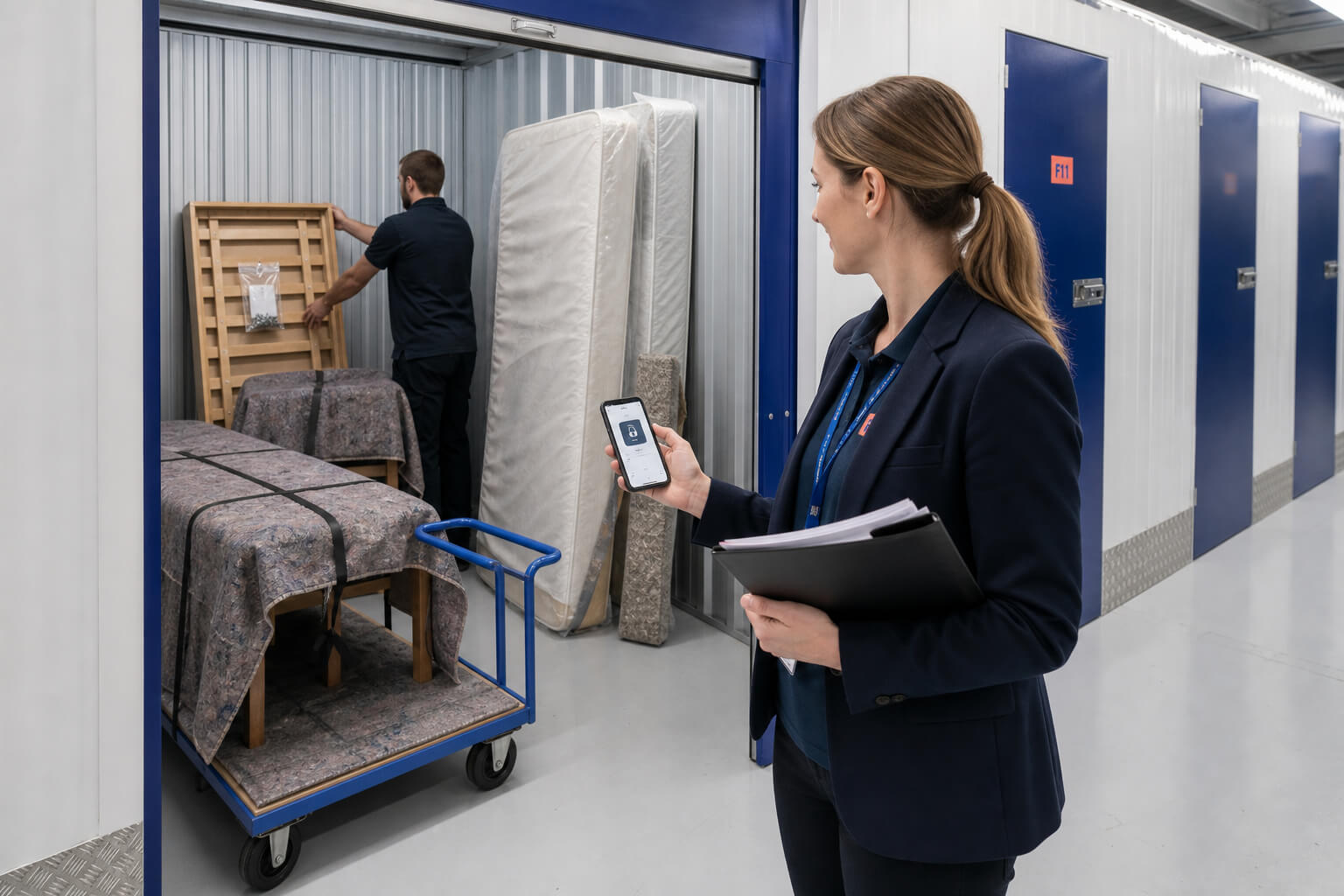
Put the two options side by side and the financial difference is not subtle. A warehouse lease asks you to commit capital, take on a rates liability and accept a minimum term before you know what next year looks like. Self storage asks you to pay for the months you use it.

No business rates on the unit, no twelve-month tie-in

When you rent a self storage unit, you are not the ratepayer for the premises. Wigwam carries the business-rates liability for the facility; you pay for the unit you use. That removes one of the biggest hidden costs of a commercial warehouse: the annual business-rates bill that arrives regardless of whether you are busy or quiet.

There is no minimum term tied to a lease. The unit rolls month to month after the two-week minimum. You are not locked into a quarterly rent commitment or a lease anniversary that forces you to renew or negotiate in advance.

Whether the cost of a self storage unit is deductible as a business expense is a question for your accountant. It is not something we are able to advise on here. For current unit costs, see our pricing and size guide.

Two-week minimum stay, refundable deposit, refund of unused days

The financial terms are designed to be the opposite of a lease commitment. The minimum stay is two weeks, not twelve months. If your peak clears faster than expected and you want to leave early, unused days are refunded. The deposit is refundable: once you have given 14 days’ notice, cleared the unit, and the account is settled with nothing outstanding, it comes back to you.

That is what “flexible” actually means in practice. Not a rolling break clause with notice obligations; not a penalty for leaving early. A unit you pay for while you use it, and stop paying for when you do not.

Full terms are at wigwamstorage.co.uk/terms-conditions.

Ready to see what a unit would cost for your peak?
Get a quote at quote.wigwamstorage.co.uk

Sizing your unit for the peak

Matching the right unit to your stock is the practical question underneath all the planning. Too small and you are cramped from day one. Too large and you are paying for air. The good news is that self storage unit sizes are straightforward, and most SME owners find the sizing conversation easier than they expected.

Matching unit size to boxes, pallets and seasonal bulk

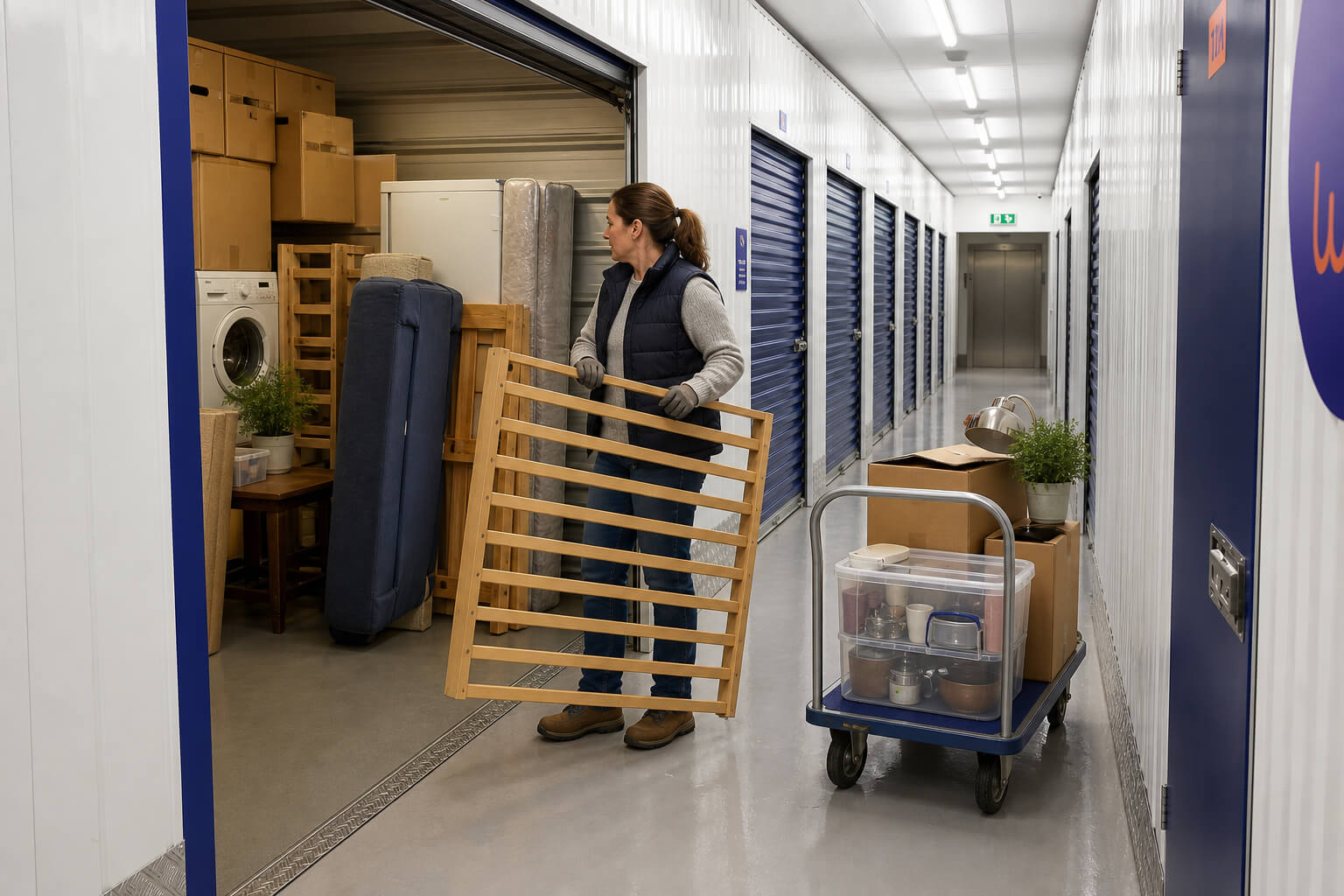
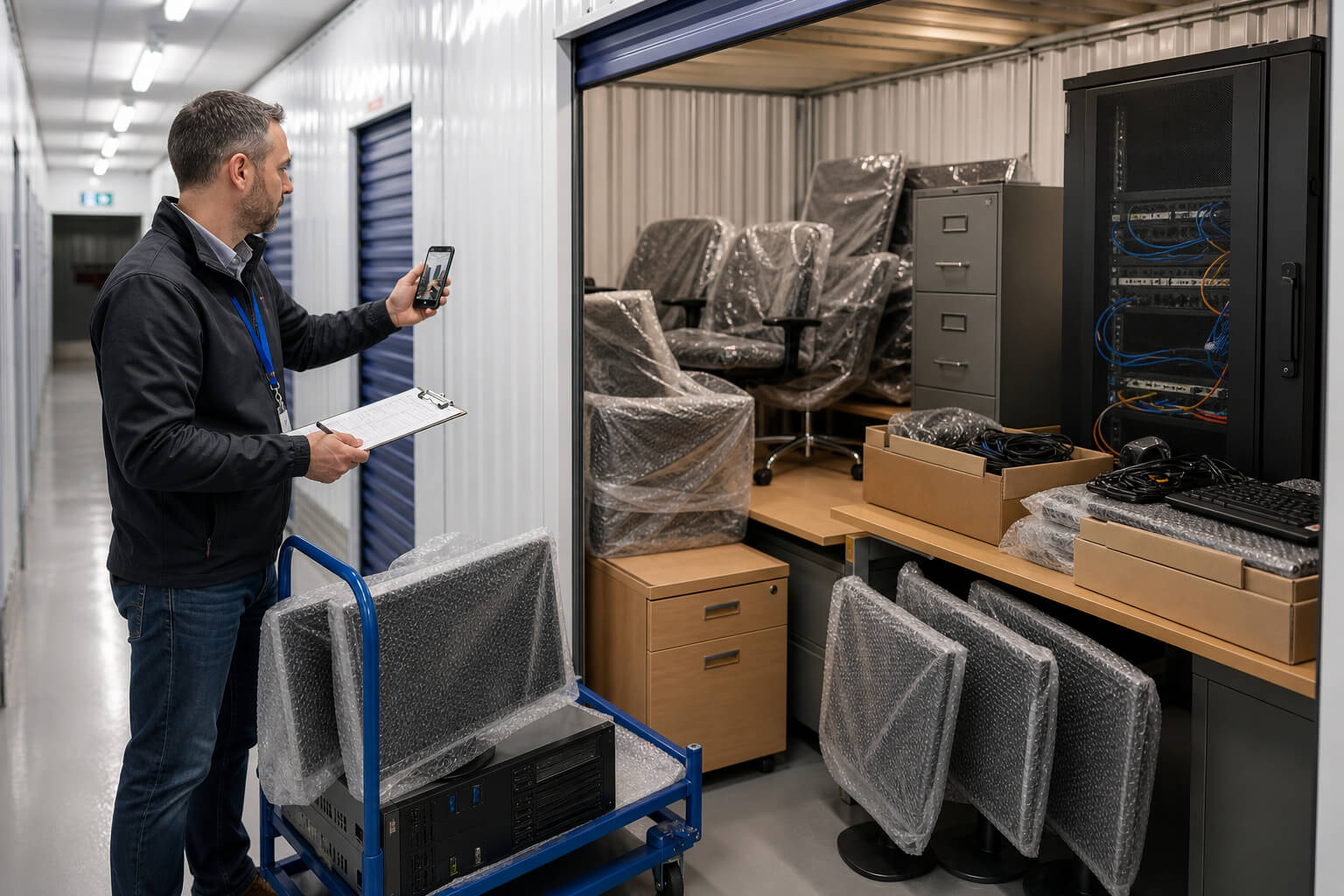
A standard self storage unit is floor-level access, either drive-up outdoor or indoor corridor. There is no loading dock and no forklift bay. Units typically range from around 25 square feet (think a large wardrobe) up to 200 square feet and beyond for larger commercial stock. A 50-square-foot unit holds the equivalent of a Transit van’s load. A 100-square-foot unit starts to feel like a small stockroom.

Pallets can be stored, but there is no dock-height loading. If your supplier delivers on a flat-bed or with a tail-lift, your team manages the unloading and gets stock into the unit. That is worth planning for before the delivery lands, especially if the stock is heavy or needs hand-trucking.

For help matching size to your volume, the pricing and size guide walks through unit dimensions.

Scaling up and down as the season moves

One of the practical advantages of a self storage unit is that you can take a second unit for the peak and hand one back once stock begins to clear. You are not committed to a fixed footprint for a fixed term. If October is bigger than expected and you need more room by November, that conversation is straightforward. If February is quiet and the stock has sold through, you give notice on the second unit and it is gone.

The space tracks the season. That is the shape that a lease cannot give you.

What stock suits a self storage unit (and what does not)

Self storage is not the right answer for every type of stock. Part of what we try to do is tell you plainly what fits and what does not, so you can make the right call for your business rather than find out at the wrong moment.

Clean, dry and secure: what that actually covers

Each Wigwam unit is individually alarmed, and the site uses smart entry to control access. The environment is clean, dry and secure. For boxed goods, clothing, homewares, trade samples, display stock, equipment, stationery, seasonal retail stock and similar goods, a unit is well suited.

What a Wigwam unit is not is climate-controlled. We do not market the units as temperature or humidity managed, because they are not. We say “clean, dry and secure” because that is what they are. If you have seen references on other sites or in search results to “climate-controlled” self storage as a general category claim, that does not apply here.

What we do not store (temperature-sensitive goods, vehicles, leisure)

Temperature-sensitive goods, perishables or anything that requires a controlled environment are not suitable for our units. That is a plain answer and an important one if your peak-season stock includes food or pharmaceutical products.

Vehicles are outside our remit. We do not store cars, vans, motorbikes, caravans, boats or any leisure vehicles. Our units are for household goods and business goods.

If you are unsure whether a specific type of stock is suitable, contact the team at your nearest location before booking.

How deliveries work on an unmanned site

This is the question we want to answer before you have to ask it, because it matters a great deal if your business model relies on supplier deliveries going into your overflow space. The honest answer is different from what some competitor brochures and general category descriptions say.

Someone from your business must be present for couriers

Wigwam sites are unmanned. There is no staffed reception, no warehouse team and no one at the facility to sign for or receive deliveries on your behalf. If a courier or supplier is delivering to your unit, someone from your own business must be on site to accept the delivery.

That is not a hidden condition. It is how the sites work, and planning around it is straightforward. You book the delivery slot to coincide with when your driver or a team member is going to be at the unit. Most SME owners running pick-and-pack runs manage this without difficulty. The important thing is to build it into your delivery schedule, not to assume someone will be there.

Access hours: 6am to 10pm, seven days, smart entry

Access runs from 6am to 10pm, seven days a week, via smart entry. That is not 24-hour access, and we do not describe it as such. What the window does cover is a full commercial working day: early runs before trading opens, restocking during the day, and an evening drop-off after the shop has closed. For most picking and delivery schedules, 6am to 10pm is more than enough.

“Smart entry” is the term we use. The access system is not described by us as app-based.

What you can and cannot do from the unit

A Wigwam self storage unit is storage you control. It is worth being clear about what that means in practice, because the honest answer to “can I run a business from a storage unit?” is “it depends which part of your business you mean.”

Stock, pick-and-pack runs and restocking: yes

Using the unit as overflow stock, coming in to collect goods for dispatch, loading your van for a market or trade event, restocking from the unit after a delivery: all of that is exactly what this space is for. You access your goods when you need them, within access hours, using your smart-entry credentials.

A shopfront, staff base or customer-facing operation: no

A self storage unit is not a place of work for employees, not a shop customers can visit and not a customer-facing premises. Wigwam does not provide inventory management, pick-and-pack staffing or any fulfilment service. The unit is space. What you do with it, within the terms of use, is up to you.

Questions about the regulatory and planning-use implications of business activity from a self storage unit are not something we can answer here. For those questions, speak to your solicitor and your accountant.

Note: business use, planning classification and any associated regulatory questions are governed by law in England and Wales. The position in Scotland and Northern Ireland may differ. Consult a solicitor for advice relevant to your situation.

Security and protecting your stock

Peak-season stock has real value, and the security of what you have stored matters. Here is what Wigwam provides, and what you need to arrange separately.

Individually alarmed units and smart entry

Each unit is individually alarmed. The site access is controlled via smart entry, which means only people with valid credentials can get in. The environment is clean, dry and secure by design. There is no staffed reception, but the security at unit level is specific: your alarm, your unit, your access.

Insuring your business stock: the contents-protection options

Contents cover is mandatory for all goods stored with Wigwam. You have two options: take Wigwam’s contents-protection policy, underwritten by RSA under their Self Storage Customers’ Goods scheme, or provide evidence of your own cover.

The RSA policy is New-for-Old cover with a £50 excess. You declare the full replacement value of what you are storing. If you under-declare, any claim is settled in proportion to the value declared, not the full value of the goods. Theft claims require evidence of forced entry. Climatic damage is excluded.

We do not quote insurance premiums on this page; costs depend on the value you declare. For full details of the cover options, see wigwamstorage.co.uk/contents-protection.

If you intend to use your own business insurance, check with your broker or insurer that the policy extends to goods held in a third-party self storage facility. Not all commercial stock policies do.

Note: insurance products are regulated by the FCA in England, Wales and Scotland. The position in Northern Ireland may differ. Speak to your broker or insurer for advice on the right cover for your goods.

Wigwam locations for business overflow, close to where you trade

One of the practical limitations of a distant industrial estate is that it adds time to every picking run and every delivery visit. If your overflow space is thirty minutes from your shop or your home-office despatch point, that is an hour of your day gone on every trip in peak season.

Wigwam operates across our UK market-town locations, chosen to sit close to where businesses actually trade rather than on the edge of a motorway junction. Named examples include Wigwam Self Storage Lincoln in Lincolnshire, Wigwam Self Storage Bath in Somerset, Cheltenham in Gloucestershire, Reading in Berkshire, Burton upon Trent in Staffordshire, Dorking and Leatherhead in Surrey, Bromsgrove in Worcestershire, Tewkesbury in Gloucestershire, Warminster in Wiltshire, Marlow in Buckinghamshire, and others.

To find the location nearest to your business, see the full locations hub.

Find the unit nearest to you and get a quote at quote.wigwamstorage.co.uk

Frequently Asked Questions

Can my staff access the unit, or only me as the account holder?

Your authorised people can access the unit, which is what makes a pick-and-pack operation practical. A peak season run by one person who has to be present for every collection does not scale, so the access is set up around the account holder’s authorised contacts rather than you alone. That means a member of your team can come in, load the van for a delivery run, and head out without you being there, using the smart entry credentials within the access window.

Two things are worth being clear about. First, access is for your authorised people, not for couriers, suppliers or unaccompanied third parties; the body of this article covers why someone from your own business must be present for any delivery, and the same principle applies to who can be in the unit. Second, the access window is 6am to 10pm, seven days a week, by smart entry, not around the clock, so a very early picking run works and a late evening drop after the shop closes works, but a 2am dispatch does not. Set up your authorised contacts when you open the account, brief them on the access rules, and your peak team can keep the stock moving without funnelling every trip through you. Sites are unmanned, so there is no reception to coordinate with: your people, your credentials, your unit.

Can I use the unit’s address as my registered business or delivery address?

Treat this as a question for your accountant and your own due diligence rather than something to assume, because a storage unit is space you rent, not a trading premises or a registered office service. The unit gives you somewhere to hold and move stock; it is not a customer-facing address, not a place of work for employees, and Wigwam does not provide a registered-office or mail-handling service. Using it as a delivery address for supplier stock is fine in the practical sense, provided you remember the delivery rule: the site is unmanned, so someone from your business must be present to receive anything, because no one here signs for or accepts goods on your behalf.

Whether you can or should register the unit as your company’s official address with Companies House or HMRC is a different matter, and it touches on planning use, business regulation and your trading structure. Those are questions for your accountant and, where relevant, your solicitor. We cannot advise on the regulatory or tax position, and it genuinely varies with your circumstances and where you trade, with rules differing across England and Wales, Scotland and Northern Ireland. The honest summary is that the unit is excellent as a physical overflow stockroom you control, and you should take professional advice before treating it as a formal business address. Keep the two questions separate: physical stock handling is what the unit is for; formal address registration is a professional-advice question.

What happens to my stock if I miss a payment during a quiet month?

Speak to the team straight away if cash flow is tight, because the worst outcome comes from going quiet, not from being upfront. A missed payment is a contractual matter governed by the terms you sign, and the specifics of arrears, any charges, and what happens to access are set out there, so read the terms and conditions before you book rather than after a problem arises. For a seasonal business, the more useful point is how to avoid the situation in the first place.

The structure is built to flex with your season precisely so you are not carrying space you do not need through the quiet months. If February is dead and the stock has sold through, you do not hold the unit and hope to make the payment; you give 14 days notice, clear it, and the unit goes, with the deposit returned once the account is settled and any unused days refunded. Then you take a unit again next peak. That is the discipline the monthly rolling term is designed for: you pay for space while you are using it and stop when you are not. If a genuine cash-flow gap hits while you still need the space, the team would always rather have an early conversation than discover a problem at the end. The terms are the contract; the practical advice is to size the commitment to the season and not let a quiet month catch you holding space you have stopped earning from.

Do the units have fire protection, and does my stock insurance cover fire?

The site is built and maintained as a clean, dry, secure facility, and any fire-detection or suppression arrangements are part of the building’s specification rather than something to claim casually, so if the precise fire provision matters to your stock or your own insurer, ask the local team about that specific site before you book. What this article can tell you plainly is how the cover works, because that is the part most stock owners actually need to get right.

Contents cover is mandatory for all goods stored with Wigwam. You either take the RSA Self Storage Customers’ Goods policy or provide evidence of your own cover, and you declare the full replacement value of the stock; under-declare and any claim is settled in proportion to what you declared, not the full value. The policy is New-for-Old with a 50 pound excess. There are exclusions that matter for stock: theft claims require evidence of forced entry, and climatic damage is excluded, which is one more reason temperature-sensitive goods are not suitable here. We do not quote premiums, because the cost depends on the value you declare, and we do not give insurance advice; for the cover detail see the contents-protection page, and if you intend to rely on your own commercial stock policy, confirm with your broker that it extends to goods held in a third-party self storage facility, because not all do.

Can I split stock across units in more than one town to be closer to two trading sites?

Yes, and for a business trading from more than one location it can make real sense. The whole logic of using market-town storage rather than a distant industrial estate is to cut the time on every picking run and delivery visit, and if you trade from two towns, two units close to each one beats a single unit that is far from both. You take a unit at each location, near where you actually trade, and run each as overflow for that side of the business.

Each unit is a separate arrangement: its own account, its own access credentials, its own two-week minimum and 14-day notice to close. That is an advantage, not a complication, because it means you can hold one through a long peak and give notice on the other the moment its stock clears, without the two being tied together. The same delivery rule applies at every site: someone from your business must be present to receive goods, because all the sites are unmanned. To set this up, look at the locations hub for the towns nearest each of your trading points, and get a quote for each at quote.wigwamstorage.co.uk. One practical note for a multi-site arrangement: keep your stock records clear about which unit holds what, so a picking run does not send someone to the wrong town. The network is built around market towns precisely so that being close to where you trade is the normal case, not the exception.
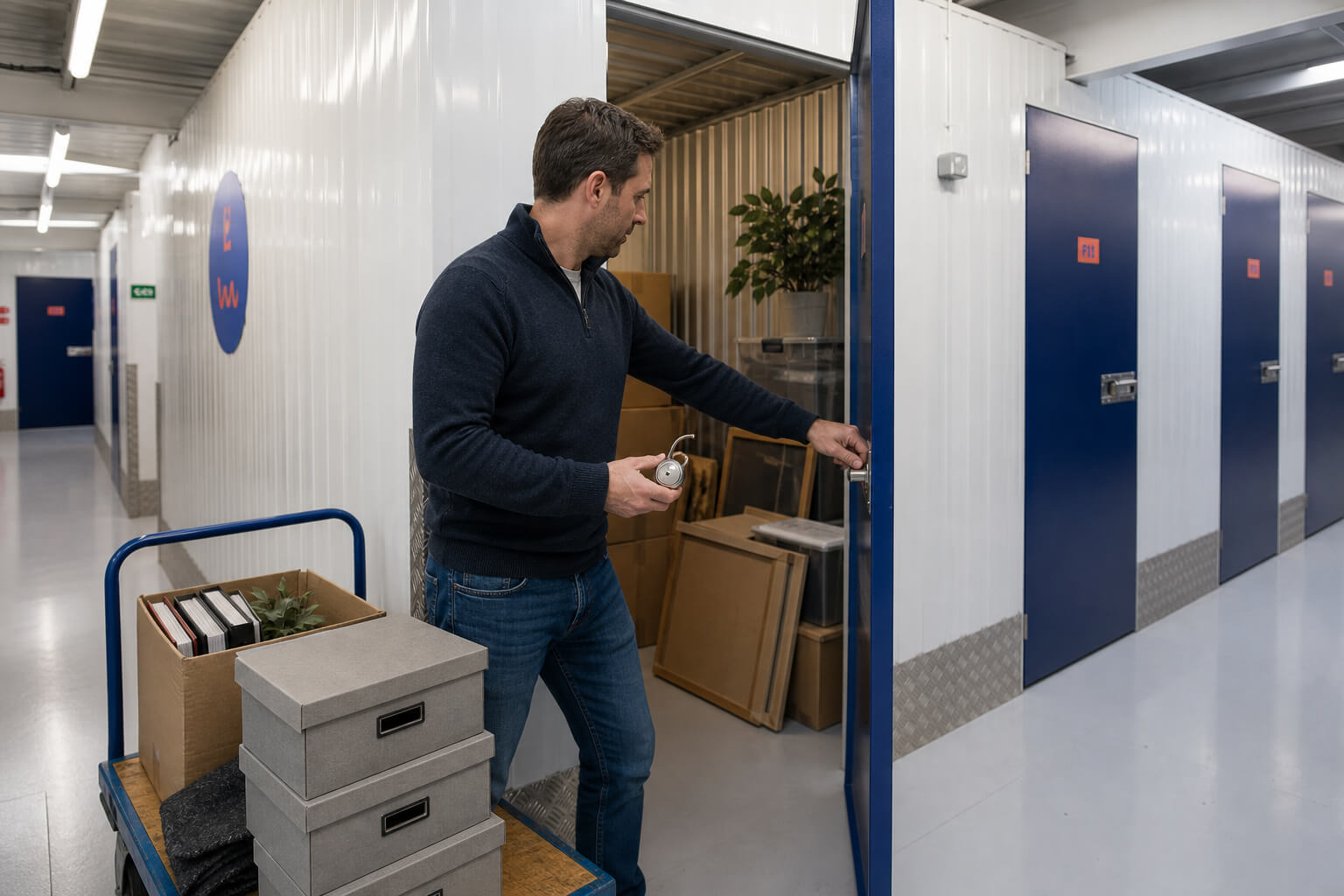
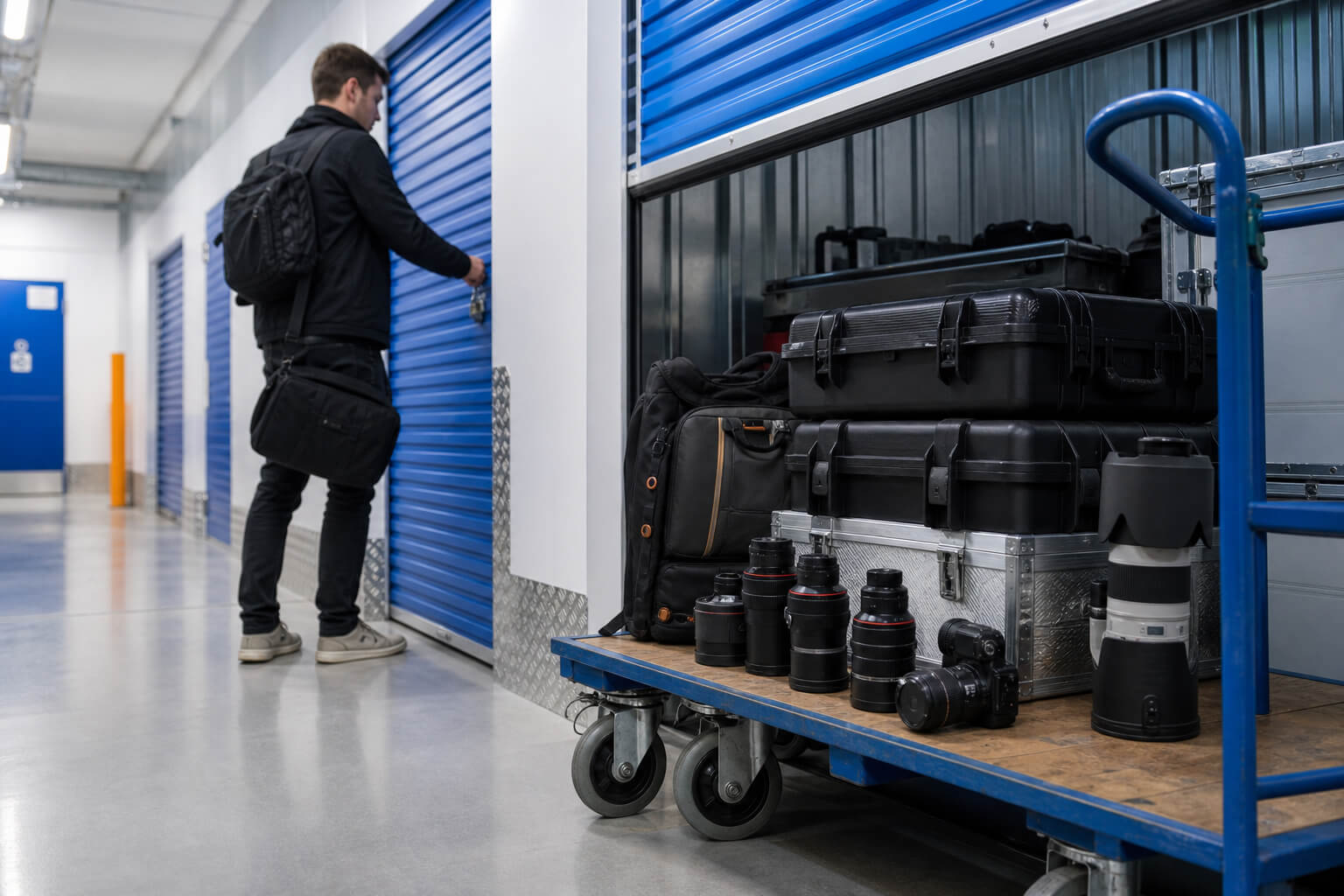
Self Storage For Market Traders And Pop Up Retail

Will the unit be open when your market pitch starts at dawn?

The load is done by seven on a Friday evening. The van is packed: the gazebo, the trestle tables, the crates of stock, the signage and the bags of tissue wrap. Everything is in order. The one question left is whether the storage unit will be open when the market starts.

That is not a small question. A market pitch starts early. Set-up time is before most people have had breakfast. If the unit is not open, or if getting in requires a phone call or a key-holder, the whole morning falls apart.

This page gives you a straight answer to that question, and explains exactly what a Wigwam unit can do for a market trader or pop-up retailer, and what it cannot.

Storage built around your trading week

Wigwam units work with the rhythm of a market week, not against it. The Friday-night load, the Saturday-morning pull-out, the quiet spell in January: the way a unit is set up here is designed to fit around a trader’s schedule, not the other way round.

The Friday-night load and the Saturday-morning pull-out

You can access your unit from 6am to 10pm, seven days a week, by smart entry. No key-holder to call. No waiting for a member of staff. You are in the system; the unit is yours to open when you need it.

In practice, that means you can load the van on Thursday or Friday evening, drive straight home, and pull back in before 6:15am on a Saturday to pick up the last few boxes before you head to the pitch. It fits around a market schedule the way a lock-up does when it works, without the scarcity and the uncertainty that come with finding a good one.

The access window runs right through the trading week. If you run a Sunday car-boot alongside a Saturday market, you are not restricted to one early morning. Seven days means seven days.

Why a unit beats a lock-up or a long commercial lease

A commercial lease is written for a business that knows it will be in the same place for twelve months or more. A market trader testing a new pitch, or running a seasonal Christmas-market circuit, does not know that. The commitment is the wrong size, the cost is the wrong scale, and the exit is rarely clean.

A Wigwam unit starts from a two-week minimum. There is no twelve-month lease to sign, no long-form commercial agreement, no landlord who needs thirty days’ notice in a specific form. The deposit is refundable. When you give 14 days’ notice, vacate the unit and settle the account, the deposit comes back. That is a different financial proposition to a non-returnable premium on a long-lease lock-up.

Lock-ups, where they exist, are also scarce in most market towns. They tend to be in industrial estates a drive away from the pitch, and the availability is rarely predictable. A Wigwam unit is booked online and ready when you need it.

Testing a new pitch without overcommitting

A new pitch is always a risk. The footfall might be wrong. The mix of traders might not suit your product. December might be brilliant and January empty. The two-week minimum means you can take a seasonal run or try a new location without locking yourself into a contract that runs past the point where you know whether it is working.

If you clear the unit before the paid period ends, unused days are refunded. That matters in practice: if the Christmas-market run ends early, or the pitch does not work out, you are not paying for space you are not using. Full conditions are on the terms and conditions page.

Access hours: the honest answer

The market starts early. Here is exactly what the access hours are, stated plainly without dressing them up.

6am to 10pm by smart entry, seven days

Several storage providers in the UK market themselves on 24-hour access. Wigwam does not. The access window is 6am to 10pm by smart entry, seven days a week. If you need a unit you can open before 6am, that is worth knowing before you sign up.

For most market traders, 6am is not a limitation. It is an honest answer that actually lines up with how early a Saturday market allows set-up. If the market opens at 9am and you need to arrive at 7:30am to secure your pitch, unload and get the gazebo up, being in the unit at 6am gives you all the time you need.

The reason we say this plainly is not because 24-hour access is not possible anywhere. It is because a claim that does not hold up on the morning it matters is worse than a clear boundary that you can plan around. You know the window. Plan your week around it. It works.

How early access fits a market or car-boot start

Put it in practical terms. You are in the unit at 6am. The van is loaded by 6:20am. The unit is locked. You drive 40 minutes to the market. You are at your pitch before 7am with time to spare. The scenario works at the standard Wigwam window without needing a 24-hour service.

For a Sunday car-boot, the same calculation holds. Most car-boot sites open to sellers at 6am or later. Smart entry at 6am covers that. The 10pm close means you can return stock to the unit after a long Saturday session and be back out for Sunday with no additional steps.

Smart entry means you come and go with your own credentials. No queue. No waiting. No one to let you in or out.

What traders and pop-ups actually store with us

Stock, kit and seasonal lines. Here is what goes in a unit, and what does not.

Stock, packaging and seasonal lines

Boxed stock is the obvious one: whatever you sell, the unit becomes the place you hold the lines you are not carrying to the next market and the overflow from a busy order week. Alongside the stock itself, there is all the packaging: retail bags, tissue wrap, ribbon, bubble wrap, gift boxes and labels. These take up more space than most traders expect until they are not in the spare bedroom or the back seat of the car.

Seasonal lines work well in a unit. You can hold your Christmas stock from October and pull it down in batches as the season progresses, without filling your home with things that are not yet selling. After the season, the unit holds the leftovers until the next year.

Units at Wigwam are clean, dry and secure. That matters for stock: damp damages packaging before it damages the goods inside, and damp-damaged packaging is a sale lost. What Wigwam units do not have is climate control. There is no temperature or humidity management system. If you are storing goods that are sensitive to atmospheric or climatic change, a Wigwam unit is not the right solution and climatic damage is not covered under the contents-protection policy.

Gazebos, trestle tables, rails and signage

The physical kit of a market stall is bulky and awkward. A gazebo in its bag takes up the boot of a car or the back corner of a van and leaves it unusable for the rest of the week. Trestle tables stack, but you still need somewhere to stack them. Display rails take up floor space. Signage is usually too large to store flat in a domestic property without risking damage.

A single unit handles all of it. The gazebo goes along one wall. The tables stack against the back. The rails stand in a corner. The signage lies flat on top of the tables or leans against the wall. When Friday evening comes and the van is ready, everything is in one place and already organised for the next morning’s pull-out.

What cannot go in

Vehicles of any kind cannot be stored in a Wigwam unit. That includes vans, trailers, cars and any leisure vehicles. If you use a transit or a horse-box trailer for your pitch, the vehicle parks elsewhere; what goes in the unit is the goods it carries.

Goods that require climate or temperature control are not suited to a Wigwam unit, and climatic damage is excluded from the contents-protection policy. Hazardous materials and other prohibited items are listed on the terms and conditions page.

The right size for your stall and stock

A rough guide to unit size, from a few boxes to a full-van load. No prices on this page: for current pricing, the Wigwam pricing page gives you the numbers.

A guide from a few boxes to a full van load

If you are storing a small number of product lines, a few boxes, a fold-up table and some display materials, a small unit is usually enough. It gives you a place to keep the overflow and the packaging without the square footage of a larger space you are paying for but not filling.

If you are adding a gazebo, a full set of trestle tables, display rails and a couple of trolley-loads of boxed stock, you are looking at a medium unit. That is roughly the contents of a standard transit van: the van holds it to drive to the pitch, and the unit holds the same volume when the van is back home.

A larger operation, running several product categories, holding seasonal stock year-round, or serving both a physical market circuit and an online business from the same unit, will need a larger unit. If you are planning a Christmas-market season with a significant stock build, it is worth thinking ahead: a unit that fits a September stock level may be too small by the first week of December.

A Wigwam team member can talk through what size suits your setup. A unit size guide is also available if you want to work it out before you call.

Stacking and shelving your own unit

You control the layout. No one from Wigwam moves, sorts or reorganises what is in your unit. That is a feature, not a gap: you know your stock, you know which lines move fastest, and you can set up the unit to match the pull-out sequence for a Saturday morning.

Bring your own shelving if it helps. Most traders with a regular unit put heavy items on the floor, lighter packaging on shelves at mid-height, and fast-moving lines closest to the door. A clear pull-out path from the unit door to the van makes a 6am start considerably less stressful. The unit is yours to organise exactly as you need it.

Running stock through a unit, and where the line is

You access your own goods, on your schedule. Here is what that means in practice, and where the boundary is.

You are in control of your unit

You open the unit when you need it. You load what you need. You lock it again when you are done. Wigwam staff are not on site to manage goods, sort orders, or hand anything over. That is not a limitation: most traders prefer it that way. The stock is yours, the unit is yours, and the schedule is yours to set.

If you sell online alongside your market trading, you can use the unit as a stock-holding point you access yourself. You can pick lines from the unit at a time that suits your dispatch schedule. What Wigwam is not is a managed fulfilment or pick-and-pack service. There is no one on site to select items, pack them, print labels or hand parcels to a courier. It is a secure, individually alarmed unit you access on your own terms.

Deliveries and couriers: the unmanned-site rule

Wigwam sites are unmanned. That means there is no member of staff present during access hours to take deliveries, sign for parcels or receive goods on your behalf.

If you want a supplier or courier to deliver stock to your unit, someone from your own business must be there to receive it. You cannot arrange for a courier to deliver to the site when you are not present and expect the goods to be received. They will not be. The site is secure, the unit is locked, and no one from Wigwam is there to accept anything.

This is worth knowing in advance. If your restocking depends on regular courier deliveries, plan those deliveries for times when you or a colleague can be at the unit to meet the driver.

What it costs and the minimum stay

No prices on this page. The minimum commitment is short, the deposit comes back, and the full pricing is one click away.

Two-week minimum and a refundable deposit

The minimum stay is two weeks. You are not signing a six-month agreement or a twelve-month lease. Two weeks is the floor, and from there the arrangement runs flexibly.

A deposit is taken when you start. It is refundable. When you give 14 days’ notice, vacate the unit and settle the account, less anything owed, the deposit is returned. This is not a premium that disappears on signing. It is a deposit in the ordinary sense: held while you are a customer and returned when the account is clear.

For a trader who is testing a new pitch, running a seasonal circuit or operating in quiet months, this is a different kind of financial exposure to a long-lease lock-up. The cash comes back. The two-week minimum means the commitment is short enough to take without certainty about how long you will need the unit.

Refund of unused days if you clear early

If you clear the unit before the end of a paid period, unused days are refunded. A quiet January that ends sooner than you expected, a season that closes early, a pitch that did not work out: you are not paying for days you are not using the space for.

The pricing page has the current figures and the calculator to work out what a unit costs for your setup. It is worth doing that before you call, so you have the size and the time period clear in your mind.

Ready to check what is available near you? Get a quote at quote.wigwamstorage.co.uk

Keeping stock clean, dry and secure

The unit is individually alarmed and the site is secure. Here is what that covers, and what to have in place for your contents.

Individually alarmed units and smart entry

Each unit has its own alarm. The site is secure. Smart entry means the access system tracks who comes and goes, which adds a further layer of security beyond a padlocked door.

Units are clean, dry and secure. That is the Wigwam commitment on the condition of the space. There is no climate control. Temperature and humidity are not managed. If your stock requires a controlled environment, a Wigwam unit is not the right fit, and goods that suffer climatic damage are not covered under the contents-protection policy.

For most market-trader stock, including clothing, homeware, gifts, craft goods, seasonal lines and packaged food items that do not require refrigeration, a clean, dry and secure unit is the right environment.

Insuring your stock

Contents protection is mandatory. You have two options: take Wigwam’s RSA “Self Storage Customers’ Goods” policy, or prove your own cover is in place.

Wigwam’s policy is New-for-Old cover arranged through RSA. If you take it, declare the full replacement value of everything in the unit. If you declare less than the full value and need to make a claim, the payout is reduced in proportion. Under-insurance is not covered in full.

Theft claims require evidence of forced entry. Climatic damage is excluded. Do not take these as the full terms: the contents-protection page sets out what is and is not covered.

If you have your own business-insurance policy that covers goods in storage, check the policy wording carefully and be ready to provide proof to Wigwam. Not all commercial insurance policies extend to off-site storage.

Insurance law and consumer-protection rights differ in Scotland and Northern Ireland. If you are based in either jurisdiction, confirm your position with your insurer or a solicitor.

Storage in your market town

Wigwam is based in the UK market towns where traders trade. The locations are not on retail parks or out-of-town industrial estates chosen for volume. They are in the towns themselves.

Find your nearest Wigwam location

Wigwam Self Storage Bath in Somerset and Wigwam Self Storage Lincoln in Lincolnshire are two of our UK market-town locations. We also have units in Reading, Cheltenham, Burton upon Trent, Dorking, Bromsgrove, Tewkesbury, Warminster, Leatherhead and Marlow, among others. The full list is on the locations page.

If you run a circuit of markets across several towns, it is worth knowing which Wigwam locations sit closest to each pitch. A unit in the same town as the Saturday market means a shorter drive on Friday night and on Saturday morning.

What to bring and what to expect on your first visit

When you start with Wigwam, bring your payment details and your contents-protection documents. If you are using Wigwam’s RSA policy, that will be arranged as part of the sign-up. If you are proving your own cover, have the policy details or insurer confirmation ready.

Smart entry means you use your own access credentials at the site. There is no key to collect from a member of staff and no code to request. The system is set up when you start and from that point you come and go on your own schedule.

The site is unmanned. That is exactly what most traders want: a secure unit they can access without coordinating with anyone. It is also what it means in practice for deliveries, as described above. Come when you need to, load or unload, lock up and leave. That is the experience, straightforwardly.

Get a quote

If your stock needs a home near the market, we will show you what is available in your town. The quote covers the unit size, the location and the current pricing, with no obligation.

Get a quote at quote.wigwamstorage.co.uk

Frequently Asked Questions

Can I use my Wigwam unit as a business address or have business rates apply to it?

No on the business address, and business rates are not something you arrange or pay through us. The unit is for storing your stock and kit and for your own access to it. It is not a registered office, a trading address, or a place you can list as your business location for Companies House, HMRC or your customers. If you need a registered or correspondence address, that is a separate service from a different kind of provider.

On rates: a self-storage unit is part of a storage facility, and the way it is rated sits with the operator and the wider site, not with you as a customer renting space inside it. You are paying a storage charge for the unit, not taking on a commercial tenancy with its own rateable value. If you are trying to work out the rates position for your business as a whole, that is a question for your accountant or your local authority, not for the Wigwam support team, who handle storage matters only: sizing, availability, access, pricing, invoicing and booking.

What you can do with the unit is straightforward and useful: hold your stock and packaging there, run your dispatch around your own access from 6am to 10pm, and keep your home clear of the trade. What you cannot do is treat it as the legal or trading address of the business. Keep those two things separate and the arrangement is clean. For the booking and cost side, the pricing page and a quote will give you the figures.

What happens to my stock in the unit overnight and on the days I am not trading?

It stays exactly where you left it, in an individually alarmed unit on a secure site, untouched by anyone. That is the quiet value of a unit for a trader: on the days between pitches, your stock is off your floor, out of your van, and in a space you do not have to think about. Each unit has its own alarm, separate from every other unit, and smart entry means the access system tracks who comes and goes, so there is a record of entry rather than an open door.

Nobody from Wigwam goes into your unit. Staff do not handle, move, count or reorganise your goods. The site is unmanned, which means there is no one wandering the corridors and no one with a master key to your space. Your stock is yours alone to access, and only you and anyone you have given your access to can get in.

Two honest points worth holding in mind. First, the unit is clean, dry and secure, but it has no climate control, so anything genuinely sensitive to temperature or humidity is not suited to it and climatic damage is excluded from the contents-protection policy. For ordinary market stock, clothing, homeware, gifts, crafts, packaged non-perishable goods, dry and secure is the right environment. Second, security cover is why contents protection is mandatory: you either take Wigwam’s RSA policy or prove your own, and theft claims require evidence of forced entry. Declare the full replacement value of the stock you hold, because under-insurance is settled in proportion.

Can I share a unit with another trader to split the cost?

You can, in the sense that the unit is your space to use as you see fit, but it brings practical and insurance complications that most traders are better off avoiding. The account, the access and the contents protection all sit with the named customer. If you let another trader keep their stock in your unit, their goods are in a space booked in your name, accessed on your credentials, and that tangles up two things that are cleaner kept separate.

The insurance point is the one to take seriously. Contents protection is mandatory and is arranged against the declared replacement value of the goods in the unit. If a second trader’s stock is in there and something happens, whose declaration covers it, and who claims? Mixing two businesses’ stock under one declaration is the kind of arrangement that causes disputes at exactly the wrong moment. The honest answer is that a shared unit is rarely worth the saving once you think it through.

If two of you genuinely want to split storage to save money, the cleaner route is usually two smaller units, each in its own name, each with its own access and its own cover. You still get sites in the same market town, the same short two-week minimum, and the same refundable deposit on each. Get a quote for the sizes you each need at quote.wigwamstorage.co.uk and compare that against one shared space before you decide. For most traders, keeping the businesses separate is worth a little more on the monthly cost.

My stock outgrows the unit at Christmas and shrinks in January. Can I change unit size through the year?

Yes, and this is one of the things the terms are built for. A seasonal trader’s footprint is not constant: you build stock through the autumn for a December peak, then shed it in the quiet new year. Rather than paying year-round for the space you only need in December, you can size up when the season demands it and size back down when it passes, subject to what is available at your nearest location at the time.

The mechanics are simple. Moving to a different unit is a matter of taking the new size and clearing the old one. The two-week minimum applies, and the refundable deposit and 14-day notice work per unit, so when you leave the larger unit you give notice, vacate, and the deposit comes back once the account is settled, with unused days refunded if you leave a paid period early. There is no long lease tying you to a peak-season footprint through a dead January.

The practical tip is to plan the build ahead. A unit that comfortably holds your September stock level can be tight by the first week of December once the seasonal lines land, so it is worth thinking about your peak when you choose the size, or booking the step-up before the stock arrives rather than after it is sitting in your hallway. Availability does vary by site and by season, so check early. A quick quote at quote.wigwamstorage.co.uk shows what sizes are free at your location, and the local team can talk through the timing if you tell them roughly when your peak falls.

If my packaging or stock gets damp-damaged in the unit, am I covered?

It depends entirely on the cause, and this is worth understanding before you store anything that matters. Wigwam units are clean, dry and secure, which for ordinary market stock is the right environment and means damp should not be an issue in normal use. But the contents-protection policy excludes atmospheric and climatic damage, so damage caused by humidity or condensation rather than by an insured event is not something you can claim for.

That makes the practical prevention more important than the cover. A few things keep stock and packaging in good condition:

  • Bring stock in dry, and do not pack damp boxes or fabric into the unit.
  • Keep boxes off the floor on a pallet or shelving rather than directly on the slab.
  • Do not overpack so tightly that air cannot move around the stacks.
  • Store anything genuinely sensitive to temperature or humidity elsewhere, because the unit has no climate control and is not the right home for it.

For the things a trader most worries about, water ingress, theft, the policy works on the usual terms: theft claims require evidence of forced entry, and you must have declared the full replacement value, because under-insurance is settled in proportion. If you are holding high-value stock, read the cover properly at the contents-protection page, and if your own business policy already extends to goods in storage, check the wording and be ready to prove it rather than assuming it carries over. This is a signpost to the policy, not insurance advice; for anything specific to your stock, speak to your insurer.

Stock Storage For Online Sellers Managing Inventory You Access Yourself

Does the house still belong to you, or has the business taken it over?

It starts as a minor inconvenience. A few boxes stacked in the corner of a bedroom. Then the landing. Then the garage. Then the car. Then one morning you are stepping over a pile of poly mailers at half past six, hunting for the parcel that needs to go out before the school run, and you realise the house no longer belongs to you. It belongs to the business.

The answer does not have to be a warehouse contract or a fulfilment company you have never visited. For a lot of UK online sellers, the right move is a self-storage unit a short drive from home. One where you hold the access code, you know exactly what is on each shelf, and you can be in and out before breakfast.

That is the model this page explains. Honestly, including the parts that other pages leave out.

Is a self-storage unit right for your online shop?

For most online sellers whose stock has grown beyond what the house can hold, yes, with one condition: you need to understand what “self-access” actually means before you sign. It is not a managed warehouse. Nobody picks for you, nobody signs for your deliveries, and nobody tidies the shelves between visits. That is the point. You are the one in control.

When the spare room, garage and hallway have run out

There is a moment every growing online seller hits. The business is doing well. The problem is that success looks like a hallway blocked with returns, a spare room that a guest cannot sleep in, and a car that smells faintly of packing tape. The home-as-warehouse arrangement that worked at twenty orders a month stops working at a hundred.

A self-access unit does not solve every problem. What it does is put a clear line between your home and your business. The stock goes in the unit. The house becomes the house again. Most sellers who make this move say they should have done it six months sooner. The decision feels bigger than it is, especially the first time you look at the monthly cost. But once you are picking orders from a unit you have properly organised, the alternative – the stepover, the search, the apology to your partner – quickly feels harder than paying a monthly fee.

A unit you control vs a hands-off 3PL

The honest comparison is this. A third-party logistics company picks, packs and ships for you. You never see the stock. You do not handle the orders. That is the right model for some sellers, particularly those with high volumes and no time to spare. But you lose visibility. You lose the ability to check a product before it ships. You lose the hands-on quality control that matters when you are the one who chose every item, graded every piece of clothing, described every listing.

A self-access unit is the opposite. You do the work. In return, you make every decision. You are still the one running every order, which for most sellers at this stage is not a compromise. It is the whole point.

What “inventory you access yourself” actually means

The phrase in the title is not marketing shorthand. It is a precise description of how this model works. You have the smart-entry credential. You open the unit. You find the stock. You pack the order. You lock up. At no point does anyone else do any of those things on your behalf.

You hold the smart-entry key and pick your own orders

Access is by smart entry, seven days a week, from 6am to 10pm. That is the real window. It is not 24-hour. It is not “24/7.” Several national competitors advertise that; we do not, because ours is 6am to 10pm and we would rather tell you plainly.

For the vast majority of online sellers, that window is more than enough. You can be at the unit at 6.30am, pull everything you need for that morning’s dispatch, and be back home before the children are up. You can restock on a Tuesday evening after the Vinted notifications come in. You can do a big Saturday morning sort before the market. The hours fit around a real seller’s day because most of the work happens at the edges of the working day, not at 3am.

No fulfilment middleman touching your stock

Every order goes through your hands. That means every order leaves the unit in the condition you intend it to leave. No pick errors from a warehouse system you did not set up. No mystery dents on a returned item. No batch-delayed dispatch because a fulfilment centre is processing a backlog.

The trade-off is honest: you do the work. Every trip to the unit, every box sealed, every label printed is yours. For the seller who takes pride in that, it is not a burden. It is the model.

Access hours and smart entry: the honest version

Access is 6am to 10pm, seven days a week, by smart entry. Not 24-hour. Here is why that distinction matters and why, for most online sellers, it probably does not.

6am to 10pm, seven days, by smart entry

Smart entry means no key to lose and no staff member to let you in. You arrive, you enter, you access your unit. The system works every day of the week, including bank holidays.

The 6am to 10pm window covers every practical dispatch and restock scenario for a seller running same-day or next-day fulfilment. The one scenario it does not cover is a late-night emergency restocking run at midnight. If your operation genuinely requires 24-hour access, that is worth knowing before you book, not after.

Competitors who advertise “24/7” may genuinely offer it. We are not in that comparison. We offer clean, dry, secure units with smart entry from 6am to 10pm, seven days, and we say so at the start.

Planning your pick-and-pack schedule around a 6am to 10pm window

The sellers who use self-storage well tend to build a routine around it rather than treating it as a drop-in whenever. A quick morning pick before 8am covers the orders that need to go out same-day. An evening run on Tuesday and Thursday handles restocking and labelling. A longer Saturday morning session deals with anything bulky or time-consuming.

That rhythm works well for a market-stall seller packing before a Sunday show, for an eBay reseller clearing a week’s worth of listings, and for an Etsy seller batching the packaging for a product launch. The window is not a constraint for most sellers. It is a timetable you can build a business around.

Deliveries, returns and the unmanned-site rule: read this before you commit

Our sites are unmanned. That means we do not sign for your couriers, we do not take in stock deliveries on your behalf, and we do not handle your customer returns. If a courier arrives at the unit, someone from your own business needs to be there to receive it. That is not a detail buried in the terms. It is the first thing we tell you.

Why our sites are unmanned and what that means for your stock

No staff member on-site means no staff member ever handles your goods. Nobody moves a box, opens a unit, or accepts a parcel on your behalf. The upside of the unmanned model is total control: from the moment your stock enters the unit to the moment it leaves, the only hands on it are yours.

The practical constraint is the other side of that same coin. When a supplier delivers a pallet, or when a courier comes to collect a customer return, someone from your business needs to be physically present at the site to receive it. You cannot book the unit and then arrange for your supplier to drop off while you are somewhere else. The key-in-your-pocket model means you are always the one holding the key.

For sellers who do not receive frequent inbound deliveries, this is rarely a problem. For those who take regular supplier drops, it is a logistical step that needs planning.

How online sellers handle inbound stock and customer returns in practice

The sellers who make this work tend to do one of a few things. They schedule deliveries for times they are already planning a unit visit, so the trip serves two purposes. They batch returns handling on a fixed day each week, so they are not making special trips. Where they have a business partner, a team member or a trusted colleague who can cover, they arrange someone to be present for large inbound deliveries.

What nobody should do is assume the site will handle it for them. We will not, and any operator who suggests otherwise is either misinformed or being imprecise about what “unmanned” means. The honest position is this: your stock, your responsibility, your control.

Ready to see what a unit costs near you?
Get a quote at quote.wigwamstorage.co.uk.
No obligation. Just a clear price for the size and town that suits your business.

Choosing the right size unit for your stock

The right size depends on two things: how much stock you hold at peak, not at a quiet month, and whether you need room to work in the unit as well as store in it. Most sellers start smaller than they think they need and move up once they see how the space fills.

From a few shelves of small parcels to pallet-scale bulk inventory

A small online seller running Vinted or eBay part-time might need nothing more than a couple of bays of shelving, enough room to stand at a folding table, and a corner for outbound parcels. A more established seller taking pallet deliveries from a supplier needs more floor space, a clear path in from the door, and room to open boxes and repack without creating a bottleneck.

The size you need is on the pricing and size guide. We do not publish prices on this page because the right size for your stock at a particular location is a conversation, not a fixed table. The guide gives you the framework; the quote gives you the number.

Room to pack as well as store

The unit works as a packing space as well as a storage space. Sellers use it to label, seal, sort and stage outbound orders. That is entirely within how the unit is designed to be used.

What it is not is a permanent manned workspace or a retail counter you open to the public. The unit is for storage and for the work of picking, packing and despatching your own goods. For the full list of what is and is not permitted, the terms and conditions are the place to look before you commit.

Storing by product type

The type of stock you sell changes how you set the unit up, not whether a unit works for you. Here is a plain-language guide to the three categories that come up most often.

Clothing and soft goods: rails, bags and breathable boxes

Clothing stores well in a clean, dry unit. The practical setup is straightforward: a freestanding rail for anything that needs to hang, breathable garment bags for better stock, and clearly labelled lidded boxes for folded items by size or SKU. A unit on a solid floor with good ventilation and no damp is what you need for soft goods, and that is what you get.

One thing to be clear about: there is no climate control. No temperature regulation, no humidity management. The unit is clean and dry and secure. For clothing that is not temperature-sensitive, that is sufficient. For specialist fabrics or items with specific storage requirements, pack accordingly and check your own product guidance.

Boxed goods, small electronics and moisture-sensitive items

Units are clean, dry and individually alarmed. For boxed goods and standard retail stock, that is more than adequate. Electronics and anything moisture-sensitive need sensible packing: sealed boxes where possible, silica gel packets where appropriate, and placement off the floor rather than directly on it.

There is no climate control at any Wigwam site. If your product requires a temperature or humidity-controlled environment, this is not the right storage for it. If it needs clean, dry and secure, this is exactly the right storage. That is an important distinction to make before you book.

Larger or bulkier items and mixed-inventory sellers

Larger items need a clear path from the door and enough floor space to manoeuvre without knocking over shelving. The practical solution is a zone layout: an inbound zone near the door for new stock as it arrives, a main shelving zone for live inventory, and an outbound staging area where packed orders wait before you take them to the post office or courier depot.

Mixed-inventory sellers, those running multiple product lines or selling across platforms simultaneously, often find that sizing up by one unit size removes the daily frustration of a bottlenecked packing corner. A little room to breathe is worth more than the marginal saving on a smaller unit when you are in the space every other morning.

Running a tidy pick and pack from your unit

A well-organised unit is not complicated. It is a shelf for each product line, a clear path from the door to the packing corner, and a labelling system you can read at 7am without the lights fully on.

Shelving, a simple location code and keeping the fast-movers near the door

Freestanding shelving makes a significant difference to usable space because it takes inventory vertical rather than spreading it across the floor. The location system does not need to be sophisticated. A shelf letter and a box number is enough for most small sellers. Shelf A, Box 3 is a faster find than a spreadsheet search when you are trying to pick six items before 7am.

Fast-movers, the SKUs that go out daily, belong nearest the door. Overstock and seasonal items go at the back. New deliveries go in the inbound zone and only move to the shelving zone once they have been counted and labelled. That simple discipline means the unit stays usable rather than becoming the tidy version of the hallway problem you left at home.

A packing corner and a clear route to the door

A folding table, a roll of tape, a label printer if you use one, and a clear sight line from the shelves to the door. That is the packing corner. Keep inbound stock separate from outbound stock. Empty flattened boxes out of the unit regularly, because collapsed cardboard on the floor is the most reliable way to make a small space feel smaller than it is.

The unit should work like a micro-warehouse with a logical flow through it: in, process, out. Not as a general dumping ground that happens to be outside the house. The sellers who get the most from a unit are the ones who spend ten minutes at the start setting it up properly and five minutes at the end of each visit maintaining that order.

What it costs, and the honest answer to “is there a cheaper alternative?”

The honest answer is: it depends on what you mean by cheaper. A spare room costs nothing in rent. A 3PL may or may not cost less than a unit, depending on your order volume and the provider. A self-access unit sits in the middle: a predictable monthly cost you control, with no long-term contract locking you in.

Unit vs spare room vs 3PL, honestly

The spare room is free, in the sense that you already pay the mortgage or rent. But it comes with a ceiling on your stock volume, a practical limit on how professionally you can run orders from a residential space, and the ongoing friction of your home and your business sharing the same square footage. At some point the cost of that friction, to your home life and to your ability to scale, outweighs the absence of a storage fee.

A 3PL handles the physical work for you. For high-volume sellers who cannot be at a unit themselves, that makes sense. For a seller who wants to stay hands-on, who wants to see every product before it ships and handle every return personally, handing the stock to a third party is a loss of the thing that makes the business theirs.

A self-access unit is the in-between. You pay a monthly cost. You do the work. You keep complete control. That combination is not for everyone, but for the hands-on seller whose stock has outgrown the house, it is the option that preserves the model without requiring a warehouse lease.

Refundable deposit, two-week minimum stay and refund of unused days

There is a refundable deposit. Not “no deposit.” A deposit that is returned to you after a 14-day notice period, once you have vacated the unit and your account is settled with nothing outstanding. The notice period and the deposit are both there in the terms and conditions.

The minimum stay is two weeks. If you leave before the end of a paid period, unused days are refunded. That is the honest contrast with a warehouse lease or a 3PL contract: you are not locked in for a year. You give notice, you clear the unit, you get the unused days back and the deposit returned once everything is settled.

For exact costs and size options, the UK pricing guide is the right place to look. Prices vary by location and unit size, which is why we do not list them here.

Security and peace of mind for your stock

Each unit is individually alarmed, clean, dry and secure. That is the real claim, stated plainly. For a seller whose stock is also her business asset and her income, those four words matter more than any marketing phrase.

Individually alarmed units, clean, dry and secure

Individual alarms mean the unit is monitored at unit level, not just at site level. If something happens to your unit specifically, the alarm responds to that unit specifically. Clean and dry means no damp, no mould risk, no pest concern for a unit that meets the standard. Secure means the site and the unit are both protected.

There is no CCTV claim to make on this page beyond what the live site confirms. There is no climate control to add to the list. The honest security offer is individually alarmed, clean, dry and secure, and for stock that does not require specialist environmental conditions, that is a solid baseline.

Insuring your stock

Contents cover is mandatory when you store with Wigwam. You can take out our RSA “Self Storage Customers’ Goods” policy, or you can prove that your own commercial contents insurance covers goods held off-premises in a self-storage unit. What you cannot do is store without cover in place.

A jurisdiction note: the information below describes the policy available at Wigwam sites in England and Wales. If you are storing at a location in Scotland or Northern Ireland, regulatory and legal differences may apply. This page is a signpost only. Speak to your own insurance adviser for guidance specific to your situation and your business.

The RSA policy, what to declare and the under-insurance rule

The RSA “Self Storage Customers’ Goods” policy is opt-in. New-for-Old replacement. A GBP 50 excess. The detail that matters most is this: declare the full replacement value of everything you store. If you declare less than the full value and you need to make a claim, the settlement is proportional to the shortfall. Under-insure by a third, and a claim is settled at two-thirds.

Theft claims require evidence of forced entry. Climatic damage is excluded, which is consistent with the fact that there is no climate control in the units.

For anything specific to your policy or your situation as a business owner, your own adviser is the right person to speak to. The full details of the contents protection available through Wigwam are on the contents protection page.

Find stock storage in your market town

We are based in market towns across the UK, not city-centre depots. For most of the sellers who use our units, the site is a short drive from home, which is what makes the self-access model practical. You are not committing to a forty-minute each-way journey every time you need to pick an order. The unit is nearby, and nearby matters when you are going in before breakfast.

Our UK market-town locations

We have units in locations including Wigwam Self Storage Bath and Wigwam Self Storage Lincoln, as well as market towns across the rest of the UK. The full list of our locations is on the locations page. Find the town nearest you, check the unit sizes available, and get a quote from there.

We do not name a hard location count here because it changes as we grow. What stays the same is the model: market-town sites, short drives from home, smart entry from 6am to 10pm, and units that are yours from the moment you access them to the moment you hand them back.

Get a quote for your unit at quote.wigwamstorage.co.uk.
No obligation. Just a clear price for the size and town that suits your stock.

Frequently Asked Questions

Can I use the unit’s address as my business or returns address?

This is a question to raise with our support team for your specific site, because the answer depends on the location and on what you mean by “use the address.” A storage unit is a stockroom, not a registered trading premises or a staffed receiving address. The sites are unmanned, so nobody here can take in a returned parcel, sign for a courier, or hold post for you. Listing the unit as your customer returns address, where buyers post items back to the site, does not work, because there is no one to receive those parcels and we do not accept goods on your behalf.

What sellers do in practice is keep their own home or registered business address as the contact and returns address, then batch the physical handling at the unit on a fixed visit. If you have a question about company registration, VAT, or how HMRC treats a storage address, that is one for your accountant. Our support team can talk you through sizing, availability, access, pricing, invoicing and booking, but they are not the right people to advise on tax or how you structure the business. For anything beyond storage logistics, speak to a professional adviser.

Can a member of my staff or a business partner access the unit instead of me?

Access is tied to the account and the smart entry credentials issued for it. If you run the business with a partner or have a trusted team member who needs to pick and pack while you are elsewhere, the practical step is to talk to our support team at your site about how access is set up on your account, rather than passing your own credentials around informally. The key point under the unmanned model is that whoever opens the unit is someone you have authorised, because there are no staff on site to check anyone in.

This matters most for inbound deliveries. If a supplier is dropping a pallet while you are away, someone from your own business has to be physically present to receive it, because we will not take it in for you. Many sellers solve this by having a partner or colleague cover those slots. Build it into the rota the same way you would a dispatch shift. The honest position is that the goods are your responsibility from the moment they arrive to the moment they ship, so the access arrangement needs to reflect who is actually doing the work.

What if my stock value grows past what I declared for insurance?

Update your declared value as your stock grows, rather than leaving it at the figure you set when the unit held half as much. Contents cover is mandatory, and if you take Wigwam’s RSA “Self Storage Customers’ Goods” policy you declare the full replacement value of everything in the unit. The detail that catches sellers out is the under-insurance rule: if you declare less than the true value and you make a claim, the settlement is reduced in proportion to the shortfall. Declare half of what is actually there, and a claim pays at half.

For a growing online shop, stock value is a moving target. A unit that held a few thousand pounds of inventory in spring can hold several times that by the Christmas peak. The sensible habit is to review the declared figure whenever your holding changes meaningfully, not just at renewal. We are signposting here, not advising. The full detail on the policy, the GBP 50 excess, the New-for-Old basis and what is excluded, is on the contents protection page. For whether the cover suits your particular business, speak to your own broker.

Can buyers or couriers collect orders directly from the unit?

A courier can come to the site, but someone from your own business has to be there to hand the parcel over, because the sites are unmanned and we do not release goods, sign for collections, or supervise handovers on your behalf. So a courier collecting outbound orders works only if you have planned to be present for that slot. Buyers turning up to collect in person is not how the unit is designed to be used: it is a stockroom in a storage facility, not a shop or a click-and-collect counter, and you cannot run retail sales or a public collection point from it.

The way sellers make collections work is to batch them around a visit they are already making. If a courier collects at a set time on a fixed day, you are there for that window anyway, picking and packing. For returns coming back in, the same rule applies in reverse: you have to be present to receive them, so most sellers handle returns on one scheduled day a week rather than expecting the site to take them in. Plan the collection and return runs around your own presence, and the model works cleanly.

Does storing stock here count as a 24-hour fulfilment operation? What about late-night dispatch?

No. Access is 6am to 10pm, seven days a week, by smart entry. It is not 24-hour, and we will not pretend otherwise even though some national operators advertise round-the-clock access. For the overwhelming majority of online sellers, the 6am to 10pm window covers every realistic dispatch and restock scenario, including an early pick before the working day and an evening restock run. The one thing it does not cover is a genuine midnight emergency, and if your operation truly depends on overnight access, it is better to know that before you book than after.

The honest way to think about it is that storage with smart entry is not the same as a manned fulfilment centre running shifts around the clock. Nobody picks for you, nobody ships overnight, and the unit is locked outside the access hours. What you get in return is total control of your own stock at a predictable monthly cost, with no fulfilment middleman touching your goods. For a hands-on seller building a routine, that trade is usually the whole point, not a limitation. Build your dispatch rhythm around the window and it rarely feels like a constraint.

Secure Self Storage For Florists Stylists And Hire Companies

Has the garage finally stopped being enough for all the kit?

There is a specific moment every florist, stylist and hire firm recognises. The arch came back from Saturday’s wedding and there is nowhere to put it. The rails are in the hallway again. The box of plinths is behind the car and someone is going to trip over it before the week is out. The garage was always a temporary answer, and it stopped being enough around the same time the bookings started coming in properly.

You have built a real business. The kit reflects that: arches, rails, lighting stands, backdrops, vintage chairs, ribbon stock, props that took years to collect. None of it is cheap to replace, and all of it needs to be clean, findable and ready to load by six on a Friday morning. What it needs is a proper home between jobs.

This is a plain account of what self storage does for kit-based trade businesses, what it does not do, and how Wigwam works in practice. No brochure language. Just the honest version.

When the garage stops being enough

The moment this becomes a storage problem rather than a clutter problem is when the kit starts costing you time. You spend twenty minutes the night before a job finding the velvet arch you know is in the garage somewhere. The rails are tangled. The lighting stand has been leaned against the wall at an angle that means the bag no longer zips properly. The kit is fine; the system is not.

A unit gives you back the system. Everything has a place it goes back to after the job. You load the van on the day from an organised space, not from three different rooms.

Florists: vases, arches, plinths, dry stock and ribbon

For a florist, the dry side of the business has nowhere good to live. Arches and plinths are bulky and awkward indoors. Vases stack but take up floor space. Ribbon, wire and oasis stock needs somewhere clean and dry, away from damp, away from the kitchen and away from the dog.

A self-storage unit handles all of that well. The units at Wigwam are clean, dry and secure. They suit dry floristry stock, props and decorative kit exactly. What they do not do is cold storage. If you need a cool room for fresh blooms, that is a different facility entirely. For everything that lives around the flowers rather than in the bucket, a storage unit is the right answer.

The unit is also where the business stops looking like a hobby. When the arches have a home and the stock is organised, you arrive at the venue looking like the professional operation you already are.

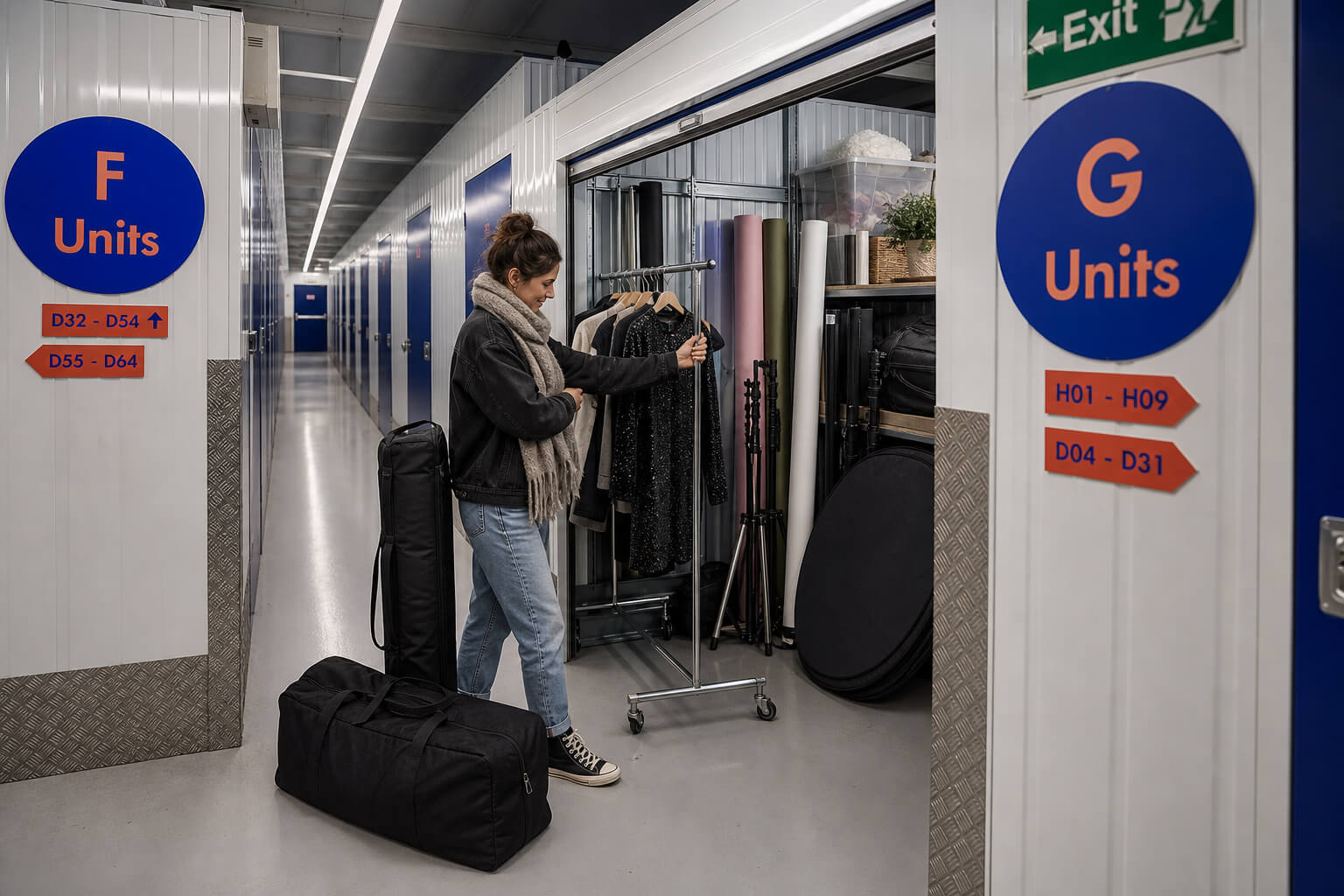
Stylists and photographers: rails, props, lighting and backdrops

A rail of sample clothing takes up a surprising amount of floor space. Two rails take up the spare room. Add lighting stands, a backdrop roll, prop boxes and a reflector bag and you have the contents of a small studio living in a domestic space that was never designed for it.

The unit becomes the studio the lease never justified. Rails can be hung properly. Equipment bags stand upright. Props are grouped by shoot type rather than wherever they fitted when you came home at midnight after a job. The next morning, the kit is ready.

A stylist told us once that the unit changed the morning. Not the job itself, just the morning before it. Everything was where it should be. That is the whole point.

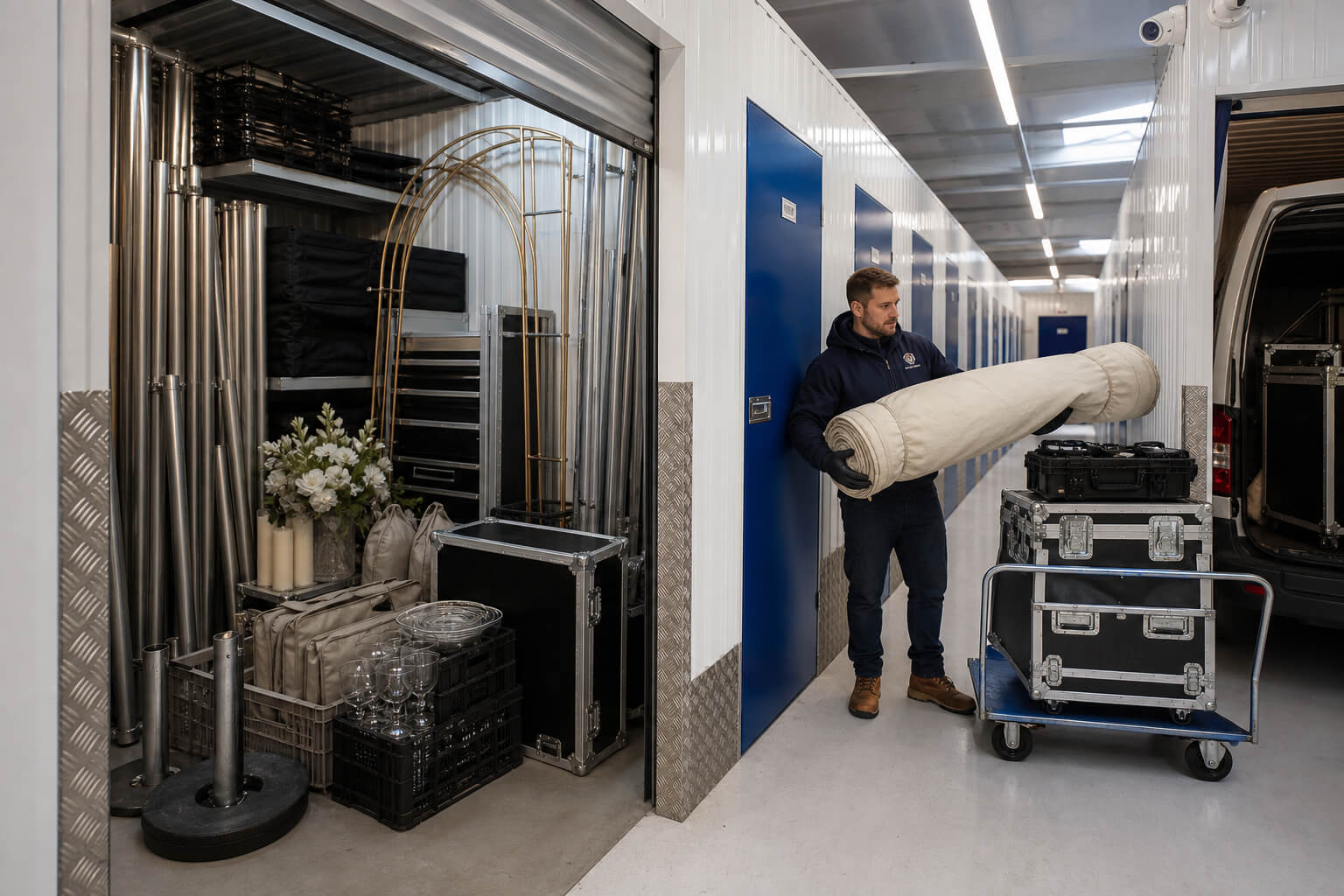
Event and party hire: chairs, decor, seasonal stock

Event and party hire businesses live by the season. June and July are relentless. January is quiet. A long commercial lease does not bend with that rhythm. A storage unit does.

Chairs, trestle tables, backdrops, centrepieces, fairy-light canopies, seasonal props that earn their price in one quarter and sit idle the rest of the year: a unit lets you hold the inventory you need for the busy season without paying commercial premises rates all year round. You can upsize when you need the room and give notice when you do not. That flexibility is the thing the national brands rarely explain clearly. We will come back to the terms later in this article.

What the unit is for, and what it is not

Self storage suits a kit-based trade business well. But it is not a workshop, not a shopfront, and not a cold room. Knowing the honest shape of it before you commit saves everyone time.

Store and access, your own goods, on your schedule

You hold the padlock on your unit. Nobody else opens it. You access your goods between 6am and 10pm, seven days a week, via smart entry. You organise the space the way your working rhythm demands. That might mean rails on the left, boxes on the right, the arch nearest the door so it loads first. You decide.

What the unit is not is a place to trade from. You cannot open the unit as a shopfront, run a workshop from it, or have clients visit. The site is unmanned. It is a secure base for your equipment, not a commercial premises.

For most florists, stylists and hire firms, that distinction does not matter at all. You collect your kit, load the van, do the job, come back and put everything away. The unit never needs to be anything other than a well-organised home for the gear.

What does not suit a storage unit

The units are clean, dry and secure. They do not offer cold storage or any form of temperature or humidity control. If any part of your stock requires a specific temperature range, the unit is not the right solution for that stock. Fresh blooms, anything perishable, or anything that needs refrigeration belongs in a different facility.

Everything else from the dry side of a floristry business, a stylist’s kit, a hire inventory of props and furniture, fits well.

The sites are also unmanned. That means you cannot have a courier deliver to the unit in your absence. If you need to receive or dispatch stock through the unit, someone from your own business must be there. Wigwam does not sign for deliveries or hold goods on your behalf. Plan your collections and dispatches accordingly. For a trade business running kit in and out on a schedule you control, this is straightforward to work around.

Access and how it works day to day

The access window is 6am to 10pm, seven days a week. Smart entry handles the gate. You do not need to book a slot, call ahead or work around staffed hours.

Smart entry, 6am to 10pm, seven days

If you need to load the van before a venue call, the unit is available from six in the morning. If you are coming back late after a wedding or event, you have until ten at night to unload. That window fits the working rhythm of most event and trade businesses without any adjustment.

The access is not 24-hour. We say so plainly, because some providers imply more than they deliver. For the businesses this article is written for, the 6am to 10pm window handles the job. The arch goes in, the arch comes out, the arch goes back in, on the schedule you actually keep.

Deliveries and collections: someone from your business must be present

The sites are unmanned. That is how the costs stay sensible and the access stays clean. It also means that for any courier collection or drop-off at the unit, you or someone from your business needs to be there to handle the handover. Wigwam does not receive deliveries, sign for parcels or manage goods on your behalf.

For most kit-based businesses this is not a complication. You are already there when the kit moves, because you are the one loading the van. But if you are planning to build in unmanned collections, factor in the need for a member of your team to be present for any handover.

Choosing your unit size

A rough guide gets you to the right ballpark before you talk to us. The exact recommendation depends on how your kit is shaped, how densely you can pack and whether you need floor space to move around.

A florist holding arches, plinths, a few rails of soft goods and a run of vase stock typically starts around 25 to 50 square feet. If the props collection is substantial, a 50 square foot unit or larger gives you room to work without unpacking everything to get to the bottom.

A stylist or photographer with multiple rails, background rolls, several bags of lighting and a box run of props is usually comfortable from 50 square feet upward. A lighting stand needs height as well as floor space; the units at Wigwam accommodate that.

An event and party hire business holding chairs, trestle tables, backdrops and a seasonal prop inventory is usually looking at 75 square feet or more, depending on how much runs out on the same weekend. If the inventory grows with the season, flexible terms mean you can change the size without being locked in.

These are starting points, not decisions. The quote tool at quote.wigwamstorage.co.uk will give you a tailored recommendation based on what you actually have.

Security and condition

The units are clean, dry and individually alarmed. That is the complete account of what you get in terms of condition and security, and it is the right account.

Clean and dry matters more than it sounds when the kit is valuable. A rack of sample jewellery, a set of vintage chairs, a backdrop that cost several hundred pounds to commission: these do not respond well to damp, dust or disorder. The units are maintained. What goes in in good condition comes out in good condition.

Individually alarmed means each unit has its own alarm, not a site-wide system that treats the whole building as one zone. Your unit is your unit.

There is no climate control, no dehumidifier and no temperature regulation. The “clean, dry and secure” description is precise. For dry floristry stock, fabric and textile props, lighting equipment, resin and paper goods, wooden furniture and general trade inventory, these conditions are exactly what is needed. For anything that requires a controlled environment, a Wigwam unit is not the right fit.

Terms that suit a seasonal business

The reason self storage works for a seasonal trade business is that the terms are designed to flex, not lock.

Two-week minimum and refundable deposit

The minimum stay is two weeks. There is a refundable deposit when you start. The deposit comes back to you after your 14-day notice period, once you have vacated the unit and the account is settled, less anything owed. It is a deposit in the straightforward sense: money held while you are a customer, returned when you leave.

That structure is worth understanding clearly before you start, because it is different from a commercial lease where a longer notice period and a non-refundable element are common. The deposit here is a protection, not a penalty.

14-day notice and refund of unused days

When you are ready to leave, you give 14 days’ notice. If your business is seasonal, that matters: you are not paying through January for space you filled in June. If you leave before the end of a paid period, the unused days come back to you.

A florist who takes a unit in March for the spring wedding season and gives notice in late July is not locked in through December. That kind of flexibility is the whole point for a business where the income does not arrive at a uniform monthly rate.

Full terms are at wigwamstorage.co.uk/terms-conditions.

Ready to find the right unit? Get a quote tailored to your kit at quote.wigwamstorage.co.uk. For a guide to what self storage costs across our UK market-town locations, see our pricing reference page.

Insuring your equipment

Contents cover is required. That is not a soft recommendation; it is a condition of storing with Wigwam. You can take out the RSA “Self Storage Customers’ Goods” policy through Wigwam, or you can provide evidence of your own contents insurance that covers goods in storage.

Either way, declare the full replacement value. If you insure for less than the kit is worth and something happens, the settlement is proportional to what you declared. A hire company with ten thousand pounds of prop inventory insured for four thousand pounds recovers four thousand pounds in proportion, not the full amount. Declare accurately.

For the details of the RSA policy and to understand what coverage applies, see the contents protection page. This article is a signpost, not advice. For questions about how your specific equipment or business is covered, speak to your insurer or a qualified broker.

A note on jurisdiction: the self-storage insurance framework described here applies under the law of England and Wales. If you are based in Scotland or Northern Ireland, the rules around insurance claims, business records retention and tenant rights in storage may differ. Take guidance from your own solicitor or insurer for jurisdiction-specific questions.

Our market-town locations

Wigwam serves UK market towns rather than city-centre commercial zones. The locations are close to where trade businesses actually operate: not a long drive on a wedding morning, not a diversion that adds an hour to the day.

Wigwam Self Storage Bath in Somerset and Wigwam Self Storage Lincoln in Lincolnshire are two of our locations. For the full list of our UK market-town locations, the locations page has everything.

If you are unsure which location suits your working route best, the quote tool will ask. The unit that saves you the most time is the one that sits between your home, your suppliers and your venues without adding a detour. For most customers, one of our locations lands in that zone.

Find your nearest location and get a quote at quote.wigwamstorage.co.uk.

Frequently Asked Questions

What do I do if kit comes back wet from an outdoor event?

Dry it before it goes back in the unit, because the unit keeps things clean and dry but it is not a drying room. After a rainy marquee wedding or a muddy festival, the worst thing you can do is stack a damp backdrop, wet linen or a soaked arch base straight into storage and close the door. Trapped moisture against fabric and timber is how you get mould, musty smells and ruined props, and a clean, dry, secure unit cannot undo damp that you sealed in yourself.

The practical routine is the same one good trade businesses already use. Lay wet kit out to dry properly first, at home, in a workshop, or wherever you have airflow and a bit of warmth, and only return it to the unit once it is genuinely dry to the touch. Wipe down metal stands and frames so they do not sit wet and start to spot with rust. Let linen and soft props air rather than bagging them damp. If you are turning kit around fast between back-to-back weekends, build that drying time into your schedule rather than treating the unit as the place things dry out, because it is not ventilated for that. There is no climate control, no dehumidifier and no temperature regulation; the description is clean, dry and secure, and that is exactly what protects kit that goes in dry. Get the drying done first and the unit does its job perfectly.

How do I protect fabric props and soft furnishings from moths and dust over a quiet season?

The clean, dry, secure conditions do most of the work, and a few simple habits handle the rest, particularly over a long quiet stretch when kit sits untouched for months. Moths and dust are the two things that quietly spoil fabric backdrops, drapes, cushions, table linen and soft props between busy seasons, and both are manageable without any special equipment.

A simple routine for dormant fabric kit

  • Store everything clean. Moths are drawn to fabric carrying food, drink or body residue from an event, so launder or air soft furnishings before they go into a quiet-season layup.
  • Box or cover textiles rather than leaving them open. Lidded plastic totes or breathable garment covers keep dust off and make casual pest access harder.
  • Keep fabric off the concrete floor on a pallet or shelf, so nothing sits against a cold surface where condensation could form.
  • Check on it. The body of this article notes you can access by smart entry from 6am to 10pm, seven days a week, so dropping in once during a long quiet spell to air things and look for any problem costs nothing but the trip.

It is worth remembering what the cover does and does not stretch to: the RSA contents policy excludes climatic damage, and pest damage is the kind of thing good housekeeping prevents rather than something to lean on insurance for. Store it clean, keep it covered and off the floor, look in occasionally, and a quiet season does no harm to the kit.

Can two of us share one unit to split the cost?

You can, but the account, the access and the responsibility sit with one named account holder, so go in with that clear between you. Two florists, a stylist and a photographer who often work together, or a couple of small hire businesses splitting a unit to keep costs down is a sensible idea when neither of you fills a unit alone. The practical reality is that one person takes the unit in their name, becomes the account holder, and is the one responsible for the contract, the deposit and the contents-cover declaration.

A few things follow from that. Access is for the account holder’s authorised people, so the sharing partner needs to be set up as an authorised contact to come and go with smart entry; it is not a free-for-all where anyone can wander in. Contents cover is mandatory and declared by the account holder, so you both need to be honest about the full replacement value of everything stored, because the unit is insured as one lot and a claim is settled against the declared figure, in proportion if it is under-declared. And you will want a clear, informal agreement between yourselves about whose kit is whose and who pays what, because as far as the contract is concerned there is one customer, not two. None of that is difficult, and sharing is a genuinely good way for small kit-based businesses to get a properly secure base without each carrying a full unit. Just decide the account-holder question and the insurance declaration up front, not after something goes missing.

Can I store the chemicals and foam that come with floristry and event kit?

Dry consumables are fine; flammable liquids and pressurised cans are not, so separate the two before you load. A florist’s dry side and an event firm’s kit involve plenty that stores perfectly well: floral foam and oasis, wire, ribbon, tape, paper, dry decorative materials, and the general run of props and fittings. Those belong in a clean, dry unit without any issue and are exactly what the space suits.

What does not belong in any storage unit is the hazardous end: aerosol spray paints and adhesives, solvent-based glues, fuel for fire effects, gas canisters for portable heaters, and anything flammable, corrosive or under pressure. These are easy to overlook because they travel around with event kit, but they are not appropriate for a storage unit and should be kept out. If you use spray adhesives, paint cans or fuel as part of your work, store those separately and bring only the dry materials into the unit. The same goes for anything that needs to stay cool: there is no climate control here, so nothing temperature-sensitive should go in. The simple test is whether an item is a stable, dry, solid material or a volatile liquid, gas or pressurised product. The first is welcome; the second is not. Keeping the hazardous items out is both a safety matter and good practice for everything else stored alongside.

Can I upsize the unit partway through the season as my inventory grows?

Yes, and for a growing or seasonal kit business that flexibility is one of the main reasons self storage works better than a fixed lease. As the body of this article notes, an event and hire inventory that grows with the season is not locked to a fixed footprint. If your prop collection expands, you book a peak run that needs more space, or you simply outgrow the unit you started in, you can move to a larger one, and the team can talk you through what is available at your location.

There are two ways this usually goes. Either you move into a single larger unit, or you take a second unit alongside the first for the busy stretch and hand one back when things quieten down. The terms make both straightforward: above the two-week minimum the arrangement rolls on with no long tie-in, and when you give up a unit you give 14 days notice, vacate, and the deposit on it comes back once the account is settled, with any unused days refunded. So scaling up for a busy summer and scaling back for a quiet winter does not penalise you, which is the whole point for a business whose income does not arrive at a flat monthly rate. Two practical notes: if you upsize, remember to update your contents-cover declaration so the full value of the larger inventory is still accurately declared, and use the quote tool to size the next step rather than guessing. The space is meant to track your season, not fight it.

Self Storage For Market Traders Stock And Stall Between Pitches

Where does the stall live between pitches, if not your hallway?

There is a particular kind of tiredness that comes after a long market day. You have been on your feet since before the pitch opened, sold well, packed down in fading light, and now you are home with a gazebo propped against the hall wall and three boxes of unsold stock on the landing because the spare room is already full. The van is still half-loaded. You will deal with it in the morning.

Most market traders know that feeling. It is not the trading that wears you out. It is the logistics between the pitches: the stock that has nowhere to live that is not your home, your vehicle, or a damp garage you share with everything else.

A clean unit in your own market town, open from 6am, changes that. You load before the pitch opens, you drop off after pack-down, and between markets the stock waits somewhere dry, locked, and out of the way. Your hallway is a hallway again.

Out of the Spare Room and Out of the Van

Most traders do not set out to turn the house into a warehouse. It creeps. A few boxes in the spare room become a room you cannot use. The gazebo moves from the garage to the hall to the car because the garage is full. The van stays half-loaded because unpacking means finding somewhere to put things, and there is nowhere to put things.

Why Traders Outgrow Home Storage

Home storage works for a while. Then it stops working, and the moment it stops working is usually the moment the trade is going well. The spare room that held one season’s stock will not hold two. The garage that coped in spring leaks by October. Cardboard in a damp space goes soft and then it goes wrong, and fabric banners and display stands take longer to dry out than they took to ruin.

There is also the business side of it. Running a trade out of a house means the business and the home are always entangled. The early starts disturb the household. The stock takes over corners that were meant for other things. At some point the arrangement stops feeling manageable and starts feeling like the trade is outgrowing itself.

That is not failure. It is a sign the round is growing. The answer is somewhere for the business side of the operation to live that is not the home.

What Belongs in a Unit and What the Hallway Is Not For

The inventory that moves to a unit is the part of the trade that does not need to come inside. Stock in boxes. A folded gazebo and its weights. Folding tables and trestle legs. Banner stands, display rails, price-card holders. Seasonal ranges that are not in rotation right now. Packaging and bags. The things that make up a stall but have no business in a living space.

What stays home is what you actually need at home. Samples, records, the things you use daily. The unit holds the operation. The home holds the family. That line, once drawn, is a relief.

A Unit That Fits the Rhythm of Your Week

The access window at Wigwam is 6am to 10pm, seven days a week, by smart entry. That covers the trader’s real day: the early load before the pitch, the drop-off after pack-down.

Loading by 6am, Packed Down by 10pm: How the Smart Entry Window Works

This is not 24-hour access. Wigwam is open from 6am to 10pm, and that is the honest number. Some competitors advertise round-the-clock entry. Most market pitches open between 7am and 9am, and pack-down on a regular market day is usually done by early evening. The access window is built around what traders actually need, and for the vast majority of the working week it covers the round without a gap.

The 6am opening means you can be at the unit, loaded, and on your way to the pitch before most people are awake. The 10pm close means an evening pack-down from a late summer fair is not a problem. You do not need a 3am access that you will never use. You need a unit that is ready when market day starts and still open when it ends.

The Quiet Days: What the Unit Does Between Markets

Between pitches, the unit holds everything. On a Wednesday when the next pitch is Saturday, the stock is in the unit, the gazebo is in the unit, the tables are in the unit. You do not think about them. They are dry, they are locked, and they will be there on Saturday morning when you arrive at 6am to load.

This is the part that does not get talked about enough. The value of a storage unit is not just the access on market days. It is the absence of the problem on the days in between. The stock is not on your mind because it is off the floor, off the van, and in a place that does not require you to manage it.

Sites Are Unmanned: Deliveries and the Honest Boundary

Wigwam sites are unstaffed. If you are expecting a stock delivery directly to your unit, someone from your own business needs to be there to receive it. Wigwam does not sign for deliveries, accept goods on your behalf, or hold anything that arrives when the site is empty. That boundary is worth knowing before you arrange a supplier drop.

This is not a complication; it is clarity. Your stock is your responsibility, your unit is your space, and everything that goes in or comes out is under your control. Many traders find that straightforward. You manage your stock; the unit gives you somewhere to keep it.

What Size Unit for Stock, a Gazebo and Tables

The right size depends on what you carry and how the business changes through the year. A general sizing frame will get you to the right area, and the pricing page carries current unit options with dimensions.

A Single Stall’s Worth: Smaller Units for Focused Stock

For a trader running one regular pitch, a small unit tends to cover one stall’s full inventory. Think about the space of a large garden shed. A folded pop-up gazebo lays flat or stands upright in a corner. Folding tables stack. Banner stands and display rails lean or hang. Boxes of stock sit on shelving or on pallets.

That configuration is what a smaller unit holds. If you are running a tight product range from one regular pitch, it is usually enough. The pricing page shows current unit sizes and rates. No prices are quoted here; what you pay depends on your location and the size you need.

Multiple Pitches, Pop-up Runs and Seasonal Volume

Traders who cover several markets a week, buy in bulk ahead of the season, or carry separate ranges for different events need more room. Seasonal stock that sits through the quiet months but needs to be ready for Christmas or summer takes up a unit for longer than it takes up the road.

The two-week minimum and the ability to size up or down as the trade changes mean you can match the unit to the season rather than to your worst-case footprint. Peak months, you hold more; quiet months, you hold less. The unit scales with the round. The pricing page covers what is available at your nearest site.

Flexible Terms for Seasonal and Event Trading

Two weeks is the minimum stay. For a seasonal or event trader, that changes the shape of the decision.

Two-Week Minimum and Unused Days Refunded

You do not sign a six-month lease. The minimum is two weeks. If the season ends early, a festival is cancelled, or the round changes direction, you give notice and leave. Any days you have already paid for but will not use are refunded. You pay for what you use and nothing beyond it.

That is the term that fits how event trading actually works. A trader who needs a unit for a summer fair season from June to September does not need to hold it through October and February to get the rate. Leave when the season ends, and you are only charged for the days you used.

Refundable Deposit and 14-Day Notice When You Scale or Leave

There is a deposit when you move in. It is refundable. When you are ready to leave, give 14 days’ notice, vacate the unit, and settle the account. Once that is done, the deposit comes back to you, less anything owed. There are no surprises and no small print designed to hold the money.

The full terms are at wigwamstorage.co.uk/terms-conditions/ and are worth a read before you commit, particularly if you are managing the unit as a business expense.

Ready to check rates for your market town? Get a quote at quote.wigwamstorage.co.uk

Clean, Dry and Secure: With Cover for Your Stock

Each unit is individually alarmed, clean and dry. Those are the three things that matter to a trader with perishable display kit, cardboard packaging and fabric banners. The honest claim is that the unit is clean, dry and secure. No more, no less.

Individually Alarmed Units and What Clean, Dry and Secure Means

Clean means the unit is not shared with garden equipment, motor oil, or the detritus of a building site. Dry means the unit is not the damp end of a rented garage where cardboard softens and fabric takes on the smell. Individually alarmed means your unit has its own alarm and your access is your own, not shared with a corridor of strangers.

Wigwam does not offer climate control or temperature management. The honest claim is clean, dry and secure, and that is what the unit delivers. For the majority of market trader stock, the items that travel to pitches week after week, that is what you need.

Insuring Your Stock: What Wigwam Requires and Where to Find Out More

Contents cover is a requirement, not an option. You either take Wigwam’s own contents-protection policy or you demonstrate that you hold your own equivalent cover. Wigwam’s policy is the RSA “Self Storage Customers’ Goods” policy. If you opt in, or prove your own, you declare the full replacement value of everything in the unit. If you declare less than the full value and you make a claim, any settlement is reduced in proportion to the shortfall.

That is a signpost, not advice. For the detail, start at wigwamstorage.co.uk/contents-protection/. If you are holding substantial stock with a high replacement value, discuss the cover with your insurer before you move in.

Insurance contracts and business-use obligations sit within UK law, but rules and interpretation can differ in Scotland and Northern Ireland on specific points. If you are operating outside England and Wales, check with your own insurer and, where relevant, your solicitor.

What It Costs to Store Between Pitches

The cost depends on where you are and what size unit you need. There is no single rate for every market town, and unit sizes vary by location.

How Pricing Works for a Trader’s Unit

Current unit sizes and rates are on the pricing reference page. No prices are quoted here because they change and they vary. What you can expect is a cost that reflects the unit size, the location, and how long you hold it.

The two-week minimum and the unused-days refund mean you are not paying for space you are not using. That matters for seasonal traders. A trader who holds a unit from April to September and then vacates pays for twenty-odd weeks, not a full year. The pricing page will give you the numbers. The terms page and the quote tool will give you the rest.

Find a Unit in Your Market Town

Proximity matters for a market trader. A unit ten miles from the pitch adds twenty miles to every market day. Wigwam is built around market towns, which means the sites tend to sit where traders actually work.

Wigwam’s UK Market-Town Locations

Our sites are in UK market towns across England. Wigwam Self Storage Bath covers one of the South West’s busiest trading towns. Wigwam Self Storage Lincoln serves a historic market city with an active trading calendar. For the full list of all our UK market-town locations, the locations hub is the place to start.

If you do not see your town listed immediately, it is worth checking the hub. The network covers more towns than the ones that appear by name in search results. Bath and Lincoln are two verified examples; the hub will show you what is nearest to where you pitch.

The Local Team: Who to Ask If You Are Unsure

Each location has a local support team and real people who know the site. Selina and her colleagues handle the questions that a quote tool cannot fully answer: what the unit looks like, how access works in practice, how other traders in the town have set up their kit.

The quote tool at quote.wigwamstorage.co.uk gives you sizes and rates for your chosen location. From there, the team picks it up. They are not a call centre. They know the sites and the towns, and they will give you a straight answer.

Running Your Market Trade From a Unit: What Works and What Does Not

The unit is for storage and for your personal access to your own goods. That is the extent of the service, and it is worth being clear about it.

What the Unit Is For: And Where to Draw the Line

Your unit is not a business address, a trade counter, or a managed fulfilment operation. Wigwam does not process orders, handle stock on your behalf, or manage deliveries while you are away. The unit holds your goods. You access them. You control everything that goes in and comes out.

Using the unit as a registered business address is not part of the service. If you need a business address, that is a separate arrangement elsewhere. The unit is yours to use for storage and access. That boundary, stated plainly, is actually a reassurance: what is in the unit is your operation, not a shared facility.

What Traders Tell Us Works

The practical habits that make a unit work for a market trader are simple, and Will Stowe has watched enough 6am loads to know the ones that matter.

Label stock by product line or by pitch, not just by date. When you are loading at 6am before a Wednesday market, you do not want to be opening every box to find the right range. A clear label means you grab what you need and go.

Roll the gazebo and store it upright or flat in a corner that you do not need to move past. A gazebo leaning across the middle of the unit adds five minutes to every load.

Keep a short grab list pinned inside the unit door: the specific items you need for each type of pitch. A regular Wednesday market may need a different set of display kit from a Saturday artisan fair. The list takes ten seconds to check and saves the trip home for the thing you forgot.

The unit works best as a base that is ready before you need it. That means putting things back in the same place every time, not just stacking them where they fit after a long pack-down. Ten minutes of order after the last market of the week is worth an hour on the next market morning.

If you want to see what a unit looks like for your town and your trade, a quote takes two minutes. Check sizes and availability at quote.wigwamstorage.co.uk.

Frequently Asked Questions

Can I store food, drink or edible stock in the unit between markets?

Packaged, shelf-stable goods that do not need refrigeration are generally fine; anything perishable is not. The unit is clean, dry and secure, which suits sealed dry goods like packaged confectionery, preserves, bottled drinks, dry baking lines and similar non-perishable retail stock. What the unit does not have is climate control or any temperature or humidity management, so it is not a place for anything that needs chilling, freezing or a controlled environment.

That rules out perishables entirely. Fresh produce, anything requiring refrigeration, and anything that would spoil at room temperature do not belong in a storage unit and are not what the space is for. If your trade is food-led and depends on chilled stock, a storage unit holds your dry lines, your packaging and your stall kit, but the cold stock needs a proper refrigerated arrangement elsewhere.

There is a sense-check beyond spoilage too. Climatic and atmospheric damage is excluded from the contents-protection policy, so even for dry goods, anything genuinely sensitive to humidity is at your own risk. For the bread-and-butter of most market food traders, the sealed packaging, the labels, the bags, the boxed shelf-stable lines, a dry, secure unit is the right home. The honest line is the one the unit promises: clean, dry and secure, not climate-controlled. If you are unsure whether a particular line is suited to it, keep perishables out and store only what is stable at ambient temperature.

What do I do if I need something from the unit outside the 6am to 10pm window?

You plan around the window, because there is no access before 6am or after 10pm, and that is the honest boundary rather than a 24-hour service dressed up. For the overwhelming majority of market mornings this is not a constraint: most pitches open between 7am and 9am, so a 6am load gives you time to get there. The cases that catch traders out are the unusually early starts, a wholesale market, a long drive to a distant fair, or a festival with a pre-dawn set-up.

The fix is to load the night before. The 10pm close means you can do an evening pack and prep the night ahead: pull everything you need for the morning, load the van or stage it by the unit door, and lock up. Then the early departure does not depend on the unit being open at 4am, because the kit is already with you. Traders who run very early pitches build this into their week as a matter of course, and it removes the only real friction the access window creates.

It is worth being honest with yourself about this before you book, not after. If your trade genuinely depends on regular access before 6am that cannot be solved by loading the night before, the window is a real limitation and you should know it going in. For nearly everyone else, the combination of a 6am open, a 10pm close and the ability to prep the evening before covers the round comfortably. The seven-day access means there is no day of the week the unit is shut to you, only the overnight hours.

Can a friend or family member load the unit for me if I am ill or away?

Yes, provided they have your access, because the site is unmanned and entry runs on smart credentials rather than a key collected from a desk. If you are ill on a market morning or away for a stretch, someone you trust can let themselves in to load or unload on your behalf within the 6am to 10pm window. For a sole trader, that bit of cover can be the difference between missing a pitch and keeping the round going.

Two things to keep clear. First, anyone you give access to is acting for you, and the stock in the unit remains your responsibility and yours to manage; the unit is your space and your account. Second, the unmanned-site rule means there is nobody from Wigwam on site to help, supervise or hand anything over. Your helper is doing exactly what you would do: opening your unit, taking what is needed, locking up again.

The same rule applies to deliveries, which is worth flagging if your stand-in is also meeting a supplier. Wigwam does not sign for or receive deliveries, so if a courier is dropping stock to the unit, your friend or family member has to be physically there to take it. Brief them on where things live in the unit before the day, ideally with the grab list pinned inside the door that this trade runs on, so they are not opening every box at 6am trying to work out what you need. A few minutes of handover saves a stressful market morning.

How should I insure stock whose value changes a lot through the season?

Declare to your peak, review it as the season turns, and never let the declared value fall below what is actually in the unit, because under-insurance is settled in proportion to the shortfall. Contents cover is mandatory: you either take Wigwam’s RSA “Self Storage Customers’ Goods” policy or prove your own equivalent cover. Either way, the declared replacement value is the number that matters when you claim, and a seasonal trader’s number moves.

The trap is declaring for a quiet month and then building stock for Christmas without updating it. If you have declared, say, the value of a thin January unit and then pack it to the ceiling with seasonal lines in November, a claim is settled against the lower figure you declared, not the higher value actually sitting there. So the practical discipline is to set the declaration against your peak holding, the most stock the unit will ever contain, rather than its average. If your trade has a genuine high season, insure for the high season.

A few honest notes on the cover itself: theft claims require evidence of forced entry, climatic and atmospheric damage is excluded, and the policy carries the usual terms set out in full at the contents-protection page. If you carry high-value stock, read that properly before you rely on it. If you already hold a business policy, check whether it extends to goods in off-site storage; not all do, and you will need to prove it to Wigwam rather than assume it. This is a signpost, not advice. For a stock holding of any real value, talk it through with your own insurer before you move in.

What happens if I stop trading partway through a season, can I get money back?

Yes. If you clear the unit before the end of a period you have already paid for, the unused days are refunded, so you are not left paying for empty space because a season ended early or a pitch did not work out. That is the point of the structure for an event and seasonal trader: the commitment is short and the money follows actual use rather than a fixed term.

The sequence when you stop is straightforward. You give 14 days’ notice, vacate the unit, and settle the account. Once that is done, the refundable deposit comes back to you, less anything outstanding, and any prepaid days you did not use are refunded. There is no long lease to break and no exit penalty for leaving when your trading stops. A trader who took a unit for a summer fair season can leave at the end of it without having committed to the autumn and winter.

One point of reassurance on the terms, because traders sometimes assume the minimum stay and the notice period stack up. They do not. The two-week minimum is simply the shortest you can take a unit for. The 14-day notice is what you give when you decide to go. They are separate, not added together, so stopping mid-season does not trap you in an extra fortnight beyond the notice. If you think you might pause and come back next year, that is fine too: you leave cleanly now and take a fresh unit when the next season starts. The full terms, including deposit return and the unused-days refund, are at wigwamstorage.co.uk/terms-conditions/.

Storing Event And Craft Fair Stock In Self Storage Between Dates

Packed down the craft-fair stall with three weeks till the next one?

Sunday afternoon. The last box goes in the boot. The trestle table is strapped to the roof. You drive away from the village hall car park and the weekend is done. The next fair is three weeks out, and somewhere between now and then, all of this has to live.

For a lot of independent traders and makers, that somewhere is the spare room. Or the hallway. Or whatever floor space the garage still has. It works, after a fashion, right up until it doesn’t. The morning you spend half an hour hunting for the banner poles before you can load the car is the morning you start wondering whether there is a better way.

There is. And it is simpler than most people expect.

Trading happens in dates, not around the clock

A weekend trader is not running a 24-hour warehouse. The real rhythm is load on Friday, sell across Saturday and Sunday, pack down Sunday afternoon, then wait until the next date comes around. That is the pattern, and a self storage unit works with it rather than against it.

You do not need access at 3am. You need stock that is safe when the stall is packed away. You need a unit that is ready at 6am on Saturday morning when you want an early start, and still open at 9pm on a Sunday when you are finishing the pack-down later than planned. That is the actual job. Everything else is secondary.

The weekend-market and craft-fair rhythm

Most of the industry talks about “round-the-clock access” and “drive-up convenience” because those are easy things to say. The reality for a maker or market trader is more straightforward. You work to a calendar of dates, not a continuous operating cycle. Between those dates, the stock needs to be somewhere that is not your living room.

The loading run might be Friday evening. Saturday it is all set up and on the stall. Sunday it comes back down, gets packed, and the van or car gets loaded. Then the unit door closes, the alarm kicks in, and you go home. Three weeks later you open it again and do the same thing in reverse. The unit earns its keep not in the hours the stall is up, but in the quiet gaps between.

Why “between dates” is the part that actually matters

This is the half of a trader’s operation that tends to get overlooked, both by the trader and by every website that writes about storage for businesses. The event itself gets the attention. The gap between events is where a lot of the real work sits.

Unsold stock, packaging, banners, branded bags, display stands, spare price tags and the general accumulation of a season of trading all needs a home. At home it creates friction with the rest of your life. In a secure, clean, dry unit it simply waits. The difference is not dramatic on any given day, but across a season, having one reliable place where everything lives makes the loading runs faster, the pack-downs less stressful and the whole operation feel more like a proper business.

How traders use a unit between dates

The practical reality of using a unit for event stock is fairly consistent across different types of trading. You build a system once and it repeats. A regular here is a good description of how that looks in practice.

Stock, banners, trestle covers, packaging and display kit in one place

Everything that goes with the stall lives in the unit. Boxed stock, of course. But also the things that surround it: the banners and signs you reuse at every fair, the trestle covers and table skirts, the bags and tissue paper, the card reader and its charger, the branded bags and the float tin. Display stands that would take up half the spare room. Hanging rails. Sample cases.

All of it, in one place, stacked and labelled the way you want it. The unit is clean, dry and secure. Individually alarmed. So when you come to load on Friday evening, you are not assembling the fair from three different rooms of the house; you are loading from one room that was built for exactly this.

A quick note on what the space is: clean, dry and secure covers a wide range of goods, but it is not climate-controlled. There is no temperature or humidity regulation. For most stock, that is fine. For goods that are sensitive to temperature swings or damp, such as certain candles, some textiles or anything where the packaging matters as much as the product, it is worth thinking carefully about whether the storage conditions are right. Be honest with yourself about what your stock needs.

Loading and collecting around the 6am to 10pm smart-entry window

Smart entry runs from 6am to 10pm, seven days a week. That window covers every realistic loading and pack-down moment in a trading week without any drama.

Friday evening load-up, six o’clock: fine. Saturday morning early start, six-thirty: fine. Sunday evening pack-down running later than expected, half past nine: fine. The window is designed for people who live and trade in the real world, not people who need to restock at 2am. Access is by smart entry, not staffed; you use the system to get in and out under your own steam.

Sites are unmanned, and what that means for you

Every Wigwam site is unmanned. You access your own goods; there is no one on site to help you in or out. That is straightforward once you know it, and it changes nothing about how you use the unit day to day.

Where it matters is deliveries. If a supplier is dropping stock at the unit, or a courier is collecting an order, someone from your business needs to be present. Wigwam does not sign for deliveries and does not accept goods on your behalf. Plan your delivery and collection runs around that: be there yourself, or have someone from your team there. It is a simple constraint and it is easy to work around once you have built it into your routine.

Ready to see what a unit near you would cost for your stall stock? Get a quote at quote.wigwamstorage.co.uk

What you can (and cannot) store here

Being straight about what works and what does not is more useful than a list of features. Here is the honest version.

What fits well: boxed stock, display materials, dry goods, event equipment

The unit suits everything that a typical market trader or craft-fair seller carries. Boxed or bagged stock. Display stands, frames, easels and rails. Banners, signs and printed material. Packaging supplies: tissue paper, ribbon, bags, boxes, bubble wrap. Seasonal inventory that is not in active rotation. Trestle tables and covers. Hanging rails. Sample cases and presentation boxes.

All of it is in an individually alarmed unit, in a clean, dry, secure building. The stock is yours and only you can access it.

For wedding fair exhibitors and events-circuit suppliers, the unit handles larger kit too: fabric drapes, display boards, hanging garments, prop boxes and the kind of bulky equipment that does not fit comfortably in anyone’s spare bedroom.

What does not belong here, and why being straight about it matters

Some things are not suitable, and it is better to say so clearly than to have you discover it after you have moved stock in.

No perishables. If you sell food, fresh flowers or anything with a shelf life, self storage is not the right home for it.

No goods that need climate control. The unit is clean, dry and secure, but there is no temperature or humidity regulation. If your stock is sensitive to heat, cold or moisture, assess your product range honestly before you commit.

No vehicles, vans, trailers or gazebo trailers. Units are for goods and equipment, not for parking.

The short test: if your stock is non-perishable, does not require specific temperature conditions, and fits through a unit door, it is almost certainly fine. If any of those conditions is in doubt, get in touch before you book.

Stockroom yes, shop no: what a unit is for

The answer to “can I run my business from the unit” is: it depends what you mean. Store, load and collect, yes. Use the unit as a retail space, meeting room or workshop, no.

Storing, loading and collecting: what the unit is designed for

The unit is a stockroom. It is the place where the business lives between events. You can come in and out of it as often as you like within the access hours, load your car or van, drop off unsold stock, reorganise your shelving, repack boxes and generally run your stock operation in a way that makes sense. That is exactly what it is for.

What it is not for is serving customers from. No retail sales from the unit. No card readers taking payments at the door. No conducting client meetings in the space. The unit is a storage room in a storage facility, and it works brilliantly for everything that falls within that definition.

Contents protection and insuring your stock

This matters more for a trader than for someone storing household furniture, because your stock has commercial value and it is the raw material of your livelihood.

Contents cover is mandatory at Wigwam. You either take Wigwam’s policy, which is the RSA “Self Storage Customers’ Goods” product, or you provide evidence of your own equivalent cover. There is no third option.

If you take Wigwam’s policy, declare the full replacement value of what you are storing. Under-insurance is settled in proportion, meaning if you insure for half the value and make a claim for the full amount, you receive half. Declare accurately. The cover is New-for-Old. There is a £50 excess. Theft cover applies after forcible entry. Atmospheric and climatic damage is excluded.

This is a signpost, not advice. For guidance on whether the policy meets your business’s specific needs, speak to your own broker or insurer. Full details are on the contents protection page.

A brief note on jurisdiction: Wigwam’s terms and insurance product apply in England and Wales. If you are storing from Scotland or Northern Ireland, conditions and legal treatment may differ in certain respects. Speak to your own solicitor or broker if you have specific questions.

Picking a size for stock and display kit

Sizing is something people tend to overcomplicate. The straightforward version is: start smaller than you think you need, because the unit will get organised quickly once you have a system, and you can always move up if the season demands it.

From a few boxes of stock to a full season of kit

A small unit handles a few dozen boxes of stock, some packaging supplies and a couple of folding tables. A mid-size unit takes a full set of display materials, banners, a hanging rail, multiple product lines and the kind of deep stock you carry across a busy quarter. A larger unit covers everything above plus the bulkier items: display boards, fabric drapes, multiple units of shelving, a full season of event equipment.

The way to think about it is not square footage in the abstract, but kit list in practice. Write down everything that would go in the unit. That list tells you more than any floor-plan diagram. There is a size guide on the website that maps kit lists to unit types; use that as your starting point rather than guessing.

Signpost the size guide in your research before you book, but do not let sizing anxiety delay you. The team can advise, and the terms are flexible enough that you are not locked in if you get it slightly wrong.

Seasonal scaling: taking a larger unit for peak season

The flexibility here is genuinely useful for traders who have a clear peak. Christmas market season, summer festival circuit, spring wedding fairs: if your stock volume doubles between October and December, you can take a larger unit for that period and scale back when the season ends.

The two-week minimum and the 14-day notice period mean you are not signing anything that commits you beyond the season. Full detail on the terms is at wigwamstorage.co.uk/terms-conditions/.

What it costs and how the terms work

Start with the terms, because they are the thing that makes the cost calculation work for a seasonal trader. The price is only useful in the context of what you are getting and what you are committing to.

Two-week minimum stay and refund of unused days

The minimum stay is two weeks. That is short. Genuinely short. If you need storage for a six-week run of markets in October and November, you take the unit for that period and you are not paying for January.

If you finish early, the unused days come back to you. You give notice, you vacate, and the days you did not use are refunded. That is the kind of term that makes sense for a seasonal business operating in short bursts.

The deposit and the notice period, in plain terms

There is a refundable deposit. It is held while the unit is active and returned once you have given 14 days’ notice, vacated the unit and settled the account, less anything owed. It is not lost; it comes back.

The notice period is 14 days. Give your notice, clear the unit, settle the account: the deposit returns. That is the full sequence. Read the terms and conditions for the complete detail before you sign, as you would with any contract.

Where to find current prices

Prices vary by size, location and season, so quoting a figure here would not serve you well. The current rates for all unit sizes are at wigwamstorage.co.uk/how-much-is-self-storage-in-the-uk. Use that page to run the numbers against your season before you get a quote.

Find your nearest market-town location

The closer the unit is to where you live and trade, the more useful it becomes. A unit across town is a unit you use less often. A unit two minutes from the van is a unit you load and unload without thinking about it.

Storing near where you live and trade

Wigwam’s UK market-town locations are designed for exactly this: traders and makers who want a stockroom in their own town, not on a distant industrial estate with a long drive each way.

Wigwam Self Storage Bath covers the Bath, Somerset area, which includes a strong craft-fair and artisan market circuit. Bath is well placed for traders who work the south-west event calendar. Wigwam Self Storage Lincoln serves Lincoln, Lincolnshire and the surrounding area, including traders who work the city’s market and the wider East Midlands fair circuit.

For all other towns, the locations hub shows the full list. Find the one nearest to your home or your regular trading patch and check what is available.

What to look for when choosing your site

Proximity to home or your main fair circuit is the first test. After that: can you get in and out easily with a loaded car or van? Is there parking close to the unit for a quick load? The access window is 6am to 10pm at every site, which covers every realistic loading and pack-down moment, so that part is consistent.

A practical tip: plan your first loading visit as if you were doing a real market run. Drive there at the time you would actually load on a Friday evening. See how long it takes. If it works on a tired Friday, it works every time.

Is a small seasonal unit worth it for a trader

This is the honest question, and it deserves an honest answer rather than a promotional one.

The hidden cost of storing at home

The spare room costs nothing in rent, which is the obvious point. The less obvious costs add up quietly. Thirty minutes hunting for the tablecloth before every market. The constant reorganisation of a house that was not designed to hold a stock room. The weekend you had to leave stock in the car because there was nowhere to put it. The friction it creates with everyone else who lives in the house.

Then there is the opportunity cost of disorganised stock. The order you could not fulfil because you did not know how much you had. The display pieces that got damaged because they were stacked badly in the hallway.

A unit trades the zero-cash-cost of the spare room for a small monthly outlay and a significant reduction in all of those hidden costs. Whether the trade is worth it depends on how much those hidden costs are weighing on you. For many traders, the tipping point comes sooner than expected. Full pricing is at wigwamstorage.co.uk/how-much-is-self-storage-in-the-uk if you want to run the numbers.

When it makes sense to start, and when to stop

The terms make the risk low. Two-week minimum. Fourteen days’ notice on exit, then you are out and the deposit returns. A trader can take a unit a week before the season’s first fair and give notice after the last one. The financial commitment is bounded by the season.

“When to start” is often a simpler question than it looks. The moment the spare room is not working, the moment you lose half an hour before every event to loading chaos, the moment your partner says something, start. “When to stop” is when the season ends and you have given notice. It is not a permanent commitment; it is a seasonal tool. Use it when the season needs it, end it when the season does.

If you are ready to see what a unit would cost for your stall stock or fair kit, get a quote at your nearest market-town location: quote.wigwamstorage.co.uk

The stock is there. The next date is coming. Between now and then, it deserves somewhere proper to wait.

Frequently Asked Questions

I sell candles and scented products. Are those allowed?

Finished candles and most scented products sold ready for retail are generally fine to store, because they are not the kind of flammable or reactive substance the rules exclude. What is not allowed is anything flammable in the raw sense: solvents, fuels, gas, aerosols containing flammables, or any liquid that can ignite or give off fumes. So a boxed stock of poured, set candles is one thing; drums of fragrance oil, wax-melting solvents or anything with a flammable safety data sheet is another, and those cannot go in. The sites are unmanned, so a fire or chemical risk in one unit affects every unit in the block, which is why the line is firm.

There is a second point for candles specifically, and it is about quality rather than safety. The unit is clean, dry and secure, but it is not climate-controlled. There is no temperature or humidity regulation. Wax and some scented products can soften, sweat or lose fragrance throw if they sit through a hot spell, so think honestly about whether the conditions suit your particular stock before you commit. For most boxed candle inventory between fairs, clean and dry is fine. If your range is heat-sensitive, factor that in. If you are unsure whether a particular product is permitted, get in touch before you book rather than after you have moved it in.

Can another trader or a friend collect my stock if I can’t make it to the unit?

Not on your behalf while you are absent. Only the account holder holds the smart entry credentials, and only they can access the unit. The sites are unmanned, so there is no one here to let a friend in, hand stock over, or release anything to a third party on request. If a fellow trader is helping you cover a fair, the practical route is for you to meet them at the unit and load together within the 6am to 10pm window, or to load the car yourself in advance.

The same rule covers deliveries and collections. If a supplier is dropping stock or a courier is collecting an order, someone from your business has to be present, because we do not sign for or accept goods on anyone’s behalf. None of this gets in the way once you know it; it just means access runs through you. Plan the loading and collection runs around when you, or someone you arrange to be there in person, can actually be at the site. For a weekend trader working to a calendar of dates, that planning is second nature, and the window is wide enough to make it easy.

Can I take a bigger unit for my peak season and scale back afterwards?

Yes, and it is one of the genuinely useful things about the flexible terms for a seasonal trader. If your stock volume doubles for the Christmas market run or the summer festival circuit, you can take a larger unit for that period and move back down when the season ends. The two-week minimum and the 14-day notice mean you are never signing anything that commits you beyond the season itself. You take the space when the season needs it and give notice when it is over.

The mechanics are simple. Moving up or down a size is a matter of availability at your site, so talk to our support team about what is free when you want to scale, rather than assuming the next size up is always there on demand at peak. Plan the change a little ahead of the busy run. When you scale back, you give 14 days’ notice on the larger unit, clear it, and any unused days beyond the minimum are refunded, with the deposit returned once the account is settled. The full detail is in the terms and conditions. Our team can advise on sizing and availability, though questions about your own trading forecasts and growth plans are for you, not for us.

How does invoicing work, and can I claim the unit as a business cost?

We can talk you through invoicing for the unit itself: how the billing works, what is included, and getting an invoice for your records. That is squarely within what our support team handles, alongside sizing, availability, access and pricing. What we cannot do is advise on whether the cost is deductible against your trading income, how to treat it for VAT, or how it fits your tax position, because that is accountancy, not storage, and it depends on how your business is set up.

For most traders running stock storage as part of a genuine trading operation, a storage cost is the kind of business expense an accountant will recognise, but the right person to confirm that for your specific circumstances is your accountant or a qualified adviser, not us. Keep your invoices filed as you go, so the record is there when you need it. If you need anything from us for your bookkeeping, ask the support team and we will sort the paperwork on the storage side. The tax treatment of that paperwork is then a conversation for your accountant. We keep our advice to storage; we do not stray into financial guidance.

I have a trailer and a gazebo for fairs. Can both go in the unit?

The gazebo, once it is broken down into its frame and canvas and packed, is goods and equipment, so that stores fine alongside your banners, trestles and display kit. The trailer does not. Units are for goods and equipment, not for parking, and we do not store vehicles, vans, trailers or gazebo trailers of any kind. There is no exception to that, so a trailer needs a different home, whether that is your own drive, a yard, or specialist vehicle storage elsewhere.

It is a distinction worth getting straight before you book, because traders sometimes hope to keep the whole rig in one place. The honest split is: anything that packs down into boxes, bags, frames and flat kit is welcome, and the unit is built for exactly that load, the drapes, the display boards, the prop boxes, the folding tables and the packed gazebo. Anything on wheels that you tow or park is not. If you are unsure whether a particular item counts as equipment or as a vehicle, the simple test is whether it fits through the unit door as packed goods. If it does, it is fine. If it rolls in on its own wheels to be parked, it is not. Get in touch if you want to check a specific item before moving it.

When To Move From Spare Room To Storage The 5K Month E Commerce Tipping Point

Has the business finally outgrown the spare room?

Most UK e-commerce founders we work with start in a spare room and hit a wall around £5,000 to £8,000 in monthly revenue. That’s when stock volume, returns, and packaging finally outgrow the space the rest of the household is willing to give. Here’s what’s actually happening at that tipping point, and the maths that justifies moving to self storage rather than jumping straight to a warehouse lease.

There is a very specific version of this moment. It’s a Sunday. You’re at the kitchen table with a coffee, Q4 somewhere on the horizon, surrounded by packaging and a returns pile that has been there since Tuesday. Your partner has stopped offering to help because there is nowhere useful to stand. You are not failing. You are growing. But the house has quietly started to lose.

This article is for founders at that exact moment. Not the ones who are ready to sign a three-year warehouse lease, and not the ones who are just starting out. The ones in the middle, building something real, who need to know whether now is the time to move, and where to move to.

The £5k Tipping Point: What We Keep Seeing

Across the e-commerce businesses that use our locations, the same pattern comes up repeatedly. At around £5,000 to £8,000 a month in revenue, home stops working as a fulfilment base. Not “could do with more space.” Stops working.

The pattern across dozens of growing brands

We have watched this play out many times. A business that started on one table, in one room, gradually colonises the landing, then a second bedroom, then the living room. The stock count grows. The SKU rotation gets complicated. Returns arrive and don’t leave quickly. Packing essentials spread into shared spaces.

The pattern isn’t random. It tracks revenue, because revenue tracks volume, and volume tracks cubic feet. The businesses that start to struggle are the ones where the operation has genuinely outgrown the building. Not every founder notices the revenue number. Almost every founder notices the space.

What Wigwam offers is not a particularly radical observation. It’s just that we’ve seen it from the other side often enough to recognise the shape of it.

Why £5k: the revenue-to-space maths

The £5,000 number isn’t arbitrary. Here is roughly what it represents.

A typical UK e-commerce order runs around £35. At £5,000 monthly revenue, that’s around 140 orders a month. With a modest SKU count of 200 to 300 product variants, and standard stock rotation, you’re turning over significant volume every month. Each of those orders needs somewhere to live before it ships: a pick location, a packing surface, and space for the returned version if it comes back.

At that volume, the amount of physical space required to run the operation starts to exceed what a typical spare room can hold without the room serving exclusively that purpose. Most spare rooms are not exclusively that purpose. Most spare rooms also contain a bed, a desk, a wardrobe, and a family member’s goodwill.

These are illustrative figures and will vary considerably depending on your product type, returns rate, and average order size. The principle is consistent: around £5k to £8k monthly revenue, the maths starts to tip.

The four signals you have hit it (even if the revenue number says you haven’t)

Revenue is not always the clearest signal. Sometimes the business is there before the number confirms it. If three of these four sound familiar, keep reading:

  1. Stock has moved from one room to two.
  2. Returns are arriving in the kitchen.
  3. Your partner has stopped making jokes about it.
  4. You have started apologising when people visit.

The last one is the one founders remember most clearly when they describe the moment they decided to act. “I was apologising to my own mother about the hallway” is a sentence we have heard more than once.

Why Your Spare Room Stopped Working

The spare room is not getting full. It has already lost. The real question is how much of the rest of the house goes with it before something changes.

The kitchen-table packing problem

Picture the actual logistics. You finish dinner, clear a space, bring in the packing supplies, process the day’s orders, seal the boxes, and then clear everything away before the table can be used again in the morning. That setup and clear-down takes time. Across a week of trading, that can account to thirty to forty-five minutes a day of work that has nothing to do with actually building a business.

Over a quarter, that’s a working week. A full working week, spent assembling a packing station from scratch and dismantling it again. The business is losing that time to the friction of not having a dedicated space, and the cost never appears on any spreadsheet.

A storage unit with a dedicated packing area doesn’t require setup. You open the door, you work, you leave. The packing station stays ready. The kitchen table stays a kitchen table.

The returns pile that ate the living room

Returns are the volume most founders underestimate, and they’re harder to deal with than outbound stock. An item that comes back is not done. It needs assessment, a condition decision, re-packaging if it’s sellable, a restock decision, and then a physical location. A returned item that arrives on Thursday doesn’t leave until you have had time to deal with all four of those steps.

In a spare room that is already operating at capacity, returned items stack up because there is no dedicated triage space. The pile grows. The pile moves to the living room. The living room becomes part of the operation.

The relationship cost: the one that doesn’t go on a spreadsheet

This is the variable most founders don’t mention when they describe their decision to move. They talk about space. They talk about the maths. They don’t always talk about the fact that the business has been quietly taking up more of the household’s tolerance than its square footage.

Every founder who has made the move to storage has at some point told us some version of the same thing: “I should have done this six months earlier.” Not for business reasons, for domestic ones.

The spare room doesn’t just hold stock. It holds a negotiation. And that negotiation has a finite amount of patience in it. The relationship cost is the variable that usually makes the decision obvious, even before the maths does.

Why A Warehouse Lease Is Usually The Wrong Next Step

The most common thing founders at the £5k point tell themselves is: “I should just get a warehouse.” Most of them should not. Here is why.

The minimum-term problem

Most UK commercial warehouse leases run three to five years as a minimum. Some shorter-term arrangements exist, but they tend to come at a premium, and the more flexible the exit, the higher the rate.

At £5,000 to £15,000 in monthly revenue, consider what a three-year commitment actually requires. Can you project your business trajectory confidently for three years? What happens if growth stalls for six months? What if you pivot into a different product category that needs less space, or more? What if a 3PL arrangement starts to make more sense at scale?

For many founders at this stage, the honest answer is that a three-year lease represents a level of certainty about the future that the business has not yet earned. The downside is not just inconvenient. A lease you cannot exit on a business that has stalled is a financial liability that continues regardless of what the business is doing.

The hidden costs of a warehouse

The headline rate per square foot is rarely the real cost. The actual cost of a warehouse space in the UK includes business rates, which typically add around 30 to 40 per cent to the net rent. It includes fit-out costs: shelving, lighting, security systems, and basic infrastructure, which can add significant one-off expenditure before you have moved a single box in. It includes utilities, broadband, insurance, and potentially separate office space if you need anywhere to work that isn’t a concrete floor.

These figures reflect England and Wales; business rates structures, reliefs, and administrative arrangements differ in Scotland and Northern Ireland. Founders in Scotland or Northern Ireland should verify costs and eligibility with their local authority or a business adviser before making any comparison.

The practical result is that the cost per usable square foot is often substantially higher than the headline quoted rate. What looks like a straightforward comparison against self storage becomes considerably more complicated when the full cost stack is assembled.

When a warehouse is actually right

This section matters, because the honest answer is that warehouses are sometimes exactly right, and a piece that ignored that would be doing founders a disservice.

The signals that genuinely point toward a warehouse include: predictable monthly revenue above roughly £25,000 to £30,000, a growing team with specific operational needs, volume that justifies the infrastructure of a dedicated pick-and-pack facility, and a business trajectory you can forecast with reasonable confidence over three or more years.

For most founders at the £5,000 to £15,000 monthly revenue stage, those conditions are not yet met. The business is real and it is growing, but it has not yet reached the point where the infrastructure cost of a warehouse is proportionate to the certainty of the return.

For most businesses at the £5k to £15k stage, there is a more proportionate option.

The Self-Storage Middle Path: How E-Commerce Brands Actually Use It

Self storage for e-commerce is not self storage as most people picture it: a unit full of furniture from a house move, sealed and forgotten. It is a working fulfilment space. Here is what that looks like in practice.

What founders actually do in their units

The operation runs like a small warehouse, without the lease, the business rates, or the fit-out bill. Stock sits on shelves that you put up. Orders come in through Shopify, WooCommerce, or whichever platform you’re using. You drive to the unit, open the roller door, pick the order, pack it on the worktable inside, and leave the door open for the courier collection window.

Returns come back to the unit address, handled during a dedicated triage session rather than spread across a kitchen that also needs to function as a kitchen. Q4 scaling is handled by taking an additional unit for November and December, then releasing it when the peak passes. Multi-channel sellers on Etsy, eBay, or multiple Shopify stores run the same stock from the same space without any of the channels knowing the difference.

The unit stays set up between visits. You don’t break it down. You don’t apologise for it. It’s a business space.

Multi-unit scaling: start with one, expand as the business needs it

One of the constraints of a warehouse lease is that you commit to a fixed size. You’re in 2,000 square feet for three years, whether your stock needs 800 or 2,400 of it.

Self storage doesn’t work that way. You start with a unit that fits what you have now, typically 50 to 100 square feet for a business at the £5k to £8k revenue point. As stock grows, you take an adjacent unit. As the business scales further, you add a third. You’re not renegotiating a lease or moving premises. You’re adding a unit.

Multi-unit arrangements are available across our UK market-town locations. Speak to the business team about what’s possible for your specific operation.

The features that matter for e-commerce, and what they actually mean

Drive-up access, where available, means you back up to the door and unload. No corridor, no lift, no carrying boxes through a shared building. It is not a small thing when you are moving stock regularly.

Smart entry, available from 6am to 10pm seven days a week, means your packing runs fit around your actual schedule rather than a landlord’s office hours. You are not locked out of your own operation because it’s a bank holiday.

The two-week minimum stay means you can test a unit before committing your whole operation. Move the slow-moving stock in. See how the access works. Run a pack-and-ship. Then commit to the longer term once you’ve seen it work.

VAT invoicing is standard. Your accountant will find the paperwork straightforward.

Units are individually alarmed and your goods are kept clean and dry. No climate control is offered or implied: the units are built for standard stock, not specialist goods with temperature or humidity requirements.

The deposit is refundable. It’s returned after your 14-day notice period, once you’ve vacated and your account is settled. Full details are in the terms and conditions.

A note on couriers: Wigwam sites are unmanned. For any courier collection or drop at your unit, someone from your business needs to be present. The sites operate on smart entry, not staffed reception, so Wigwam cannot sign for or receive deliveries on your behalf. Plan your collection windows accordingly, and brief your courier accounts with your access schedule.

Contents cover is mandatory for all Wigwam customers. You can take Wigwam’s own policy or demonstrate equivalent cover from your own insurer. Whichever route you take, declare the full replacement value of your stock. Under-insurance is settled in proportion. Full details at the contents protection page.

Ready to look at options for your operation? The right unit size and location for your fulfilment geography is something our team works out with you. It usually takes around 15 minutes. Start at quote.wigwamstorage.co.uk.

The Maths: Storage vs Warehouse vs Staying Home

The question most founders want answered is: what does it actually cost? Here is a comparison across three options at three approximate revenue points. These are illustrative ranges only; treat them as a framework rather than a quote.

Monthly cost comparison

Monthly revenueApprox. stock SKUsSpace neededSelf storage (indicative)Warehouse lease (indicative, England and Wales)Staying home
£5,000~200~150 cu ftAround £75/week (50 sq ft)Typically uneconomic at this scaleTime cost + relationship cost
£10,000~500~400 cu ftAround £150/week (100 sq ft)£1,500 to £2,000/month, including indicative ratesStrained
£20,000~1,200~900 cu ftAround £300 to £400/week (200 sq ft, multi-unit)£2,500 to £3,500/month, including indicative ratesBreaking

All storage figures are illustrative only. For actual pricing at our UK market-town locations, see the self-storage pricing page. Warehouse cost estimates reflect England and Wales and do not include fit-out, utilities, or broadband; verify with a commercial agent for your area.

The hidden cost of home-based fulfilment

The “staying home” column in the table above carries four costs that don’t appear in a simple rate comparison.

Time: that daily setup and clear-down adds up to roughly a working week per quarter at the volumes this article describes.

Space: a room that functions as a fulfilment space cannot function as anything else. That room has a rental or mortgage equivalent that the business is occupying without paying for it explicitly.

Relationship: finite and real, as described earlier.

Professional presentation: at some point, suppliers, wholesale buyers, or collaborators may visit or ask about your operation. “I run it from my spare room” is not a problem in itself, but it can become one when you are trying to establish the kind of business relationships that require credibility.

When storage starts to pay for itself

The break-even point is not the same for every business, but the pattern is consistent. For most founders at the £5,000 to £8,000 monthly revenue range, the combined time cost, relationship cost, and opportunity cost of staying home starts to exceed the monthly cost of a storage unit. Most founders who work through this with our team find that the maths have actually been pointing toward a move for two to four months before they ran the numbers.

If you want to run this maths against your own situation, our team will do it with you.

How To Plan The Move Without Disrupting Trade

Moving stock to a storage unit while keeping orders flowing is manageable if you sequence it correctly. Here is what tends to work.

When to move

The lowest-risk windows are Q1, roughly January to February, and Q3, July to August. Order volumes are lower in both periods. A packing mistake or a missed collection during transition costs proportionally less when you are not at peak volume.

Avoid moving during Q4 if you can help it. The cost of any disruption during peak season is disproportionate to the benefit of getting into a unit a few weeks earlier. If the tipping point has arrived in October, the pragmatic answer is often to plan the move for January and use that time to get the unit set up and ready.

What to move first

Start with slow-moving stock: lines that sell steadily but are not urgently needed in the next forty-eight hours. Leave fast-moving stock and packing essentials at home for the first week as a fallback while you settle into the unit.

Set the unit up properly before you move the main operation in. Shelving, a logical layout by SKU, clear labels. Do a dry-run pack-and-ship from the unit before committing. Find out where the natural packing position is, how the light falls, where you’ll put the tape gun. Small things, but they matter when you are trying to maintain pace on a working trading day.

How to keep fulfilment running during the transition

Stage the move over two to three weekends. Run home and the unit in parallel for the first week: if something is urgently needed and hasn’t made it to the unit yet, you still have a fallback. Most founders who try to do the move in a single weekend find it more stressful than necessary.

Brief your courier accounts well in advance. Give them the new collection address, your access schedule, and the contact number for whoever will be present for the collection. Remember: someone from your business needs to be at the unit for any courier collection or delivery. Smart entry means the site is unmanned, so couriers cannot be left to collect unattended.

Once the dry-run pack-and-ship from the unit has worked, commit. The home fallback has served its purpose.

What Happens When It Works: The Pattern We See At Wigwam Bath

Wigwam Self Storage Bath has become a natural home for a number of e-commerce businesses, including product brands that started exactly where this article describes: stock on a kitchen table, a spare room that had given up the fight, a growing order count and nowhere clean to process returns.

The moment the spare room loses

The shape of the story is consistent across the businesses that have made this move. At a specific point in growth, the signals from the earlier section of this article all land at once. The SKU count reaches a level where a single room cannot hold the logic of the operation. Returns start arriving faster than they can be triaged. The domestic truce that has been holding since the business started finally breaks.

The decision to move is rarely made on a spreadsheet. It is made on a Sunday afternoon, looking at what the house has become, and deciding that the business deserves a proper space.

What founders almost always say afterward

The most consistent thing we hear from founders who have made the move, regardless of the specific business or location, is some version of the same sentence: “I should have done this six months earlier.” Not because the earlier arrangement was unworkable in a logistical sense. Because the domestic cost of waiting was higher than they had admitted to themselves.

The six months earlier point is almost always identifiable in retrospect. The four signals from earlier in this article had been present for a while. The revenue maths had tipped. The relationship cost was real. The move had been the right call before the founder made it.

What the operation looks like once it’s settled

Within a month of the transition, the pattern tends to look the same. A working unit: shelves by SKU, a packing station that stays set up, a clear triage area for returns. Orders shipped on schedule. The kitchen table used for meals again. Access from 6am when an early dispatch window is needed, or an evening packing run when the day’s orders have come in.

The business hasn’t changed. The space it occupies has. That separation is the thing most founders say they underestimated. When the operation is in a unit, it belongs to the business. When it’s at home, it belongs to the house.

If your business is at that point, the same conversation our team has had with founders who’ve made this move is available to you.

Talk To Our Team: A 15-Minute Conversation, Not A Sales Call

The £5,000 tipping point is not a precise number. It is a pattern, and only you can tell where your business sits within it. If this article has landed, if you recognised the four signals, the returns pile in the kitchen, the partner who has gone quiet, the warehouse hesitation, then the proportionate next step is a 15-minute conversation with someone who has helped many e-commerce brands through exactly this stage.

What the call covers

The call is specific. Where your business actually sits right now: revenue, SKU count, and the cubic footage that implies. Which of our UK market-town locations suits your fulfilment geography. Realistic cost projections at your current revenue and at the next likely growth point. A specific recommendation, including, if the evidence points that way, an honest “a warehouse is probably the better fit for you at this stage.” That honesty is not a problem. It is the point.

It is not a sales call. We are not trying to put every founder in a storage unit. We are trying to give you a clear-eyed view of your options, from people who have watched many businesses make this decision.

What Wigwam offers for e-commerce businesses

For the right business at the right stage, here is what is available:

  • Two-week minimum stay: test the unit before you commit the whole operation
  • Multi-unit option: start with one unit, add capacity as your stock grows without moving premises or renegotiating anything
  • Drive-up access at available locations: back up, unload, and get on with the day
  • Smart entry from 6am to 10pm, seven days: access that fits around packing runs, not office hours
  • VAT invoicing: straightforward for business accounts
  • Refundable deposit: returned after your 14-day notice period, once you have vacated and your account is settled
  • Individually alarmed units, kept clean and dry
  • Contents protection: mandatory for all customers; take Wigwam’s policy or demonstrate your own cover. Full details at contents protection

No prices on this page: storage costs vary by location, unit size, and current availability. For accurate figures, use the self-storage pricing page.

Find our UK market-town locations to see which site suits your fulfilment geography.

How to start

Whatever you decide, even if it’s another six months at home while you track the numbers, we hope this helped you think it through clearly.

Book a 15-minute consultation at quote.wigwamstorage.co.uk. Tell the team where you are with the business and what you’re working out. They will help you think it through.

Frequently Asked Questions

Can I use my storage unit’s address as my registered business address?

That is a question for the team and your own admin setup rather than something I would assume yes to. A storage unit is built to be a working stock and fulfilment space, not a registered office or a trading address in the way a serviced office is, and how you can use it for correspondence depends on the specifics. Before you put the unit address on Companies House, your invoices or your courier accounts, ask the support team what is and is not appropriate for your site.

What the unit genuinely does well is the operational side: somewhere to hold stock, pick and pack orders, and run returns triage. Where people get into trouble is treating it as a manned premises it is not. The site is unmanned, so post and parcels are not received on your behalf, and there is no reception to take a delivery while you are elsewhere. If you list the unit as the delivery address for courier collections of your own outbound orders, that works because you are there to hand them over within the access window. Using it as a passive receiving address does not, because no one from Wigwam signs for anything.

So the honest steer is: ask the team about address use for your specific situation, and keep the distinction clear in your head between an operational space you actively work from and a registered or receiving address that implies someone is there to act on your behalf. For the legal and tax side of where your business is registered, your accountant is the right adviser, not a storage company.

What happens to my stock if I am away and an order needs shipping?

Nothing ships unless someone from your business is at the unit to do it, so this is worth planning for before it bites. The site is unmanned and runs on smart entry, which means access is yours and no one else picks, packs or hands goods to a courier on your behalf. If you are on holiday or off sick, the unit does not run itself, and a courier cannot be left to collect unattended.

The realistic answers are about cover, not about the unit. Most founders at this stage either build a short pause into their dispatch promise around known absences, or give a trusted person, a partner, a part-time helper, their own smart entry arrangement so orders keep moving while they are away. Some hold a small buffer of fast-moving stock and packing materials at home as a fallback for exactly these gaps, which is also useful during the first week of a move into the unit. The point is that the operation is still person-dependent: the unit removes the space problem, not the staffing one.

This is one of the honest differences between a storage unit and a full 3PL arrangement. A fulfilment provider ships in your absence because that is their job; a unit is your own working space that runs when you or your people are in it during the 6am to 10pm window. For most founders at the five to fifteen thousand a month stage that trade-off is the right one, because the flexibility and cost suit the stage. But plan your absences around it rather than assuming the unit covers them.

How quickly can I add a second unit when a seasonal peak hits?

Quickly in principle, but it depends on what is available at your site when you ask, so the practical advice is to flag a peak before it arrives rather than the week it lands. Multi-unit arrangements are available across our market-town locations, and the model is designed to let you add capacity for November and December and release it afterwards, without renegotiating a lease or moving premises. That flexibility is one of the main reasons the storage route beats a fixed warehouse for a seasonal business.

The constraint is simply stock of units. At a busy site heading into Q4, an adjacent unit may already be taken, so the founder who tells the team in September that they expect to need a second unit for the peak is in a far better position than the one who calls in late November. The team can talk through whether an adjacent unit, a second unit elsewhere on the site, or a single larger unit is the cleaner answer for how you actually pick and pack. Bring them your expected peak volume and they will work the options.

There is no penalty built into scaling up and down: the two-week minimum and the refund of unused days mean a unit taken for the peak and released afterwards costs you the time you use, not a long commitment. The thing to manage is timing and availability, not contract risk. Treat the second unit as something you reserve ahead of the curve, the same way you would forecast stock, and the peak handles itself.

Is a storage unit suitable if my products need a stable temperature, like certain cosmetics or food-adjacent goods?

If your stock genuinely needs a controlled temperature or humidity, a standard unit is not the right home for it, and I would rather say that plainly than have you assume otherwise. We do not offer climate control and we do not imply it. The honest description of what a unit gives you is clean, dry and secure, which is the right environment for the large majority of e-commerce stock, packaging and equipment, but not for goods with specific conditioning requirements.

The grey area is worth thinking through carefully. Plenty of products that sound sensitive are actually fine in a clean, dry space: most homewares, textiles, hard goods, sealed dry stock. Where you need to be cautious is anything with a manufacturer-stated storage temperature, certain cosmetics and skincare, supplements, anything food-adjacent with a shelf life affected by warmth, or items that degrade in humidity. For those, the controlling factor is your supplier’s storage guidance and any regulatory requirement on your category, not what is convenient for your fulfilment.

So the steer is: check your product’s stated storage conditions first. If it is happy in an ordinary dry room, a unit suits it and the access, cost and flexibility all work in your favour. If it has a defined temperature or humidity window, you need a specialist facility for that line, even if the rest of your range stores with us perfectly well. And remember the support team handle storage questions, not your product compliance or your business decisions; for what your specific goods require, your supplier and your own regulatory checks are the right sources.

How is storing business stock different from a house move when it comes to insurance?

The principle is the same, contents cover is mandatory and you declare the full replacement value, but the valuation is more dynamic for a business, so it needs active management rather than a one-off figure. With a house move you declare the value once and it sits largely static. With trading stock, the value in the unit rises and falls as you buy in, sell through and hit seasonal peaks, and your declared value needs to reflect that, because under-insurance is settled in proportion.

Here is the practical consequence. If you declare the value of your stock in January and then triple your holding for a Q4 peak without updating the figure, a claim during that peak could be settled against the lower January declaration, leaving you recovering a fraction of the loss. So for a business unit, treat the declared replacement value as something you review when your stock level changes materially, not as a number you set once and forget. You can take the RSA “Self Storage Customers’ Goods” policy we offer or demonstrate your own equivalent business cover; either is acceptable, but the goods must be covered before they go in.

I will signpost the contents-protection detail and stop there, because the choice of cover and the right level for a trading business is a conversation for your insurer or broker, not for a storage company. What I can be clear on is the discipline: declare honestly, update as your stock grows, and check whether your existing business policy already extends to goods held off-site in a storage unit, because many do not without a specific endorsement. Get that right and the insurance side of running stock from a unit is straightforward.