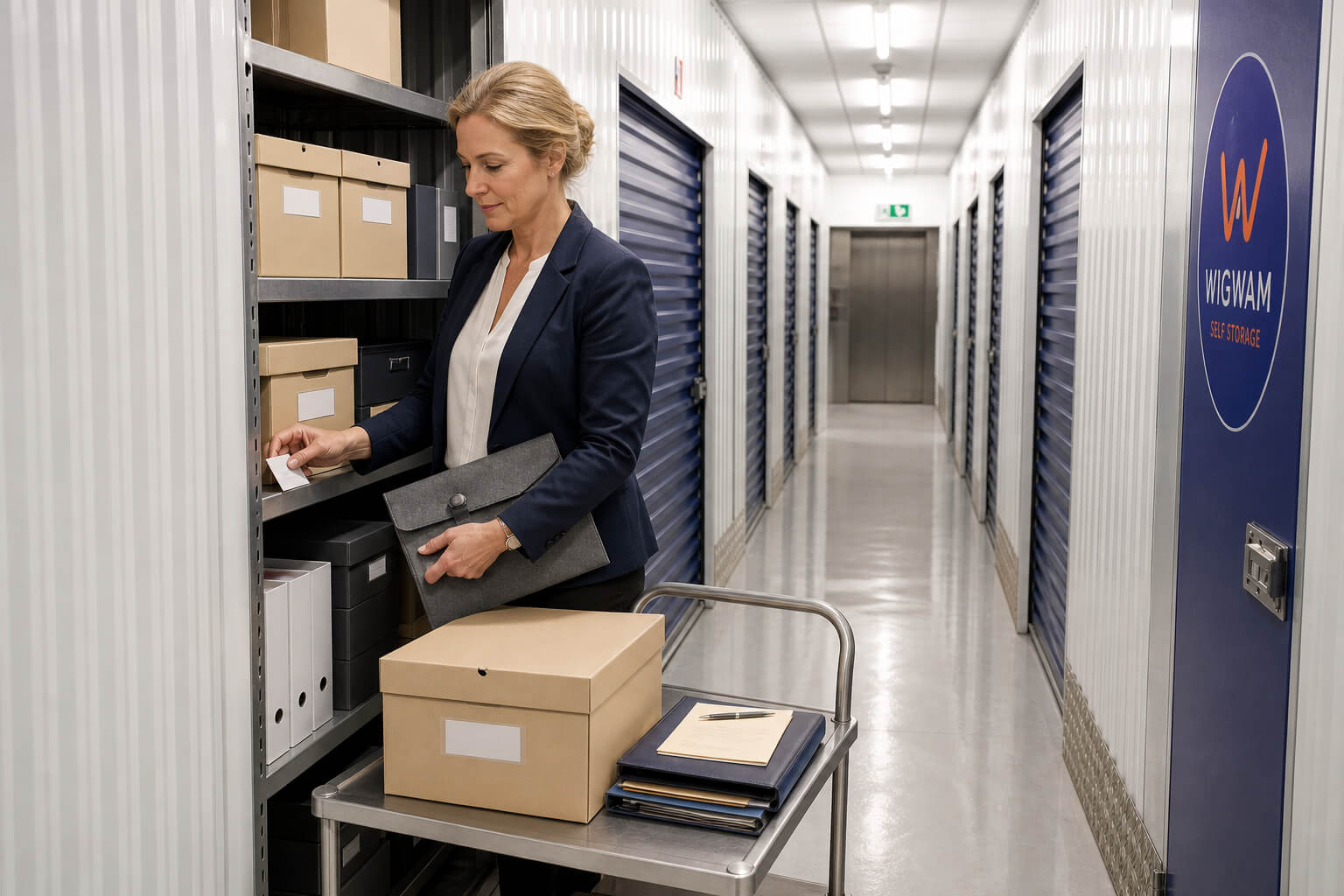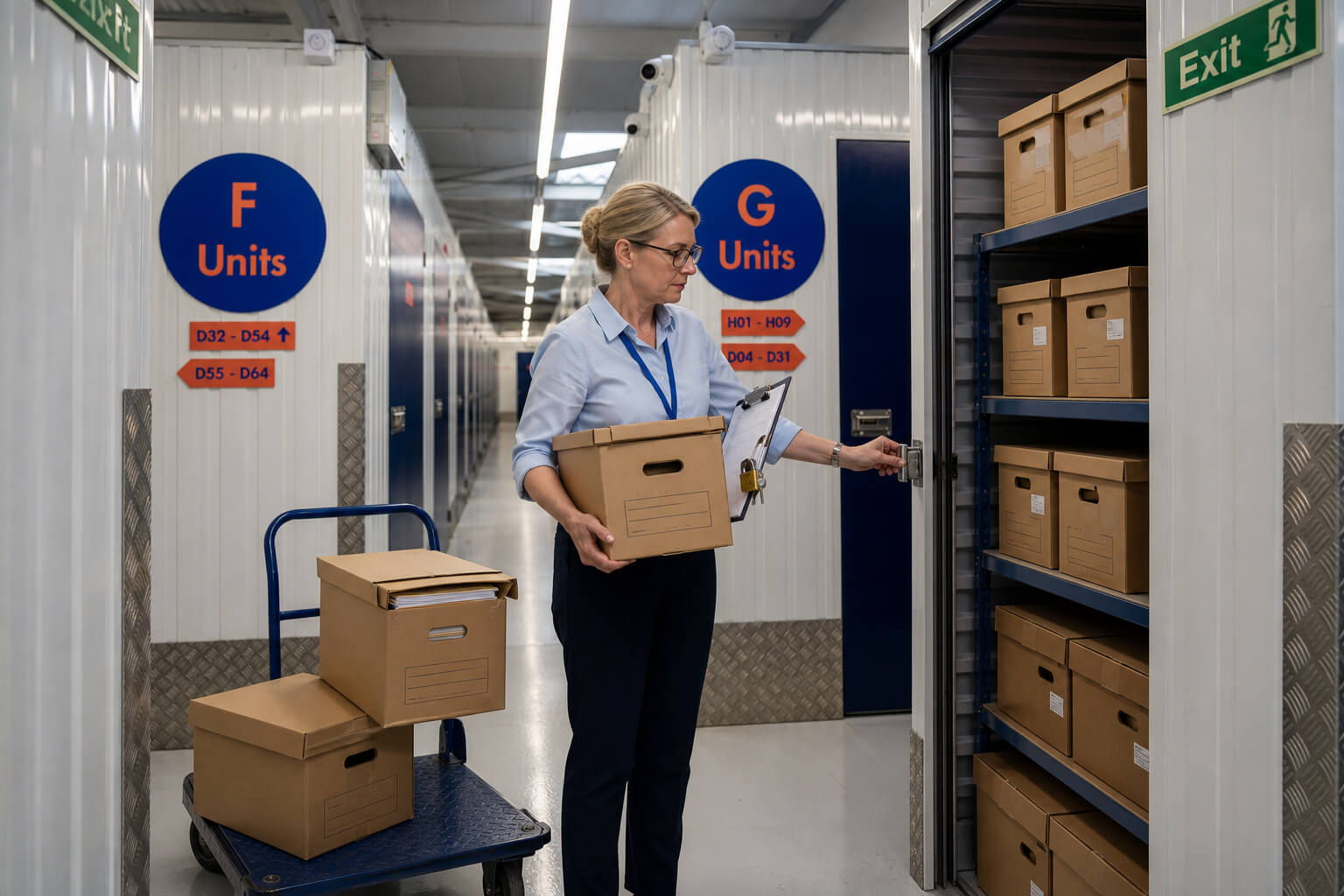
Document Storage For Business Secure Compliant Records

Paying office rent to house boxes nobody’s allowed to throw away?

Most practices reach the same point eventually. A corridor stacked with archive boxes. A filing room that was supposed to be a meeting room. Files nobody can throw away, because the rules say so, quietly consuming floor space the practice is paying rent on. It is not a crisis. It is just a slow, familiar squeeze.

We speak to a lot of office managers and practice partners in this position. They are not looking for a records-management company to take over their archive. They know what the files contain. They know the retention rules. They just need somewhere secure to put the boxes that is not costing them prime office space, and where they can get to a file themselves if they need it.

This page explains the self-storage route for business documents: what it includes, what it does not, and whether it fits your situation. If you need managed retrieval, indexing or secure shredding, we will say so plainly and point you somewhere better. If you need a secure, private, locked unit you control, read on.

Why practices keep boxes they cannot simply throw away
The decision to keep files long after a matter closes is not overcaution. For regulated professions it is a legal obligation, and the periods are longer than most people expect.

Retention rules vary by profession, and the periods are longer than most people expect

Solicitors operating under SRA rules typically retain client files for six years from the end of a matter, and much longer for property, wills, or anything involving a minor. Accountants regulated by ICAEW or HMRC generally hold client records for six years from the end of the relevant tax year, with some categories going further. GP surgeries and dental practices work under NHS and CQC guidance, which extends to ten years or more for adult patient records and until a patient’s 25th birthday for childhood records.

These are indicative figures only. The rules change, they differ by file type, and they differ if a claim has been raised. The SRA, ICAEW, and CQC publish current guidance for their respective professions.

Note on jurisdiction: the retention rules mentioned above apply in England and Wales. Scotland and Northern Ireland operate under different regulatory frameworks, with different professional bodies and different NHS governance. If your practice is based in Scotland or Northern Ireland, check with your own professional regulator or a solicitor qualified in your jurisdiction.

Our article on Records Retention for Solicitors and Accountants goes into more detail on specific periods by profession, when the counting starts, and what triggers an extension. The point here is simpler: for most practices, the archive is not going anywhere for years, and that is not a problem to solve. It is just a logistics question.

The office is not free: what archive boxes really cost

A standard archive box takes up about 0.05 square metres of floor space. That sounds small until you stack sixty of them in a room that was meant to be used for something else, and realise you are paying office rent on storage that earns nothing and retrieves rarely.

The cost is not just the floor space. It is the partner or receptionist time spent hunting for a file in a room with no system. It is the risk of misfiling in a space that is too full to organise properly. And it is the quiet administrative overhead of a filing room that nobody quite manages because it is not anyone’s job.

We do not publish storage pricing in this article because the right unit size depends on your volume and how it grows. You can see current sizes and costs at our pricing page. The comparison point is the rent per square foot you are paying for the space the archive is currently occupying.

When a managed records service is right, and when it is not

A managed records company collects your archive, holds it in their warehouse, and returns files on request. For some practices that is the right tool. If you need same-day courier retrieval of individual files, formal chain-of-custody documentation, indexed scanning, or secure shredding at the end of the retention period, a managed service is built for that.

Self storage is not. There is no retrieval team, no indexing, no shredding. What there is instead: a private, locked, individually alarmed unit that only you can open, at a fraction of the cost of managed records for sealed archives that you access occasionally yourself. If that fits the shape of your archive, the rest of this page is relevant. If it does not, a managed records service is the honest answer.

What Wigwam offers and what it does not

Before anything else: a clear statement of what is on the table, and what is not.

A secure, private, individually alarmed unit you control

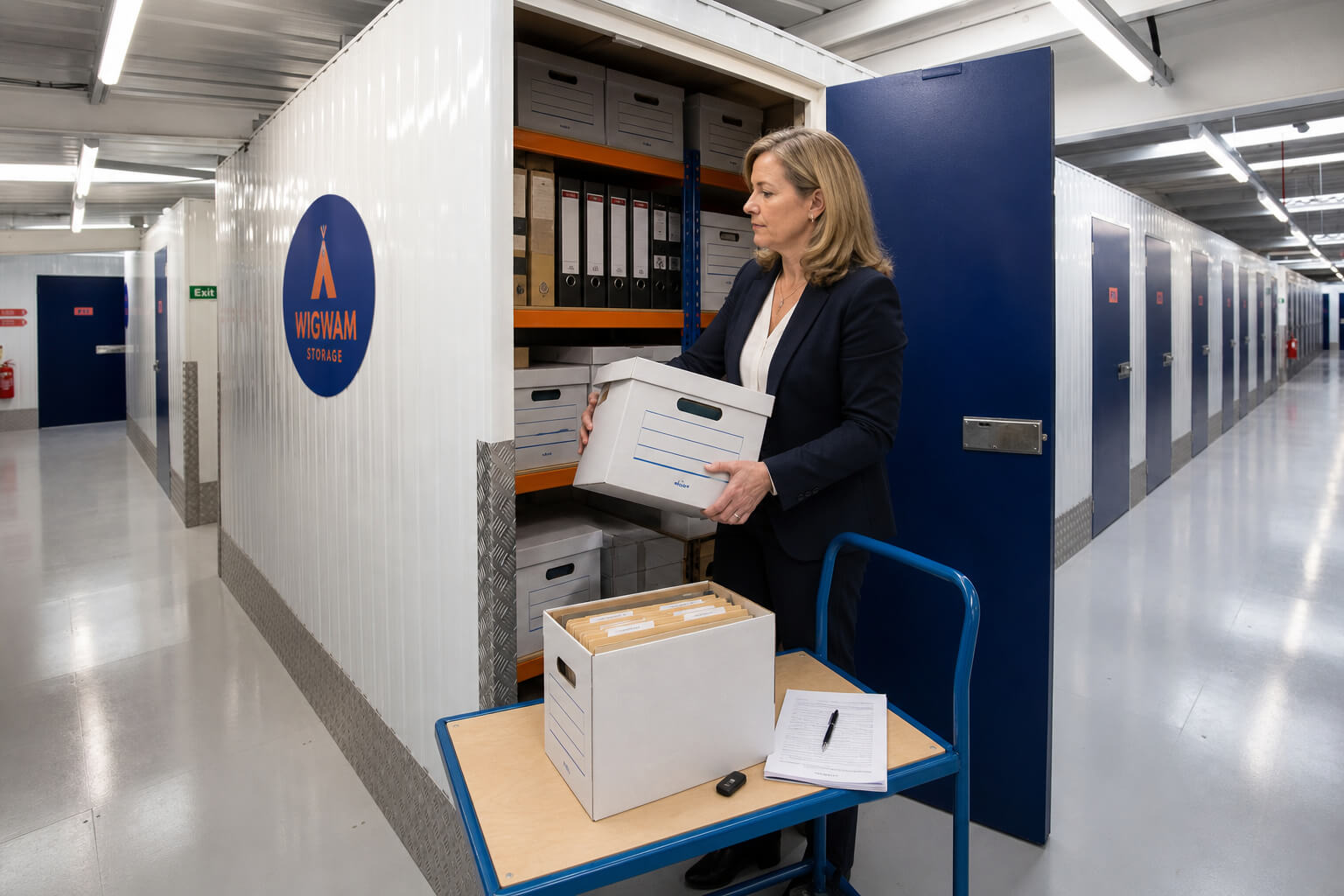
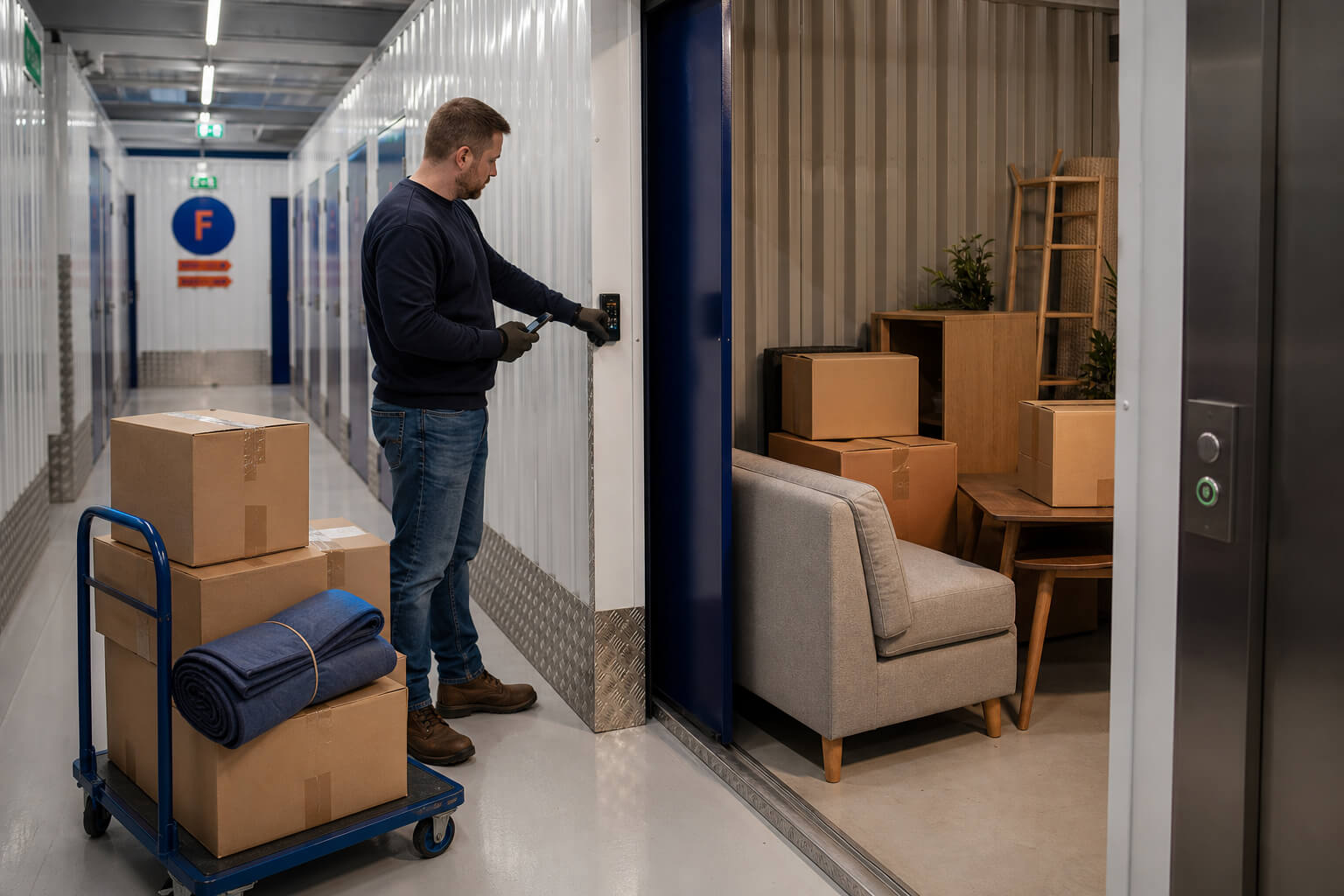
Your unit is yours alone. No shared access, no shared floor space. The only way in is your smart-entry code. Every access is recorded digitally, so you have a log of who entered and when. That is your audit trail, held by you.

Each unit is individually alarmed. If the alarm activates on your unit, it triggers on your unit, not on a whole corridor. Access is available between 6am and 10pm, seven days a week. Units are clean, dry and secure.

There is no Wigwam staff member who holds a copy of your access code. Nobody from the Wigwam team can open your unit without your knowledge or consent. For a practice manager who is responsible for client confidentiality, that matters.

What is not included: managed records, retrieval, indexing, shredding, climate control

This is a self-access storage unit. Wigwam does not retrieve files, does not index your archive, does not provide shredding, and does not operate a chain-of-custody service.

Units are not climate-controlled. For most sealed business paper in archive boxes, that is not a problem. Paper held in a clean, dry, secure environment stores well for decades. Climate control is designed for humidity-sensitive materials like photographs, artwork, or certain electronic media. Standard office files in bankers boxes do not need it.

If a managed records service told you climate control was essential for paper archives, it is worth asking whether that is a feature of the product they sell rather than a requirement of the material you are storing.

We say this plainly because it is what we do not offer that earns trust here. No managed records, no retrieval, no indexing, no shredding, no climate control. For practices that need those things, a specialist managed service is the right route. For practices that need a secure, private, affordable place to hold a sealed archive they access themselves, Wigwam is worth considering.

Is self storage suitable for confidential files?

The short answer is yes, with the right understanding of what you are controlling.

Your unit is accessed only by you, via your smart-entry code. The digital access log records every entry. Wigwam does not hold a key to your unit. No third party has access to your files unless you give them your code.

Under GDPR, you remain the data controller for the personal data in your archive. Storing files off-premises in a unit you control does not transfer that responsibility to Wigwam. The ICO publishes guidance on data controller obligations for keeping personal data secure, and it applies whether your files are in your office, a managed records warehouse, or a self-storage unit.

We are not a compliance advisory service and this is not legal advice. If you have specific GDPR obligations or concerns about your firm’s data processing arrangements, your own data protection officer or a solicitor is the right person to speak to. What we can say is that the model itself, a private alarmed unit with recorded access and no third-party key holder, is a reasonable physical arrangement for sealed archives. Whether it meets your specific regulatory requirements is a question for your professional advisers.

Security and access: your own lock, your own log

The practical security picture is worth describing concretely, because “secure storage” means different things to different providers.

Smart entry and the recorded access log

Wigwam uses smart-entry technology. There is no physical padlock to cut, no key to lose, no code shared among site staff. You access your unit with your own code, and every entry is logged.

For a practice manager or compliance partner, that log is useful. If a regulatory query ever asks who accessed the archive files and when, you have a record. It is not a managed chain-of-custody system, but for a practice that accesses its own files on an occasional and controlled basis, the access log is a practical audit trail.

Access hours are 6am to 10pm, seven days a week. This is not a 24-hour facility. Plan your archive visits accordingly.

Individual alarms and site security

Each unit at a Wigwam site is individually alarmed. That means an incident on your unit triggers your alarm, not a site-wide alert that covers a hundred different tenants. The alarm is on your space.

Sites are enclosed and secured. We do not make fireproofing claims, because we do not offer a fireproof unit. Paper in a clean, dry environment in a secure building carries the same fire risk as paper in any other building. If fireproof document storage is a specific regulatory requirement for your profession, a specialist vault or managed records service with accredited fireproof storage is the right route.

Contents protection: what you need to have in place

Contents protection is mandatory when you store with Wigwam. You can take the Wigwam contents protection policy, or prove that your own business insurance covers goods stored off-premises.

Either way, declare the full replacement value of what you are storing. If you under-insure and make a claim, the settlement will be proportional to the declared value, not the actual value. For a practice archive, the value is probably not the paper itself. It may be the cost of reconstructing records, the professional liability exposure if files cannot be produced, or the regulatory consequence of losing a retention-compliant archive. Your insurer is the right person to help you place that value accurately.

You can find details of the contents protection options at wigwamstorage.co.uk/contents-protection/.

Note on jurisdiction: contents protection requirements and the legal interpretation of insurance obligations differ between England and Wales, Scotland, and Northern Ireland. Check the policy terms and speak to your insurer if you are in any doubt.

Access on your own schedule, no retrieval fees

The managed-records model charges you for access to your own files. Every retrieval is a transaction. That is fine when files are retrieved constantly. For a sealed archive that a practice visits twice a year, it is a premium you pay for a service you rarely use.

What it looks like in practice: pulling a file when you need it

A partner needs a client file from six years ago. With a managed records service, that means a phone call, a retrieval request, a wait for courier delivery, and a fee. With a Wigwam unit, it means driving to the site, entering your code, pulling the box, and leaving. Same morning. No charge beyond the unit you are already paying for.

That is the practical difference. Not every practice needs it. But for practices that visit their archive unpredictably, where a file might be needed for a complaint, an audit query, or a follow-on instruction, having direct access on your own schedule is worth more than the retrieval-fee arithmetic suggests.

Flexible terms: how the notice period and refund work

There is no long-term contract. Storage runs on flexible terms: give 14 days’ notice and your storage ends when you move out and settle the account. Unused days are refunded once you have vacated and cleared the balance.

A refundable deposit is required at the start. This is returned after the 14-day notice period once you have vacated and the account is settled. The terms and conditions set out the full detail, and it is worth reading them before you start.

There is no lock-in beyond the notice period. If a practice changes size, moves premises, or digitises its archive, exit is straightforward.

Sizing: how much space does a business archive need?

A standard archive box is roughly 40cm x 30cm x 30cm. A 25 cubic foot unit holds approximately 40 to 50 standard boxes. A 50 cubic foot unit holds closer to 90 to 100. These are working estimates; how you stack and how much aisle space you leave affects the real number.

Most practices starting with a corridor’s worth of archive begin with a small to medium unit and increase if needed. Because terms are flexible, sizing up or down as the archive grows is straightforward.

No pricing appears in this article because it changes and varies by location. For current unit sizes and costs at the location nearest you, use the pricing page.

Ready to see what is available near your practice? Check unit sizes and get a quote at quote.wigwamstorage.co.uk. For a full list of sites, see our UK market-town locations.

How Wigwam compares to a managed records service

The comparison is worth making directly, because the two options serve different needs and the marketing of managed records services sometimes obscures that.

Cost comparison: per-box retrieval versus a flat unit fee

Managed records services typically charge in three ways: storage by volume, retrieval by box, and destruction by box. The storage cost is often lower than you expect. The retrieval cost is where practices get surprised, especially if a complaint or an audit generates a run of file requests.

Wigwam is a flat monthly unit cost. No retrieval fee. No destruction charge. No minimum order on access. The pricing page shows current costs. The comparison with your current managed records spend is a calculation worth doing before you dismiss self storage on price.

Control comparison: who holds the key

In a managed records warehouse, your files are in a facility you cannot enter. Retrieval is mediated by staff. The provider holds custody. That is a deliberate service model for high-volume managed archives, and it works well when the practice genuinely needs that infrastructure.

At Wigwam, you hold the only access code. Nobody from the Wigwam team enters your unit. The digital access log records every entry. If a regulatory body, an auditor, or a court asks who has had access to your files, you have a clean answer: you and anyone you have authorised.

For a practice manager who has personal accountability for client file security, the control model matters as much as the price.

When managed records is genuinely the better choice

There are situations where a managed records service is the right answer, and we will say so plainly.

If your practice needs same-day courier retrieval of files from a warehouse across the country, a managed service can do that. If you need your archive indexed so that individual documents can be retrieved without pulling an entire box, a managed service does that. If you need secure shredding with a certificate of destruction at the end of the retention period, a managed service provides it. If your profession requires formal chain-of-custody documentation on every file movement, a managed records contract is built for that.

Self storage does not do any of those things. If your archive access is occasional, self-managed, and the files go back and forth in boxes you carry yourself, the managed-records infrastructure is overhead you are paying for but not using. That is the gap self storage fills.

Finding a Wigwam unit near your practice

Wigwam operates across our UK market-town locations, chosen for exactly the kind of practice that carries a document archive: solicitors, accountants, GP surgeries, dental practices, and small professional firms in the towns and high streets where most regulated practices are based.

Our UK market-town locations

You can find the full list of sites at the locations hub. If your practice is in or near Bath, Wigwam Self Storage Bath is the nearest site. For practices in and around Lincolnshire, Wigwam Self Storage Lincoln covers that area. For all other towns, the locations hub will show which site is closest to you.

The drive time to a site is worth thinking about. Most practices access their archive unit a handful of times a year. A 20-minute drive to retrieve a file yourself is rarely a burden compared to the weekly cost of per-box retrieval fees on a managed contract.

Sites are unmanned: what this means for a practice

Wigwam sites are unmanned. There is no site office, no reception, and no on-site staff during access hours. You enter your unit using your smart-entry code, collect or deposit what you need, and leave.

This is relevant for practices that send deliveries to a storage address. Wigwam cannot sign for or receive deliveries on your behalf. If a courier is delivering archive boxes to your unit, someone from your practice must be present to accept them. Do not arrange deliveries to a Wigwam site expecting staff to receive them. The site is access-controlled, not staffed.

Starting your storage: what to expect

The process is practical and there is no long setup. Use the quote tool at quote.wigwamstorage.co.uk to choose a location, see available unit sizes, and get a cost. Read the terms and conditions before you start. A refundable deposit is required at the outset.

Once the unit is confirmed, you move the archive in at your own pace. There is no Wigwam induction or onboarding process. You have a code, you have a unit, you have access from 6am to 10pm, seven days a week.

Questions we hear from practice managers

The specifics vary, but the questions that come up most often are about retention obligations, security, what we do not offer, and what happens to your contents cover when files go off-site. The FAQ section below covers all of these. If your question is not there, the most direct route is to use the quote form, which gives you the option to ask before you commit to anything.

What to do next

The next step is straightforward: find out whether there is a Wigwam location close enough to your practice to be practical, and see what a unit of the size you need costs.

Get a quote for your practice’s document archive

Use quote.wigwamstorage.co.uk to choose a location, check available unit sizes, and get a cost. There is no obligation and no call required. If you know roughly how many archive boxes you need to move, you will be able to narrow the unit size in the quote tool.

No pricing is published in this article because it varies by location and unit size, and because the right comparison for most practices is against their current managed-records contract or the cost of the office space the archive is occupying. The pricing page gives current figures by site.

Still not sure whether self storage is right for your situation?

If the archive is sealed, access is occasional, and cost control matters, self storage at Wigwam is worth a look. If retrieval is frequent, if individual documents need indexing, or if secure shredding is part of your obligation, a managed records service is the more appropriate tool. There is no hard sell here. The purpose of this page is to give you enough to make the decision yourself.

If you are a practice manager in a profession with specific retention duties and you have not checked the relevant regulator’s current guidance recently, that is worth doing before you design any storage arrangement. The SRA, ICAEW, CQC, and the relevant NHS bodies all publish current retention schedules. For Scotland and Northern Ireland, check the guidance from your equivalent professional body.

Related reading

Our article on Records Retention for Solicitors and Accountants covers the specific periods by profession in detail. The Business Storage section of the Wigwam site covers other common business uses alongside document archiving. Details of contents protection options are at wigwamstorage.co.uk/contents-protection/.

Ready to reclaim your filing room? Get a quote at quote.wigwamstorage.co.uk

Frequently Asked Questions

How should I organise the archive in the unit so I can actually find a file without an index?

Since there is no managed indexing, the organising work is yours to do, but a small amount of discipline up front makes a self-access archive perfectly workable. The mistake to avoid is treating the unit as a place to stack boxes in the order they came off the shelf. The fix is a simple, consistent labelling scheme combined with a one-page location map you keep at the office, not in the unit. Most practices already number or date their archive boxes; the unit just needs that scheme carried through into how the boxes are physically placed.

A practical setup looks like this. Label every box on the side facing the aisle, not the top, because top labels vanish once boxes are stacked. Record on each box a unique reference, the date range, and the broad category. Then keep a master list at the office, ideally a spreadsheet, that maps each box reference to its rough position in the unit, for example “bay 2, third row, second from top”. Leave a central aisle so you can reach the back without unstacking the front, and put the boxes you are most likely to need, the most recent and the most claim-relevant, nearest the door. With that in place, retrieving a six-year-old file becomes a five-minute job rather than an afternoon of hunting. This is the trade-off of self storage over a managed service: you do the indexing, but you also avoid the per-retrieval fee every time you need something back.

What happens at the end of the retention period, since Wigwam does not offer shredding?

You arrange the destruction yourself or through a specialist, because the unit is purely a storage space and we do not provide shredding or certificates of destruction. This is one of the genuine limits of the self-storage route, and it is worth planning for from the start rather than discovering at the end. When a file or a batch of files reaches the end of its retention period and you are satisfied, having checked the current regulatory guidance, that it can be destroyed, you have a few options. You can take the boxes to a commercial confidential-shredding service and receive a certificate of destruction from them. Some shredding firms will collect from a site by arrangement, though remember that the site is unmanned, so you would need to be present to hand the boxes over.

The important point is that destruction of records carrying personal data is itself a GDPR-relevant act, and you remain the data controller throughout. A casual trip to the tip with confidential client files is not appropriate; secure, documented destruction with a certificate is. If certified destruction at the end of retention is a frequent and significant part of your workflow, that is precisely the kind of need a managed records service is built around, and it may tip the balance for you. For a practice whose archive is largely dormant and whose destruction events are occasional and predictable, handling it yourself through a confidential-shredding specialist is straightforward and far cheaper than paying for a managed contract you otherwise rarely use. We can hold the archive securely up to the point of destruction; the destruction step itself is yours to arrange.

If my firm merges, relocates or closes, what happens to the archive in storage?

The archive stays exactly where it is, under your control, until you decide to move or transfer it, and the flexible terms make any of those changes simple to manage. There is no long lock-in beyond the 14-day notice period, so a merger, relocation or wind-down does not leave you trapped in a storage contract. If the firm relocates, you can simply keep the existing unit if it remains conveniently placed, or give notice and move the archive to a unit nearer the new premises. If the firm merges, the practical question is which entity becomes responsible for the records and the data-controller obligations attached to them, and that is a matter for the firms’ own advisers to settle, not for us.

A few sensible steps make these transitions clean. Keep the account details and the master box list somewhere accessible to whoever is managing the change, so the archive is not orphaned if a single individual leaves. Make sure the responsibility for the retention obligations and the eventual destruction is explicitly assigned in any merger or closure arrangement, because those duties do not disappear when a firm changes shape. When you do move or close the unit, you give 14 days’ notice, vacate, settle the account, and the refundable deposit and any unused days are returned. What we cannot advise on is the regulatory side of who inherits the records and the data-protection duties; that sits with your professional advisers and, where relevant, your regulator. Our part is to keep the archive secure and accessible throughout, and to make exit or transfer easy when the time comes.

Should I be digitising the archive instead of storing the paper, and can the unit hold a mix?

That is a strategic decision for the practice, not one we can make for you, but a unit copes equally well with a shrinking paper archive as you digitise, and many firms run both in parallel for a period. Digitising has real attractions: searchable files, no physical bulk, and easier retrieval. It also carries its own considerations, including the cost of scanning, the need to ensure scanned copies meet any evidential or regulatory standard your profession requires, and the data-protection care needed during the scanning process itself. Whether a digital copy can replace the original, or whether you must retain certain originals on paper, depends on your profession’s rules, so that is a question for your regulator and your own advisers.

Where storage fits is as the flexible holding space while you work through it. Because the terms let you size up or down with 14 days’ notice, you can take a unit sized for the current paper archive and reduce to a smaller one as digitised batches are destroyed and the physical volume falls. There is no penalty for shrinking the footprint over time; that is exactly the kind of phased change the flexible terms are designed for. A unit can hold a mix without difficulty, the original paper you are still required to keep, the boxes awaiting scanning, and the batches cleared for destruction, all clearly labelled and separated by your own scheme. The honest summary is that self storage and digitisation are not competing choices; storage is the affordable, flexible home for the paper while you decide how far and how fast to digitise.

Can I authorise a colleague to access the unit, and what happens when staff change?

Access is controlled by the smart-entry credentials on the account, and managing who holds access as staff come and go is part of your own data-governance responsibility. The account holder controls who can enter the unit. If you want a trusted colleague, a partner, a practice manager or a designated records-handler, to be able to retrieve files independently, that access can be arranged so they can come in within the 6am to 10pm window, seven days a week, without coordinating with anyone, because the sites are unmanned. Every entry is logged digitally, which gives you a record of who accessed the archive and when, useful evidence of controlled access if a regulatory query ever arises.

Staff turnover is the point to stay on top of. When someone with access leaves the practice, their access should be removed promptly, exactly as you would revoke their access to your case-management system or the office itself. Leaving a former employee with the means to enter an archive of confidential client files is a clear governance weakness, and because you remain the data controller, keeping the access list current is your responsibility, not ours. A simple internal habit covers it: review who holds unit access whenever there is a joiner or leaver, and keep that review alongside your other offboarding steps. If you ever need to change the access arrangements on the account, that is a straightforward request. The model is designed so that access is always limited, recorded, and within your control, but it relies on you keeping the authorised list accurate as your team changes.
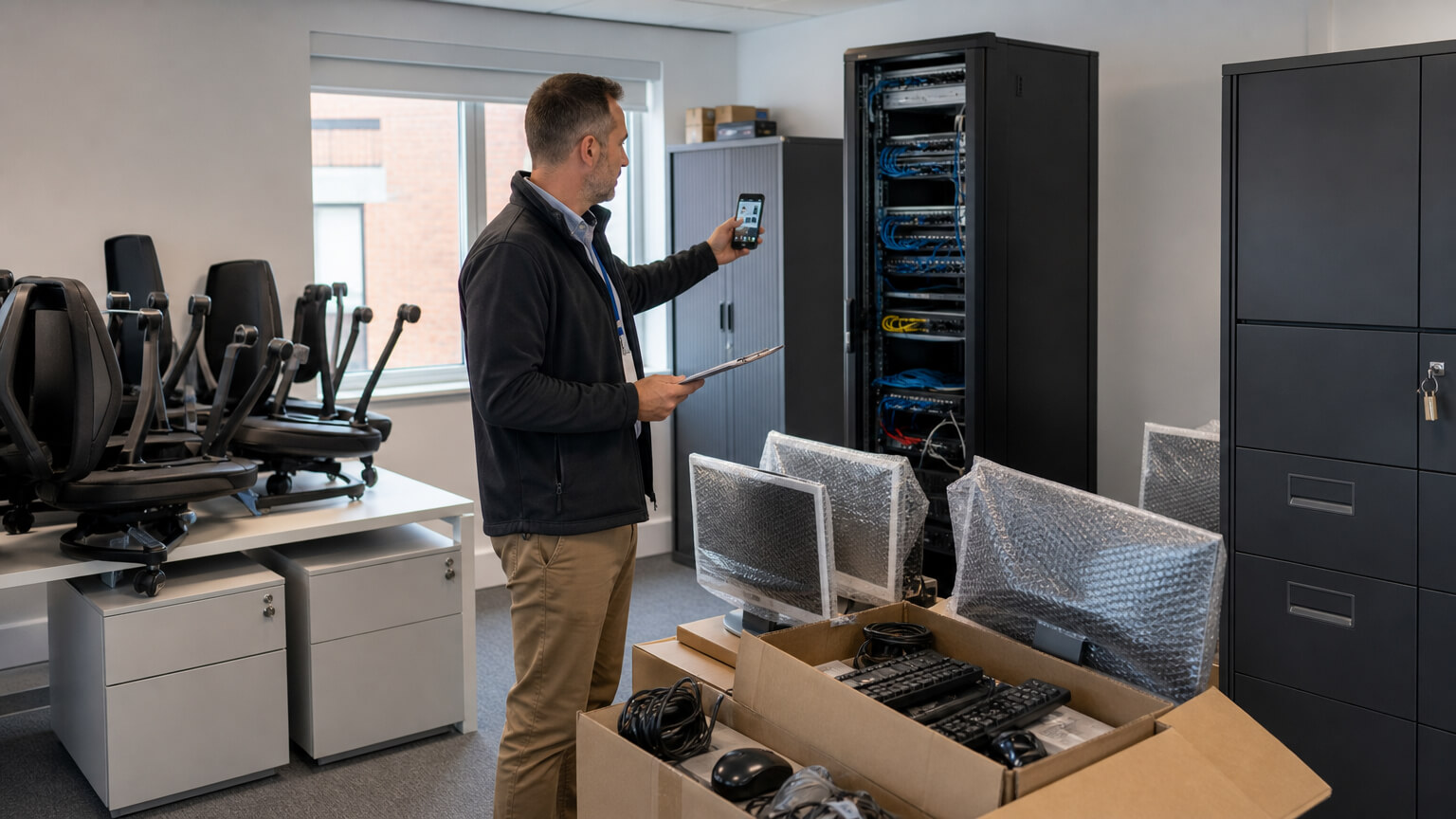
Self Storage For Office Furniture And It During A Refurbishment

Twenty desks and a comms rack to shift before the refit — to where?

Every office refurbishment starts the same way. Someone pins a contractor start date to the calendar, and then someone else works backwards and realises the floor has to be completely clear before that date arrives. Twenty desks. A stack of monitors. Three filing cabinets. A comms rack. Somewhere to put all of it for six weeks, without leaving town, without spending a fortune, and without signing something you cannot get out of cleanly.

Most people in that position have not arranged commercial storage before. They search around, get quoted minimum three-month contracts by the national operators, and wonder whether it is actually cheaper just to sheet everything up in a corner and hope the plasterers work carefully. It is a reasonable question. But the answer, once you have thought it through, is almost always no.

A unit near the office, one your own team controls, loaded and retrieved on your schedule, is the cleaner solution. And if the fit-out finishes a week early, you should not be paying for storage you are no longer using.

Why Move the Office Out Before the Contractors Arrive

The honest reason is simple: a cleared floor lets the work happen properly, faster, and without risk to your kit.

Dust, Paint and Trade Traffic Damage Furniture and Electronics

Refurbishment work generates more airborne material than most people expect. Sanding, cutting, painting and plastering all produce fine dust that settles everywhere, including into ventilation slots on monitors, keyboards and network switches. A desk that looks clean the day the trades leave can have a quarter-inch of fine particulate worked into every surface.

Paint splashes are the other risk. Floor coverings can be protected. A board table that takes a drip of emulsion is a different problem. Electronics that get wet from ceiling work above them can fail entirely, and the damage is not always covered by standard office insurance because it happened during works the business chose to undertake.

The honest advice here is practical: if you are storing IT equipment, wrap monitors in their original packaging where you still have it, or in bubble wrap, and bag keyboards and peripherals before they go into the unit. A clean, dry, secure unit protects against ambient dust and incidental moisture. It does not offer temperature or humidity control, and we do not claim otherwise. What it does offer is a sealed, individually alarmed space that no trade operative can walk through by accident.

A Cleared Floor Lets Contractors Finish Faster (and Keeps Them on Budget)

A contractor working around furniture is a contractor adding days to the programme. Trades cannot lay flooring under desks that are still in place. They cannot paint walls behind filing cabinets that have not moved. Every workaround costs time, and time in a refurbishment costs money at day rates.

Frank, the person running the logistical side of a fit-out, is also the person who gets called when the programme slips. A cleared floor on the agreed start date is the single most effective thing he can do to keep the contractors on schedule and the final invoice close to the original quote. Storage is not a cost here. It is insurance against a programme overrun that would cost considerably more.

Why a Sealed Unit Beats Sheeting It Up in a Corner

Sheeting furniture up on site keeps it in the building. That sounds like the simpler option until you work through what it means in practice. The trades are now working around a large sheeted mass in the corner. The corner itself cannot be refurbished. The sheets are not airtight and dust will get in regardless. And if anything goes wrong with the materials stored underneath, it is in the middle of an active building site with limited access and no separation from the work.

A self-storage unit removes the furniture from the risk entirely. Your team loaded it, your team has the access code, and the unit is individually alarmed. Nothing goes in or out without someone from your business being there. That level of control is simply not available from a sheeted corner, and it does not require a full-service removals contract either.

What to Store and How to Pack It for a Refurbishment

Most offices move more than they expect and pack it better than they think they will. The practical answer is: move everything that is in the direct path of the works, pack fragile and electronic items carefully, and label everything systematically before it leaves the building.

Desks, Chairs and Partitions

Flat-pack desks that disassemble are straightforward. Frame-and-panel partitioning stacks efficiently in a mid-range unit. The items that take up the most space are usually solid desks that cannot be broken down, pedestal units, and operator chairs stacked three high. A ten-desk office with associated chairs and a couple of storage pedestals typically needs less space than people expect, but the quote tool will give you a more accurate figure than any rule of thumb.

Stand furniture upright where possible. Chairs stack seat-down to reduce height. Wrap chair bases and desk edges with moving blankets or offcuts of cardboard to prevent surface contact damage. Label everything with the room or zone it came from, so the move-back-in happens in one organised pass rather than a sorting exercise.

IT Kit, Monitors and the Comms Rack

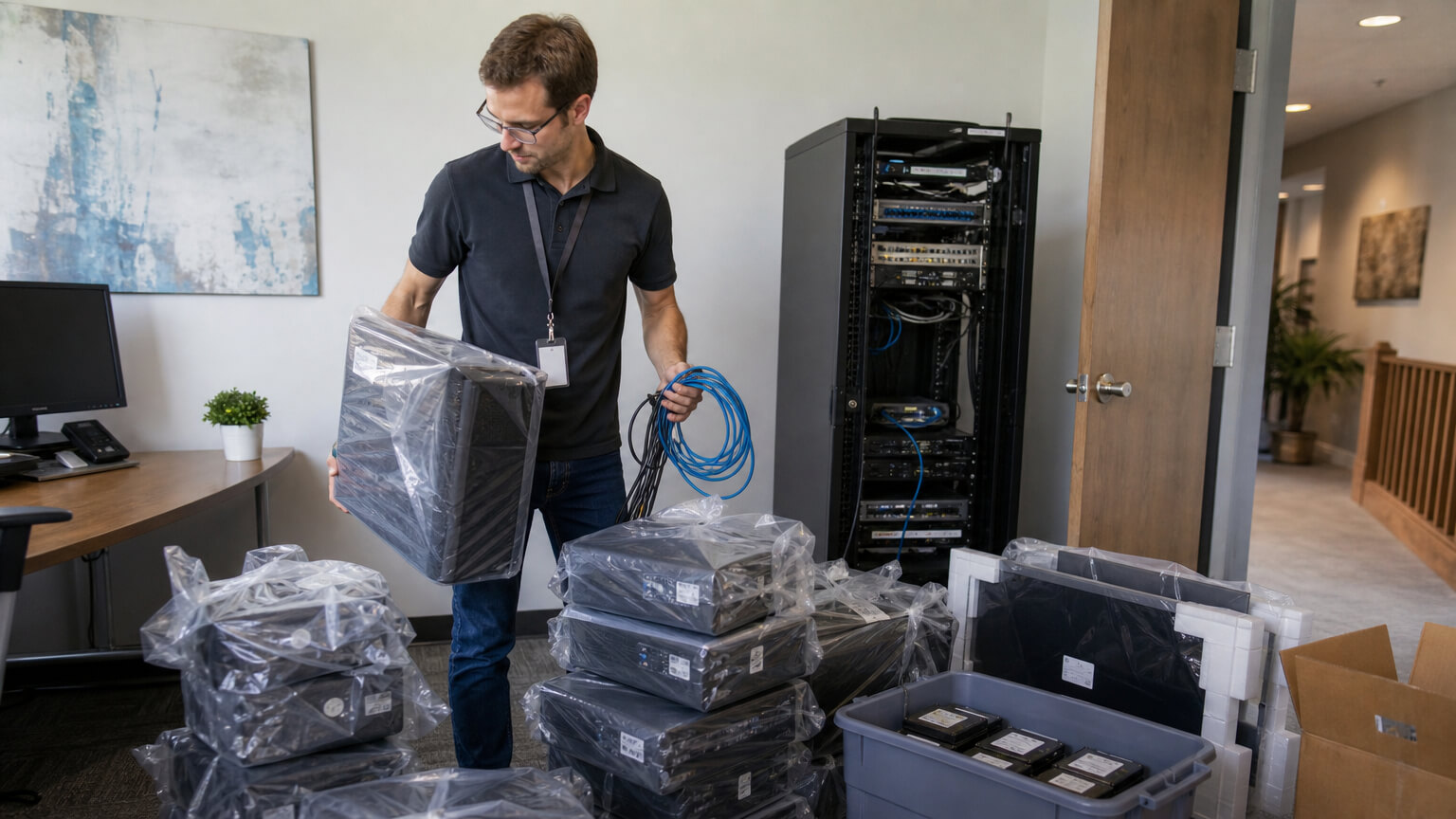
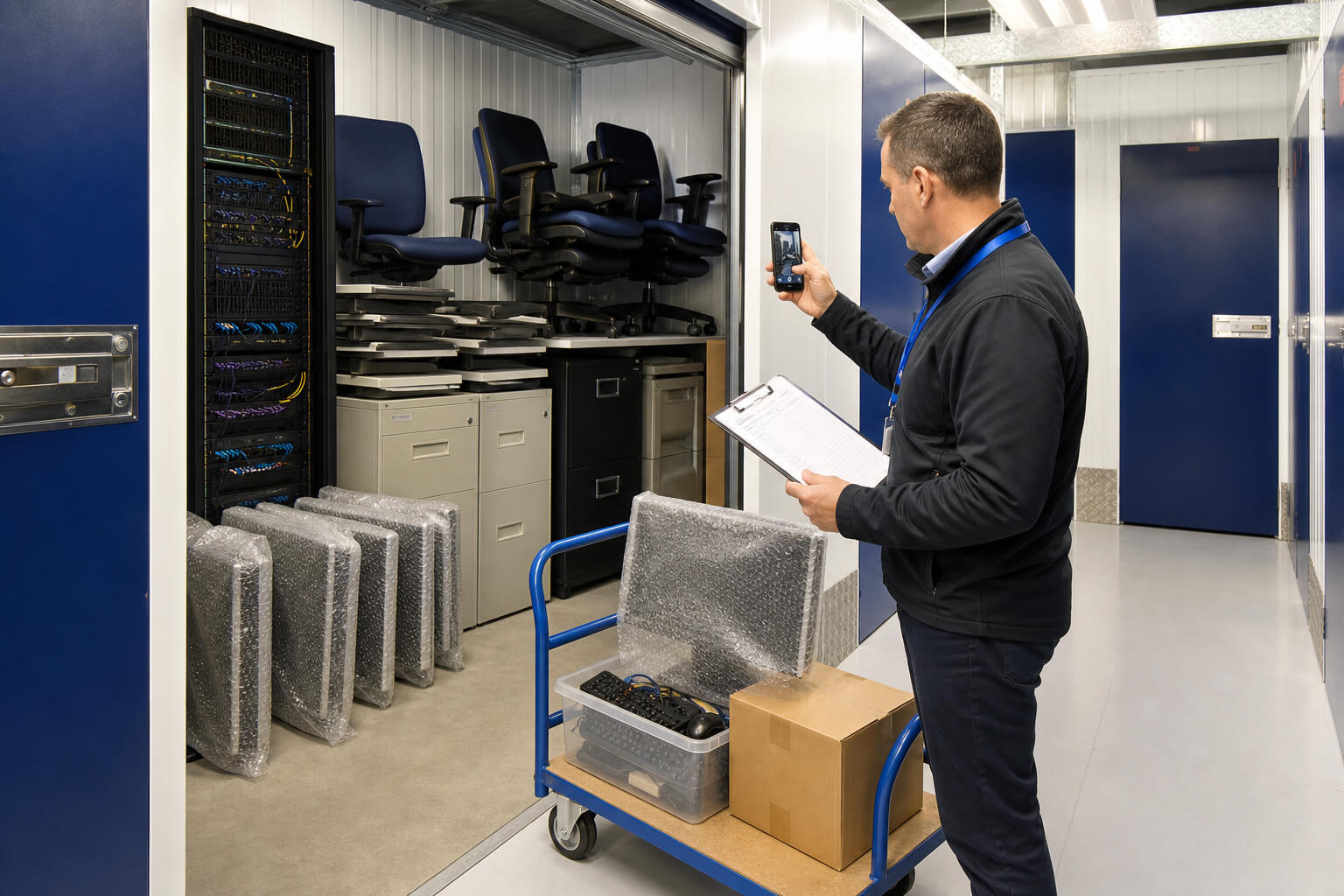
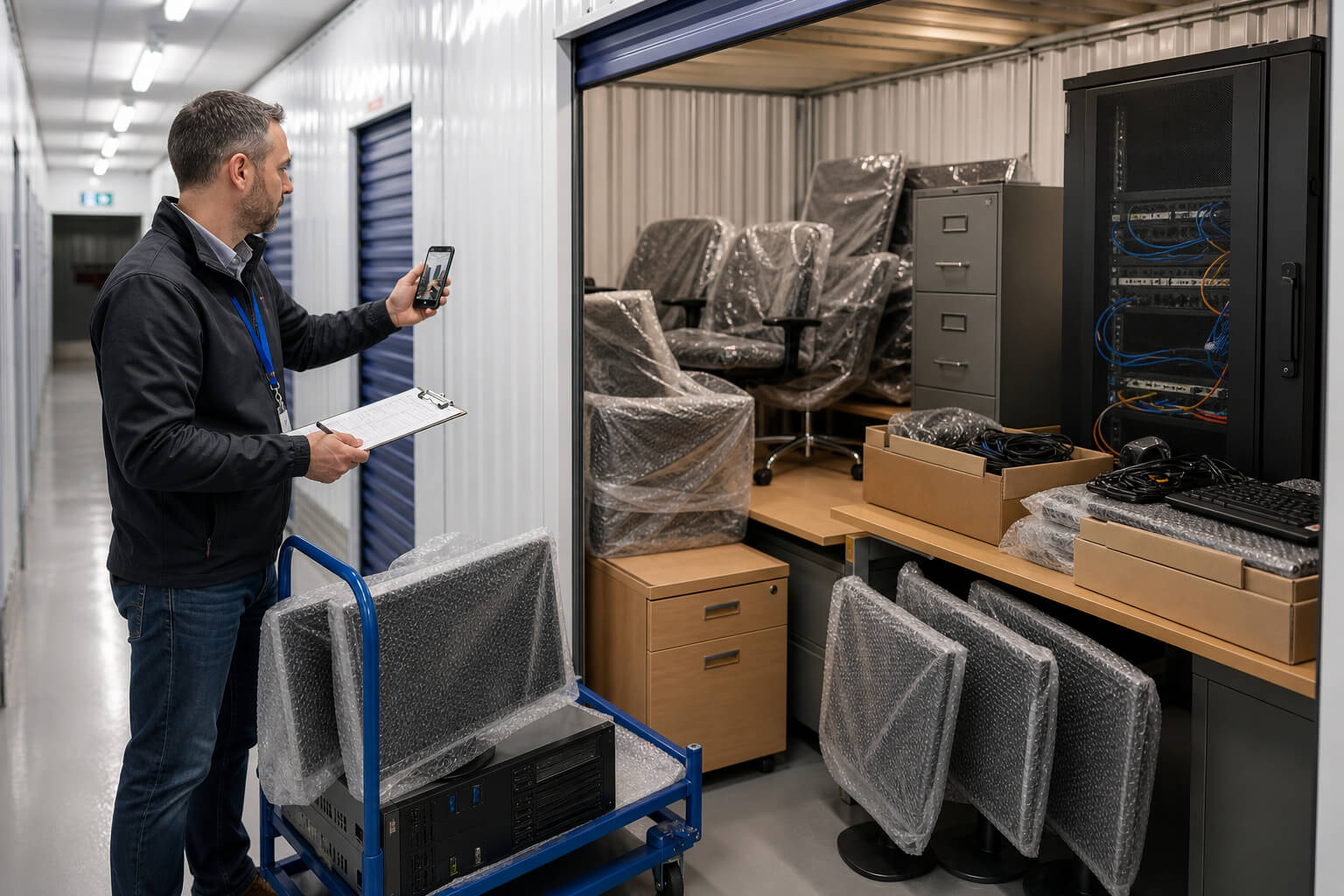
IT kit needs the most attention before it goes into storage. Monitors should be wrapped individually in bubble wrap and stood upright, not flat. If you have the original packaging, use it. Desktop towers and small form-factor machines should be bagged against dust before being packed into boxes. Keyboards, mice and cables should be coiled and bagged by workstation so re-connection is straightforward.

The comms rack is usually the last thing out and the first thing back in. Before it goes into the unit, photograph the back-of-rack cabling layout. Patch cables that are removed without documentation take time to reconnect that the programme does not have. Some businesses prefer to move the rack with cabling partially intact and reconnect only the trunk cables at the storage end. Either approach works; the photograph is the safeguard.

Keep a written inventory of everything that goes into the unit. Serial numbers for high-value items. This feeds directly into the contents protection requirement covered in the safety section below.

Filing Cabinets and Paper Records

Filing cabinets go into storage as they are, locked. If the cabinets are unlocked, box the files or transfer them to archive boxes before loading, so nothing falls or spills during transit. Label each cabinet or box with the contents at department level, not document level.

If your records are held for regulatory or legal purposes, which will be the case for most businesses, check your obligations before deciding what to store and for how long. HMRC document retention requirements, Companies House filing obligations, and professional regulatory requirements all set minimum periods for different record types. These rules apply in England and Wales; Scotland and Northern Ireland have differences in some areas. Your accountant or solicitor is the right person to advise on retention obligations. This article signposts the storage option; it does not give records-management advice.

What Size Storage Unit Do You Need for an Office Refurbishment

The size depends less on headcount than on what you are actually moving. Furniture density, the number of filing cabinets and whether the comms rack stays racked or comes apart all affect the unit requirement more than the number of desks.

Rough Sizing by Team Count and Furniture Volume

A small office of eight to ten people with standard desks, operator chairs, a few pedestals and two or three filing cabinets typically fits comfortably in a mid-range unit. A larger open-plan floor of fifteen to twenty-five desks with full pedestal sets, meeting tables, collaborative furniture and a server rack will need a larger space, and the exact requirement depends on how the furniture is loaded.

The cleanest way to size the unit accurately is to use the quote tool at quote.wigwamstorage.co.uk and describe what you are moving. We can advise on the right unit before you commit. That conversation also lets you flag any phased requirements, which matters if the refurbishment is happening in sections.

Swapping Contents in Stages as the Works Progress

Phased fit-outs are more common than people expect. The works might run floor by floor, or wing by wing, or in contractor sequences where one trade hands over before the next arrives. In that case, Frank may be clearing half the office into storage, then swapping contents as each phase completes.

A single flexible unit handles this well. Smart entry from 6am to 10pm, seven days a week, means your team can make a retrieval on a Tuesday afternoon when the first wing hands back, without needing to book access in advance or wait for a staffed office to open. The unit is yours to use as the programme dictates.

Ready to size your unit? If the contractor start date is in sight, getting a quote now means the unit is ready when you need it. Get a quote at quote.wigwamstorage.co.uk

How Long Can You Store For, and What If the Schedule Slips

The terms here are simpler than most national operators will tell you. The short answer is that you are not locked into a long contract, and if the job finishes early, you do not pay for the days you are not using.

The Two-Week Minimum Stay and What Happens If the Works Overrun

The minimum stay is two weeks. Beyond that, storage continues on a rolling basis. If the refurbishment takes longer than planned, which most do, you simply carry on. There is no penalty for overrunning the original estimate. You give 14 days’ notice when you are ready to vacate, clear the unit, settle the account, and the deposit comes back.

For a finance manager reviewing the projected cost, this structure is straightforward to budget. The terms are on the terms and conditions page if you need to put them in front of a finance director before signing.

When the Fit-Out Finishes Early: the Unused-Days Refund

This is the point that most business storage arrangements get wrong. A fixed three-month minimum contract on a refurbishment that completes in six weeks costs the business six weeks of unnecessary storage. That is a meaningful sum for a mid-sized office, and it is money the project manager has no good answer for when the finance team queries it.

At Wigwam, unused days are refunded. If you move back in and vacate the unit after week four of a planned six-week contract, you give your 14-day notice, clear the unit and return the key, and the days you did not use come back to you once the account is settled. The deposit returns at the same point. There are no exit fees and no penalty for finishing on time.

That is the difference between a storage contract designed around flexibility and one designed around the operator’s revenue. For Frank, it is the number that lets him tell the finance director the storage cost exactly what it should have.

What It Costs and How the Deposit and Notice Work

Three numbers matter before you can present a storage budget to your finance team: the deposit, the notice period, and the unit rate.

The Refundable Deposit and 14-Day Notice, in Plain Terms

A deposit is required when you take a unit. It is refundable. Once you are ready to leave, you give 14 days’ notice, clear the unit and settle any outstanding balance, and the deposit is returned. That is the full sequence. There are no hidden retention clauses, no administrative fees taken from the deposit, and no ambiguity about when it comes back.

The deposit is not a fee. It is held against the account and returned in full when the account closes cleanly. This is worth stating clearly because some national operators are vague on this point in ways that matter to a finance team signing off on a commercial contract. The terms and conditions set out the full detail.

Where to Check Current Pricing

Unit rates vary by size and location. We do not list prices on this page because they can move with demand and availability. The right place to check current rates is the how much self storage costs page, which covers sizing and pricing across our locations. For an accurate figure on the specific unit size you need, the quote tool at quote.wigwamstorage.co.uk gives you a current, location-specific number.

Keeping Your IT and Records Safe While the Works Are On

The worry most office managers carry into this decision is whether the IT will come back in the same condition it left. A board table is replaceable, at a cost. A server that fails because it sat in plaster dust for six weeks, or a monitor that was stored incorrectly, is both a cost and a delay. That concern is reasonable, and it is worth addressing directly.

Individually Alarmed, Clean, Dry and Secure Units

Every unit at Wigwam is individually alarmed. The alarm is unit-level, not perimeter-level, which means that access to the building does not create access to your storage. Your unit opens with your code, and any movement inside it triggers the alarm independently of everything around it.

The units are clean and dry. We do not offer climate control, and we do not pretend otherwise. What you get is a dry, weatherproofed, individually secured space that keeps your furniture and IT away from building-site conditions. Combined with proper packing (bubble wrap for screens, bags for keyboards, original packaging where you have it), that is a genuine level of protection for the duration of a standard office refurbishment.

Contents Protection for Business Goods

Contents cover is a requirement, not an option. You can take the policy Wigwam offers, underwritten by RSA (“Self Storage Customers’ Goods”), or you can demonstrate that your existing business insurance extends to goods held in self storage. Either is acceptable. What is not acceptable is leaving high-value IT and furniture in a unit uninsured.

When you declare your goods, declare the full replacement value. If you under-insure and a claim arises, the settlement is proportional to the declared amount against the actual replacement cost. For a rack of IT equipment, that gap can be significant. The contents protection page has the full detail on the policy. This article points you there; it does not give insurance advice. Policy terms, coverage scope and excess should be confirmed directly with the provider. Insurance regulation is broadly UK-wide, but policy terms should be read carefully and queries directed to your insurer.

Access, Deliveries and Who Needs to Be Present

Smart entry runs from 6am to 10pm, seven days a week. There is no staffed reception and no need to book an access slot. You turn up within those hours, enter your code, and your unit is available.

The sites are unmanned. That is worth understanding clearly before the refurbishment starts, because it affects how you plan deliveries and contractor collections. If a courier or contractor needs to bring something to or collect something from your unit, someone from your own business must be there to receive or hand over the goods. Wigwam does not sign for deliveries and cannot receive goods on your behalf. If that is part of the plan for the fit-out, build the team schedule around it from the start.

Finding a Wigwam Near Your Office

The reason most office managers end up storing with national operators is geography: they search and the nearest option listed is twenty miles out on a city ring road. Wigwam sits in UK market towns, which means the unit is near the office, not a long drive away.

Our UK Market-Town Locations

Our locations are in market towns across the UK. That matters for an office refurbishment because the loading and retrieval schedule ties directly to the working day. If a team member needs to pick up a monitor for a remote worker on a Wednesday afternoon, a nearby unit means it happens. A unit twenty miles away on a dual carriageway is a half-day logistics exercise.

Wigwam Self Storage Bath and Wigwam Self Storage Lincoln are two examples. The full list of our UK market-town locations is on the self storage locations page. The quote tool will also match you to the nearest branch when you enter your postcode.

If you want to know which location is closest to your office before you start the quoting process, Selina and the team at your nearest branch can help you think through the unit size and access logistics. First names and contact details are on the individual location pages.

Getting a Quote for Your Nearest Branch

The quickest way to confirm availability and size is the quote form at quote.wigwamstorage.co.uk. Put in your postcode, a rough description of what you are moving, and the start date the contractors need the floor clear by. You will get a location-specific unit recommendation and current rate.

After the Refurbishment: Keeping a Unit for Archive and Overflow

Most people who use storage during an office refurbishment come back into the building and move everything back exactly as it was. But some of them, once they have lived through a fit-out, notice something useful: the new office layout does not actually need all of what they brought back.

The four filing cabinets that went into storage because they had to may only need to return as two. The rest can stay in the unit, on a rolling basis, as an off-site archive. The training materials and branded event kit that went in may work better staying out, accessible from 6am to 10pm rather than buried in a cupboard that now does not exist in the new floor plan.

This is the moment Branch-Overflow Ben appears. He is the office manager who took the unit for the refurbishment and kept it on afterwards, because it turned out to solve a second problem he had always had. Archive space. Seasonal overflow. Equipment that the business needs a few times a year but not every day.

There is no new contract to negotiate. The terms that served the refurbishment serve the ongoing overflow arrangement on exactly the same basis. The unit continues, the access continues, and the 14-day notice period applies whenever the arrangement is no longer needed. For a business already familiar with the unit and the access routine, that continuation is essentially frictionless.

A dedicated business storage article on the Wigwam site covers the ongoing business storage use case in more detail, if the archive and overflow question becomes the main question after the fit-out completes.

Your office floor is about to belong to the builders for a while. Let us hold everything safely until it is yours again. Get a quote at quote.wigwamstorage.co.uk

Frequently Asked Questions

Who is liable if a contractor or removals crew damages our kit while moving it in or out of the unit?

The relationship that governs damage during a move sits between you and whoever is doing the moving, not between you and the storage site. Wigwam staff do not handle, load or move your goods; the unit is unmanned and you, or the contractor and removals crew you engage, do the loading and retrieval. So damage caused in transit or in handling is a matter for the terms you have with that firm, and it is worth checking their liability and insurance before they touch anything valuable.

This is one of the strongest reasons to document the kit before it goes in. Keep a written inventory with serial numbers for high-value items, and photograph monitors, the comms rack cabling and any furniture with existing marks before the move. If something turns up damaged, you can show its condition going in. For IT especially, that record is also what underpins a contents-protection claim and what an external insurer or the moving firm will ask to see.

Once the goods are inside the unit, the picture changes: there they are protected by the individually alarmed, clean, dry and secure space and, crucially, by the contents cover that is mandatory at Wigwam. But the handling itself, the lifting, the carrying, the loading of the van, is the moving party’s responsibility. Choose a firm that carries goods-in-transit cover, get their liability position in writing, and keep your inventory and photographs. For how the storage cover works once the goods are in the unit, the contents protection page sets out the detail.

We are decommissioning servers before storage. Is data on stored drives our responsibility?

Yes, entirely. The security of the data held on any device you store is your responsibility, not the storage operator’s, and it should be handled as part of your decommissioning before the kit ever reaches the unit. Wigwam provides a secure physical space, individually alarmed and accessed only by your business, but it does not access, manage, image or wipe your equipment, and physical security of a unit is a different thing from data security on a drive inside it.

The practical approach most IT teams take during a fit-out is to treat the storage window as part of the chain of custody. If servers or workstations are simply being held and reinstalled afterwards, keep them powered down, bagged against dust and logged on your inventory with serial numbers, so you can account for every device in and out. If any drives are genuinely being retired rather than reused, the decommissioning, secure wiping or destruction is a job to complete before storage under your own data-handling process.

There are obligations here that sit well outside what a storage page or a storage support team can advise on. Data protection duties, including how personal data on stored devices is handled, are governed by law and by your own policies, and your data protection officer, IT lead or a specialist is the right source of guidance. Wigwam’s support team handles storage matters only, sizing, access, pricing, booking, and cannot advise on data security or compliance. Build the data-handling step into the decommissioning plan, and use the unit for what it is: a secure place to hold the hardware.

How does the contents cover handle high-value IT, where the replacement cost is much higher than the furniture?

It handles it well, but only if you declare honestly, because the policy settles against the full replacement value you declare, and under-insurance is settled in proportion. For an office move, the trap is that the furniture is bulky and visible while the IT is compact and easy to undervalue. A single comms rack, a stack of workstations and a set of monitors can be worth far more than the desks and chairs around them, and if your declaration is anchored to the volume of furniture rather than the value of the kit, you will be under-declared on the thing that matters most.

Work it the other way: total the replacement cost of the IT first, at what it would cost to buy equivalent equipment new, then add the furniture, and declare the full figure. This is where the inventory with serial numbers earns its place, because it gives you an itemised basis for the declaration and the evidence to support a claim. Contents cover is mandatory regardless: you either take the Wigwam policy underwritten by RSA or demonstrate that your own business insurance extends to goods in self storage.

A few terms to read before you rely on the cover. The policy is New-for-Old, theft claims require evidence of forced entry to the unit, and atmospheric or climatic damage is excluded, which is one reason the packing guidance for screens and hardware matters. The full policy detail is on the contents protection page. This article signposts the cover; it does not give insurance advice. For a high-value IT estate, confirm the scope, the excess and the declared-value basis directly with the provider or your own insurer before the kit goes in.

Our fit-out runs floor by floor. Can we move things in and out in stages from one unit?

Yes, a single unit works well for a phased fit-out, because smart-entry access runs from 6am to 10pm, seven days a week, with no need to book a slot or wait for a staffed office to open. As each floor or wing hands back, your team can retrieve what belongs there on the day it is ready, then return it as the next phase clears. The unit is yours to use as the programme dictates, and you are not paying a separate charge each time you open the door.

The thing that makes staged retrieval painless is how you load on the way in. Pack and label by floor, zone or phase, and put the contents of the area that comes back first nearest the door, with a clear path to it. A phased programme that loads everything in one undifferentiated mass turns every retrieval into an excavation; one that loads in reverse order of the works turns it into a five-minute pickup. Keep the inventory ordered the same way so a team member sent to collect a specific item knows roughly where it sits.

Plan the access around the unmanned-site rule, too. Because there is no reception and no one to receive goods, any contractor collecting from or delivering to the unit during a phase needs someone from your business present with access. For a fit-out running in sequence, the simplest setup is to have one or two named team members hold the access for the whole programme and coordinate the staged moves. If you flag the phasing when you get a quote at quote.wigwamstorage.co.uk, the team can help you pick a size that gives you room to work in and out rather than one packed solid.

Will the same unit work as ongoing archive and overflow once the office reopens, and does anything change in the terms?

It will, and nothing in the terms changes when the use shifts from refurbishment to archive. Plenty of businesses that take a unit for a fit-out keep it on afterwards, because the move-back-in reveals that the new layout does not need everything that came out. The surplus filing cabinets, the seasonal or event kit, the equipment used a few times a year, all of it can stay in the unit on exactly the same basis rather than being crammed back into a floor plan that no longer has room for it.

There is no new contract to negotiate and no renegotiated rate for changing what you use the unit for. The arrangement that served the refurbishment simply continues: the same rolling monthly terms after the two-week minimum, the same 6am to 10pm smart entry, the same 14-day notice whenever the overflow is no longer needed, and the same refundable deposit returned when you eventually vacate and settle the account. The only practical change is yours, not ours: you reorganise the unit for long-term holding rather than short-term swap-in, swap-out.

A couple of things are worth carrying over. Keep the contents cover current, declaring the full replacement value of whatever stays in the unit long term, since the mix of goods may change once the bulky furniture goes back. And keep your inventory updated so the archive does not drift into a forgotten pile of boxes. Wigwam’s site also covers the ongoing business storage use case in more detail if the archive question becomes the main one after the fit-out. For the rolling terms and notice arrangements, the terms and conditions page has the full detail.

Records Retention For Solicitors And Accountants A Self Storage Guide For Documents

Closed files stacking up faster than the retention clock runs down?

A practice manager we know in Lincoln told us she could not see the far wall of the back room. Not because anything had gone wrong. The files were exactly where they should be, properly boxed and labelled, waiting for the legal clock to run down on each one. The room was simply full, and the firm was still taking on new work.

That is the problem this page addresses. Not a compliance failure. Not poor records management. Just the structural reality of running a regulated practice in the UK: closed matters do not disappear when you finish them. They join a queue. The queue is measured in years, and it grows.

There is a straightforward answer for most firms, and this guide sets it out plainly. We will cover how long UK solicitors and accountants are required to keep records, whether a self storage unit is a legitimate home for those boxes, how to pack and index them sensibly, and where Wigwam fits into that picture. We will also tell you where a self storage unit is not the right tool, because that honesty is worth more than a sales pitch.

Why professional firms run out of file space

Most law and accountancy firms have the same problem. Closed matters do not go away. They join a queue measured in years, not weeks, and the queue grows every year the firm takes on new clients.

The closed-file problem

The cycle is the same across most regulated practices. A matter closes. The file is boxed and labelled. It sits in a queue for the retention period, whether that is five years, six years, fifteen years, or longer depending on matter type. Then, and only then, can it be reviewed for destruction. Until that date arrives, the box stays. You cannot bin it, you cannot delete it, and your regulator may ask for it at any point.

This is not a sign of poor organisation. It is a structural feature of running a practice under legal and regulatory obligations. A growing firm with a healthy caseload will accumulate closed-matter boxes faster than it destroys them, year on year, for as long as it operates. The back room fills up because the firm is doing its job properly.

Why the office cannot solve it

Office space is expensive. The back room, the storage cupboard, the spare desk stacked with boxes: all of that is rented at your office rate per square foot, which is almost certainly the most expensive filing cabinet you will ever own. At a certain point, the cost and the inconvenience of retrieving a file from a wall of boxes tips the balance. Off-site storage becomes the practical answer, not a last resort.

For current unit sizes and pricing across our UK market-town locations, the pricing reference page gives a useful starting point. Most practices make the move within the first few years, once the volume of closed matters reaches a certain mass.

The mixed-format problem

Most firms still hold a mix. Scanned PDFs live on the practice management system. But the original signed documents, physical title deeds, wills held on behalf of clients, and correspondence that predates the digital transition: these are physical and they need physical space for the retention period. Scanning does not make the originals disappear, and many originals carry legal weight that a digital copy cannot replace.

A self storage unit is a straightforward answer for the physical layer while the digital records stay on your system. The two solutions do not compete; they complement each other.

How long must UK solicitors and accountants keep records?

The rules differ by professional category, matter type and which regulator applies. The table below is a starting point, not professional advice. Always confirm the period with your own regulator and your firm’s retention policy.

Jurisdiction caveat: The retention periods set out in this section apply in England and Wales. Scotland and Northern Ireland operate under different rules in some areas. If your practice is based in Scotland or Northern Ireland, check with your own regulator and, if needed, your solicitor.

Accountant and tax records

The period depends on how the business is structured.

Limited companies are required to keep accounting records for six years from the end of the accounting period, under the Companies Act 2006 and HMRC rules. Sole traders and partnerships must keep records for five years after the 31 January self-assessment deadline for the relevant tax year, under HMRC self-assessment rules. VAT records carry a six-year minimum requirement from HMRC.

These are the standard minimums. If HMRC opens an investigation, the practical position is that records should be retained until the investigation closes, regardless of what the standard period says. Your own accountant or tax adviser can confirm what applies to your specific situation; Wigwam signposts the rules but does not give tax advice.

Solicitor and legal files

The baseline across most matter types is a minimum of six years, derived from the Limitation Act 1980, which sets the general limitation period for most civil claims. Beyond that, the period depends on matter type.

Conveyancing and title deeds carry a longer retention period. The Council for Licensed Conveyancers (CLC) file-storage code references a 15-year longstop under section 14B of the Limitation Act 1980. If you work in conveyancing, assume the longer period applies and check the current CLC guidance directly.

Litigation and personal injury files typically require retention for seven years or more, or until the end of any proceedings, whichever is later. Wills and probate matters are more variable; best practice is to retain until the estate is fully administered and, where there is any prospect of dispute, longer still. The SRA and CLC both issue guidance on matter-specific periods. That guidance, not this article, is your authoritative reference.

When a complaint, claim or investigation extends the clock

The periods above are minimums. They can be extended by circumstances the firm cannot always anticipate. A pending SRA complaint, an open ICO inquiry, live litigation, or an HMRC investigation all override the standard periods. The file cannot be destroyed while any of these are open, and your professional indemnity insurer may also specify retention minimums that exceed the statutory floor.

For files in either of these situations, a self storage unit is a clean holding solution. The boxes sit in the unit until the matter is resolved and the regulatory position is clear. For definitive guidance on your own position, check your PI policy and speak to your regulator. Do not rely on this article alone.

Is a self storage unit the right home for your records?

For the bulk of a professional firm’s closed files, a self storage unit you control is a practical, compliant solution. It is not the right tool for everything, and it is worth being clear about where the boundary sits before you go any further.

A unit you control versus a managed records service

A managed records service, the kind offered by large archive operators, gives you indexed retrieval. You call them, identify the specific file you need, and they pull it and courier it to you. You never visit the facility yourself. The trade-off is cost, and for most closed-matter files, it is a trade-off that does not make sense.

A self storage unit works differently. You hold access. You visit the unit yourself, between 6am and 10pm, seven days a week, with no need to book in advance. You retrieve what you need, usually a box at a time. The unit is the right tool when your retrieval pattern is occasional and bulk rather than frequent and single-file. For a firm reviewing closed-matter boxes for destruction once a year, or retrieving a box because a former client has made contact, that pattern fits a self storage unit well.

There are honest limits to state. Our sites are unmanned. You access your own goods; there is no member of staff present to assist. If a document-shredding firm visits the unit to collect boxes for destruction, someone from your own practice must be present. Wigwam does not manage, index, retrieve or sign for documents. The key, in every sense, stays with you.

Confidentiality, GDPR and the “is self storage risky?” question

Some managed-archive providers argue that self storage is risky for confidential records. It is worth meeting that argument directly rather than sidestepping it.

The “risky” argument assumes a shared or poorly secured space is handling your files. Wigwam units are individually alarmed. The unit is accessed only by the firm, or by whoever the firm authorises. No third-party handler touches the files between visits. The key does not leave your pocket.

Under the UK GDPR and the Data Protection Act 2018, your firm remains the data controller. The storage unit is infrastructure, not a data processor with independent access to your clients’ information. Your firm’s own access controls, packing standards and destruction procedure form the compliance layer. A well-managed unit with a clear retention log and a sensible access policy can sit within a compliant records management approach. For guidance specific to your firm’s circumstances, the ICO’s records management guidance for professional organisations is the appropriate starting point.

Two things are worth being clear about. Units are clean, dry and secure. That is the honest standard we operate to. There is no managed temperature or humidity control, and the contents protection policy excludes climatic damage. For paper records, good packing practice matters: sealed archive-standard boxes, off the floor where possible, and a consistent stacking arrangement. If you are storing original documents of particular significance, it is worth discussing appropriate storage conditions with a records management professional rather than relying on general self storage standards.

Ready to get your closed files off the office floor?

Get a quote at quote.wigwamstorage.co.uk. Tell us your approximate box count and your nearest Wigwam town, and we will suggest the right unit size.

How to pack and index your records for storage

Good packing does more for your compliance position than the unit specification alone. Here is a simple starting approach that most practices follow.

Boxing, labelling and a basic retention log

Use standard archive boxes. Uniform size means they stack reliably, take up predictable space, and give you a rough sense of how many will fit in a given unit. On each box, record at minimum:

  • The matter reference or ledger year
  • The date the matter was last active
  • The earliest date destruction is permitted
  • The category of contents (tax, conveyancing, litigation, wills, or similar)

Keep a simple retention log, even a spreadsheet, in the office. The log maps each box to its location in the unit and its permitted destruction date. This log is your audit trail if a regulator or insurer asks how you manage your off-site records. Keep the log in the office; do not store it solely in the unit.

What goes in and what stays out

The unit is the right home for: closed-matter box files, old ledgers and accounts files, historic client correspondence, and original signed documents whose retention period has not yet expired.

What stays in the office: active matter files, the retention log, the firm’s own insurance and regulatory documents, and any original documents held on behalf of a current client. If your firm holds original wills or title deeds on behalf of clients, consider whether moving those to an off-site unit changes anything in your client care letter or the SRA’s expectations. That is a question for your compliance officer, not for Wigwam.

Destruction review and secure disposal

Review the unit contents annually. Check the retention log against each box. When a box has passed its destruction date and no extending circumstances apply, the next step is secure shredding.

Several document-shredding firms offer collect-and-shred or on-site services. If a shredding firm visits the unit, remember that the site is unmanned: someone from your practice must be present. Wigwam cannot receive, supervise or sign for contractors on your behalf. After destruction, update the retention log to reflect what has left the unit. Over time, as the clock runs down on older matters, the unit should get smaller, not larger.

What a Wigwam unit gives a professional firm

The short answer is a private, individually alarmed room a few miles from your office, open 6am to 10pm, seven days a week, that only your firm can enter.

Security and access

Each Wigwam unit is individually alarmed. Access is by smart entry, available from 6am to 10pm every day of the year. The authorised account holder enters using their own access code. No third party handles your files between visits. Sites are unmanned, which means the space is entirely yours, without staff walking past the unit door.

The physical standard is clean, dry and secure. That is what we deliver and what we claim. We do not offer or market climate-controlled storage, and no temperature or humidity promises are made or implied.

Contents protection is mandatory. You can take Wigwam’s RSA Self Storage Customers’ Goods policy, or you can bring evidence of your own equivalent cover. Either way, cover is required. If you take Wigwam’s policy, declare the full replacement value of what you are storing; any under-insurance claim is settled in proportion to the value declared. Note that the policy excludes climatic damage. Full details are on the contents protection page.

Flexibility and commitment

The minimum stay is two weeks. If you leave early, unused days beyond the minimum are refunded. A refundable deposit is taken when you start; it is returned after a 14-day notice period, once you have vacated the unit and the account is settled. There is no long-term contract and no managed-service lock-in.

For a practice that expects its archive volume to change over time, as boxes come in and destruction reviews take boxes out, these terms give flexibility to scale up or down without financial penalty. For current unit pricing, see the pricing reference page. We do not quote prices within this guide because they vary by size, location and availability.

Choosing a unit near your office

Wigwam’s market-town locations mean that most practices in the areas we serve are within a short drive of a unit, rather than a city-centre journey. That matters when you are retrieving a box before a court hearing or dropping off six months of closed matters on a Saturday morning.

Unit sizes for professional file storage

A standard archive box takes up roughly 0.05 cubic metres. As a rough starting guide:

  • A small unit (around 25 sq ft) holds approximately 40 to 50 standard archive boxes
  • A medium unit (around 50 sq ft) holds approximately 80 to 100

For a starting estimate, count the boxes already waiting in the back room, add two years of projected closed-matter volume, and use that as the floor size. If the volume grows, transferring to a larger unit is straightforward. For current sizes and an up-to-date size guide, check the pricing and locations pages; specifications can change and we want you to have the current figures.

Finding your nearest location

Wigwam Self Storage Lincoln in Lincolnshire and Wigwam Self Storage Bath in Somerset are two of our market-town locations. For practices in Reading (Berkshire), Cheltenham (Gloucestershire) and elsewhere across our network, the locations hub lists our full range of UK market-town locations. We do not use city-centre vaults; our sites are in the towns where the practices are.

Cost and getting a quote

We do not publish prices in this guide because they vary by unit size, location and availability. The pricing reference page gives you current starting points. The terms and conditions page sets out the deposit, notice period and refund rules in full.

What affects the cost

The main variables are unit size and location. The two-week minimum stay means the initial outlay is modest. A refundable deposit is taken at the start, returned after the 14-day notice period once the unit is vacated and the account is settled. If you leave earlier than expected, any unused days beyond the minimum are refunded.

For most practices, a small or medium unit covers the initial requirement. As the destruction review process reduces the box count over time, you can downsize or close the account with the standard notice.

Getting a quote

If you know roughly how many boxes you have and which of our locations suits, a quote takes about two minutes.

Get a quote at quote.wigwamstorage.co.uk

Tell us your approximate box count and your nearest Wigwam town, and we will suggest the right unit size. No pressure, no obligation, and no hidden fees to unpick.

When the retention period ends: secure disposal

A self storage unit for professional records is not a permanent arrangement. Most boxes have a destruction date. The unit should get smaller over time, not larger.

Reviewing and destroying records correctly

An annual review against the retention log is the simplest system. Work through the log, identify every box whose destruction date has passed, and confirm that no extending circumstances apply: no open complaint, no live investigation, no pending litigation, no PI insurer requirement that overrides the standard period.

When a box is cleared for destruction, arrange secure shredding. As boxes leave, you can downsize to a smaller unit or close the account when the last box goes. Closing the account requires the 14-day notice, full vacation of the unit and settlement of the account. The terms and conditions cover the process in full.

Regulatory confirmation before destruction

Before destroying any professional file, confirm the retention period with your firm’s own regulator (SRA, CLC, HMRC as appropriate) and with your professional indemnity insurer. Do not rely solely on the table in this article; it is general guidance, not a regulatory ruling on your firm’s specific position.

A brief file note recording that destruction was authorised by the compliance officer, with the date and the basis for the decision, is good practice. It creates a record if the decision is ever queried. Wigwam does not issue destruction certificates; that responsibility stays with the firm and its contracted shredding provider.

If your back room is looking full and the boxes are not going anywhere for a few years yet, we have units near you. A plain quote takes two minutes. Get one at quote.wigwamstorage.co.uk and we will suggest the right size.

Frequently Asked Questions

How quickly can I retrieve a file if a client makes a subject access request?

That is entirely in your hands, which is both the advantage and the responsibility of a self storage unit over a managed archive. There is no retrieval service to call and no turnaround time to wait on: access runs 6am to 10pm, seven days a week, by smart entry, with no need to book in advance. If a subject access request lands and the file is in your unit, an authorised member of the practice can drive over, pull the box, and have the documents back at the office the same day. For the statutory timescales that apply to a subject access request under data protection law, that immediacy is genuinely useful, because the clock on responding is yours to manage, not a third party’s. The catch, and it is the whole reason indexing matters, is that fast retrieval depends entirely on knowing which box holds the file. A unit you can reach in twenty minutes is no help if you then spend two hours opening boxes to find the right one. This is where the retention log earns its keep. A log that maps each box to its position in the unit and its contents turns retrieval into a quick, targeted trip. Keep that log at the office, not in the unit, so you can identify the box before you set off. The managed-archive trade-off is the mirror image: they do the finding for you but on their timescale and at their cost. For a practice that indexes its own boxes properly, self storage gives faster, cheaper, same-day retrieval under your own control. The data protection obligations of responding to the request itself remain your firm’s, and the ICO’s guidance is the authority on those, not this article.

Who is liable if a box of client files is lost or damaged in storage?

Start from the legal reality: your firm remains the data controller and the custodian of those records regardless of where they are physically stored. The storage unit is infrastructure, not a party that takes over responsibility for your clients’ files. That distinction shapes the whole answer. Wigwam provides a secure, individually alarmed room that only your firm accesses, and no third party handles the files between your visits, which is precisely the point of the self-access model for confidential records. But the duty to manage, account for, and protect those records sits with the practice. Two layers of protection back this up, and they are different things. The physical layer is the unit: clean, dry and secure, individually alarmed, sole access by your firm. The financial layer is contents protection, which is mandatory; you either take Wigwam’s RSA “Self Storage Customers’ Goods” policy or prove your own equivalent cover. That policy stands behind the replacement value of what you store, subject to its terms, with theft claims requiring evidence of forced entry and climatic damage excluded. What contents protection does not do is indemnify the regulatory or professional consequences of losing client records, which is a matter for your professional indemnity insurer and your regulator. So the honest, layered answer is: the unit keeps the files physically secure, the contents policy addresses the value of the goods, and the professional and data-protection responsibility stays with your firm throughout. For the cover detail see the contents protection page, and for your firm’s specific liability position, your PI insurer and compliance officer are the right authorities. We signpost; we do not advise.

Can I scan everything and shred the originals instead of storing paper?

Sometimes, but not always, and the line is a legal and regulatory one rather than a storage question, so the useful answer is where to draw it and who to ask. For a great deal of routine material, a properly made and indexed scan can satisfy the retention obligation, and many firms run a scan-and-shred policy for correspondence and standard file content to reduce physical volume. But originals are not all equal. Some documents carry legal weight that a copy cannot replace: original signed deeds, wills held on behalf of clients, certain title documents, and instruments where the original itself has standing. Shredding those because you hold a scan can be a serious mistake. The safe approach is to separate your file content into what can be digitised and destroyed versus what must be retained in original form, and to take that classification from your regulator’s guidance and your firm’s own retention policy, not from a general rule of thumb. The SRA, the CLC, and HMRC all have positions relevant to different parts of this, and your professional indemnity insurer may have a view too. Where a scan-and-shred policy is appropriate, the secure destruction of the originals still has to be done correctly through a certificated shredding provider, with the destruction recorded against your retention log. Where originals must be kept, that physical layer is exactly where a self storage unit earns its place: the digitised records live on your system, the originals that genuinely must survive sit in a secure, indexed unit for their retention period, and the two complement rather than compete. Wigwam stores the physical layer; it does not advise on which documents you may digitise and destroy. That classification belongs with your compliance officer and your regulator.

Does my professional indemnity insurer have requirements about where files are stored?

Quite possibly, and it is worth checking your policy before you move a single box, because PI insurers sometimes specify conditions about the retention and security of client records that go beyond the statutory minimums. Some policies set minimum retention periods that exceed the regulatory floor. Some take an interest in how and where confidential records are kept, particularly for matter types with a long tail of potential claims, such as conveyancing or probate. The honest position is that I cannot tell you what your specific policy requires, because PI wordings vary considerably between insurers and between firms; that is a question for your policy document and your broker. What I can tell you is what a Wigwam unit offers so you can check it against whatever your insurer asks for. Each unit is individually alarmed and accessed only by your firm through smart entry, with no third-party handling of the files between visits and no site staff with access to your unit. The physical standard is clean, dry and secure. Contents protection is mandatory, through the RSA policy or your own equivalent cover. Those are concrete, verifiable controls you can point to if your insurer wants to know how off-site records are secured, and a clear retention log kept at the office demonstrates the management layer on top. The sensible sequence is: read your PI policy’s requirements on records, confirm whether off-site self storage is acceptable and on what conditions, and then check those conditions against what the unit provides. If there is any doubt, raise it with your broker before committing. Wigwam does not advise on insurance; the policy and your broker are the authority.

What if two partners want to store their own firms’ files in one unit to save money?

Keep them separate. The instinct to split a unit and halve the cost is understandable, but for two distinct regulated practices it creates problems that outweigh the saving. The core issues are access control and accountability, both of which matter far more for confidential client files than for ordinary goods. A unit is rented under one account with access controlled by that account holder through smart entry. If two separate firms share a single unit, you have two firms’ confidential client records behind one point of access, one account, and one contents protection declaration, which muddies the data-controller responsibilities, the confidentiality position, and any later claim. Each firm is its own data controller with its own duty over its own clients’ files, and that responsibility is cleaner to demonstrate when each firm controls its own locked, alarmed space. There is also the practical confidentiality point that one firm’s authorised person would, in a shared unit, have physical access to the other firm’s client files, which is exactly the kind of arrangement a regulator or a PI insurer would question. The cleaner and barely-more-expensive answer is a unit each, sized to each firm’s volume, at the same site. Both firms get the proximity and the flexible terms, both control their own access, and both keep their own contents declaration and retention log clean and separate. The cost difference between two smaller units and one shared one is usually modest, and it buys you a defensible records management position rather than a tangled one. If cost is the driver, talk to the team about right-sizing each unit to the actual box count; that is where the real saving sits, not in sharing a space that should not be shared.

Pick Pack And Post From A Self Storage Unit A Small Sellers Setup

Orders climbing steadily but nowhere left to pack them?

There is a moment most online sellers recognise. The orders are coming in steadily, which is the good news. The bad news is that there are parcels on the kitchen table, bubble wrap wedged behind the sofa, and no clear floor to pack on. The spare room that started as a temporary stockroom now belongs entirely to the business, and you are beginning to wonder whether this is actually sustainable.

A self storage unit is the practical answer a lot of small sellers land on at that point. And it is a good one. But before you commit, you deserve a straight account of what a unit can genuinely do for a pick, pack and post operation, and just as importantly, the two things it cannot. That honesty is what makes the setup work.

This guide is written for one-person or very small online selling businesses: Etsy shops, eBay stores, Vinted and Depop sellers, Shopify and TikTok Shop operations. If that is you, read on.

Yes, you can run your online shop from a unit, and here is what that actually means

Running your e-commerce operation from a self storage unit is genuinely workable for a small online seller. The unit becomes your dedicated stockroom and packing space. You arrive, pull the orders for the day, pack them at a folding table, label them up, lock the unit, and head to the post office. That is the whole operation, and it works well.

What a typical working day looks like

You access the unit via smart entry from 6am, seven days a week. Most small sellers find a morning visit fits naturally: in early, pack the overnight orders, post by 9am or 10am, and the rest of the day is yours. The unit gives your operation a home that is not your kitchen. Stock is in one place. Packing happens in one place. You are not tripping over boxes in the hallway.

There is no manned reception, no queue, no one to check in with. You use your own access, you lock your own unit, and you control your own schedule within the access window. For a one-person operation, that simplicity is exactly right.

The kinds of stock that work well in a clean, dry and secure unit

Clothing, homewares, books, craft supplies, small electrical items, prints, ceramics, dry goods of most kinds: these all store well in a Wigwam unit. The conditions are clean, dry and secure. Fragile or high-value items are fine to store, but the insurance declaration matters more in those cases. See the insurance section below, and the contents protection page for what the cover includes.

No vehicle or leisure storage. If your business involves caravans, boats, motorbikes or similar, a Wigwam unit is not the right place. Stock only.

The business types this does not suit, said plainly

A self storage unit is not a registered business address, not a shopfront, and not a space where you can have customers visit. It is not a full-time office. You can pack and organise stock there. You cannot run a workshop open to the public or conduct regular client meetings from the unit. If you have questions about what constitutes a trading address for your specific business structure, take a look at Wigwam’s existing guide on running a business from a storage unit, and speak to your own adviser if you need clarity.

The honest rules: store and pack, not a trading address

A self storage unit is entirely legal for running a pick, pack and post operation. There are some clear lines worth knowing upfront, and they are not complicated.

Jurisdiction note: the guidance below reflects the position in England and Wales. Rules on business registration addresses and what constitutes a trading address differ in Scotland and Northern Ireland. If you are based in either nation, Companies House guidance and your own solicitor are the right places to check.

Packing on site is fine; desk-working and customer visits are not

Pick, pack and post is exactly what a self storage unit is designed to accommodate. You can be on site daily, organising stock and preparing orders. What you cannot do is use the unit as a full-time office for desk-based work, or as a shopfront where customers come to browse or collect. The distinction is practical rather than bureaucratic: a unit is a storage and packing space, not a place of business in the trading sense.

It is not your registered business address or a shopfront

Wigwam units cannot be used as your registered address with Companies House. If you are a sole trader, you register your home address or use a separate registered address service. If you are a limited company and need a registered office address, that is a question for your accountant or solicitor, not for Wigwam. We can give you excellent, clean, secure stock storage; we cannot give you a business address.

What you do control: your unit, your access, your schedule

Within those clear lines, you have considerable freedom. You hold the access to your unit. You decide when you visit, within the 6am to 10pm window. You choose how the space is organised. You lock it yourself when you leave. No one else has access to your unit. For a small seller who has been running operations from a shared house or a garage, that level of control and separation is a real relief.

What a Wigwam unit is, and is not, said plainly

Several pages online will suggest looking for a “climate-controlled workspace unit” for e-commerce stock. That is not what Wigwam offers, and it is worth being direct about why that distinction matters.

Clean, dry and secure: what that means for your stock

The honest description of a Wigwam unit is clean, dry and secure. That covers the vast majority of what small online sellers stock. Clothing, books, homewares, gifts, craft materials, board games, art prints, small appliances: all of these store well in those conditions. You do not need climate control for most dry goods. The temperature and humidity in a well-maintained, dry self storage unit will not harm your stock.

Where it is worth thinking more carefully is with genuinely fragile or moisture-sensitive specialist items. If your stock is particularly sensitive to temperature swings or humidity variation, talk to the contents protection team before you move stock in, and consider your insurance declaration carefully.

What a Wigwam unit is not: it is not climate-controlled, it is not temperature-regulated, and it is not a refrigerated or humidity-managed facility. We say this not as an apology, but because being straight with you about it is more useful than a vague “premium conditions” claim.

Power, light and conditions: what to bring and what to expect

The practical kit for a small seller’s packing visit is simple: a folding table, packing tape and a tape gun, your packaging materials, a label printer if you use one, and a decent light if you prefer extra brightness for checking orders. Bringing what you need means you are self-sufficient for the visit, which suits the unmanned setup well.

If you have specific questions about lighting or power provision at your nearest Wigwam location, ask the team before you move in. We would rather you ask the question up front than discover something unexpected on your first morning visit.

Why the honest limits are a feature, not a drawback

The large self storage chains rarely tell you what a unit cannot do. They let you read the “yes” list and figure out the edges later. We have found that small sellers, especially those running on tight margins, do not need cheerleading. They need to know exactly what they are committing to. When we tell you the site is unmanned, the access is 6am to 10pm, and the conditions are clean and dry rather than climate-controlled, we are giving you the information that lets you make a clear decision. If the setup fits, it fits well. If it does not, we would rather you knew before you moved stock in.

Access hours: 6am to 10pm by smart entry, and why that suits a small seller

Access is available 6am to 10pm, seven days a week, via smart entry. Not 24 hours. Some sellers see that and wonder whether it is enough. In practice, for a one-person pick, pack and post operation, it is more than sufficient.

What 6am to 10pm covers for a one-person operation

Six in the morning is well before most post offices and courier depots open for drop-offs. Getting into the unit at 6am or 7am, packing the overnight orders, and posting by 9am gives you a clean morning routine with time to spare. If you prefer evenings, 10pm covers a late packing session after a full day elsewhere. The window suits a sensible working day. The question is not whether you need 3am access; it is whether the hours fit a real, sane routine, and they do.

Smart entry means you use a code or fob to access the site. You do not need to speak to anyone or wait for a member of staff. You access your unit directly and you leave when you are done.

Planning your visit around courier collection times

Because the sites are unmanned, your packing visit and any courier activity need to be coordinated by you. The practical answer is simple: plan your visit to close before your courier collection or post office drop-off. Pack, seal, label, then head straight to the post office or handover point. Most small sellers find this a natural rhythm within a couple of weeks.

Deliveries and couriers: the present-in-person rule

This is the section most worth reading carefully if you are comparing Wigwam to larger providers. Some chains offer a goods-in service: they receive supplier deliveries on your behalf. Wigwam does not, and the reason is straightforward: our sites are unmanned.

Why our sites are unmanned and what that means for inbound parcels

There is no member of Wigwam staff on site to sign for parcels, receive deliveries, or store incoming stock until you arrive. If a supplier or wholesaler is sending stock to your unit address, someone from your own business needs to be on site to receive it. Wigwam cannot sign for deliveries, cannot store incoming goods on your behalf, and cannot guarantee that a courier driver will find anyone at the site to accept a parcel.

The AI-generated summaries you might have read online sometimes attribute goods-in services to self storage providers generally. That information does not apply here. We say that plainly because a courier turning up to a locked, unstaffed site on a busy fulfilment day is not a situation you want to discover by accident.

A simple inbound-stock routine that works around it

The practical answer is coordination rather than compromise. Schedule your supplier deliveries to coincide with your regular unit visits. If you restock every two weeks, book the delivery for a morning you are already planning to be on site. For a one-person operation with a small number of suppliers, that is easy enough to manage.

Some sellers batch their inbound deliveries to one or two specific days a week: the delivery arrives, they receive it on site, they shelve it, and they continue with the morning’s orders. It adds a small scheduling step, but it is not a barrier. It is a routine.

What this looks like for a courier dropping off stock

The sequence is simple. You book the delivery window with your supplier. You are on site during that window. The driver arrives, you receive the goods, you bring them into your unit. You lock up. Done. There is no complexity once you have built the habit of aligning delivery windows with your site visits. Most sellers who use Wigwam units for their stock find the unmanned setup gives them more control, not less. No one else is handling your goods or making decisions about where to put them.

Picking the right size for your stock, and changing it as you grow

Choosing the right unit size is easier than most people expect. The key is to think in terms of your actual stock footprint plus working space, not an abstract square footage number.

How to estimate what you actually need (start smaller than you think)

Measure your current inventory. How much floor space does it take up when stacked reasonably? Add a rough allowance for a small folding table and clear access around your shelving. That gives you a working estimate of the unit size you need. Most small sellers start with a modest unit and find it more than adequate. If you overshoot the size, you are paying for space you are not using. If you undershoot, you can move up.

The pricing page has a size guide that can help you match your estimate to a real unit size. Take a look before you book.

The flexible terms: two-week minimum, 14-day notice, unused days refunded

The terms at Wigwam are designed for businesses that want flexibility, not a long lease. The minimum stay is two weeks. There is a refundable deposit, which is returned after you give 14 days’ notice, vacate the unit, and settle any outstanding balance on the account. The notice period is 14 days. If you leave before the end of a paid period, unused days are refunded.

Those terms mean you are not locked in for months if your stock volume drops after a slow season, or if you need to move to a larger unit as the business grows. You give notice, you vacate, the deposit comes back. See the terms and conditions for the full detail.

No prices appear on this page: unit costs vary by location and size, and the pricing page will give you an accurate picture for your nearest location.

Growing into more space as your operation expands

If you start small and your sales grow, you are not stuck. The flexible notice terms mean you can move to a larger unit without penalty beyond the standard notice period. Some sellers who started with a single modest unit are now in a larger space at the same site. The terms make that progression low-risk. You are not committing to a warehouse lease you cannot unwind if a quiet quarter hits.

Ready to see what a unit near you would cost? Get a quote at quote.wigwamstorage.co.uk.

Insuring your stock the right way

Contents cover is mandatory for every Wigwam unit. This is not optional, and it is worth understanding what that means for your business stock before you move in.

Jurisdiction note: the guidance below applies in England and Wales. Insurance requirements and policy terms may differ in Scotland and Northern Ireland. If you are based in either nation, or if your stock situation is complex, speak to your broker or solicitor for advice specific to your circumstances.

Why contents cover is required: what you need to know before you move stock in

Every customer must either take out Wigwam’s RSA Self Storage Customers’ Goods policy or provide evidence of equivalent cover from their own insurer. There is no middle option. The requirement protects your stock and ensures that if something goes wrong, there is a clear route to a claim.

If you have an existing business policy that covers goods in storage, check the wording carefully and be ready to provide evidence of that cover. If you are not sure, Wigwam’s policy is available and straightforward to arrange. The contents protection page has the detail. For complex business stock situations, speak to your broker rather than assuming your general business insurance extends to a self storage unit.

Declaring full replacement value: why getting this right matters

When you take out cover, you declare the replacement value of everything in your unit. Under-insurance is settled in proportion. If your stock is worth £10,000 and you declare £5,000, and the whole lot is lost, you receive £5,000. You cover half the loss yourself. That proportional settlement is standard across most storage insurance policies, and it is the most common mistake sellers make when they are in a hurry to move stock in.

Take a few minutes to count the replacement value of what you are storing, not the price you paid for it, and not the resale value. Replacement value means what it would cost you to replace the stock at today’s cost. If you are unsure how to calculate that figure for your business, your insurer or broker can advise.

What Wigwam’s RSA cover includes: a plain summary

The RSA Self Storage Customers’ Goods policy covers stock on a New-for-Old basis. Theft from the unit is covered provided there is evidence of forced entry. The policy has a £50 excess. Climatic damage and flooding are excluded. The contents protection page sets out the full terms. If anything in the policy wording is unclear, talk to the insurer directly rather than assuming. Insurance advice is not something Wigwam can give; the policy document and your broker are the right places for specific questions.

Your local Wigwam: market towns near you

Wigwam operates across our UK market-town locations, all of them in towns rather than on ring roads or industrial estates. That distinction matters for a small seller: you want your stock close to home, close to the post office, and close to where your day already takes you.

How to find the nearest location to you

The Wigwam locations page lists all current sites. Two verified examples with direct links: Wigwam Self Storage Bath and Wigwam Self Storage Lincoln. For all other towns, the locations hub will take you to the right page. Do not rely on guessed web addresses for individual towns; use the hub to get to the right place.

Why market-town storage works for a local e-commerce seller

A unit near the town centre means the post office is a short drive, sometimes a short walk. Supplier drop-offs at the unit are not a detour to a distant logistics park. You can slot a morning pick, pack and post run into a day that still includes school pick-up, a client call, or whatever else your schedule holds. That proximity is worth something. The large sheds on the edge of a retail park are not unreasonable for bulk pallet storage. For a one-person daily packing routine, a unit in your own town is simply more convenient.

A typical morning at a Wigwam unit: a small seller’s routine

You arrive at 7am. Smart entry opens the site. Your unit is individually alarmed; it has been locked since your last visit, and no one else has been in it. You pull up today’s order list on your phone. You pick from the shelves, pack at the folding table, seal and label. An hour later, or maybe two on a busy day, you have a bag of parcels ready to go. You lock the unit, load the car, and head to the post office for a 9am drop. The orders are dispatched before most people have finished their first coffee.

That routine works 7 days a week, from 6am. It is quiet. It is yours. Nothing about it requires a manned team, a loading bay, or a climate-controlled workspace. It just requires a clean, dry, secure unit in a sensible location, and a habit.

See what a unit near you would cost. Get a quote at quote.wigwamstorage.co.uk.

Frequently Asked Questions

Where do I process returns if the unit is full of outbound stock?

Plan a returns corner from day one, because returns are the part most small sellers forget until a parcel lands back on them. A self storage unit handles returns perfectly well, but only if you leave room for them. The practical rule is not to pack the unit to the ceiling with sellable stock. Keep a clear shelf or a marked box for incoming returns, so when one arrives you have somewhere to triage it rather than balancing it on a pile. Your returns workflow inside the unit is simple: open the parcel, check the item against the order, and route it. Sellable stock goes back to its shelf. Damaged or unsellable items go in a separate, clearly marked box for write-off or disposal. Items needing a closer look get set aside for a dedicated session rather than blocking your morning pack run. The reason this matters for a one-person operation is timing. Returns do not arrive on your schedule, they arrive on the customer’s, and they cluster after busy selling periods. If you have no space reserved, a wave of returns turns your packing area into chaos at exactly the wrong moment. The fix costs nothing: reserve a slice of the unit, perhaps fifteen to twenty percent of your space, for returns and the inevitable overflow. Because the site is unmanned, returns come back to you directly through the normal post, not to a reception, so build a quick triage into one of your regular visits rather than letting them stack up.

Will running my shop from a storage unit make me liable for business rates?

This is genuinely a question for your local council and your accountant, not for me, but here is the honest shape of it so you know what to ask. Business rates on commercial property are a matter between the occupier, the Valuation Office Agency, and the local authority, and how they apply to a self storage unit used by a small seller is not something a storage provider can rule on for your specific situation. What I can say plainly is that a Wigwam unit is a storage and packing space, not a registered trading address, not a shopfront, and not a place customers visit. That distinction is exactly the sort of thing that feeds into how any rates question is assessed, which is why it is worth getting clear advice rather than guessing. The sensible move is to speak to your accountant about your business structure and, if there is any doubt, to ask the local council directly how they treat a storage unit used for stock and fulfilment. Many small sellers operate from a unit as a straightforward stock and packing space, but your circumstances, turnover, and how you use the space all feed into the answer, and only a qualified adviser who knows your business can give you a reliable one. Wigwam gives you a clean, secure unit and clear terms; we cannot and do not advise on rates, tax, or your trading status. Rules also differ across Scotland and Northern Ireland, so if you are based outside England and Wales, take advice local to your nation.

Can I use the unit address on my postage labels and returns slips?

Be careful here, and treat it as a question with two different answers. For outbound postage, the sender address on a label is a practical matter and many sellers use a unit as the dispatch point, but the unit is not a manned address and nobody is there to receive anything sent to it unless you are present. That is the heart of the issue. If you print the unit address on a returns slip, you are inviting customers to post items back to a site that has no reception and no staff to take them in. Royal Mail and couriers deliver returns the same way they deliver any inbound parcel, and the present-in-person rule applies: someone from your business must be on site to receive a delivery, because Wigwam does not sign for or hold parcels on your behalf. A returns parcel turning up at an unstaffed site when you are not there is exactly the situation you want to avoid. Many small sellers handle this by using a returns service or a separate returns address they can reliably staff, while using the unit purely as their own dispatch and storage base. Whatever you decide, do not treat the unit as a registered business address with Companies House, because it cannot be used that way. The cleaner setup is to keep your trading and registered address arrangements separate from the unit, and to coordinate any inbound post around your own visits. If you are unsure how to structure that for your business, speak to your accountant rather than guessing.

Can I store food, cosmetics or other perishable stock in the unit?

For most dry, shelf-stable stock the answer is straightforward yes, but perishables and anything with a temperature or shelf-life sensitivity need a careful look, because the unit is clean, dry and secure rather than climate-controlled. There is no temperature regulation, no refrigeration, and no humidity management, so anything that genuinely needs cool, stable, or controlled conditions is not suited to a standard unit. Sealed, ambient-stable goods are usually fine: tea, coffee beans, dry packaged food with a long shelf life, sealed cosmetics and toiletries that are not heat-sensitive. Where you need to think harder is anything that melts, spoils, expires quickly, or degrades in warmth, such as chocolate, fresh or chilled food, or cosmetics with active ingredients sensitive to temperature. For those, a dry storage unit on its own is not the right environment. There is also a hard line worth knowing: hazardous, flammable, and certain regulated goods cannot be stored, which can catch out sellers of aerosols, some nail and beauty products, or anything classed as dangerous goods. If your stock sits anywhere near that boundary, check with the team before you move it in, and check the manufacturer’s and any regulatory storage requirements for the product itself. Honesty here saves you a ruined batch. The unit protects dry goods very well; it is not a substitute for cold storage or a controlled environment, and we would rather tell you that up front than have you discover it with spoiled stock in July.

Is there power in the unit for a label printer or to charge equipment?

Do not assume there is power in the unit itself, and plan your visit around being self-sufficient. Power and lighting provision varies, and a unit is fundamentally a storage space, not a kitted-out workshop with a socket waiting for your label printer. The practical answer most small sellers settle on is to run a battery setup for the packing visit: a thermal label printer that runs off its own battery or prints from a charged device, a phone or tablet for pulling the order list, and your own light if you want extra brightness for checking orders. Charge everything at home, bring it charged, and you are independent for the morning, which suits the unmanned, self-service model perfectly. That is genuinely how most one-person operations run, and it works smoothly once it becomes a habit. If your operation depends on mains power at the unit, for a desktop printer, a heat sealer, or anything that has to be plugged in, do not guess: ask the team about power provision at your specific location before you commit, because it differs site to site. They would far rather answer that question up front than have you arrive on your first morning with a printer and nowhere to plug it in. The same goes for lighting if you are a stickler for checking colour or condition on items. A quick call before you book tells you exactly what to expect and what to bring, and means your first packing run goes smoothly instead of teaching you a lesson.

How Long Do Solicitors Actually Need To Keep Client Files

Six years or forever — how long must those closed files really hang around?

UK solicitors must retain client files for periods ranging from six years to indefinitely, depending on the type of matter. Most firms hold those files in expensive office space because they have not yet found a better answer. This article is that better answer.

The retention periods come from a mix of the Limitation Act 1980, SRA guidance, Law Society recommendations, and the professional liability tail that runs well beyond statutory deadlines. Getting them right matters. Getting the storage wrong costs money, creates confidentiality risk, and can leave a firm exposed at exactly the moment it can least afford it.

What follows is a practical reference for compliance officers, practice managers, and partners at SME law firms weighing up what to keep, for how long, and where to keep it. We cover the retention rules, the regulatory framework for off-site storage, the GDPR question, and the operational reality of making it work.

This article covers the position in England and Wales. Solicitors practising in Scotland or Northern Ireland should refer to their respective regulatory bodies, the Law Society of Scotland, and their own compliance officer, as different rules and limitation periods apply.

1. The Actual Retention Periods, By Matter Type

UK solicitors must retain client files for between six years and indefinitely, depending on the type of matter. The figures below reflect current Law Society guidance and the professional liability windows that sit behind them. Your firm’s compliance officer should confirm the current position against Law Society and SRA publications before amending your own retention policy.

Wills and Probate: Indefinitely

For wills and probate files, indefinitely is the only safe practice. There is no defined statutory endpoint. The Limitation Act 1980 provides the foundation but does not close the window on estate liability; beneficiaries can emerge, errors can surface, and disputes can arise decades after a grant of probate. A will that appears closed may be called on again when a family member dies, when a property is sold, or when a beneficiary challenges the original distribution.

In practice, wills should be retained as original documents for the life of the client and beyond. Even closed probate files should remain accessible. The professional exposure attached to a missing will or an incomplete probate file is sufficient to justify permanent retention.

Conveyancing: 15 Years Recommended, 12 Years Minimum

The Law Society’s guidance points to 15 years as the recommended retention period for conveyancing files, with 12 years as the defensible minimum. The distinction matters.

The Limitation Act 1980 provides a 12-year limitation period for actions on deeds, and conveyancing transactions are generally executed as deeds. But post-completion liability does not always arise promptly. A defective title may not surface until a property is sold again, a decade or more later. Latent defects in a conveyancing transaction can produce claims long after the original files might otherwise have been destroyed. Fifteen years reflects the professional consensus on where the safe boundary lies, not where the legal minimum sits.

Litigation: 6 Years From Conclusion, With Extensions

The basic position for litigation files is six years from the date the matter concluded. The Limitation Act 1980 sets the general limitation period for contractual claims at six years, and that is the minimum reference point.

However, “conclusion” is the operative date, not the date the matter opened, and that distinction matters more than it sounds. A piece of litigation that runs for three years does not have a six-year retention period measured from the file-opening date; it has a six-year period from the final order, settlement, or dismissal.

Extensions apply for personal injury matters. Claims by or for minors run until the claimant reaches 18, after which the standard limitation periods begin. Firms with a personal injury caseload should maintain extended retention schedules accordingly and should take specific advice on each category of claim.

Family Law: 6 Years, Longer Where Children Are Involved

Standard family-matter retention follows the six-year baseline, but the position where children are involved is different. For matters involving child welfare, contact arrangements, or protective orders, the retention period should extend at minimum until the child reaches adulthood, and in some cases beyond.

The asymmetry here is deliberate. The obligation runs not just to the adult client but to the potential for the matter to be revisited in circumstances that could arise years later, including family court proceedings, welfare inquiries, or adoption proceedings in which historical records may be material.

Commercial Matters: 6 Years From Termination, Rolling For Ongoing Clients

Commercial files are generally retained for six years from the termination of the retainer, not from the end of the client relationship. For a firm with long-standing commercial clients, that distinction creates a rolling retention pattern that can accumulate significantly over time.

The termination of a matter and the end of a client relationship are not the same event. A firm that has acted for a commercial client across dozens of matters over ten years will have files terminating at different points, each with their own six-year clock running. Managing that schedule requires discipline in the matter-management system.

These periods accumulate. A 20-fee-earner firm generating a normal spread of matter types will, over ten to fifteen years of practice, create a retained-file footprint that office archive space cannot comfortably absorb without cost.

2. Why Office Space Is The Wrong Home For Retained Files

Archive rooms in solicitor offices typically cost £40 to £60 per square foot per year in occupancy terms. The files inside them rarely justify that spend. Those estimates are indicative of UK commercial property rates in town-centre locations; your firm’s actual occupancy cost will vary, and your finance director can produce the exact figure. The principle is the same regardless.

The Occupancy Cost Gap

A small to medium law firm occupying central or near-central office space in a market town or regional centre pays office-grade rents for every square foot it holds. A dedicated archive room of 300 square feet at £50 per square foot per year costs £15,000 annually. That same square footage in a purpose-built self storage unit typically costs a fraction of that.

Self storage is priced for storage, not for office use. It is not a like-for-like comparison in terms of specification; but for files that are retrieved four to six times a month and otherwise sit quietly, you are not using £50-per-square-foot space. You are paying for it.

For archive purposes, the cost differential is material. For most SME firms, the savings over five years of retained file storage will significantly outweigh the administrative effort of making the move. The pricing page at wigwamstorage.co.uk/how-much-is-self-storage-in-the-uk gives current rates; no prices appear in this article because they vary by location and unit size.

Fire and Damage Risk in Improvised Archive Spaces

Offices store retained files wherever there is space: basements, attics, back rooms, under-stair cupboards. Most of these spaces are not fire-rated. Many lack adequate fire detection. Few are purpose-secured.

The professional indemnity implications of a fire that destroys a client archive are significant. A missing probate file, a destroyed set of conveyancing documents, a burned litigation bundle, each of those is a potential PI claim at a moment when the evidence to defend it has also been destroyed.

Purpose-built self storage facilities are designed to house goods securely. Fire detection is standard. The building is purpose-specified. Moving retained files to a unit where the fire risk is properly managed is not a downgrade from office storage; for most firms, it is a meaningful upgrade in the security of the archive.

Confidentiality in Multi-Tenant Office Buildings

Multi-tenant office buildings carry confidentiality risks that are easy to overlook until something goes wrong. Cleaning contractors arrive in the evening. Maintenance staff have access to corridors and common areas. Hot-desk visitors pass through. An unlocked archive room in a shared building is not a secure storage environment under any reasonable professional standard.

A Wigwam unit, individually alarmed and accessible only to your authorised staff, eliminates those vulnerabilities. Only the people you authorise can open the unit. No contractor, no other tenant, no building staff. That is a stronger confidentiality profile than most shared office buildings can offer, not because Wigwam has invented anything extraordinary, but because the architecture is designed for the purpose.

3. SRA Compliance and Off-Site Storage: What the Code Actually Says

The SRA Code does not prohibit off-site file storage. It requires reasonable security. The question is not whether you can move files off-site; the question is whether the facility you choose meets the standard.

What “Reasonable Security” Actually Means

The SRA Code of Conduct imposes obligations around confidentiality and the proper handling of client information. It does not prescribe specific equipment or specify that files must remain on the firm’s own premises. The test is whether the security arrangement is reasonable.

“Reasonable” in this context means appropriate to the sensitivity of the material and the firm’s professional obligations. For solicitor files, that means restricted access, protection from loss or damage, and the ability to retrieve files when needed. A purpose-built self storage unit with individual alarms, CCTV, and access logging can meet that standard. Your firm’s compliance officer should make that assessment for your specific circumstances.

Do not over-claim SRA approval. Wigwam does not carry any SRA endorsement or certification, and no self storage operator can truthfully claim to be “SRA-approved”. What Wigwam provides is a set of operational features, individually alarmed units, CCTV throughout, access logging, that a compliance officer can assess against the reasonable-security standard.

Confidentiality Obligations in an Off-Site Context

The SRA’s confidentiality obligations run to the protection of client information regardless of where that information is held. Moving files off-site does not reduce the obligation; it changes the operational context in which it must be met.

The practical answer is documentation. A firm that moves files off-site should document the arrangement: the location, the access controls, the retrieval procedure, and the authorised personnel. That documentation serves two purposes. It demonstrates to an SRA inspector that the arrangement was considered, and it provides the operational baseline the firm needs to manage the archive day-to-day.

Individually alarmed units, CCTV throughout the facility, and logged access provide the chain of evidence a documentation policy needs to be credible.

Retrieval Requirements and the Reasonable Promptness Standard

The test that matters is simple: can your firm get the file when it needs it? If the matter is called again, if a complaint is raised, if a dispute arises, can you retrieve the relevant documents within a professional timeframe?

Wigwam locations are accessible from 6am to 10pm, seven days a week. Sites are unmanned. Retrieval requires an authorised member of your firm’s own staff to attend in person; Wigwam does not retrieve files on your behalf. For most SME firms with four to six retrieval requests per month, that is entirely workable. It means establishing a retrieval workflow, designating authorised staff, and maintaining a simple call-ahead procedure. It is not complicated, and the retrieval window is wide enough to accommodate urgent requests.

Chain of Custody and Access Logging

A documented chain of custody matters most precisely when a matter is in dispute, which is when you are least well-placed to reconstruct it from memory. Access logs, outbound documentation when files leave the unit, and inbound records when they return, give your firm a retrievable record of every movement of every file.

That record is not a bureaucratic nicety. If an SRA review asks who accessed a file and when, or if a PI claim turns on whether a document was available at a particular point, the access log is the evidence. Knowing that the chain of custody is documented is a specific form of relief that is very hard to value until the moment you need it.

Ready to talk through how this works for your firm? Our document storage team is happy to go through your retention obligations, your estimated volume, and the Wigwam location that suits your retrieval frequency, and give you an honest answer on fit. Start the conversation at quote.wigwamstorage.co.uk.

4. GDPR and Stored Personal Data: The Landlord Distinction

Wigwam is your landlord, not your data processor. That distinction resolves the GDPR question for most firms.

The Landlord/Processor Distinction Under UK GDPR Article 4

Under UK GDPR Article 4, a “processor” is a party that processes personal data on behalf of a controller. Processing includes collecting, storing, using, transmitting, and many other operations performed on personal data.

Wigwam provides physical space. The files are in a sealed unit. Wigwam’s staff do not open the unit, read the files, handle the documents, or perform any operation on the personal data they contain. Wigwam does not “process” personal data within the meaning of Article 4. It provides a space in which the controller’s files are held.

That is the landlord role. A landlord who lets office space to a law firm does not become a data processor because the firm stores client files on the premises. The analysis is the same when the space is a self storage unit. This distinction is widely misunderstood, and the uncertainty it creates is what stops many firms from moving files off-site. The GDPR question is not an obstacle to off-site storage; it is a question with a clear answer once the Article 4 definitions are applied correctly. Your firm’s Data Protection Officer should confirm this analysis for your specific register and risk profile, and the ICO’s guidance on controller/processor distinctions provides further reference material.

Your Firm Remains the Data Controller

Moving files off-site does not alter who is the data controller. The firm instructed the client, collected the data, determined the purposes of processing, and holds the retention obligation. None of that changes when the physical files are in a Wigwam unit rather than in your archive room.

Controller obligations remain entirely with the firm: the retention schedule, the deletion obligation at the end of the retention period, the response to subject access requests, the records of processing activities. If a data subject makes a subject access request, the firm retrieves the relevant file from the unit, as it would have done from the archive room. The location of the file does not transfer the obligation.

What This Means for the Storage Contract

Wigwam’s standard terms are written on the basis of the landlord relationship. You can review the current agreement at wigwamstorage.co.uk/terms-conditions/. Because Wigwam is not a data processor, no data-processing addendum is required under UK GDPR.

Your DPO should review the agreement before signing and should confirm that the landlord characterisation is consistent with your firm’s own processor register and risk assessment. That is a standard step, not a complication. The agreement’s terms are straightforward, and most DPOs are familiar with the landlord/processor distinction once it is put to them clearly.

5. Making Off-Site Storage Work Operationally

Moving files off-site only works if you can find them again. The minimum viable system is simpler than most firms expect, and the discipline it requires is worth establishing before the first box leaves the office.

Indexing: The Matter-Reference-to-Physical-Location Link

The operational foundation is a digital index that maps every retained matter to its physical location. Matter reference, matter type, date range, box number, shelf position. The index lives in your case management system, backed up by a paper copy kept at the unit and at the office.

The test is finding any file within five minutes of a retrieval call. That is a realistic standard if the index exists and is maintained. It is impossible without one. Firms that have moved files off-site without building the index first consistently describe the experience the same way: the first six months are spent trying to find things rather than accessing them. Build the index before the first move.

Boxes, Shelving, and Labelling

Standard A4 archive boxes work for the vast majority of SME law firms. They stack efficiently, they are inexpensive, and they fit standard shelving. For smaller firms, shelving inside the unit is optional; boxes stacked on a clean floor with clear labelling can be perfectly workable at modest volumes.

Box labelling should include the matter type, the date range of the contents, the authorisation level for access (all authorised staff, or a named practice group), and the review date at which the contents should be assessed for destruction or extended retention. That four-element label is enough to manage a functioning archive.

Storage Conditions for Paper Files

Standard paper files, lever-arch binders, A4 folders, counsel’s notebooks, are durable materials. They survive well in clean, dry, and stable conditions. The key risk to paper over long retention periods is damp, not temperature variation within a normal occupied-building range.

Wigwam units are housed in converted and insulated buildings that maintain clean, dry, and secure conditions. That is the correct framing. Wigwam does not offer or market active climate control, and no temperature or humidity regulation is provided or implied. For standard solicitor files, clean and dry is sufficient. If your practice holds original artworks, photographic archives, or materials with specific conservation requirements, take specialist advice; those materials sit outside the scope of standard self storage.

Retrieval Workflow

A retrieval workflow is four things: a defined retrieval window, an authorised staff list, an outbound record, and an inbound record. Nothing else is needed.

The window is when files move. Many firms operate a weekly retrieval day; others retrieve on demand. Either works. Wigwam’s 6am to 10pm access, seven days, is wide enough to accommodate both patterns. Sites are unmanned, so retrieval means your authorised staff attending the unit in person. The outbound record is a note of what left the unit and when. The inbound record confirms when it came back. That paper trail is the chain of custody documentation your access log supports.

6. What Off-Site Storage Actually Costs a Firm

The cost of off-site storage for a typical SME law firm is materially lower than the office space it replaces. Here is how to size the decision.

Sizing for a Typical SME Firm

A rough working estimate for solicitor file volumes is approximately half a cubic foot of physical space per active matter per year, though that varies significantly by matter type. Conveyancing and probate files tend to be bulkier than commercial correspondence files. Litigation files from contested matters can be substantial.

As an indicative guide, a five-fee-earner practice running 150 to 200 active matters per year and retaining files for ten years might accumulate a footprint in the region of 750 to 1,000 cubic feet over that period. A 15-fee-earner practice, proportionally larger. A 30-fee-earner practice with a conveyancing and litigation mix can reach a retained footprint of several thousand cubic feet within ten years.

These are working estimates for planning purposes, not commitments. Our document storage team can help you build a sizing model for your firm’s specific matter mix and retention schedule. Current unit sizes and pricing are at wigwamstorage.co.uk/how-much-is-self-storage-in-the-uk.

Monthly Cost for Typical Volumes

The brief for this article references indicative monthly costs for different unit sizes; those figures were prepared at a point in time and may not reflect current rates. We have chosen not to reproduce them here because pricing varies by location and current availability. The pricing page carries live figures.

What is consistently true is the structure of the arrangement: there is a refundable deposit, returned after a 14-day notice period once the unit is vacated and the account is settled. Unused days are refunded if you leave before the end of a rental period. VAT invoices are provided as standard, which simplifies accounts. Multi-unit arrangements and long-term stays are both options for larger firms; speak to our document storage team about the right structure for your volume.

Multi-Year Comparison Against Office Archive Space

Over a ten-year period, the comparison between retaining archive space in your office and moving that footprint to self storage typically resolves clearly in favour of off-site storage. The office square footage you reclaim can be put to productive use, whether as additional fee-earner capacity, meeting space, or to reduce your overall occupancy at the next lease event.

The hidden cost reductions compound the picture. A file retrieve from a well-indexed off-site unit is faster and less disruptive than an archive room search, once the index is built. Fewer mid-week archive interruptions to the fee-earner team is a measurable productivity gain. The payback calculation for most SME firms, once the full picture is drawn, shows a return within the first year of the arrangement.

7. Two Firms That Made The Move

Both firms said they should have done it sooner. Here is what they actually found.

A Six-Partner Practice in the Cotswolds

The trigger for one six-partner practice with a mixed conveyancing, probate, and commercial caseload was a lease renewal. The renewal forced a proper cost review for the first time in a decade, and the archive room, by then occupying roughly 400 square feet of prime office floor, appeared in the numbers in a way it never had before.

The decision they made was straightforward: everything older than two years went off-site. Current matters, frequently retrieved files, and anything needed within the next 90 days stayed at the office. Conveyancing archives, completed estates, and closed commercial files moved to a unit at one of our UK market-town locations.

The cost saving on reclaimed office occupancy was approximately £18,000 per year, based on the rate per square foot in their lease. Retrieval reality after the move: four to six requests per month, all within 24 hours of the retrieval call.

What They Got Right, and What They Would Do Differently

They built the index before they moved the first box. That was the right call and, in reflection, the thing they are most glad they did. The indexing exercise took two days of a paralegal’s time and produced a spreadsheet that has run without modification since. Every box is numbered, every matter is indexed, and every retrieval is completed by one person in under 20 minutes.

The one thing they would do differently is move earlier. The lease renewal forced the decision, but the cost saving had been available for the previous three years. The archive room had been full, the cost had been running, and the inertia of the existing arrangement had prevented the question being asked properly.

Twelve-Month Review

After 12 months, the shifts in working practice were more noticeable than the cost saving. The archive room at the office, now repurposed as a second meeting room, no longer acted as a gravitational pull on paralegal time during busy periods. The firm’s recommendation to peer practices in their network is consistent: do the indexing properly, move everything older than two years, and do it before the next lease event rather than at it.

This case study is anonymised. The figures are illustrative of a real experience; exact circumstances varied.

8. Talk to Our Document Storage Team

The first conversation is usually fifteen minutes. We go through your firm’s retention obligations, your estimated volume, the Wigwam location that suits your retrieval frequency, and we give you an honest answer on fit.

What the Consultation Covers

We cross-check your retention obligations against current SRA and Law Society guidance. We work through your volume and growth projection so the unit sizing is right from the start, not something you are revising in 18 months. We identify the location from our UK market-town locations that suits your retrieval frequency and your team’s travel patterns. For firms in the south-west, Wigwam Self Storage Bath is the natural reference point; for firms in the East Midlands, Wigwam Self Storage Lincoln serves well.

We tell you what compliance documentation we provide, and we give you an honest sizing and cost estimate. If we are not the right fit for your firm, we will tell you that.

What Wigwam Provides for Solicitor Clients

Each unit is individually alarmed. Only the staff you authorise can access it; no one else enters. CCTV runs throughout the facility, which means the chain of custody is documented at the building level as well as through your own outbound and inbound records. Access is logged, giving you the retrievable visit record that an SRA review would ask for. The access window is 6am to 10pm, seven days, which is wide enough for urgent retrieval without requiring overnight operations. Sites are unmanned; retrieval is by your team on your schedule.

VAT invoices are provided as standard. Multi-unit arrangements scale with the firm. Long-term pricing is available for stays of five years or more, which is a realistic baseline for a solicitor file archive. The relationship is built for longevity, not for churn.

Contents Protection

Contents cover is mandatory for all Wigwam units. At sign-up, you either take Wigwam’s own policy or you demonstrate your own existing cover. The full replacement value of the files and any equipment in the unit must be declared; under-insurance is settled in proportion to the declared value, which makes accurate declaration important.

For a law firm with irreplaceable original documents, the policy mechanics warrant careful attention. The details of Wigwam’s contents protection are at wigwamstorage.co.uk/contents-protection/. For professional advice on the right level of cover for your firm’s specific archive, speak to your firm’s insurer or broker; we signpost the policy but we do not advise on it.

This is not a glamorous decision. It is a quietly important one. The firms that get it right are the ones that treat the archive as a professional obligation, not a storage problem, and find an operator that understands the difference. We would be glad to help. Start the conversation at quote.wigwamstorage.co.uk.

Frequently Asked Questions

What happens to the files when a matter reaches the end of its retention period?

Destruction is the firm’s responsibility, and it has to be secure and documented, because Wigwam does not destroy files on your behalf. When a matter’s retention period expires, the file should be confidentially destroyed, typically by cross-cut shredding or a certificated secure-destruction service, with a record of what was destroyed and when. That destruction log matters as much as the retention record: it shows an SRA inspector that disposal was deliberate and controlled rather than accidental, and it satisfies the GDPR principle that personal data is not kept longer than necessary.

In practice the unit makes this easier to manage rather than harder, provided your index is in good order. The four-element box label this article recommends, matter type, date range, access level, and review date, is what drives the destruction cycle. When you do a periodic review, you pull the boxes whose review date has passed, confirm with your compliance officer that the retention obligation has genuinely ended, and arrange secure destruction of those that have. Wigwam units are accessible 6am to 10pm, seven days, so an authorised member of staff can attend, retrieve the boxes due for review, and take them to your destruction provider.

What we do not do is open units, handle files, or carry out destruction, because Wigwam is the landlord of the space, not the custodian of the data. The firm remains the data controller throughout, including for the deletion obligation at the end of the retention period. So build the review-and-destroy step into your archive routine, keep the destruction certificates with your records, and treat the unit as the secure holding place between retention and disposal. Your compliance officer should sign off the destruction policy; we provide the space and the access that let you run it cleanly.

Can I move an entire practice’s archive in at once, then grow the space as the firm grows?

Yes, and most firms do exactly that: a bulk move of the historic archive at the start, then incremental growth as new matters close and join the retention pile. The initial migration is usually the bigger exercise, shifting everything older than your active-matter threshold, as the Cotswolds practice in this article did when they moved everything older than two years off-site. After that, the archive grows steadily rather than in one block, and the storage can grow with it.

The flexibility comes from how the arrangement is structured. There is no long fixed lock-in beyond the two-week minimum, and multi-unit arrangements are available, so as your retained-file footprint expands you take additional space rather than being capped at the size you first booked. A firm that starts in one unit and finds, three years on, that its conveyancing and probate volume has filled it, simply adds a second unit at the same site, subject to availability. If you anticipate steady growth, it is worth flagging that to the document storage team at the outset so the location and the headroom suit your projection from the start.

Long-term pricing is geared to this kind of relationship, with stays of five years or more being a realistic baseline for a solicitor archive, so the arrangement is built for longevity rather than churn. The practical advice is to size the initial move accurately, using the cubic-foot-per-matter working estimate in this article as a planning basis, and then review the footprint at sensible intervals so you add space before you are wedged rather than after. The team can build a sizing-and-growth model for your matter mix. They handle the storage side; your compliance officer owns the retention schedule that determines how fast the archive actually grows.

If we scan and go digital, do we still need to keep the paper files?

Sometimes yes, sometimes no, and that depends on the document and on your firm’s policy rather than on anything we set. Many firms scan closed files to reduce physical volume, and for a lot of routine correspondence a properly made digital copy, with the right controls and retention applied, can be sufficient. But certain documents have an enduring value as originals, original wills, deeds, signed agreements, anything where the physical document itself carries legal weight, and those are commonly retained in hard copy regardless of whether a scan exists. The article makes the point about wills in particular: they are retained as original documents for the life of the client and beyond.

So a digitisation programme tends to reduce, not eliminate, the physical archive. You scan what can safely become digital-only, and you keep secure physical storage for the originals that must persist. That is often where a unit earns its place even for a “paperless” firm: a relatively small, secure, well-indexed space for the originals that cannot be reduced to a scan, freeing expensive office floor from the bulk that can. The clean, dry conditions this article describes suit long-term paper retention well, since the main risk to paper over a long period is damp rather than temperature variation in a normal range.

The decisions about what can be scanned-and-destroyed and what must be kept as an original are legal and compliance judgements for your firm, guided by SRA and Law Society positions and your own retention policy, not something we advise on. We provide the secure physical space and the access controls; your compliance officer and DPO decide the digitisation and retention rules. If your scanning programme leaves a smaller core of originals, the team can size a unit to suit that reduced footprint.

During an SRA inspection or a complaint, can we get evidence of how the archive is controlled?

Yes. Between your own records and the building-level security, you can show how the archive is controlled and who accessed what. This is one of the practical reasons the off-site arrangement stands up under scrutiny rather than weakening it. Your own outbound and inbound records, the note of what file left the unit and when, and when it came back, form the chain of custody at the file level. The site’s CCTV throughout the facility and the access logging provide the building-level layer on top of that. Together they give you a retrievable, documented account of how the archive is held and accessed.

This is exactly the evidence an SRA review or a complaint tends to turn on: can you demonstrate restricted access, protection from loss or damage, and a credible record of who handled a file and when? Individually alarmed units accessible only to the staff you authorise answer the access-restriction point. The access log answers the who-and-when point. Your documented arrangement, the location, the access controls, the retrieval procedure, and the authorised personnel, which this article recommends every firm should maintain, answers the question of whether the arrangement was considered rather than improvised.

A note on what is honest to claim. Wigwam carries no SRA endorsement, and no self storage operator can truthfully say it is SRA-approved. What we provide is a set of operational features, individually alarmed units, CCTV, logged access, that your compliance officer assesses against the reasonable-security standard for your firm’s circumstances. We can supply confirmation of the security features and the compliance documentation we provide; what we cannot do is make the compliance judgement for you, because that is your compliance officer’s call. If an inspection is looming and you want to know precisely what documentation we can supply, the document storage team can set that out.

How is solicitor file storage treated for VAT and business rates compared with office archive space?

VAT is charged on the storage and invoiced as standard; business rates do not apply to you the way they do to your own office space, but the precise treatment is a question for your accountant. Self storage is a business cost, and we provide VAT invoices as standard, which is what your finance team needs to reclaim input VAT in the normal way and to record the expense cleanly. That invoicing is built in, so the accounts side is straightforward from the start.

On business rates, the relevant contrast with office archive space is part of why the cost comparison in this article comes out as it does. When you hold a dedicated archive room in your own office, you are carrying office-grade occupancy costs on that floor, the rent and the associated overheads of premises you rate and occupy, for space that files barely justify. Moving the archive to a storage unit takes that footprint out of your office occupancy, which is the reclaimed-space saving the Cotswolds practice realised when they freed roughly 400 square feet of prime floor. The unit is priced for storage, not for office use, which is the whole point of the cost gap.

What we will not do is advise on your firm’s specific VAT recovery position, how the cost interacts with your premises rating, or the tax treatment in your accounts, because we are a storage provider, not a tax or rating adviser. We give you accurate figures and proper VAT invoices; your accountant or finance director advises on the treatment and produces the exact occupancy-cost comparison for your lease. The document storage team can give you a clear storage cost to put into that comparison, and the pricing page carries the current rates.

Self Storage For Business Thats Cheaper Than Office Rent Archiving Off The High Street

Paying prime rent for a back room full of archive boxes?

There is a cost hiding in almost every small business: the space you pay rent on that nobody sells from, nobody meets clients in, and nobody particularly enjoys. The back room stacked with last season’s stock. The corner of the studio piled with archive boxes. The desk nobody sits at because the surface is covered in kit waiting to go out on the next job. It does not feel like a crisis. But it is still costing money, every month, at whatever rate your commercial landlord charges per square foot.

Most business owners I speak to have done the arithmetic in their heads at least once. They just have not done it all the way through. This article tries to do it properly: what moving that dead weight off the premises actually costs, what a storage unit can and cannot be for your business, and where a market-town location might make the numbers work.

Why businesses move their storage off the high street

The pattern is almost always the same. A business grows into its space, and then a little bit beyond it. The surplus ends up in the office, the studio, the back of the van, the spare desk. Before long, the floor plan that made sense three years ago is carrying weight that the business is paying full rent on and getting nothing back from.

The space your business is really paying for

Take an honest look at your floor plan and separate the space that generates turnover from the space that just holds things. For most small firms in market towns, the holding space is significant. Boxes of archived client files from three tax years ago. A pallet of product you ordered at the bulk price and will not shift until Christmas. A set of tools that only go out on one type of job and spend most of the year on a shelf. None of it is junk. All of it is taking up room at office rates.

The stockroom behind the counter is the oldest version of this problem. The business needs it. Nobody would say otherwise. But it costs the same per square foot as the space where the real work happens, and it earns nothing.

What that floor space actually costs when you add it all up

Rent is only the start. Add business rates, which in England and Wales are calculated separately from your rent and can add a meaningful percentage to your total occupancy cost. Add utilities. Add the service charge if your lease includes one. And then add something that rarely appears on a spreadsheet but is real: the tie-in premium. A commercial lease commits the business to paying all of the above for the full term, whether the space is earning or not. If trade slows, if the team shrinks, if the project that drove the need for extra room turns out to be shorter than expected, the lease does not flex with you.

These are England-and-Wales observations on commercial property costs, leases and business rates. Scotland and Northern Ireland have separate rating systems and distinct tenancy law. If you are reviewing a lease or calculating your rates liability, your solicitor is the right person to talk to, not this article.

The point is not to frighten anyone. It is just that the cost of holding space inside a commercial property is rarely just the rent figure. The total occupancy cost is the number worth comparing against a storage unit.

What a business storage unit actually costs

A storage unit carries none of the costs that accumulate around commercial floor space. That is the core of the rent-arbitrage argument, and it is worth saying plainly before getting to the specifics.

The unit versus commercial floor space

There are no business rates on a storage unit. No utilities bill. No legal fees for taking a unit or leaving one. No long lease tying the business in for three years or five. The costs are simpler: a monthly amount for the unit, and a refundable deposit paid at the start.

When you leave, you give two weeks’ notice. The deposit is returned once you have vacated and the account is settled, less anything owed. If you leave before the period you have paid for ends, unused days are refunded. That is the structure. It is designed to be easy to exit because a short-term overflow commitment should not feel like a property decision.

For the specific figures, see how much is self storage in the UK. Unit costs vary by town and size, and we do not publish a headline rate because the honest answer depends on where you are and how much space you need. What I can tell you is that many of the businesses we work with find the comparison between their old dead-weight space and a unit cost considerably more comfortable than they expected.

Ready to see what a unit costs in your town?
Get a quote at quote.wigwamstorage.co.uk

How unit size maps to what you store

The other half of the calculation is the physical fit. Not every business storage question needs a large unit, and it is worth thinking about this before you get a quote.

A small archive run, the kind that most professional services firms generate across a few years of client files and levy arch folders, often fits in a unit that would surprise people by how compact it is. If it is just paperwork, boxed and labelled, you may need less space than you think.

Mid-size stock holding, the kind that suits an e-commerce business with a seasonal peak or a retailer who buys ahead at the bulk price, typically needs something larger. Flat-pack product, seasonal inventory, packaging materials: these stack well if they are boxed and organised, but they do take floor space.

Larger kit, the tools, trade equipment or surplus office furniture that tends to fill corners in a workshop or office, often benefits from a unit with a bit of room to manoeuvre. You want to be able to get to the thing you came for without unpacking everything else first.

See the pricing page for size options and current unit availability in your area.

What you can store in a business unit, and what a unit cannot be

This is the section I want to get right, because the answer to one version of this question is cheerful and the answer to another version is a firm no.

Good fits: stock, seasonal overflow, tools between jobs, paper archives

A self storage unit works well as an extension of the business that holds things rather than operates them. Boxed archived documents. Business stock awaiting dispatch or the next trade fair. Trade tools and equipment between jobs. Seasonal retail overflow that the shop floor cannot carry during quiet months. Surplus office furniture from a recent move. Flat-pack and branded materials. All of this is the normal, practical business of a storage unit.

Each unit is individually alarmed. The space is clean, dry and secure. The customer holds the only access. That is what the unit is: a room your business controls, close to where your business trades.

The honest boundary: not a registered address, not a staffed shop, not a workshop

The question “can you run a business from a storage unit?” comes up regularly, and the honest answer is that it depends what you mean.

Storing the goods and equipment your business uses: yes. Operating your business from the unit, meeting clients there, using it as a staffed workshop or trade floor: no. And using a storage unit as your company’s registered address is not something the unit can provide or support. A storage address is not a legal registered business address in England and Wales. If you need a business address, that is a question for a serviced office, a registered office service, or your solicitor, depending on what your companies house filing requires.

Business address registration, what constitutes a “place of business,” and the planning law around trading from premises are matters of company and planning law in England and Wales. Scotland and Northern Ireland operate under parallel but distinct rules. Please speak with your solicitor on anything touching on this.

Archiving off the high street

This is one of the more satisfying shifts a professional services business can make. The archive boxes leave the office. The filing corner becomes a desk, or a small meeting space, or just breathing room. And the records are safer and tidier than they were wedged between the printer and the window.

A secure unit you control, not a managed records service

The unit is yours. Wigwam does not manage, index, retrieve or handle documents. We do not offer a document-management service. What we offer is a clean, individually alarmed, secure room that your business controls and accesses on its own terms.

Smart entry is available from 6am to 10pm, seven days a week. You access your unit directly. There is no check-in process, no staff member to route you through. You come when you need to, take what you need, and leave. The unit is secure when you are not there.

If you want to be able to get to a particular file at short notice, that is achievable. If you are archiving material you are unlikely to need again but need to keep, the unit works for that too. The access window is genuinely practical for most business hours and the hour on either side of them.

Keeping records dry and secure

The honest claim is what is on the tin: clean, dry and secure. The units are maintained to a standard that keeps stored goods in good condition. They are not climate controlled. There is no temperature or humidity management beyond what a well-maintained, enclosed storage unit provides. If you are storing materials that require precise environmental conditions, a self storage unit may not be the right answer and you should take advice on that specific question.

For most business archive storage, clean and dry is exactly what is required. Archived client files, lever arch folders, boxed financial records: these do well in a standard self storage environment if they are packed sensibly. Box them properly, keep them off the floor, seal the boxes against dust. That is the practical standard for archive storage, and it is within what these units reliably provide.

One important note: atmospheric and climatic damage is excluded from the contents-protection policy. See the contents protection page for the full terms.

On document retention: how long your business is legally required to keep different categories of records is a question of company law, HMRC requirements, employment law and in some cases GDPR. These obligations vary by business type and are not something Wigwam can advise on. Please speak with your accountant or solicitor about what your retention schedule requires.

Stock and seasonal overflow for growing firms

An e-commerce business is a slightly different shape of problem from a professional services archive, but the underlying logic is the same: the physical footprint of the business is outrunning the space it started in.

Short-term overflow without a long-term commitment

A storage unit can grow and shrink with the business cycle. In October, you fill it with Christmas stock. In February, it is half-empty again. In September, the school-term inventory arrives. The unit absorbs what the business needs to hold at any given point, and when the need drops off, you give two weeks’ notice and you are out. The deposit comes back once the account is settled and the unit is vacated. Any unused days in the final period are refunded.

That kind of reversibility is rare in commercial property. A lease commits you whether trade supports the space or not. A unit does not.

There is a two-week minimum stay, so this is not same-day storage, but for project-length or seasonal overflow it is well-suited. The minimum term is low enough that it does not feel like a commitment.

What stays in, what stays out

The practical list of what works: boxed business stock, flat-pack product, trade tools, seasonal retail inventory, archived files, branded materials, surplus office furniture and equipment. These are all straightforward uses of a business storage unit.

What does not work: the units are for goods storage, not vehicle storage. No cars, vans, motorbikes, caravans, motorhomes or boats. No hazardous goods. If you are in any doubt about whether your goods are suitable, the right thing to do is ask before you book rather than after.

Deliveries and access, the practical bit

This is important to understand before you plan your logistics around a unit, because the answer is different from what national operators sometimes advertise.

Sites are unmanned: what that means for your business

Wigwam sites are unmanned. There is no staff member on-site to receive deliveries, sign for parcels or hold goods on your behalf. If a courier is delivering to your unit, someone from your own business needs to be present at the site to accept the delivery. Wigwam cannot sign for parcels, cannot take goods in, and cannot hold deliveries.

This is not a complaint or an apology; it is just how the sites work, and it matters for planning. If you run an e-commerce business where courier deliveries are regular and you cannot be on-site for every one, you will need to arrange your dispatch and logistics around the access hours and your own availability. Some customers manage this easily. Others find it a constraint worth thinking through before committing.

The access system is smart entry, 6am to 10pm, seven days a week. Within that window, the sites are accessible and the process is straightforward. Outside that window, they are not.

Smart entry and your own schedule

Six in the morning to ten at night covers most of what a business working day demands. It covers early starts before the office opens. It covers late closes after the shop shuts. It does not cover genuine out-of-hours emergencies, and it is not intended to. If your business requires access outside those hours, this is worth factoring into the decision.

Within the window, the access is flexible and personal. You are not waiting for a member of staff to let you in or log you out. Smart entry means you go when you need to go.

Business storage in your market town

Why market-town storage beats the ring-road warehouse

The units closest to a business reduce the daily time cost of access. If the archive is fifteen minutes away on an industrial estate, getting a single file costs you thirty minutes of travel and the parking at the other end. If the unit is in the same town where the business trades, getting what you need and getting back takes a fraction of that.

This is the practical advantage of the market-town model. We are not on a ring road. We are in the towns where these businesses actually operate, which means the unit is useful for daily or weekly runs, not just occasional visits.

Our UK market-town locations

We have units across our UK market-town locations. Two worth naming for search purposes: Wigwam Self Storage Bath serving businesses in and around Bath, and Wigwam Self Storage Lincoln for businesses across Lincolnshire. We are also in Reading, Cheltenham, Burton upon Trent, Dorking, Marlow and several other towns, and the list is growing.

To see all current locations and find the one nearest to your business, visit the self-storage locations hub. If your town is not there yet, it is worth checking back or getting in touch directly.

If you do get in touch with a question about your unit or your account, the support team are genuinely helpful on the practical questions. They will not discuss your business plans, which is not their role, but on anything to do with access, the unit, or the booking, they are the right people.

Contents protection for business goods

The contents-protection policy

Contents protection is mandatory for all units: either take Wigwam’s policy or demonstrate that you already have your own cover in place. This is not optional, and it is worth understanding what the policy covers before you store.

The RSA Self Storage Customers’ Goods policy is offered on a New-for-Old basis. There is a GBP 50 excess. Theft claims require evidence of forced entry; opportunistic or undiscovered removal does not qualify under this requirement. Atmospheric and climatic damage is excluded from the policy, which is relevant for anyone storing paper records or goods sensitive to temperature and humidity changes.

Full details are on the contents protection page. For questions about your own business insurance position and whether your existing policy covers goods stored off-site, your insurance broker is the right person to ask. Wigwam can tell you what the policy covers. It cannot advise on your broader business insurance needs.

Insurance policy terms are governed by the policy contract and relevant FCA rules, which apply UK-wide. Your broker is your best starting point for any policy questions.

What to declare and why it matters

Declare the full replacement value of everything you are putting in the unit. This is not an occasion for conservatism. If the goods in the unit are worth GBP 20,000 to replace, declare GBP 20,000.

Under-insurance is settled proportionally. If you declare half the true value and suffer a total loss, the settlement will reflect the declared proportion, not the actual loss. For business stock or archived records, this can be a significant difference. It is worth taking five minutes to estimate the full replacement cost accurately before you set your declared value.

See the contents protection page for the full terms and how to register your cover.

Ready to move the overflow off the high street?

If the arithmetic looks right, the next step is a quote for a unit in your town. Costs vary by location and unit size, so the quote tool is the fastest way to see what is available and what it costs.

Get a quote for a unit in your market town at quote.wigwamstorage.co.uk

See current pricing | Find your nearest location | Terms and conditions

Frequently Asked Questions

Can I claim the cost of a business storage unit against tax?

In most cases the rental cost of a unit used wholly for the business is an allowable expense, but this is a question for your accountant, not for us. Wigwam cannot give tax advice, and the treatment depends on how your business is structured, what you store, and the rest of your accounts. What we can do is make the paperwork easy for whoever does your books.

You will get a clear monthly invoice for the rental. Keep those alongside your other overhead records and your accountant can treat them like any other business cost. Two points worth flagging to them. First, the refundable deposit is not an expense in the ordinary sense. It is money held and returned when you leave, so it usually sits on the balance sheet rather than in the profit and loss, in the same way a rental deposit on premises would. Treating it as a cost overstates your spending. Second, contents cover is a separate, mandatory line, so factor that in too. If you are weighing the unit against your existing commercial floor space, the comparison your accountant will want is total occupancy cost against the unit plus cover. The unit carries no business rates, no service charge and no utilities, which is most of where the saving comes from. Get the figures from your invoices, hand them over, and let the person who knows your full position decide how they are treated. That division keeps it clean: we supply the space and the paperwork, your accountant handles the tax.

What happens to my stock or archive if I miss a payment while the business is busy?

The honest answer is that you should never let it get there, and the simplest protection is a Direct Debit set up at the start so a payment is never something you have to remember in a busy month. If a payment is missed, the account falls into arrears and there is a process that follows, set out in full in the terms and conditions. It is not instant and it is not arbitrary, but goods held against an unpaid account are not a position any business wants to be in, because access can ultimately be affected.

For a business storing live stock or records it needs, the practical steps are straightforward. Put the rental on Direct Debit. Keep the contact details on the account current, so any reminder actually reaches you rather than an old inbox. If cash flow is genuinely tight for a stretch, talk to the support team early, before a payment is missed rather than after. They handle the practical side of accounts, access and invoicing and will tell you plainly where you stand. What they will not do is restructure your business finances or advise on cash flow, because that is not their role and not their expertise. The terms that govern arrears, notice and the steps that follow are at wigwamstorage.co.uk/terms-conditions/. Read that section before you book if you want to know exactly how it works. The whole arrangement is designed to be easy to keep on top of, and a standing payment plus current contact details is almost always enough to keep it that way.

Can customers or suppliers come to the unit to collect goods?

They can, but only when someone from your business is there to let them in, because the site is unmanned. There is no member of staff to receive a visitor, sign anything, or supervise a collection on your behalf. So a supplier or customer arriving at the site alone will not be able to get in, and Wigwam cannot hand goods over for you.

This shapes how you can realistically use a unit. It works well as a stock or archive store that your own people draw from. It does not work as a collection point you can leave running while you are elsewhere. If a courier or a customer needs to pick something up, you or a colleague meets them at the unit during access hours, which are 6am to 10pm, seven days a week, opens up, hands the goods over, and locks up again. For an occasional collection that is easy to arrange. For a business built on frequent third-party pickups it is a real constraint, and worth thinking through before you commit. It is also worth being clear that a storage unit is not a staffed trade counter or shop. You can store the goods your business sells and collect them yourself to dispatch or hand over, but operating a customer-facing collection service from the site, with people coming and going to a space you are not present at, is not what the unit is for. Plan your logistics around your own presence and the access window, and it works smoothly.

Is there a limit on how often I can access my business stock during the week?

No. Within the access window there is no cap on how often you come and go, and no booking system to work around. Smart entry runs from 6am to 10pm, seven days a week, and you can use it as many times in a day or a week as the business needs. For a firm running regular stock pulls or dipping into the archive often, that matters, because the unit only earns its place if you can actually get to your goods on your own schedule.

There is no check-in process and no staff member routing you through, which is the practical advantage over a managed facility. You arrive, you let yourself in with your own access, you take what you came for, and you leave. A retailer topping up the shop floor twice a day, a tradesperson grabbing kit before each job, an office manager pulling a file at short notice: all of that is normal use. The one boundary is the window itself. Access is 6am to 10pm, not round the clock, and outside those hours the site is closed. If your business genuinely needs goods in the small hours, that is worth factoring in before you book. But for almost every business working pattern, including early starts before the shop opens and late finishes after it shuts, the window covers the working day and the hour either side of it comfortably. Within it, come as often as you like.

Does a market-town unit work if my business operates across several towns?

It can work well, and the question is really about where your access pattern centres rather than how wide your trading area spreads. If most of your runs to the store start and end near one town, a unit in that town keeps the daily time cost of access low, which is the main practical advantage of the market-town model over a unit on a distant ring road. Fifteen minutes each way to fetch a single file or a box of stock adds up fast when you do it weekly.

For a business spread across a region, there are a couple of sensible approaches. Pick the town closest to wherever the goods are most often needed or dispatched from, so the unit sits on a route you already travel rather than adding a special trip. Wigwam operates across a network of UK market towns, including Bath, Lincoln, Reading, Cheltenham, Burton upon Trent, Dorking and Marlow, with more being added, so there is a reasonable chance one sits conveniently for your operation. The full list is at the self-storage locations hub. If you genuinely need storage in two separate areas, there is nothing stopping you taking a unit in each, on the same flexible terms, though most businesses find a single well-placed unit does the job. The thing to avoid is choosing a location for the headline rate alone and then losing the saving in travel time and fuel every week. Put the unit where your people already go, and a multi-town operation gets the convenience the model is built for.

Is It Legal To Run A Business From A Self Storage Unit

Where’s the line between a stockroom and a shop you’re not allowed to run?

Yes, it is legal to run certain business activities from a self storage unit in the UK. The law does not prohibit you from using a unit as a stockroom, a fulfilment base or an archive for your business records. What it does not allow is operating the unit as a shop, an office, a workshop or any kind of customer-facing premises.

That distinction matters, and it is the thing most guides quietly gloss over. People asking this question are usually not trying to bend any rules. They are trying to do things properly, and they want someone to tell them plainly where the line sits. We have this conversation at the counter most weeks across our market-town sites, and the answer is always the same: it depends on what you are doing in there.

This article maps those limits honestly, and it maps them against Wigwam’s own terms, not just the general legal principle. That includes access hours, how couriers and deliveries work at our unmanned sites, and what business stock insurance actually covers. No vague reassurance. Just the plain answer.

The Short Answer: Yes, With Clear Limits

The legal principle in the UK is straightforward. A self storage unit can be used for storage, stock-holding, fulfilment and archiving. It cannot be used as a trading premises, a retail unit, an office where clients visit or a workshop where manufacturing takes place. Storing and fulfilling is the right side of the line. Operating and trading from it is not.

Wigwam’s own terms sit well inside that line. Our units are for storing goods and accessing them during business hours. You can pick, pack, organise inventory and access records. You cannot use the unit as a registered business address, invite customers on site or have employees working alongside you in the unit.

The rest of this article takes each of those points in turn. If any of them change the shape of what you were planning, it is better to know now than after you have signed a contract.

Storing and Fulfilling Is Allowed. Trading From the Unit Is Not.

The distinction the law draws is between the unit as a stockroom and the unit as a premises. A stockroom holds goods and enables you to fulfil orders. A premises is where you receive customers, conduct transactions or employ people to carry out work.

Most online sellers, tradespeople and small professional practices fall comfortably on the storage side. You hold your goods, you access them during business hours, you prepare and dispatch orders. None of that makes the unit a trading premises.

Where it crosses the line is when the unit starts to function as a place of business rather than a place of storage. Staff working there, clients visiting, retail display, signage or manufacturing activity are all the wrong side of that distinction. Some of those things are prohibited by Wigwam’s own terms. Some are matters of planning or employment law that reach beyond what any storage contract covers.

How Wigwam’s Own Rules Sit Inside Those Limits

Our terms are built around what a storage unit should be: secure, accessible and used for storing your goods. That means business stock, inventory, archived records, tools and materials are all legitimate uses.

What our terms do not support is the unit functioning as a workspace or business premises. We return to the specifics in later sections, but the headline limits are: access hours of 6am to 10pm rather than round the clock, sites that are unmanned and therefore cannot receive courier deliveries without someone from your business present, and an address that cannot be used as your registered office with Companies House. Those limits are worth knowing before you enquire, because we would rather tell you now than after you have moved in.

What You Can Do: The Legal, Everyday Uses

The uses that work well are more varied than most people expect. The following are the categories we see most often across our UK market-town sites, and they all sit firmly within the legal and contractual limits.

Storing Stock, Surplus Inventory and Raw Materials

Holding product stock is the most common business use we see. An online seller who has outgrown the spare bedroom, a florist keeping seasonal supplies, a small manufacturer who needs somewhere to hold raw materials between orders: they all use units for clean, dry and secure stock-holding.

Our units are individually alarmed and kept to a consistent clean, dry and secure standard. That is the right environment for most product stock. It is not climate-controlled in the sense of regulated temperature or humidity, so if your goods are sensitive to temperature extremes, that is worth checking before you commit. For the vast majority of retail, trade and professional stock, clean, dry and secure is exactly what is needed.

Pick, Pack and Prepare Orders for Dispatch

Solo fulfilment work within access hours is permitted. That means you can visit your unit, pick the items you need, pack orders and prepare them for dispatch. That is exactly how e-commerce sellers use a unit most effectively: as a pick-and-pack base without the cost of a commercial warehouse.

Access is from 6am to 10pm, seven days a week, by smart entry. For most fulfilment patterns, that is a full working day and then some. It does not cover overnight packing sessions or very early morning dispatch runs before 6am, so if your business runs to that kind of schedule, factor it in.

This covers solo work. If you are planning to bring a member of staff to work alongside you in the unit, that moves into different territory. We cover it in the next section.

Keep Tools and Trade Equipment Safe Between Jobs

For tradespeople and contractors, a storage unit is a practical halfway house between sites. Tools, materials, specialist equipment and seasonal gear all benefit from somewhere secure, clean and dry rather than a van, a rented lock-up of variable quality or a crowded garage.

Smart entry from 6am to 10pm suits a tradesperson’s working day well. You can collect what you need before an early start and return equipment at the end of an evening job. The individual alarm on each unit adds a straightforward layer of security for tools that represent a significant working investment.

Archive Paper Records, Files and Business Archives

Professional practices and offices often have a records management problem rather than a space problem. Filing cabinets fill up; compliance records have to be kept for seven years; client files accumulate. A secure, alarmed storage unit is a practical answer.

The clean, dry and secure standard matters here. Documents do not need climate control, but they need to be protected from damp and deterioration. Our units meet that standard. Compliance Claire, the office manager archiving HR files or financial records, can be confident that the physical condition of the storage will not create a problem of its own.

Ready to see what a unit costs for your business? Get a quote at quote.wigwamstorage.co.uk. For pricing detail, see our storage pricing page.

What You Cannot Do: Where Storage Ends and Trading Begins

This is the section most guides rush through. We do not. Knowing what is off limits is as important as knowing what is allowed, and we would rather name the constraints plainly than have someone discover them at the wrong moment.

No Customer-Facing Use: No Shop Front, No Client Meetings at the Unit

A storage unit is not a commercial premises and cannot be used as one. That means no retail display, no signage at the unit entrance, and no inviting customers or clients to visit.

This is not just a Wigwam rule. It reflects the planning and use-class status of storage facilities, which are not licensed for retail or public-facing commercial activity. If your business model involves customers coming to you, a storage unit is not the right space for that part of the operation.

No Staff Working Alongside You, No Workshop, No Manufacturing

Solo admin, solo picking and packing, and solo stock organisation are all within the permitted use. Bringing employed staff to work in the unit alongside you is not. Employment law, health and safety obligations and the planning use of storage facilities all point in the same direction.

The same applies to light manufacturing, workshop activity, or anything that produces noise, fumes or waste. Even if the activity seems minor, if it involves tools producing output rather than tools being stored, it has moved from storage use into workshop use. That is a meaningful distinction in planning terms, and it is one Wigwam’s terms reflect.

No Registered Office Address for Companies House

A self storage address cannot be used as your registered office with Companies House (in England and Wales). Your registered office must be an address where legal documents can be properly served and where someone is available to receive them. A storage unit, unmanned and inaccessible outside business hours, does not meet that requirement.

If you need a registered office address separate from your home, virtual office services offer that as a standalone product. Wigwam does not provide that service. For specific advice on registered office requirements, Companies House publishes guidance, and a solicitor can advise on the options.

No Hazardous Goods, No Living in the Unit

Standard storage-unit exclusions apply: no flammable or hazardous materials, no perishable goods, and absolutely no living in the unit. These exclusions are written into Wigwam’s terms and conditions and exist for safety reasons that apply across all operators.

If you are storing chemicals, cleaning products, fuels or any materials that could be classified as hazardous, speak with us before you move anything in. The default answer is no, and we would rather be clear about that upfront.

Access Hours and What a Working Day Actually Looks Like

Access at Wigwam is from 6am to 10pm, seven days a week, by smart entry. It is not 24-hour access.

That is worth stating plainly, because the AI tools and some competitor guides assume 24/7 availability as a standard feature of self storage. It is not a standard feature at Wigwam, and presenting it as one would be doing you a disservice.

Smart Entry, 6am to 10pm, Seven Days: Not 24-Hour

For the vast majority of business users, 6am to 10pm covers the full working day and adds real flexibility at either end. An early morning tradesperson can be at the unit before their first job. An online seller can do an evening packing run. Seven-day access means weekends work too, which matters for seasonal sellers in particular.

What 6am to 10pm does not cover is overnight operation or access in the very early hours before 6am. If your fulfilment model requires packing runs at 3am or 4am, or if your business needs access outside those hours as part of normal operations, this is the honest answer before you commit. We would rather you know that now.

Smart entry is the access method across our sites. You will not need to manage keys or call ahead. Access within hours is straightforward.

Deliveries and Couriers at an Unmanned Site

Wigwam’s sites are unmanned. That is central to how the model works and central to keeping costs down for our customers. But it has a direct implication for deliveries that is worth addressing explicitly, because it is not something every operator makes clear.

Someone From Your Business Must Be There: Wigwam Cannot Receive on Your Behalf

If a courier or delivery vehicle is bringing stock to your unit, someone from your business needs to be present on site to accept it. Wigwam staff will not be there to sign for packages, secure incoming deliveries or manage a handover on your behalf.

This is not an unusual limitation for storage facilities, but it is one that some fulfilment models depend on working around. If your supplier dispatches stock direct to your storage unit and expects it to be received and signed for without you being present, that will not work at a Wigwam site. Plan your deliveries around windows when you or a colleague from your business can be on site.

For many online sellers, this simply means scheduling supplier deliveries to coincide with visits they were planning anyway. For others, it is a genuine constraint on how their fulfilment chain works. Either way, it is better to work out the logistics before you move in than after.

The Grey Areas People Get Wrong: Rates, Address and Planning

Three topics come up repeatedly in enquiries, and each one has a nuance that generic guides tend to flatten. We take each one in turn.

Jurisdiction note: Business rates, Companies House registration, and planning permission are England-and-Wales matters. The rules differ in Scotland and Northern Ireland. If you are based or trading outside England and Wales, check with your local authority and a solicitor qualified in your jurisdiction before drawing conclusions from what follows.

Business Rates and Your Local Authority

The question of whether you will face a business-rates liability for your storage unit is one we are asked often, and the honest answer is that it depends on factors outside our knowledge and outside our control.

In general, a self storage operator holds the rateable value of the facility as a whole. Individual occupiers within a storage facility do not typically attract a separate business-rates assessment in the way a commercial tenant of dedicated office or retail space would. However, the position can depend on how the unit is used, how local authority valuers interpret occupancy, and whether the activity within the unit moves from storage into something the valuer treats differently.

We cannot give a definitive answer here, and we would be doing you a disservice if we tried. Speak to your local authority’s business-rates team and, if needed, a business-rates adviser. They can give you an assessment based on your specific circumstances and location.

Registered Address and Companies House

We covered this above in the “cannot do” section, but it is the single most searched grey area in this topic, so it is worth repeating plainly.

A Wigwam storage address cannot be used as your company’s registered office with Companies House. That is true regardless of how your unit is set up or how long you rent it. If you need a proper registered office address, virtual office services offer that as a standalone product. Companies House publishes guidance on what constitutes a valid registered office, and a solicitor can walk you through the options.

Insuring Your Business Stock in Storage

Contents cover is not optional at Wigwam. Every occupier must either take our contents protection policy or provide proof of their own adequate cover. For business users, the stakes of getting this wrong are higher than for household customers, so it is worth understanding what the policy covers and what it does not.

The RSA Policy, Full Replacement Value and What Is Not Covered

Wigwam offers a “Self Storage Customers’ Goods” policy administered through RSA. Business stock qualifies for cover under that policy. The basis of settlement is New-for-Old, with a GBP 50 excess per claim.

The single most important thing to understand is the requirement to declare the full replacement value of your goods. Under-insurance is settled proportionately. If you declare half the value and make a claim for the full amount, the settlement reflects that discrepancy. For business stock that fluctuates in volume and value, you need to think carefully about the figure you declare and revisit it as your stock levels change.

Two exclusions matter particularly for business users. Theft is covered only where there is evidence of forcible entry. A unit that was unlocked or improperly secured will not meet that condition. Atmospheric and climatic damage is excluded, which is relevant if your goods are sensitive to temperature or humidity fluctuations.

If you have existing business insurance that covers goods in third-party storage, you may be able to use that policy instead. You will need to provide proof of cover that meets Wigwam’s requirements. Check with your insurer that the policy extends to goods held at an off-site storage facility, and confirm the coverage level.

For the full policy terms, see our contents protection page. We signpost; we do not advise. For specific insurance questions, speak to your insurer or a qualified insurance broker.

Business Storage at Our UK Market-Town Locations

The business customers we see most often are online sellers managing stock from home who have reached the point where the spare room no longer works, tradespeople who need a secure, accessible base for tools and materials, and professional practices with an archive problem rather than a space problem. All three have found that a market-town storage unit is a practical answer, provided the limits above fit their working model.

Online Sellers, Tradespeople and Professional Practices

Wigwam Self Storage Bath, in the centre of Bath, is used by a range of online sellers and small businesses for whom the city’s property costs make any kind of commercial unit expensive. Wigwam Self Storage Lincoln serves a strong base of tradespeople and contractors who find the smart-entry hours work well alongside an early start.

Selina and the wider team across our sites are used to the questions business customers bring. We are not a large logistics provider. We are a local, unmanned facility with real team members behind it, and the questions about legality, insurance and access are the ones that come up most often.

For the full list of our UK market-town locations, see the locations page.

Costs and How to Get a Quote

We do not list prices on this page because the right unit size and the right cost depends on what you are storing, how much of it, and which location works for you. Our storage pricing page sets out how costs are structured.

On terms: there is a two-week minimum stay. If you leave before the end of your contracted period, unused days are refunded. There is a refundable deposit, which is returned after a 14-day notice period, once you have vacated and your account is settled, less anything owed. All of the detail is in our terms and conditions.

Get a quote for business self storage at quote.wigwamstorage.co.uk. To find the location nearest to you, see our UK market-town locations.

Frequently Asked Questions

Can I put the storage unit address on my invoices, website or as a delivery address?

This is a question for your accountant and a solicitor rather than for me, because it touches tax and trading rules I am not the right person to advise on. What I can tell you is the practical position at Wigwam, which usually answers the underlying worry. The unit is a place to store and fulfil, not a trading or correspondence address. It cannot be used as your registered office with Companies House, because that has to be somewhere legal documents can be served and someone is available to receive them, and an unmanned unit accessible only 6am to 10pm is not that.

On using it as a delivery address, the constraint is operational. The sites are unmanned, so there is no one to sign for or accept couriered deliveries on your behalf. If stock is sent to the unit, someone from your business has to be present to receive it. So listing the unit as a general delivery address, expecting parcels to be taken in while you are not there, will not work. You can have stock delivered, but only into a window when you or a colleague are on site.

Whether the address can appear on invoices or a website is a separate matter that depends on your tax registration, VAT position and how you trade, and those are exactly the questions to take to your accountant. Our support team handles storage: sizing, availability, access, pricing and booking. They are glad to confirm what the unit can and cannot be used for, but they will not advise on your tax or company structure.

Does Wigwam’s contents cover protect against business interruption or lost profit if stock is damaged?

The honest answer is that contents protection covers the goods, not the consequences, and the specifics are set out in the policy rather than something I should characterise for you. The Wigwam option is the RSA Self Storage Customers’ Goods policy, settled New-for-Old with a fifty pound excess per claim. It is built around the replacement value of the physical stock you store, which is why declaring the full replacement value matters: under-insurance is settled in proportion, so declaring half the value recovers roughly half a claim.

What a goods policy of this kind typically does not reach is the knock-on commercial loss: the orders you could not fulfil, the profit forgone, the cost of sourcing replacement stock at short notice. Those are business-interruption questions, and they sit with a commercial insurer, not with a storage-goods policy. If your business genuinely cannot absorb a period without its stock, that is a conversation to have with your own broker about wider cover, separate from the contents protection that Wigwam requires.

You have two routes for the contents requirement itself: take the RSA policy, or prove your own insurance covers goods held in third-party storage to the level Wigwam requires. Either way, contents cover is mandatory before you store. We signpost rather than advise; the contents protection page sets out the policy terms, and for anything about business interruption or wider commercial cover, your insurer or broker is the right authority. Read the terms before you rely on them.

Can I share a unit with another business or sublet part of it?

This is one to confirm in your terms and conditions and with the support team before you assume anything, because the account and the access are tied to the named account holder. Smart entry credentials belong to that account holder, not to whoever happens to be using the unit on a given day, so the model is built around one responsible party rather than a shared arrangement that quietly becomes a sublet.

The practical reasons are straightforward. The contents cover is declared and held against the account holder’s goods, so mixing in a second business’s stock muddies who is insured for what and at what declared value. Liability for the unit, access and the account all rest with one party. Informal arrangements where a friend’s business “just keeps a bit of stock in the corner” tend to cause problems precisely when something goes wrong and the question of whose goods and whose cover comes up.

If two businesses genuinely want storage, the clean answer is usually two accounts, or one clearly responsible account holder who treats the whole unit and its contents as theirs. Before you make any arrangement that looks like sharing or subletting, check the terms and have a word with the team. They handle the storage side and can tell you what is and is not permitted under your agreement. They will not advise on a partnership or commercial arrangement between the businesses themselves; that is for your own solicitor.

What if I need to retrieve archived records quickly for an audit or inspection?

You can get to your records any day between 6am and 10pm using smart entry, with no need to book a slot or wait for anyone, because the sites run on smart entry and are unmanned. For most audit and inspection situations, that access window is ample: you go to the unit, pull the files you need, and take them to wherever the inspection is happening. There is no reception to negotiate and no appointment to make.

The thing that makes a short-notice retrieval painless is how you store the archive in the first place. Label boxes clearly on the side, keep an index of what is in which box, and keep the records you are most likely to be asked for, recent years, compliance files, within easy reach near the front rather than buried at the back. A unit you can walk into and a sensible filing order turn an audit request from a panic into a half-hour errand.

Two limits are worth noting. Access closes at 10pm and opens at 6am, so a genuine out-of-hours demand has to wait until the window opens, though that is rarely an issue in practice. And the storage standard is clean, dry and secure, which suits paper records well; there is no climate control, but documents do not need it, they need to be kept dry and free of damp, which the units are. Keep the archive ordered and the retrieval looks after itself.

Are there data-protection or confidentiality issues with storing client records in a unit?

The data-protection obligations stay with you as the controller of that information, and how you meet them is a matter for your own compliance advice rather than something a storage provider decides for you. What storage gives you is a physically secure place to keep the records: each unit is individually alarmed, the site is secure, and only the account holder accesses the unit via smart entry within the 6am to 10pm window. That physical security is part of meeting your obligation to keep personal data safe, but it is only part.

Practically, treat a storage unit like any other place you hold confidential files. Keep records boxed and ordered so you know exactly what is held and where, so that a subject-access request or a retention review can be answered. Apply your normal retention schedule rather than letting files accumulate indefinitely, and dispose of what you no longer need to keep, securely, when its retention period ends. The unit is for keeping records you are obliged to retain, not a place to forget about data you should have destroyed.

Wigwam’s role is to provide a clean, dry, secure, alarmed unit and controlled access to it. We do not access your records, and there is no on-site staff handling your boxes, because the sites are unmanned. The compliance side, lawful basis, retention periods, how you respond to requests, is yours, and for anything specific the right people are your data-protection adviser or a solicitor. Our support team can speak to the storage and the security; they cannot advise on data protection.