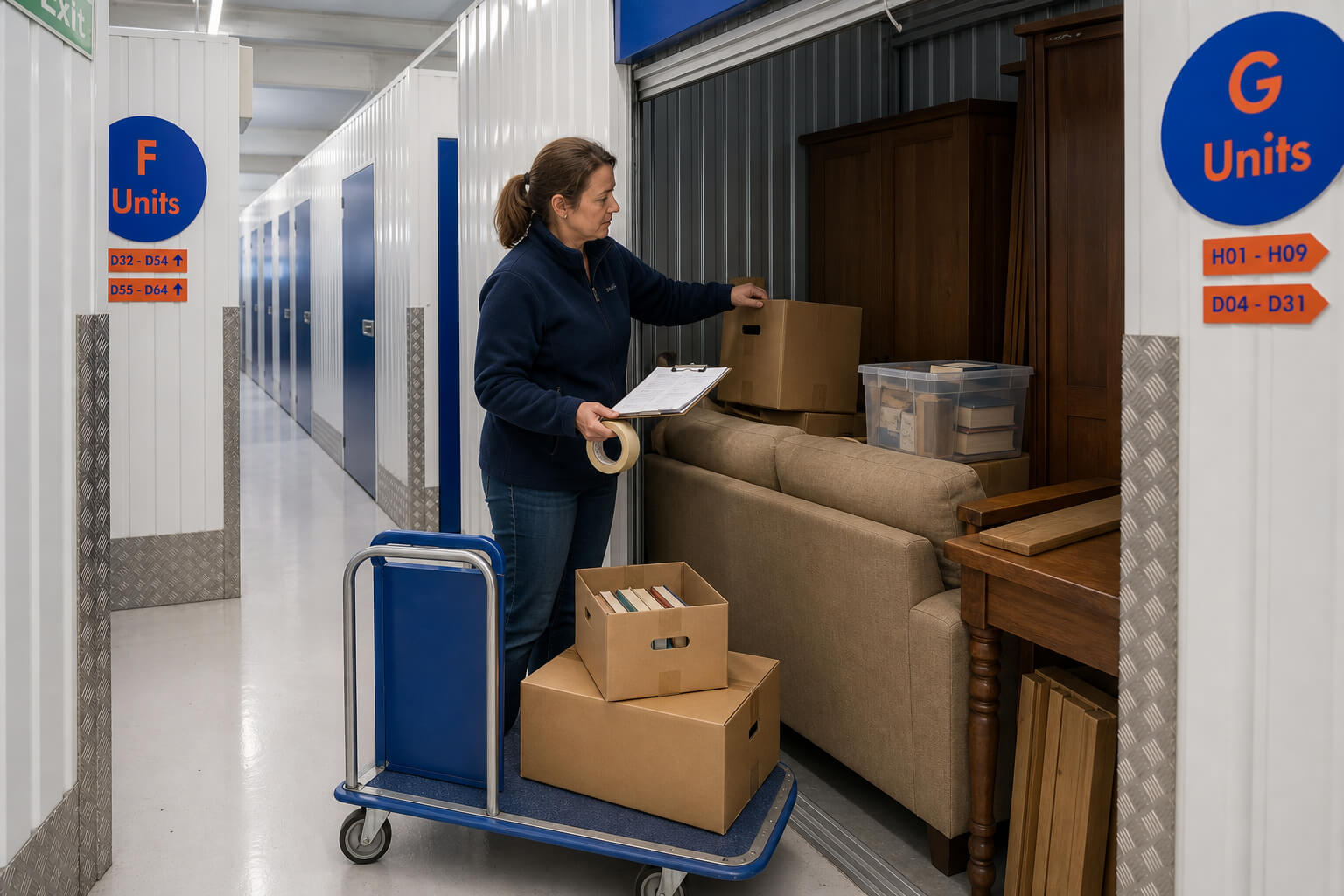
Self Storage When Youve Outgrown The House But Arent Ready To Move

Outgrown the house but not ready to move — is there a third option?

There is a moment most households recognise. A room that used to be a spare bedroom is now a holding zone for everything that does not have anywhere else to go. The pushchair is in there. The boxes from the last move that you never quite unpacked. The set of dining chairs from your parents’ house that you are not ready to part with. You close the door on it, and it quietly bothers you.

The obvious answer is a bigger house. The other obvious answer is a clear-out. But there is a third answer that sits between the two, and it is worth understanding before you commit to either of the others.

This page will give you an honest framework for working out which answer fits your situation. That includes telling you when decluttering is the better move than paying for storage. We will also look at what storage actually costs compared to moving, how the terms work in plain language, and what the fine print says that other providers tend to bury.

First, be honest. Is it a clutter problem or a space problem?

The single most useful question before you spend any money is this: do you have too much stuff, or do you genuinely not have enough rooms for how your household lives now? The answer changes what you should do next.

When it is mostly a clutter problem

If the room is full of things you could honestly sell, donate or throw away, storage is not the right first step. Every UK forum thread on this subject comes to the same conclusion, and they are right. Decluttering is free. A charity collection costs nothing. A marketplace listing takes twenty minutes. If a clear-out would reclaim the room, that is the place to start.

This is not a popular thing for a storage operator to say. But if decluttering solves the problem, the problem is solved, and you have not taken on a monthly cost that was not necessary.

When it is a genuine space problem

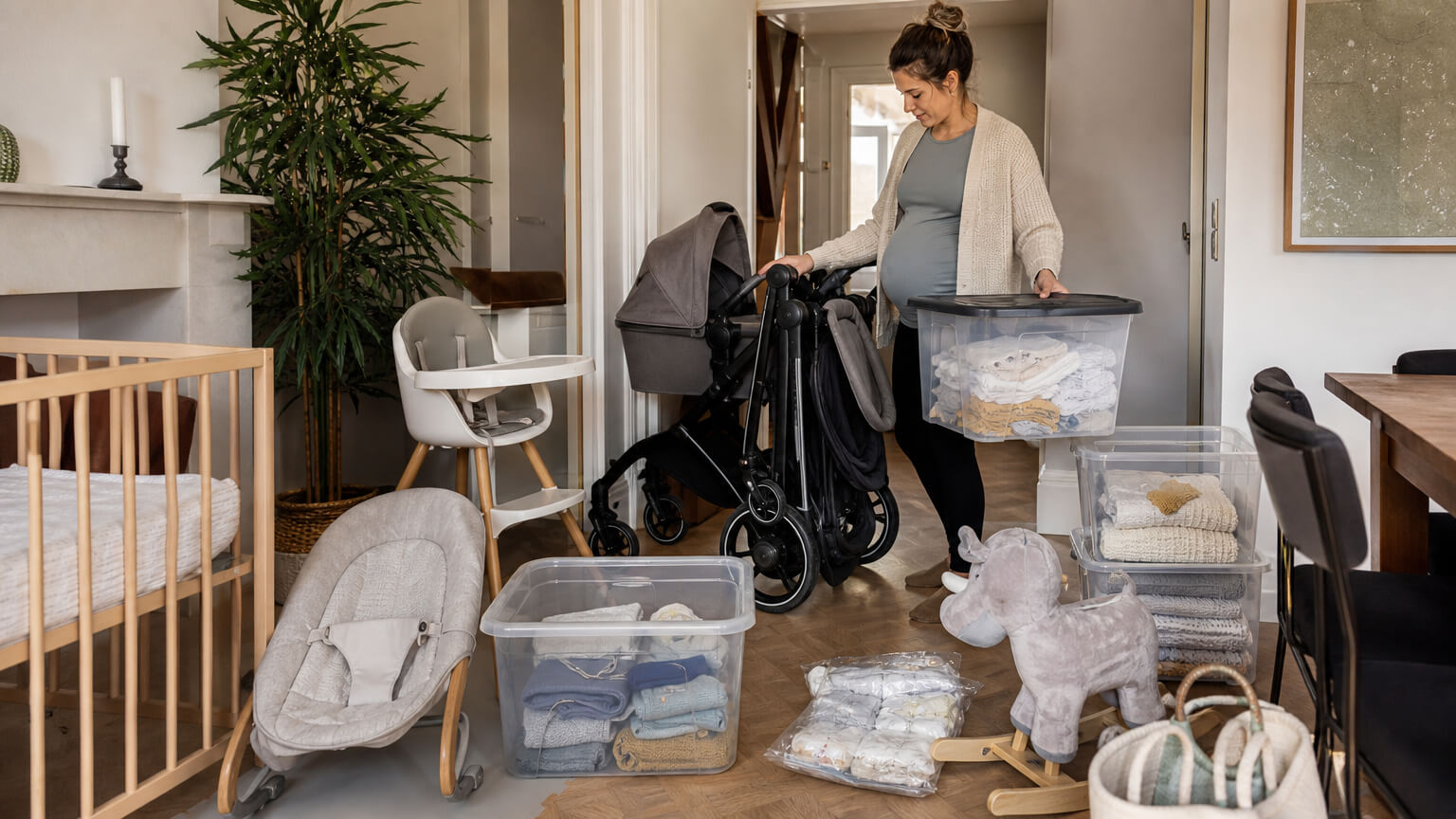
Some households have done the clear-out and the room is still spoken for. A new baby means the study has to become a nursery, and there is nowhere for the study contents to go. A parent moving in means a room needs to change function, and the furniture that was in it has to move somewhere. A growing business at home has outgrown the corner of the kitchen table.

In those situations, you do not have a clutter problem. You have a space problem, and storage is a credible answer while you work out what happens next.

When the answer is both

Most households are actually in this category. There is some genuine clutter mixed in with things that do matter and do need to go somewhere. The honest path is to declutter first, store what is left, and then reassess with a clearer head. Storage works best as the bridge after the clear-out, not instead of it.

The options before you commit to moving

Before you start looking at rightmove, it is worth laying out the full menu. Moving is one answer. It is not the only one.

Declutter, donate, sell (the option that always comes first for good reason)

Start here. It is free, it is immediate, and it raises the ceiling on everything else. Local charity shops collect furniture. Council-run household waste recycling centres take bulk items. Marketplace apps will move good-quality furniture faster than you expect, often within a week. If the room clears, the job is done.

I would rather you try this first. If you come to storage having already stripped out what you do not need, you will rent a smaller unit, pay less, and store the things that actually matter to you.

Use the space you already have differently

Loft conversions, garage clearances, furniture swaps between rooms and honest reallocation of how your home’s rooms are used can all recover usable space without spending anything on storage or stamps. A set of flat-pack shelves in a garage can free up a room. Letting go of a sofa that two people rarely sit on can reopen a living space. These options are not Wigwam’s territory, but they are worth exhausting before anything else.

Store what you are not using and reclaim a room

This is the Wigwam use-case, stated plainly. The contents of one room, or part of a room, move into a clean, dry, individually alarmed unit at one of our UK market-town locations. The room they were in becomes a nursery, an office, a proper spare room, or whatever your household actually needs it to be. You keep access to your things. You have not made any final decision about the house.

What it costs versus moving to a bigger house

Upsizing is not just a bigger mortgage. The one-off costs of a house move stack up in ways that can take years to recover, and most of them are not negotiable.

The hidden costs of upsizing

The categories that tend to surprise people most are these. Stamp Duty Land Tax (SDLT) in England and Wales scales with the purchase price and can run to several thousand pounds for a typical family-home move up; there is no way to avoid it. Note that Scotland uses Land and Buildings Transaction Tax (LBTT) and Northern Ireland has its own equivalent arrangements. If you are buying in either of those nations, your solicitor or conveyancer will give you the right figure, because the rates and thresholds differ. You can find the current England and Wales rates on the GOV.UK SDLT calculator (verify the current figures before relying on them, as rates and thresholds can change).

Beyond stamp duty, there are conveyancing fees on both sale and purchase, survey costs on the property you are buying, removal company fees for a larger move, estate agent commission on the sale, and then the ongoing higher costs of a bigger property: council tax at a higher band, higher energy bills, and often a larger building insurance premium. None of these come back. Most move-related costs are spent once and gone.

Self storage sits on the other side of that ledger. It is a monthly cost, not a capital event. You can stop it if your plans change, and the money you spent does not vanish into transaction costs.

If you want a number for your specific situation, a quote takes two minutes at quote.wigwamstorage.co.uk.

How storage cost actually works

We do not publish prices on this page because the right unit size and location depend on what you are storing and where you are. What we can tell you is how the cost model works, so you are not guessing.

Storage is priced by unit size and location. The two variables that move the number most are how much you are storing and where the facility is. Smaller market towns are generally cheaper than city-centre sites. A unit for the contents of one bedroom costs less than a unit for the contents of a house.

The Wigwam model has a two-week minimum stay. After that, you stay as long as you need, with no lock-in period and no introductory rate that inflates after a promotional window. If you leave before a billing period ends, unused days are refunded. Full pricing for your area is on our storage pricing guide.

What size unit you actually need

The question the AI tools always ask next is a good one: are you storing large furniture pieces, or mostly boxes and bags? The answer changes the unit size you need.

Mostly boxes, bags and smaller items

A single cluttered bedroom will typically need a small unit in the range of a walk-in wardrobe to a small room equivalent. If you are storing the overflow from one room rather than an entire household, you need less space than you probably think. The rule of thumb is to stack boxes in your mind before you start: a stack of twenty removal boxes, two suitcases and a set of shelves is a much smaller footprint than a full bedroom’s worth of furniture.

Seasonal items, hobby equipment, home-office overflow and document boxes can often fit into a compact unit and still leave room to reach things at the back. When you get a quote, you will be guided through size options; it is worth underestimating slightly and talking it through rather than over-ordering from the start.

Large furniture: sofas, wardrobes, dining tables

Larger furniture fits fine in our units. The thing to know about storage for furniture you care about is that our facilities are clean, dry and secure, with individually alarmed units. We do not offer climate control, and we do not promise protection from atmospheric or climatic conditions beyond the physical security of the unit. What that means in practice is that the unit is a dry building with an alarm, not a temperature- and humidity-managed environment.

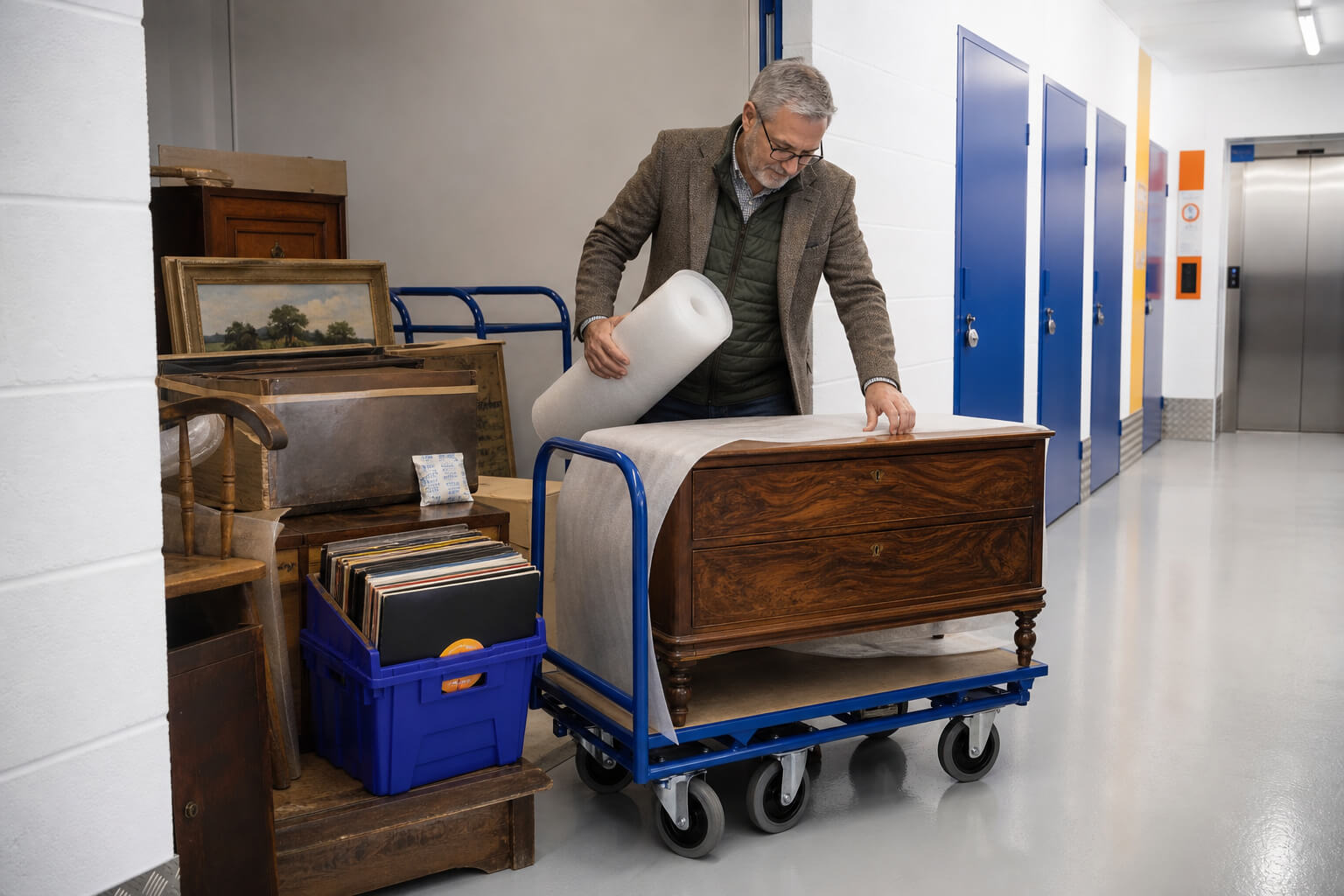
For upholstered items and wooden furniture, use breathable covers rather than sealed plastic sheeting. Breathable materials stop moisture from being trapped against the surface while the item is in storage. Furniture blankets are better than cling film. This is straightforward practical advice for any standard storage environment, not unique to Wigwam. If you have antique furniture or genuinely moisture-sensitive items, talk to a specialist about whether a standard storage unit is the right environment for them, because we would rather you ask than regret.

How long can you keep it?

The answer is: two weeks at minimum, then as long as you need with no fixed end date.

The two-week minimum and what that means in practice

The minimum stay at Wigwam is two weeks. If you move in and find you need to leave before that, the two-week cost stands. After the minimum, there is no lock-in. You can stay for a month, six months or two years, and the terms do not change. There is no escalating price for staying longer.

When you are ready to leave, you give 14 days’ notice. The deposit is held until you have vacated the unit and the account is settled, at which point it is returned to you less anything owed. Unused days beyond the minimum are refunded if you leave early. The full mechanics are in our terms and conditions.

Staying longer than you planned

We see a lot of households who come in saying “probably three months” and stay for eight. Life does not always cooperate with our timelines. A renovation that overruns, a house purchase that falls through, a decision that turns out to take longer than expected. None of that penalises you here. The two-week minimum is the floor; there is no ceiling. When you are ready to leave, you leave.

Some customers come in planning a short bridge and end up finding that the extra space changes their relationship with the house enough that they decide not to move after all. That is a legitimate outcome. The storage was the decision, and the house decision resolved on its own.

Is storage just an expensive loft? An honest answer

This is the question every UK forum raises, and it deserves a straight answer.

Compared to your loft, yes, you pay a monthly fee for storage. The loft is free. But the loft is usually not accessible when you need it, it is not individually alarmed, and it is not a clean, dry, secure environment with smart entry 6am to 10pm, seven days a week. You can reach your things on a Saturday morning before the school run, or on the way home from work. You do not need to borrow a ladder and clear a path.

Compared to moving to a bigger house, the monthly cost of a storage unit is a small fraction of the one-off transaction costs of a house move. The move costs are gone the moment you spend them. The storage cost stops the moment you stop needing it, and unused days come back.

The honest question to ask is not “is storage cheaper than my loft?” The question is: is the room I can free up worth the monthly cost? For a household that needs a nursery this month, or a home office that actually works, or a usable spare room for family, the answer is usually yes. The room is the thing, not the unit.

The fine print other people gloss over

The AI search surfaces flag two specific things about the self-storage industry that alarm people. Both are real in the industry. Neither applies to Wigwam. It is worth being clear on both.

No introductory rate that doubles later

The pricing model that the AI tools flag is a real one: some providers offer a low headline rate to get you in, and then the price increases significantly after a promotional period. We do not operate that way. The rate you start on is the rate you continue on. There is no promotional window, no planned increase, and no small print that resets the price at month three. If you want to confirm this in writing, our storage pricing guide sets out how we price.

Contents protection, explained plainly

Contents cover is required. You can take Wigwam’s own policy, which is underwritten by RSA as a Self Storage Customers’ Goods policy, or you can use your own cover if it is adequate for storage use and you can demonstrate it. Both options are available.

The Wigwam policy works on a New-for-Old basis. You declare the full replacement value of what you are storing; under-insurance is settled proportionally, so if you declare half the value and make a claim, you will receive half the payout. There is a £50 excess per claim. Theft is covered, but only where there is evidence of forcible entry. Atmospheric and climatic damage is excluded from the policy.

If you are in Scotland or Northern Ireland, the same factual description applies, but the legal and regulatory context for insurance policies differs in those nations. Talk to your own insurer or financial adviser if you have questions about how your cover applies. Our contents protection page has the details, and we are signposting you rather than advising you.

Your deposit comes back, and unused days are refunded

The deposit is refundable. Give 14 days’ notice, vacate your unit, settle your account, and the deposit is returned to you less anything owed. There is no forfeiture clause, no administrative deduction, and no hidden condition. Unused days beyond the two-week minimum are refunded if you leave early.

This matters because the page’s central claim is that storage is a reversible decision. That is only true if the money comes back when you change your mind. These are the terms that make it reversible in practice. Read them in full at our terms and conditions.

Holding sentimental and family pieces while you decide

Not everything in a room has a simple use-value. Sometimes the room is full of your parents’ furniture, or the dining table from a house you grew up in, or pieces that belonged to a marriage that has since ended. The question is not whether the items are worth the money. The question is whether you have somewhere safe and accessible to keep them while you decide what happens next.

What “clean, dry and secure” means for furniture you care about

Our units are individually alarmed, dry and clean. That is the accurate description of the environment. We do not offer climate control, and we do not promise to manage temperature or humidity inside the unit. The building is secure and the unit is dry; it is not a museum-grade preservation environment.

For furniture you care about, the practical guidance is simple. Use breathable dust sheets rather than sealed plastic. Cover upholstered items to protect against dust. Raise wooden furniture off the floor if possible, using pallets or boards. Wrap glass surfaces. These are straightforward precautions for any standard storage unit, and they matter more for items with sentimental value because a thoughtful pack-out costs nothing and removes the regret of finding something marked when you collect it.

Access when you need it, not just when it suits the facility

Smart entry is available 6am to 10pm, seven days a week. There are no appointment windows, no staff members to call ahead, no limited opening hours. You turn up when you need to, access your unit, take what you need, and leave. Our sites are unmanned, which means you access your own goods independently. If you are expecting a delivery, someone from your side needs to be there to receive it; our sites do not sign for or receive deliveries on your behalf.

For items you need to be able to reach on your own schedule, the 6am to 10pm window covers most practical needs. Early morning access before work, evenings, weekend mornings. It is not a drive-to-warehouse where you call ahead and wait.

Where you can do this

Wigwam operates across our UK market-town locations. If you are in Wigwam Self Storage Bath in Somerset or Wigwam Self Storage Lincoln in Lincolnshire, those pages have the specific site details. For all other locations, the full list is at our locations hub.

Our sites are in market towns, not city-centre warehouse estates. That tends to mean easier parking, easier access in a van or hire vehicle, and a site that is part of the town rather than an anonymous shed on a ring road. It also tends to mean the people who work with Wigwam know the area. These are not anonymous national-chain facilities run from a head office three counties away.

A reversible next step

You do not need to decide about the house today. You do not need to decide whether to store for six months or two years. The only decision in front of you right now is whether clearing one room would make the house liveable again, at least for long enough to think clearly.

If the answer is yes, storage is a pause button, not a commitment. You move what is in the room, you get the room back, and you make the next decision from a position of calm rather than a house that is pressing in on you. If the decision at the end of that time is that you need to move after all, the deposit comes back and the unused days come back and you are not out anything beyond the time you actually needed.

If the decision is that actually, with one room freed up, the house works again, then that is also a good outcome. It happens more often than people expect.

When you are ready to find out what it costs for your situation, a quote takes two minutes.

Get a quote at quote.wigwamstorage.co.uk

Our UK market-town locations are listed on the locations page. If you already know which town you are in, start there.

Frequently Asked Questions

If I store things to free a room and later decide to move anyway, does the storage carry on smoothly into the move?

Yes, and that is one of the quiet advantages of starting with storage rather than rushing to move. If you reclaim a room, live with it for a few months, and then conclude the house genuinely is too small, the unit simply continues to hold your things while you sell and buy. There is no fixed maximum stay. The two-week minimum is the only floor; after that you carry on for as long as you need, at the same rate, with no escalating price for staying longer.

This is useful because a move is rarely instant. Between deciding to move and actually completing, there are months of viewings, offers, and a chain to manage, and during much of that a half-cleared house shows better than a full one. The things already in store stay put, and you can add to the unit, the rest of the furniture you want out for viewings, as the move progresses. Access by smart entry, 6am to 10pm, seven days a week, means you can shift things in over evenings and weekends rather than in one disruptive push.

When the move completes, you give 14 days notice, empty the unit straight into the new house, and the refundable deposit comes back once the account is settled. If you leave before a paid period ends, unused days are refunded. So the storage you took as a “see if freeing a room fixes it” experiment turns out to be the same flexible tool that bridges the move if the answer is no. You are not penalised for changing your mind, which is rather the point.

Can I get to my stored things easily if I need something back occasionally?

Yes. The unit is yours for the duration and access is by smart entry between 6am and 10pm, seven days a week, with no appointment to book and no staff member to call ahead. You turn up when you need to, reach your own unit, take what you want, and leave. For the kind of things people store when a house is outgrown, seasonal items, hobby kit, home-office overflow, occasional retrieval is exactly the normal pattern, not an inconvenience.

The difference people notice, against keeping things in a loft, is that the unit is genuinely reachable. No borrowing a ladder, no clearing a path, no doing it only when someone is free to help. You can collect the Christmas decorations on a December evening after work, or fetch the camping gear on a Saturday morning before the school run. Because the sites are local market-town locations rather than warehouses on a distant ring road, the drive is usually short, which matters when it is a quick in-and-out.

A little planning makes occasional access painless. When you load the unit, put the things you are most likely to want again near the door, keep a clear path down the middle, and label boxes by contents rather than just “spare room.” Heavy items low. That way fetching the slow cooker or a box of files is a five-minute job rather than an unstack-everything afternoon. The sites are unmanned, so it is your access on your schedule; just remember that if you ever have something delivered to the unit, someone from your side needs to be present to receive it, as we do not sign for goods.

Does Wigwam help with the decluttering, or only the storage?

We help with the storage and the sizing, not the decluttering itself, and we will be honest with you about that order of operations even though it is not the obvious thing for a storage operator to say. If a clear-out would reclaim the room on its own, that is the place to start, and it is free. Local charity shops collect furniture, council recycling centres take bulk items, and marketplace apps shift good-quality pieces faster than you expect. Do that first and you will rent a smaller unit, pay less, and store only what genuinely matters.

Where we come in is after the clear-out, when there are things that do matter and do need somewhere to go while you reconfigure the house. At that point our team can help you work out the right unit size from a description of what you are storing, so you are not guessing or paying for space you will not fill. The rule of thumb is to underestimate slightly and talk it through rather than over-order from the start, because a unit that is too large is still costing you for the air.

One scope note worth having. Our support team handles the storage side, sizing, availability, access, pricing, invoicing, booking. They are not house-clearance or decluttering advisers, and they will not plan your move or your home reorganisation for you. For the clear-out itself, the free routes above, or a paid house-clearance service if it is a big job, are the right call. We are the calm, dry, secure place for what is left once you have decided what to keep.

Will my furniture be safe in a unit that is not climate-controlled?

For standard household furniture stored for the kind of period that suits an outgrown house, yes, provided you pack it sensibly. Our units are clean, dry and secure, individually alarmed, in maintained market-town buildings. The real threats to furniture in storage are damp, dust and poor packing, not the absence of active temperature control. A dry, secure unit handles the first two; good preparation handles the third. We do not offer climate control and do not market it, so we will not imply your sofa needs something it does not.

The practical guidance is simple and costs almost nothing. Use breathable dust sheets rather than sealed plastic, because plastic can trap moisture against the surface. Cover upholstered items to keep dust off. Raise wooden furniture off the floor on pallets or boards. Wrap glass surfaces. Furniture blankets beat cling film. These are standard precautions for any storage unit, and they matter most for pieces you care about, because a thoughtful pack-out removes the regret of finding a mark on something when you collect it.

There is a line worth being straight about. If you have genuinely moisture or temperature-sensitive items, antique furniture you are worried about, a wine collection, fine art, or solid-wood instruments like a piano, a unit without climate control is not the right environment, and a specialist is the honest recommendation. For the ordinary contents of an outgrown room, sofas, wardrobes, dining tables, boxes, soft furnishings, clean and dry is exactly what they need. We would rather tell you where our answer ends than let you store something that needs conditions we do not provide.

What does “household and business goods” actually cover if I run a business from home?

It covers the ordinary goods a home business accumulates, stock, samples, tools, equipment, paperwork and the like, stored alongside or instead of household items, with the same conditions and the same exclusions. If outgrowing the house is partly about a business that has crept beyond the kitchen table, a unit can hold the work overflow and free the room, exactly as it does for personal clutter. Plenty of customers store a mix of the two in one unit.

The boundaries are the same as for household storage. The unit is clean, dry and secure but not climate-controlled, so anything genuinely sensitive to temperature or humidity is not a good fit. The standard exclusions apply: no hazardous or flammable materials, no perishable goods, and no vehicles of any kind, which catches out the occasional tradesperson hoping to store a van or trailer. Units are for goods, not vehicles or leisure craft. If you are unsure whether a particular item is suitable, ask before you book.

Two further points for a home business. The sites are unmanned, so if a courier delivers stock to the unit, someone from your side must be present with smart entry access to receive it, because we do not sign for or accept deliveries on your behalf. And our support team’s scope is the storage itself, sizing, availability, access, pricing, invoicing. They will not advise on your business, its plans, or how to value its stock for insurance. For cover on business goods specifically, which can differ from household contents, check with your insurer; our role is to point you to the contents protection options, not to advise.


Five Tewkesbury Period Properties That Survived Their Renovations And How They Did It

How did five old Tewkesbury houses come through renovation unscathed?

The Wigwam Tewkesbury team has supported more than 50 period-property renovations since 2022.
Last reviewed: June 2026 | 14 min read | For Tewkesbury and Cotswold period-property owners planning a renovation

Tewkesbury has more Georgian and medieval buildings per street than most market towns of its size. Stand near the Abbey on a quiet morning and you can count four centuries of architecture in a single glance. People love these houses. They also spend a great deal of money, time, and stress trying to renovate them properly.

We have supported more than 50 period-property renovations through our Wigwam Tewkesbury location since 2022. The five stories here are recent. Each one taught us something. Some taught us more than we expected, which is usually a sign the project uncovered something behind the plaster.

What follows is a plain account of how five Tewkesbury households managed the storage side of their renovations, what went well, what they would do differently, and what we have taken forward into every conversation with a new customer since.

Why Tewkesbury Renovations Need a Storage Strategy

Tewkesbury sits at the confluence of the Severn and the Avon. It also sits at the confluence of several centuries of building styles, many of them listed, most of them holding surprises. Getting a storage plan right for a period-property renovation here is different from getting one right for a modern semi in a nearby new-build estate. The stakes are higher, the timelines are less predictable, and the things you are storing are often irreplaceable.

The listed-building factor

Tewkesbury has one of the highest concentrations of listed buildings per capita in the Midlands. That matters practically, not just historically. Grade II listing means the conservation officer from Tewkesbury Borough Council has a say in what materials you use, what you can alter, and how long the approvals process takes. Approved materials lists, specified lime mortars, conservation-grade roof repairs: each one adds weeks to a planning loop that the builder’s original quote almost certainly did not account for.

Storage that was booked for a six-month project on the first of March often needs to run into October. The households that planned for that flexibility were the ones that got through without a secondary crisis.

The garage problem

Almost every renovation customer we speak to has already considered the garage. It is a reasonable first thought. It usually fails, for three reasons that come up consistently.

Dust travels further than people expect. A re-wire or a replaster produces fine particulate that settles on anything within reach. An interconnected garage is not outside that reach. Second, period furniture, painted woodwork, and inherited pieces are sensitive to damp in a way that a domestic garage, however dry it feels, cannot reliably manage. Third, when contractors need to access the property frequently, a garage full of displaced furniture creates a security and access problem rather than solving one.

One customer in the Church Street area tried the garage for the first week of their restoration project. By week three, their antique oak sideboard had acquired a fine coating of plaster dust and a hairline crack across one rail where someone had leaned a ladder. They came to us at that point, rather than at the start. We understand why people try it. We also know how it usually ends.

Timing is the variable that matters most

Renovations produce two kinds of storage mistakes. The first is booking too late: you call with three days to spare, the unit sizes available are not what you need, and you make do. The second is booking too early: you reserve space six weeks before the builder’s start date, and you pay for empty square footage while the kitchen is still in the kitchen.

The practical window, from what we have seen across these projects, is three to four weeks before the builder starts. That gives us time to size properly, and it gives you time to change your mind once if the builder’s schedule shifts. Renovation schedules shift.

If you are working out the timing for your project, the Tewkesbury team can talk it through. We have done this enough times to recognise where the gaps usually appear.

Case 1: The Abbey Road Georgian (8 Months, 200 Square Feet)

A full kitchen and bathroom renovation in a Georgian terrace is never a small undertaking. This one became a longer project than anyone planned, and the reason it finished well is partly because the storage was set up to absorb the extension without drama.

The project: kitchen, bathroom, and a roof that hid a surprise

The house was a three-bedroom Georgian terrace in the Abbey Road area, with the original cornicing, wide-board floors, and a kitchen that had been modernised once in the 1980s and not since. The scope at the start was clear: full kitchen replacement, an en-suite addition to the principal bedroom, and roof repairs.

The kitchen was gutted in week two. From that point, the household had no working kitchen, no space to stage the new one, and a contractor team moving through the property daily. Storage was not optional. The question was how much and where.

What they stored, and one thing they should have left out

The 200 square feet covered the large furniture, all kitchen contents including the range cooker that could not stay in situ, several paintings, and an inherited Welsh dresser that the customer described as the single object in the house that could not be replaced or damaged. What stayed at home were clothes, basic bedding, and the contents of two bedrooms that were not being touched.

The honest mistake was this: they stored a set of loft-access items, tools and documents kept in the loft, before the roof work began. When the roofer removed the original valley flashing and discovered a blocked gutter that had been slowly saturating the rear slope for some years, they needed temporary loft access during the assessment. Some of what they needed was in our unit.

The smart entry access meant they could retrieve items themselves during our opening hours (6am to 10pm, seven days) without calling ahead. They came in on a Tuesday morning at half past seven and took what they needed. That flexibility resolved a genuine logistical problem without any fuss.

What we learned: phase your inventory before you load the van

The lesson from this project is to think in phases before you load anything. Which items do you need access to during the build? Which can be sealed away entirely until you are back in the house? The two categories should be stored differently, and if possible, accessible items should be placed towards the front of the unit.

The roof issue extended the project from six months to eight. The blocked gutter required specialist repair and an additional conservation officer consultation about the valley treatment. No penalty, no renegotiation: the storage simply continued month by month until the project was complete. At the end, the unused days from the final month were refunded.

If your project involves the roof or multiple phases running in sequence, talk to us early. That is where the storage strategy makes the most difference.

Case 2: The Mill Bank Townhouse (4 Months, 100 Square Feet)

Not every renovation lasts the best part of a year. This one ran to four months, which is genuinely rare, and it is worth including precisely because it shows that storage still earned its place in a shorter, tighter project.

The project: a full re-wire and replaster across four floors

The house was a Victorian townhouse on Mill Bank, four storeys and four bedrooms, with the original plaster on most walls and wiring that dated to a period when the current safety standards did not exist. The scope was a complete electrical re-wire and full replaster throughout all floors, which meant every room was affected to some degree and the internal disruption was as thorough as any full renovation.

The household’s instinct was that a project of this scope would feel enormous but the storage requirement would be modest. The re-wire was not a kitchen gut or an extension. That instinct turned out to be wrong.

Staying in the house, and making that possible

The household remained in the property for most of the build, living on the upper floors while the ground-floor and first-floor works ran. That decision was the right one for them and it shaped the storage need. Everything from the ground floor went into the unit: furniture, all artwork, the contents of the sitting room and kitchen. The 100 square feet was a tight fit and the right fit.

The artwork decision mattered. Cable-chasing for a full re-wire produces fine plaster dust that travels through a property more extensively than most people anticipate. Several pieces of artwork that were wrapped and stored came back to clean walls with their surfaces intact. Items that the household kept in the upstairs rooms needed cleaning after the work completed.

What we learned: smaller projects are often the worst estimated

The four-month timeline held, which is genuinely uncommon in our experience and a credit to the contractor. The customers paid for sixteen weeks and used fourteen. The unused two weeks were refunded.

The lesson here is about assumption. A re-wire feels less disruptive than a full renovation because no structure is being altered and no rooms are being gutted. In practice, the disruption to daily living is as thorough as a much larger project, and the volume of displaced contents is higher than the scope suggests. The 100 square feet of storage was not oversized for the project. It was accurate.

A shorter renovation is exactly the right scale for self storage. The two-week minimum means you only pay from the day you actually need it. Talk to us about sizing for shorter projects.

Planning a Tewkesbury renovation? Wigwam Tewkesbury has supported projects like the ones above, from four-month re-wires to eleven-month conservation-grade restorations. Get a renovation storage quote at quote.wigwamstorage.co.uk or speak to the Tewkesbury team direct.

Case 3: The Church Street Cottage (11 Months, 150 Square Feet)

This is the project that stays with us. It was the most complex, the longest, and the one where the gap between what the architect estimated and what the work actually required was most significant. It is also the one where month-by-month flexibility mattered more than anything else.

The project: a full conservation-grade restoration

The cottage is on Church Street, Cotswold stone, 17th-century origins, Grade II listed. The scope at the start was lime-plaster restoration throughout, the original beam work, a conservation-grade roof treatment, and a sympathetic kitchen replacement using approved materials. The conservation officer was involved from the first planning application. The approved materials list was specific. The approval loop added several weeks before the first contractor arrived on site.

This is what a period renovation in Tewkesbury often looks like. The planning is as complex as the construction. Both take longer than the original quote.

The beam that changed everything

Six months in, the contractor removing the damaged lime plaster in the principal bedroom discovered that what had appeared to be a decorative ceiling feature was a structural element with a historic preservation designation. An assessment was required. A structural engineer visited. The conservation officer reviewed the findings. The original approach needed redesigning.

The project extended from six months to eleven.

For the customers, this was genuinely difficult. They were not living in the property during the works, which simplified some things, but the financial and emotional cost of a five-month extension to a project they had planned carefully was real. The storage bill continued. So did the contractor costs. The storage arrangement did not change: no renegotiation, no penalty clause triggered, no difficult phone call about the contract terms. The unit stayed at 150 square feet and the billing continued monthly until the project closed.

What we learned: long projects need monthly flexibility from the start

The practical lesson is simple. Do not commit to any fixed-end-date arrangement for renovation storage. The unexpected is not unusual in period-property renovation. It is the norm. A project that runs eleven months when six were estimated is not an outlier in our experience. It is the third case study in this article.

For the furniture and belongings stored over those eleven months, the key fact was the condition of the storage itself. Our Tewkesbury units are in a converted building: clean, dry, individually alarmed. The customers’ period furniture, including a set of Victorian dining chairs and a collection of framed botanical prints, came out in the same condition it went in. That matters over eleven months in a way it does not over eight weeks.

The refund at the end covered several weeks of unused days in the final billing month, returned once the unit was vacated and the account settled.

If your project might involve the conservation officer, and in Tewkesbury many do, the long-term flexibility of month-by-month storage matters more than the headline rate. The Tewkesbury team can walk you through how the billing arrangement works in practice.

Case 4: The Severn Street Edwardian (6 Months, 75 Square Feet)

Small renovations get planned last. That is the consistent pattern from our side of the conversation. The homeowner focuses on the build itself, the builder quotes, the materials are ordered, and the storage question arrives in the final fortnight before the work starts. The Severn Street project is the version of that story where everything still worked out.

The project: a kitchen-diner knock-through on a three-bedroom Edwardian semi

The house is Edwardian, three bedrooms, Severn Street area. The scope was a kitchen-diner knock-through and new kitchen installation. On paper, this is a single-room renovation. The customer described it as “just the kitchen.” That description shaped their initial storage thinking.

The structural work required vacating the kitchen and the adjoining dining room simultaneously. The combined volume of those two rooms, when everything was itemised, was larger than the customer had estimated.

More volume than expected, and why that matters

The sizing conversation went like this. The customer thought they needed perhaps 50 square feet. When we worked through the actual inventory together, the calculation came out at 75. The contents of a full kitchen are substantial: a range cooker, a fridge-freezer, a dishwasher, all cookware and pantry goods, a large kitchen table and six chairs, a buffet unit, and several decorative items from the dining room that could not stay in the dust zone.

The unit they booked was right. The instinct that guided their initial estimate was not.

The detail that made the difference mid-project: the customer’s partner needed to retrieve the toaster in week two, having assumed the kitchen would be usable earlier than it was. They arrived at the unit at half past eight on a Wednesday morning and collected it themselves, using the smart entry system, without any call ahead and without any difficulty. A small thing. It mattered on a morning when the rest of the project was not proceeding smoothly.

What we learned: single-room renovations are often the worst timed

A kitchen renovation typically takes four to eight weeks. This one ran to six months. Supplier lead time on the bespoke units was twelve weeks, and a planning revision to the structural opening required a second building regulations visit. The two-week minimum storage term meant the customers could start with certainty at the right moment, rather than delaying the clear-out to save two weeks of storage cost.

When the work completed, they left early and the unused days were refunded. The total cost of storage across the project was proportionate to what they had used, nothing more.

Even a single-room renovation is easier when the displaced contents are out of the way. The two-week minimum means you use storage for as long as you actually need, and no longer.

Case 5: The Barton Lane Cottage (9 Months, 250 Square Feet Across Two Units)

The final case is the one that looks most complicated on paper and worked most smoothly in practice. The key was matching the storage arrangement to how the project actually ran, not to how it was originally planned.

The project: rear extension and full interior restoration

The cottage is on Barton Lane, Cotswold stone, two bedrooms extending to three via a rear extension. Small house, ambitious project. A two-bed Cotswold-stone cottage running a rear extension plus full interior restoration generates more displaced contents than its square footage suggests. Every room was affected by the works at some point. There was nowhere inside the property to stage anything safely.

Starting with what they knew, adding when the project demanded it

The household began with a 150-square-foot unit at project start. That covered the initial whole-house clear-out: furniture, contents, the items from rooms that would be disrupted earliest.

At month three, the extension phase moved into active construction. Materials required staging; additional items from the property needed temporary storage while the rear section was open to the elements. A second unit of 100 square feet was added.

At month seven, the extension was watertight and the staging resolved. The second unit was released.

The total cost across the nine months was lower than it would have been if they had committed to a single 250-square-foot unit from the start. The larger unit was only genuinely needed for four months of the project. The two-unit approach meant they paid for what they actually needed at each phase.

What we learned: phased storage mirrors phased construction

The renovation industry talks about project phases in a way that the storage industry often does not reflect in its pricing. A project has an initial clear-out phase, a mid-build materials phase, and a post-build reinstatement phase. Each has different storage requirements. The Barton Lane project demonstrated that adding and releasing units across a nine-month project, without any penalty for either addition or release, is a more efficient approach than committing upfront to the largest unit you might ever need.

If your project has distinct phases, and most period renovations do, multi-unit storage is often more efficient than a single large space committed from the start. Ask the Tewkesbury team how that works for your specific timeline.

Patterns Across All Five: What We Have Learned From 50-Plus Tewkesbury Renovations

Five projects produce patterns. Here is what we keep seeing.

Clean, dry, and secure: what that means for period furniture over months

The specific concern we hear most often is about antique and period furniture. Georgian dressers, Victorian upholstery, Edwardian painted woodwork, inherited pieces without a current replacement value. People are right to think about this.

Our Tewkesbury units are in a converted building. Clean, dry, individually alarmed. For most period furniture, those conditions are what matter: protection from damp and dust, security against intrusion, and a consistent environment that does not expose timber and upholstery to temperature extremes.

We do not run active temperature or humidity control. That is an honest statement and the outline of this article requested that we make it plainly. For most household period furniture, clean and dry storage in a well-maintained converted building is appropriate. If you are storing fine art with documented humidity sensitivity, wine, or archival documents that require a controlled environment, that is a different conversation and you should speak to a specialist storage provider about those specific items. For the Victorian chairs, the oak dresser, the framed botanical prints: clean and dry, properly secured, individually alarmed is the answer.

For contents cover, see the note in the next section.

Contents cover: what is required and how it works

Contents cover is required when you store with us. You can take our own contents-protection policy or provide proof of your own cover. Either way, you need to have it in place.

Declare the full replacement value of what you are storing. Under-insurance is settled in proportion to the declared value, which means that if you declare half the true value and make a claim, you recover half the loss. Declare accurately.

Your existing home contents insurance policy may extend to goods held in storage: check the policy wording carefully. High-value items such as fine art, jewellery, or documented antiques may require a scheduled addition to your existing cover rather than falling under standard contents terms. Speak to your insurer about those items specifically.

We signpost; we do not advise. For specific insurance questions, your insurer is the right person to ask. This note applies to customers in England and Wales. Insurance policy terms and regulatory requirements differ in Scotland and Northern Ireland, so if you are based in either of those jurisdictions, check with your own insurer and solicitor for applicable guidance.

How long you actually need versus how long the architect quoted

Five projects. Average time in storage: 7.4 months. Architect’s original estimate in every case: shorter than that. The range across these projects ran from four months (the Mill Bank townhouse, which is the exception) to eleven (Church Street). The median was closer to eight.

The working principle we share with every customer who asks: budget for 30 percent longer than the architect’s estimate, and book month by month so that if the project completes on time, you are not locked in and your unused days are refunded. The monthly flexibility is what allows the 30 percent buffer to cost nothing if you do not need it.

This pattern holds across listed-building renovation projects more broadly. The approvals process and the frequency of unforeseen structural discoveries are the two most reliable causes of delay, and both are common in Tewkesbury. That matches what we see here consistently.

When month-by-month billing matters most

The renovation storage window for most period properties runs four to nine months. That is the territory where monthly billing significantly outperforms any arrangement that asks you to commit upfront to a fixed duration.

The deposit we take is refundable. It is returned after you have given 14 days’ notice, vacated the unit, and the account is settled, less anything outstanding. Your capital is not committed for the duration of the project. You pay month by month for what you use, and you get back what you did not.

For current pricing by unit size, the pricing page has the detail. We do not quote prices in the article because they vary by unit size and location, and we would rather give you an accurate figure for your specific situation than a number on a page that may not match what you are quoted.

Every renovation is different, but the patterns are consistent. Five minutes with the Tewkesbury team usually clarifies the right approach for your specific project.

Talk to the Tewkesbury Team About Your Renovation

Period-property renovation is the kind of project where the storage decision either runs quietly in the background, making life marginally simpler, or becomes a problem of its own. The difference is usually in the planning conversation before the builder arrives.

What the first conversation covers

We will want to understand the project type, scope, and likely timeline. From that, we can suggest a realistic unit size, which is not always the size you will have estimated, and talk through the phasing questions: do you need to access your stored items during the build, or is this a single clear-out and retrieve? Are there high-value or fragile items that need to be placed carefully in the unit? Are you likely to need to add space mid-project, or release some early?

We will also explain the cover requirement and point you to the contents-protection page so you can decide whether our policy or your own is the right route. The terms and conditions cover the deposit, the notice period, and the refund arrangement, and we are happy to walk through any of that on the call.

Why local matters for a renovation project

We know Tewkesbury. We know which streets are likely to have Grade II listing implications. We know what the conservation officer’s involvement usually means for a timeline. We know the local builder community and the patterns that come up again and again across projects of this type.

A Tewkesbury team with that background is a different resource from a national call centre that takes your booking and processes it. The store lead here is the same person from your first conversation to the day you collect your last box. That continuity matters across a project that might run nine months.

For customers outside Tewkesbury, our locations page covers our full network of UK market-town locations.

Getting started

Whether you are six months out and planning carefully, or the builder starts on Monday and you have just realised you have nowhere to put the kitchen: the Tewkesbury team is here.

Get a renovation storage quote at quote.wigwamstorage.co.uk.

Frequently Asked Questions

Can my builder or contractor access the unit to drop off or collect items?

Only if someone from your own side is there with them. Wigwam sites are unmanned, which means there is no member of staff to let a contractor in, supervise them, or sign for anything. So if your builder needs to drop salvaged fittings into the unit or collect a piece of furniture, you or someone you have authorised on the account has to be present to open up using smart entry and let them in.

In practice, most renovation customers handle this easily. You meet the builder at the unit during the 6am to 10pm access window, open up, oversee the load or collection, and lock up again. The early opening at six is genuinely useful here, because contractors often want to move things first thing before they start on site. If your builder works to their own schedule and you cannot always be there, the cleaner arrangement is to authorise a trusted person on your account so access does not depend solely on you being free.

What we would not recommend is handing your access over to the contractor informally or expecting site staff to let them in, because there are no site staff to do that. The unit is yours, the responsibility for who enters it is yours, and the contents cover is based on the value you declared regardless of who is moving things on a given day. Keep the access controlled, keep a note of who took what, and the arrangement stays clean for the whole project.

What happens to my storage if the renovation stalls or the builder lets me down?

The unit simply waits, and you keep paying month by month for as long as you need it, with no fixed end date forcing your hand. A renovation that stalls, whether because a contractor walks off, a planning approval drags, or a structural surprise halts the work, is exactly the situation month-by-month storage is built to absorb. The Church Street case in this article ran to eleven months against a six-month estimate, and the storage arrangement did not change: no penalty, no renegotiation, the unit stayed and the billing continued monthly until the project closed.

That is the deliberate point of not committing to a fixed term. You are never locked into an end date that the building work then blows past. If the project drags on, the storage drags on with it at the same monthly rate. If the project suddenly resolves, you give 14 days’ notice, vacate, and any days you have paid beyond that notice are refunded. The refundable deposit comes back once the unit is empty and the account is settled.

What we cannot help with is the contractor side of a stalled project: disputes with a builder, contracts, or recovering costs are matters for you, your contract, and if needed a solicitor. Our support team handles the storage, sizing, access and billing, not your dealings with the trades. What we can promise is that the storage will not add pressure to an already difficult situation. The unit holds still while you sort the rest out.

Can I store building materials and salvaged period features during the works, not just my furniture?

Yes, within the standard rules. Reclaimed period features are a common thing to store during a Tewkesbury renovation: original doors taken off for repair, salvaged floorboards, a fireplace surround removed while the chimney breast is worked on, lime-plaster samples, or tiles set aside for matching. All of that is fine in a clean, dry, secure unit, and keeping it out of the dust zone and the weather is often the difference between reusing a feature and losing it.

There are honest limits. The exclusions that apply to any self storage unit apply here: nothing perishable, no flammable or hazardous materials, no pressurised containers, and no liquids that could leak. So tins of paint, solvents, adhesives and the like should not go in the unit, and a conservation officer’s specified lime mortar is best kept where the builder needs it rather than in storage. Heavy materials are fine by weight, but pack and stack them sensibly so nothing shifts onto your furniture.

A practical tip from the projects we have seen: keep salvaged features that the builder will need back during the works towards the front of the unit, and seal away the furniture you will not touch until the house is finished. The Abbey Road case learned this the hard way when loft items they needed mid-project were buried at the back. Phase what goes in by when you will need it out again. If you are unsure whether something is suitable, the team can confirm before you load the van.

Is renovation storage treated differently for VAT if I am storing through a business or a property company?

The storage arrangement is the same; the tax treatment is a question for your accountant. Whether you are a homeowner renovating your own period property or a property company or developer doing the work commercially, the unit, the terms and the access are identical. What differs is how the cost sits in your books, and that depends on your circumstances rather than on anything we set.

We provide proper invoices as standard, which is what your accountant needs to treat the cost correctly. If you are renovating through a registered business or a property development company, the VAT on storage and how it interacts with the wider project will be a matter for your finance team or accountant to judge. We are a storage provider, not a tax adviser, so we will not tell you how the expense should be treated against a development scheme or a domestic project. We will give you clean paperwork and an accurate figure for the unit.

One thing worth flagging for a property company: contents cover is still mandatory and is based on the full replacement value you declare. If you are storing fittings, salvaged features or staging furniture as part of a commercial project, declare the genuine value, because under-insurance is settled in proportion. Speak to your accountant about the tax position and your insurer or broker about cover levels. The support team here can size the unit and set up the booking, but they handle storage, not your business planning or forecasts.

Should I store everything in one unit, or split it the way the Barton Lane project did?

It depends on whether your project runs in distinct phases. For a single clear-out where everything comes out at the end, one unit sized to the whole load is simplest. For a phased project where your storage need grows and then shrinks, splitting across units can cost less overall, which is exactly what the Barton Lane case showed: they started with 150 square feet, added a second 100-square-foot unit when the extension phase needed material staging, then released it once the rear was watertight. They paid for the larger footprint only during the four months they actually needed it.

The trade-off is convenience against cost. A single large unit means everything is in one place and there is nothing to coordinate. A two-unit approach means you pay closer to what each phase genuinely requires, but you are managing two spaces and deciding what lives where. For a project with a clear initial clear-out, a mid-build materials phase, and a reinstatement phase at the end, the phased approach often mirrors the work better and keeps the bill in proportion.

There is no penalty for adding a unit mid-project or releasing one early, so you are not punished for getting the initial estimate wrong. If you take a second unit, you give 14 days’ notice to release it and unused days are refunded, the same as a single unit. The honest answer for most period renovations is to start with what you know you are moving immediately and add space only if the project demands it. The Tewkesbury team can model both options against your likely phasing before you commit.

Self Storage For Sentimental Things Not The Loft Not The Skip

Not the loft, not the skip — so where do the keepsakes actually go?

There is a particular kind of box that nobody can open and nobody can throw away. It sits at the back of the loft, or on the landing, or pushed under a spare bed. Inside are things that belong to someone you loved, or to a version of yourself you are not ready to let go of. You know they are there. You do not know what to do with them.

Most people end up doing one of two things. They push the box further back into the loft and try not to think about it. Or they feel the pressure build until one afternoon they carry it out to the skip, and regret it for years. Neither of those is the right answer, and somewhere underneath the guilt and the indecision, you probably already know that.

There is a third option. It is not dramatic. It is just a small, clean, dry, secure place that is yours to control, close to where you live, sized to what you actually have. This piece is about how that works, what protects sentimental things and what does not, and how to decide what you are keeping before you decide where it goes.

The loft is just a slower skip

The loft feels safe because things go up there and stay up there. Out of the way, out of the decision. But a loft in a UK house is not a controlled environment. It is cold in winter, warmer in summer, and it breathes moisture up from the roof. Most loft spaces are not insulated against that movement. Things do not disappear up there. They degrade, slowly and invisibly, until one day you open the box and find that the photographs have stuck together, the paper has gone brown and spotted at the edges, and the fabric smells of something you cannot fix.

Why a cold, damp loft quietly ruins photographs, paper and wood

The damage is not from temperature. That is the common assumption, and it is the reason every storage advertisement reaches for “climate control” as its proof word. But in the context of a UK loft, the real enemy is damp, and specifically the condensation that forms when temperature changes cause moisture to move through uninsulated spaces.

Photographs suffer what archivists call foxing: the red-brown spots that appear on paper that has been exposed to humid conditions over time. The emulsion on older photographic prints can separate from the base layer when it absorbs moisture and then dries out repeatedly. Documents develop the same speckled browning. Paper warps and buckles. Wooden objects and furniture swell when they take on moisture and crack when they give it back. Textiles develop mildew that is very difficult to remove without damaging the fabric.

None of that requires a flood. It just requires a cold loft, a few winters, and the moisture that is already in the air of a British house. Clean, dry and secure storage interrupts that process honestly, without overpromising. That is the test that matters.

Why the skip feels final, and why you do not have to reach for it

There is a strand of advice that has spread through decluttering communities that says: if you want to keep a sentimental object but are not sure why, take a photograph of it and then let it go. The idea is that you keep the memory without the physical weight. It is not wrong, exactly. But it does not understand grief, and it does not understand the particular weight of objects that connect you to people you have lost.

The keeper is not being irrational. She is being responsible. These objects are not clutter in the ordinary sense. They are the physical evidence of people, relationships, and moments that deserve to be treated with some care. The pressure to “just sort it out” often comes from people who do not understand what is being asked of her when she is told to make that decision quickly, or on someone else’s terms.

You do not have to choose between the loft and the skip. You can choose to keep the things that matter, properly, in a place that looks after them. The question is how to do that without filling an entire room you do not have.

You can keep the things that matter, the defined-space way

Keeping sentimental things well is not the same as keeping everything you have ever accumulated. The difference is intention. A defined space, decided in advance, gives you permission to keep without guilt, because you have chosen what goes in it rather than just avoiding the decision. That is the keeper doing the job well, not hoarding.

One memory trunk and a set number of archive boxes, not a room

The image worth holding onto is the trunk. One physical container for the things that are truly irreplaceable: the letters, the small heirlooms, the photographs of people who are gone. Beside it, a defined set of archive boxes, three or four at most to start with, for the wider category of things you are not ready to part with but that do not all need to live in the trunk. Together, that is a very small storage unit. It is not a wing. It is not a room. It is a deliberate, contained home for what matters.

This is where the idea of right-sizing begins to be practical rather than abstract. A 10 or 16 square foot unit is enough for a memory trunk and several archive boxes. A 25 square foot unit suits those boxes plus a few pieces of furniture you are holding from a family home. The point is that the physical container defines the category. You are not storing everything. You are storing the things that made it into the trunk and the boxes.

The 90/90 question, used gently, not as a rule to throw things away

You may have come across the 90/90 rule: have you used this item in the last 90 days, and will you use it in the next 90 days? If the answer to both is no, the rule says let it go. It is a useful question for a coat or a kitchen gadget. For a box of letters from your grandmother or the tea set from a marriage that no longer exists, it is the wrong tool, and applying it too strictly can lead you somewhere you will regret.

Will Stowe’s version is gentler: would it change something if this were gone? Would losing it be a loss you could not later undo? If the answer is yes, it belongs in the trunk. The 90/90 question can still help you decide what goes into the archive boxes rather than the trunk, and what you are perhaps ready to let go of. But it is a prompt, not a verdict. You do not have to follow it to the letter to feel like you are doing this right.

How to store sentimental things so they survive

Getting the items into a clean, dry, secure unit is most of the work. The packing matters too, and the principles are simple. The aim is to limit the movement of moisture and prevent physical damage from compression, contact and poor materials.

Packing photos and documents

Photographs should be stored upright, not flat, in rigid boxes that will not flex under the weight of whatever is stacked on top. Do not put them in plastic bags: sealed plastic can trap condensation from the items themselves, particularly if they were not fully acclimatised before packing. Archival interleaving paper or acid-free tissue between prints prevents the emulsion from sticking to the surface above or below. Acid-free boxes and folders slow the natural deterioration of photographic paper and documents over time. Label each box clearly on the outside so you can find what you want without having to move everything to get to it.

Clothing and textiles

Clean the items before they go into storage. Any moisture, body oils or food residue left in a fabric will cause damage over time, and can encourage mildew if conditions change. Items need to be fully dry before they are packed. Use acid-free tissue to wrap individual pieces, and store in breathable boxes or cotton covers rather than sealed plastic containers. Vacuum-seal bags compress fabrics under pressure and can cause creasing that becomes permanent. They can also trap any residual moisture or off-gas from the bag material itself. Breathable is better.

Metals, silverware and small heirlooms

Silver tarnishes when it is exposed to sulphur compounds in the air. Anti-tarnish cloth wrapping or anti-tarnish strips placed in the storage box slow that process significantly. Wrap each piece individually so that surfaces are not in contact with each other. Note that silver can react with rubberised shelf liners, so if you are using shelves in your unit, lay a neutral cloth or acid-free tissue down first. Keep small valuables in a clearly labelled, sealed box where you can find them without disturbing everything else.

Furniture and wood

Breathable dust covers protect wooden surfaces from dust and from contact damage without trapping moisture against the wood. Plastic sheeting does trap moisture, which is the opposite of what you want. If the piece can be disassembled, do that before moving it into the unit: it protects joints under load and makes the most of a compact space. Elevate furniture off a concrete floor on boards or pallets, because concrete can transfer ground moisture upward. Clean the piece thoroughly and make sure it is dry before it goes in.

What actually damages keepsakes in storage, and what does not

Here is the honest version of an answer that most storage guides avoid giving, because most storage operators want to sell you climate control.

Damp is the enemy, not temperature: clean, dry and secure is the real test

Climate control in self-storage means maintaining a unit within a narrow temperature and humidity band year-round. It is expensive, it is energy-intensive, and for the vast majority of household keepsakes stored in a UK self-storage unit, it is more than the problem requires. The specific risk that ruins photographs, paper, wooden pieces and textiles in UK storage is damp: condensation from temperature change, moisture from packed-while-damp items, and humidity that has nowhere to go.

A clean, dry and secure unit, with individually alarmed access and a building that is properly maintained, addresses that risk directly. Wigwam does not offer climate control, and this is where that honesty matters: we are not a luxury product, and you do not need a luxury product for a memory trunk and four archive boxes. What you need is genuinely dry, genuinely clean, and genuinely secure. That is what we offer.

The practical things that make the biggest difference are within your control: bring items in dry, use breathable rather than sealed packing, place silica gel sachets in boxes to absorb residual moisture, and do not overpack so tightly that air cannot move. Damp arrives with the items more often than it arrives from the unit itself.

What does not belong in a unit at all

Honest limits are part of the service, so here they are. Perishable food does not belong in a self-storage unit. Hazardous or flammable materials do not belong in one. Living things cannot be stored. Wigwam sites are unmanned and not set up for animals of any kind. Vehicles, caravans and boats are not something Wigwam offers storage for. If you are clearing a family home and have items in those categories, those need separate arrangements.

This is not a long list, and it is not meant to be alarming. Most keepsakes, heirlooms, household textiles, furniture, documents and photographs are fine. The boundary is simply around the categories that create safety or legal risks in a shared, unmanned facility.

When you are ready to see what size unit suits what you have and get a quote, start here: quote.wigwamstorage.co.uk

How much space you actually need

One of the things that holds people back from getting a unit is the assumption that it will cost more than it is worth, or that they will end up with a room they cannot fill and cannot justify paying for. The short answer is: for a memory trunk and a set of archive boxes, you probably need less space than you think, and the cost per month is likely to be considerably less than the guilt of leaving things in the wrong place for another year.

A few boxes versus a roomful: right-sizing so cost does not spiral

A 10 square foot unit fits a memory trunk and several archive boxes with room to access them comfortably. A 16 square foot unit gives you a bit more room around the trunk, or accommodates a couple of smaller pieces of furniture alongside the boxes. A 25 square foot unit is appropriate when you are also holding furniture from a family home: a chest of drawers, a bedside table, chairs wrapped and stacked. These are illustrative sizes; current dimensions and pricing are on the Wigwam pricing and size guide, which is worth checking before you book.

The right-sized unit is the one that fits what you actually have, with room to get in and find things, rather than the largest available on the assumption that you will fill it eventually. The defined-space approach means you already know roughly how much space the trunk and the boxes will need. That clarity makes the booking straightforward.

A two-week minimum stay and a refund of unused days if plans change

The minimum stay at Wigwam is two weeks. If you need to leave early after that, unused days are refunded. There is a refundable deposit, which is returned after a 14-day notice period once you have vacated and the account is settled, less anything owed. The full terms are at wigwamstorage.co.uk/terms-conditions.

For someone who is unsure how long they will need the space, that flexibility matters. If you are clearing a parent’s house and holding things while the family makes decisions, you are not locked in to a year-long commitment. If circumstances change and you need the items back sooner than expected, the financial exposure is limited. That is worth knowing before you decide whether this makes sense for your situation.

Keeping them safe and keeping them close

Security in self-storage is not just about the site perimeter. The meaningful question is whether your specific unit, with your specific things in it, is properly protected. Wigwam’s answer to that is individual alarm on each unit rather than shared site-level security alone.

Individually alarmed units, smart entry, access 6am to 10pm

Each unit at Wigwam has its own alarm. If your unit is accessed without your smart entry, the alarm is specific to your unit, not a general building alert. Access is via smart entry from 6am to 10pm, seven days a week. That is not 24-hour access, and if late-night access is a firm requirement for your situation, that is worth knowing before you book rather than after.

Wigwam sites are unmanned. You access your own goods directly. If you are arranging for items to be delivered to your unit, note that someone from your own party needs to be present to receive them. Wigwam does not sign for or receive deliveries on your behalf.

Visiting your things: storage does not mean out of your life

The keeper motif is important here. One of the fears that runs underneath the question of storage is that it becomes a form of abandonment: you put the things away and then you never see them again, and in five years you feel worse rather than better because they are in a box somewhere you have not visited.

That is not what storage has to mean. Six in the morning to ten at night, seven days a week, means you can go on a Saturday morning to find your grandmother’s tea set for a birthday. You can go in November to retrieve the box of Christmas things before the school holidays. You can add a new box of letters when a parent passes, and take the time to sit with the older ones if you need to. The unit is not a warehouse where things disappear. It is a place you chose, close to where you live, that you can visit whenever suits you. The keeper is still keeping.

Cover for the irreplaceable

Before we get to locations, there is one more thing to address, because it is the question that tends to arrive late in the decision and then feel urgent.

Why you insure stored goods, and where to read the policy yourself

Contents cover is a requirement for storage at Wigwam. You can take Wigwam’s RSA “Self Storage Customers’ Goods” policy, or you can provide evidence that your own policy covers goods in self-storage. This is not optional, and it is worth taking seriously for sentimental items precisely because they are irreplaceable.

The key facts about the Wigwam policy are these, stated plainly so you can read them against your own situation: it is a New-for-Old replacement policy; there is a £50 excess; you must declare the full replacement value of your goods, and any claim is settled in proportion to the value declared (so under-declaring the value reduces your payout accordingly); theft is only covered if there is evidence of forced entry to your unit; and atmospheric or climatic damage is excluded. Those terms may affect your decision about which cover to take, and they are set out in full at wigwamstorage.co.uk/contents-protection.

For items of significant monetary or sentimental value, read the policy carefully. If you are unsure whether the cover is right for your specific situation, speak to your own insurance adviser. This is information, not advice, and the policy document is the right place to start.

Where to keep them, close to home

The practical final question is where. A unit that is an hour’s drive away is not the same as one that is part of your town.

Market-town locations and how to get a quote

Wigwam is in UK market towns. That is the deliberate choice: not the industrial estate on the edge of a city, but the town you live in or near, where you can stop in on the way back from the farmers’ market or on a Sunday morning when you want to spend half an hour going through the boxes. Wigwam Self Storage Bath and Wigwam Self Storage Lincoln are two of those locations. For the full list, our UK market-town locations has every site with directions.

The quote is straightforward. It asks you for your postcode and a rough sense of what you have. It does not commit you to anything. It just gives you a number to work from so you can decide whether this makes sense. When you are ready: quote.wigwamstorage.co.uk.

Frequently Asked Questions

Some of my things already show damp damage or a musty smell. Should I still store them?

Yes, but deal with the damage and the moisture first, because storing a damp or musty item alongside dry ones risks spreading the problem rather than containing it. A clean, dry, secure unit interrupts further deterioration, which is exactly what you want for something that has already suffered in a cold loft. But the unit cannot reverse damage that has happened, and a piece that is still carrying moisture or active mould needs attention before it goes in, not after.

The honest approach depends on the item. Anything visibly mouldy or genuinely wet should not be packed straight into a box, because sealed in, the moisture has nowhere to go and the mildew keeps working. Let things dry out fully and air properly first. For textiles, that often means a gentle clean and complete drying before wrapping in breathable cotton or acid-free tissue. For paper and photographs, the damage from foxing or sticking is frequently beyond a home fix, and forcing apart stuck prints can destroy them.

For anything of real monetary or sentimental value that is already showing damage, the right call is to speak to a conservator before you do anything irreversible, rather than guessing. A specialist can advise on whether a piece can be stabilised and how to handle it. Once items are clean, fully dry and properly packed, breathable wrapping, silica gel sachets in the boxes, nothing sealed in plastic, a dry, individually alarmed unit gives them a far better future than the loft that damaged them in the first place. The packing section above sets out the method.

How will I know the unit is staying dry, and how often should I check on my things?

You manage this mostly through good packing and the occasional visit, rather than relying on any monitoring system, because a Wigwam unit is a clean, dry and secure space, not a climate-controlled one with humidity readouts. The building is maintained to stay dry, and that, combined with sensible packing, is what protects keepsakes from the damp that ruins them in a loft. What you bring to it is preparation and the habit of looking in now and then.

A few practical signals are worth knowing on a visit. A musty smell, any sign of condensation on surfaces, or boxes that feel damp to the touch are the things to notice. In practice, the moisture that causes trouble usually arrives with the items rather than from the unit itself, which is why bringing things in dry, using breathable rather than sealed packing, and placing silica gel sachets inside boxes matters so much. Refreshing or replacing those sachets is a good reason to drop in.

As for how often, there is no rule, and it depends on what you are storing and how settled your mind is. Some people visit every few weeks, partly to check and partly because the things still matter to them; others look in a couple of times a year. Smart entry from 6am to 10pm, seven days a week, means you can go whenever suits without booking ahead. For genuinely precious or fragile items, a check every few months to refresh silica gel and reassure yourself is sensible. The unit is not a place where things vanish; it is a place you chose, close to home, that you can keep an eye on.

Can I add new boxes to the trunk and the archive over time, or is the unit fixed once I set it up?

You can keep adding, and most people do, because life keeps producing things that belong in the trunk. A unit is not sealed once you set it up; it is your space to come and go from within the 6am to 10pm window, seven days a week, by smart entry. You can bring a new box of letters when a parent passes, add the order of service from a funeral, or fold in the small inherited things that arrive as an estate is settled, whenever you are ready.

The thing to plan for is space. The defined-space approach in this piece, one memory trunk and a set number of archive boxes, works best when you allow a little room to grow rather than packing the smallest possible unit solid on day one. If you expect to add over the years, it is worth choosing a size with some give in it, so a new box does not mean a unit move. A 16 square foot unit, for instance, gives more room around the trunk than the smallest locker, and a step up again accommodates a few pieces of furniture alongside.

If you do outgrow the space, changing to a larger unit is straightforward: you take the new size and clear the old one, with the two-week minimum and the refundable deposit applying per unit. There is no penalty for resizing as your needs change. The practical tip is to keep the archive ordered as you add to it, label every new box on the outside, and put the things you visit most near the door, so the unit stays a place you can find things in rather than a pile that grows past the point of usefulness.

What actually makes something belong in the memory trunk rather than the archive boxes or the let-go pile?

The trunk is for the irreplaceable: the things whose loss could never be undone. That is the test worth holding onto, and it is gentler and more useful than the 90/90 rule, which was written for coats and kitchen gadgets, not for a box of letters. The question to ask of each item is the one in this piece: would it change something if this were gone, and would losing it be a loss you could not later recover? If the answer is yes, it goes in the trunk.

The archive boxes are for the wider category: things you are not ready to part with, that have meaning but are not singular and irreplaceable. Duplicate photographs, the bulk of a collection, things connected to a memory but not the only evidence of it. The 90/90 question works gently here, as a prompt rather than a verdict, to help you decide what stays in the archive and what you might, in time, feel able to let go.

The let-go pile is for what you are keeping out of habit or guilt rather than meaning, and there is no rush to fill it. The whole point of a defined space is that you do not have to decide everything at once. Things can sit in the archive while you make up your mind, and a unit held on a flexible stay, two-week minimum, no maximum, unused days refunded if you leave early, means there is no deadline forcing the choice. Many people find the trunk fills quickly with the obvious irreplaceable things, the archive takes the maybes, and the let-go pile grows slowly and honestly over later visits, once the pressure is off.

Is there an option smaller than your smallest unit if I only have a single box or two?

The smallest unit is a small locker, and it is already modest, roughly the interior of a garden shed, but it is sized to hold a good deal more than one or two boxes. There is not a sub-locker tier below it, so if you genuinely have only a box or two, the honest position is that the smallest locker will have room to spare, and you are paying for a little space you will not fill. For most people that is still a sensible trade, because the alternative is leaving irreplaceable things in a damaging loft.

There is a practical upside to the spare room, though. A small locker that is not packed solid is easier to access, you can reach the box you want without unstacking everything, and it leaves room to add to over time, which sentimental collections tend to do. A single box today is rarely a single box in five years. So the locker that feels slightly large now often turns out to be the right size as letters, photographs and the occasional inherited keepsake accumulate.

If the cost of even a small locker feels out of proportion to one box, it is worth thinking about whether you can sensibly combine. Many people in this position are holding a memory trunk plus a few archive boxes rather than truly just one, once they gather everything scattered around the house. Pulling it all together often justifies the locker comfortably. For current sizes and what they cost, the pricing and size guide is the place to look, and a no-obligation quote at quote.wigwamstorage.co.uk gives you the figure for your nearest market-town location.

Storing Baby Gear In Self Storage Between Children

Done with the cot for now, but not for good?

The first year fills a house fast. The cot takes the corner of the spare room. The pram blocks the hallway. Clothes in six different sizes sit in bags waiting for a child who has already grown through them. You are not done with any of it. You are just between.

A second baby is somewhere in the plan, or at least somewhere in the hope, and selling everything now would mean buying it all again later. That is money you do not have, and most of it is perfectly good. What you need is somewhere to put it safely while life catches up. Not the loft. Not the garage. Somewhere it will come back to you clean and ready.

Here is how to do this properly.

Why keep baby gear at all between children

Keeping it is the sensible choice. A good travel system costs several hundred pounds new, and a decent cot and mattress is not far behind. Clothes in every size bracket, blankets, the bouncer, the rocker, the high chair – if you bought it once and it is still good, buying it again in two years is simply waste.

The cost case, and being honest about what you will actually reuse

The honest question is not whether to keep things, but which things to keep. Before anything goes into boxes, go through it once. Anything damaged, mouldy or recalled does not belong in a unit for two years – it belongs in the bin or the charity bag now. The same goes for things you genuinely disliked and will not use again. But the rest – the big-ticket gear that still works, the clothes that have no stains and no real wear – all of that is worth keeping if another child is within a realistic horizon.

A single round of honest sorting before you pack saves a lot of opening boxes later.

The keepsake clothes, which are a different category

The tiny newborn outfits that nobody will ever wear again but that you cannot release – they are allowed to be there too. They are not waste. They are the first year, folded up small. Honour them, bag them separately, label them clearly, and set them aside. They are not taking up much space, and they do not need a reason.

Why a self storage unit beats the loft, the spare room or the garage

A unit in your own town is the right choice because it keeps the gear out of your home without putting it somewhere you cannot easily access or trust. The loft is often damp, awkward to get into without a ladder, and already full. The spare room is probably the next bedroom, which means you will need it back at exactly the wrong moment. The garage has cold swings, pest risk and rarely locks properly. A well-maintained unit in a market town is none of those things.

Reclaiming the room without losing the gear

The cot alone takes a corner. The folded pram blocks the hallway. A travel system in a small house makes a two-bedroom feel smaller than it is. Moving that gear into a unit gives you the room back now, which matters when you are trying to function day to day. The gear does not go away. It just moves ten minutes down the road.

A unit you control, ten minutes from home in your town

Access at our UK market-town locations runs 6am to 10pm, seven days a week, via smart entry. That means you can pop in on a Saturday morning, drop off the next size bracket, or pick up the snowsuit when the weather turns, without coordinating with anyone. It is your unit, on your timeline.

Wigwam Self Storage Bath and Wigwam Self Storage Lincoln are examples of what that looks like in practice, but you will find the same approach across all our UK market-town locations. Families store baby gear between children at these sites every week. The gear is accessible when you need it and out of the way when you do not.

Sites are unmanned, which is an advantage here. You do not need to wait for staff. You have smart entry, and your unit is yours. (If you expect deliveries to the unit at any point, someone from your side will need to be present to receive them; we do not sign for or receive on customers’ behalf.)

Security the loft or garage cannot match

Each unit at Wigwam is individually alarmed, not shared in a corridor. The site itself is clean and secure. That matters for baby gear that you are not planning to check on for a year or two. You are not just hoping it is fine. You have the real reassurance of a unit that is locked, alarmed and looked after.

What baby gear actually needs (clean, dry and secure, not a climate vault)

Here is the honest answer to the question every AI search result gets wrong: baby gear does not need climate-controlled, temperature-regulated, humidity-monitored storage. It needs somewhere clean, dry and secure. That is what our units are, and for cots, prams, clothes, bouncers and high chairs stored for one to three years in a well-maintained unit, that is genuinely sufficient.

Every competitor page and AI overview you have seen recommends climate-controlled storage as the default. We do not offer it, and we are not going to pretend you need it. You do not. What ruins baby gear between children is damp, not a degree or two of seasonal temperature change.

Why clean and dry does the job for hard goods

Cots, travel systems, high chairs, bouncers, rockers – all of them are built to live in homes, which are not climate-controlled in the technical sense either. What they cannot survive is sustained damp, direct UV, or being stored wet. Our units are dry, clean and enclosed. That is the environment they need. Wipe down hard surfaces before they go in, and they will come out the same way they arrived.

Keeping fabrics fresh so nothing smells musty next time

The musty smell that sometimes meets you when you open a storage box comes from one thing: moisture. Either the item went in slightly damp, or it was stored in something airtight that trapped residual moisture. The fix is straightforward. Wash everything. Dry it completely, which means properly aired, not just out of the dryer. Then store it in a breathable lidded container, not a black bag, and not vacuum-sealed unless you are entirely certain it is bone dry.

A word on vacuum-seal bags

A lot of storage advice recommends vacuum bags for clothes. They do compress well, and they do keep dust out. But they are unforgiving of any moisture you missed. One garment that was not quite dry, fully sealed inside a vacuum bag for eighteen months, will emerge smelling of mildew. Our line is simple: wash, dry fully, store breathable. If you use vacuum bags, fine – but be sure everything is completely dry before you seal them.

How to prep each type of baby gear for storage

The goal is straightforward. Open the unit in one to three years and find everything exactly as it went in. That means a few minutes of preparation before each category goes into the boxes.

Cots, changing tables and travel systems

Disassemble anything that breaks down into flat parts. Bag all screws, bolts and fittings together – a small zip-lock bag for each piece of furniture works well – and tape the bag to the main frame before you wrap it. This is the step that future-you will be grateful for at 34 weeks, hunting for a specific bolt. Wipe down all surfaces. Store cot sides flat or lean upright, depending on your unit space.

For travel systems, remove the car seat and store it separately. Deflate pram tyres slightly for long-term storage. Fold the chassis to its smallest footprint and stand it upright or lay it flat.

Prams, bouncers and high chairs

Wipe everything down thoroughly, paying attention to crevices where food residue or moisture collects. High chairs in particular gather grime in the joints. Take it apart where you can, clean it properly, and let it dry before it goes in.

Remove batteries from everything before storage. Battery acid is a slow leak that damages fabric, plastic and metal over months. It is the most common avoidable damage we see in unit returns. A bouncer, a rocker, a light-up toy left with its batteries in for two years is a bouncer with corroded contacts and stained upholstery. Remove them.

Clothes, blankets and soft toys

Wash everything first. Dry it completely. Then sort by size and season before it goes into boxes. The label system you set up now is the one you will thank yourself for later.

Rigid lidded boxes or tubs are better than cardboard for anything that will sit for more than a few months. Cardboard can soften over time, especially in a unit that is opened and closed across seasons. Lidded plastic tubs with a clear front panel are ideal: you can see what is inside without opening, and they stack cleanly. Label every box on all four sides and the top.

This section can carry a quieter beat. You are filing away the first year, sorted by size, ready to hand to the next one. The 0-3m winter box at the back. The 6-12m summer box in front of it. Everything folded, clean and waiting. There is something orderly and optimistic about that.

How to pack and label so the next baby is easy, not a treasure hunt

The point of packing well now is a simple one: being able to walk into the unit at 36 weeks and find the right newborn bundle in under two minutes. Pack with the retrieval in mind, not just the drop-off.

Boxes, tubs and what not to do

Rigid lidded tubs are the first choice for textiles and anything that might get compressed. Cardboard is acceptable for hard goods (wrapped, labelled) in a dry unit. Black bin bags are not acceptable for anything. They are impossible to identify without opening, they collapse, they trap moisture and they do not stack. Do not use them.

Clear or light-coloured tubs with clip lids stack securely and stay identifiable. They also protect against dust if the unit door is opened regularly.

Label by size and season, and keep an inventory

Label each box on four sides and the top. Include the size range and season: “0-3m winter,” “3-6m summer,” “6-12m mixed,” and so on. This is the labelling system for someone who has just had a baby and is trying to find the right vest in the right size at the right time of year.

A simple inventory takes five minutes. A phone note or a piece of paper inside the lid works. Box 1: 0-3m winter. Box 2: 0-3m summer. Box 3: 3-6m winter. That list, checked off against what you have, makes the retrieval trip calm rather than chaotic. Do not make it a project. Make it a quick note.

How to lay the unit out

Heavy and rarely needed items go at the back: cot frame, high chair, the travel system chassis. First-year tubs (newborn to 6m) go near the front on the right-hand side. The pram, if you will be retrieving it early in the next pregnancy, goes last in and first out. Leave a walkable aisle down the middle. You will use it.

Choosing your Wigwam unit

The size question is a practical one and we will not guess for you, because it depends on how much you are storing and whether you are adding to it over time. What we can say is that one baby’s worth of gear – a travel system, a cot, boxes of clothes in all size brackets, a bouncer and assorted equipment – is a well-defined and manageable volume. A small unit covers it for most families. Our pricing page shows current unit sizes and rates, with no obligation.

What size you need for a baby’s worth of gear

Start by listing what you are actually storing. Cot, travel system, pram, high chair, bouncer, rocker, and then the boxes of clothes – count the boxes. Most families find a locker to small unit range covers it comfortably, with room to add a few more boxes as you sort through the house. If you are storing for two children’s worth of gear, or holding furniture alongside it, think bigger. The pricing page will give you a clear map of what is available in your town.

Access, smart entry and your flexible terms

Smart entry is available from 6am to 10pm, seven days a week. The minimum stay is two weeks. If your timeline changes and you want to leave earlier, unused days are refunded. When you do leave – properly vacated, account settled, 14-day notice given – your deposit comes back to you.

Those terms suit an open-ended “until the next one arrives” timeline very well. You are not committing to a fixed end date. You are holding space until it is needed, and leaving when you are done. Our terms and conditions have the full detail.

Ready to see what a unit looks like? Get a quote at quote.wigwamstorage.co.uk or find your nearest site at our UK market-town locations page.

What it costs and how flexible it is

We do not quote prices on this page, because prices vary by location and unit size and we want you to see current rates rather than numbers that may be out of date. The pricing page has all of that, clearly laid out.

What we will say is this: the cost of a small unit for a year is a fraction of what you would spend replacing a travel system, a cot and a wardrobe of baby clothes. Framed that way, it is not an expense so much as insurance against a very expensive rerun. You pay for the months you use, get a refund for any unused days, and leave when the next child arrives and the gear moves home again.

A quick word on contents protection

Contents protection is required at Wigwam. You can take our RSA Self Storage Customers’ Goods policy, or you can provide evidence of your own cover.

If you take our policy, or any other, declare the full replacement value of everything in the unit. Under-insurance matters here: if you declare half the value and need to claim, any settlement is calculated proportionally. The baby gear you are storing may be worth more than you think once you count the travel system, the cot, the clothes and the equipment together.

Our contents protection page has the detail on the policy options available. For any questions about your own insurance cover, speak to your insurer directly.

Ready to store between babies

You sorted it. You prepped it. You packed it by size and season, labelled every box, and stood the pram where you can reach it. The unit is ten minutes from home, clean, dry, secure and individually alarmed. It is yours, on your schedule, six in the morning to ten at night.

When the next one arrives – whether that is in eight months or three years – it will all be there exactly as you left it. The newborn vests in the front box. The cot frame at the back. The travel system ready to go.

That is what you were keeping it for.

Get a quote at quote.wigwamstorage.co.uk. Or find your nearest location at our UK market-town locations page.

Frequently Asked Questions

Is it safe to store a car seat for two or three years and reuse it?

The unit will keep a car seat clean, dry and secure, but whether it is safe to reuse after a long gap is a separate question, and one to check against the manufacturer’s own guidance rather than ours. We are a storage company, not a child safety authority, so we will not tell you a seat is good to go. What we can tell you is what storage does and does not change. A seat stored dry, off the floor, out of direct sunlight and away from any source of damp will not deteriorate the way one left in a hot car or a damp loft would.

The things to take up with the maker or a retailer are the seat’s expiry date, whether it has been in any collision, and whether the model is still compliant with current standards by the time you come to reuse it. Many seats carry a usable life printed on the shell. If yours is approaching that, a long store may take it past the point of safe reuse regardless of how well it was kept. Store it well, but check the safety position before you trust it with the next child. For the seat itself, the manufacturer’s instructions are the authority.

Quick storage checklist for a car seat

  • Clean the cover and harness, dry it fully before it goes in.
  • Store the seat upright, off the concrete floor, away from the door.
  • Keep it out of direct light to protect the fabric and plastic.
  • Note the expiry date now so future-you does not have to hunt for it.

What about a cot mattress? I’m worried about damp and mould.

A cot mattress can be stored, and the worry about damp is the right one to focus on, because moisture is what ruins a mattress in storage, not a degree or two of seasonal temperature change. The unit is clean and dry, which is the environment a mattress needs. The risk comes from what you put in, not from the unit itself. A mattress that goes in even slightly damp, or one sealed in airtight plastic that traps residual moisture, is the one that comes out smelling musty.

The fix is straightforward. Make sure the mattress is completely dry before it goes in, which means properly aired, not just surface-dry. Store it flat where you can, or stood on its long edge against a wall rather than folded, so it holds its shape. If you wrap it, use a breathable cover, not a sealed plastic bag. Keep it off the concrete floor on a pallet, a board or another item, so air can move underneath. That said, with anything a baby sleeps on, many parents take a fresh view on whether to reuse a mattress at all after a long gap, on hygiene grounds. That is a personal call and one worth a look at current safer-sleep guidance, which is outside what we can advise on. Stored properly, the mattress will keep. Whether to reuse it is your decision.

Can I lend the gear to a friend or sibling while it’s in storage?

The gear is yours, so what you do with it is entirely your call, but the practical mechanics run through your account. Only the account holder holds the smart entry credentials, and only they can access the unit. The sites are unmanned, so there is no one here to let a friend in, hand items over, or release anything on your behalf. If you want to lend the travel system to a sibling for a few months, the simplest route is to meet them at the unit yourself within the 6am to 10pm window and hand it over in person.

What you cannot do is arrange for someone else to collect from the unit while you are not there, because we do not supervise handovers or give access to anyone who is not on the account. The same applies if a courier or man-and-van is moving items in or out: someone from your side has to be present to receive or release them. None of this is a problem in practice, it just means lending gear is a thing you do in person on a visit, not something the site handles for you. Pop in, hand it over, lock up. The unit stays yours throughout.

What if the gap between children turns out to be longer than I planned?

That is completely fine, and the terms are built for an open-ended timeline. After the two-week minimum, the stay is open with no maximum. There is no fixed end date you have to commit to, which suits an “until the next one arrives” situation precisely, because that date is rarely something you can pin down in advance. Whether the gap turns out to be eighteen months or four years, you simply keep the unit for as long as it is useful and give 14 days’ notice when you are ready to leave.

A couple of practical notes for a longer store. Check on the unit once or twice over a long period if you can, partly for peace of mind and partly to swap batteries out of anything you forgot, top up the inventory note, or pull a box you suddenly need. Review your declared value for contents cover too, because what you store can change over a long gap. And keep your contact and payment details current with us so the account does not lapse. Beyond that, a clean, dry, secure and individually alarmed unit holds hard goods and properly packed textiles well over a span of years. Longer than planned is not a problem here. It is what the flexible terms are for.

How do I retrieve just one box at 36 weeks without unpacking the whole unit?

You plan for the retrieval when you pack, not when you need it. The trick is to load the unit with the late-pregnancy visit in mind, so the newborn boxes are the easiest things to reach. Put the heavy, rarely needed items at the back, the cot frame, the high chair, the travel system chassis, and stand the first-year tubs near the front where you can lift them without moving anything else. Leave a walkable aisle down the middle so you are not climbing over furniture at 36 weeks.

Label every box on four sides and the top with the size and season, so you can read it from any angle in poor light, and keep a short inventory, a phone note or a sheet inside a lid, listing what is in each box. Then a retrieval trip is a two-minute job: open the unit, walk to the front, find “0-3m winter,” lift it out, lock up. Access is by smart entry, 6am to 10pm, seven days, so you go when it suits, with no appointment and no one to coordinate with. The sites are unmanned, so it is genuinely on your schedule. A little discipline at the packing stage turns the retrieval from a treasure hunt into a quick stop on the way home.

Moving House With Children Using Self Storage For What You Cant Sort Mid Move

Moving with children and no time to sort what goes where?

It is the week before completion. Three rooms are still unpacked. One child thinks the move means leaving the cat behind; another is upset because you put their Lego in a box labelled “misc.” The removal firm is booked for eight o’clock Thursday morning, and somewhere between now and then you are supposed to have decided what to do with the spare-room furniture, the boxed keepsakes from your parents’ house, and approximately six bags of children’s clothing that might fit next year or might not.

Nobody tells you that a family move is not a single event with a clean end. It is a sequence of decisions, most of which are impossible to make in the middle of the chaos. The things you cannot sort right now are not a failure. They are just things that need somewhere calm to wait while you do the most important job first: get the children settled into the new house.

That is what this page is for. Not a list of box sizes. Not a monthly price comparison. Just a plain answer to the question parents actually ask mid-move: can I store what I cannot sort, and how does that actually work?

Three things to know before you read on:

Why a family move never sorts itself neatly

Family moves do not end on moving day. The sorting, the deciding, the things the children are not ready to lose: these take longer than the removal van, longer than the keys, longer than anyone plans for.

The “decide later” pile and why it always grows

The pile starts small. A few things from the spare room that you are not sure about. Your mother’s writing desk. The bunk beds your youngest has outgrown but your eldest is not ready to part with yet.

Then life keeps moving while the move is still underway. Work deadlines do not pause for packing. The children still need feeding, bathing, reassuring. And every time you open the spare-room door, you close it again because deciding what to do with its contents is a whole afternoon you do not have.

This is not disorganisation. It is just the reality of moving a family. The pile grows because the decisions inside it are real ones, and real decisions take time. The point of a storage unit is not to put your failures in it. It is to give the pile somewhere safe to sit while you buy yourself the time to think.

When the chain slips or completion moves

Even the best-planned moves face delays. A buyer’s survey comes back with a query. A solicitor needs another week. The completion date shifts by a fortnight and suddenly your removal slot no longer fits.

When that happens, a storage unit converts a crisis into a buffer. Instead of negotiating desperately with the removal firm or leaving everything in the van, you can move what you have packed to a local unit and pick up the rest when the chain is ready. Selina and the teams at our local sites are used to this. They have helped families time their start date around exactly these kinds of slips, more times than they can count.

If you are moving in England or Wales, the conveyancing chain works differently from Scotland and Northern Ireland. If you are moving to or from either, speak to your solicitor about how timings may vary.

How storage takes the pressure off

Store the overflow now. Move the children into the new house first. Come back for the rest when you are ready. That is the sequence, and it works because it turns moving day into one job instead of three.

Move in first, sort after

The job on moving day is getting the children into the new house with what they need: their beds, their school bags, the things that make the new place feel like home by bedtime. Everything else is secondary.

A storage unit near your old address or your new one means the secondary pile does not have to be resolved on the same day. The unit holds what cannot be decided. The house holds what the children need tonight. That sequencing is the whole point. You are not avoiding the decisions; you are giving them the right conditions.

The first-night box, and the boxes that can wait in storage

There is a practical habit that experienced movers swear by: pack a first-night box for every person in the house and keep it out of the removal van entirely.

For the children, that means their bedding, their current favourite toy or comfort item, their pyjamas, their school uniform for Monday. For adults: kettle, mugs, tea, phone chargers, medications, a change of clothes, the broadband router. Anything that would mean a crisis if it ended up buried under a mattress in a van.

Everything that does not make that list is a candidate for the storage unit. The children’s things they are not ready to sort. The kitchen boxes that can wait until the new kitchen is actually ready. The spare-room furniture that has no obvious home yet. These are not clutter. They are the second wave, and they can arrive when the dust has settled.

What to put in storage, and what to keep with you

A simple rule: if you do not need it in the first two weeks of the new house, it can go in the unit. Apply that filter to every room and the decisions get much easier.

Furniture and the spare-room overflow

Spare-room furniture is almost always a candidate. The double bed that was a guest bed but no longer has a room. The chest of drawers that might go into a child’s room eventually, once you have worked out whose room is whose. The seasonal items, the third sofa, the garden furniture that does not fit the new garden.

These are not problems. They are things that have not found their moment yet. A unit holds them cleanly and gives you the room to make the decision properly, without half a removal van parked outside.

Keepsakes and the things the children are not ready to lose

This is where the emotional weight of a family move tends to sit. The things that belong to your parents. The children’s artwork from infant school. The outgrown baby equipment that you are not quite ready to part with. The boxes labelled in your own handwriting from the last move, still sealed.

These are not clutter to be thrown away in the chaos. They are your family’s continuity. They deserve care, not a bin bag in a hurry.

Each Wigwam unit is clean, dry and individually alarmed. These things are not abandoned in storage. They are looked after while you get the house straight. The honest description of our units is exactly that: clean, dry and secure. We do not offer climate-controlled storage, and we will not pretend otherwise. For most household keepsakes stored over the course of a move, clean, dry and secure is what matters.

What we cannot store

Wigwam stores household goods. We do not offer storage for vehicles, caravans, motorhomes or boats. There are no climate-controlled units. If you are unsure whether something qualifies, the straightforward answer is: if it lives in your house, it almost certainly does.

How much space and how long you will need it

Most families moving from a two or three-bedroom house need less space than they expect. And they usually need it for less time than they fear.

Rough sizing by property

A rough guide: a one-bedroom flat overflow might need a small unit of around 25 to 50 square feet. A two or three-bedroom house partial move often needs somewhere between 50 and 100 square feet, depending on how much furniture is involved. A four-bedroom house with a full spare-room overflow can run higher.

These are starting points, not quotations. Our pricing page gives you a clearer picture of costs by unit size. When you request a quote, we can help you work out what you actually need. Property size is a reasonable proxy to start with; we will refine it from there.

Two-week minimum, and unused days refunded if you finish early

The minimum stay is two weeks. That is it. There is no pressure to commit to months of billing when you only need a fortnight’s buffer.

If you finish earlier than expected and give 14 days’ notice, unused days are refunded. The deposit is refundable too: it comes back to you once you have vacated the unit and the account is settled, less anything owed. These are the terms as they stand, and they are there in full on our terms and conditions page.

This matters because the national storage chains tend to bill monthly, whether you use the month or not. The two-week minimum and refund of unused days are the honest alternative for a family who might finish the move faster than they expected.

Ready to get a quote? Tell us your town and roughly how much you need to store. We will come back with a number.
quote.wigwamstorage.co.uk

How it works at your local Wigwam

There are no complicated sign-ups. You book a unit, you access it on your own timetable, and the terms are written in plain English. Here is what to expect.

Smart entry, 6am to 10pm, seven days

Access is by smart entry, seven days a week, from 6am to 10pm. Our sites are unmanned: you use your own secure access to reach your own unit. Nobody is waiting to let you in, and nobody is waiting to lock up after you.

If you are using a removals firm, or a friend with a van, they can drive to the site and help you move things in. But someone from your side needs to be present. Wigwam does not sign for deliveries, and we do not accept goods on your behalf. Plan for a person from your household or team to be there when goods arrive.

Access runs until 10pm, not midnight, not around the clock. If you need an early-morning start on moving day, 6am is available. But please do not plan around 24-hour access; it is not available.

Refundable deposit and 14-day notice, in plain terms

When you book, a deposit is taken. It is refundable: once you give 14 days’ notice, vacate the unit and settle the account, the deposit is returned to you less anything outstanding.

The 14-day notice period and the deposit refund are separate things. The notice is what you give to end your contract. The deposit is what comes back when everything is clear. Both are covered in full on our terms and conditions page.

Individually alarmed units, clean, dry and secure

Each unit at every Wigwam site has its own individual alarm. The site itself is clean, dry and secure. These are the conditions your furniture, your keepsakes and your children’s things will be kept in. We describe them exactly as they are. No temperature-controlled marketing, no humidity claims. Clean. Dry. Secure. That is the honest promise.

Contents cover

Contents cover is mandatory at Wigwam. You can take our RSA Self Storage Customers’ Goods policy, or you can provide evidence of your own sufficient cover.

If you take the Wigwam policy, it is important to declare your goods at full replacement value. If you under-declare, any claim is settled in proportion to what you declared. For your keepsakes, your furniture and your children’s things, declare the full cost of replacing them as new.

If you are relying on a home-contents policy, check with your insurer that it extends to goods in commercial storage. Not all do.

We will not advise you on which option to choose: that is for you and your insurer to work through. What we will do is make sure you have access to the right information. Full details are on our contents protection page.

Packing for a family move when not everything is going at once

Pack in two rounds, not one. The first round is everything going directly into the new house. The second round is everything going into the unit. If you try to pack both at once, you will spend three days repacking boxes that went into the wrong van.

Labelling for a two-destination move

A simple system works better than a complex one. Use two colours of label, or two consistent written tags: one for “new house” and one for “Wigwam unit.” Apply the label to the top and one side of each box, so it is visible however the box is stacked.

Room labels matter too. “Kids’ room, Wigwam” tells the removal team exactly where a box is going even before it leaves the old house. Keep the labelling brief and consistent. The chaos of moving day is not the moment to introduce a colour-coded spreadsheet.

What goes in last, and comes out first

The children’s rooms are usually the hardest to pack. Not because there is more there, but because the decisions are the most loaded. What goes with them on day one, what waits in the unit, what they are ready to say goodbye to: these are questions that cannot always be answered quickly, and certainly not in the last week before completion.

Give yourself permission to put the undecided children’s things in the unit. They are not lost. They are nearby, accessible from 6am, and you can go through them properly once the new house has its own rhythm. The unit is the pause button. The new house is where the children land first.

Find your nearest Wigwam

Wigwam has market-town locations across the UK. Find the one nearest to your new or old address, and you can use that site for as long as the move takes.

Our UK market-town locations

We are in market towns across England. Wigwam Self Storage Bath in Somerset and Wigwam Self Storage Lincoln in Lincolnshire are two of our verified locations. For the full list of our UK market-town locations, the locations hub is the right place to start. Search by town or postcode and it will show you what is nearest.

We do not operate in every town, but our market-town network is designed to put local, accessible storage within reach of the kinds of communities where family moves actually happen.

If your move is between two of our towns

Some families find they need storage at both ends: one unit near the old house while they clear it, and another near the new house while they settle in. Both sites can be used independently, with their own contracts, their own access and their own terms. The locations hub will show you what is available at each end of your move.

Get a quote for your family move

You do not need to have everything figured out. Tell us your town and roughly what you need to store. We will come back with a quote. That is genuinely all it takes to get started.

What to have ready when you request a quote

Three things are enough: the town where you need storage, a rough sense of how much you need to store (property size works as a starting point), and when you need to begin. You do not need to have sorted the boxes, labelled every item or made every decision. The quote is the first step, not the last.

Pricing and terms

Costs depend on unit size and location. Our pricing page gives you the full picture without the need to speak to anyone first. The terms and conditions page covers the deposit, the notice period, and everything else in plain language.

The short version: two-week minimum, refundable deposit, unused days refunded if you leave early. No hidden traps. No months-long commitments if you do not need them.

Ready when you are. Tell us your town and we will sort the rest.
quote.wigwamstorage.co.uk

Frequently Asked Questions

Can my children come into the storage unit with me?

Yes, your children can come into the unit with you, as long as you keep them close and supervised at all times. The sites are unmanned, which means there is no staff member on hand and no separate play area or waiting room. You let yourself in by smart entry and access your own unit directly, so anyone with you, including children, is your responsibility throughout the visit.

A few practical notes for a family visit. Storage corridors can have trolleys, other customers moving heavy items, and roller doors that are not toddler-friendly, so it is sensible to hold little ones close rather than let them roam. If you are doing a proper load-in or sorting session, it is often calmer to bring another adult so one of you can keep an eye on the children while the other shifts boxes. For older children, the unit can actually be useful, letting them help carry their own things and see that their belongings are safe and nearby rather than gone, which is reassuring during a move.

Access runs from 6am to 10pm, seven days a week, so you can pick a time that suits the family rhythm, an early start before nursery, or a calmer evening visit. There is no need to book a slot. Just bear in mind that because the site is self-access and unmanned, supervision is entirely down to you, and a working site is not a playground. Plan the visit around that and bringing the children along is perfectly fine.

How do I explain storage to a child who thinks we’re getting rid of their things?

Tell them plainly that their things are not gone, they are being kept safe nearby, and where possible, show them. The fear under “are we throwing my things away” is usually about losing something that matters and not being consulted. The fix is honesty and a little involvement. Explain that the unit is a room with a door that only your family opens, that their things are clean, dry and safe inside, and that you can go and get them whenever you need to.

Concrete reassurance works better than words alone. Let the child choose which of their things go in the first-night box and which can wait in the unit. Label a box with their name in their own handwriting. If they are old enough and it suits the day, take them along on a visit so they can see their things sitting safely in the unit rather than imagining them gone. Because the unit is close to home and access runs 6am to 10pm, that visit is easy to arrange.

It also helps to give a rough timeline a child can hold onto: “your bunk bed is in the unit for a few weeks while we sort your new room, then we will bring it through.” That turns storage from a loss into a plan with their things at the end of it. The emotional weight of a family move often sits exactly here, in the children’s sense of control. Involving them in what stays close and what waits nearby is usually enough to turn the worry into cooperation.

What if we finish the move faster than two weeks? Do we still pay the full two weeks?

Yes, the two-week minimum is the floor you commit to, but if you finish faster you are not penalised beyond that, because unused days beyond the period you use are refunded. The minimum stay means you are booking at least a fortnight. For a family move that is usually a comfortable fit anyway, since settling children into a new home and sorting the overflow rarely wraps up in a few days. But moves do sometimes resolve quickly, and the terms are built so a fast finish does not cost you.

Here is how it fits together, because two separate things often get confused:

TermWhat it means
Two-week minimumThe shortest period you can book; you commit to at least this.
14-day noticeWhat you give when you decide to leave, to close the account.
Unused days refundedOnce you have vacated and the account is settled, days paid but not used come back.
Refundable depositReturned after you vacate and settle, less anything owed.

The key point for a family worried about over-committing: the minimum does not compound with the notice. They are not stacked on top of each other into a long lock-in. You book your fortnight, give your notice when ready, clear the unit, and what you did not use is refunded. Full detail is on the terms and conditions page. For a move that might finish ahead of schedule, this is the honest alternative to a national chain billing you a full month regardless.

Should I use one unit near the old house or one near the new one?

Pick the end of the move where you will be doing the most lifting and visiting, which for most families is the new house. The job on moving day is getting the children settled into the new home, and the overflow you store is usually what could not go in yet, things you will bring through over the following weeks as rooms get sorted. If that is the pattern, a unit near the new house means short, easy trips to fetch the next thing rather than a drive back to the old town every time.

There are sensible exceptions. If you are clearing the old house gradually, perhaps it is being prepared for sale, or completion on the new place is delayed, a unit near the old address can make more sense while that end is the active one. And some families genuinely need both: one unit near the old house while they clear it, another near the new one while they settle. Both sites run as independent contracts with their own access and terms, so that is entirely workable.

Because the sites are in market towns rather than ring-road industrial estates, a local unit is usually a genuinely short hop from home, which is what makes the “store the overflow, fetch it as you go” approach practical. Use the locations hub to see what is nearest each end of your move, then choose the site closest to where the day-to-day sorting will actually happen. For most families, that is the new home.

How do I keep track of what’s in storage versus what came to the new house?

Use a simple two-destination labelling system and a written list, and you will avoid the most common mid-move headache: not knowing where something is. During a family move things get split across two places, the new house and the unit, and the boxes that vanish are always the ones nobody labelled clearly. A little structure at packing time saves hours of searching later.

The method that works under moving-day pressure is deliberately basic:

  • Two clear destinations only: “new house” or “Wigwam unit.” Mark every box with one or the other.
  • Add the room and, for children’s things, the child’s name: “Ellie’s room, Wigwam unit.”
  • Put the label on the top and one side of each box so it is readable however boxes end up stacked.
  • Keep one master list, even just notes on your phone, of roughly what is in the unit so you know what to come back for.

Because the unit is local and access runs 6am to 10pm, seven days a week, retrieving something you find you need is a quick errand, not a crisis, but only if you know it is in the unit and roughly where. The children’s things especially benefit from this: when a child asks where a particular toy or item is, being able to say “it is safe in the unit, we will fetch it this weekend” turns a potential upset into a plan. Keep the system simple and consistent, resist the urge to over-engineer it on the day, and the split between house and unit stays manageable from start to finish.

Self Storage For A Kitchen Renovation Where Everything Goes For Six Weeks

New kitchen booked — where does the old one live for six weeks?

You confirm the start date with the kitchen fitter on a Tuesday afternoon. The excitement lasts about twenty minutes. Then you walk back into the kitchen, look at the fridge, the dresser full of your grandmother’s crockery, the dining table that seats six, the slow cooker, the stand mixer, the contents of every cupboard, and you think: where does all of this actually go?

That is the moment this article is for. Not the choosing of tiles, not the worktop decision. The practical question nobody warns you about: where does it all live while your kitchen is a building site, and how do you arrange it without spending a fortune or losing your mind?

The answer is usually a self storage unit. This is how to make it work.

Why a Kitchen Renovation Needs More Than a Spare Room

Most renovating homeowners start with the same instinct: shove it in the spare room, stack it in the garage, pile it in the hall. Three problems arrive quickly.

The spare room fills up faster than you expect. A fridge, a dishwasher, a stand mixer, four dining chairs and a folded-down table take up more floor space than you think when they are all in a ten-by-ten bedroom. The garage is often damp, which means your dry crockery becomes clammy crockery, and your furniture absorbs the kind of moisture that warps joints and lifts veneer. The hall becomes a safety hazard the day the plasterer arrives with a wheelbarrow.

The Dust and Damage Problem Builders Actually Create

What a kitchen rip-out does to the air in your house is something most people underestimate until the plaster dust settles on everything in a three-room radius. Paint, plaster, sawdust and brick dust travel through gaps you didn’t know existed. They land on fabric, on crockery that wasn’t wrapped, on the felt padding on the underside of furniture legs, on the veneer of a sideboard you have been careful with for twenty years.

Moving your kitchen contents into a clean, dry, secure unit before the first skip arrives means none of that reaches them. The unit is not a dust-proof vacuum, but it is an enclosed space with no builders in it, and that matters.

Why Fitters Need the Room Completely Clear

There is a practical reason your kitchen fitter will thank you for it too. A room that is fully cleared from day one lets tradespeople work without stepping around stacked chairs and shuffling the bread bin from counter to counter. When they are not choreographing around your belongings, they work faster. When they work faster, the job runs to time. When the job runs to time, the bill does not creep.

A half-cleared kitchen is genuinely one of the things that stretches a six-week job into an eight-week one. Giving them the whole room on day one is one of the better project-management decisions you can make.

A Unit, Not a Pod on the Drive

It is worth saying what a Wigwam unit actually is, because there is a lot of confusion in this space. We are not a container dropped on your driveway. We are not a portable storage pod that sits outside your front door while the builders step around it. Our units are indoor, purpose-built spaces in a secure facility that you drive to. Clean, dry, and individually alarmed.

That distinction matters. An on-site container sits in the English weather for six weeks and accumulates whatever the weather brings. An indoor unit does not.

The Six-Week Timeline (and What to Do When It Slips)

Here is the part nobody writes down for you. Most kitchen renovation guides skip from “choose your units” to “enjoy your new kitchen” without mentioning the six or eight weeks in between. Let us put it on the envelope.

What a Typical Kitchen Job Looks Like, Week by Week

This is the honest version of what happens once the fitter starts:

Week one: Rip-out. The old units come out, the old worktops come off, the first fix plumbing and electrics begin. The room is a shell. Your stuff needs to already be elsewhere.

Weeks two and three: First fix continues. Plaster goes on where walls have been disturbed. This is the slow part. Plaster needs to dry properly before you can tile or paint. Depending on the weather and the ventilation, this takes longer than the quote says.

Weeks three and four: Tiling, painting, and the new units going in. This is where delays pile up: wrong tile delivery, a unit that arrives damaged, a worktop template that has to be remade.

Week five: Worktops measured, templated, and fitted. For stone or composite, the template to installation gap is usually seven to ten working days. This is where a five-week job reliably becomes a six-week job.

Week six (sometimes week eight): Second fix electrics and plumbing, appliances reconnected, snagging. Snagging rarely takes a day. It takes a week.

That is six to eight weeks, routinely. Not a pessimistic estimate. A realistic one.

The Two-Week Minimum and Why It Fits the Kitchen Calendar

Wigwam has a two-week minimum stay. If you have just done the arithmetic above, you will notice something: six weeks is exactly three two-week minimums. The minimum stay was not designed to penalise a short job. For a kitchen renovation, it is simply the natural unit of time. One minimum for the rip-out and plaster. One for the units and worktops. One for the second fix and snag.

Our advice is to book the unit a few days before the skip arrives, and book it out a week past the fitter’s “finished” estimate. That week of cushion is not pessimism. It is the week you will need for the snagging, the re-plumb, the worktop that needs a slight adjustment, and the afternoon you realise the extractor still has not been connected.

When the Builders Run Late

They will, sometimes. Not always, but often enough that building it into the plan is sense, not worry. The good news is that Wigwam’s terms are built for this. If the job runs long, you simply continue in the unit. If the job finishes early and you vacate before your booked period is up, unused days are refunded.

That means the financially sensible move is to book a generous amount of time rather than a tight one. You will not be punished for finishing early. You give 14 days notice, vacate once the account is settled, and any unused days come back to you. The details are in our full terms and conditions.

What to Put into Storage, and How to Pack It

The right way to approach this is in two piles: what goes into the unit, and what stays at home in your survival kit. Start with the survival kit, because it is smaller.

Appliances: Fridge, Dishwasher and the White Goods

The fridge is the one that catches people out. A fridge that goes into storage still running, or that goes in while it is still wet inside after defrosting, is a fridge that comes out smelling of mould. Defrost it completely, dry the interior thoroughly, tape the doors shut so they stay slightly ajar (this prevents the seal from moulding), and then store it upright.

The same principle applies to the dishwasher: drain it, dry it, leave the door slightly open if you can arrange it. For a range cooker, give the interior a proper clean and make sure the gas connection is handled by a registered engineer before disconnection.

One thing to say plainly: our units are clean and dry, but they are not climate-controlled. There is no temperature or humidity regulation. This is exactly right for defrosted, dry appliances and properly dried crockery. It is not a fix for already-damp equipment. The unit is “clean, dry and secure.” Bring it in dry, and it will stay that way.

Crockery, Glassware and the Dining Furniture

Wrap glass and crockery in plain white packing paper, not newspaper. The ink from newspaper transfers onto glazed surfaces and is a nuisance to remove from fine china. Box by room and by category: all the glasses in one box, labelled clearly at the side as well as the top (because you will stack boxes and only the side label will be readable).

For the dining table, disassemble where possible. Legs off, tabletop wrapped in moving blankets or furniture pads. Stack the chairs rather than leaving them free-standing, and put the heaviest items on the floor with lighter boxes on top. Use the vertical space in the unit; that is what it is there for.

What Stays at Home: The Survival Kit

Set aside one box before you pack anything else. It does not go into storage. It goes into a corner of the bedroom or the living room, and it keeps daily life running for six weeks.

In it: a kettle, a microwave, a handful of plates, mugs and cutlery, a slow cooker (your most useful appliance for the duration), a can opener, and a couple of good sharp knives. A portable induction hob if you have one. A small chopping board. A cafetiere or travel mug if coffee is non-negotiable in the mornings, which it probably is.

Six weeks without a kitchen is liveable. People do it while camping. The survival kit just needs to be assembled thoughtfully before you pack the rest.

What Size Unit Do You Need for One Kitchen?

The honest answer is: a kitchen plus the dining furniture usually fills a small-to-mid room-sized unit. Think somewhere between a large walk-in wardrobe and a small single bedroom.

Rough Guide to Sizing a Kitchen Renovation Unit

A compact modern kitchen with standard appliances and a four-seater dining set will generally fit in a unit at the smaller end of the range. A Victorian kitchen with a larder fridge, a range cooker, a six-seater extending table, a dresser, and twenty years of accumulated crockery and cookware is a different calculation.

The best approach is to walk through the kitchen and make a list of the largest items: the fridge-freezer, the oven or range, the dining table (dimensions, not just “dining table”), and the number of chairs. Everything else, boxed, is almost always less than you expect. It is the big items that drive the size decision.

What Changes the Size Calculation

A few things to flag. An American-style fridge-freezer is significantly larger than a standard one, and it cannot be laid on its side. A range cooker occupies more floor space than it looks. If you have a larder cupboard full of tinned goods, that is another set of boxes. Garden furniture that was already living in the kitchen during winter does not need to go into storage unless you are putting it back; consider whether the garden shed has room.

When you are not sure, the right move is to size up rather than down. If you leave early, unused days are refunded. If you try to cram too much into a small unit and damage something in the squeeze, that is not refundable.

Get a quote for your kitchen renovation dates at quote.wigwamstorage.co.uk. Tell us the rough list of what you are storing and your renovation start date, and we will size a unit with you.

What It Costs, and How the Deposit and Refund Work

The cost of a storage unit for a kitchen renovation is not a fixed number. It depends on where you are, what size you need, and how long you take. We do not quote prices on this page because the honest figure comes from your specific situation.

How Pricing Works

You can see how our pricing is structured at our pricing page. The quote tool gives you a personalised figure based on your size, location, and dates. That is the number to work from for your renovation budget.

The Refundable Deposit and 14-Day Notice

There is a deposit. We say this plainly because some storage providers obscure it, and obscuring it helps no one. The deposit is refundable. You pay it at the start; it comes back to you at the end, once you have given 14 days notice, vacated the unit, and the account is settled with nothing outstanding. Nothing complicated about it.

What this means for your renovation planning: when you decide the kitchen is done and you want to bring everything back, give the 14-day notice at the same time. That gives you a fortnight to transport things back in manageable runs rather than a single frantic moving day. By the time the notice period expires, the last boxes are home and the unit is empty.

Full details are in our terms and conditions.

Refund of Unused Days

If the kitchen finishes early, you are not trapped paying for time you do not need. Unused days are refunded when you leave early, after giving the 14-day notice. This makes the sensible strategy a generous booking rather than a tight one. Book enough time to cover the realistic worst case. If it goes smoothly, you get the days back.

Getting to Your Unit While the Renovation Is On

Six weeks is a long time. You will forget something. Everyone does. That casserole dish you use every Sunday. The tin opener that went into a box that got labelled “misc kitchen.” The extra set of keys that somehow ended up in the junk drawer, which is now in storage.

Smart Entry, 6am to 10pm, Seven Days

Our sites use smart entry, which means you can get in from 6am to 10pm, seven days a week. Not 24-hour access, and we say that plainly because accuracy matters. But 6am means before work if you want to collect something on the way, and 10pm means after a full renovation day if you need to drop off a box that could not go on the first run.

For a six-week renovation, this window is genuinely useful. Pop in on a Sunday morning to retrieve the pasta bowls. Go in on a Wednesday evening to pick up the slow cooker because you have decided the microwave alone is not enough.

Individually Alarmed Units and What Secure Means for a Kitchen

Each unit is individually alarmed. The facility is secure. The units themselves are clean and dry.

Clean and dry is what matters for kitchen goods. Dry crockery and properly defrosted appliances will come out in exactly the condition they went in. The units are not a climate-controlled environment, and we do not claim they are. What they are is enclosed, dry and alarmed, which is the right environment for everything a kitchen normally contains.

Sites Are Unmanned: What This Means for Deliveries

Our sites are unmanned. There is no on-site team to receive things on your behalf. If you are using a removals company to bring your kitchen contents to the unit, someone from your household needs to be there to meet them and let them in. We cannot sign for deliveries, and we cannot receive goods on your behalf.

This is worth knowing before you book a removals firm. The slot you book with the removals company needs to be a slot where you, or someone you trust, can be present at the facility.

Finding a Unit Near Your Market-Town Home

The value of a local unit over a national warehouse on the edge of a city is the same as the value of a local tradesperson over a firm that drives an hour each way. You are not making a round trip of thirty miles every time you need the bread knife.

Why Market-Town Locations Suit the Renovation Customer

Wigwam’s UK market-town locations are positioned to be a short drive from the homes they serve. During a renovation, when you are already managing fitters, deliveries, decisions about grout colours and late-afternoon visits from the plumber, adding a forty-minute drive each way to retrieve something you forgot is not a reasonable ask.

A unit that is ten or fifteen minutes from home means you can call in on the way back from the builders’ merchant. You can drop off the final boxes on a Tuesday evening. You can collect the stand mixer the day before the worktops go on, because you know the kitchen is nearly done.

Where to Find Your Nearest Wigwam

Wigwam Self Storage Bath in Somerset and Wigwam Self Storage Lincoln in Lincolnshire are two of our locations. For all of our UK market-town locations, the full list is at wigwamstorage.co.uk/self-storage-locations/.

Contents Protection While Your Kitchen Is in Storage

A self storage unit is not the same as home insurance cover extended to off-site belongings. It is worth checking your own policy, but most home insurance does not automatically extend to goods stored away from the home.

Why Contents Protection Matters for Kitchen Goods

Your kitchen contains things that are genuinely expensive to replace. A range cooker, a good stand mixer, a dresser full of crockery, a dining table and chairs. These are not items you want to discover are uninsured after something unexpected happens.

Opt-In Cover or Prove Your Own

Contents protection is mandatory when you store with Wigwam. You either take our policy or demonstrate that your own insurance covers goods in a storage facility. You declare the full replacement value of what you are storing. If you under-declare and a claim is needed, it is settled in proportion to the declared value. That is standard insurance practice, but it catches people who estimate low because it feels more comfortable.

We are not insurance advisers. We signpost, we do not advise. The details of our policy are at our contents protection page. For questions about whether your existing home insurance extends to stored goods, talk to your insurer or broker directly.
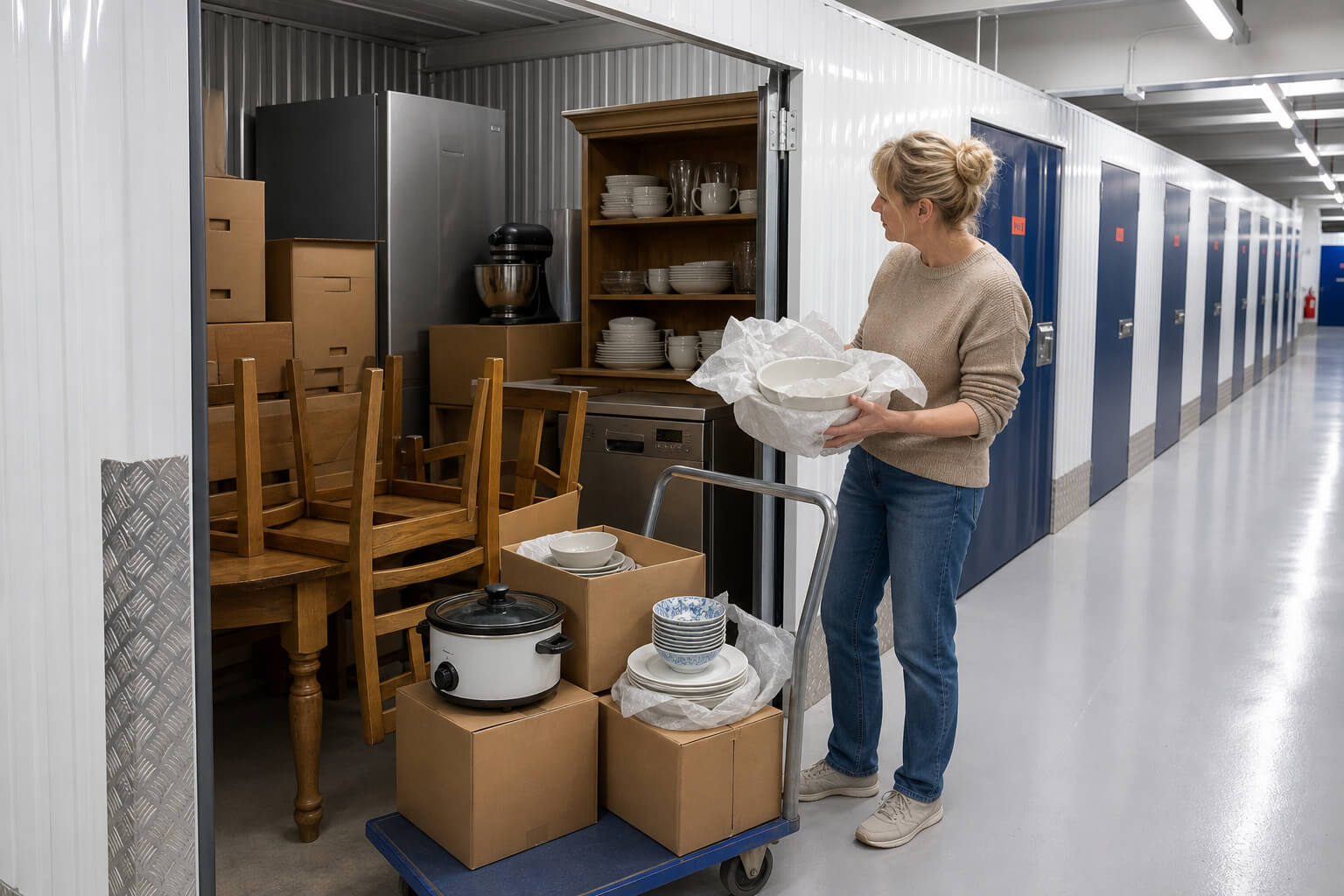
The sketch on the back of the envelope ends here. A confirmed start date, a list of what goes, a unit booked with a week’s cushion at each end, and a survival kit assembled before the skip arrives. Storage becomes the settled part of a complicated project, and the kitchen that comes back will come back in the same condition it left.

Get a quote for your kitchen renovation storage at quote.wigwamstorage.co.uk. Tell us your start date and what you are storing and we will find the right size.

Frequently Asked Questions

What do I do with the freezer food while the kitchen is out of action?

Plan the freezer down before the rip-out, because food is the one thing that cannot go into a storage unit. Storage is for the appliance, not its contents, so the freezer needs to be empty, defrosted and dry before it travels, and that means dealing with what is inside first. The simplest route is to run the freezer down in the weeks before the build. Stop restocking a month out, and start working through what is in there so it is as empty as possible by the start date. For whatever is left, you have a few options:

  • Eat it down in the final fortnight by planning meals around the contents.
  • Move the essentials into a cool box or a small spare freezer in the garage or utility for the duration, if you have one.
  • Ask a neighbour, friend or relative nearby to take a drawer of your freezer space for six weeks. Most are happy to help and it is easily repaid.

What you should not do is leave food in the freezer and store it switched off, or try to keep an appliance running in a unit. Units are not powered for customer appliances, and a freezer of food left off will spoil. Once the freezer is empty, defrost it fully, dry it out, and store it with the door wedged slightly open so the seal does not mould. Your survival-kit plan and your freezer plan should be made together, a few weeks before the skip arrives, not on the morning of.

Who disconnects the gas and electric appliances, and when should that happen?

A registered engineer disconnects anything connected to gas, and competent electrical disconnection should be done properly too, ideally folded into your fitter’s schedule rather than left to the day of the move. This is a safety matter, not a corner to cut. A gas hob, a gas range or a gas oven must be disconnected by a Gas Safe registered engineer, and reconnected by one at the other end. Do not attempt to uncouple a gas appliance yourself. For electrics, a freestanding cooker on its own circuit, or hardwired appliances, should be isolated and disconnected safely, which usually means your electrician or kitchen fitter as part of first-fix. The timing matters for your storage plan. You want appliances disconnected, cleaned and dried in the day or two before your removals slot, not still plugged in when the van arrives. Build a short gap into the schedule: engineer disconnects, you clean and dry the appliance, then it goes to the unit. Coordinate the date with your fitter when you book, because a missed disconnection is exactly the kind of thing that turns a tidy move-out into a scramble. Keep any certificates or paperwork from the gas engineer, both for the disconnection and the later reconnection, in your survival-kit box rather than in a stored carton, so they are to hand when the kitchen goes back in.

Should I store integrated appliances or leave them in place?

Most integrated appliances stay where they are if the carcass around them is staying, but in a full rip-out they come out and need the same handling as freestanding ones. The answer depends on the job. If you are keeping the existing units and only changing worktops, doors or tiling, the integrated oven, hob, dishwasher and fridge often stay built in and simply get protected in place by the fitter, in which case they are not your storage problem at all. If it is a full kitchen replacement, the old integrated appliances either go to the tip, get sold or donated, or, if they are newish and going back into the new kitchen, come out and need storing like any other appliance. Treat a stored integrated appliance exactly as you would a freestanding one: disconnect it safely (gas by a registered engineer), clean and dry the interior, tape the door slightly ajar, and store it upright. The complication with integrated units is that they often arrive without their original housing or fixings, so bag and label any brackets, screws and trim that come out with them and tape that bag to the appliance. A photo on your phone of how it was fitted before removal saves a great deal of guesswork when the new kitchen goes in. If in doubt about whether an appliance is worth storing and refitting versus replacing, the fitter is the right person to advise, since the labour to refit can sometimes outweigh the value of an older unit.

What about the old units and worktops being ripped out: can those go in the unit?

No, the old kitchen carcasses, worktops and rip-out waste are not storage items, they are waste, and they need a skip or a removal plan of their own. It is a common mix-up, so worth saying plainly: a storage unit is for the things you are keeping and bringing back, not for the debris of the old kitchen. Old units, broken worktops, ripped-out tiling and packaging from the new kitchen all go to a skip, to the tip, or out with the fitter if waste removal is part of their quote. Check that point when you book the fitter, because skip hire and waste disposal are sometimes included and sometimes not, and it changes your plan either way. If any of the old kitchen is still good, an old but serviceable freestanding cooker, a dresser you are not putting back, units someone could reuse, that is worth selling or donating rather than skipping, and it can leave the house before the build rather than cluttering it during. The only things that belong in your storage unit are the keepers: the dining furniture, the crockery, the good appliances going back in, the things you have carefully boxed and labelled. Keep that distinction clean in your head when you are packing, because paying to store something destined for the tip is money straight down the drain, and unit space you could have used for the things that matter.

How do I bring everything back so the kitchen goes back together smoothly?

Bring things back in reverse order of how the kitchen comes together, and use your 14-day notice as the window to do it in calm runs rather than one frantic day. The end of a kitchen job is staged: worktops go on, then appliances reconnect, then the room is decorated and snagged. Your belongings should return on the same rhythm. There is no need to empty the unit the moment the fitter says “done,” because snagging always takes longer than expected, and a half-finished kitchen full of boxes just gets in the way. Instead, when you can see the genuine finish line, give your 14-day notice. That gives you a fortnight to move things back in manageable trips, using the 6am to 10pm access seven days a week to fit runs around work. Bring the appliances back first, once the fitter confirms the services are ready for reconnection (gas by a registered engineer again). Then the dining furniture once the floor and decorating are done. Crockery and the contents of cupboards come last, when the units are in and clean, so they go straight into their new homes rather than sitting in boxes on the new floor. This is exactly where labelling by room and category earns its keep: a box marked “glasses” on the side goes straight to the right cupboard. By the time the notice period ends, the last boxes are home, the unit is empty, and you give it back with the account settled and the deposit returned.

Short Term Self Storage When Youre Between Homes After A Breakup

Between homes after a breakup and not sure yet where you’re going?

When a relationship ends, most people are not planning. They are reacting. A partner is moving out this weekend. Or you need your own things out of a shared place before it gets harder. You do not always know where you are going yet, and that is fine. You just need somewhere safe to put your belongings while you work it out.

That is exactly what short-term storage is for. Not a permanent answer. A bridge.

What follows is a plain account of how this works: the commitment involved, what it costs to start, what happens when you leave, and what you can and cannot store. No soft language. No traps.

The short version if you need it right now

  • Minimum stay: two weeks
  • Notice to leave: 14 days (deposit returned after you vacate and the account is settled)
  • Access: smart entry, 6am to 10pm, seven days a week
  • Get a quote now: quote.wigwamstorage.co.uk

When a relationship ends, your things need somewhere to go

This is not a dramatic statement. It is just true. When a shared home stops being shared, the practical question comes quickly: where do the things go while you sort out the next chapter?

Storage is not a permanent solution and it is not supposed to be. It is a way of buying yourself time without making a rushed decision about what to keep, what to let go of, and where it all ends up.

Buying yourself time, not making it permanent

When you put things into storage mid-separation, you are not committing to anything beyond a short stay. You are taking the physical pressure off the situation so you can think more clearly. The belongings are safe. They are yours. You can access them when you need to. And when your life settles into a new shape, you move them on.

People sometimes feel they should have a plan before they do anything. They do not. Getting things into a secure unit this week is the plan. Everything else can follow.

A neutral place that is just yours

One thing that matters when you are going through a separation is privacy. Your unit is your own. No one else accesses it. The sites are unmanned, which means no staff are handling your goods or observing your comings and goings. It is not a shared space. It is yours, for as long as you need it.

The units are individually alarmed, clean, dry and secure. Your belongings are looked after, and only you can get to them.

How short is short-term? The two-week minimum

The shortest stay at Wigwam is two weeks. That is the full extent of the minimum commitment. You do not need a long lease, a rolling six-month agreement, or any kind of long-term contract. Two weeks to start.

Stay as long, or as little, as you need

After those first two weeks, the stay is open-ended. There is no maximum. We have seen people move in for two weeks and move out in ten days once they found somewhere to land. We have seen people stay for six months. Both are completely fine.

The only commitments are the ones that are honest to state: a two-week minimum at the start, and 14 days’ notice when you are ready to go. That is it. You are never paying for months you do not need.

What the two-week minimum actually means in practice

In week one you bring your things in, get settled, and start making decisions at your own pace. In week two you know whether you need more time or whether things are resolving. If you are ready to go by the end of that fortnight, you give 14 days’ notice and you leave.

The full detail is in the terms and conditions. The headline, though, is simple: you are never trapped for longer than two weeks if things move faster than expected.

Leaving when you’re ready: 14-day notice and your deposit back

When you are ready to go, give 14 days’ notice. That is the process. No complex paperwork. No negotiation. You tell us you are leaving, you vacate the unit, the account is settled, and the deposit is returned to you.

The deposit comes back to you

There is a refundable deposit when you start. It is not a large figure and it is not lost money. Once you have given your 14 days’ notice, vacated the unit, and the account is settled, the deposit comes back. That is the mechanism, stated plainly.

We know that when you are mid-separation, the fear of being caught out by fine print is real. The deposit return is one of the things we want to be completely clear about. You are not leaving money behind.

We refund the days you don’t use

If your situation resolves faster than you expected and you leave before the end of a paid period, you are refunded for the unused days. You pay only for the time you actually use.

This is not something many storage providers state clearly. We think it matters, especially when the end date of a stay is genuinely uncertain. You should never be paying for days you have vacated.

Ready to get a quote?
You can do it in two minutes at quote.wigwamstorage.co.uk. No commitment until you sign up.

What size unit do you need?

A studio flat’s worth of belongings will usually fit in a 25 to 50 square foot unit. A full two-bedroom flat’s contents typically needs something in the 75 to 100 square foot range. These are starting points, not rules.

A few boxes, a room’s worth, or a whole flat

If you are moving out quickly and taking only your own things, you may need less space than you think. A few boxes, clothes, a piece or two of furniture, and personal documents can fit in a small unit. One room’s worth of furniture and boxes fits in a medium unit. A whole flat’s contents needs something larger.

The right size depends on what you are moving and how neatly it is packed. If you are not sure, it is worth starting with a rough estimate of what you are bringing and then checking the pricing and unit size guide before you book.

Getting the size right so you don’t overpay

The single most practical thing you can do to keep costs down is to right-size the unit. An oversized unit costs more every week for no benefit. If you are unsure, the how much does storage cost page walks through the unit sizes and what they hold.

We do not quote prices on this page because they vary by location and unit size. The pricing page has the detail. What we can say is that starting with a smaller unit and upgrading is possible if your circumstances change and you end up needing more space.

What you can and cannot store here

Household furniture, clothes, bedding, books, kitchenware, personal effects, documents, electronics and sentimental items are all straightforward. If it came out of a home, it almost certainly fits into one of our units.

Household goods and personal belongings: all fine

The full run of things you’d move out of a flat or house is exactly what the units are designed for. Boxes of clothes, a sofa, a bed frame, kitchen equipment, paperwork, personal effects. All of it is fine.

If you have delicate or sentimental items you are concerned about, the units are clean, dry and secure. That is what we can say. We do not offer climate-controlled storage and we do not make that claim.

What we cannot take: the short list

No vehicles. No cars, caravans, motorhomes, boats or motorbikes. No hazardous materials. No perishables. No living things of any kind.

If you are losing access to a shared vehicle during a separation and are wondering whether a storage unit is a solution, the answer is no, for practical reasons: our units are not designed or licensed for vehicle storage. The same applies to any kind of vehicle, regardless of size.

There are no exceptions to the hazardous materials rule, and the prohibited items list in the terms and conditions covers the full detail.

Getting your things in: smart entry and self-access

You access your unit yourself, by smart entry, between 6am and 10pm, seven days a week. There is no staff member to check in with, no sign-in desk, no appointment needed. You arrive, you use the smart entry system, and you go to your unit.

Smart entry: 6am to 10pm, seven days

The smart entry system is available every day of the week from 6am to 10pm. That is the access window, stated clearly. It is not 24-hour access, and we will not pretend otherwise. Most people find the 6am to 10pm window gives them everything they need, including early morning access before the working day starts.
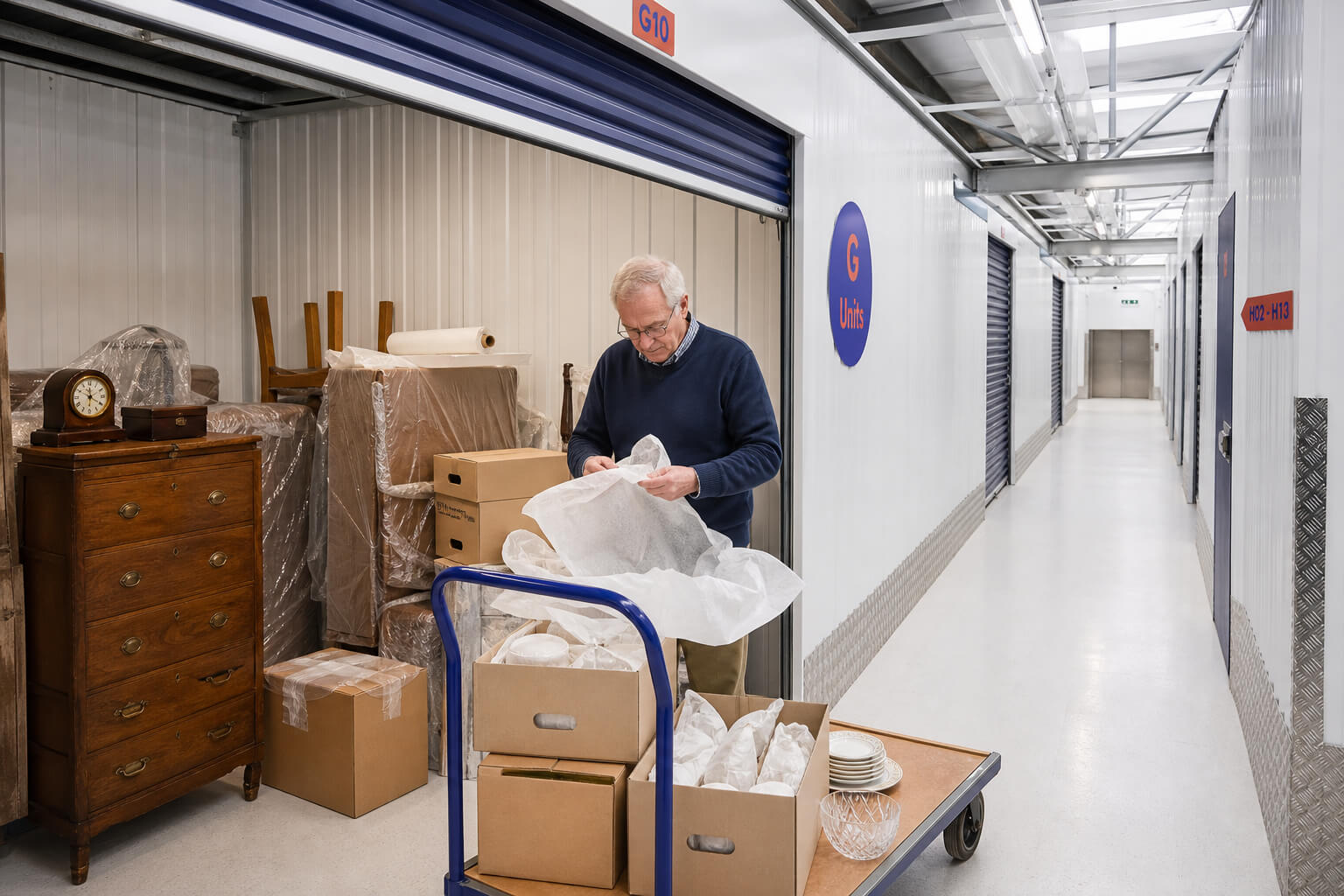
The system is straightforward to use. When you book, you will get the access details you need.

If you’re using a removal company

If a removal company or delivery service is bringing your things to the unit, someone from your side must be present. The sites are unmanned. Wigwam does not sign for deliveries, receive goods on your behalf, or supervise unloading. This applies whether the delivery is from a removal company or a courier.

Coordinate with your remover in advance so they know you need to be there when they arrive. It is a simple thing to plan for, and avoiding a wasted trip is worth a quick conversation beforehand.


Keeping your things safe while you’re between homes

Your unit is individually alarmed, clean, dry and secure. Only you have access. No one else can enter your unit, and the alarm is specific to your unit, not shared across the building.

Individually alarmed units, clean, dry and secure

The individual alarm means that if anyone attempts to access your unit without authorisation, it triggers independently of any other unit. Your things are not grouped in with someone else’s security.

Clean and dry is exactly what it says. Your belongings will come out in the same condition they went in. We do not claim to regulate temperature or humidity, and we do not offer climate-controlled storage. The environment is clean, dry and secure, and for the vast majority of household and personal belongings, that is what matters.

Protecting your belongings: contents cover

Contents protection is required. You can take Wigwam’s RSA-backed Self Storage Customers’ Goods policy, or you can prove you have your own adequate cover. Either works.

If you take the Wigwam policy, you will need to declare the full replacement value of what you are storing. If you under-insure, any claim will be settled proportionally. Theft claims require evidence of forcible entry. Climatic or atmospheric damage is excluded under the policy.

The full detail is at wigwamstorage.co.uk/contents-protection. We are signposting, not advising.

One point worth noting if you are going through a divorce or separation: questions about who legally owns the items being stored are not for us to answer. If there is any dispute about ownership of goods, speak to your solicitor before putting items into storage. This page covers England and Wales. Divorce and property law differs in Scotland and Northern Ireland, and readers in those jurisdictions should take local legal advice.

Find a unit in your market town

We have locations across UK market towns. The right one is usually the closest to where you are currently based, or halfway between your old home and your new one if you already have a rough idea where you are heading.

Towns we cover

Wigwam Self Storage Bath in Somerset and Wigwam Self Storage Lincoln in Lincolnshire are two of our market-town locations. For a full list of our UK market-town locations, the locations hub is the right place to start.

Each location page shows you the address, access details, and how to get a quote for that specific site.

Not sure which location is right for you?

If you are in transition and not yet settled in a fixed place, the practical choice is usually the location closest to where you are staying right now. If you have a rough sense of where you will land, somewhere between your current base and your next home can also work well.

The locations hub lists all our sites. If you are not sure which one suits, get in touch and we will point you in the right direction.

Ready to get a quote? It takes two minutes at quote.wigwamstorage.co.uk.

Frequently Asked Questions

Can I open an account and move in on the same day?

In most cases, yes, but it depends on availability at your chosen site and on getting the account set up first. The booking and the smart entry credentials have to be in place before you can access a unit, so the practical step is to get a quote at quote.wigwamstorage.co.uk as early in the day as you can, rather than turning up at the gate and hoping. Once the account is live and contents cover is sorted, you have the access details and you can go straight to the unit within the 6am to 10pm window.

When a relationship ends, the timing is often forced on you. A partner is moving things out this weekend, or you have a narrow window to clear your share of a shared home. The honest position is that we cannot promise a unit will always be free at the exact size and town you want at no notice. What we can say is that the faster the account is started, the faster you have a space to move into. If you know the move is coming, even a day or two of warning makes the whole thing calmer. Get the quote in, settle the cover, and the unit is ready when you are.

Whose name does the unit go in if the furniture belongs to both of us?

The account goes in the name of the person who books it, and that person holds the smart entry credentials. Only they can access the unit. This is worth thinking about carefully when you are mid-separation, because the account holder is the one in control of the space and the one responsible for the payments and the contents cover.

If the goods inside genuinely belong to both of you, the storage account does not settle who owns what. We do not arbitrate that, and we cannot. Questions about ownership of shared property during a separation are for your solicitor, not for us. What we would say plainly: only store items you are clear are yours to store, or items both sides have agreed should sit in neutral storage while things are sorted. If there is any doubt about who owns a piece, get legal advice before it goes in a van. A short written note of what was agreed, dated and kept by both sides, is sensible. We are signposting here, not advising: divorce and property law differs across England and Wales, Scotland and Northern Ireland, and your solicitor is the right person to guide you.

What happens to my deposit and notice if I find a new place faster than expected?

You give 14 days’ notice, vacate the unit, and once the account is settled the deposit comes back to you. If you leave before the end of a period you have already paid for, the unused days are refunded too, so you are not paying for time you did not use.

The point worth understanding is that the two-week minimum and the 14-day notice do not stack on top of each other into a month. The minimum stay is simply the shortest booking. The notice is how you end the rental cleanly. If you found somewhere to land in week three and you are ready to go, you tell us, the 14 days run, you clear the unit, and that is the end of it. For someone between homes, that matters: separations rarely run to a fixed timetable, and you should never feel trapped paying for an empty unit because your circumstances changed quickly. The whole arrangement is built to flex with a situation that, by its nature, is hard to plan.

Can my ex-partner get access to the unit, or ask you to let them in?

No. Only the account holder holds the smart entry credentials, and only they can access the unit. We do not hand access to anyone else, we do not hold spare keys, and we will not let a third party in on request, whoever they say they are. The sites are unmanned, so there is no front desk where someone could talk their way in. The locked unit is yours and yours alone.

For someone going through a separation, that privacy is often the quiet reason storage helps in the first place. Your belongings are in a neutral space that is not the family home and not a relative’s spare room, both of which can become flashpoints. Nobody is observing your comings and goings, because there are no staff on site. If there is any genuine legal dispute about the goods themselves, that is a matter for solicitors and, if it comes to it, the courts, not something we can or should resolve at the unit door. But the day-to-day reality is simple: the access is tied to your account, and it stays that way.

I can’t get into the old home to collect my things. Can Wigwam help with the move itself?

No, and it is better to be straight about that. We provide the unit, the secure space and the access. We are not a removals firm and we do not collect goods on your behalf. The sites are unmanned, so there is no one here to drive a van, supervise a load, or sign for anything. If you are using a removals company or a man-and-van service to bring your things in, someone from your side has to be present at the unit to receive them, because we cannot accept deliveries for you.

The point about not being able to get into the old home is a separate problem, and an important one. If access to a shared property is contested, that is a legal question for your solicitor, not a storage question. Do not force the issue or remove items you are not clear you are entitled to take. Once you do have your things and a way to move them, the unit is ready to receive them within the 6am to 10pm window. Coordinate the removals slot so you are there when the van arrives, and you avoid a wasted trip. A quick call with your remover beforehand sorts that out.

Self Storage For Emigrating Without Selling Up An Open Return

Moving abroad but not ready to sell everything you own?

There is a particular kind of move abroad where you do not burn the boats. The contract is for two years, or the adventure has no fixed end date, and the last thing you want is to sell the sofa, the books and the things that took a decade to collect, only to start from scratch if you come back. That is a different kind of move from emigrating for good, and it deserves a different kind of answer.

Storing rather than selling is how you keep the door open. It is how you stay the sort of person who could come home. This page is for you: someone going abroad with a UK base they want to mothball, not dismantle.

What follows is a plain account of how long-term self storage works for that situation, what it costs, how your things stay safe while you are thousands of miles away, and how you close the account cleanly when you are ready to come back, whether that is sooner than you planned or later.

Why store instead of sell or ship

Selling everything before a move abroad means buying it all again if you come back. For an open-ended absence, storing is often the cheaper and less final choice, and it keeps your options open in a way that a clearance sale does not.

When the move is open-ended or reversible

Some moves have a fixed end date. Most do not, not really. A two-year contract becomes three. A sabbatical turns into a life chapter. An adventure that was supposed to last twelve months stretches pleasantly into two. If you are honest with yourself, you are not sure when you are coming home, and you are not sure you want to commit to a date yet.

That is exactly the kind of move that self storage is built for. You are not being indecisive. You are being practical about a genuinely uncertain timeline. Storing what matters, rather than selling it at a loss under pressure, is the sensible call for anyone who wants to leave a door open behind them.

The cost of selling and rebuying

Think about what it would cost to replace a household from scratch. A decent sofa, a bed, a dining table, the accumulated kitchen equipment of years, the bookshelves, the art, the seasonal things you only need a few months a year. You would not get good money selling them in a hurry before a move, and you would pay full price to replace them when you came back.

Storing is not always cheaper than selling, but for a household that took years to build and would cost a great deal to rebuild, the arithmetic usually points in one direction. We do not quote prices here, but you can check what a unit costs on Wigwam’s pricing page and decide for yourself.

Freeing the house for tenants without a full clearance

Some people going abroad rent their home furnished and only need to move personal, sentimental or seasonal items into storage while tenants are in. Others clear the house completely before it goes to market or is let unfurnished. Both work. A storage unit gives you a place for whatever the house cannot hold in the meantime, whether that is a handful of boxes of irreplaceable things or the entire contents of a four-bedroom semi.

What to store, what to sell, what to ship

Not everything is worth storing for a year or more. Here is a plain way to sort the decision, based on what tends to be worth keeping and what tends to be cheaper to let go.

Worth storing: furniture, books, sentimental and seasonal items

Solid furniture, a good mattress, bookshelves and their contents, art, sentimental objects that cannot be replaced, musical instruments, sporting equipment you use seasonally, kitchen equipment that took time to accumulate, family documents and photographs. These are things that are either hard to replace, expensive to replace, or simply yours in a way that has nothing to do with money.

If you would feel the loss of it, it is probably worth storing.

Often worth selling: bulky low-value items you would replace cheaply

Flat-pack furniture that has been assembled and disassembled once too often, exercise equipment that was optimistic in the first place, large appliances in a property you are vacating, garden equipment if there is no garden to come home to. These are things that are straightforward to replace at modest cost and awkward to store efficiently. A good rule: if you can replace it for less than a year’s storage fee for the space it takes, let it go.

This is a heuristic, not a rule. Only you know what your things are worth to you.

Shipping is a separate decision: we store, we do not ship

If you want to take furniture or household goods abroad rather than leaving them behind, that is a decision for an international removals or shipping firm, not a self storage provider. Wigwam stores your UK household goods in the UK. We do not ship internationally, we do not advise on it, and we would not want to give you the wrong steer on something as significant as an international move. Find a reputable international removals company for that part of the conversation.

Ready to get a quote? Visit quote.wigwamstorage.co.uk to find your size and check availability at your nearest Wigwam location.

How long can you keep things in storage

There is a two-week minimum stay at Wigwam. There is no upper limit. Stay as long as you need.

The two-week minimum and no fixed upper limit

The shortest stay we offer is two weeks. Beyond that, there is no fixed end date and no pressure to commit to one. Your account runs for as long as you need it to, month by month, without penalties for an open timeline. If you know you are going for two years, fine. If you genuinely do not know, that is fine too.

This is not common across the industry. Some providers have minimum terms of a month or more, or expect you to commit to a fixed period. We do not, because we know that the nature of an open-ended move is that the end date is not yet known.

Why an open timeline suits an open return

The billing model is straightforward: you pay for the time your things are with us, and when you give notice, we return your deposit and refund any unused days. You do not have to decide how long you will be gone before you leave. The account simply runs until you are ready to close it.

That matters for someone going abroad without a fixed return date. You are not locked into anything. The unit is there, holding what you left behind, until the day you are ready to come home. It is the same principle as leaving the light on.

How Wigwam keeps it safe while you are away

Each unit is individually alarmed, and the buildings are clean, dry and secure. Here is what that means in practice, and what it does not mean.

Individually alarmed units, clean, dry and secure

Every unit at Wigwam has its own alarm. Not a shared corridor alarm, not a building-wide system that covers everything roughly. Your unit has its own alarm, so if it is opened without authorisation, that triggers its own response. The buildings are clean, dry and secure: maintained, well-lit, and built to keep your things in the condition you left them.

We do not offer climate control. We will not pretend to. The honest line is clean, dry and secure, and for household goods, books, furniture and the usual contents of a home, that is the right environment. If you need controlled temperature and humidity for something specialist, you need a provider that offers that; we do not.

Smart entry: access 6am to 10pm, seven days

Access to your unit is by smart entry, seven days a week, from 6am to 10pm. That covers most practical needs for you or for a person in the UK you trust with access.

We do not offer 24-hour access. You will see that claim from competitors, and it sounds reassuring. We think it is more useful to tell you the actual hours. If someone you nominate needs to collect something from your unit at 6pm on a Sunday, they can. If they need to get in at 3am, they cannot, and we would rather you knew that before you relied on it.

Unmanned sites: you control your own goods

Our sites are unmanned. That means there is no on-site team managing access or watching over units during the day. You, or a person you have authorised, access your own unit directly. That is the model.

It has one practical implication that is important to understand before you go abroad: if you are expecting a courier delivery to your unit, or if you need a courier to collect something from it, someone from your own household or business needs to be there in person to facilitate that. Wigwam does not sign for deliveries, accept parcels on your behalf, or manage courier access. The site is unmanned, so nobody can.

If you are managing a unit from overseas and you intend to have things delivered or collected, your nominated UK contact needs to be present for it. Plan for that before you fly.

What Wigwam does not offer: and why that matters

We do not offer climate-controlled storage. We do not offer 24-hour access. We do not store vehicles, caravans, motorhomes, motorbikes or boats. Sites are unmanned and we do not sign for couriers.

We tell you these things plainly because you are making a decision from a distance, and you deserve to know exactly what you are getting before you commit. A provider who tells you only the good things is not a provider you want to trust with your household goods for two years while you are on the other side of the world. Honest limitation is the trust signal. If any of those things matter to you, know now rather than after you have left.

Managing a unit from overseas

Running a storage account from another country is straightforward when you set it up properly before you go. Three things to sort before you fly.

Photograph and log what you store before you leave

Before the unit is loaded, take a room-by-room photograph of everything that is going in. Then write a brief inventory: a list by category is enough, you do not need a spreadsheet. Keep a copy in cloud storage or on a device you carry with you.

This serves two purposes. It gives you a record for the insurance declaration. And it answers the question you will inevitably ask yourself from abroad, usually at 11pm: did I actually pack that thing? A photograph log is simple to make and very useful to have.

Set up a Direct Debit before you go

The simplest way to run a storage account from overseas is to set up a Direct Debit before you leave and let it run. No manual payments to remember, no risk of a lapse because you forgot what time zone the bank operates in.

If your banking arrangements change while you are abroad, update the Direct Debit promptly. A lapsed payment is the one thing that can complicate an otherwise straightforward long-term account. Sort it before you go.

Nominating someone in the UK to access the unit

You can nominate a person in the UK to access your unit on your behalf. A family member, a trusted friend, a solicitor. If you need someone to check on things, retrieve an item, or facilitate a collection, they can do it.

Two things to be clear on before you set this up. First, your nominated person needs their own access authorisation; check the terms and conditions for how that works. Second, and this follows from the unmanned-site point above: if a courier or delivery is involved, your nominated person needs to be present in person. They cannot call ahead and ask Wigwam to take in a parcel. Plan any deliveries or collections around someone being physically there.

Insurance for goods you leave behind

Contents protection is not optional at Wigwam. You either take the policy Wigwam offers or prove you have your own cover. Here is what the Wigwam policy covers, and what you need to know before you declare a value.

The RSA Self Storage Customers’ Goods policy: opt in or prove your own

The policy in place at Wigwam is the RSA Self Storage Customers’ Goods policy. When you start your rental, you either take that policy or demonstrate that you have equivalent cover in place through your own insurer. You cannot store without one of those two in place.

The full detail of what the policy covers and how to take it is on Wigwam’s contents protection page. Read it. We signpost it; we do not advise on it.

New-for-Old, the £50 excess, and declaring full replacement value

The RSA policy operates on a New-for-Old basis, which means a valid claim is settled at the cost of replacing the item new, not its second-hand value. The excess on any claim is £50.

The critical thing to understand about the policy is how underinsurance works. You must declare the full replacement value of everything you store. If you declare less than the true replacement value, and you need to make a claim, the settlement is reduced proportionally to reflect the gap between what you declared and what the items were actually worth. Declare honestly, based on what it would cost to replace everything new. This is how the policy works; it is not advice.

What the policy covers and what it does not

Theft is covered following forcible entry to the unit. Atmospheric or climatic damage is excluded. This is consistent with the fact that Wigwam does not offer climate control: the policy reflects the actual storage environment honestly, just as the service description does.

For the full list of what is covered and what is excluded, go to the contents protection page. Read the policy document, not just the summary.

A note on jurisdiction: This page describes self storage and insurance practice in England and Wales. Scottish and Northern Irish law and consumer contract practice differ in some respects. If you have any doubt about how these matters apply to your situation, speak to a solicitor or independent insurance broker in the relevant jurisdiction. We do not give legal or insurance advice.

What long-term storage costs

The cost depends on the size of the unit you need and how long you store. Wigwam does not list prices here, but the pricing page shows current rates.

How size and duration drive the price

Unit size is the main driver of cost. The larger the unit, the higher the fee. Duration works differently here than at some providers: there is no discount for committing to a longer term upfront, and there is no penalty for a shorter stay than planned. You pay for the time your things are there, and if you come home earlier than expected, unused days are refunded.

For current pricing by unit size, go to Wigwam’s pricing page. Take a look before you get a quote, so you have a sense of what size you need and what to expect.

Coming home, or moving on

When you are ready to leave the unit, whether that is sooner than you planned or later, the process is straightforward. Give notice, settle the account, collect your things, and the deposit comes back to you.

Give 14 days notice and your deposit comes back

To close your account, give 14 days written notice. Once you have vacated the unit and the account is settled, with nothing outstanding, your refundable deposit is returned to you. That is the full sequence: notice, vacate, settle, deposit returned.

This is worth dwelling on for a moment. When you take out a unit and pay a deposit, you are not losing that money. It is held and returned to you at the end. The deposit is refundable. That is the honest version of a claim you will see some providers make in a less accurate way.

Refund of unused days if you return early

If you return home earlier than you planned, you do not pay for the days you do not use. Any unused days past your notice period are refunded.

This is the open return made concrete. The reason to commit to a storage unit rather than sell everything is that the decision is reversible, and the billing model confirms it. Come back in six months instead of two years and the account closes cleanly. You are not penalised for coming home. That is the point.

Whenever you are ready, get a quote at quote.wigwamstorage.co.uk and find your nearest Wigwam location.

Where you can store with Wigwam

Wigwam has self storage locations in UK market towns across England. If you are looking for a base that is genuinely local, not a warehouse on a ring-road outside a city, that is the kind of place we operate.

Our market-town locations

We have units in towns including Wigwam Self Storage Bath and Wigwam Self Storage Lincoln. For a full list of our UK market-town locations, including Reading, Berkshire, go to the locations hub.

Name a place you know and there is a reasonable chance we are nearby. And when you come home, the location you stored with is the same one you left. The same town, the same building, the same door. That matters when you are making a decision from the other side of the world.

Frequently Asked Questions

Can I pay for my storage from a foreign bank account or in a foreign currency?

The cleanest answer is to set up a UK Direct Debit before you leave, and the most reliable way to run an account from abroad is to keep a UK bank account open and let the payment run from it automatically. Sorting the payment method while you are still in the country, with full access to your bank, avoids the single most common complication of a long-distance account: a payment that lapses because the arrangement was harder to manage than expected once you had flown.

If you cannot keep a UK account, this is worth raising with the support team before you go, because they can tell you what payment methods the account accepts and how to keep it current from overseas. What they cannot do is advise on foreign exchange, the cost of international transfers, or your banking arrangements, because that is well outside storage and into territory only your bank or a financial adviser can properly cover. A few practical habits protect you whichever route you use. Set the payment up before you leave rather than after you arrive. Keep the contact details on the account current so any reminder reaches an inbox you actually read. And if your banking changes while you are away, update the payment promptly, because a lapsed payment is the one thing that can turn a quiet long-term account into a problem. The storage side is simple and predictable; the money side is yours to keep flowing. Settle it before you fly and it looks after itself.

What happens to my unit if I cannot return on the date I planned?

Nothing, because there is no date you are committed to in the first place. The account has no fixed end and no upper limit on how long you stay, so a return that slips from two years to three, or a plan that changes shape entirely, does not create a problem at the storage end. The unit simply keeps running, month by month, holding what you left until you are ready, whenever that turns out to be. An open-ended move is exactly what the terms are built for.

The mechanics are worth knowing from a distance. You only ever owe two weeks notice to close the account, given whenever your real return date firms up. The minimum stay is two weeks at the start, which has long since passed by the time an overseas absence is in question, and it does not compound with the notice period; they are separate things. The two practical risks to manage from abroad are both about keeping the account live, not about timing. Keep the payment running, ideally by Direct Debit, so an extended stay never trips over a missed payment. And keep your contact details current so we can reach you. If your return is delayed indefinitely, the account carries on as normal; if it is brought forward, you give your notice, your nominated UK contact or you clears the unit, and any unused days you have already paid for are refunded. The deposit comes back once the unit is empty and the account is settled. So a changed return date costs you nothing in penalties. You pay for the time your things were actually with us, and not a day more.

Can someone access or empty my unit on my behalf if I am still abroad when the lease ends?

Yes, provided you have set it up properly before you go. You can nominate someone in the UK, a family member, a trusted friend, a solicitor, to access the unit on your behalf, and that person can check on things, retrieve an item, or clear the unit entirely when the time comes. The arrangement has to be made in advance, because the same security that protects your goods means nobody gets in without authorised access. Your nominated person needs their own access authorisation set up on the account; the terms and conditions explain how that works, and it is worth confirming with the support team before you fly.

Two things follow from how the sites work, and both matter when you are managing this from overseas. First, the sites are unmanned, so there are no staff to let your nominee in or to hand goods over. They access the unit directly with their own authorised entry, within the access window of 6am to 10pm, seven days a week. Second, and this is the one people overlook, if a removal firm or courier is involved in emptying the unit, your nominated person must be physically present to let them in and oversee it. We do not sign for or release goods to a third party on your instruction alone, and we do not hold spare keys. So if you intend to have the unit cleared while you are still abroad, line up a UK contact with proper access, brief them on what is inside, and make sure they can be there in person for any collection. Get that in place before you leave, and closing the account from the other side of the world becomes a phone call and a visit rather than a problem.

How do I keep contents cover valid on goods stored for two years or more while I am overseas?

Keep the policy live and the declared value honest, and review it if the contents change. Contents cover is mandatory throughout the let, not just at the start, so over a long absence the thing to avoid is letting it lapse. If you take the RSA Self Storage Customers’ Goods policy through Wigwam, it runs alongside the rental, so keeping the rental payment current keeps the cover current too, which is another reason a Direct Debit set up before you leave is the sensible default. If instead you are relying on your own insurer, the responsibility to keep that policy in force, and to confirm it genuinely covers goods in self storage over a long period, is yours, and it is worth checking with your insurer that a multi-year storage situation does not breach any condition.

The value you declare is the part that quietly matters most over a long store. You must declare the full replacement value of everything in the unit, because under-insurance is settled proportionally: declare half the true value and a claim pays out roughly half the loss. Replacement cost is what it would take to buy the items new today, which for a household built up over years is usually more than people first estimate, so add it up room by room rather than guessing. Over two years, prices drift and the contents may change if your nominated contact adds or removes items, so it is worth a mental review if anything significant alters. Wigwam can tell you what the policy covers and point you to the contents-protection page for the detail, but we cannot advise on your insurance position or whether the cover suits your circumstances; for that, speak to your insurer or an independent broker before you leave. Keep it paid, keep the value true, and the cover holds for as long as the unit does.

Will damp or the British climate damage my furniture over a long store if there is no climate control?

For ordinary household goods, no, provided they go in clean and dry, because the unit is clean, dry and secure, which is the right environment for furniture, books and the usual contents of a home over a long period. The honest framing matters here: we do not offer climate control, and we will not pretend to. There is no managed temperature or humidity. What protects your things over a long absence is a dry, secure, individually alarmed unit combined with sensible packing, and for the vast majority of households that is exactly what is needed.

The risk to manage is moisture you bring in yourself, not the unit. Anything packed slightly damp, cushions, a mattress put away after a wet move, will sit in that state for as long as it is stored, so let everything dry fully before it goes in. Lift furniture and boxes off the floor on a pallet or boards, leave a little air around larger pieces rather than sealing them tight in plastic, and use breathable covers rather than wrapping wood in sheet plastic that traps condensation against the finish. This is consistent with the policy, where atmospheric and climatic damage is excluded, which is the honest reflection of an environment that is dry rather than conditioned. If you own something genuinely sensitive that needs a regulated temperature and humidity range, a specialist instrument or a fine antique, that needs a provider offering climate control, and we would rather tell you that plainly than imply we can do something we cannot. But for the furniture, books, kitchen equipment and seasonal things of a normal home, packed dry and stored sensibly, a clean, dry unit holds them in good order for two years just as well as for two months.

Downsizing Into A Bungalow A Room By Room Self Storage Plan

Moving somewhere with no loft — where does forty years of it go?

Most family homes keep their secrets in the loft. Forty years of things end up there because the loft is patient. It holds the Christmas decorations, the boxes of school reports, the dining chairs nobody sits on any more. It does not judge. It just waits.

A bungalow has no loft. That single fact changes everything about how you move.

If you are heading from a three-bedroom or four-bedroom house into a single-storey home, you are not just moving. You are renegotiating what you own and where it lives, in the space of a few very charged weeks. This guide is a room-by-room plan for getting through that renegotiation sensibly, without being forced into decisions you are not ready to make.

The one thing a bungalow takes away

A bungalow solves a great many problems. Stairs, for one. The need to carry shopping to a first floor. The draught that lives halfway up a staircase. But it takes something away in the same breath: the overflow space that every larger home quietly provides. No loft. Often no attic. Sometimes a garage that is smaller than the one you are leaving, or no garage at all.

That means when you start moving, there is no holding area. Everything in your family home has to make a decision at the door.

Why the loft problem hits bungalow movers hardest

Most downsizing advice online treats the loft as an afterthought. A heading, a paragraph, a note to sort through the boxes before moving day. In practice, the loft is often where a family’s history has settled over decades. Photos. Tax returns from 1998. A rocking horse that someone once loved. The camping equipment from that summer in Brittany that everyone still talks about.

Those things did not end up in the loft by accident. They ended up there because they were not ready to be decided about yet. The loft was doing a job: it was buying time.

A well-run storage unit does the same job. The difference is that a storage unit is on the ground floor, it is individually alarmed, and it gives you a key. You are not hiding things away. You are putting them somewhere clean and dry while the new floor plan shows you what it needs. That is the whole idea, and it is a sensible one.

Less floor space, different room shapes

Beyond the loft, bungalows simply have different proportions. The Victorian corner sofa that dominated your old living room may not turn into the new hall. The freestanding wardrobe that seemed modest in a high-ceilinged bedroom may overwhelm a lower-ceilinged bungalow room entirely. The mahogany sideboard with the double doors, the one everyone calls a family heirloom, may be a metre too wide for the wall it was going to go on.

A tape measure is the first tool you need. Not a storage unit, not a removal van. A tape measure, the floor plan of the bungalow, and an honest afternoon.

Why the usual downsizing advice does not quite fit

Much of what appears online when you search for downsizing advice is American, or Canadian, or general enough to apply to anyone moving anywhere. A bungalow-specific plan needs to be different. The rooms are different. The scale is different. The structural fact of no loft is different. The room-by-room plan below starts from those differences and works outward from there.

Measure first, then decide

Before anything goes into boxes, before you book the removal firm, before you even think about storage: go to the new bungalow with a tape measure and the current dimensions of your largest furniture. This is the single most useful thing you can do in the early weeks. It turns the whole process from guessing to knowing.

Get the new room dimensions before moving day

Walk every room of the new bungalow with a notepad. Measure ceiling height as well as floor area, because furniture that looks fine on a plan can feel oppressive under a lower ceiling. Note which walls are solid and which have radiators, windows or doors that limit where furniture can sit. Then go home and hold those dimensions against your largest pieces.

Many removal firms offer a pre-move survey at no extra charge, and it is worth taking them up on it. They see hundreds of moves a year and can tell you quickly whether the oak dining table will pass through the hall, or whether you will be storing the chairs.

Furniture that rarely makes the cut in a bungalow

In my experience helping people store through a move, the same pieces come up again and again. Freestanding wardrobes, because fitted wardrobes are the norm in bungalows and freestanding ones take up a lot of floor space. Large corner sofas, because the rooms that were designed for them were bigger. Double-door sideboards and oak dressers, because the walls are shorter and narrower. Spare-room beds, because the spare room itself is often gone.

None of that means these things should go to the tip. It means they need somewhere to wait while you get settled. Storing them rather than making a panicked decision keeps the options open and the regrets low.

The temporary holding rule

A storage unit does not have to be a long-term commitment. At Wigwam, the minimum stay is two weeks. After that, you give 14 days’ notice, vacate the unit, and once the account is settled and the unit is empty, the refundable deposit is returned and any unused days are refunded. That is the honest version of the terms, and it matters.

It means you can take a unit for the moving period, use it while you settle in, and leave when you are ready. The decision about what to keep, what to offer to the children, and what to let go does not have to be made in the middle of completion week. The unit holds the space open while you breathe.

A room-by-room plan

This is the section that earns the title. Not a general list of tips, but an actual walk through the rooms of a family home with a bungalow move in mind.

The lounge

The lounge is usually where the most contested decisions live. The sofa. The armchairs. The Welsh dresser or display cabinet that has always anchored the room. The bookshelves.

A useful way to approach it: keep what fits the new floor plan and what you cannot imagine the new home without. Store what is not ready to be decided about and what might find a role once you have lived in the new space for a month. Let go of true duplicates, pieces already in poor condition, and anything you only keep out of obligation.

The second armchair often falls into the store pile. So does the large occasional furniture that filled corners in a bigger room. The display cabinet with the family china is worth storing in a clean, dry unit for a few months before you decide whether there is a wall for it. There usually is, once the room has settled.

The bedrooms

The emotional weight of the bedrooms tends to catch people off guard. Your own bedroom is manageable; you know what you need. But the spare bedroom, the one that used to be a child’s room, and the one that has accumulated everything without a home, those are harder.

A bungalow often has two bedrooms, sometimes three. If you are moving from four, one bedroom simply disappears. All the furniture in it, and all the things that were stored there because there was room, now have nowhere obvious to go.

Storing the guest bed is a practical solution that often gets missed. It means the bungalow does not need a permanent guest bedroom to receive visitors; the guest bed lives in the unit until someone is coming, and then the conversation about where it goes can happen at a calmer moment. A small storage unit can act as a spare room for furniture in a way that a skip cannot.

The kitchen

A kitchen produces duplicates. Two sets of everything, accumulated across decades of changing tastes, wedding presents, and hand-me-downs from parents. Most bungalow kitchens are modestly sized, and the new one is unlikely to have room for the casserole dishes from the seventies and the newer ones both.

The good china is worth particular thought. A clean, dry, individually alarmed unit is a sensible home for a tea service that only comes out twice a year. It is not a perfect solution, but it is much better than a damp garage, a daughter’s attic, or a decision made under pressure. The units are clean, dry and secure. That is the honest claim, and for fragile ceramics during a transition period, it is enough.

Work through the kitchen methodically: keep what gets used at least twice a month, store things with genuine sentimental value or future use, and let the duplicates go to a local charity shop.

The garage and shed

This is where people get into difficulty, because garages accumulate differently from houses. Tools, garden machinery, bikes, golf clubs, sports equipment, decades of fixtures and fittings from projects long finished. A bungalow garage, if there is one, may be smaller than the one you are leaving.

One important point before you plan anything: Wigwam units are for household goods only. There is no vehicle storage, no space for caravans, motorhomes, boats or leisure vehicles. Tools, garden equipment, bikes and sports kit are all fine. Anything motorised and road-registered is not.

The other thing to know is that Wigwam sites are unmanned. You access your own unit, your own way, during access hours. If you are arranging for a removal firm or courier to deliver goods to the unit, someone from your side needs to be there in person to receive them. Wigwam does not sign for or receive deliveries.

Plan the garage contents into two lists: what goes straight to the bungalow garage, and what goes into storage while you work out what you actually need now. A lot of tools from a large house become redundant in a bungalow. But you will not know which ones until you have been in the new place for a few weeks.

The loft itself

This is the room that does not exist in the bungalow, and it is the one that most needs a plan.

Open almost any family loft and you will find the same things: boxes that were moved from the previous house and never reopened, seasonal decorations, family photographs, children’s toys kept for grandchildren, documents going back further than anyone can explain, and a number of items that nobody can identify but everyone is reluctant to throw away.

None of that is rubbish. It is a family archive, and it has lived in the loft because the loft was the right place for it: out of the way, safe, not requiring a decision. Moving into a bungalow means the loft goes away. The archive needs a new home.

A storage unit is the honest answer to this. It is literally what a storage unit is for: things that are not ready to be decided about yet, held somewhere clean and dry and accessible, waiting for when the time is right. Label everything clearly. Stack logically. Leave room to walk in and find what you need. The unit becomes the new loft, except it has a proper door, a light, and an alarm.

Know roughly how much you are clearing? Get a size and price guide at how much is self storage in the UK. When you are ready to get a quote, go to quote.wigwamstorage.co.uk.

Sentimental and valuable items: do not decide these in a fortnight

The hardest calls in a house move are not about furniture. They are about the things that carry meaning: the rocking chair that nobody sits in but everyone remembers, the boxes of letters, the collection of items that belonged to someone who is no longer here.

These things deserve more time than a completion fortnight allows. That is not sentiment for its own sake. It is practical advice.

Why a few months of storage is better than a permanent decision under pressure

A storage unit rented for three or four months costs less than the regret of clearing something you cannot replace. This is not a sales line. It is what people tell us after the move, when they have settled in and the bungalow floor plan has had time to tell the truth.

Some items that seemed impossible to accommodate turn out to fit somewhere once the furniture settles. Some items you thought you might keep turn out to feel wrong in the new space, and parting with them becomes easy once you can see that. Either way, the unit gives you the time to let the answer arrive rather than forcing it.

Storing sentimental items properly, in a clean and dry unit, is not the same as avoiding a decision. It is patience made practical. The decision can still be made, and it will be better made in three months than in three weeks.

Protecting what you store (contents cover)

Contents cover is not optional at Wigwam. You either take Wigwam’s RSA Self Storage Customers’ Goods policy or you bring evidence of your own policy that covers goods in storage. Either way, cover needs to be in place from day one.

Whichever route you take, declare the full replacement value of what you are storing. Under-insurance is settled in proportion, which means if you insure for half the value and lose the lot, you will be paid for half the lot. Declare honestly and fully.

The current policy carries a GBP 50 excess. Theft is covered, but only following forcible entry. Climatic damage, including atmospheric moisture and water ingress, is excluded.

Full details of Wigwam’s policy are at wigwamstorage.co.uk/contents-protection. Read it before you start moving. For independent advice on whether the policy suits your particular situation, speak to an independent insurance broker.

A note on jurisdiction: Insurance is a regulated product. The information above describes Wigwam’s current offering and is relevant to customers in England and Wales. Policy terms, exclusions and regulatory requirements may differ in Scotland and Northern Ireland. If you are storing in those parts of the UK, check the full policy wording carefully and seek independent advice if you are uncertain.

What clean, dry and secure actually means (and what it does not)

The units are individually alarmed, clean, dry and secure. That is the real claim and it is the right one for most household goods in a transition move.

What it does not mean is climate-controlled storage. There is no temperature regulation. There is no humidity management. If you are thinking about storing temperature-sensitive items such as wine collections, specialist photographic materials or certain medical equipment, that is a different conversation and Wigwam’s units are not the right place for those things.

For furniture, ceramics, clothing, books, bedding, seasonal decorations, family keepsakes and the typical contents of a family home: clean, dry and secure is a reasonable and honest standard, and it is what you will get.

What size unit do I need

The right size depends on how much you are clearing, not just how many rooms you have. Two people who move from the same size house can need very different amounts of space, depending on how much they are storing versus letting go.

That said, bedroom count is a useful starting point.

A rough guide by number of bedrooms

As an approximate guide:

  • Clearing one bedroom’s worth of goods: a small unit, roughly the size of a single garage or a large walk-in cupboard, typically suits.
  • Clearing two to three bedrooms plus a loft: you are likely looking at a medium unit, roughly the size of a single garage, possibly larger.
  • Clearing a full four-bedroom house including loft and garage: a large unit or two smaller ones, depending on what you are keeping.

These are starting-point figures only. Bulky items such as sofas, dining tables and wardrobes take up more space than the number of pieces suggests, because of their shape. Boxes, on the other hand, stack efficiently.

Use the online size and cost guidance

The most reliable way to choose a unit size is to use Wigwam’s own size and cost page. It walks you through what different units hold and what they typically cost, without requiring any commitment. No prices are published in this article because they vary by location and change over time; the guide at wigwamstorage.co.uk/how-much-is-self-storage-in-the-uk will give you the current picture.

How long will you need it

The honest answer is that you will not know until you are in the bungalow. And that is fine.

The two-week minimum and what it means in practice

The minimum stay at Wigwam is two weeks. That exists to keep the process manageable for both sides. In practice, most people using storage for a house move stay for longer than that.

After the minimum stay, you give 14 days’ notice. Once you have vacated the unit and settled the account, the refundable deposit is returned and any unused days are refunded. That is the complete, accurate version of the terms. There is no long lock-in. Full details are at wigwamstorage.co.uk/terms-conditions.

The flexibility matters because a downsizing move does not have a fixed end date. You might need the unit for six weeks or for six months. Both are normal.

A realistic downsizing timeline

In most transitions, the practical work of unpacking and deciding takes one to three months. Getting the bungalow set up, working out which furniture fits where, figuring out which pieces the children actually want to collect and which will be going to the charity shop: that takes time.

Some people keep a unit for longer, sometimes a year, while they work through sentimental items at a pace that suits them. There is nothing wrong with that. The unit is there for as long as it is useful, and you can leave when you are ready. Some people discover the unit is no longer needed sooner than expected, once the new floor plan has settled and certain things have clearly found their home. Either way, the terms give you the room to find out.

Storage as a buffer when the chain is staggered or delayed

Completions do not always align. In a downsizing move, this is particularly common: you may be ready to move but your buyer’s chain is running two weeks behind, or your bungalow vendor needs a later completion date that your buyer cannot accommodate. The result is a gap, and furniture that has nowhere to go during that gap.

When completion dates do not align

A storage unit solves this cleanly. If you need to vacate the family home before you can move into the bungalow, the unit holds everything while the legal process catches up. You are not camping in an empty house, and you are not paying a removal firm to store your belongings in their warehouse at short notice.

Access to the unit is yours throughout, by smart entry, every day of the week. If you are arranging for a removal firm to bring goods directly to the unit, remember that someone from your side needs to be present. The sites are unmanned and Wigwam does not receive deliveries on customers’ behalf.

Access during the transition

Smart entry means you can come and go between 6am and 10pm, seven days a week. For a staged unpacking, where you visit the unit several times over several weeks to retrieve pieces as the bungalow is ready for them, that window is more than enough. Early starts are fine. Weekend visits are fine. You are in charge of when you come and when you leave.

Choosing a Wigwam yard near your new bungalow

Where your unit sits matters more than most people expect when they are first choosing one.

Why location matters more than price when downsizing

A storage unit that is 45 minutes from the new bungalow is much harder to use than one that is 10 minutes away. When you are making multiple visits to retrieve furniture, drop off boxes or collect seasonal items, that journey time compounds. Proximity is a practical advantage that outlasts the initial saving from a cheaper, more distant yard.

Choose a unit that you could visit on a Tuesday afternoon on the way back from the shops, not one that requires a dedicated trip.

Our UK market-town locations

Wigwam operates across our UK market-town locations. For customers moving into a bungalow in the south west, Wigwam Self Storage Bath in Somerset is a useful starting point. For customers in the east Midlands and Lincolnshire, Wigwam Self Storage Lincoln is similarly placed.

For all other locations, the full list is at wigwamstorage.co.uk/self-storage-locations. Do not guess at a location from the name of a town; use the locations page to find the yard nearest to where you are moving.

Do not let the unit become a permanent second home for things you are avoiding

A storage unit is a tool for transition, not a place to defer decisions indefinitely. The best use of a unit is purposeful: you know roughly what is in it, roughly why it is there, and roughly when the decision about it will be made.

Label everything, leave an aisle, write an inventory

Three practical steps that make a storage unit genuinely useful rather than quietly overwhelming.

Label every box on the side facing the door, not the top. When boxes are stacked, the top label disappears. A side label stays visible. Write what is in the box, not just the room it came from. “Lounge” tells you nothing when you are looking for the reading lamp. “Lounge: table lamp, spare cables, photo frames” tells you everything.

Leave a central aisle in the unit. Even a narrow one. The temptation is to fill every inch, but a unit you cannot walk into is a unit you will not use well. Stack your heaviest and least-needed boxes at the back and your most likely candidates for retrieval near the front.

Keep a one-page inventory at home, not in the unit. A simple list of what is there, roughly where it sits, and what it is waiting for. This does not need to be elaborate. It needs to exist.

The six-month review

Set a diary reminder for six months after your move-in date. By then, the bungalow will have settled. The furniture will be in its places. The rooms will have told you what they need and what they do not. Some things in the unit will have clearly become available for the charity shop or for the children to collect. Others will have earned their place and will be coming back into the home.

That review is when the unit does its final work. Not by holding things indefinitely, but by giving the new floor plan time to tell the truth before the hard decisions are made. Six months is usually enough. Some people need a little longer and that is fine. But the review date is worth setting, because without it the unit can drift from a tool into a habit, and that is a more expensive outcome than anyone intended.

If you are ready to see what size and cost looks like for your move, start at wigwamstorage.co.uk/how-much-is-self-storage-in-the-uk. When you are ready to take the next step, get a quote at quote.wigwamstorage.co.uk.

Frequently Asked Questions

What happens to my belongings if the bungalow purchase falls through after I have already cleared the family home?

The unit holds everything safely for as long as it takes you to find another property, with no fixed end date pressing on you, which is precisely why a flexible storage arrangement is worth having during a chain. Purchases collapse for all sorts of reasons, a survey problem, a buyer pulling out further down the chain, a seller changing their mind, and when it happens after you have committed to moving out, your belongings need somewhere to live in the meantime. That is the job the unit does. There is no assumption that you will be in and out within a set window. If the bungalow falls through and you have to start house-hunting again, the unit simply continues on the same terms while you do.

This is one of the strongest reasons not to rush the decision to clear and store rather than gamble on perfectly aligned completions. The minimum stay is two weeks, and beyond that you stay for as long as you need, whether that turns out to be a month or the better part of a year. When you finally complete on a new place, you give 14 days’ notice, move your things in, and the refundable deposit and any unused days come back to you. Access throughout is yours by smart entry, 6am to 10pm, seven days a week, so you can get to anything you need while you wait, paperwork, seasonal clothing, a particular item, without disruption. The one practical reminder is that the sites are unmanned, so when a removal firm eventually brings your goods to the new bungalow, or if anything is delivered to the unit in the meantime, someone from your side must be present, because there is no staff on site to receive goods for you. A failed purchase is stressful enough; knowing your belongings are secure and the storage will not penalise the delay removes at least one worry from it.

Should I store the guest bed and visitor furniture long term, or is that not what storage is for?

Storing a guest bed is a perfectly sensible long-term use of a unit, and for many bungalow downsizers it is one of the smartest decisions they make. A bungalow with two bedrooms instead of four often has no room to keep a permanent guest bed standing idle, yet you still want to be able to put up family when they visit. The unit lets you have it both ways: the guest bed, and perhaps a folding table and spare chairs, live in the unit until someone is coming to stay, then come out for the visit and go back afterwards. You keep the capacity to host without surrendering a whole room of your smaller home to furniture that is used a few weekends a year.

This is a slightly different use from the transitional “decide later” storage that most of the article describes, and that is fine; a unit can serve both purposes at once. The thing to weigh is simply whether the ongoing cost of the unit is worth it to you against the alternative of buying a sofa bed or a folding guest bed that tucks away in the bungalow itself. For some people the storage route wins, particularly if they are also keeping other furniture in the unit and the guest bed is just part of the load. For others, once the rest of the unit empties out, it makes more sense to bring in a space-saving bed at home and close the unit. Because the terms are flexible, you are not committed either way: you can keep the unit as long as it earns its place and give 14 days’ notice when it no longer does, recovering your deposit and unused days. Pack the bed properly, dismantled and wrapped, label it clearly, and keep it near the front of the unit so the periodic retrieval for visitors is quick and easy.

Can I store garden furniture, the mower and outdoor things over winter, given the bungalow garage is smaller?

Most garden furniture, tools and equipment store well over winter, with two clear exceptions to keep in mind. A bungalow garage is often smaller than the one you have left, or there may be no garage at all, so a unit is a practical home for the outdoor things you do not need through the colder months: garden furniture, parasols, cushions, hand tools, and the mower. Getting them under cover protects them from a winter of weather and frees up the limited space in the new garage for what you actually use day to day. The unit is clean and dry, which suits this far better than a damp shed or an exposed corner of the drive.

The two exceptions matter. First, anything with fuel in it cannot go into storage: a petrol mower or strimmer must be drained of fuel and oil before it is stored, because fuel is a flammable hazard that is not permitted in a unit. A battery or electric mower, emptied and clean, is fine. Second, the unit is for goods, not vehicles, so while a mower counts as equipment, anything road-going or motorised in the vehicle sense, a quad, a sit-on mower large enough to be classed as a vehicle, and certainly any caravan, motorhome or trailer, is not something the unit can take. For ordinary garden kit, the practical preparation is simple: clean off soil and grass so you are not storing damp organic matter, let everything dry fully, wrap or cover what you want to keep pristine, and stand items so they are stable. Cushions and soft furnishings do best in a sealed box. Come spring, you retrieve it all by smart entry whenever suits, and if by then you have decided some of it has no place in the smaller garden, that is an easy thing to pass on or let go.

How easy is it to get to the unit if my mobility is limited, and is access all on one level?

Access is at ground level and on your own schedule, which suits anyone for whom stairs or rigid timings are a difficulty. Part of the reason people move to a bungalow is to live on a single level, and the unit fits that thinking: you reach it by smart entry and the access is designed to be straightforward, without the need to negotiate flights of stairs to get to your belongings. Because the sites are unmanned and run on smart entry from 6am to 10pm, seven days a week, there is no queue, no waiting for a member of staff, and no pressure to come at a busy time. You can choose a quiet morning or a calm afternoon when you have help to hand and energy to spare.

A few practical things make it easier still. When you load the unit, leave a clear central aisle so you can walk in and reach what you need rather than climbing over a wall of boxes, and keep the lighter, more frequently needed items near the front. A folding trolley or sack truck is well worth having for moving boxes between the car and the unit, sparing you the lifting. And because you can authorise family to access the unit as well, an adult child or grandchild can come along for the heavier visits or call in on your behalf when you would rather not make the trip yourself. For the big move itself, a local removal firm handles the furniture, so you are never expected to shift heavy pieces alone. If you have a specific concern about reaching a particular unit, it is worth raising when you book so you can be matched to a unit that suits, rather than discovering an awkward layout later. The whole point of the arrangement is that you use it at your own pace, with whatever help you choose, on a single level.

If I decide to keep a large piece after all, how do I get it into the smaller bungalow doorways?

Measure the doorways and access route before you commit to bringing a large piece back, because the commonest disappointment in a bungalow move is discovering a beloved item simply will not fit through the door. The unit actually helps here, because it gives you the time to check properly rather than finding out on moving day. While the piece waits in storage, take the dimensions of the bungalow’s doorways, hallways, any tight turns, and the wall the furniture is meant to sit against, and hold them against the measurements of the piece itself. Remember to allow for the diagonal: a wardrobe or sofa often goes through at an angle, so the critical figure is sometimes the diagonal of the doorway, not its straight width.

If the measurements are tight, there are usually options before you give up on the piece. Many items come apart more than people realise: wardrobe doors and feet, bed frames, table legs, the backs and arms of some sofas. Dismantling for the move and reassembling inside is often the difference between a piece that fits and one that does not, and the unit is a good place to do that disassembly in advance, calmly, rather than in the doorway with a removal crew waiting. A professional removal firm sees this constantly and can advise quickly whether a piece will go in, and how; many will tell you during a pre-move survey. Where a treasured item genuinely cannot be made to fit, the unit again gives you room to decide gently rather than under pressure, whether to offer it to family, sell it, or let it go. The honest sequence is: measure first, try dismantling, take professional advice if it is close, and only then make the keep-or-part decision. Doing that while the piece sits safely in a clean, dry unit is far less fraught than discovering the problem with the van already on the drive.