Self Storage When Youve Outgrown The House But Arent Ready To Move

Outgrown the house but not ready to move — is there a third option?

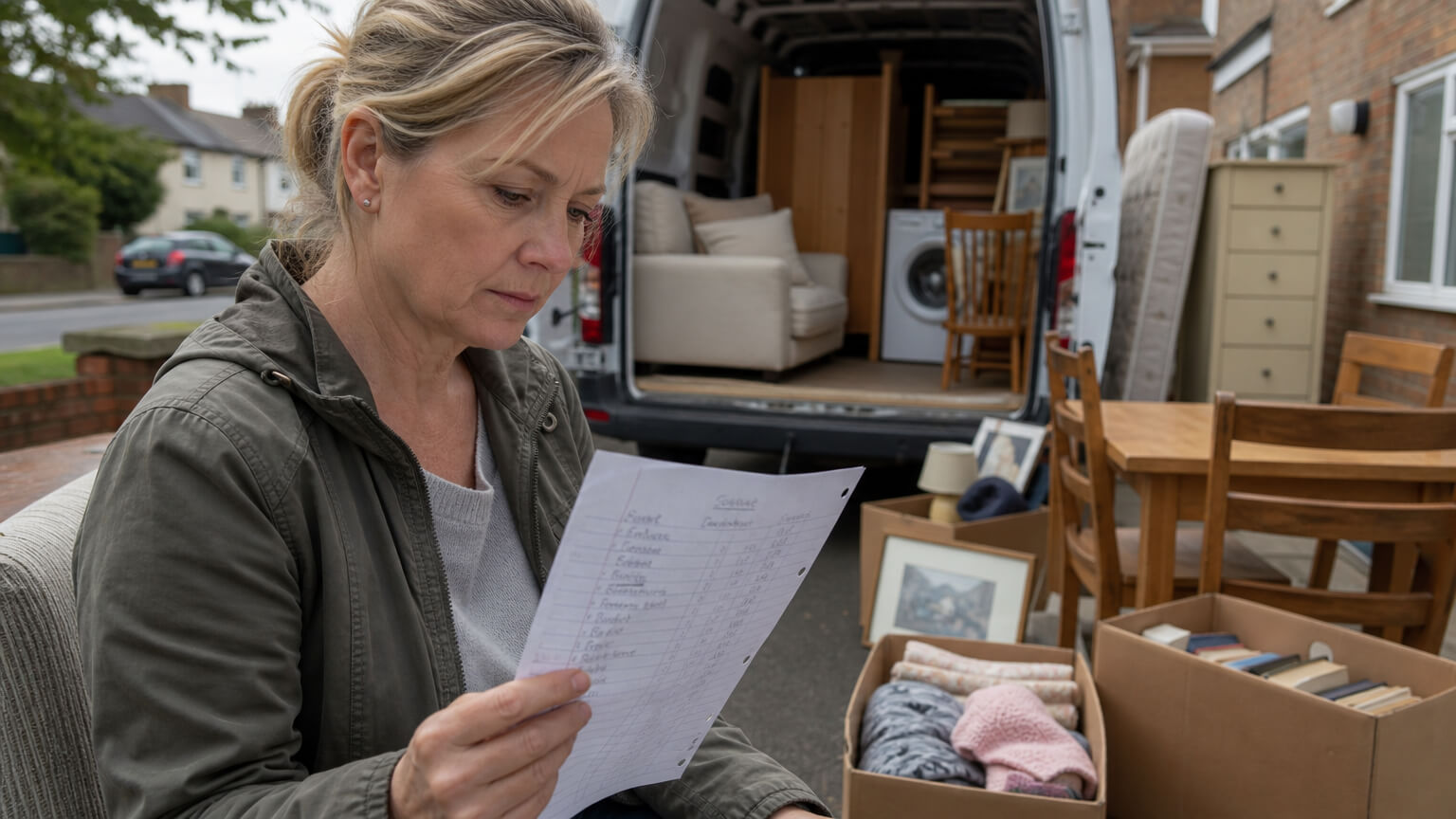
There is a moment most households recognise. A room that used to be a spare bedroom is now a holding zone for everything that does not have anywhere else to go. The pushchair is in there. The boxes from the last move that you never quite unpacked. The set of dining chairs from your parents’ house that you are not ready to part with. You close the door on it, and it quietly bothers you.

The obvious answer is a bigger house. The other obvious answer is a clear-out. But there is a third answer that sits between the two, and it is worth understanding before you commit to either of the others.

This page will give you an honest framework for working out which answer fits your situation. That includes telling you when decluttering is the better move than paying for storage. We will also look at what storage actually costs compared to moving, how the terms work in plain language, and what the fine print says that other providers tend to bury.

First, be honest. Is it a clutter problem or a space problem?

The single most useful question before you spend any money is this: do you have too much stuff, or do you genuinely not have enough rooms for how your household lives now? The answer changes what you should do next.

When it is mostly a clutter problem

If the room is full of things you could honestly sell, donate or throw away, storage is not the right first step. Every UK forum thread on this subject comes to the same conclusion, and they are right. Decluttering is free. A charity collection costs nothing. A marketplace listing takes twenty minutes. If a clear-out would reclaim the room, that is the place to start.

This is not a popular thing for a storage operator to say. But if decluttering solves the problem, the problem is solved, and you have not taken on a monthly cost that was not necessary.

When it is a genuine space problem

Some households have done the clear-out and the room is still spoken for. A new baby means the study has to become a nursery, and there is nowhere for the study contents to go. A parent moving in means a room needs to change function, and the furniture that was in it has to move somewhere. A growing business at home has outgrown the corner of the kitchen table.

In those situations, you do not have a clutter problem. You have a space problem, and storage is a credible answer while you work out what happens next.

When the answer is both

Most households are actually in this category. There is some genuine clutter mixed in with things that do matter and do need to go somewhere. The honest path is to declutter first, store what is left, and then reassess with a clearer head. Storage works best as the bridge after the clear-out, not instead of it.

The options before you commit to moving

Before you start looking at rightmove, it is worth laying out the full menu. Moving is one answer. It is not the only one.

Declutter, donate, sell (the option that always comes first for good reason)

Start here. It is free, it is immediate, and it raises the ceiling on everything else. Local charity shops collect furniture. Council-run household waste recycling centres take bulk items. Marketplace apps will move good-quality furniture faster than you expect, often within a week. If the room clears, the job is done.

I would rather you try this first. If you come to storage having already stripped out what you do not need, you will rent a smaller unit, pay less, and store the things that actually matter to you.

Use the space you already have differently

Loft conversions, garage clearances, furniture swaps between rooms and honest reallocation of how your home’s rooms are used can all recover usable space without spending anything on storage or stamps. A set of flat-pack shelves in a garage can free up a room. Letting go of a sofa that two people rarely sit on can reopen a living space. These options are not Wigwam’s territory, but they are worth exhausting before anything else.

Store what you are not using and reclaim a room

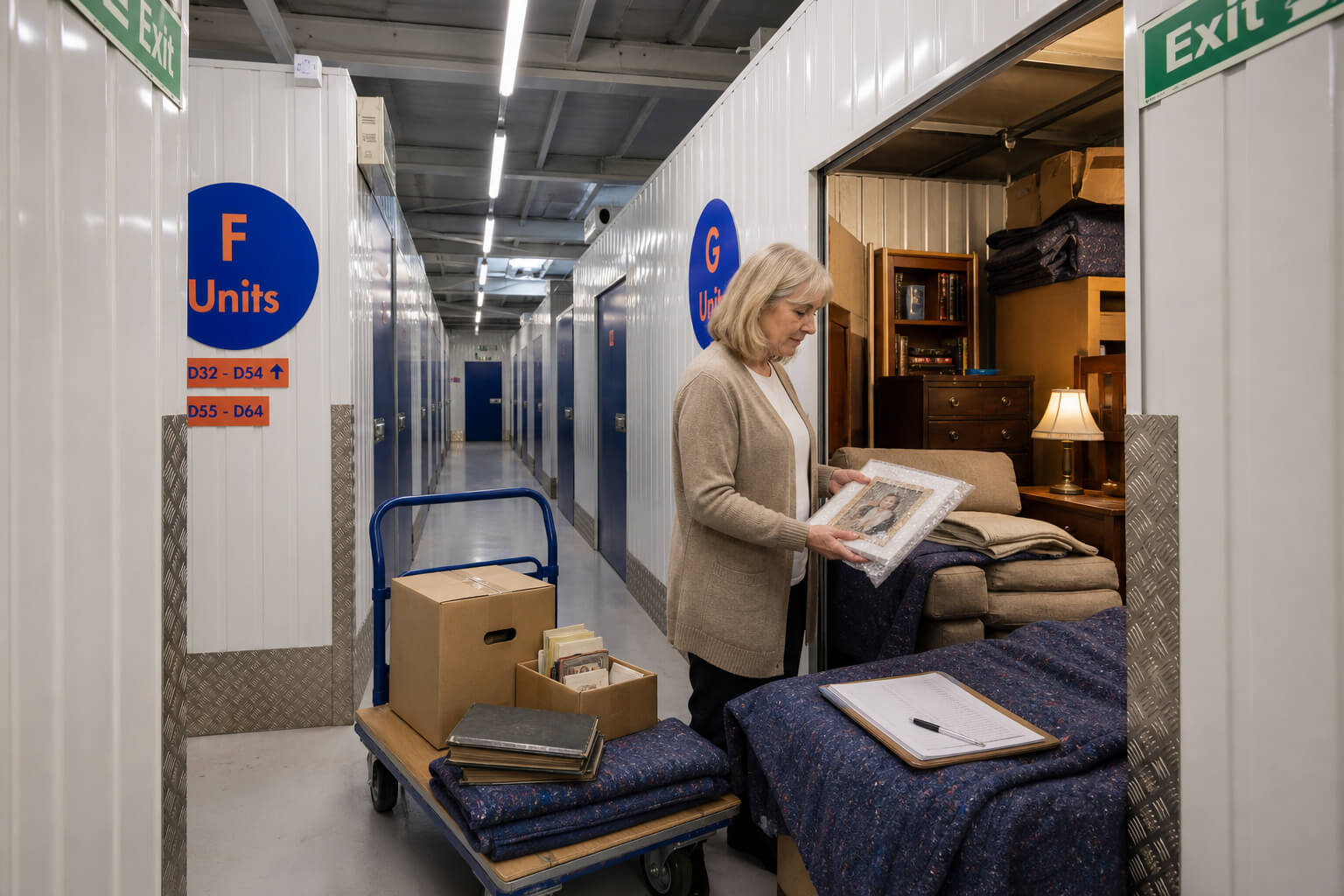
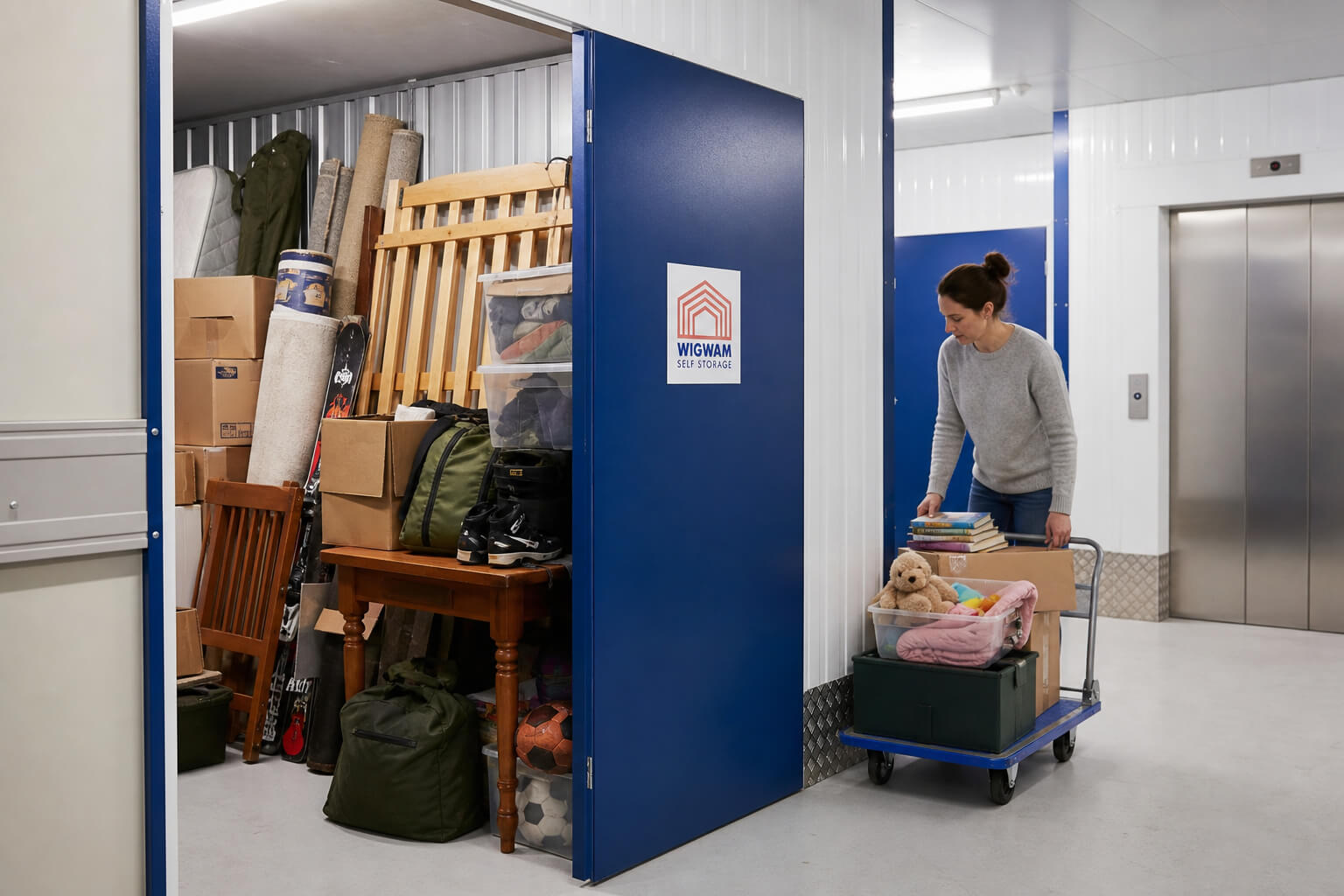
This is the Wigwam use-case, stated plainly. The contents of one room, or part of a room, move into a clean, dry, individually alarmed unit at one of our UK market-town locations. The room they were in becomes a nursery, an office, a proper spare room, or whatever your household actually needs it to be. You keep access to your things. You have not made any final decision about the house.

What it costs versus moving to a bigger house

Upsizing is not just a bigger mortgage. The one-off costs of a house move stack up in ways that can take years to recover, and most of them are not negotiable.

The hidden costs of upsizing

The categories that tend to surprise people most are these. Stamp Duty Land Tax (SDLT) in England and Wales scales with the purchase price and can run to several thousand pounds for a typical family-home move up; there is no way to avoid it. Note that Scotland uses Land and Buildings Transaction Tax (LBTT) and Northern Ireland has its own equivalent arrangements. If you are buying in either of those nations, your solicitor or conveyancer will give you the right figure, because the rates and thresholds differ. You can find the current England and Wales rates on the GOV.UK SDLT calculator (verify the current figures before relying on them, as rates and thresholds can change).

Beyond stamp duty, there are conveyancing fees on both sale and purchase, survey costs on the property you are buying, removal company fees for a larger move, estate agent commission on the sale, and then the ongoing higher costs of a bigger property: council tax at a higher band, higher energy bills, and often a larger building insurance premium. None of these come back. Most move-related costs are spent once and gone.

Self storage sits on the other side of that ledger. It is a monthly cost, not a capital event. You can stop it if your plans change, and the money you spent does not vanish into transaction costs.

If you want a number for your specific situation, a quote takes two minutes at quote.wigwamstorage.co.uk.

How storage cost actually works

We do not publish prices on this page because the right unit size and location depend on what you are storing and where you are. What we can tell you is how the cost model works, so you are not guessing.

Storage is priced by unit size and location. The two variables that move the number most are how much you are storing and where the facility is. Smaller market towns are generally cheaper than city-centre sites. A unit for the contents of one bedroom costs less than a unit for the contents of a house.

The Wigwam model has a two-week minimum stay. After that, you stay as long as you need, with no lock-in period and no introductory rate that inflates after a promotional window. If you leave before a billing period ends, unused days are refunded. Full pricing for your area is on our storage pricing guide.

What size unit you actually need

The question the AI tools always ask next is a good one: are you storing large furniture pieces, or mostly boxes and bags? The answer changes the unit size you need.

Mostly boxes, bags and smaller items

A single cluttered bedroom will typically need a small unit in the range of a walk-in wardrobe to a small room equivalent. If you are storing the overflow from one room rather than an entire household, you need less space than you probably think. The rule of thumb is to stack boxes in your mind before you start: a stack of twenty removal boxes, two suitcases and a set of shelves is a much smaller footprint than a full bedroom’s worth of furniture.

Seasonal items, hobby equipment, home-office overflow and document boxes can often fit into a compact unit and still leave room to reach things at the back. When you get a quote, you will be guided through size options; it is worth underestimating slightly and talking it through rather than over-ordering from the start.

Large furniture: sofas, wardrobes, dining tables

Larger furniture fits fine in our units. The thing to know about storage for furniture you care about is that our facilities are clean, dry and secure, with individually alarmed units. We do not offer climate control, and we do not promise protection from atmospheric or climatic conditions beyond the physical security of the unit. What that means in practice is that the unit is a dry building with an alarm, not a temperature- and humidity-managed environment.

For upholstered items and wooden furniture, use breathable covers rather than sealed plastic sheeting. Breathable materials stop moisture from being trapped against the surface while the item is in storage. Furniture blankets are better than cling film. This is straightforward practical advice for any standard storage environment, not unique to Wigwam. If you have antique furniture or genuinely moisture-sensitive items, talk to a specialist about whether a standard storage unit is the right environment for them, because we would rather you ask than regret.

How long can you keep it?

The answer is: two weeks at minimum, then as long as you need with no fixed end date.

The two-week minimum and what that means in practice

The minimum stay at Wigwam is two weeks. If you move in and find you need to leave before that, the two-week cost stands. After the minimum, there is no lock-in. You can stay for a month, six months or two years, and the terms do not change. There is no escalating price for staying longer.

When you are ready to leave, you give 14 days’ notice. The deposit is held until you have vacated the unit and the account is settled, at which point it is returned to you less anything owed. Unused days beyond the minimum are refunded if you leave early. The full mechanics are in our terms and conditions.

Staying longer than you planned

We see a lot of households who come in saying “probably three months” and stay for eight. Life does not always cooperate with our timelines. A renovation that overruns, a house purchase that falls through, a decision that turns out to take longer than expected. None of that penalises you here. The two-week minimum is the floor; there is no ceiling. When you are ready to leave, you leave.

Some customers come in planning a short bridge and end up finding that the extra space changes their relationship with the house enough that they decide not to move after all. That is a legitimate outcome. The storage was the decision, and the house decision resolved on its own.

Is storage just an expensive loft? An honest answer

This is the question every UK forum raises, and it deserves a straight answer.

Compared to your loft, yes, you pay a monthly fee for storage. The loft is free. But the loft is usually not accessible when you need it, it is not individually alarmed, and it is not a clean, dry, secure environment with smart entry 6am to 10pm, seven days a week. You can reach your things on a Saturday morning before the school run, or on the way home from work. You do not need to borrow a ladder and clear a path.

Compared to moving to a bigger house, the monthly cost of a storage unit is a small fraction of the one-off transaction costs of a house move. The move costs are gone the moment you spend them. The storage cost stops the moment you stop needing it, and unused days come back.

The honest question to ask is not “is storage cheaper than my loft?” The question is: is the room I can free up worth the monthly cost? For a household that needs a nursery this month, or a home office that actually works, or a usable spare room for family, the answer is usually yes. The room is the thing, not the unit.

The fine print other people gloss over

The AI search surfaces flag two specific things about the self-storage industry that alarm people. Both are real in the industry. Neither applies to Wigwam. It is worth being clear on both.

No introductory rate that doubles later

The pricing model that the AI tools flag is a real one: some providers offer a low headline rate to get you in, and then the price increases significantly after a promotional period. We do not operate that way. The rate you start on is the rate you continue on. There is no promotional window, no planned increase, and no small print that resets the price at month three. If you want to confirm this in writing, our storage pricing guide sets out how we price.

Contents protection, explained plainly

Contents cover is required. You can take Wigwam’s own policy, which is underwritten by RSA as a Self Storage Customers’ Goods policy, or you can use your own cover if it is adequate for storage use and you can demonstrate it. Both options are available.

The Wigwam policy works on a New-for-Old basis. You declare the full replacement value of what you are storing; under-insurance is settled proportionally, so if you declare half the value and make a claim, you will receive half the payout. There is a £50 excess per claim. Theft is covered, but only where there is evidence of forcible entry. Atmospheric and climatic damage is excluded from the policy.

If you are in Scotland or Northern Ireland, the same factual description applies, but the legal and regulatory context for insurance policies differs in those nations. Talk to your own insurer or financial adviser if you have questions about how your cover applies. Our contents protection page has the details, and we are signposting you rather than advising you.

Your deposit comes back, and unused days are refunded

The deposit is refundable. Give 14 days’ notice, vacate your unit, settle your account, and the deposit is returned to you less anything owed. There is no forfeiture clause, no administrative deduction, and no hidden condition. Unused days beyond the two-week minimum are refunded if you leave early.

This matters because the page’s central claim is that storage is a reversible decision. That is only true if the money comes back when you change your mind. These are the terms that make it reversible in practice. Read them in full at our terms and conditions.

Holding sentimental and family pieces while you decide

Not everything in a room has a simple use-value. Sometimes the room is full of your parents’ furniture, or the dining table from a house you grew up in, or pieces that belonged to a marriage that has since ended. The question is not whether the items are worth the money. The question is whether you have somewhere safe and accessible to keep them while you decide what happens next.

What “clean, dry and secure” means for furniture you care about

Our units are individually alarmed, dry and clean. That is the accurate description of the environment. We do not offer climate control, and we do not promise to manage temperature or humidity inside the unit. The building is secure and the unit is dry; it is not a museum-grade preservation environment.

For furniture you care about, the practical guidance is simple. Use breathable dust sheets rather than sealed plastic. Cover upholstered items to protect against dust. Raise wooden furniture off the floor if possible, using pallets or boards. Wrap glass surfaces. These are straightforward precautions for any standard storage unit, and they matter more for items with sentimental value because a thoughtful pack-out costs nothing and removes the regret of finding something marked when you collect it.

Access when you need it, not just when it suits the facility

Smart entry is available 6am to 10pm, seven days a week. There are no appointment windows, no staff members to call ahead, no limited opening hours. You turn up when you need to, access your unit, take what you need, and leave. Our sites are unmanned, which means you access your own goods independently. If you are expecting a delivery, someone from your side needs to be there to receive it; our sites do not sign for or receive deliveries on your behalf.

For items you need to be able to reach on your own schedule, the 6am to 10pm window covers most practical needs. Early morning access before work, evenings, weekend mornings. It is not a drive-to-warehouse where you call ahead and wait.

Where you can do this

Wigwam operates across our UK market-town locations. If you are in Wigwam Self Storage Bath in Somerset or Wigwam Self Storage Lincoln in Lincolnshire, those pages have the specific site details. For all other locations, the full list is at our locations hub.

Our sites are in market towns, not city-centre warehouse estates. That tends to mean easier parking, easier access in a van or hire vehicle, and a site that is part of the town rather than an anonymous shed on a ring road. It also tends to mean the people who work with Wigwam know the area. These are not anonymous national-chain facilities run from a head office three counties away.

A reversible next step

You do not need to decide about the house today. You do not need to decide whether to store for six months or two years. The only decision in front of you right now is whether clearing one room would make the house liveable again, at least for long enough to think clearly.

If the answer is yes, storage is a pause button, not a commitment. You move what is in the room, you get the room back, and you make the next decision from a position of calm rather than a house that is pressing in on you. If the decision at the end of that time is that you need to move after all, the deposit comes back and the unused days come back and you are not out anything beyond the time you actually needed.

If the decision is that actually, with one room freed up, the house works again, then that is also a good outcome. It happens more often than people expect.

When you are ready to find out what it costs for your situation, a quote takes two minutes.

Get a quote at quote.wigwamstorage.co.uk

Our UK market-town locations are listed on the locations page. If you already know which town you are in, start there.

Frequently Asked Questions

If I store things to free a room and later decide to move anyway, does the storage carry on smoothly into the move?

Yes, and that is one of the quiet advantages of starting with storage rather than rushing to move. If you reclaim a room, live with it for a few months, and then conclude the house genuinely is too small, the unit simply continues to hold your things while you sell and buy. There is no fixed maximum stay. The two-week minimum is the only floor; after that you carry on for as long as you need, at the same rate, with no escalating price for staying longer.

This is useful because a move is rarely instant. Between deciding to move and actually completing, there are months of viewings, offers, and a chain to manage, and during much of that a half-cleared house shows better than a full one. The things already in store stay put, and you can add to the unit, the rest of the furniture you want out for viewings, as the move progresses. Access by smart entry, 6am to 10pm, seven days a week, means you can shift things in over evenings and weekends rather than in one disruptive push.

When the move completes, you give 14 days notice, empty the unit straight into the new house, and the refundable deposit comes back once the account is settled. If you leave before a paid period ends, unused days are refunded. So the storage you took as a “see if freeing a room fixes it” experiment turns out to be the same flexible tool that bridges the move if the answer is no. You are not penalised for changing your mind, which is rather the point.

Can I get to my stored things easily if I need something back occasionally?

Yes. The unit is yours for the duration and access is by smart entry between 6am and 10pm, seven days a week, with no appointment to book and no staff member to call ahead. You turn up when you need to, reach your own unit, take what you want, and leave. For the kind of things people store when a house is outgrown, seasonal items, hobby kit, home-office overflow, occasional retrieval is exactly the normal pattern, not an inconvenience.

The difference people notice, against keeping things in a loft, is that the unit is genuinely reachable. No borrowing a ladder, no clearing a path, no doing it only when someone is free to help. You can collect the Christmas decorations on a December evening after work, or fetch the camping gear on a Saturday morning before the school run. Because the sites are local market-town locations rather than warehouses on a distant ring road, the drive is usually short, which matters when it is a quick in-and-out.

A little planning makes occasional access painless. When you load the unit, put the things you are most likely to want again near the door, keep a clear path down the middle, and label boxes by contents rather than just “spare room.” Heavy items low. That way fetching the slow cooker or a box of files is a five-minute job rather than an unstack-everything afternoon. The sites are unmanned, so it is your access on your schedule; just remember that if you ever have something delivered to the unit, someone from your side needs to be present to receive it, as we do not sign for goods.

Does Wigwam help with the decluttering, or only the storage?

We help with the storage and the sizing, not the decluttering itself, and we will be honest with you about that order of operations even though it is not the obvious thing for a storage operator to say. If a clear-out would reclaim the room on its own, that is the place to start, and it is free. Local charity shops collect furniture, council recycling centres take bulk items, and marketplace apps shift good-quality pieces faster than you expect. Do that first and you will rent a smaller unit, pay less, and store only what genuinely matters.

Where we come in is after the clear-out, when there are things that do matter and do need somewhere to go while you reconfigure the house. At that point our team can help you work out the right unit size from a description of what you are storing, so you are not guessing or paying for space you will not fill. The rule of thumb is to underestimate slightly and talk it through rather than over-order from the start, because a unit that is too large is still costing you for the air.

One scope note worth having. Our support team handles the storage side, sizing, availability, access, pricing, invoicing, booking. They are not house-clearance or decluttering advisers, and they will not plan your move or your home reorganisation for you. For the clear-out itself, the free routes above, or a paid house-clearance service if it is a big job, are the right call. We are the calm, dry, secure place for what is left once you have decided what to keep.

Will my furniture be safe in a unit that is not climate-controlled?

For standard household furniture stored for the kind of period that suits an outgrown house, yes, provided you pack it sensibly. Our units are clean, dry and secure, individually alarmed, in maintained market-town buildings. The real threats to furniture in storage are damp, dust and poor packing, not the absence of active temperature control. A dry, secure unit handles the first two; good preparation handles the third. We do not offer climate control and do not market it, so we will not imply your sofa needs something it does not.

The practical guidance is simple and costs almost nothing. Use breathable dust sheets rather than sealed plastic, because plastic can trap moisture against the surface. Cover upholstered items to keep dust off. Raise wooden furniture off the floor on pallets or boards. Wrap glass surfaces. Furniture blankets beat cling film. These are standard precautions for any storage unit, and they matter most for pieces you care about, because a thoughtful pack-out removes the regret of finding a mark on something when you collect it.

There is a line worth being straight about. If you have genuinely moisture or temperature-sensitive items, antique furniture you are worried about, a wine collection, fine art, or solid-wood instruments like a piano, a unit without climate control is not the right environment, and a specialist is the honest recommendation. For the ordinary contents of an outgrown room, sofas, wardrobes, dining tables, boxes, soft furnishings, clean and dry is exactly what they need. We would rather tell you where our answer ends than let you store something that needs conditions we do not provide.

What does “household and business goods” actually cover if I run a business from home?

It covers the ordinary goods a home business accumulates, stock, samples, tools, equipment, paperwork and the like, stored alongside or instead of household items, with the same conditions and the same exclusions. If outgrowing the house is partly about a business that has crept beyond the kitchen table, a unit can hold the work overflow and free the room, exactly as it does for personal clutter. Plenty of customers store a mix of the two in one unit.

The boundaries are the same as for household storage. The unit is clean, dry and secure but not climate-controlled, so anything genuinely sensitive to temperature or humidity is not a good fit. The standard exclusions apply: no hazardous or flammable materials, no perishable goods, and no vehicles of any kind, which catches out the occasional tradesperson hoping to store a van or trailer. Units are for goods, not vehicles or leisure craft. If you are unsure whether a particular item is suitable, ask before you book.

Two further points for a home business. The sites are unmanned, so if a courier delivers stock to the unit, someone from your side must be present with smart entry access to receive it, because we do not sign for or accept deliveries on your behalf. And our support team’s scope is the storage itself, sizing, availability, access, pricing, invoicing. They will not advise on your business, its plans, or how to value its stock for insurance. For cover on business goods specifically, which can differ from household contents, check with your insurer; our role is to point you to the contents protection options, not to advise.


Private Self Storage For A Separation Moving Out At Short Notice

Need somewhere safe for your things before the week is out?

Some decisions arrive slowly. Others land in a single conversation, and by the end of it you already know you need somewhere safe for your things before the week is out. If that is where you are right now, this is a practical guide, not a sales pitch. We will tell you exactly how it works, what it costs to leave again, and why a private unit might be the one straightforward thing in an otherwise complicated month.

You do not need to have everything figured out before you book. A lot of people who come to us through a separation do not know how long they will need the space, or how much they are bringing, or even what the next few weeks look like. That is fine. We can work with that.

Here is what you need to know, in plain language.

If you are in a hurry, here is the short version:

  • Same-week move-in available
  • Smart entry 6am to 10pm, seven days a week
  • Two-week minimum stay; refundable deposit; 14-day notice to leave, with unused days refunded
  • Your unit is private: only you have access
  • Get a quick, private quote: quote.wigwamstorage.co.uk

A neutral space while you decide what comes next

When you are in the middle of a separation, a private unit is not just somewhere to put furniture. It is the one space where nothing is contested and no one else has a key. Your belongings are there, they are secure, and the room is yours alone while you work out the larger things at your own pace.

Somewhere that is only yours

Only you hold access to your unit. That is not a policy footnote; it is the literal promise. Each unit has its own alarm, and no one else, not staff, not another customer, not anyone connected to the shared home, can walk in. You get smart entry via the door system. The unit is yours from the moment you move in.

That matters most when everything else feels shared or disputed. The contents of this room are not. The door is not. Access is not.

Time to decide what to keep, without pressure

One of the hardest things about moving out quickly is that you are making permanent decisions in a temporary state of mind. A private unit removes that pressure. Your things are safe and secure while you take the time you actually need to decide what stays, what goes and what waits.

We provide the space. We do not provide legal guidance, and you should not lean on a storage provider for that. If you have questions about what you are entitled to move out of a shared property, or whether storing certain items could affect any legal proceedings, speak to a solicitor or contact Citizens Advice. Rules and timelines differ in Scotland and Northern Ireland, and the right answer depends on your specific situation. Wigwam gives you a secure, private unit for your belongings. The legal side belongs with a qualified adviser.

How quickly can you move in?

Same-week move-in is available at our UK market-town locations. You do not need to plan weeks ahead. If you need a unit by Thursday, the process from quote to access can happen that quickly.

Same-week move-in, two-week minimum stay

The minimum stay is two weeks. That is the honest number, and we think it is worth saying plainly, because you will see other providers suggest no minimum, or wave at “flexible” terms without naming them. Two weeks is enough time to get your things in, settle the immediate crisis, and decide what happens next. You are not signing up for three months you might not need.

Smart entry is available from day one, 6am to 10pm, seven days a week. Those hours cover most real moving schedules. Early morning before work, evenings after, or a long Saturday haul with a van. You come when it works for you.

Booking when you are not sure what size you need yet

Most people in this situation underestimate what they are bringing and overestimate how complicated booking is. Start with a rough count of rooms and main items, get a quote, and if you get there and need more space, we can sort that out. The goal is to get you into a unit this week, not to get every detail perfect before you begin.

What the terms actually are, stated plainly

Most self-storage pages mention terms in the small print, if they mention them at all. We put them here, at the top, because someone moving out at short notice deserves to know exactly what they are agreeing to before they book.

The refundable deposit and the 14-day notice

There is a deposit. It is refundable. You get it back after you have given 14 days’ notice, vacated the unit and settled your account. If you owe nothing outstanding, your deposit comes back to you.

The 14-day notice is not a catch. It is the interval between “I am done here” and the door officially closing. It gives you time to collect anything you have left, tie up any loose ends, and leave without rushing a final trip to the site. Once your notice period has run and the unit is clear and the account is settled, the deposit is returned.

For full terms, including what counts as settling the account and the specifics of timing, read the terms and conditions.

What happens to unused days when you leave

If you give your 14 days’ notice and move out before the period you have already paid for ends, unused days are refunded. You pay for the storage you actually used. That is the full picture.

Some providers charge to the end of the month regardless. Wigwam does not. If your plans change faster than expected, which is common in a separation, you are not trapped paying for days you are not using.

If you want to know what a unit near you would cost, get a quick, private quote at quote.wigwamstorage.co.uk. No long forms, no pressure.

Private and secure: only you get in

The privacy of a self-storage unit during a separation is not a minor feature. It is often the whole point. The question we hear most often, in different forms, is: “Can anyone else access my things?” The answer is no.

Smart entry, 6am to 10pm, seven days a week

Access is by smart entry, available every day from 6am until 10pm. You use the entry system to get into the site and to your unit. No staff member needs to let you in; no appointment is required during those hours. You come and go as your schedule allows.

Practically, this covers the vast majority of moving days, collection trips and top-up visits. Early starts when you want to avoid traffic. Evenings when the day has been long. Weekends when you have help available. The 6am to 10pm window is broad enough to fit around real life, not just business hours.

Individually alarmed units: only your belongings, only your alarm

Each unit has its own alarm, separate from every other unit on the site. If your unit is disturbed, that alarm is triggered. Not a shared corridor alarm, not a site-wide system that covers ten units at once. Yours.

The units are clean, dry and secure. We do not claim climate control or temperature regulation, because we do not offer it. What we do offer is a well-maintained, individually protected space for household goods. Furniture, boxes, personal items, clothing, equipment. The things that matter.

Your unit, your access: no shared entry

You are the only person who accesses your unit. There is no shared key, no secondary access for staff, no arrangement under which another party could be given entry. If you need someone else to collect things on your behalf at some point, that is a conversation for when the time comes, and it stays under your control.

This is not legal protection against a court order or a solicitor’s instruction. It is simply the physical reality: the door to your unit opens for you. No one else holds access.

What size unit do you need?

The right size depends on what you are bringing, and most people have a reasonable sense of that even before they have made a list. Here is a practical scale to work from.

A few boxes to a full three-bedroom house

A small locker-style unit holds boxes, archive files, a few bags of personal belongings. A room-sized unit takes the contents of a bedroom or a small study. A larger unit fits the contents of a one-bed flat, furniture and all. If you are clearing a shared three-bedroom house and taking your half, you need a bigger space still, and we can help you size that from a quote.

The rule of thumb: if in doubt, go slightly larger. The cost difference between adjacent sizes is usually less than the hassle of realising mid-move that you need more room. You can check indicative costs on our pricing reference page. No prices are quoted in this article because the right number depends on your location, size and duration, and a quote will give you the real figure quickly.

If you are not sure yet, start smaller

There is no need to get the size exactly right on the first booking. If you move in with a smaller unit and find you have underestimated what you brought, the practical path is to talk to us. Starting with what you know about and adjusting from there is far better than stalling the whole process because you cannot picture every piece of furniture in advance.

The first step is to get a quote and get in. The rest can follow.

Getting your things there

Moving into storage during a separation often means coordinating transport at short notice, sometimes without much planning time. Here is how it works in practice.

Using a man and van or a removals firm

Yes, a man and van or a removals firm can bring your things directly to the unit. That is straightforward. What to know beforehand: our sites are unmanned for self-access. When goods arrive by van, someone from your side needs to be present at the site to direct the delivery, open the unit and oversee the move. Wigwam does not sign for goods or receive deliveries on your behalf.

That is not a limitation, it is you staying in control of your own move. You, or someone you trust, is there when your things arrive. Nothing is handed over to a stranger at a site you cannot see.

If you are coordinating from a distance and need someone present, that person should be from your own arrangements: a friend, family member, or the removals team themselves with you on the phone. The unit is yours to manage.

What to do on moving day

Bring photo ID and proof of address when you first access the unit. You will also need a padlock for the unit door; bring one or pick one up before you arrive. Have a clear plan for how the goods are arriving: own vehicle, a man-and-van booking, or a full removals firm. Know the window (6am to 10pm), and allow time to park and work through the door.

Beyond that, moving day is moving day. Get the van in, stack the unit, lock up and leave. The process is straightforward once you are there.

Protecting what you store: contents cover, simply explained

Contents protection at Wigwam is mandatory, which means you cannot store goods without it. That is a clear requirement, and we think it is a fair one.

Contents protection: opt in or prove your own

Two options. Either take Wigwam’s RSA contents protection policy, which is set up at the time of booking, or provide evidence of your own equivalent cover. If you already have a home insurance policy that extends to goods in storage, check the terms and bring that confirmation. If you do not, Wigwam’s policy covers you from day one.

For the full detail on what is covered, how to opt in, and what the RSA policy includes, visit our contents protection page. We do not give insurance advice here; what we give you is the requirement clearly stated and the route to the right page.

Declaring the right value

Declare the full replacement cost of everything you are storing. Not the second-hand value, not a rough estimate: full replacement value for each item as if you were buying it new today. Under-insurance is settled proportionally. If you insure for half the real value and make a claim, you receive half the settlement. That is not a technicality to worry about later; it is a number to get right at the start.

If you are not sure what your things are worth to replace, take an hour before you move in, photograph the main items and make a list. It protects you and it makes any future claim simpler. The contents protection page has the full terms.

Find your nearest Wigwam location

Wigwam operates across our UK market-town locations, not out of a national distribution hub or an edge-of-town industrial park. The sites are in the places where people actually live, which means shorter drives and a team that knows the local area.

Wigwam in UK market towns

If you are in Somerset, Wigwam Self Storage Bath is our Bath site. If you are in Lincolnshire, Wigwam Self Storage Lincoln covers that area. For all other locations, the full list is at our self-storage locations hub, where you can find the nearest site to your postcode.

We do not name a fixed number of locations here because it changes as we grow. The hub always reflects the current list.

A local team, not a call centre

Our team members are based at or near the market-town sites, not in a shared call centre fielding queries from across the country. Selina and the team across our locations are the kind of people who have helped a fair few people through exactly this situation. Not because they were trained to manage it as a category, but because they have been at those sites long enough to know that someone moving out of their home in a hurry usually just needs a straightforward answer and a unit they can get into this week.

Sites are unmanned in the sense that you do not need to check in with staff to access your unit during opening hours. But there are real people contactable, and they know their locations.

When you are ready, get a quick, private quote at quote.wigwamstorage.co.uk. No pressure, no long form. Just a clear number so you can plan your next step.

Frequently Asked Questions

Can the other person find out where my things are, or get access?

No. The account is in your name, the unit is accessed by smart entry under your control, and nobody is given access just because they ask. The site team will not let anyone into your unit, will not confirm to a caller whether you hold a unit, and holds no key that opens your space. That is the physical reality, and during a separation it is often the part that matters most. Your belongings are in a room that opens for you and nobody you have not authorised. A few honest boundaries, because pretending otherwise would not help you. This is privacy, not legal protection. If a court issues an order, or a solicitor is acting through proper legal channels, that is a legal process and it operates outside what a storage provider controls; we cannot advise you on that, and you should speak to a solicitor or Citizens Advice about anything of that kind. What the unit gives you is straightforward day-to-day privacy: no shared key, no second access for a former partner, no casual way for someone to walk in. If you are worried about being traced through the booking, raise it with the team when you set up the account so the contact and billing details are handled sensibly. And keep your own access details and any spare key somewhere genuinely private, not in the shared home. The control of the unit sits with you, and it stays there unless you choose to change it or a legal process requires otherwise.

What happens if money is tight and I fall behind on payments?

Talk to the team early, before it becomes a problem, because a separation often comes with a sudden squeeze on money and a unit you genuinely need. The honest position is that storage is a paid service, and the terms and conditions set out what happens if an account falls into arrears, including the steps before a unit can eventually be repossessed. That is not a threat, it is just the arrangement being clear. But the practical advice is the useful part: if your circumstances change and you are worried about a payment, the worst thing to do is go quiet. A short conversation about what is coming is always better than a missed payment with no explanation. The refundable deposit sits behind your account and is returned on a clean exit, so it is not a fee you lose, but it is not a substitute for keeping the account current either. If the cost stops making sense, you have a clean way out: give 14 days’ notice, vacate, settle up, and the deposit comes back with any unused days refunded, so you are never trapped paying for storage you no longer need. The flexible terms exist precisely because lives change faster than long leases allow. Read the detail in the terms and conditions, and if you are facing genuine financial hardship more broadly, Citizens Advice can talk you through your options. On the storage itself, the team would always rather hear from you early than not at all.

Should I store things that we jointly own, or only my own belongings?

This is one to think about carefully, and it is genuinely a legal question rather than a storage one, so the most useful thing I can do is point you to the right person rather than pretend to answer it. A storage unit will hold whatever you put in it, but what you are entitled to remove from a shared home, and whether moving jointly owned items into storage could affect any proceedings, is a matter for a solicitor or Citizens Advice. Rules and timelines also differ in Scotland and Northern Ireland, so advice needs to fit where you are. What I would gently say from experience, not as advice but as common sense, is that a clean record helps. If you do move shared items, knowing exactly what you took and being able to show it was kept safe and not disposed of tends to make any later conversation calmer. The privacy of the unit cuts both ways here: your things are secure and only you can access them, which protects your belongings, but it does not change the legal ownership of anything inside. Storage keeps items safe and out of dispute physically; it does not resolve who they belong to. So the sensible order is to take advice first on what you should and should not move, then use the unit to keep whatever you do move secure while the larger questions get worked out. We provide the room. The question of what belongs in it, when ownership is contested, belongs with a qualified adviser.

Can a friend or family member collect things for me if I cannot face going myself?

Yes, and during a separation that is a fair and common thing to need, so it is worth knowing how it works. Access to the unit is under your control, and you can authorise someone you trust to access it on your behalf by setting up their access, rather than handing your own details around informally. That keeps things clean: the person you choose can get in, and nobody you have not chosen can. What does not happen is the site team letting someone in on a phone call without that being properly set up through your account, which is the same protection that keeps an ex-partner out and is worth keeping intact even when it is a friend you trust. So if you know you will not be able to manage a collection trip yourself, sort the access arrangement with the team in advance rather than at the gate. A practical note on deliveries and helpers: the sites are unmanned, so if a friend, a family member, or a man-and-van is bringing things in or taking them out, someone from your side needs to be there to open the unit and oversee it, because Wigwam does not receive goods or supervise access for you. That someone can be the trusted person you authorised; it does not have to be you. The point throughout is that control stays with you. You decide who can act for you, you set it up properly, and it stays under your authority unless you change it. If your situation is delicate and you would rather not be there in person at all, the team can talk through the most discreet way to arrange it.

What if I move in, then disappear for weeks because life is chaotic? Are my things still safe?

Yes. Your things stay exactly where you left them, in a locked, individually alarmed unit, whether you visit every day or not at all for a month. There is no requirement to attend, no maximum gap between visits, and nothing happens to your belongings simply because you have not been in. During a separation that reassurance matters, because the weeks after moving out are rarely tidy and you may genuinely not have the headspace to think about a storage unit for a while. The unit does not need managing to stay secure. It is alarmed, it is yours alone, and it sits quietly until you are ready to deal with it. The one thing that does need to keep ticking over is the account. As long as payments are current, the unit is yours and your things are safe and untouched. The risk is not absence, it is an account quietly falling into arrears while you are not looking, which is why it is worth setting up payment in a way that runs without you having to remember, and why a quick word with the team early is wise if money is going to be tight. If you genuinely cannot face anything to do with the move for a stretch, the kindest thing you can do for your future self is make sure the payment side is on a steady footing before you step away. The belongings will keep. Get a quick, private quote and a clear monthly figure at quote.wigwamstorage.co.uk so you know exactly what that commitment is before you start.

Why We Built Self Storage For Market Towns Not Cities

Why build a storage company in a market town instead of a city?

When we first started planning Wigwam, the obvious move would have been to find a big industrial unit off a city ring road. Cities have density. Cities have footfall. Cities are where the self-storage industry told you to go if you wanted volume.

We went the other way. We chose market towns: places like Lincoln in Lincolnshire, Bath in Somerset, Cheltenham in Gloucestershire. Not because they were cheaper or easier. Because we thought they were the right kind of place to build a storage company that actually worked for the people using it.

That decision shaped everything that followed. The terms, the access hours, the way we talk to customers. All of it flows from the original choice to be a town company, not a city one.

We chose market towns on purpose

We did not end up in market towns by accident. From the beginning, the plan was to put Wigwam where people in local communities actually needed it: not by a motorway junction in a shed the size of an aircraft hangar, but near the places where people live, work and move house.

That choice was a founding decision, not a fallback. And it is worth explaining why, because it changes what you get when you store with us.

What a town needs that a city shed does not

A city-based storage facility is built around throughput. High turnover, short stays, walk-in customers who need a unit today and leave next month. That model works at scale. The big national chains are good at it.

A market town moves differently. The people who need storage here are often in the middle of something longer: a house move, a family clearance, a business that is growing and needs a bit more room than the spare bedroom allows. They are not passing through. They are putting down roots, or already have them. They need somewhere close, calm and trustworthy, with an operator who is going to be here next year too.

That sustained, local need is what we built for. Town customers tend to stay longer, care more about the relationship, and want to deal with a company that is part of the same community rather than headquartered three hundred miles away.

The towns Wigwam chose, and why

You can see the pattern in our locations. Wigwam Self Storage Bath in Somerset. Wigwam Self Storage Lincoln in Lincolnshire. Cheltenham in Gloucestershire. Dorking in Surrey. Warminster in Wiltshire. Bromsgrove in Worcestershire. Tewkesbury. Marlow. Leatherhead. And others across the UK.

These are real market towns with real communities. Not every major city is covered, because covering every major city was never the plan. The full list of our UK market-town locations is on the site.

What a town operator is, and what it is not

We are honest about this from the start, because you will find out anyway and we would rather you heard it from us.

We are a local operator with deep roots in market towns. We are not a national chain with hundreds of sites. That difference matters, and it runs in both directions.

What you get that the chains do not offer

When you store with a town operator, the experience feels different. There is a named person to speak to. The support team knows your location and knows the town. When something is unclear or you need to change your dates, you are not navigating an automated system that cannot find your file.

The terms, which we cover in detail below, were written for how real life works rather than for how a corporate spreadsheet works. A refundable deposit, unused days back if you leave early, a short notice period. These are not marketing angles. They are written into our terms and conditions.

And then there is the question of belonging. A lot of our customers have told us that choosing a local operator felt right in a way that goes beyond price. It is the same instinct that makes someone choose the independent hardware shop over the out-of-town chain. You want the person holding your things to actually know where you live.

Where the big chains genuinely win

This is worth being straight about, because the honest answer builds more trust than the promotional one.

The big national chains, Big Yellow, Safestore, Access and their peers, have scale and coverage that we do not. If you need storage in a major city that is not on our list, they are probably the more practical choice. Some chains have extended hours beyond what we offer, or on-site retail points where you can buy packing materials while you load your unit.

If you need nationwide coverage across multiple cities, or if the specific town you are moving to does not have a Wigwam location, the chains are the right answer for you. We would rather say that plainly than lose your trust later.

The limits we are honest about

Our sites are unmanned. You access your unit directly, with no on-site member of staff. If you are expecting a courier or a delivery while you are storing with us, someone from your own side needs to be there to receive it. We do not sign for deliveries, and we are not on site to meet them.

Access hours are 6am to 10pm, seven days a week, by smart entry. This is not a 24-hour facility. For most of our customers, those hours cover everything they need. But if your situation requires overnight access, we are not able to offer it.

We do not offer climate control. What we do offer is clean, dry and secure storage. The environment inside our units is consistent and protected. If you are storing wine, museum-grade items or anything that needs precise temperature or humidity management, we are probably not the right fit, and we will say so directly.

We also do not store vehicles, caravans, motorhomes or boats. Our units are for household and business goods.

The terms we built for town life

Here is what the contract actually says, in plain English.

We wrote our terms to suit the pace of life in a market town: moves that take longer than expected, clearances that need flexibility, businesses that are not sure how long they need. The terms reflect that reality rather than trying to lock customers in.

A deposit that comes back, and unused days refunded

There is a refundable deposit. We say that clearly, because there was a time when Wigwam literature said “no deposit”, and that was wrong. There is a deposit, and it is refundable.

How the return works: when you give notice and then vacate, and your account is settled, the deposit comes back to you. The 14-day notice is the mechanism. Once you have served it and left, with nothing outstanding, the deposit is returned.

If you leave before your paid period runs out, you get the unused days refunded. You do not pay for time you do not use. That matters when life does not follow the plan you set at the start.

The minimum stay is two weeks. After that, the notice period is 14 days, and when that period is served, you are free to go.

A short notice period and no long lock-in

The 14-day notice period is not a long commitment. It is there so we can manage the unit properly. Once you have given notice, you serve two weeks, you vacate, and that is that. There is no rolling annual contract pulling you back in, no penalty for deciding the move has settled and you no longer need the space.

That flexibility matters to town customers in a way it might not in a city. A move into a new house often throws up surprises. The furniture that was going to fit does not. The clearance runs longer than expected. The flexibility to adjust without penalty is part of what we were building for.

A plain word on price

We do not quote prices on this page, because they vary by town, unit size and how long you need. What we can say is that the approach to pricing is straightforward: you pay for what you use, you get unused days back if you leave early, and there are no surprises buried in the small print.

For a clear guide to what self storage costs, the pricing guide on our site walks through the variables.

Ready to see what we have in your town? Get a quote at quote.wigwamstorage.co.uk – it takes a few minutes and there is no obligation.

What your things actually need (and what they do not)

Before you book, it helps to think about what you are storing and whether our units are the right match. Most of the time, the answer is straightforward.

The things most of our town customers store

Household goods during a move or a renovation: furniture, appliances, boxes of belongings that do not fit in a new house before everything settles. Family clearances where there is more to sort through than there is time in a day. Small business stock and paperwork, archive boxes, equipment that is not needed every week but cannot be thrown away.

These are the everyday contents of a home or a small business that needs temporary room. If that describes what you have in mind, we are probably a good fit.

What our units are: clean, dry, secure and individually alarmed

Each unit is individually alarmed. Smart entry to the site runs from 6am to 10pm, seven days. The units are clean, dry and secure: we keep them that way and inspect them regularly.

That is the honest description of the environment. We do not use phrases like “climate controlled” or “temperature managed” because those imply a level of active regulation we do not provide. What we do provide is a stable, protected environment that is right for the vast majority of household and business goods.

What we do not offer, stated plainly

No climate control. If you are storing wine or artworks or temperature-sensitive goods, speak to us first and we will be straight with you about whether our units suit your needs.

No vehicle storage of any kind. This includes caravans, motorhomes, classic cars, motorbikes and boats. Our units are for goods, not vehicles.

Sites are unmanned. If you are planning to have deliveries arrive at your unit, you will need someone from your own team to be there to receive them. We do not sign for or collect deliveries on your behalf.

Contents protection: what you need to know

Contents protection is mandatory with Wigwam. This is not optional and it is not small print: you either take our RSA Self Storage Customers’ Goods policy, or you prove that your own cover meets the required standard.

We are not insurance advisers. We signpost; we do not advise. What follows is a plain description of how the cover works, and we would always encourage you to read the policy and, if in doubt, speak to the insurer directly.

Why cover is part of how we store

Declaring the full replacement value of your goods matters. If the declared value is lower than the actual value, any claim will be settled in proportion to the shortfall. This is standard practice across self-storage insurance, but it catches people who underestimate what they are putting in.

The policy is there to protect you, not to add cost for its own sake. The details are on our contents protection page.

What the policy covers and what it does not

The RSA policy covers theft where there is evidence of forced entry, fire and flood damage, and similar events. What it does not cover is climatic or damp damage that results from goods being improperly packed or sealed before they go into storage. If boxes are not sealed, or furniture is not properly protected, and moisture accumulates over time, that falls outside the policy.

Pack well, seal boxes properly, and store with the same care you would use at home. The policy does the rest.

How access works at an unmanned site

The practical question most new customers ask is: what actually happens when I turn up for the first time? Here is the plain answer.

Smart entry and what it means in practice

Smart entry means secure, keypad or access-code entry at the site gate and at your unit. It is not app-dependent: it works on a code you are given when you set up your account. Access runs from 6am to 10pm, seven days a week.

That window covers most working lives. Before work, after work, weekends. If you need to make a run in the evening after the removal van has been, 10pm gives you time. If you are an early riser who wants to sort boxes before the day starts, 6am is there.

What it does not cover is the middle of the night. If your situation calls for that, we are not the right operator and we would rather say so now.

What unmanned means for you

There is no on-site staff member at a Wigwam location. You arrive, you use your access code, you go to your unit, you do what you need to do, and you leave. It is your space, on your schedule.

The practical implication: if a courier arrives with something that needs signing for, you need to arrange for someone from your own side to be present. We cannot receive deliveries, sign for packages or coordinate with couriers on your behalf. This is worth planning for if deliveries to your unit are part of how you intend to use the space.

Our support team is reachable remotely for any questions or issues. They know the locations and can usually sort things without a visit being necessary.

The people behind Wigwam

A brand page ought to say who is behind it.

Simon Fothergill and why he built it this way

Simon Fothergill is the founder and Managing Director of Wigwam Self Storage. The decision to build in market towns rather than cities was his, taken at the start and held to since. The reasoning, as he describes it, is not complicated: towns generate the kind of quiet, sustained demand that suits a company built on local relationships rather than volume. And the customers in those towns deserve terms that are fair rather than terms that are optimised for the operator.

The founding decision was that if you are going to ask someone to trust you with their belongings, you owe them honesty about what they are getting, clarity about what it costs and how to leave, and a team that is actually reachable when something does not go to plan.

That is what Wigwam set out to be.

A real team in the towns

The support team includes people like Selina, who customers in several of our towns will have spoken to. First names, because that is how it works here. Not a call centre in a city you have never been to. People who know the locations, know the towns, and know that the person on the other end of the call is in the middle of something that matters to them.

Finding your nearest Wigwam and taking the next step

Our UK market-town locations

Wigwam has locations across UK market towns: Bath, Lincoln, Cheltenham, Dorking, Warminster, Bromsgrove, Tewkesbury, Marlow, Leatherhead and others. If you are moving to, or already living in, one of those towns, there is likely a Wigwam nearby.

The full list, with maps and details for each site, is at our UK market-town locations hub. Wigwam Self Storage Bath and Wigwam Self Storage Lincoln both have their own dedicated pages with local detail.

Getting a quote

The quote process is short. Tell us your town, the rough size of unit you think you need (we can help you work that out if you are not sure), and how long you expect to need it. A few minutes, no obligation.

If you want to understand pricing before you request a quote, the pricing guide explains how costs vary by town and unit size.

Take the next step. Get a quote at quote.wigwamstorage.co.uk and see what is available near you.

Frequently Asked Questions

What if my market town does not have a Wigwam yet?

Check the locations hub first, because the nearest site may be closer than you think, and a short drive to the next market town can still beat a trip to a city. We operate across a number of UK market towns, but not every town is covered, and we would rather say that plainly than imply blanket coverage. If your town is not on the list, the honest options are the nearest Wigwam town, a different local operator, or one of the national chains if you are near a city that has one.

The UK market-town locations hub shows where we are and gives you a sense of how far the nearest site is. For a lot of people the nearest Wigwam town is a sensible drive, and the closeness still holds up against the alternative of a city ring-road facility forty minutes away. The test worth applying is the one that matters for any site: how far will you travel every time you need to get in, not just on move-in day.

We chose market towns deliberately rather than trying to cover every town at once, so the network grows around that model rather than chasing scale. If your town is not served today, it is worth checking the hub again over time, and in the meantime the nearest listed town is the place to compare. See what is within reach and get a quote at quote.wigwamstorage.co.uk.

How should I pack so that the damp exclusion in the contents policy never bites?

Pack and seal everything properly before it goes in, because the policy does not cover climatic or damp damage that results from goods being poorly packed or sealed. The units are clean, dry and secure, but they are not climate controlled, so the care you take in packing is what protects items over a long stay. This is a process point the policy wording rests on, so it is worth getting right from the start.

A few practical habits help:

  • Seal boxes fully rather than leaving them open or loosely folded
  • Wrap and protect furniture, especially upholstery and wood
  • Make sure anything stored is properly dry before it goes in, with no residual moisture
  • Avoid packing damp or perishable items that can spoil over time

Doing this is not just about the policy. It is how you would store things carefully at home anyway. The cover is there to protect you against events like theft with forced entry, fire and flood, not to make up for goods that went in damp or unsealed. We signpost the detail and do not advise on it: the full wording is on the contents protection page, and if you have questions about your own policy meeting the standard, speak to your insurer directly. Pack with care and the cover does the rest.

Can I store goods on behalf of a relative, or rent a unit for someone else?

Yes, but the agreement and the contents cover need to sit with whoever is named on the account, so be clear from the start about who is responsible. People often take a unit while helping with a family clearance, a downsizing, or a relative who cannot manage it themselves. That is a common and perfectly workable situation. The key is that the person who signs the agreement holds the obligations: the payments, the notice, and the contents cover.

Contents cover is mandatory and is declared at the full replacement value of the goods stored, regardless of whose belongings they are. If you declare less than the full value and need to claim, any settlement is proportional, so it matters that the declared figure reflects what is actually in the unit. You either take Wigwam’s RSA Self Storage Customers’ Goods policy or prove equivalent cover of your own. We signpost this; we do not advise on it, and for anything to do with a relative’s estate or probate, a solicitor is the right person to ask, not us.

Access is by smart entry tied to the account, and the site is unmanned, so whoever needs to get in must have access set up. We do not hold spare keys or let people in on the day. If a relative or a removal firm is bringing goods, someone from your side needs to be present to receive them. The support team can help with sizing and the booking; they handle storage, not the wider family or legal arrangements. Get a quote at quote.wigwamstorage.co.uk.

Do long-stay and short-stay customers get different terms or treatment?

No. The terms are the same whether you stay two weeks or two years: a two-week minimum, a 14-day notice period, a refundable deposit, and unused days refunded if you leave early. There is no extended notice for longer-stay customers and no different deposit for a short booking. The 14-day notice applies to everyone, on every unit, across our market-town locations, with no exceptions based on how long you have been with us.

What does change with a longer stay is the relationship rather than the rules. A town operator gets to know its regulars: the business that brings stock in at month-end, the customer mid-renovation who needs Tuesday-morning access. That familiarity is a feature of the local model, not a tier you have to qualify for. The support team is reachable for everyone, and the access hours of 6am to 10pm by smart entry are the same for a fortnight’s storage or a multi-year arrangement.

The flexibility is the point of the design. A short stay is not penalised, and a long stay is not locked in. If a renovation runs to six months, the unit rolls with you; if a move completes in three weeks, you give notice and go, with unused days back. That even-handedness is deliberate. For your own situation, get a quote at quote.wigwamstorage.co.uk.

Can I add a second unit if my needs grow, or do I have to move to a bigger one?

Either route is possible, and which makes sense depends on availability and how much extra space you need. If the overflow is modest, taking a second unit alongside your first is often the simplest answer, subject to what is free at your site. If you have clearly outgrown your current size, moving up to a larger single unit can be tidier than splitting your goods across two spaces. The support team can help you weigh it; sizing and availability are squarely what they handle.

Each unit is its own booking, so a second unit carries the same two-week minimum, 14-day notice, and contents cover requirement. You would declare the full replacement value across what you store, and the same smart entry account gets you into both. There is no penalty for adjusting, because the whole model is built around moves and businesses that do not follow the plan set at the start.

The one thing to plan for is that availability is not guaranteed, particularly for popular sizes at busy times, so it is worth checking early if your need is growing toward a fixed date. We do not store vehicles or leisure craft and we do not offer climate control, so the growth we can help with is more household or business goods, not a change in the kind of item. To check what is available and get a quote, go to quote.wigwamstorage.co.uk.

Relocating With A Family Storing The Overflow In Self Storage Until You Settle

New town, new house, and three vanloads that don’t have a home yet?

Most families who have moved house will tell you the same thing: moving day is just the beginning of it. You get the van loaded, you hand over the keys, and then reality sets in. The new house is not quite the blank canvas you imagined. One room needs painting before anyone sleeps in it. The children’s beds need to go up tonight, and nobody knows where the duvet covers are. And somewhere in the middle of all that, there are three more vanloads of things that simply do not have a home yet.

That is not a failure of planning. It is just what a family move looks like. There are too many moving parts, too many people who need things right now, and not quite enough space to absorb everything at once.

The question is not how to get everything into the new house on day one. It is how to get the people settled first, and give everything else a safe, nearby place to wait while you do.

If you are mid-move and need the quick facts:

Why a family move rarely happens in one clean go

Most families who have been through a relocation will recognise this: what looked like a single event on the calendar turns out to be a process, and the process takes longer than anyone plans.

When completion dates do not align

Completion dates slip. Chains wobble. The buyers of your old house want to move on a Thursday, and the sellers of your new house are not ready until the following Monday. Suddenly you have four days when your furniture has nowhere to be, and a removal firm booked for the Thursday who cannot wait. It is a practical logistics problem, and the answer is practical: a storage unit near the new town, booked ahead, gives the overflow a place to land while the dates sort themselves out. You are not in the lurch. You are just running the move in two stages instead of one.

A new home that needs a little work before the good furniture goes in

Sometimes the timing is not a chain problem at all. The new house is available, but the front bedroom needs a coat of paint, and there is a cracked tile in the bathroom you want fixed before the family is fully in. Putting the good furniture in before the work is done is how things get damaged. Storing the dining table and the good chairs for three weeks in a clean, dry, secure unit nearby means the decorators can work without moving around your belongings, and the furniture arrives in the room it was always going to, rather than dragged across fresh paint.

Settle the people first, store the overflow second

The governing principle for a family move is simple. Get the people into the new home. Get the beds up, the kettle on, the school bags by the door. Everything else can follow in the right order, at the pace real life allows.

What to keep with you

What goes in the van and stays with the family on night one is a short list. Children’s beds, bedding, and a week of clothing. School bags, uniforms, the car seats. Medication and the medical bag. The kettle, a few plates, the toothbrushes. The things that cannot wait a week in a unit and cannot be retrieved at short notice if someone needs them.

Keep that list tight. Everything that does not belong on it is a candidate for the unit.

One practical note: Wigwam sites are unmanned. If you are using a removals firm or courier to drop things at the unit, someone from your side needs to be present to open up and oversee the drop. The local team cannot sign for deliveries or be on site for you. Plan for that when you brief your removals company.

What can wait safely in a unit

The spare bedroom furniture. The seasonal equipment (camping kit, ski gear, garden tools that do not fit the new garage). The boxes labelled “study, deal with later” that you know will not be opened until month two. The second set of curtains that might not fit the new windows anyway.

This is not the overflow you failed to move. This is the overflow you chose not to move yet, because you were thinking clearly about what the family actually needs in the first week. That is a different thing entirely.

How much space a family move needs

For a three-bedroom family home, a unit around 75 to 100 square feet is a reasonable starting point for the overflow. That will hold the contents of two to three furnished rooms comfortably, with space to move around.

A rough size guide by home size

The estimates below are a useful starting point:

  • One-bedroom home: around 50 square feet
  • Two-bedroom home: around 75 square feet
  • Three-bedroom home: around 100 square feet
  • Four-bedroom home or larger: 150 square feet upwards, depending on what stays and what goes

These are starting points, not guarantees. The actual amount varies with how much the family is staging versus moving in one go, and how much the new house can absorb immediately. If you are in any doubt, book a slightly larger unit.

For cost expectations by unit size, the Wigwam pricing page gives a clear picture without requiring a quote.

Why it is fine to take a little more space and get the unused days back

If the family books a slightly larger unit and the move resolves faster than expected, you are not penalised for it. Unused days are refunded if you vacate early. That means you can book with a little breathing room rather than squeezing everything in to keep the invoice down, and if you are out of the unit in three weeks instead of six, you only pay for three weeks. For a family working against an uncertain timeline, that is a meaningful reassurance. The contract works in your favour, not against you.

How long you will need it, and how flexible that is

The two things worth knowing upfront: the minimum stay at Wigwam is two weeks, and ending the contract requires 14 days notice. Both are worth understanding before you book.

Two-week minimum stay and no guesswork on the end date

The two-week minimum means a short bridge between homes is straightforward. You are not signing up for six months of warehouse storage. You are booking a clean, dry, secure unit near the new town for as long as the gap between homes requires, with a two-week floor. Most families using storage as a bridge during a relocation find the unit for four to eight weeks covers the settling-in period and leaves room to deal with the overflow without pressure.

You are in control of the end date. When you are ready, you give notice.

Ending it with 14 days notice when you are settled, and getting your deposit back

When the unit is empty and the account is settled, the deposit is returned to you. To end the contract, you give 14 days notice, vacate the unit, and settle anything outstanding on the account. After that, the deposit comes back and any unused days from the notice period are refunded. That is the whole process. You can read the exact terms at wigwamstorage.co.uk/terms-conditions/.

The deposit is refundable. Not waived, not complicated. It is returned to you when you leave.

Ready to get a quote for your move? You can do that now at quote.wigwamstorage.co.uk. You do not need to commit to dates yet. The process is quick and you will get a figure for the size and location that suits you.

Packing the overflow so the next few weeks are easier

Label every box by room, not by content. That is the single most useful habit in a storage unit. When you come back three weeks later for the thing you need, you want to know it is in the “dining room” box, not that it is somewhere in the van’s worth of cardboard you stacked on arrival.

Label by room, keep an aisle, put the “might need soon” boxes at the front

Three habits make a storage unit usable rather than a wall of cardboard:

  1. Label by room. Write the destination room on the top and at least one side of every box. When you come back, you can read the labels without moving half the unit.
  2. Keep a clear aisle. Stack along the walls and leave a walking path down the centre of the unit. You will thank yourself the first time you need to reach something near the back.
  3. Stage the “might need soon” boxes at the front. If you think you might want the winter bedding, the spare towels, or the children’s books in the first fortnight, put those boxes nearest the door. The things you are sure you will not need for a month can go at the back and on top.

None of this takes extra time on moving day. It just takes a decision about what goes where before you start loading.

The hardest rooms to pack (the kitchen and the kids’ rooms) and how to stage them

The kitchen is the hardest room in the house to pack for a reason. Almost everything in it is both essential and awkward. The approach that works: pack a week’s worth of cooking and eating into one clearly labelled box that travels with the family. Everything else from the kitchen that does not fit the new setup yet goes to the unit. The duplicates, the rarely-used appliances, the mixing bowls you use twice a year. They are fine in a clean, dry unit for a few weeks.

The children’s rooms are harder in a different way. The children are watching. If packing feels like losing things, they feel it. The approach here is to keep each child’s essentials with them on the move, in a bag they helped pack: favourite toys, books, a comfort item, a week of clothing. What goes to the unit is the spare furniture, the extra toys, the things that can wait. The bedroom they sleep in on night one in the new house should feel like theirs. The rest can follow.

What to ask any storage company before you book

The AI Mode summaries that appear in search results when you look for moving storage in the UK often include a checklist of questions to ask any local facility. Here are those questions, answered plainly for Wigwam.

Access hours, security and how you get in

Access is by smart entry, from 6am to 10pm, seven days a week. That means you can pop in early before the school run or in the evening after work to grab a box you need. It is not 24-hour access, and that is worth knowing before you book if you anticipate needing things very late at night.

Units are individually alarmed. The site is clean, dry and secure. Sites are unmanned, which means you access your own unit directly. If you have a removals firm or courier dropping goods at the unit, someone from your own side needs to be there with you. Wigwam does not receive deliveries or sign for goods on a customer’s behalf.

Insurance and what is and is not covered

Contents protection is mandatory when you store with Wigwam. You can take Wigwam’s RSA-backed contents-protection policy, or you can demonstrate that your own home contents insurance extends to goods in storage. The Wigwam policy is New-for-Old and covers a wide range of household goods. Declare the full replacement value when you set up cover: if the declared value is lower than the actual value of what you are storing, any claim is settled in proportion, not in full. Theft from a storage unit requires evidence of forced entry.

For the full policy detail, read the contents protection page before you commit to a figure. If you have questions about whether your own home policy extends to goods in storage, speak to your insurer. For customers storing in Scotland or Northern Ireland, policy terms and the regulatory framework may differ from England and Wales, so check the policy wording or speak to your insurer directly.

Wigwam signposts the cover and the policy detail. They do not give insurance advice.

How much does self storage cost for a family move?

The cost depends on the size of unit, the duration, and the location. It varies between towns. No prices are listed here because the right size and the right location for your move will be specific to you.

What affects the price

Three things determine the cost of a storage unit during a family move:

  • Unit size. Bigger units cost more. A rough size guide is in the section above.
  • Duration. You pay for the time the unit is in use. Unused days are refunded when you vacate, so the final cost reflects what you actually used.
  • Location. Prices vary between Wigwam’s market-town locations. A unit in a larger town will typically differ from one in a smaller market town.

For a realistic sense of cost before getting a quote, the Wigwam pricing page sets out what to expect.

Getting an accurate quote for your specific move

The quote tool takes the postcode and the size you think you need and returns an accurate figure for that location. It is quick and you do not need to commit to dates today. You can get a quote at quote.wigwamstorage.co.uk and use it to plan the cost into the move.

Storing near your new town with Wigwam

Wigwam has locations across UK market towns, so there is likely one near wherever you are landing. The point of a local unit is that it is practical in a way that a city depot an hour away is not: you can stop in on the way back from the school run, or collect a box on a Saturday morning when the house is quiet.

Find the location nearest your new town

If you are moving into a town served by Wigwam, the unit is close by rather than out of the way. For example, families moving into Bath can find their nearest facility at Wigwam Self Storage Bath, and those heading to Lincoln can see what is available at Wigwam Self Storage Lincoln. For other towns across the network, the locations hub has the full list.

Sites are unmanned. If you have questions about sizing a unit before you book, the quote tool is the quickest way to get a figure for the location you need.

Get a quote for your move

The minimum is two weeks and the contract is flexible. If the gap between homes closes faster than you hoped, you give 14 days notice, vacate, and get the deposit and any unused days back. If you need longer, you stay on. You decide when you are settled, not the contract.

You can get a quote now at quote.wigwamstorage.co.uk. Tell the tool the postcode for your new town and the rough size you need, and it will give you a figure. It takes a couple of minutes and there is nothing to commit to at that stage.

The overflow has a clean, dry, secure place to wait. The family has time to settle. That is the right order for a move.

Frequently Asked Questions

Should I time the storage around the school term or the move date?

Time it around whichever is harder to change, and for most families that is the school term. A house move can usually flex by a week or two. A school start date rarely can. If the children are changing schools and the new term begins on a fixed Monday, that date often becomes the real anchor for the whole move, and the storage simply bridges the gap between when you have to be out of the old house and when the new one is properly ready.

In practice this means booking the unit to cover the longer of the two windows. If completion is uncertain but term starts on the 4th, get the family settled and the children into school first, and let the overflow sit in the unit while the rest of the house comes together over the following weeks. The two-week minimum gives you a sensible floor, and because unused days are refunded when you vacate, booking a little longer to cover term-start week costs you nothing if you clear out sooner. You give 14 days notice when you are ready, vacate, and the deposit and any unused days come back. The point is that the children should not be the part of the move that gets rushed. The boxes can wait. The first day at a new school cannot.

What if we are renting for a few months before we buy in the new town?

A storage unit is well suited to a rent-then-buy move, because the rental rarely has room for everything you own. Most families renting between sales take a smaller place than the one they sold, or a furnished let where their own furniture has nowhere to go. The overflow, the spare beds, the dining set, the garden things, sits in a unit near the new town until you complete on the house you actually want to live in.

The flexibility matters here more than on a quick move. A rent-then-buy timeline can run for months and you often do not know the end date when you start. There is no fixed ceiling at Wigwam: above the two-week minimum the unit rolls on for as long as you need it, and you give 14 days notice when the purchase completes and you are ready to bring everything into the new home. If the purchase falls through and you stay renting longer, the unit simply continues. You are not committing to a six-month block to get a flexible arrangement. One practical note: contents cover is required throughout, so if your own home insurance lapsed when you sold, you will need either the RSA contents policy through Wigwam or proof your new cover extends to goods in storage. Check that before the rental period starts, not after.

Can the children get their own things out of storage if they need them?

Yes, within access hours, and it is worth setting that expectation with them before you pack. Access is by smart entry from 6am to 10pm, seven days a week, so if a child suddenly needs the box of books or the spare duvet that went to the unit, you can collect it on the way back from school or at the weekend. It is not instant in the way the spare room would be, which is exactly why the body of this article suggests keeping each child’s genuine essentials with them on the move. But it is not locked away either.

The thing that helps most is how you packed. If the children’s overflow boxes are labelled by child and room and sat near the front of the unit, a retrieval trip is five minutes, not an unpacking exercise. Telling a worried child “your things are not gone, they are in our unit, and we can go and get them” is easier when you can actually do it quickly. For an anxious child, that reassurance is often worth more than the object itself. Sites are unmanned, so it is just you and your access code, no appointment and no waiting. Plan one or two retrieval trips into the first fortnight if you know certain comfort items will be missed, and put those boxes where you can reach them.

Is it cheaper to take one big unit or split the overflow across two?

For a single family move, one unit sized correctly is almost always the simpler and better-value choice. You pay for the space you use, and a single unit means one access trip, one place to keep organised, and one set of labelled boxes to work through. Splitting across two smaller units rarely saves money and usually adds hassle, because you end up walking between two spaces trying to remember which one holds the thing you came for.

Where a second unit genuinely earns its place is a different situation: when you are merging two households, clearing a relative’s home at the same time as your own move, or when the overflow grows partway through and your original unit is full. In those cases a second unit is straightforward to add, and you can give notice on it separately once that portion is dealt with. The general rule for a standard family relocation is to size up rather than out. If you are unsure between two sizes, take the larger single unit. Because unused days are refunded when you vacate early, the cost of a little extra room is genuinely modest, and it is far less stressful than discovering on loading day that the wardrobe will not fit. The quote tool will size it for you if you describe what is going in.

Do you store cars, caravans or a roof box during the move?

No. Wigwam units are for household and business goods only. We do not store vehicles of any kind, no cars, vans, motorbikes, caravans, motorhomes, trailers or boats. So if part of your relocation involves finding somewhere for a second car or the touring caravan while you settle, that is a separate arrangement you will need to make elsewhere. A roof box, awning, bikes, camping kit or garden equipment are all fine in a unit as household goods, but the vehicle itself is not something we can take.

It is worth saying plainly because families relocating often have more on wheels than usual during the move, and it is easy to assume a storage company handles all of it. We do not, and we would rather tell you now than have you arrive expecting to park something. For the things that do belong in a unit, the contents need to go in clean and dry, the same commonsense care you would give any move. Keep liquids out of stored furniture, make sure anything from the garage is not damp, and lift items off the concrete floor where you can. The unit is clean, dry and secure, which suits the entire contents of a family home. It is simply not a parking space.

Self Storage For Forces Families Flexible Terms For Postings And Deployments

Posting order in, dates set by someone else — how do you store around that?

A posting order lands and the timeline shifts immediately. The quarter needs to be cleared, furniture needs somewhere to go, and the dates were set by the chain of command, not by you. If the serving member is already on exercise or getting ready to ship out, the whole thing falls to whoever is left holding the keys.

This is not an unusual situation. It is the ordinary shape of a forces family move. What makes it harder than a civilian house move is that the usual storage question, when do I need it and for how long, often does not have a clean answer. You might know the move-in date but not the move-out. You might know the rough tour length but not whether it runs long or cuts short.

This page explains how Wigwam’s terms work in that kind of uncertainty. What the deposit does and when it comes back. What happens to days you have paid for if the posting ends early. Where our nearest units are to the Warminster in Wiltshire garrison area, and what to expect from a quiet, unmanned market-town site you can use on your own schedule.

Why self storage and a posting go together

The practical fit is simple: a posting produces a gap between homes, and self storage fills it. But the version that actually works for a forces family is one where the terms are as flexible as the posting is unpredictable.

The quarter has to be cleared, whatever else is happening

When a posting order comes through, the married quarter typically has to be cleared by a fixed date. That date is not negotiable and it often arrives faster than expected. You need somewhere for the furniture, the boxes, the things that do not travel with you to the next location, and you need it to be ready quickly.

Self storage sits well here because it starts when you need it to start. There is no lead time tied to a removal company’s schedule or a new tenancy. You take a unit, you start moving things in, and the belongings wait for you. Clean, dry, individually alarmed. Nothing ties the start date to anything except the day you begin.

For the partner managing the clear while the serving member is already elsewhere, this matters more than it sounds. One fewer variable in a week that has too many.

Unaccompanied tours, deployments, and the gap in between

An unaccompanied tour might run six weeks or eighteen months. A deployment might be extended at short notice. The gap between one posting and the next permanent address can be a few weeks or the best part of a year.

Wigwam’s terms do not ask you to guess how long you will need the unit. You start when you need to start, and you leave when you are ready to leave, with two weeks’ notice. Whether the storage runs for two months or two years, the mechanics are the same. You pay for what you use. Nothing more is tied up than needs to be.

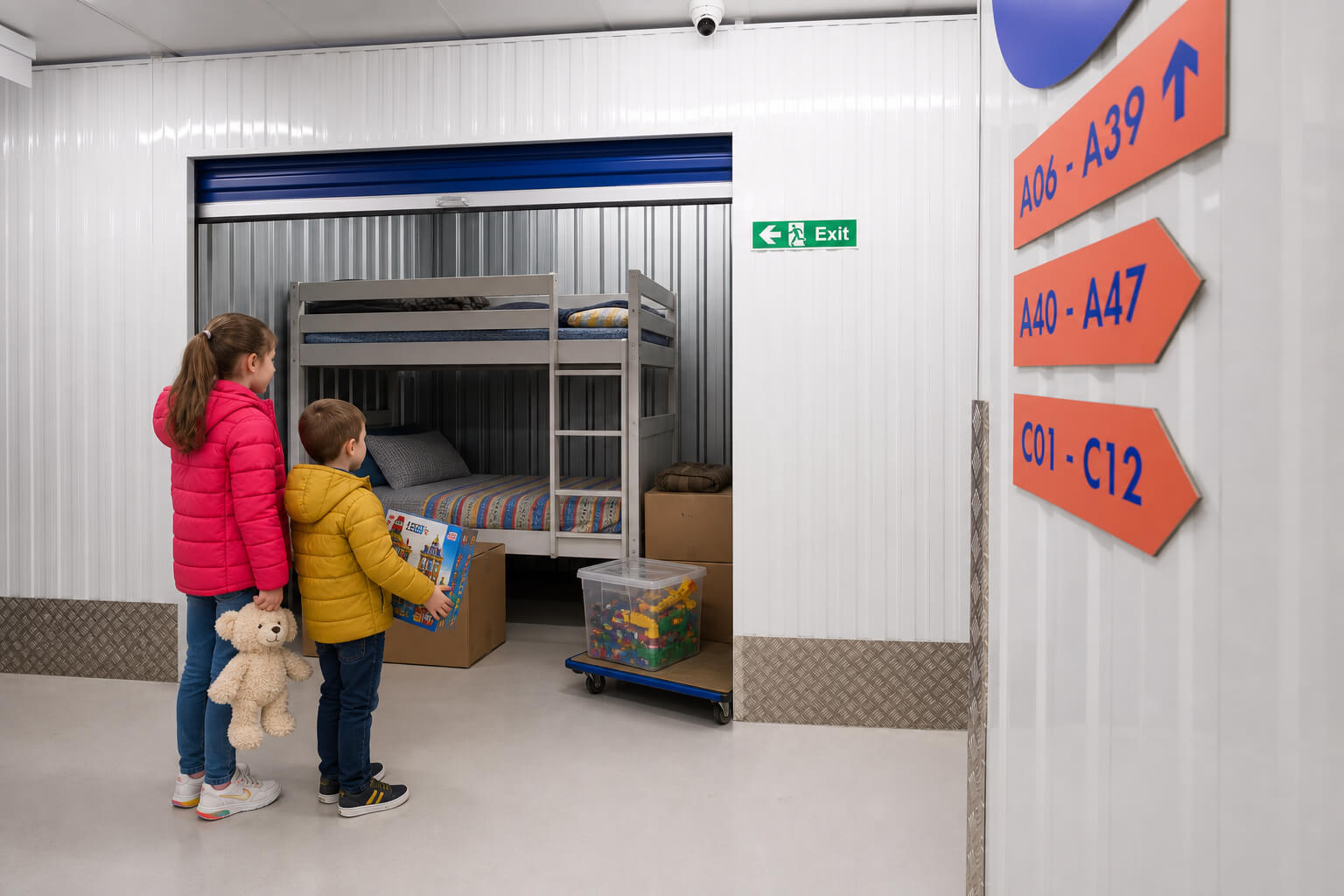
The partner managing the move without backup

This one comes up more often than providers acknowledge. The serving member is gone, or going, or already on the ground somewhere else. The partner is managing the clear, the removals firm, the handover, the new school, and the storage, all at the same time.

Our market-town sites are quiet and local. Smart entry means you do not need anyone to open the site for you. You arrive, you get in, and you work at your own pace. Between 6am and 10pm, every day of the week, it is yours to use without assistance. If you are fitting access around a school run or a working day, you have the hours to do it.

The terms that matter when dates are not yours to control

Wigwam’s contract bends to military dates rather than the other way around. The deposit comes back, unused days are refunded, and the minimum stay and notice period are both two weeks. Here is exactly what each of those means.

The deposit comes back – here is exactly how

You pay a refundable deposit when you take the unit. That deposit is not a fee and it is not lost if dates change. When you are ready to leave, you give two weeks’ notice, you clear the unit, and the account is settled. Once that is done, the deposit is returned to you. Nothing is held back unless there is something outstanding on the account.

For a forces family managing a move on someone else’s timeline, knowing the deposit comes back is not a small thing. It is the difference between committing to storage feeling financially exposed and committing knowing there is no penalty for leaving when the posting says to leave. Full terms are at wigwamstorage.co.uk/terms-conditions/.

Unused days refunded if you leave early

If your return date moves forward – the tour ends early, the next posting comes through ahead of schedule, the circumstances change – you do not pay for days you have not used. If you have paid to the end of a month and you clear the unit halfway through, the unused days are refunded.

This is the single term that matters most to forces families. Every provider says “flexible.” Wigwam’s version of flexible means you actually only pay for what you use. If the posting runs short, the storage cost runs short with it.

Two weeks minimum, two weeks notice – and nothing longer

The minimum stay is two weeks. The notice period is two weeks. That is the full extent of the commitment. There is no rolling six-month contract, no annual tie-in, no penalty for ending the storage sooner than planned.

In practice this means you do not need a confirmed end date to start. You take the unit when you need it, and you leave it when you are ready, with two weeks’ warning. If dates firm up later, the plan firms up with them. If dates shift again, the two-week notice is all you owe.

Ready to see what a unit would cost for your posting? Get a quote at quote.wigwamstorage.co.uk. No commitment, no long form.

What to put in store before you go

A Wigwam unit holds household goods well. Furniture, boxes, appliances, books, personal effects. The honest standard is clean, dry and secure. Here is what that means for what goes in, and what does not.

Furniture, boxes and the things you cannot take on a posting

The things that typically fill a forces family unit: sofas, beds, wardrobes, dining tables, kitchen equipment, the childrens’ toys and books, the things accumulated across a family home that have no business travelling on a posting. Clothes in wardrobe boxes, books in small boxes, fragile items well-packed.

What you need to know is that we do not offer climate control. We do not manage temperature or humidity. What we offer is clean, dry and secure, which is what furniture and packed boxes need for the months they are with us. If you have items that require controlled conditions, you will need a specialist facility for those. For the standard household contents of a forces family home, a Wigwam unit is the practical and honest choice.

What we do not store (vehicles, caravans, boats)

We store household goods. We do not store vehicles, caravans, motorhomes, motorbikes or boats. If a vehicle is part of what you need to sort before a posting, you will need a specialist vehicle or leisure storage provider for that. We will not be the right fit, and we would rather tell you plainly than have you arrive and find out.

Deliveries and removals – what to know about an unmanned site

Our sites are unmanned. That is by design: it keeps costs down and it means smart entry gives you direct access without needing anyone to be there. But it does mean one thing to plan for when a removals firm is involved.

If a removals company or courier is delivering goods to your unit, someone from your own side needs to be present to receive them. We do not sign for deliveries and we do not manage goods arriving on your behalf. If you are using a removals firm, coordinate with them so that you or someone you arrange is there when the van arrives. It is a simple thing to plan for, and worth confirming before the move day.

How much space you will need

Unit sizing depends on what you are clearing and how much of it you are putting in store rather than taking with you.

From a studio flat to a full family home – a rough guide

A rough starting point: a studio or one-bedroom flat typically fits into one of our smaller units. A two- or three-bedroom house needs something in the mid-range. A larger family home with a full set of furniture, appliances and packed belongings will need a bigger unit still.

These are rough guides. The variables that matter most are how much furniture you are putting in whole versus flat-packed, how densely you can stack boxes, and whether there is anything large and awkward that takes up more floor space than its weight would suggest. If you are unsure, err on the side of slightly more space rather than less. You will find it easier to fit and retrieve things in a unit that is not crammed.

Our storage sizes guide (reference it by name in the quote flow) gives more detail on what fits where.

Where to check current prices

We do not list prices on this page because they vary by location and unit size. The current pricing page is at wigwamstorage.co.uk/how-much-is-self-storage-in-the-uk and gives a clear picture of what to budget before you get a quote.

Keeping your belongings secure while you are away

The security question matters more for a forces family than for most. You are not popping in every few weeks to check. The goods may be in store for months with no one from your side anywhere near. The setup needs to hold without needing you to monitor it.

Individually alarmed units, clean, dry and secure

Every unit at Wigwam has its own alarm. This is not site-level security alone – it is unit-level. If someone opens a unit that is not theirs, it triggers. Your unit is not part of a communal space that relies on a perimeter being unbroken. Its alarm is specific to it.

The units are clean and dry. We maintain that standard because it is what furniture and belongings need. No damp, no debris, no evidence of previous use left behind. What goes in should come out in the same condition.

We do not offer climate control. There is no temperature management, no humidity regulation. What we offer is the honest baseline: secure, clean, dry, and individually alarmed. For most household goods, that is what matters.

Smart entry, 6am to 10pm, every day – on your schedule

Access is by smart entry, seven days a week, between 6am and 10pm. It is not 24-hour. That is a plain fact worth knowing before you book.

The access hours are broad enough to fit around most schedules. If a partner is running the move around work and a school run, there is plenty of time before and after. If a removal van is arriving at 7am, access is open. If a late-evening retrieval is needed, there is time for that too.

“Smart entry” is the right term for how the access works. You do not need to call ahead, you do not need anyone on site to let you in, and you do not need to fit your visit around staffed hours. You arrive, you access your unit, and you leave.

Cover for your goods while the unit is closed for months

Contents protection is mandatory at Wigwam. You cannot store with us without it. That is a condition of storage, not a recommendation. Here is how it works.

The RSA Self Storage Customers’ Goods policy, or prove your own

There are two routes. You can take the RSA Self Storage Customers’ Goods policy, which is available through Wigwam and is specific to goods held in a storage unit. Or you can demonstrate that an existing policy of your own extends to cover goods in a storage facility. If you go the second route, you will need to confirm it in writing.

Whichever route you take, you need to declare the full replacement value of everything in the unit. Under-insurance is not a grey area: if you declare half the value and make a claim, you recover half the loss, no more. Declare what it would actually cost to replace the contents, not what you paid for them originally or what you think they are worth now.

Full details of the cover options are at wigwamstorage.co.uk/contents-protection/.

Declaring the right value – why it matters

For a forces family with a full household in store for a long tour, the total replacement value can be more than it first appears. Add up the furniture, appliances, clothing, personal items, and anything else in the unit, room by room if that helps, and declare the total at replacement cost.

If you have questions about what your cover includes, what a claim process looks like, or whether your existing policy extends to a storage unit, speak to the insurer directly or to an independent broker. Wigwam can signpost but cannot advise on insurance. If your policy covers goods in England and Wales, be aware that cover terms and rules in Scotland and Northern Ireland can differ. Check with your insurer for the position that applies to your specific policy and location.

Our market-town locations, including Warminster in Wiltshire

Wigwam Self Storage operates across our UK market-town locations. These are quiet, local sites in towns rather than industrial edge-of-city facilities, which matters for a partner managing access alone without a long drive.

Warminster in Wiltshire – near the garrison, in the town

Wigwam Self Storage Warminster is well-placed for families connected to the garrison at Warminster. It is a market-town site, local and accessible, not a large out-of-town facility. If you are clearing a quarter in the area or need somewhere within reach of the garrison for the duration of a posting, it is the nearest Wigwam location to that part of Wiltshire.

A specific page for Warminster is being confirmed – in the meantime, the full locations hub lists all current sites and lets you check what is nearest to you. (Verify the Warminster-specific slug before publishing – do not invent it.)

Bath, Lincoln, and our wider network of market towns

Forces families based further afield will find sites across our UK market-town network. Wigwam Self Storage Bath serves the Bath and wider Somerset area. Wigwam Self Storage Lincoln covers Lincolnshire, a county with a long military presence. For the full list and to find the nearest site to your posting area, the locations hub is the right starting point.

Getting a quote for your posting

Getting a quote is straightforward and does not lock you into anything.

What to have ready when you ask for a quote

Two things help: a rough sense of how much you are putting in store – a flat’s worth, a house’s worth, or a specific set of items – and a start date, even if the end date is uncertain. That is enough to get a realistic quote. You do not need exact measurements and you do not need a confirmed departure date before you make contact.

Start at quote.wigwamstorage.co.uk.

If your dates are not fixed yet

The two-week minimum means you do not need a confirmed posting end date before you take a unit. You can start when you need to, and when the return date firms up, the notice period is two weeks from whenever that is. The plan can stay loose until the posting lets it firm up.

If the order is likely but not yet official, it still makes sense to ask for a quote. Knowing what a unit would cost and what sizes are available in your nearest location means you are ready to move the moment you need to.

When the order lands, we are here. Get a quote at quote.wigwamstorage.co.uk.

Frequently Asked Questions

Can the serving member’s partner or a family member manage the unit if the serving member is deployed?

Yes, and for most forces families that is exactly how it works, because the move is often run by whoever is left holding the keys while the serving member is already elsewhere. The account is held by a named renter, and that does not have to be the person who is away. The partner managing the clear can hold the account, take the unit, move things in, access it, and close it when the time comes, all without the serving member being present.

A couple of points are worth settling at the start so there are no snags later. Decide who holds the account and who needs access, and raise it with the support team at quote stage; the formal position on access arrangements is in the terms and conditions. Because the sites are unmanned and entry is by smart entry, the person managing the unit uses their own authorised access and does not need anyone to let them in, which is the whole point for a partner fitting a move around a school run and a job. If the serving member is the named holder but is deployed when the unit needs closing, sort the access arrangement before they go, rather than trying to fix it from overseas. The practical reality is that one fewer dependency on the absent person is one fewer thing to go wrong in a week with too many moving parts. Set it up so the person actually on the ground can do everything the unit requires, and the deployment stops being an obstacle to managing the storage at all.

What if the posting is cancelled or changed after I have already taken a unit?

You are not stuck with it, because nothing about the unit is tied to the posting going ahead. If the order is cancelled, brought forward, or changed entirely, the storage flexes the same way it does for everything else: you give two weeks notice whenever you need to, clear the unit, settle the account, and the refundable deposit comes back. There is no fixed term you are locked into and no penalty for the plan changing under you, which it does often enough in service life.

The detail that matters most here is the refund of unused days. If you have paid to the end of a period and the situation changes so you clear the unit partway through, you are refunded for the days you did not use. So a cancelled posting does not leave you paying for storage you no longer need; you only ever pay for the time your things were actually with us. Equally, if the posting is merely delayed rather than cancelled, you can simply keep the unit running until the new dates firm up, since there is no upper limit on how long you stay. The two-week minimum is the only floor, and it does not compound with the two-week notice; they are separate things, the shortest stay and the warning you give to leave. This is the part that takes the financial worry out of committing before dates are confirmed. You can take a unit on a likely posting that has not yet been made official, knowing that if it falls through, closing the unit costs you nothing beyond the time you actually used it. The contract bends to the order, not the other way round.

Does Wigwam offer a forces or military discount, and how does that compare to the flexible terms?

We do not run a published forces discount, and we would rather be straight about that than imply otherwise. What we offer instead is the set of flexible terms described throughout this page, and for a service family those terms are usually worth more in practice than a headline percentage off. The reason is simple: the cost that hurts a forces move is not the rate, it is paying for storage you cannot use because the dates moved.

Consider what the terms actually do. Unused days are refunded if a tour ends early or a posting comes through ahead of schedule, so a shortened stay costs less, not the same. There is no long tie-in, no rolling annual contract, and no penalty for leaving sooner than planned, so a changed posting does not cost you a cancellation charge. The refundable deposit comes back in full when you give notice and clear the unit. And the two-week minimum means you can start the moment the quarter has to be cleared, without committing to a fixed period you cannot predict. A flat discount applied to a contract that punishes early exit or ties you in for a year would often leave you worse off than fair terms that simply charge you for the time you use and refund the rest. If your circumstances mean a particular rate question is worth asking, ask at quote stage and you will get a straight answer. But the honest position is that the flexibility is the benefit built for service life, and it is available to everyone without needing to prove eligibility.

How does storage interact with the official MOD removals and disturbance allowance process?

This is a question for your unit’s admin staff or the relevant MOD removals process, not for us, and it is important to keep the two things separate. Wigwam provides the unit and a clear invoice for what you pay; we cannot advise on entitlements, what the MOD will or will not fund, or how disturbance allowance and official removals arrangements apply to your move. Those rules sit with the service, change over time, and depend on the type of move and your individual circumstances, so the only reliable source is the official process and the people who administer it for you.

What we can do is make the paperwork side easy for whatever that process requires. You will get a proper invoice for the rental, and the terms, the deposit arrangement and the notice period are all set out plainly in the terms and conditions, so if the official process needs documentation or a clear statement of costs, it is straightforward to provide. The sensible order of operations is to check what is funded or claimable through the official channel before you commit, so you take the unit knowing where it sits against any entitlement. If the official removals contractor is delivering goods to the unit, remember the site is unmanned, so you or someone you arrange must be present to receive them; we cannot sign for a contractor’s delivery on your behalf. Beyond supplying the space and the paperwork, the entitlement questions genuinely belong with your admin staff. Ask them first, take the unit second, and the two fit together without surprises.

Can I store firearms, ammunition or regulated military kit in a unit?

No. A self storage unit is not a lawful or suitable place for firearms, ammunition, or regulated military equipment, and you should not store any of it with us. Firearms and ammunition are governed by strict legal requirements about secure storage, certification and who may hold them, and a self storage unit does not meet those requirements; the proper arrangements run through licensed channels and the relevant authorities, not a storage provider. Regulated or issued military kit is subject to its own service rules about how and where it is held, and those rules, not a storage contract, govern it.

More broadly, units are for ordinary household goods only. Alongside firearms and ammunition, that rules out other hazardous or prohibited items, and it is always better to ask before you book than to arrive with something that cannot go in. The honest list of what a Wigwam unit is for is furniture, boxes, appliances, books, clothing and the everyday contents of a family home, stored clean, dry and secure. It does not extend to weapons, ammunition, anything explosive or hazardous, or controlled equipment that the law or the service requires to be held in a specific way. If part of what you need to sort before a posting involves regulated kit or firearms, that is a conversation for your unit’s armoury or the appropriate licensing authority, who can direct you to the lawful storage route. We would rather tell you plainly that we are not the right place for it than have you assume otherwise. For everything else a forces family home contains, the unit is exactly the practical, secure answer it is meant to be.

Self Storage Refunds For Unused Days How Our Billing Actually Works

Leave early — do you get money back for the days you didn’t use?

Most people come to us having already braced themselves for bad news. They have been reading about self storage refunds online and the answers they found were written for the American market, where “all rental transactions are final” is standard. Here in the UK, that is not how we do things. At Wigwam, if you leave before your paid period is up, you get your money back for the days you did not use.

There is one condition worth knowing from the start: there is a two-week minimum stay. If you only need storage for a handful of days, we will be honest with you about that up front. But if you have booked for a month and your move completes three weeks in, the days you did not use come back to you. That is just fair billing.

The deposit is also refundable. You give us 14 days’ notice, you empty your unit and remove your padlock, and the deposit comes back once your account is settled. No mystery, no arguing about it afterwards. Let me walk you through the whole thing, start to finish.

The short answer: yes, Wigwam refunds unused days

At Wigwam, we refund unused days as a matter of standard policy. This is not a special exception or a favour we extend in certain circumstances. If you have paid ahead and you leave before that period runs out, the unused days come back to you.

What “refund for unused days” actually means

You pay for storage by the day. If you have paid for a month and you are done after three weeks, we calculate the days you actually used and refund the remainder. The only condition on this is the two-week minimum stay: you need to have been with us for at least a fortnight before the unused-days refund applies. Give us 14 days’ notice, clear the unit, and the money follows.

We will state the two-week minimum term plainly every time the unused-days offer is mentioned, because we think it is the honest thing to do. You should be able to plan around it before you book.

How this compares to the US “no refunds” norm

If you have been reading American self storage sites, you will have seen a lot of “all transactions are final” and “no partial refunds.” That is how most US month-billing operators work, and unfortunately those answers are what most UK searchers find first. Wigwam operates under UK terms, not US billing norms, and this page is written for people who are renting in market towns across England.

How our day-based billing works

Your billing at Wigwam is calculated by the day, not by an arbitrary monthly block. That means what you pay reflects how long you actually store, and it is why returning unused days makes sense as a starting point rather than as an exception.

Paying ahead and what your payment covers

When you book, you pay ahead for a period of storage. That payment covers every day of that period. There is no ambiguity about what you are buying. You are buying days of secure, individually alarmed storage in a clean, dry unit. The moment those days are no longer being used because you have moved your things out, you have a right to the money for the days that remain.

For current pricing, see how much self storage costs in the UK. We do not quote prices on this page because your exact rate depends on your unit size and location, and we would rather you see it accurately than estimate.

Why we do not bill you for storage you are not using

It would not be fair to charge you for an empty unit. That is the short version of our billing philosophy. There are no cancellation fees at Wigwam. If you give proper notice, clear the unit, and settle your account, the unused days are refunded. We are not looking for reasons to hold on to your money.

See our pricing and your unit options at how much self storage costs in the UK, then get a quote at quote.wigwamstorage.co.uk. Your price and our terms, in the same place.

Your 14-day notice period, plainly

The refund is triggered by notice. You need to tell us 14 days before you intend to vacate. That is the one step between you and the money coming back, and it is entirely within your control.

How to give notice (a quick note to the team)

Giving notice is straightforward: a message to the support team is all it takes. You do not need to come into a branch or fill out a form. Get in touch, tell us the date you are planning to move out, and that starts the 14-day notice clock. If you have questions about timing, the team, including Selina, are there to help. We keep this simple because the move itself is complicated enough.

What happens to the days inside the notice window

If you have already prepaid beyond your planned move-out date, those extra days are refunded after you vacate and the account is settled. The 14-day notice period is not a separate billing window that costs you money; it is the administrative requirement that lets us process the end of your contract cleanly. You will not be charged twice for the same period. For the precise mechanics, the full terms and conditions are always the binding reference.

Your refundable deposit and when it comes back

The deposit is refundable. It is returned once you have served your 14 days’ notice, vacated the unit, and your account is settled with nothing outstanding. Those are the three conditions, and they are all straightforward.

What the deposit is for and how much it is

The deposit is held while you are a customer with us. It exists as a security against any amounts that might fall due at the end of your contract. It is not a booking fee or an admin charge. You get it back. The amount varies and we do not quote it on this page; you will find the current figure on the pricing page or in the full terms and conditions.

The timeline from move-out to deposit return

Once you have given notice, cleared the unit, removed your padlock and confirmed you are done, we process the deposit return against any final amounts owed. The timeline from that point is set out in the terms. The important thing to know is that once those three steps are done, the refund is processed. You do not need to chase it or argue for it. If you have contents protection through us, make sure you have confirmed with the team that this is also being cancelled, so nothing is left running after your move-out date. See the contents protection page for how that works.

The two-week minimum term, explained

We have a two-week minimum stay. We say it early and plainly because we think it is the honest thing to do. The refund of unused days is a genuine offer, and the minimum term is the one condition attached to it.

Why there is a minimum term and what it covers

The two-week minimum is our floor. It covers the administrative and operational cost of setting up and closing a storage contract. Below two weeks, the economics do not work for either side. Above two weeks, the offer is straightforward: you pay for what you use, and what you do not use comes back.

What the two-week minimum means in practice for a short-notice move

If you only need storage for a week, we will tell you that the minimum stay is a fortnight and you will be billed for at least that period. That is not a trick; it is just a realistic constraint. Most people using storage around a house move need longer than two weeks anyway, but if your timeline is very tight, it is worth knowing the floor before you book. A short conversation with the team will make this clear before you commit.

What we need from you before we process the refund

The refund is within your control. You do the steps, we process the money. There are no gatekeepers and no hoops to jump through beyond the practical ones.

Empty the unit and remove your padlock

Our sites are unmanned. You access your own unit using smart entry, and you move your things out at a time that suits you. When you are done, the unit needs to be empty: nothing left behind, and your padlock removed. We cannot process the end of your contract while the unit is still occupied or locked. This is one of the practical realities of how our sites work: you are in control of the space, and moving out is your action to take.

If you are using a removal company to help, someone from your side needs to be present on the day to manage access. Our sites are not staffed, so there is no one from Wigwam who can oversee a removal team or take responsibility for the process.

Tell us you are out (the notice and final confirmation)

Once the unit is empty and the padlock is off, tell the team you are done. This is the final step. A message confirming you have cleared out lets us close the contract, calculate the unused days, and initiate the refund. If you have contents protection in place with us, confirm its cancellation at the same time. See the contents protection page for details on that.

Access on move-out day: 6am to 10pm by smart entry

Move-out timing is in your hands. Our smart entry system operates from 6am to 10pm, seven days a week. You do not need to book a slot, wait for a member of staff to unlock the site, or work around anyone else’s schedule.

How smart entry works on the day you move out

Smart entry lets you access your unit during opening hours without anyone from Wigwam needing to be present. You arrive, access the site, and get on with the move. If you need to make several trips, you can come and go between 6am and 10pm. The access window is generous enough to accommodate most removal company schedules without having to push to be first pick-up or last drop-off of the day.

Access is not 24 hours. We want to be clear on this: 6am to 10pm is the window, and it applies every day of the week. Plan your removal company around those hours and you will have no issues.

If you are using a removal company or van hire

Smart entry means you can coordinate a removal team without needing us involved on the day. Arrive at the site, access your unit, and your team can help you clear it. The one requirement is that someone from your side is present throughout. Our sites are unmanned, so Wigwam cannot supervise or assist with the removal. Most removal companies are familiar with self storage sites and will not find this unusual.

Billing you can trust, wherever you are storing

The terms described on this page are not specific to one site. They apply across our UK market-town locations. Whether you are storing at Wigwam Self Storage Bath or Wigwam Self Storage Lincoln, the billing mechanics are the same: unused days refunded, deposit returned on notice, no cancellation fees, two-week minimum.

The same terms across our UK market-town locations

This is a company-wide policy, not something that varies by site or by manager. We think that consistency matters. If you move from one town to another and need storage at a different Wigwam location, the terms work the same way. You are not starting from scratch or negotiating something different. The same offer, the same honesty, in every market town we operate in.

Where to find the full terms (the binding version)

This article is the plain-English version. It is written to be readable and direct, but it is not a legal document. The binding version of our terms is the full terms and conditions on our website. If you have a legal question, for example relating to storage during probate, a disputed estate, or a dispute of any kind, the right step is to consult your solicitor. We can describe our own terms, but we cannot give legal advice.

Ready to store? Get a quote at quote.wigwamstorage.co.uk. Your price and our terms, in plain sight from the start.

Frequently Asked Questions

How does the refund actually reach me, and how long does it take?

The refund is processed back once the unit is empty, the padlock is off, you have told the team you are done, and the account is settled. The mechanics of how the money returns and the exact timeframe are set out in the terms and conditions, which is the binding reference on this. We do not put a specific number of days in this article because the precise timing sits in the terms, and we would rather point you to the document that governs it than quote a figure that might not match your situation.

What is worth understanding is the sequence, because the timeline only starts once the steps are complete. Giving notice begins the 14-day clock. Clearing the unit and removing your padlock is your part, and it has to be finished before anything can be calculated. Telling the team you are out is the trigger that lets us close the contract, work out the unused days, set them against anything still owed, and start the refund. If you leave any of those steps half-done, a box still in the corner, a padlock still on, no confirmation message, the contract stays open and the clock on your refund has not really started. The cleanest way to get your money back quickly is to do all three steps in one go: empty it, unlock it, tell us. If you want to know the exact processing window for your circumstances, the support team can talk you through it, or the terms and conditions page sets out the mechanics in full.

Are the deposit and the unused-days refund two separate things, or one payment?

They are two separate things, and it helps to hold them apart in your head because they answer different questions. The unused days are a refund of rent you paid ahead for time you did not use. The deposit is a separate sum, held throughout your stay as security against anything that might be owed at the end, and returned once you have vacated and settled up. One is about the time you paid for; the other is about security on the account. They are processed around the same exit but they are not the same money.

In practice, both come back to you on a correct exit, which is why people often blur them together. When you give 14 days’ notice, clear the unit, and settle the account, the unused days are calculated and refunded, and the deposit is returned, less anything genuinely outstanding. The reason it is worth keeping them distinct is budgeting. The deposit is not a cost; it is your money held temporarily, so plan it into your cash flow as something that comes back, not something you have spent. The unused-days refund only exists if you happened to pay ahead beyond the date you actually left, so it may or may not apply depending on how your billing fell. The amounts and the conditions for both sit on the pricing page and in the terms and conditions. If your final statement is not clear on which figure is which, ask the team to break it down for you.

Can I pause my storage instead of closing it and reopening later?

The model is built around a live rental rather than a freeze button, so there is not a “pause” in the sense of suspending the account while the unit sits reserved at no charge. While you have the unit, you are renting it, and the rent runs. If you genuinely no longer need the space for a stretch, the honest options are either to keep paying to hold the unit, or to close the contract properly, give your 14-day notice, clear it, get your deposit and any unused days back, and book again when you need it.

Which makes sense depends on the length of the gap and the hassle of moving your things twice. For a short gap, keeping the unit on is usually simpler and avoids two moves, and you only ever pay for the days you use because unused days are refundable if you then leave early. For a long gap, closing the contract and reopening later can save money, but you have to weigh that against the cost and effort of emptying the unit and filling it again, and against the fact that the same unit at the same size is not guaranteed to be free when you return. There is also the two-week minimum to factor in: a fresh booking starts that minimum again. If you are wrestling with a gap of uncertain length, the practical step is to talk it through with the team, who can look at your dates and the rate and tell you honestly which way works out better. They handle the storage and billing side, so that is squarely their remit.

What happens to my refund if I owe for contents cover or have an outstanding balance?

Anything genuinely owed on the account is settled before the refund is returned, which is why we describe the deposit as coming back “less anything outstanding”. A refund is not a separate pot that ignores the rest of your account; it is the closing balance once everything is reconciled. So if there is rent due, or a contents-cover charge still running, that is accounted for first, and what comes back to you is the net figure. In the ordinary case, where the account is up to date, there is nothing to deduct and you simply get the unused days and the deposit returned in full.

Contents cover is the one people most often forget about at the exit. If you took Wigwam’s RSA policy, that cover runs alongside your storage and needs to be stopped when you move out, otherwise it can keep ticking after the unit is empty. The fix is simple: when you confirm you are out, confirm the contents cover should be cancelled at the same time, so nothing is left running past your move-out date. If you do not, you could find a small charge has continued and is then netted off your refund. The same logic applies to any other balance. The cleanest exit is to make sure rent is current, the cover is cancelled, and the account shows nothing outstanding before you expect the money back. If your closing statement shows a deduction you do not understand, ask the team to itemise it. They can explain what was set against the refund, though for anything touching the contents policy itself the detail sits on the contents protection page.

If I move from one Wigwam site to another, does my notice and refund carry over?

Each unit is its own contract, so moving between sites is handled as closing one and opening another rather than transferring a single agreement across towns. The terms are identical at every Wigwam location, which is the reassuring part, but the paperwork does not simply slide from one site to the next. To leave the first unit cleanly you give your 14-day notice, clear it, remove your padlock, settle up, and your deposit and any unused days come back as normal. At the new site, you take out a fresh rental, pay a deposit, and the two-week minimum starts again from your new start date.

The reason this matters is timing and double-paying. If you need continuous storage across the move, you will likely overlap for a short period, holding both units while you shift your goods, and you pay for the time you use at each. Because unused days are refundable, you are not penalised for that overlap beyond the actual days you hold both. The practical advice is to plan the dates so the overlap is as short as the move realistically allows, and to remember that the deposit at the first site is returned to you separately rather than rolled into the new one. The terms working the same way everywhere means you are not learning new rules, but you are starting a clean contract, not migrating an old one. If you want the timing worked out so you are not paying twice for longer than necessary, the team can line up the notice on the old unit against the start date on the new one. That co-ordination is exactly the kind of storage and booking question they are there to help with.

Moving To Reading How To Use Self Storage For A Smooth Landing

Landing in Reading before the new place is quite ready for you?

Most people get the big things right when they move. They book the removal van. They notify the utilities. They change the address. What catches them out is the gap, the few weeks where you have left the old place but the new one is not quite ready yet.

It is not a failure of planning. It is just how moves work, especially when a chain is involved. Completion dates shift. Lettings overrun. You find yourself in a short-term rental in Reading while you wait for the right house to come through. The boxes are real. The furniture is real. And they need somewhere to go.

That is what a storage unit is actually for. Not a warehouse at the edge of town. Not a last resort. A hinge, the quiet thing that holds the two halves of your move together while you get settled.

In a hurry? Here is what you need:

Why moving to Reading often needs a middle step

A move to Reading is rarely one clean event. It is almost always two: the move out, and the move in. Self storage is what makes that double move manageable rather than chaotic, and understanding how it fits your particular situation is the first thing worth sorting.

The gap between leaving and arriving

The most common trigger for storage is simple: your moving date and your completion date do not coincide. You need to hand back the keys to your old property before the new one is legally yours. Or the landlord at your short-term place wants you out in three weeks and the chain has another month to run.

In those few weeks, everything you own has to go somewhere. For most people, it goes into a unit. The goods are safe, the removal van is paid off, and you can breathe while the paperwork catches up with real life.

It is not a niche situation. It is one of the most common patterns we see: people moving into Reading from further afield who need a clean bridge between the two chapters.

When the chain slips or the new place is not ready

Even careful moves slip. A buyer’s mortgage offer takes longer than expected. A solicitor flags something that needs resolving. The sellers of your new house have their own complications upstream.

When that happens, storage removes the crisis element. Your goods are already in a unit. You are not paying for double removal costs. You are not sleeping on a friend’s floor surrounded by boxes. You give the chain a little more time, and you get on with setting yourself up in Reading in the meantime.

Moving to an unfamiliar town is a different kind of stress

Reading is a city people relocate to for work, for family, for the rail links west and into London. If you are coming from somewhere else in the UK, you are doing all of the practical work of a move without a local network to lean on. No neighbour to ask about the right removal firm. No family member to mind a van for an afternoon.

A trusted local operator, one who is straight about how their units work and honest about their terms, is actually worth something in that context. It is one less thing to figure out from scratch.

Three ways storage smooths a Reading move

The practical payoff is simple: a unit takes the time pressure off. Whether you are bridging a gap between completions, making the old property more saleable, or just arriving in Reading with room to think, here is how it works in practice.

Bridge the gap between completion dates

The mechanics are straightforward. Your goods leave the old property on day one, go into the unit, and follow you to Reading when the new home is ready. You are not rushing the completion, not paying for a second round of removals because the first attempt did not line up, and not living out of suitcases at a relative’s house.

The unit absorbs the mismatch. That is the job it does. And if the dates align more neatly than expected, you are not penalised: unused days are refunded.

Declutter the old place for viewings, and the new place for calm

If you are selling and buying simultaneously, a unit lets you stage the old property without drowning in it. Move out the furniture you are not ready to live with, the extra bedroom pieces, the loft boxes, the things that make rooms look small in photographs. The house shows better. The sale moves faster.

At the other end, you arrive in Reading without every box in every room on day one. You unpack when you are ready, not because you have no choice. The difference between starting a new chapter in control and starting it buried is usually about fifty cubic feet of storage space.

Keep furniture clean, dry and secure while you settle

Good furniture does not need a climate-controlled unit. It needs to be clean, dry and secure. Our units are individually alarmed, the buildings are secure, and the goods inside are stored at ambient temperature in dry conditions.

If you are in a short-term rental in Reading while you find the right permanent home, there is often no room for a sofa or a dining table. The unit holds it safely until you are ready. When you find the right place, you go and get it.

What size unit will you actually need

Most people overestimate. Furniture is bulky, but when it is stacked sensibly, a well-packed unit holds more than it looks like it should. A rough guide gives you a starting point.

A rough guide from a few boxes to a family home

A small unit of around 25 square feet suits a studio or a single room: a few boxes, a bike, a chest of drawers. A 50 square foot unit covers the contents of a one-bedroom flat comfortably. A two-bedroom home typically fits in 75 to 100 square feet once furniture is stacked well.

Larger family moves, three or four bedrooms, often need 150 square feet or more, but that depends on what you are keeping out for daily use versus what goes into the unit for the duration.

These are rough numbers. The Reading location page has a more detailed size guide. For current unit prices in Reading, see wigwamstorage.co.uk/how-much-is-self-storage-in-the-uk. No prices in this article: they vary by unit size and availability.

What to do if you are not sure

Get in touch with the Reading team before you book. They have helped plenty of people size up a move similar to yours, and they will give you a straight answer rather than defaulting to the biggest unit on offer. If you genuinely cannot tell what you will need, start slightly smaller: unused space costs money, and if you need more room, we can look at options.

The flexibility is part of the offer. This is not a long-term warehouse contract. It is a bridging tool, and the team treats it that way.

How long will you need it

The honest answer is: probably less time than you fear. Most bridging moves are a matter of weeks, and the terms are designed around that.

The two-week minimum and what it means for a bridging move

Two weeks is the floor. For most people bridging a completion gap, that is enough or close to it. If your move completes in ten days and you move out of the unit then, unused days from your billing period are refunded. You pay for what you actually used, not what you booked in advance.

The two-week minimum is short enough to match a narrow gap between properties, without forcing you into a month’s commitment when you only need a fortnight.

When the move runs long

If the chain slips again, or the new place is not ready when you expected, you simply stay in the unit. You are already in. There is no new contract to negotiate, no emergency arrangement to make.

When you are ready to leave, give 14 days’ notice. Once you have vacated the unit and the account is settled, the deposit comes back. That is how it works. No fine print, no ambiguity: 14-day notice, vacated, account cleared, deposit returned.

The deposit is required at the start. It is also refundable at the end. That is worth saying plainly because a lot of national operators are vague on exactly this point.

Getting in and out of your unit in Reading

Access is one of the questions people get wrong when they are planning a move. The expectation of round-the-clock access is common because some national operators market 24-hour entry. We do not offer that, and we think it is worth being upfront about it.

Smart entry, 6am to 10pm, seven days a week

Our Reading site uses smart entry. That gives you access from 6am to 10pm, every day of the week. Not 24 hours. We say that clearly, because the honest version of access matters more than the headline version.

In practice, 6am to 10pm covers nearly every realistic need. An early collection before work? Yes. A late run after the removal van finishes? Yes. An early moving day before the traffic builds? Yes. The window is wide enough for most moves. What it does not cover is a 2am retrieval, and if that is a firm requirement, we are better off telling you now.

Individually alarmed units and what clean, dry and secure means in practice

Each unit has its own alarm. The site is secure. Clean, dry and secure is the right description of what you are getting: not temperature-managed, not humidity-controlled, just a solid, alarmed, dry space that keeps your goods in the same condition you left them.

That is what furniture, boxes, clothing, kitchen equipment and the general contents of a home actually need during a move. The words matter. We do not oversell it because there is no need to.

Deliveries and couriers: what to know before you arrange one

Our sites are unmanned. That means there is no staff member on site to sign for deliveries or receive goods on your behalf.

If you are expecting a courier or delivery at the unit while your move is in progress, someone from your own household needs to be present to receive it. Wigwam cannot accept, sign for, or manage incoming deliveries. This is worth knowing before you give a storage address to an online retailer or a furniture supplier. Plan the delivery for when you can be there.

Ready to reserve a unit? Get a quote at quote.wigwamstorage.co.uk or visit the Wigwam Self Storage locations page for unit sizes and availability in Reading.

What it costs to commit, and how the terms actually work

Here is what you are committing to, stated plainly. A deposit, a two-week minimum, a 14-day notice to leave, and a contents protection requirement. None of these are hidden. All of them are in the terms.

The refundable deposit and the 14-day notice, explained plainly

You pay a deposit when you open the account. It is a standard part of the contract. What matters is what happens to it at the end: give 14 days’ notice, vacate the unit, settle any outstanding balance, and the deposit is returned.

There are no penalties for leaving on time. There is no situation where the deposit disappears into an admin fee. It comes back. That reassurance is worth writing out because national operators tend to either bury the deposit conditions in the small print or make the notice period hard to find. You can read the full terms at wigwamstorage.co.uk/terms-conditions/.

Unused days refunded and the two-week minimum, in plain English

If your move completes earlier than expected and you clear the unit before your billing period is up, unused days are refunded. You will not be charged for days you no longer need.

The two-week minimum means you need to commit to at least a fortnight at the start. For a bridging move, that is usually the right amount of time anyway. It is short enough to suit a narrow completion gap and long enough to give you a real cushion if things shift.

Contents protection: the requirement you should not overlook

Storing your goods does not automatically mean they are insured. You are required to have contents protection in place for the duration of your stay: either through Wigwam’s policy with RSA (Self Storage Customers’ Goods cover) or by proving your own existing cover is valid for goods in self storage.

The Wigwam policy is New-for-Old replacement with a £50 excess. When you declare the value of your goods, declare the full replacement value. If you understate it and a claim arises, the settlement is proportional, not full. This is not insurance advice. For the details, see wigwamstorage.co.uk/contents-protection/ and speak to your insurer or the Wigwam team about which route suits you.

What you can store, and what does not belong in a unit

The sorting question is simpler than most people expect. Almost everything in a household goes in. A small number of things do not.

The household goods that belong in a unit during a move

Furniture, boxed possessions, clothing, kitchen equipment, soft furnishings, books, bedding, appliances, ornaments, tools. The everyday contents of a home. If it lives in a room in your house, it almost certainly belongs in a unit during a move.

Goods are stored at ambient temperature in dry, clean conditions. That suits standard household furniture, including wood and upholstered pieces, without any issue.

What Wigwam units are not designed for

Vehicles do not go in. No cars, no vans, no motorbikes, no caravans, no motorhomes, no boats. If your move involves a vehicle that needs storing, you will need a specialist vehicle storage facility for that piece.

There is no temperature-controlled or climate-controlled storage available at our sites. For most household goods, that is not a limitation. For wine collections, archive materials that need humidity management, or other sensitive goods, it is worth knowing in advance.

A note on hazardous and regulated items

Standard self storage prohibitions apply: nothing flammable or combustible, no perishables, no living things, no hazardous materials. The full list of prohibited items is in the terms at wigwamstorage.co.uk/terms-conditions/. Worth a read before you pack, not after.

Your calm landing in Reading starts here

The unit is the least interesting part of a move. That is exactly how it should be. When the storage piece is sorted, you can concentrate on the rest of getting settled: finding the good coffee, working out the parking, getting the new address registered everywhere. The boxes are safe and you know where they are. That is the whole point.

How to size your unit and get started

Three steps. Estimate what you have (the size guide on the Reading location page helps, or call the team and talk through it). Get a quote at quote.wigwamstorage.co.uk. Confirm a start date that fits your moving timeline.

There is no commitment to lock in before you are ready. The quote is the starting point, not the contract.

The Reading team and what they know

The team at Wigwam’s Reading site has helped movers through all the variations: the chain that slipped twice, the flat that was not ready on the day, the rental that ended before the completion came through. They are not a call centre reading from a script. They know what a Reading move looks like and they can size a unit around your specific situation.

If you are arriving in an unfamiliar town with a lot to organise, having one person in Reading who already understands the storage side of your move is worth something. That is the offer.

Ready for your calm landing? Get a quote at quote.wigwamstorage.co.uk, or explore our UK market-town locations at wigwamstorage.co.uk/self-storage-locations/.

Frequently Asked Questions

I’m commuting into London from Reading. Do the 6am to 10pm hours actually work around a commute?

For most commuters the 6am to 10pm window works well, because it brackets the normal working day at both ends. If you catch an early train to Paddington, you can reach the unit before you leave, and if you are back in the evening, the site stays open until 10pm, which covers a late return on a delayed service. The honest caveat is the one this article makes plainly: it is not 24-hour access, so a genuine middle-of-the-night need is not catered for.

In practice, the kind of access a relocating commuter needs is rarely at 2am. It is more often a Saturday load-in, an early collection before catching the train, or an evening visit to fetch something for the weekend. All of that sits comfortably inside 6am to 10pm, seven days a week. The point of stating the hours clearly is so you can plan around them rather than discover a limit at the worst moment.

If your schedule is genuinely unusual, the sensible move is to think through when you will actually need the unit during your settling-in weeks and check that against the window before you book. For the overwhelming majority of Reading commuters bridging a move, the hours are wide enough that access never becomes the problem. The site is self-access and unmanned, so within those hours you simply let yourself in by smart entry whenever it suits, with no slot to book and nobody to wait for.

Can I have new furniture delivered to the unit before I move into my Reading home?

No, the unit cannot receive deliveries on your behalf, because the sites are unmanned and Wigwam does not sign for or accept goods. This catches people out, so it is worth being clear before you give a storage address to a retailer or furniture supplier. There is no staff member on site to take in a delivery, so if a courier turns up to an unmanned site with nobody there, the delivery will not be received.

What you can do is be present yourself, or have someone from your side present, to accept the delivery and put it straight into the unit during access hours. So if you have bought furniture ahead of moving into your Reading home and want it held in the unit until the place is ready, the workable version is to arrange the delivery for a time you can personally be at the site between 6am and 10pm, meet the courier, and store it then. The delivery is received by you, not by Wigwam.

This is not an arbitrary restriction; it is the same principle that keeps your unit secure, that only you and people you authorise can access or receive goods. Plan any delivery around when you can attend, rather than treating the unit as a depot that accepts parcels. If you are coordinating several deliveries during a move, it is worth grouping them into windows when you know you can be there. That small bit of planning turns the unmanned model from an inconvenience into the reason your goods stay under your control.

Is self storage a sensible option for a short-term rental in Reading while I house-hunt?

Yes, a unit pairs particularly well with a short-term Reading rental, because the rental rarely has room for everything and the storage flexibility matches the open-ended nature of house-hunting. As this article describes, plenty of people relocate to Reading into a temporary let while they wait for the right permanent home, and a short-term rental simply does not have space for a sofa, a dining table and the contents of a previous home. The unit holds what will not fit until you have your own place.

The terms suit an uncertain timeline. The two-week minimum is short enough to start without a big commitment, and because the arrangement rolls on, you are not penalised if house-hunting takes longer than expected. You simply stay in the unit. When you do find your permanent home and are ready to leave, you give 14 days notice, vacate, and the refundable deposit comes back along with any unused days. There is no need to predict your house-hunting timeline in advance and over-commit to cover it.

A practical tip for this situation: when you first load the unit, put anything you might want during the rental period, seasonal clothing, a specific item, near the front, since access runs 6am to 10pm seven days a week and you may dip in more than once over a long search. Keep a rough note of what is in there. For someone bridging an indefinite gap between a previous home and a future Reading one, a flexible unit is often the calmest way to avoid renting somewhere larger and pricier than you need just to hold furniture.

What’s the difference between using storage and just leaving everything with the removal company between dates?

The main differences are control, access and cost, and for anything beyond a day or two of gap, a unit usually wins on all three. Some removal firms will hold your goods between dates in their own storage or on the van, which can suit a very short overlap. But once the gap stretches to weeks, which is the common Reading pattern when a chain slips, the picture changes.

A few points to weigh:

  • Access. With a unit, you can reach your goods yourself, 6am to 10pm, seven days a week, by smart entry. Goods held by a removal firm are usually not accessible to you on demand, so if you need one box, you may be stuck.
  • Cost. Extended storage with a removals firm, or a second round of removals because the dates did not line up, can add up quickly. A unit lets you pay for the bridging period directly, with unused days refunded if you finish early.
  • Control. The unit is yours, with your own access and your own contents cover. Your goods are not sitting on someone else’s schedule.

The honest version is that a removal firm holding goods overnight or for a couple of days is fine and often simplest. For a genuine multi-week gap between leaving and arriving in Reading, a unit gives you a fixed, accessible, separately insured space you control, rather than your entire household waiting on a third party’s availability. The two even work together: the firm delivers into your unit, and you take it from there.

Does my contents cover for the unit also protect my things while they’re in transit to or from Reading?

Not necessarily, and this is an important gap to check, because the storage contents cover is for goods while they are in the unit, not while they are being moved. The RSA Self Storage Customers’ Goods policy, or your own cover if you prove it extends to self-storage, protects what is sitting in your unit. Transit, the period when your belongings are on a van travelling to or from Reading, is a different risk and is usually covered, if at all, by your removal company’s goods-in-transit insurance.

So there can be a window, during loading, the journey, and unloading, where the storage policy may not apply. The practical step is to ask your removal firm directly what their goods-in-transit cover includes, what it is worth, and what excesses or exclusions apply. Do not assume the storage cover and the transit cover overlap, because they are designed for different moments in the move.

A note on the unit cover itself, so the boundaries are clear: it is New-for-Old with a £50 excess, theft claims require evidence of forced entry, and atmospheric or climatic damage is excluded. Declare the full replacement value, because under-declaring means a claim is settled proportionally. The full policy detail is at wigwamstorage.co.uk/contents-protection/. This is signposting, not insurance advice: for any question about whether your transit and storage risks are both properly covered, speak to your insurer, your broker, or your removal company, who can confirm exactly where one cover ends and the next begins.

Why We Dont Lock You In The Case For Fair Self Storage Terms

Been caught out by someone else’s small print before?

Most people who go looking for storage terms have already been caught out by something else. A tenancy that ran long. A gym that kept billing after the cancellation. A phone contract with a clause they missed. By the time they type “self storage notice period” into a search engine, they are not curious. They are wary.

That is a reasonable place to be. And it is the reason this article exists. These are Wigwam’s actual terms, explained in plain English, from the customer’s side.

There is nothing in here designed to catch you out. There never was.

The four things people worry about before they book storage

Before you sign anything, four questions usually come up. Here are Wigwam’s answers to all four.

Am I locked into a long contract?

No. There is a two-week minimum stay, and after that the agreement rolls on for as long as you need it. There is no fixed long term, no annual commitment, and no penalty for leaving once you have given proper notice. If your house move completes quickly or your clearance takes less time than you planned, you are not paying for weeks you never used.

Will I lose money if I leave before the end of a billing period?

No. Unused days are refunded. This is worth pausing on, because it is not universal in the industry. Some providers bill in advance and keep the remainder if you leave early. At Wigwam, if you have paid ahead and you vacate before the period is up, you get the unused days back. The financial risk of a move that goes faster than expected sits with us, not with you.

Is there a hidden minimum stay?

Two weeks. That is the whole minimum. It is stated plainly before you commit, not tucked into a footnote. After those two weeks, you stay for as long or as short as you need. The refund of unused days applies from the first period onward. There is no further lock-in.

Can someone else get into my unit?

Your unit has its own individual alarm, and access is yours to manage. Wigwam’s sites are unmanned, which means nobody is roaming the corridors with a master key. You come in during access hours, you go to your unit, and you leave. Some providers’ terms include language about the right to enter a unit or break a lock. Wigwam’s terms are built around the opposite principle: your goods are in a secure, individually alarmed space that you control.

How the deposit works, and how it comes back to you

There is a deposit. Here is exactly what happens to it.

What the deposit covers

The deposit is refundable. It is there to cover the agreement, not to create a trap. Once you have given your 14-day notice, vacated the unit and settled the account, the deposit is returned. Nothing in those three steps is hidden or unreasonable: give notice, empty and clean the unit, make sure there is nothing outstanding on the account.

You can read the precise wording in Wigwam’s full terms and conditions. That page is the authoritative version. What we are doing here is explaining the shape of it in ordinary language.

Leaving cleanly and getting your deposit back

When the time comes to leave, the process is straightforward:

  • Give 14 days’ notice
  • Remove everything from the unit
  • Take your padlock off
  • Make sure your account is settled, with nothing outstanding

Do those four things in the right order and the deposit comes back to you. That is what a fair exit looks like.

Ready to see a clear quote with the terms in writing?
Start at quote.wigwamstorage.co.uk

The 14-day notice period, explained plainly

We ask for 14 days’ notice. Here is what that means in practice.

How to give notice

Notice is a formal step, not a phone call. The full process is set out in the agreement, and the terms page is the right place to read exactly how it works. We are not going to paraphrase a legal mechanism here in a way that could mislead. Read the agreement. If something is unclear, ask us directly.

What we can tell you plainly: 14 days is the figure. It applies to everyone, on every unit, at every one of our UK market-town locations. No exceptions based on unit size, no extended notice for longer-stay customers.

What happens to your billing when you give notice

Once notice is given, the clock runs. If you have paid ahead and you vacate before the 14 days are up, the unused portion comes back to you. If you want to understand the billing cycle in detail before you commit, the pricing page covers how costs work. No prices appear on this page. The quote tool will give you the real figure for your unit, your location and your dates.

The two-week minimum stay

Every storage booking at Wigwam starts with a two-week minimum. That is the whole minimum.

Two weeks is in line with what serious operators across the industry charge as a floor. It is not designed to trap you. It is long enough to make the logistics work on both sides, and short enough to be genuinely flexible for a house move or a clearance that takes less time than you expected.

After that first two weeks, the agreement rolls on and you stay for as long as you need. There is no secondary lock-in, no escalating commitment, no penalty for going. If you are storing for a long renovation project and you end up needing the unit for six months, it rolls with you. If the move completes in three weeks, you give notice and leave. The refund of unused days means you are never paying for time you are not using.

This is what flexible actually means. Not a sales word. A practical fact.

How our terms compare, in plain English

It helps to know what is normal in UK self storage, so you can see where Wigwam sits.

What “rolling” and “flexible” mean in practice

The AI Overview on this query cites Big Yellow and Safestore as requiring 14 days’ written notice, and Access Self Storage as asking for seven to 14 days on standard units. Wigwam’s 14-day notice puts us in line with the better operators. The notice period itself is not the differentiator.

What is different is what happens around it. Some providers bill on a rolling monthly cycle and keep the remainder if you leave early. Some list the right to enter your unit as a standard term. Wigwam does not run billing that way, and Wigwam does not build entry rights into the customer-facing position. The terms are designed around your exit being clean, predictable and fair.

The phrase “flexible contract” appears on most providers’ websites. At Wigwam, the flexibility is measurable: you get unused days back, your deposit returns on a proper exit, and a two-week minimum is all that stands between you and leaving when you need to.

What cooling off and changing your mind look like

If you book and then your move collapses or your plans change, the minimum two-week stay applies. The honest thing to say is that there is a floor, and that floor is two weeks. The refund of unused days softens that: if you vacate inside the minimum period and have paid ahead, you get the remaining days back. The full terms at wigwamstorage.co.uk/terms-conditions/ cover the precise mechanism. Do not rely on this page for contractual decisions. Read the agreement.

What is actually in a Wigwam storage agreement

A Wigwam agreement covers the practical things. Here is what is in it and what is not.

What is in it:

  • A two-week minimum stay, stated plainly before you sign
  • A 14-day notice period to end the agreement
  • A refundable deposit, returned after proper notice, vacating and account settlement
  • A refund of unused days if you leave mid-period
  • Access hours of 6am to 10pm by smart entry, seven days a week
  • An individual alarm on your unit
  • Household goods only (and business goods); the agreement does not cover vehicle or leisure storage

What is not in it:

  • A long fixed term
  • A rolling annual commitment
  • Hidden escalators or penalty clauses for leaving

The full terms and conditions are the authoritative document. Read them. They are not long and they are not written to confuse.

A note on legal questions. If you have a question about how a storage agreement interacts with your lease, your probate process, a business liability, or any other legal matter, Wigwam is not the right place to ask. A solicitor is. This applies particularly if you are storing in Scotland or Northern Ireland, where some contract and property rules differ from England and Wales. The Wigwam agreement is written under English law, and this article does not address other jurisdictions.

Access, hours and what to expect on site

Before you start storing, here is what access to your unit looks like day to day.

Smart entry, 6am to 10pm, seven days

Access is by smart entry, from 6am to 10pm, seven days a week. You do not need to call ahead or arrange a time. You arrive during those hours, use the smart entry system, and go straight to your unit. Sunday morning before most people are awake, that works. A late run after work on a Friday, that works too.

The hours are fixed at 6am to 10pm. This is not 24-hour access, and we would rather you knew that up front than found out when it mattered.

Unmanned sites and deliveries

Wigwam’s sites are unmanned. There is no on-site team waiting for you when you arrive. You access your own goods. The system works because everything is secure and individually alarmed, and you are in charge of your own unit.

One thing to know before your removal firm or a courier turns up: Wigwam does not sign for deliveries and does not receive goods on your behalf. If a courier or removal team is dropping something off at your unit, someone from your side needs to be there to accept it. This is not a limitation we apologise for. It is the honest shape of how the site works, and knowing it now means there are no surprises on moving day.

Honest about what we do not offer

Wigwam’s storage is for household goods and business goods. The honest claim for every unit is clean, dry and secure.

There is no climate control at Wigwam sites. If you need temperature or humidity management for specialist items, a different facility would serve you better, and we would rather tell you that now.

There is no vehicle, caravan, motorhome or boat storage. Our units are for goods, not leisure or transport equipment. If you are looking for vehicle storage, Wigwam is not the right fit.

We say this because honesty about what you do not offer is itself a trust signal. A firm that is clear about its limits is easier to trust on the things it does promise.

Find a location and get a clear quote

If the terms make sense to you and you are ready to see what a unit costs, here is where to go next.

Wigwam operates across our UK market-town locations. Two examples: Wigwam Self Storage Bath covers the Somerset area, and Wigwam Self Storage Lincoln covers Lincolnshire. For the full list, the locations hub is the right starting point.

A note on contents cover. Storage at Wigwam requires contents cover. You can take Wigwam’s own policy or prove your own policy covers goods in a third-party storage facility. Either way, declare the full replacement value of what you are storing. Under-insurance is settled in proportion, which means if you declare half the value, a claim pays out at half the rate. The contents protection page has the detail. We signpost it here, but this article does not give insurance advice. For any questions about whether your existing policy covers storage goods, speak to your insurer.

When you are ready, get a clear quote with the terms in writing at quote.wigwamstorage.co.uk.

Frequently Asked Questions

What happens if I fall behind on a payment?

The first thing to know is that falling behind does not mean someone walks into your unit. The practical answer is that you should talk to the support team early, because the situation is far easier to sort before a balance builds up than after. The terms set out what happens with arrears, and the full terms and conditions are the authoritative document on the precise consequences, so read them rather than relying on a paraphrase here.

In plain terms, the account needs to be settled for a clean exit: the deposit is returned only once you have given notice, vacated, and cleared any outstanding balance. So if money is owed, that is what the deposit and the exit process are measured against. A missed payment is a balance to resolve, not an instant loss of your goods, and the sensible move is to contact the team and agree how to bring the account back in order.

What the support team can help with is the storage account itself: invoicing, what is owed, and how to settle it. What they cannot do is give you financial advice or restructure your wider finances, because that sits outside storage. If you are in genuine difficulty, free debt advice services exist and are the right place for that. For your account specifically, contact the team, and read the terms for the exact wording on arrears.

Can Wigwam ever enter my unit or dispose of my goods?

Day to day, no. The sites are unmanned, nobody roams with a master key, and your unit has its own individual alarm that is yours to control. The customer-facing position is built around the opposite of an open entry right: your goods sit in a secure, individually alarmed space that you manage through smart entry. That is the normal state of things and it is the principle the whole agreement is written around.

There are limited circumstances any storage agreement has to address, such as an emergency, a legal requirement, or a long-unpaid abandoned unit, and those are governed by the precise wording of the contract rather than by anything we would summarise loosely here. This is exactly the kind of clause where you should read the full terms and conditions rather than trust a plain-English gloss, because the detail matters. We are not going to paraphrase a legal mechanism in a way that could mislead.

If you have a question about how those provisions interact with your own situation, a probate, a business liability, or a dispute, that is a question for a solicitor, not for us. This applies particularly in Scotland and Northern Ireland, where some contract and property rules differ from England and Wales, and the Wigwam agreement is written under English law. For the everyday reality, though, the answer is simple: your unit is yours, it is alarmed, and no one is entering it in the normal course of things.

Do I have a cooling-off period if I change my mind after booking?

The honest answer is that the contractual floor is the two-week minimum stay, and the refund of unused days is what softens a change of mind, rather than a separate cooling-off window we set out on this page. If you book and your plans then collapse, the minimum two weeks applies, but if you vacate inside that period having paid ahead, you get the remaining days back. So the financial sting of a cancelled move is limited, even though the minimum is real.

Whether any statutory cancellation right applies to your booking depends on how and where you signed up, and that is a matter of consumer law rather than something we would rule on here. We are not legal advisers, and we will not tell you what your statutory rights are, because getting that wrong would not serve you. The full terms and conditions are the authoritative document, and for a definitive view on any cancellation right, a solicitor or a consumer-advice service is the right place to ask.

What we can say plainly is the shape of it: a two-week minimum, a 14-day notice period, unused days refunded, and a deposit returned on a proper exit. Those four together mean changing your mind is rarely as costly as people fear. Do not rely on this page for a contractual decision; read the agreement, and if something is unclear, ask us directly before you commit.

Can I extend my stay after I have already given notice?

Yes, in practice this is usually straightforward, but you need to tell the support team rather than simply staying put, because once notice is given the clock is running toward your exit. People often give notice expecting a move to complete, then find the timeline slips. The sensible step is to contact the team as soon as you know, so the account can be kept open rather than closed out at the end of the notice period.

The terms are built to be flexible in both directions. There is no long lock-in, so extending is not a matter of signing a fresh long contract; the agreement simply rolls on as it did before, for as long as you need it. The two-week minimum has already been met by that stage, so there is no fresh floor to clear. Practically, withdrawing or pausing a notice is an account change, and the team handles account changes during office hours.

What you should not do is assume an extension happens automatically. Notice is a formal step set out in the agreement, and so is keeping the unit beyond it, so confirm it with the team rather than leaving it to chance. The exact mechanism is in the terms and conditions. If your situation is uncertain and you are not sure whether to give notice at all yet, it is often easier to hold off and give it once your dates are firm, given the notice is only 14 days.

Will I lose part of my deposit if the unit needs cleaning or has minor marks?

The deposit is refundable in full on a proper exit, and a proper exit means the three clear steps: give 14 days’ notice, remove everything and take your padlock off, and settle the account so nothing is outstanding. Do those, and the deposit comes back. It is there to cover the agreement, not to be whittled down over ordinary wear, and nothing in those steps is hidden or unreasonable.

Where a deduction could arise is if there is a genuine cost left behind, for example goods or rubbish not removed, or damage beyond normal use, because then there is an outstanding amount the deposit is measured against. The way to avoid any question is to leave the unit as you would want to find it: emptied, padlock off, swept out, with nothing left for someone else to deal with. That is what a clean exit looks like, and it is the same care most people would take anyway.

The precise wording on the deposit and on the condition the unit should be left in is in the full terms and conditions, which is the authoritative version; this is the plain-English shape of it. If you are ever unsure what counts as a clean exit for your unit, ask the support team before your last visit. They handle the account and the exit process directly, so a quick check beforehand removes any doubt about the deposit coming back.

What You Can And Cant Store In Self Storage The Uk Prohibited Items List

Worried something in your boxes will get you turned away at the unit?

Most people come to us with the same worry. They have a van to fill, a moving date approaching, and a nagging feeling there might be something in there that will cause a problem. It is a reasonable worry. The last thing you need, after weeks of packing, is to be turned away at the unit.

So let me say this plainly: the list of things you actually cannot store is short. If you are moving house and your boxes contain the usual mix of furniture, clothes, kitchen gear and loft things, almost all of it will be fine. The rules exist because a small number of items genuinely threaten the safety and condition of the unit, for you and for the people storing next to you. Once you see why those items are on the list, the list stops looking like a trap and starts making sense.

What follows is the plain version. The short list of what is banned, the items that quietly catch people out on moving day, and the much longer list of what stores well. If you finish reading and you are still not sure about one specific thing, ask before you load.

The short list of what you cannot store

The list has four categories. If your things do not fall into any of them, they are almost certainly fine. The Self Storage Association UK frames these four buckets, and you will see variations on the same list at every reputable operator in the country, because the reasoning behind each category is the same.

No living things

No pets. No animals of any kind. No plants, however small or easy to care for. This is a hard rule with no exceptions. A storage unit is not a suitable environment for a living creature, and no conscientious operator will make an exception here.

Plants left in a unit will die and decay. That creates moisture, then mould, then a problem that spreads to your other belongings and potentially to your neighbours’ goods. The rule protects your things as much as anything else.

Nothing that can leak, ignite or give off fumes

Petrol, diesel, LPG, paint, solvents, pesticides, herbicides, fireworks, gas cylinders, aerosols under pressure. All banned, no discussion required. One spill or slow leak in an enclosed unit can contaminate an entire corridor. One ignition source near stored fuel is an emergency. The clean, dry and secure environment that keeps your grandmother’s armchair in good condition for six months depends on keeping every unit free from anything combustible or corrosive.

The practical application of this rule trips people up, and I will come back to it in the next section.

No food, perishables or waste

Opened or unsealed food, anything that will decay, household waste, compost. The reason is straightforward: scent attracts pests, and pests do not respect the walls between units. A bag of dog food you forgot to clear out of a kitchen box can bring in mice that work through your belongings and your neighbour’s before anyone notices.

A note on sealed tins: they are not formally banned, but pests can track the scent of food even through intact packaging. If you are clearing the kitchen before a move, the better option is to use what you have, donate what you cannot, or run it to a food bank. Do not put groceries in a storage unit.

Nothing illegal, stolen or counterfeit

This one needs no elaboration. Prohibited substances, illegal weapons, counterfeit goods, stolen items. None of it belongs in storage, and none of it will be accepted.

The items that quietly trip people up

These are not on the obvious banned list, but in our experience running sites across the country, they are the ones that cause real difficulty on moving day. Most are easy to deal with if you know about them in advance.

The damp trap: dry everything before it goes in

The rule here is simple and the consequences of ignoring it are slow and nasty. Anything that goes into a unit damp will stay damp, and then become mouldier.

Think about the garden chest that has been sitting in the garage all winter. The set of garden chairs stored under a tarpaulin. The boxes you carried to the van in the rain and stacked straight in. The chest of drawers from the outbuilding that never quite dried out after last autumn. None of these items are banned outright. The problem is what they do inside an enclosed unit.

Our units are clean, dry and secure. That promise holds because every customer puts dry goods in. Moisture from one damp item creates condensation that spreads to wooden furniture, soft furnishings and cardboard boxes stored nearby. It does not stay in your unit. It finds a way to your neighbour’s things as well.

The solution is not complicated. Dry everything properly before it goes in. Leave garden furniture in the sun for a day. Air out a chest of drawers. Let anything that got wet in the move dry off before it goes into storage. It is worth the extra time.

Do not be tempted to assume a damp item will dry out once inside. There is no climate control in a self-storage unit. The protection comes from what you put in, not from what we regulate inside. Bring dry things, and they stay dry.

Batteries and fuel: the modern catch-out

This is the one that has become significantly more common in recent years. The petrol mower with a little fuel still in the tank and carburettor. The e-bike in the garden shed. The e-scooter bought during lockdown and barely used since. The lithium battery pack that is bolted into the frame and will not come out.

Petrol-powered equipment must be run completely dry before storage. That means the tank emptied and the carburettor run clear. A small residue of petrol is still petrol. This rule applies to lawnmowers, generators, chainsaws, pressure washers, anything with a combustion engine. Run it dry, then bring it in.

Lithium batteries present a different issue. A lithium battery that can be removed from the item should be removed and kept elsewhere. A lithium battery that is permanently fixed and cannot be removed makes the item itself a fire risk. If the battery cannot come out, the item cannot come in. This applies to e-bikes and e-scooters with non-removable battery packs.

The same logic applies to propane tanks, camping gas canisters and anything pressurised. Run the equipment dry, detach what can be detached, and if in doubt, ask before you load.

High-value items: cash, deeds, fine jewellery and where they really belong

A unit at one of our sites is individually alarmed, clean, dry and secure, and it is space only you can access. It is not a managed vault, and it is not a records archive. That honest distinction matters for certain categories of items.

Cash belongs in a bank. Title deeds and wills belong with your solicitor. Fine jewellery and items of serious monetary or sentimental value are better housed in a bank safety deposit box.

For items that do go into storage but carry real value, contents protection matters. Cover is mandatory at Wigwam: you can take our RSA Self Storage Customers’ Goods policy, or you can demonstrate equivalent cover of your own. Either way, declare the full replacement value. Under-insurance is settled proportionally, not in your favour. New-for-Old replacement means a genuine claim pays out at today’s replacement cost, not the original purchase price. Theft cover requires evidence of forced entry.

More detail on the policy, and what you need to declare, is on our contents protection page. We signpost it because it matters; we do not advise you on it because that is your insurer’s job.

Jurisdiction note: for legal documents such as title deeds, wills, or Powers of Attorney, storage requirements and access rights can differ under Scottish law and Northern Irish law compared to England and Wales. If you are storing legal documents and are based outside England and Wales, consult your solicitor. The guidance on this page reflects the position in England and Wales.

Why we do not store vehicles, caravans or tyres

Our units are for goods, not for vehicles. We do not store cars, caravans, motorhomes, boats, trailers, tyres or leisure transport. No exceptions, and this is not a conversation worth having in advance to see if we will make one.

If you are looking for vehicle or caravan storage, you need a different kind of operator. We are a market-town goods-storage business, and our units are sized and designed for that.

What you can store with confidence

The ban list is genuinely short. Here is the much longer, more reassuring half of the picture.

Household furniture and belongings between homes

Furniture, boxed household belongings, white goods that are clean and fully defrosted, bicycles (standard, pedal-powered), seasonal items, garden tools that are fuel-free, clothing and textiles, sporting equipment, musical instruments, books, pictures, mirrors and anything else from a home that does not fall into one of the four banned categories.

Smart entry runs from 6am to 10pm, seven days a week. If you pack the unit in a hurry and realise two weeks later you cannot find the box of things you needed, you can pop back on a Sunday morning to retrieve it. You are not locked to office hours.

Business stock, equipment and trade goods

Boxed stock, retail displays, non-petrol tools and equipment, office furniture and equipment, sample sets, seasonal overflow for an e-commerce business. A storage unit makes a practical short-term or long-term stockroom for a growing business.

One thing worth being clear about here: our sites are unmanned. Smart entry means you come and go without needing a member of staff present. If a courier is delivering to your unit, someone from your own business must be there to receive them. Wigwam does not sign for parcels, accept deliveries or hold items on your behalf. If a delivery arrives when no one from your business is there, it cannot come in. Plan your deliveries accordingly.

A future article will cover the business-storage and e-commerce angle in more detail. For now, if you are a sole trader with non-petrol tools and trade equipment, the unit works well.

Documents and records you need kept safe

Boxed paper records, archive files, business ledgers, family documents accumulated over decades. A self-storage unit is secure space that only you can access. It is not a managed records service: we do not catalogue, retrieve or manage the files inside. Access is yours; the organisation inside is yours.

For documents with legal status, title deeds, wills and court orders, see the guidance above in the high-value section and consult your solicitor if you are unsure about what applies in your jurisdiction.

How size and how long affect what you bring

Knowing roughly what you plan to store makes choosing the right unit straightforward. Our pricing and unit-sizing guide walks through the options and helps you match the volume of what you have to the unit that suits it. There are no prices on this page; the guide covers that.

Two points worth knowing before you book. The minimum stay is two weeks, and if you leave before your time is up, unused days are refunded. That makes short awkward-period storage workable, the fortnight between keys where you have nowhere to put things, the month between a sale completing and a purchase going through.

Smart-entry access runs from 6am to 10pm, every day of the week. You are not relying on office hours or a site manager being available. If you want to add something to the unit on a Saturday evening or retrieve something early on a weekday morning, you can.

What to do if you are unsure about one item

If you have read through the sections above and you are still not sure whether one specific thing is allowed, ask before you load the van.

That is a genuine offer, not a formality. Tell us what the item is, and we will give you a straight answer. Not a policy document. Not a referral to the terms. An actual answer about your actual item, from a person at your local site.

Ready to check your items and get a price?
Head to quote.wigwamstorage.co.uk and add your question in the quote request. We will come back to you with a plain answer and a unit option that works. No commitment required to ask.

You can find your nearest site on our locations page. Our UK market-town locations include Wigwam Self Storage Bath in Somerset and Wigwam Self Storage Lincoln in Lincolnshire, among others across the country.

Keeping your goods covered: contents protection

A unit with an individual alarm is secure space. Contents protection adds the financial layer on top.

Cover is mandatory when you store with us. You can take the RSA Self Storage Customers’ Goods policy that we offer, or you can show us you have equivalent cover of your own in place. What matters is that the cover exists and that you have declared the full replacement value of what you are storing. Under-insurance is not corrected in your favour at claim time: if you declare half the value, you recover half of any loss.

The RSA policy runs on a New-for-Old basis and requires evidence of forced entry for a theft claim. Climatic damage is excluded.

For the detail of what the policy covers and what you need to do before you move in, visit our contents protection page. This is a signpost, not advice. Your insurer is the right person to advise you on whether your existing home or business policy extends to goods in storage and what its limits are.

Jurisdiction note: insurance requirements and cover rules for goods stored in self storage can differ between England and Wales, Scotland, and Northern Ireland. If you are storing in Scotland or Northern Ireland, or if you have a claim query, confirm the position with your insurer and, where legal documents are involved, with your solicitor.

The rules, the terms and where to read them

The four categories above align to standard UK self-storage practice as the Self Storage Association UK recognises it. Wigwam’s full terms and conditions set out the complete picture: your rights, our rights, and the specific prohibited-items list that applies to every one of our sites.

You can read them at wigwamstorage.co.uk/terms-conditions/.

On deposit: when you book, a deposit is taken. It is refundable. Once you have given your 14 days’ notice, vacated the unit, and settled the account, the deposit is returned to you, less anything owed. That is the full picture.

There is no fine print designed to catch you out. If you read the terms and you have a question about what something means, ask. That is what we are here for.

Ready to check your list against a real site?

You have seen what is allowed and what is not. If your things pass the test, the next step is finding the right unit and getting a price.

Get a quote and, if you have a question about a specific item, add it in: quote.wigwamstorage.co.uk. We will give you a plain answer and a unit option that suits what you have.

Find your nearest location at wigwamstorage.co.uk/self-storage-locations/. For unit sizes and what they cost, the guide is at wigwamstorage.co.uk/how-much-is-self-storage-in-the-uk.

Frequently Asked Questions

Can I store paint, weedkiller or a half-full gas bottle if I seal it really well?

No, and sealing it tighter does not make it allowed. Anything that can leak, ignite or give off fumes is banned regardless of how well you think you have contained it, because the risk is not really about your packaging. It is about what happens in a sealed unit over weeks and months, and what one container failing would do to a whole corridor of other people’s belongings.

The category is broad on purpose: paint and solvents, weedkiller and pesticides, petrol and diesel, LPG and camping gas, aerosols under pressure, fireworks. A seal that holds today can fail in heat or with age, and a slow leak in an enclosed space contaminates the air and the goods around it. A gas bottle, even one you believe is empty, can retain enough residual pressure to be a genuine hazard. None of this is us being awkward; it is the same rule you will find at every reputable operator, and it is the reason a clean, dry, secure unit stays that way.

So the practical answer is to deal with these items before the move rather than trying to store them. Use up the paint or take it to a household waste site that accepts it. Return or properly dispose of gas bottles through the supplier. Empty fuel from equipment. If you are genuinely unsure whether a specific product counts, describe it when you ask, and we will give you a straight yes or no before you load it rather than turn you away at the unit.

Where exactly is the line between “household goods” and “a vehicle” for things like a ride-on mower or a trailer?

The line is whether the thing is, in effect, a vehicle or leisure transport, and a couple of the awkward cases fall on the no side. We store household and business goods, not vehicles, and that exclusion covers cars, motorbikes, caravans, motorhomes, boats, trailers and tyres. A ride-on mower sits in the difficult middle, and the deciding factors are that it is engine-powered and that it carries fuel, both of which push it toward the prohibited side rather than the ordinary-goods side.

Here is the cleaner way to think about it. A push mower or a hand tool with no engine and no fuel is ordinary garden equipment and stores fine once it is clean and dry. A petrol mower has to be run completely dry of fuel before it could even be considered, because residual petrol falls under the hazardous-items rule, and a ride-on adds the question of whether it is really a small vehicle. A trailer is excluded outright as leisure or transport equipment, regardless of what you would tow it with. Tyres are out too, on their own, because of how they behave in storage.

If you are clearing a garage that contains a mix, the boxed tools, the shelving and the garden bits are welcome; the engine-driven, fuelled or wheeled-transport items are the ones to query or rule out. Rather than guess, list the borderline items when you request a quote and we will tell you which side of the line each one falls. It saves a wasted trip with something in the van that was never going to be allowed in.

Who is responsible if something I stored damages a neighbouring unit, like a leak or pest problem?

The responsibility sits with the person who stored the item that caused it, which is exactly why the rules on damp, food and hazardous goods exist. The units share an environment to a degree, so a problem that starts in one unit, mould from a damp chest, mice drawn to a forgotten bag of food, a leak from something that should never have been stored, does not always stay politely within its own walls. The rules are there to stop that happening, and following them is how you protect both your own goods and everyone else’s.

This is the practical reason behind advice that can otherwise sound fussy. Drying everything before it goes in is not about the unit being damp; it is about one wet item creating condensation that can travel. Keeping food out is not pedantry; it is because scent attracts pests that do not respect the boundary between units. The hazardous-items ban protects the whole corridor from one container failing. When everyone puts in dry, clean, permitted goods, the shared environment stays clean, dry and secure for all of it.

Contents protection is the financial backstop, and it is mandatory for that reason. Your own cover, whether the RSA policy we offer or your own proven cover, protects your goods. It is not a substitute for following the rules, though. The honest summary is: store what is permitted, in the condition the rules require, and you are very unlikely to be the cause of a neighbour’s problem or the victim of one. If you ever spot something amiss, a smell, a damp patch, signs of pests, tell us, so it can be dealt with before it spreads.

Can I store opened food or drink for a short stay, like a week or two?

No, and the short stay does not really change the answer. Opened or unsealed food, anything perishable, and household waste are out regardless of how long they will be in the unit, because the issue is scent and decay, and both can start working within days, not months. A week is plenty of time for a forgotten box of kitchen goods to attract attention you do not want.

The reasoning is the pest one. Mice and insects track the scent of food, and they do not distinguish between a fortnight and a year; they simply follow the smell to its source. Once they are in, they work through your belongings and can move to a neighbour’s before anyone notices. That is why this rule is firm even for a short overlap between homes. Sealed tins are not formally banned, but I would still keep them out, because pests can detect food even through intact packaging, and a few tins are not worth the risk to a whole unit of furniture.

If you are clearing a kitchen ahead of a move, the better routes are to use up what you can, donate unopened, in-date items to a food bank, and dispose of the rest properly before moving day. Pack the kettle, the mugs and the empty, clean kitchen equipment, all of which store perfectly well, and leave the actual food behind. If you are unsure about a specific item, a sealed bottle of oil, say, ask before you load and we will give you a plain answer.

If an item I want to store is borderline, who actually decides, and how fast can I get an answer?

You ask the support team and they give you a straight answer, usually quickly, before you ever load the van. The decision rests on the rules, the four banned categories plus the no-vehicles exclusion, applied to your specific item, and the team are there precisely to apply them to real cases rather than leave you guessing from a list. It is a genuine offer, not a formality: tell them what the item is and you get an actual answer about that actual item.

The fastest way to get that answer is to fold the question into your quote request. Head to the quote tool, describe the borderline item in plain terms, and the team comes back with a yes or no and, where it is a yes-with-conditions, what those conditions are. For example, a petrol tool can come in once it is run completely dry; a battery item is fine if the battery is removable and removed, but not if the pack is fixed in. You get the reasoning, not just the verdict, so you know how to prepare the item.

One boundary worth setting: the team decide on storage questions, not on anything outside their lane. They will tell you whether your item can be stored and how to prepare it. They will not advise you on insurance choices, legal documents or how to run a business; those get signposted to the right professional. For the question that matters here, “can I store this thing”, they are exactly the right people, and asking first is always cheaper than turning up with something that was never going to be allowed in.