Student Summer Self Storage What Fits In The Smallest Unit

How small a unit does a single term’s worth of stuff really need?

The pile on the bedroom floor looks bigger at the end of term than it ever did during it. Bedding rolled up and shoved against the wall. Boxes of books that felt essential in October. A kettle, a desk lamp, a monitor you dragged from home. Standing there with a van booked for the morning, it is hard to know whether all of it fits in a storage unit, whether you need one the size of a small room, or whether you are already worrying about nothing.

The honest answer is that most students need less space than they think. A single bedroom’s worth of belongings, packed well, fits into a unit that is smaller than a bathroom. And the smallest units will handle most of what a student leaves behind for the summer, unless a mattress or a bike is going in as well.

This page takes a real end-of-term bedroom, item by item, and shows you exactly what goes in and where the line sits.

What “Summer Storage” Actually Means in a Market Town

It is not a warehouse on an industrial estate at the edge of a motorway. Summer storage for a student is a unit you walk into, set your own padlock on, and leave. Clean, dry and secure space you control, accessed at a time that suits you, in a town that is near where you actually live or study.

How Long the Summer Really Runs, and the Two-Week Minimum

Most university summer breaks run from May or June through to September, and very few students need to store for that entire period. You might be away for eight weeks, or ten, or you might come home a fortnight early when the flat above yours floods and everyone moves out.

At Wigwam, the minimum stay is two weeks. If you come home earlier than planned, unused days are refunded. The bill matches the break, not a calendar month of empty air. That is worth knowing before you price anything, because it means you are not committing to a fixed season. You pay for the time you actually use.

Where Wigwam Fits: Market Towns Near Universities

Wigwam is deliberately not an out-of-town industrial shed. Our UK market-town locations sit in the kind of town centres students already travel through, which means you are not hiring a van for a 40-minute drive just to drop things off.

Wigwam Self Storage Bath serves students from the University of Bath and Bath Spa. Wigwam Self Storage Lincoln covers the University of Lincoln in the centre of that city. You can see all our locations at the locations hub, with each one listed by town so you can check what is nearest to campus or to home.

What Fits in the Smallest Unit, Item by Item

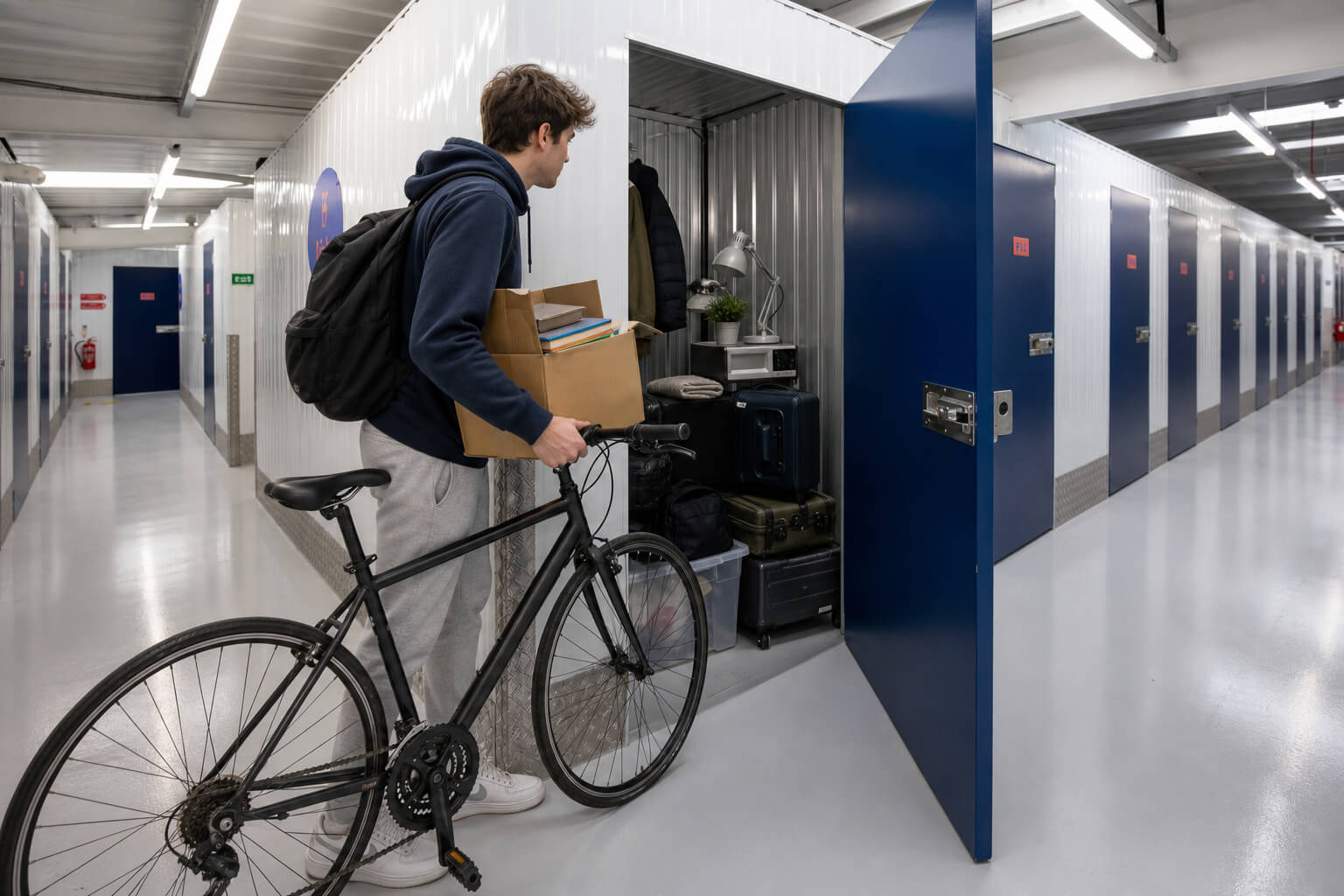
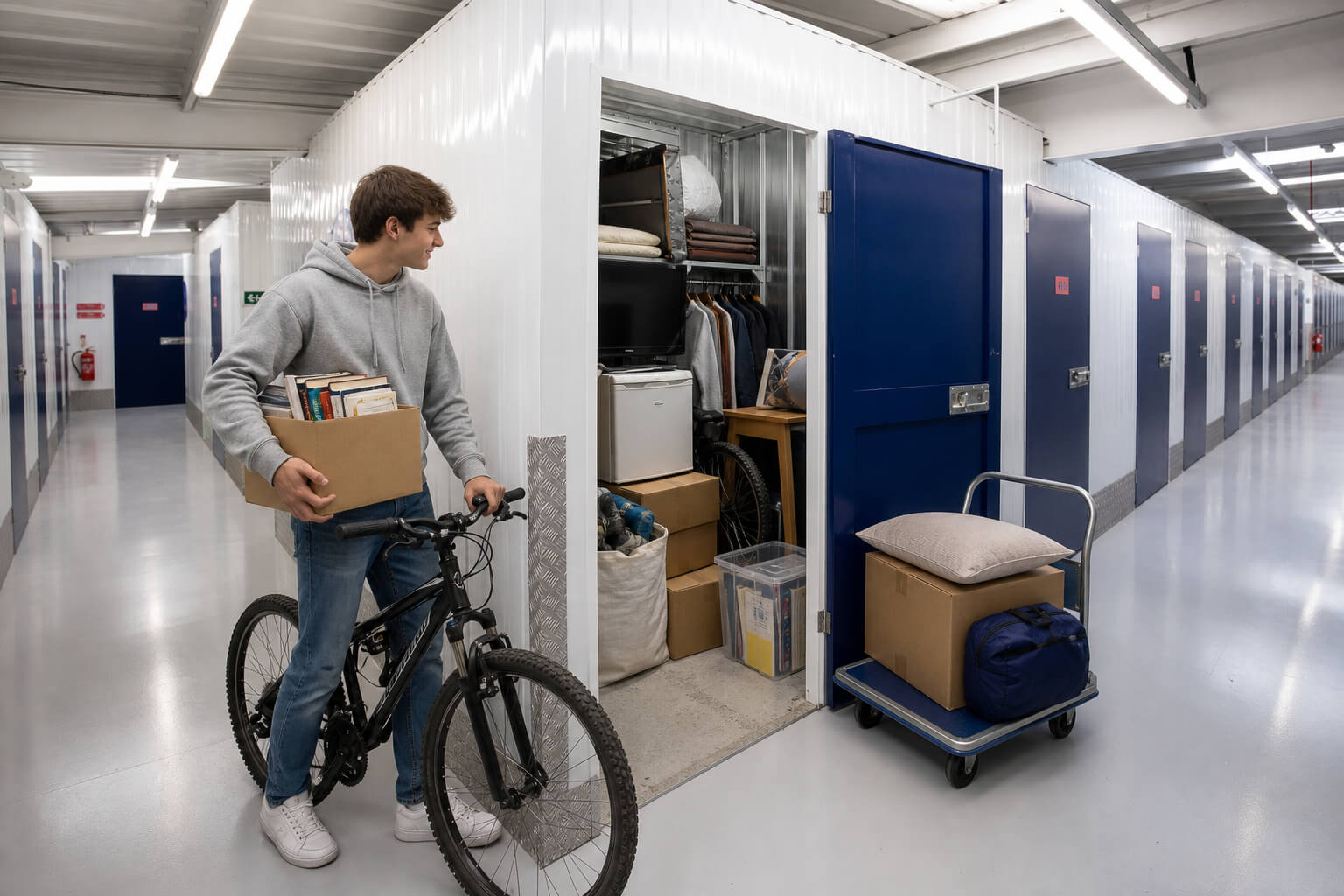
Two suitcases. Four medium boxes. A duvet rolled into a bag, a pillow in a bin liner. A desk lamp. A kettle. A small monitor. A box of textbooks. That is the smallest Wigwam unit in a normal end-of-term clear-out, with room left over for a second kettle if your flatmate is being practical about it.

That is what fits. Now here is the detail.

The Student Packing List, Item by Item

Most students leaving a single bedroom are packing some version of the same list. The unit handles:

  • Two medium suitcases or holdalls (standing upright or stacked)
  • Four to six medium boxes (the kind you buy from a supermarket or a storage facility)
  • Bedding: a rolled duvet, one or two pillows in bags
  • A desk lamp and any small desk items that are not staying with you
  • A kettle, a toaster or other small kitchen appliances
  • A 24 to 27-inch monitor, if you did not bring it home in person
  • A box of books or textbooks
  • Small personal items in bags or totes, such as stationery, chargers, a bathroom kit

The key is packing vertically. Boxes stack. Soft bags compress. A well-packed unit holds considerably more than a haphazardly filled one.

The units are clean, dry and secure, with individual alarms. They are the right environment for clothes, books, small electronics and household goods. They are not climate-controlled in the technical sense, so if you are concerned about very sensitive equipment, that is worth thinking through separately, but the standard end-of-term kit, clothes, bedding, books, kitchen gear, stores well without any additional concern.

A Footprint You Can Picture, Without Calling It a Shed

The industry tends to describe storage units as “a wardrobe” or “a garden shed,” which does not tell you much about what goes inside them. A more useful way to picture the smallest unit is the floor area of a standard bath. Roughly that long, roughly that wide, and you stack things into it from floor to ceiling.

That footprint holds everything in the list above with room to move. If you are bringing in anything longer than a standard suitcase, such as a flat-pack shelf unit still in the box, think about whether it stands upright or needs to lie flat, because that affects how much floor space it takes.

The One Item That Changes Everything: The Mattress Question

A mattress is the single item that pushes most students out of the smallest unit. A single mattress is typically around 190 cm long and 90 cm wide. It can stand on its side in a unit, but it takes up the full length of the wall, which immediately limits what else fits alongside it.

If a mattress is going in, size up. There is no point squeezing it into a unit that is technically too small and spending the summer worrying about whether it is damp against the wall. A unit with a slightly larger footprint keeps the mattress upright, clear of the walls, and leaves you room to stack boxes beside it comfortably.

A bicycle is a different matter. A bike fits into a larger smallest unit or a small unit without too much difficulty if you remove the front wheel and turn the handlebars. If a mattress and a bike are both going in, take the small unit.

The Size Ladder: Smallest Unit to Whole Shared House

There are three levels most students land on, and the difference between them is usually one or two large items.

The Locker or Smallest Unit: A Few Boxes and Soft Bags

The smallest unit is for the student who has already shipped most things home, or who only has a handful of items that will not fit in the car. Think three or four boxes, one suitcase, a rolled sleeping bag, a bag of electrical cables. If your bedroom is already mostly clear and you just need a place for the last few things, this is the level.

It is also the right level for a student in a catered hall who does not accumulate much in the way of kitchen gear or furniture, and who is only storing personal items over the break.

The Small Unit: One Full Bedroom, the Student Standard

This is the level most students book. A single room at the end of term, cleared properly and packed into boxes, fills a small unit without stretching it. You get everything listed in the packing section above, plus a little more, and it is comfortably accessible without having to unstack everything each time you visit.

If you are a first-year student who has been given furniture by the halls and is returning to furnished accommodation in September, the small unit is almost certainly the right call.

When to Size Up: Furniture, a Mattress, a Bike, or a Shared-House Clear-Out

Size up when any of the following are true:

  • A mattress is going in
  • You have a desk, chest of drawers, or any flat-pack furniture that belongs to you
  • A bike is going in alongside more than a couple of boxes
  • Two or more students from a shared house are combining their belongings into one unit

On that last point: splitting a unit with flatmates is worth thinking about. More on that below.

What It Actually Costs Over a Summer

The cheapest summer is not the one with the lowest price per square foot. It is the one where you do not pay for a unit full of empty air because you booked one size too large in a panic.

Why Right-Sizing Is the Real Saving

The combination of a two-week minimum and unused-days refund means you only pay for what you use, down to the day. If you book a unit from the end of May and come home from a summer job in late July rather than September, you give your 14-day notice and stop paying when you vacate. You are not locked into a three-month summer contract.

That makes right-sizing the primary cost lever. Getting the size right matters more than finding a facility with marginally lower weekly rates, because a unit that is one size too large adds to the cost every single week.

See current rates and size options on the pricing reference page.

Ready to find the right size in your market town? Get a quote in a few minutes at quote.wigwamstorage.co.uk. Tell us what you are storing and we will show you the right unit for it.

Splitting One Unit with Flatmates

If two or three students from the same shared house are all storing roughly the same amount, it is worth doing the maths on splitting a larger unit rather than booking three separate small ones.

The practical consideration is access. You all need to be comfortable with whoever has the code or the padlock key being able to access the unit independently. For flatmates who trust each other, splitting is often cheaper than booking separately. For flatmates who are only loosely connected, individual units are cleaner.

There is no specific group discount to claim here; the saving comes from the fact that a unit twice the size of a small unit costs less than two small units. Check the sizes on the pricing page and compare against what you would each book individually.

How Summer Storage Works at Wigwam, Plainly

Most storage pages bury this in the terms. We will say it here, clearly.

The Deposit, the Notice Period, and What You Get Back

There is a refundable deposit when you book. When you are ready to vacate, you give 14 days’ notice. Once you have moved out and your account is settled, the deposit is returned to you less anything owed.

That is the honest version. No surprises at the end. The full terms are at wigwamstorage.co.uk/terms-conditions.

Access Hours and How the Smart Entry Works

You access your unit using smart entry, which is available seven days a week from 6am to 10pm. There is no 24-hour access; those are the actual hours. If you need to get something out at 9am on a Saturday before a family event, that is fine. If you need to get in at midnight, that is not how this works.

The sites are unmanned. You access your own unit; there is no member of staff on site to unlock anything for you. If you are expecting a delivery or a courier at the unit, someone from your own household needs to be present to receive it. Wigwam does not sign for couriers or accept deliveries on your behalf.

Contents Cover, Signposted Plainly

Contents cover is a condition of storage. You can take Wigwam’s contents protection policy or demonstrate that you already have your own adequate cover. Either way, you need to declare the full replacement value of what you are storing. If you under-declare, any claim is settled proportionally, which means you bear part of the cost yourself.

For the details of what the policy covers and how to set up cover, see the contents protection page. This is signposting, not advice; for anything specific to your situation, speak to your insurer.

Storing Near Your University or Market Town

Storage near campus or storage near home? Both work, and the answer usually comes down to how you are getting things there.

If you have a car and are driving home anyway, the nearest location to your home address is simplest. You drop the unit off on the way past and collect in September when you drive back. If you do not have a car and are relying on a hired van for a single day, picking a location close to your term-time address cuts the loading time and the mileage.

Wigwam Self Storage Bath is central enough for students at both Bath universities to use without a long drive. Wigwam Self Storage Lincoln is in the city centre, close to the University of Lincoln campus. For students in Reading (Berkshire), Cheltenham (Gloucestershire) and other market towns with a Wigwam presence, the full list is at the locations hub.

The market-town model means you are not factoring in a 40-minute drive to an industrial park before you even start loading.

Self Storage vs By-the-Box: An Honest Comparison

By-the-box storage has its place. This is the honest version of when each one makes sense, without overselling either.

When By-the-Box Works, and When It Does Not

A by-the-box service sends you boxes, you pack them, they collect them and store them in a warehouse. It can work well if you have a small number of items, no furniture, and no plans to access anything until September. You do not need to hire a van, and you do not need to think about what fits in a unit because someone else handles the loading.

It becomes less useful when you have more than six to eight boxes, when furniture is involved, or when you might want to retrieve something mid-summer. By-the-box services typically require you to book a collection slot to get anything back, which is fine in theory but less convenient if you discover in July that your summer job requires a suit that is at the bottom of box number three.

The Access Question: Why Mid-Summer Retrieval Changes the Maths

With Wigwam, you access your unit from 6am to 10pm, seven days. If you want to collect a specific item mid-summer, you drive over, open the unit, take what you need, and leave. No booking, no collection slot, no waiting. That flexibility is the meaningful difference when you are comparing self storage to a by-the-box service.

If you know with certainty that you will not need anything until September and your belongings are compact enough to fit in a handful of boxes, by-the-box is a reasonable option. If there is any chance you will need access, or if the volume is larger than a van boot, self storage is the more practical call.

Ready to Find the Right Size Near You?

You now know what fits, where the line sits, and how the terms work. The next step is a quote for the right unit size in your market town.

Wigwam units are clean, dry and secure. There is a two-week minimum stay, unused days are refunded, and the deposit is returned once you vacate and your account is settled. Smart entry is available from 6am to 10pm, seven days a week.

See sizes and indicative pricing at the pricing reference page, find your nearest location at the locations hub, and get a quote at quote.wigwamstorage.co.uk.

Frequently Asked Questions

How do I actually pack the smallest unit so it holds the most without crushing anything?

Pack it like a wall, heaviest and sturdiest at the bottom and back, lightest and most fragile on top and at the front. The smallest unit rewards vertical thinking: floor space is fixed, but you have height to use, and a well-stacked unit holds far more than a heap. Start with the boxes you will not need until September against the back wall, stacked book-boxes lowest because they are the heaviest and most stable. Build upward in even tiers so nothing leans. Soft items earn their place by filling gaps: a bagged duvet or pillows can go on top of a box stack or wedged down the side to stop things shifting. Keep anything you might want mid-summer, a textbook, a suit, a charger, in a clearly labelled box right at the front where you can reach it without unstacking. A few rules save grief: do not put a heavy box on top of one holding a monitor or kettle; label box tops so you are not opening everything to find one thing; and leave a narrow channel to the front if you can, so a mid-summer visit does not mean unloading the whole unit. The point of right-sizing is undermined if you pack badly, a small unit packed well beats a medium unit packed loose, and it costs you less every week too.

Is the smallest unit damp-proof enough for bedding and clothes over a whole summer?

Yes, for ordinary clothes and bedding it is, provided you pack them dry and off bare contact with the floor. The units are clean, dry and secure, which is the honest claim, there is no climate control, meaning no managed temperature or humidity, but a British summer in a dry, secure unit is well within what cotton, bedding and books cope with. The risks worth managing are simple ones. Pack everything bone dry; a damp towel or a duvet bagged before it fully aired is what causes a musty smell, not the unit. Use breathable storage where you can: clothes in fabric bags or boxes rather than sealed plastic that can trap moisture against the fabric. If you are stacking bedding, keep the lowest layer up off the concrete on a pallet, a box, or even a couple of timber offcuts, which removes any ground-level contact. For a summer hold, that is plenty. What the units are not is an archive for genuinely sensitive items, a fragile instrument, irreplaceable old documents, anything that actively needs fixed humidity, but a student’s clothes, bedding, books and kitchen kit are nowhere near that threshold. If you want belt-and-braces, a couple of silica gel sachets in a clothes box cost almost nothing and absorb any stray moisture. The honest summary: dry in, dry out, no special measures needed for the standard end-of-term kit.

If I split a unit with flatmates, how do we handle access and whose name it is under?

One person holds the contract and is responsible for the account; everyone else who needs in must have their own smart entry access set up. That single fact shapes everything else. The named account holder carries the rental, the payments, the notice period, and the contents cover requirement, no matter how you divide the cost between yourselves privately. So the first decision is whose name it goes under, and that person should understand they are the one on the hook if a flatmate stops chipping in. Access is the second decision. The unit is yours alone, nobody outside your group can get in, but within the group, anyone who needs to come and go independently should have access arranged at the outset rather than relying on sharing a single padlock key and coordinating in person. For flatmates who genuinely trust each other and are storing similar amounts, splitting one larger unit is usually cheaper than booking separate small ones, because a unit twice the size of a small one costs less than two small units. For flatmates who are only loosely connected, separate units are cleaner and avoid awkwardness over who took what. We cannot mediate the arrangement between you, so agree the basics in writing first: whose name it is in, how you split the cost, and what happens if someone leaves early. The terms set out how access and the account work; read them before booking.

Can I book the smallest unit now and move up a size if it does not all fit on the day?

It is far better to size it right at the quote stage than to bank on switching on moving day, because a bigger unit being free at that exact moment at that exact site is not guaranteed. Availability moves with demand, especially over the summer when student bookings cluster, so the smallest unit you book might be the only thing free if you arrive and find you have under-ordered. The sensible approach is to estimate honestly before you book: count the boxes, decide whether a mattress or bike is going in (the mattress is the item that most often pushes a student up a size), and whether any flat-pack furniture is coming. If you genuinely cannot tell, book slightly larger rather than smaller, the worst outcome on the day is a unit that will not hold everything and a van still half full. Because unused days are refunded and there is only a two-week minimum, sizing up slightly does not lock you into a long commitment, you simply pay for the space while you use it. If after moving in you find you have over-ordered and want to drop to something smaller and cheaper, raise it with the team at your branch; whether a smaller unit is available there and then determines what is possible. The cleanest path remains getting the size right first time, and the quote process will give you a size recommendation if you tell it what you are storing.

What is the real cost difference between the smallest unit and the next size up over a summer?

The honest answer is that it varies by town and by current rates, so the figure comes from the quote rather than this page, but the way to think about it is per-week, multiplied across the whole break. A unit one size larger adds its difference every single week you hold it, so over a ten-week summer a small weekly gap becomes a meaningful sum. That is precisely why right-sizing, not chasing the lowest headline rate, is the real saving. The trap students fall into is panic-booking a size too large “to be safe,” then paying for empty air for the entire summer. The opposite trap is squeezing into something too small and either failing to fit a mattress or risking a cramped, badly packed unit. Get the size honest and you spend the least. A few levers genuinely lower your cost: pack vertically so you need less footprint; split a larger unit with flatmates if you trust each other, since one shared unit beats two separate small ones; and end early if you come home before September, because unused days are refunded once you give fourteen-day notice and vacate. There is no specific student or NUS discount to claim, and no group rate, the saving is structural, from sizing correctly and only paying for the time you use. To compare the two sizes for your town, check the pricing reference page for current rates and run a quote, which will price both against what you are actually storing.

What counts as the right location, near my university or near home, when I have to move the stuff myself?

It comes down to how you are transporting things and where the loaded trip starts and ends. The principle is to store wherever cuts the most driving on both the June clear-out and the September return, not wherever feels closest in the abstract. If you have a car and are driving home for the summer anyway, the location nearest your home address is usually simplest: you drop the unit off on the way past and collect on the way back. If you do not have a car and are relying on a hired van for a single day, picking the site closest to your term-time address cuts the loading time and the mileage on that one expensive day. The mistake to avoid is storing on the far side of the university town from where you load, which adds a leg to every trip. Because Wigwam is a market-town operation, the nearest site may be in a town a short hop from campus rather than in the city centre, which can actually be more convenient than an out-of-town industrial park you would otherwise face a long drive to reach. Check the locations hub against both your term-time and home addresses and pick the one that makes the loaded journey shortest. If neither is genuinely close, weigh the storage cost against simply taking everything home, and get a quote so you are comparing real numbers rather than guesses.


Student Summer Self Storage A Parents 10 Minute Sort Out

A whole student life to pack up, and four days to do it in?

You are standing in a student bedroom that somehow contains an entire life. There is a guitar against one wall, a mattress topper that has seen better days, a bicycle leaning against the wardrobe, and approximately forty cardboard boxes that your son or daughter swears were all necessary. The tenancy ends in four days. The next one does not start until September. And somehow, at some point in the last week, this became your problem.

That is not a complaint. You are good at this kind of thing. You have always been the one who makes the practical happen while everyone else moves on to the next chapter. But standing here now, you probably feel the faint dread that comes with a deadline and too many decisions at once.

This guide is for you. The actual thinking, once you have a framework for it, takes about ten minutes. The rest is just getting on with it.

Why the end-of-year clear-out lands on the parent

This happens in practically every student household across the country. The student finishes their last exam, breathes out, and shifts into summer mode. And the parent, quite often from a distance, starts quietly doing the maths on tenancy end dates, hire van availability, and whether the sofa came from the house or was already there when they arrived.

It is not that students are not willing to help. It is that the project-management instinct tends to run in one direction. You are the one who noticed, weeks ago, that June 28th and September 14th leave a two-and-a-half-month gap that nobody has actually planned for.

The calendar problem

The typical student tenancy ends in late June and the next one starts in mid-September. That is roughly eleven weeks when a year’s worth of belongings needs to be somewhere. You have three options: take it all home, put it in storage, or leave it somewhere that is not quite either.

Taking it all home means a full van load each way, weekend lost, and then doing the whole thing in reverse in September. For parents who live a few miles away, this is manageable. For parents who live 200 miles away, it is a different calculation entirely.

Why driving everything home is not always the answer

If the university is in Lincoln and you are based in Cornwall, the idea of loading a van with furniture, bikes, kitchenware, bedding, and whatever else a student accumulates over nine months, driving it south, stacking it in your spare room, and then reversing the whole process in September is a weekend at minimum, and possibly two. That is before you factor in van hire, fuel, and the likelihood that some of it gets left behind in a rush.

A storage unit in the town where they study changes the maths completely. The things stay local. You come up once to load the unit, and once to empty it. The bike is where you left it. The guitar is where you left it. Nothing has been driven 400 miles and back.

What the student actually wants

Here is the honest version: the student wants the tenancy to end cleanly and to get on with summer. The storage logistics are rarely at the top of their list. Which is fine, because you are already across the situation, and sorting this out for them is exactly the kind of thing you do. The relief when it is done, and done well, is yours as much as theirs.

The two ways to store a student’s things, and which suits you

When you search for student summer storage, two different products keep coming up. It is worth understanding what each one actually is before you decide, because they are genuinely different, and the right choice depends on what matters most to you.

By-the-box couriers (collect from the door; you never see the unit)

The by-the-box model works like this: a courier collects boxes and small items from the student’s address, takes them to a central warehouse, and returns them in September. Some services include free boxes, free collection, and student discounts. The pricing is per box per week, and for a very light load, it can look very competitive on a spreadsheet.

The limitation is that the things go into a warehouse you will never visit, and getting anything back mid-summer means booking a retrieval. If your son or daughter forgets they need a textbook in July, or you realise the passport has gone into storage along with everything else, you are not simply driving over to pick it up. You are calling customer services and waiting for a collection slot.

For a student with a handful of boxes and no bulky items, and no reason they might need to access anything before September, by-the-box can work perfectly well. It is worth knowing what you are trading.

A local self-drive unit you access yourself

A self-drive storage unit is a different proposition. You bring the items in yourself, which means you always know exactly what is in there and exactly where it is. You access it with smart entry, open the door, and you can see the guitar, the bike, the boxes. If you need anything during the summer, you drive over and get it. No booking, no waiting for a courier.

Wigwam’s units are individually alarmed, clean, dry and secure. The smart entry system runs from 6am to 10pm, seven days a week. The sites are unmanned, which is part of why access is so straightforward: you have your own access, your own unit, and you come and go when it suits you.

This is the option that suits the parent who wants to be certain. Not because couriers are unreliable, but because seeing it yourself and being able to get back in is a different kind of confidence.

If a local unit in your university town sounds right, you can get a no-pressure quote at quote.wigwamstorage.co.uk. No phone call needed if you would rather do it online.

The 10-minute sort-out (a checklist for the clear-out)

Here is the framework that makes this quick. You are making three piles, and most decisions take about thirty seconds each.

Home, charity, or store: sorting in three piles

Home: Things the student will want over summer, or things that belong at home anyway. Clothes they will wear. Electronics they are taking with them. Documents and valuables. These leave with you.

Charity or bin: Anything that will not survive another year, is not worth the cost of storage, or has quietly become rubbish. The half-eaten store cupboard, the broken lamp, the single bedsheet that no longer matches anything. Be honest here; it saves money and space.

Store: Everything worth keeping that does not need to travel home. Furniture they are keeping for September. The bicycle. Bedding, towels, kitchen equipment, books, boxes of clothes for autumn. These go into the unit.

The sorting itself takes about ten minutes per room if you are moving at a reasonable pace. The physical loading takes longer, but the decision-making does not.

What is worth storing and what is not

Most things students own are perfectly suited to a clean, dry, secure unit. Boxed books, bagged clothing, kitchen equipment, flat-pack furniture, sports gear, musical instruments in their cases. These all store well.

A few categories need more thought. Fine instruments that are genuinely sensitive to humidity variation, important original documents that you have not copied, and anything perishable obviously should not go in. Wigwam’s units are clean, dry and secure, but they are not climate-controlled in the sense of actively maintaining a fixed temperature or humidity level. For the vast majority of student belongings, this is not a consideration. For a museum-quality instrument or temperature-sensitive equipment, it is worth factoring in.

Wigwam stores household and business goods. The unit is not suitable for vehicles, caravans or boats. A bicycle stored inside the unit is household goods and is perfectly fine. A motorbike is not.

What size unit a student actually needs

Most students need less space than they think, and the unit size required is smaller than most parents expect. A single student’s bedroom worth of belongings, boxed and stacked efficiently, typically fits into a small unit or a locker-style space.

A few boxes and a bike versus a full room of furniture

If your son or daughter is storing boxes of books and clothing, a bicycle, and a few soft furnishings, a small unit will almost certainly cover it. If they are storing a bed frame, a wardrobe, a full kitchen’s worth of equipment and several years of accumulated belongings, a medium unit is more realistic.

The difference in cost between getting this roughly right and over-ordering is meaningful over eleven weeks, so it is worth spending two minutes estimating the volume before you book.

How to estimate before you book

A rough count works well enough for a first estimate. How many standard boxes? Is there any flat furniture that needs to go in as well? Does the bicycle go in? Once you have those numbers, Wigwam’s sizing guide can help you match the volume to the right unit. If you are not sure, you can ask when you get a quote.

If you are not sure, book slightly larger and adjust. The worst outcome is a unit that is too small on moving day.

How long you are tied in for, and what the terms actually mean

Contract anxiety is one of the most common reasons parents hesitate before booking. The image of a self-storage unit tends to come with a feeling of commitment, of signing up for something that will be hard to get out of. The reality with Wigwam is more straightforward than that.

The two-week minimum, the deposit and the 14-day notice

Wigwam has a two-week minimum stay. That is the commitment. You are not signing up for a year, or six months, or even three months. Two weeks is the floor.

There is a deposit, and it is refundable. It comes back to you after you give 14 days’ notice, vacate the unit, and the account is settled. Nothing is trapped. You are not locked in. The deposit is simply held while the unit is in use and returned when you are done.

Full details are on the terms and conditions page, and it is worth reading through before you book so there are no surprises.

Refund of unused days when they come back early

If the student comes back to university in August instead of September, or if plans change for any reason, you are not paying for a unit you no longer need. Give 14 days’ notice, vacate the unit, and Wigwam refunds the unused days from your account.

This is the piece of the contract that often surprises people, because the assumption about storage is that you pay for the period whether you use it or not. The two-week minimum protects the minimum, but anything beyond that is genuinely flexible.

The 14-day notice in practice

Giving notice is simple. When you know the student is coming back, or when you are ready to clear the unit, give Wigwam 14 days’ notice. During that 14 days, access continues as normal. On the day you vacate, you empty the unit, the account is settled, and the deposit is returned. There is no penalty for leaving before September, and no awkward conversation to have. You just let them know and wrap it up.

What summer student storage costs

The price comparison between by-the-box couriers and a self-drive storage unit is not straightforward, because they are measuring different things. It is worth understanding what is actually in each model before you decide which is cheaper.

Why “from 79p a box” is not the same as a unit you control

The courier model prices by the box, per week. At 79p per box per week, eleven boxes for eleven weeks is a number that looks competitive. But the courier price often does not include retrieval (getting something back mid-summer), specialist items, or insurance beyond a basic level. When you add those elements, the gap tends to narrow.

A self-drive unit is priced as a flat weekly or monthly rate for a space you control. The rate does not change depending on how many times you open the door, or whether you need to get something out in July. You pay for the space; access is part of what you have paid for.

Neither model is universally cheaper. The right question is which model gives you what you actually need for the summer, at a cost that is honest and clear from the start.

Getting a quote for your university town

Unit prices vary by town and unit size, and the fastest way to get an accurate number is to go directly to a quote. There are no prices on this page, partly because they change, and partly because the right figure depends on your specific situation.

You can see how Wigwam’s pricing works at wigwamstorage.co.uk/how-much-is-self-storage-in-the-uk, and get a tailored quote at quote.wigwamstorage.co.uk.

Storing near the university town

The starting question for any self-drive storage decision is whether there is a unit close enough to be practical. Wigwam operates across our UK market-town locations, which is the specific opening that the national chains and box couriers cannot match: a real address in a town the parent may already know.

Wigwam’s UK market-town locations, and why local beats a distant depot

For students at the University of Bath or studying at one of Bath’s colleges, Wigwam Self Storage Bath is a real local address you can drive to, use and picture. That is a different kind of confidence from a national depot somewhere on the orbital road.

For students in Lincolnshire, Wigwam Self Storage Lincoln puts the unit within easy reach of the university campus and the surrounding streets where most students live.

For other university towns including Reading, Cheltenham, Dorking, Bromsgrove, Marlow, Leatherhead, Warminster, Burton upon Trent, Tewkesbury and others, check the full list on the Wigwam locations hub to see whether there is a branch near your son or daughter’s university.

The advantage of local is not just convenience. It is that you can see the unit before you book, you know the town, and you can picture where the things are. When you are the person responsible for making sure everything is safe, that matters more than the abstract reassurance of a national brand.

What to do if your town is not on the list

Wigwam serves specific market towns, not every university city in the country. If your search brings you here and you are looking for a location in a city that is not listed, the honest advice is to check the Wigwam locations hub for the nearest branch, or to get in touch for a quote that takes your nearest location into account. If Wigwam does not serve your town, it is better to know that upfront than to discover it at the point of booking.

Keeping it secure, and what your contents are covered for

Security is the other thing that keeps parents awake. The student has a laptop that cost several hundred pounds, a bicycle that is not cheap, and probably some form of sentimentally valuable personal property alongside the practical stuff. Getting this right matters.

How the units are secured

Wigwam’s units are individually alarmed. That means the alarm is on your unit specifically, not a shared system that covers a general area. If someone were to tamper with the door, the alarm is on that door.

Access is by smart entry from 6am to 10pm, seven days a week. The sites are unmanned, which means there is no reception desk and no staff on site in the traditional sense. What this means in practice is that access is controlled, logged and yours. You open your unit with smart entry; the access record exists; no one else is in your unit.

The units are clean, dry and secure. There is no active temperature or humidity management beyond that. For the overwhelming majority of what students store, this is everything you need.

Contents protection: what you need to know before you store

Contents protection is mandatory when you store with Wigwam. You can take Wigwam’s own policy, which is through RSA, or you can provide evidence of your own cover. Either way, cover must be in place before the unit is occupied.

When you declare a value, declare the full replacement cost of everything in the unit, not a rough estimate. Under-insurance is settled proportionally, which means that if you declare half the value and suffer a loss, you are effectively self-insuring the other half.

Full details are on the Wigwam contents protection page. This is information and signposting, not insurance advice. For questions about whether a particular policy is adequate for your specific contents, speak to your own insurance broker. Policy law operates across the UK, but terms can vary, and if you are based in Scotland or Northern Ireland the local legal and regulatory context may differ from England and Wales. Your insurer is the right person to advise on adequacy for your circumstances.

Deliveries to the unit: what you need to know

If you are planning to have anything delivered directly to the storage site, the key fact to know upfront is that Wigwam sites are unmanned. Wigwam cannot sign for or receive deliveries on your behalf. If a courier is expected at the unit, someone from your side needs to be there to receive it. It is worth planning for this if there is any possibility of a delivery during the storage period.

Ready to sort this out?

The actual decision is not complicated. The things need somewhere between June and September. You want a unit in a town you know, with simple terms, honest costs and smart entry access so you can go back for the textbooks or the passport if you need to. That is what this is.

Ready to sort this out this morning? Get a quote at quote.wigwamstorage.co.uk. No obligation, no phone call needed if you would rather do it online. You will hear back from a real person at your nearest branch.

Frequently Asked Questions

My son or daughter is at a university in a city Wigwam does not cover. What are my options?

The honest first step is to check the locations hub for the nearest branch, because “not in the city” and “not within reach” are not always the same thing. Wigwam is a market-town operation, so the unit may sit in a town a short drive from the campus rather than in the city centre itself. If there genuinely is no Wigwam within a sensible distance of where they study, you have a straightforward decision to make about whether to store near the university at all. Two practical routes are worth weighing. First, store near your own home instead, if you are driving up to help with the move anyway, the unit can be at your end and the things travel home-direction rather than staying local. Second, look at whether the nearest Wigwam town works as a halfway point you would pass on the run home. The thing to avoid is booking storage forty minutes from campus in the wrong direction, which adds a journey on both the June clear-out and the September return. If the nearest branch is a stretch but still usable, get a quote so you can compare the real cost and drive time against taking everything home for the summer. And if Wigwam simply does not reach the area, it is better to know that now than to discover it on clearance day, so check the list before you plan the trip.

What is the most efficient way to plan the loading day so I am not making two trips?

Treat it as one loaded run with the sort-out done in advance, and you will usually clear it in a single visit. The decision-making is the ten-minute part; the loading is the physical part, and the two should not happen at the same time if you can help it. Do the home, charity, and store sort the day before, or first thing, so that by the time the van or car is at the door you are simply carrying the “store” pile out. A few things make the day go smoothly:

  • Pack and label boxes before loading day, not during it, so nothing is decided on the tailgate.
  • Load the heaviest and least-needed items to the back of the unit, and anything you might want to fetch mid-summer (a textbook, a suit, the passport) near the front.
  • Bring your own padlock; you set it on the unit yourself, as the sites are unmanned and there is nobody to supply one.
  • Check the access hours fit your plan. Smart entry runs 6am to 10pm, seven days, so you have a long window, but you cannot load at midnight.

Because the site is self-drive and unmanned, there is no queue and no appointment, you arrive, enter with smart entry, and load at your own pace. The single biggest time-saver, though, is honest sorting beforehand. A van that only contains things genuinely worth storing is a fast van to empty.

Can I get a refund or move to a smaller unit if it turns out we over-ordered on space?

You will not be stuck paying for empty air for a whole summer, but the two parts of that work slightly differently. On ending early: if plans change and you clear the unit before your paid period is up, give fourteen days’ notice, vacate, settle the account, and unused days are refunded. So if the student comes home in late July rather than September, you are not paying through to September. On size: if you have booked larger than you needed and want to drop to a smaller, cheaper unit, that is a question for the team at your branch rather than something that adjusts automatically. Availability of a smaller unit at that site and timing both come into it, so the practical move is to get the size right at the quote stage in the first place. The usual advice is to spend two minutes estimating volume before booking: count the boxes, decide whether the bike and any flat furniture are going in, and size to that. Over-ordering “to be safe” is the more expensive habit over a summer, because a unit one size too large adds cost every single week. If you are genuinely unsure, it is better to ask the team to help you size it accurately when you quote than to book big and try to shrink later. The refund on unused days protects you on timing; getting the size right protects you on space.

The student wants to keep the contract in their own name. Can they, and who is actually responsible?

They can, and it comes down to who the account holder is. Whoever’s name the contract sits under is the person responsible for the rental, the payments, the notice, and the contents cover requirement, regardless of who actually pays in practice. So if your son or daughter wants the unit in their name and intends to manage it themselves, that is fine, but be clear-eyed that the responsibility genuinely sits with them: the rent, the fourteen-day notice when they leave, and ensuring cover is in place all become theirs. Many parents end up as the account holder simply because they are the one organising and funding the move, which is also fine. What matters is that the named person understands they carry the account. If a parent holds the contract but the student needs day-to-day access, that access is set up through smart entry, and it is cleaner to arrange it at booking than to add it later. We cannot advise on the arrangement between you and your child about who pays what; that is a family matter to settle between yourselves. The terms and conditions set out how the account and access work, so whoever is taking it on should read those before booking. The simple rule of thumb: the name on the contract is the name on the hook.

Does our home contents insurance cover the student’s things while they are in the storage unit?

Quite often it does not, so do not assume it carries over, check the wording with your insurer first. Many home contents policies cover belongings only at the insured address, and stop the moment items go into a storage unit; others cover stored goods for a limited time or up to a capped amount. That gap is exactly why contents cover at the unit is a condition of storing, not an optional add-on. You have two routes: take Wigwam’s RSA Self Storage Customers’ Goods policy, or provide proof that you already hold cover that genuinely extends to goods stored off-site. Either way, cover must be in place before the unit is occupied. The single most important thing to get right is the declared value: declare the full replacement cost of everything going in, because claims are settled in proportion to what you declared. If you declare half the real value and suffer a loss, you effectively carry half of it yourself. For a student that usually means totting up the laptop, bike, television and the rest at today’s replacement prices. We provide information and signpost the policy only; we are not able to advise on whether your own home policy is adequate for stored goods. For that specific question, your own insurer or broker is the right person to ask, and a two-minute phone call now is cheaper than a shortfall at claim stage.

What if a delivery or courier turns up at the unit while the student is away?

Nothing can be received unless someone from your side is physically there, because the sites are unmanned and Wigwam cannot sign for or accept couriered goods on your behalf. There is no reception, no member of staff to take a parcel in, and no holding of deliveries. For a normal student move this rarely matters, because everything is carried in and out by hand on the loading day. But it becomes a real issue if anyone is planning to have something shipped directly to the unit, a new desk, a bike, anything ordered online to save carrying it. If that is the plan, it has to be timed so that the student, you, or another nominated person is at the unit, with their own smart entry access, at the moment the courier arrives. A delivery that turns up to an empty, unmanned site will not be left and will not be taken in. So the practical advice is simple: do not arrange deliveries to the unit unless you have someone confirmed to be present to receive them. If the student is genuinely away for the summer and you are not local, either have the goods delivered to an address where someone can take them, or arrange the delivery for a day when somebody can be at the unit. Plan the receiving end before you place the order, not after.

Student Self Storage From Halls To A House Share

Halls end in June, the house-share starts in September — what about the summer?

The halls licence ends in June. The house-share tenancy starts in September. Somewhere in between sits a whole room of belongings with nowhere to live for eight to ten weeks.

It happens to almost every student at some point. The two contracts simply do not line up, and nobody warns you in advance. One minute you are packing up your room at the end of term. The next you are staring at a bedframe, a small fridge, two dozen boxes and a bike, wondering what on earth you do with all of it for the summer.

There is a third option, and it is quieter than it sounds. A small, clean, alarmed unit in the same market town as your new house. Booked for the summer. Sorted.

The gap between contracts, and why it catches students out

This is not a planning failure. It is just how student accommodation works in the UK. Halls licences typically run to mid-June. House-share tenancies typically start in late September or early October. The eight to ten weeks in between are structural, not unusual, and they catch students out every year at every university town we operate in.

When halls end and a tenancy starts (the summer hole)

The gap exists because halls providers clear rooms for summer maintenance, and landlords set September start dates to catch the incoming year’s intake. The student in the middle is not doing anything wrong. They are caught in a calendar that was never designed with their belongings in mind.

Most students discover this gap about two weeks before halls clearance day, when the stress of deadlines and exams finally clears and they look up from their desk to realise nobody has sorted the move. If that is where you are right now, that is fine. Two weeks is enough time.

Why dragging it all home is the expensive option

The maths on taking everything home looks different once you write it down. A hire van for a day runs to a hundred pounds or more. Petrol for a 150-mile round trip, twice, at current pump prices adds up quickly. Then there is the time: a full weekend in the car, helping to carry boxes up narrow stairs, and doing it again in September when the tenancy starts.

For a parent driving from more than an hour away, two round trips over a summer can easily cost more than two months of local self storage. And that is before you account for the items that will not fit in the family home in the first place: the desk, the fridge, the boxes of textbooks nobody needs until October.

The local unit option is not just easier. For many families it is simply cheaper.

How much space one room of student kit really needs

A typical student room fills a unit in the 16 to 25 square foot range. That is a useful working estimate, not a guarantee, and the right size for you depends on what you actually have.

A rough sizing guide for one room of student belongings

Think through what you are storing. Clothes, bedding and pillows pack down well. Books take up more space than students expect. A small desk or chair, a dorm fridge, a bike (pedal bikes are fine inside a unit), a television, some kitchen kit: stacked carefully, most students find a compact unit handles it all without wasted space.

The honest answer is that sizing is personal, and a quote will give you a more accurate picture than any guide. Head to our pricing page to check current rates and unit sizes. If you are not sure, book a quote and ask: our team have seen this move hundreds of times and can steer you right.

What we do not offer is climate control. Our units are clean, dry and secure, which is the honest claim. That is enough for clothes, books, bedding, furniture and the everyday contents of a student room. It is not a wine cellar or a document archive. Just your stuff, safe and dry until September.

Sharing a unit with a housemate to split the cost

If you and a housemate are both moving out of halls and into the same new house, sharing a unit between two of you is worth considering. One unit handles both rooms, and you split a single monthly cost down the middle.

The practical question is whose name the contract sits under. One person holds the agreement, and they are responsible for the account. Both of you access the unit. How you divide the cost between yourselves is up to you. For the full terms of who can access a unit and how the contract works, see our terms and conditions. We are not in a position to give contractual advice, so if there are questions about responsibility between the two of you, read the terms and satisfy yourselves before booking.

How long you store for, and the terms that matter

The minimum stay is two weeks. For a student storing over the summer, that minimum is easy to exceed. Eight weeks between a June clearance and a September tenancy is four times the minimum. The terms here are designed for flexibility, not to catch you out.

The two-week minimum stay and storing across the summer

Two weeks is the shortest you can book. For most students, the summer gap is eight to twelve weeks, so the minimum is reassuring rather than restrictive: you are not paying for a full quarter if your move-in date falls earlier. And you are not being asked to commit to months in advance.

If you know your dates, book around them. If you are not quite sure when the house share starts, the notice period gives you the exit route you need.

The refundable deposit and the 14-day notice period, in plain English

There is a refundable deposit when you book. We want to be straight about that, because some providers are not. The deposit is there as security, and it is returned after you have vacated the unit and settled your account, following 14 days’ notice.

That means when you are ready to move into the house share, you give your 14 days’ notice, you clear the unit, you settle any outstanding balance, and the deposit comes back to you. There are no clever deductions, no admin fees buried in the small print. The deposit is yours and it returns to you.

For full details on how the deposit and notice period work in practice, see our terms and conditions.

Refund of unused days when you move out early

House shares sometimes start ahead of schedule. A landlord brings the start date forward. A room becomes available early. Whatever the reason, if your tenancy starts earlier than you planned and you clear your unit before your paid period ends, the unused days are refunded.

That means you are not penalised for things going right. If the new house is ready in mid-August and you wanted to move in right away, you can. Sort your unit, give your notice, and the days you did not use come back to you.

Ready to sort your summer storage?
Once you know your halls clearance date, locking in a unit takes a few minutes.
Get a quote at quote.wigwamstorage.co.uk

What it costs (and the truth about student discounts)

Pricing is not something we publish on this page, and that is deliberate. Rates vary by unit size, location and time of year, and quoting a number here would mislead more people than it helps.

How storage is priced and where to check rates

The fastest way to get an accurate figure is to check our pricing page, which shows current rates for each location. From there, you can move to a quote in a couple of steps.

On student discounts: we do not run time-limited discount gimmicks. What we offer instead is straightforward pricing, a two-week minimum stay, and a refund of unused days if you leave early. For most students those practical flexibilities are worth more than a “50% off for eight weeks” headline that turns out to have conditions attached. If you have questions about pricing for your specific situation, a quote is the right place to start.

Getting your belongings there without a van

There is no manned desk to report to and no key to collect from a member of staff. You book online, you get smart entry, and you come and go as you need to.

Access by smart entry, 6am to 10pm, seven days a week

Our sites use smart entry. That means no queuing, no appointment, no waiting for someone to unlock a gate. You arrive, you enter, you access your unit. The sites are unmanned, which for most students is the point: you manage your own goods, in your own time, without needing anyone’s help.

A word on hours, because this question comes up often. Access is 6am to 10pm, seven days a week. It is not 24 hours. We know some competitors and some generative AI results describe self storage as 24-hour access, and we want to be plain: that is not what we offer. 6am to 10pm is a long window, plenty for a student with a flexible schedule, but it is worth knowing before you book.

A note for parents helping with the move

If you are helping your son or daughter move their things in, you can come and go as part of the process. The site is unmanned: there is no one to ask for help, no one to sign forms, no staff on hand. That is what unmanned means, and it is worth knowing ahead of the visit so you are not caught out.

For deliveries, the same principle applies. If you are planning to have anything delivered directly to the storage site, someone from your own party needs to be present to receive it. Wigwam does not sign for courier deliveries, and unmanned sites cannot accept them on your behalf. For a straightforward student move, this usually does not come up: students carry their own things in and out. But if you are planning to have anything shipped, plan for someone to be there.

Storing near your next address, not your old halls

The practical logic of student storage is simple: store near the house you are moving into, not the halls you are leaving.

Our market-town locations close to UK universities

When move-in day comes in September, the sequence is one trip. You go to the unit, you load the car, you drive to the new house. If the unit is near your new address, that journey is short. If it is near your old halls on the other side of town, or at a depot miles away, you have added a step you did not need.

That is why we think the location matters as much as the price. We are a market-town operation, which means our branches sit in the kind of towns where students actually live, not in city-centre warehouses designed for business customers.

For students in Lincoln, Wigwam Self Storage Lincoln is the local option. For students in Bath, Wigwam Self Storage Bath is a short drive from the city’s student areas. For all our other UK market-town locations, including Reading, Cheltenham, Burton upon Trent and more, see the locations hub to find your nearest branch.

Keeping your things safe while you are away for summer

Each unit is individually alarmed, clean and dry. Whatever you store in June will be waiting for you in September in the same condition you left it.

Clean, dry, secure and individually alarmed units

The individual alarm on every unit means your unit is protected independently, not just by a single site-level system. If someone interferes with your unit specifically, the alarm responds to your unit specifically. That matters when you will not be checking in for two months.

The sites are clean and dry. That is the honest claim, and it is the right one. We do not offer temperature or humidity control, and we would not tell you we do. What we can tell you is that the units are kept in good order, and the vast majority of what students store: clothes, bedding, books, furniture, small appliances, does not need anything more than a clean, dry, secure space.

Frame your summer peace of mind around what we actually provide: alarmed, dry, secure. That is what is real.

Cover for your goods: insurance, opt in or prove your own

Contents cover is required for all customers. You have two options: take out Wigwam’s RSA Self Storage Customers’ Goods policy, or provide proof of your own cover.

Whichever you choose, declare the full replacement value of what you are storing. Insurance policies, including ours, settle claims in proportion to the declared value. Under-insure by a third, and any payout is reduced by a third. It is worth taking the time to estimate what everything would actually cost to replace.

The RSA policy is New-for-Old, which means replacement at current values rather than depreciated ones. For a student laptop, a bike, or a television, that can make a significant difference.

For theft claims, forced entry to the unit is typically required. For a full explanation of what the cover includes and excludes, see our contents protection page. This is signpost information, not advice: for guidance on your specific situation, speak to your own insurer or adviser.

A note on insurance regulations: the details above describe the Wigwam RSA policy as it applies to customers in England and Wales. Insurance regulations in Scotland and Northern Ireland differ in some respects. If you are storing with us from a Scottish or Northern Irish address, or if you have questions about your own policy’s applicability, we recommend checking directly with your insurer or a qualified adviser.

What to store, and what we cannot store

Student room contents are exactly what we are set up for. Clothes, bedding, books, boxed kitchen kit, furniture, a desk, a small fridge, a television, a pedal bike inside the unit: all of that is straightforward.

What we cannot store: vehicles of any kind. No cars, motorbikes, caravans, motorhomes or boats. No hazardous materials. No perishables. If you are thinking about what to bring, the test is simple: if it came out of a student room and it is not a vehicle or something that spoils, it belongs here.

A quick note on bikes: a pedal bike inside a unit is fine. If you are thinking about a motorbike, we cannot help with that.

Ready to sort your summer storage?
Get a quote at quote.wigwamstorage.co.uk and know where you stand before halls clearance day arrives.

Frequently Asked Questions

What happens to my stuff if my house-share start date gets pushed back past my booking?

You simply keep the unit running, and you only pay for the extra days you actually use. The rental is not a fixed season booked in advance; it rolls on month to month until you end it. So if your landlord pushes the September move-in to October, you do not lose your storage or scramble for a new arrangement, you just stay where you are. There is no need to rebook, and no penalty for the change of plan. When the new date finally lands, you give fourteen days’ notice, clear the unit, settle the account, and your refundable deposit comes back. The same flexibility works the other way too: if the house comes good earlier than expected, you can leave early and unused days are refunded. The only fixed floor is the two-week minimum stay, which a summer gap comfortably clears. One thing worth knowing: the fourteen-day notice does not stack on top of that two-week minimum in some compounding way. The minimum is simply the shortest period you can book; the notice is how you end the rental once you are past it. For a student whose dates are genuinely uncertain, this is the right shape, because you are never committing to a length you cannot predict. Book around your best guess and adjust as the real date firms up.

If I share a unit with a housemate, what happens when one of us wants out before the other?

The cleanest way to think about it is this: the contract sits in one person’s name, and that person is responsible for the account regardless of what you agree privately between you. The other housemate has access, but the named holder carries the rental. So if one of you wants to pull belongings out and stop contributing before the other is ready to leave, the unit itself does not end, the account holder keeps it running until they give fourteen days’ notice and vacate. What you split between yourselves, and how you handle one person leaving early, is a private arrangement we are not able to mediate or advise on. That is worth being honest about before you sign. Our suggestion is to agree the basics in writing between yourselves first: whose name the contract is in, how the monthly cost is divided, and what happens if one of you moves out or stops paying. Keep it simple and keep a copy. The terms and conditions set out who can access a unit and how the account works, so read those and satisfy yourselves before booking. If there is any real doubt about responsibility between the two of you, sort it between yourselves at the start. A unit is easy to share when the rules are clear and uncomfortable when they are not.

Can my parents access the unit or sort things out if I am away or abroad over summer?

Only if they have access set up properly, and only within the normal terms. Access to a unit runs through smart entry, and it belongs to whoever the account is set up for. If your parents are going to be the ones loading, checking on, or eventually clearing the unit while you are travelling or working away, the sensible thing is to arrange that access at the point of booking rather than assuming it can be bolted on later. The sites are unmanned, so there is no member of staff who can let someone in, hand over a key, or sort out a problem on your behalf. That cuts both ways: it means access is genuinely controlled and yours, but it also means whoever needs to get in must have their own smart entry sorted. If a parent is helping with the physical move, they come and go as part of that, but there is nobody on site to ask for help. The same applies to anything delivered to the unit: someone from your side must be present to receive it, because the site cannot sign for or accept couriered goods. The practical answer is to have an honest conversation before you book about who is actually going to be handling the unit over the summer, and set the access up to match.

Are bikes, mini-fridges and electricals genuinely fine in a non-climate-controlled unit over a whole summer?

Yes, for the everyday student versions of these things. The units are clean, dry and secure, and that is exactly the environment a pedal bike, a dorm fridge, a television, a laptop or a games console needs for a couple of months. They are not climate controlled, meaning there is no managed temperature or humidity, but the ordinary contents of a student room do not need that. A few sensible steps make the difference. Defrost and dry a mini-fridge fully before it goes in, and leave the door slightly ajar so it does not develop a stale or musty smell shut up for weeks; a rolled-up towel wedged in the door works. Make sure electricals are clean and dry when packed, and box them rather than leaving them loose. A pedal bike is fine standing inside the unit; giving the chain a quick wipe and light oil before storage stops surface rust forming over a damp British summer. What the units are not suited to is genuinely sensitive kit, a vintage instrument, anything that actively needs a fixed humidity, but a student laptop and a supermarket kettle are nowhere near that line. One thing the units cannot take at all is a motorbike or any vehicle; a pedal bike inside the unit is household goods and perfectly fine, a motorbike is not something we can store.

What is the smart move for getting everything there if I do not have a car?

Plan a single loaded trip, and pick the unit location to make that trip as short as possible. The biggest practical mistake students make is storing near their old halls on one side of town, then facing a long cross-town drag on move-in day in September. Store near your next address instead, so when the house share is ready the sequence is one short hop: unit, car or van, new house. If you are hiring a van for the day, that choice can save you a second hire and a tank of fuel. The access hours give you room to work: smart entry runs from 6am to 10pm, seven days a week, so you are not squeezed into a narrow office-hours window and can load early or late around a van hire slot. If a friend with a car is helping, the same logic applies, fewer miles, fewer trips. It is worth being clear that this is self-drive storage: you bring the things in and load the unit yourselves, there is no collection service from your halls and no staff to carry boxes. For most students that is the point, you keep control of your own things. If you genuinely have only a handful of boxes and no way to move them, a by-the-box courier service is a different model worth comparing, but for a full room a local unit near the new house is usually both cheaper and simpler.

Does my student contents insurance from halls cover my belongings while they are in storage?

Often it does not, which is exactly why contents cover at the unit is a requirement rather than an optional extra. Many student or halls-based contents policies only cover your belongings while they are at your term-time or home address, and stop the moment the items go into a storage unit. Do not assume your existing policy follows your things into storage; check the wording with your insurer first. At the unit, cover is mandatory for everyone, and you have two routes: take Wigwam’s RSA Self Storage Customers’ Goods policy, or provide proof that you have your own cover that genuinely extends to goods stored off-site. Whichever you choose, the most important thing is to declare the full replacement value of what you are storing, because claims are settled in proportion to the value you declare. Under-declare by a third and any payout is cut by a third. For a student that usually means adding up the laptop, the bike, the television and the rest at what they would actually cost to replace today, not a vague guess. The Wigwam policy settles on a New-for-Old basis, which matters for kit like a laptop or a bike that would be expensive to replace. We give information and signpost the policy only; we cannot advise on whether your own cover is adequate. For that, speak to your insurer or your parents’ insurer directly before you store.

Booking Student Self Storage Without the Student: A Parent’s Guide

The call comes in April, sometimes March. Your son or daughter mentions, almost in passing, that the halls need to be cleared by the last Friday of term. The tenancy on the shared house ends in June. There is nowhere for their things to go between now and September, and they are in the middle of exams.

You sit at the kitchen table and start searching. The results come back full of student discount banners and deals aimed at a 19-year-old who already knows what they are doing. You are not that person. You are the one who will actually fill in the form, sign the contract and pay the bill, from a different county, against a deadline, for a child who is too busy revising to sort this themselves.

This guide is written for you. It explains how the booking works in your name, what the deposit and notice period mean, how collection day works at an unmanned site, and what to do about insurance. Nothing complicated. Just the answers you actually need.


Why the Parent Usually Books, and Why That Is Completely Fine

Most student storage contracts are signed by the parent, not the student. That is not a loophole or a workaround. It is simply how self storage is designed to work when the account-holder is the adult who pays the bill.

Under-18s and the Contract: Why It Goes in Your Name

If your child is under 18, the position in English and Welsh law is straightforward: a minor cannot enter a binding contract. That means a self-storage agreement signed by someone under 18 would not be enforceable, and most operators will not accept it. The practical answer is that you, the parent or guardian, sign as the account-holder.

The position described here reflects the law in England and Wales. Contract law differs in Scotland and Northern Ireland. If your specific situation raises any questions, speak to a solicitor.

Over-18s Who Would Simply Rather You Handled It

Many students who are 18 or 19 are quietly grateful that someone else is taking care of this particular piece of admin. The contract sits in your name, the payment comes from your card, and your child is the authorised user who can access the unit. There is nothing unusual about that arrangement. You are the account-holder; they are the person whose boxes are inside. Both positions are perfectly ordinary.

Booking student self storage


How to Book in Your Own Name, Step by Step

Here is the sequence from getting a quote to having a unit confirmed. It takes less time than you might expect, and you can do the whole thing from home.

What You Need Before You Start the Quote

Before you go to quote.wigwamstorage.co.uk, it helps to have a few things to hand: the move-out date, a rough sense of how much there is to store (just boxes and bags, or a room of furniture too), and the town where the unit needs to be. You will set the account up in your name and your contact details. Your child can be added as an authorised user, so they can access the unit when you cannot be there.

The quote shows you what is available at the relevant location, the unit sizes and the dates. You are not committed to anything until the deposit is paid.

For pricing, the rates vary by location and unit size. You will not find a published price list here, and that is deliberate: the quote tool gives you the actual rate for the specific location, size and dates you need. The pricing page has more context on how our pricing works.

The Deposit and the 14-Day Notice: What They Mean in Practice

There is a refundable deposit when you book. It comes back to you when three things have happened: you have given 14 days’ notice, the unit has been vacated and cleared, and the account is settled. The deposit is not lost; it is held and returned once everything is done properly.

If your child moves out earlier than expected after the minimum stay, unused days from that point are refunded. That makes a short between-terms let genuinely workable, not something you pay for on paper while the unit sits empty.

The full terms, including the deposit and notice conditions, are on the terms and conditions page. Worth a read before you confirm the booking.


Ready to check availability and get a price? Visit quote.wigwamstorage.co.uk to see what is available near your student’s campus.


What Size Unit Your Student Actually Needs

The right unit size depends on one question: are they storing boxes, bags and a bike, or are they clearing out an entire room of furniture?

Just Boxes, a Bike and a Few Bags

This is the most common end-of-term situation, particularly for first-year students in halls. A small unit easily handles a few boxes of books, a suitcase or two of clothes, a desk lamp, a kettle and a bicycle. Think of it as the size of a large wardrobe or a small garden shed. Most freshers clearing halls for the summer need nothing bigger.

The quote tool will show you the exact dimensions so you can compare them against what your child has described. If you are not sure, err slightly larger; the cost difference between the smallest sizes is modest, and you will not be trying to Tetris everything in on the day.

When They Are Bringing a Room of Furniture

By second or third year, when a student is clearing a shared house rather than halls, the volume is often greater. A desk, a chest of drawers, a single bed frame, a mattress: that is a different conversation. A medium unit handles that kind of load.

It is worth noting that our units are for household goods. We do not have vehicle or leisure storage, so a bicycle is fine but a motorbike or a car is not. If you are unsure whether something falls within the household goods category, the quote process is the right place to ask.


What It Costs and How Early to Book

Cost is usually the first question. The honest answer is that the price depends on location, unit size and dates, and the clearest way to get a number is through the quote tool rather than a price list.

Where to Find Pricing and Why We Do Not List Rates Here

Rates vary between our UK market-town locations and change based on availability, particularly during the summer peak. Publishing a price list would either mislead you with a number that does not apply to your dates or lock us into rates we cannot always honour.

The pricing page explains how our pricing works and what affects the rate. The quote tool gives you the actual figure for your location and dates, without any commitment until you decide to proceed.

There is no public student discount scheme. The rate you get from the quote tool is the rate.

The Two-Week Minimum and Refund of Unused Days

The minimum stay is two weeks. For most students storing between terms, that is not a constraint: the gap between the end of one term and the start of the next is almost always longer than that.

If your child moves out and collects their things before the summer is up, any unused days beyond the two-week minimum are refunded. You are not paying for empty space you no longer need.


Timing the Booking: The Summer Rush and How Early Is Early Enough

Availability near university towns runs short faster than most people expect. The window from May to September is when demand peaks, and the sites closest to campuses feel it first.

When to Book for the May to September Peak

The practical advice is to book as soon as you know the move-out date. That might be April, or even March if the tenancy end-date is fixed early. Getting a quote early does not commit you to anything; you confirm when you are ready. But securing a unit early means you are not chasing availability in the final week of term when everyone else is doing the same thing.

The closer you are to the end of term, the more compressed the options become. Booking early is not about panic; it is about having a choice rather than taking what is left.

Last-Minute Bookings: What Is Still Possible

If you are already in the crunch, the honest answer is that availability depends on location and timing. Some sites will have units free at short notice; others will not. The quote tool shows real-time availability, so the quickest way to know is to check at quote.wigwamstorage.co.uk. If a particular location is full, the locations hub at wigwamstorage.co.uk/self-storage-locations shows all our sites so you can check the next nearest option.

Student loading their self storage unit in Bath

Collection Day When Nobody Local Will Be There

This is the part that worries parents most. You are booking a unit in a town three hours away, for a child who may or may not have transport, and you cannot necessarily be there in person when the van arrives. Here is how it actually works.

How Smart Entry Works at Our Unmanned Sites

Our sites use smart entry. Access runs from 6am to 10pm, seven days a week. That window suits a parent doing a weekday morning lift: you can be there at seven, have everything loaded by ten, and be on the road before the traffic builds.

The sites are unmanned. That is not a gap in our service; it is how the model works. You, or a person you authorise, holds access to the unit. You do not need to coordinate with staff on the day, and there is no key handover to arrange.

One thing to be clear about: Wigwam does not sign for couriers or receive deliveries on a customer’s behalf. If a courier is delivering anything to the site, someone from your own side needs to be present to accept it. The site will not take in a parcel and hold it for you.

Who Can Access the Unit: You, the Student or Someone You Nominate

Because the account is in your name, you control who has access. That might be you and your child. It might also be a trusted third party: a friend with a car, a flatmate’s parent who has offered to help with the lift, or anyone else you want to authorise. The terms and conditions page covers how authorised access is set up, and the quote process is the place to ask if you have specific questions about arrangements.


Keeping Their Things Safe Over the Long Break

Three months is a long time to leave things you cannot check on. The reassurance here is straightforward, and we will give it to you plainly.

What Individually Alarmed Units Actually Mean

Every unit at Wigwam is individually alarmed. That means the alarm is on your unit specifically, not just on the building or the site perimeter. The units are clean, dry and secure. Standard household goods, laptop, textbooks, clothes, kitchen kit, a bicycle: all of that stores well over a summer.

A few things worth noting. We do not offer or market climate control. The condition claim is clean, dry and secure, and that is what we can honestly stand behind. For most student goods, that is more than adequate. Perishables, plants and hazardous materials are excluded, as they are at any reputable self-storage site.

Contents Protection: Your Student’s Belongings Need to Be Covered

This is the part that catches people by surprise, so we mention it early. Contents cover is required when you store with Wigwam. You have two options: take out Wigwam’s own RSA Self Storage Customers’ Goods policy, or demonstrate that your existing home contents insurance or other cover extends to goods in self storage.

If you take the RSA policy: it is New-for-Old cover, with a GBP 50 excess. You declare the full replacement value of everything stored; if you understate the value and need to claim, any payout is calculated proportionally to the declared value. Theft is covered, but only where there has been forcible entry. Atmospheric and climatic damage is excluded.

We are not giving you financial or insurance advice here; that is not our place. What we are doing is laying out the facts so you are not caught short. Full details are at wigwamstorage.co.uk/contents-protection/, and if you have questions about whether your existing home contents policy extends to self storage, your insurer is the right person to ask.


Where to Store Near Your Student’s Campus: Our UK Market Towns

Wigwam’s sites are in UK market towns, which puts us close to student populations where some of the large national chains are thinly represented or entirely absent. If your child is studying in or near one of these towns, it is worth checking our availability before assuming you need to use one of the big-name brands in the nearest city.

Lincoln and Bath: Two of Our Student-Town Sites

Wigwam Self Storage Lincoln sits in Lincolnshire, close to the University of Lincoln and Bishop Grosseteste University. Lincoln is a market town where national chain coverage is patchy, and summer demand from students is real.

Wigwam Self Storage Bath is in Somerset, convenient for the University of Bath and Bath Spa University. Bath fills quickly in the summer peak, so booking early matters here more than most places.

Both Lincoln and Bath are verified live locations. If your child is at one of those universities, either of those pages will give you the local detail.

Reading, Cheltenham and Beyond

For students near Reading, Cheltenham or our other UK market-town locations, the starting point is the locations hub. It shows every Wigwam site with links to the individual location pages, so you can find the one closest to campus without guessing.

We use the phrase “our UK market-town locations” deliberately. We are not a national chain with a site in every city. We are in the towns, which is often exactly where students are.


Find your nearest Wigwam location and get a quote at quote.wigwamstorage.co.uk. Availability is live, and there is no commitment until you decide to go ahead.


Frequently Asked Questions

My child is an international student flying home for the summer. Can things stay longer than one summer?

Yes. There is no upper limit on how long a unit can be held, so an international student who flies home for the long vacation, or even for a full year abroad on a placement, can leave their belongings in the unit for as long as they need. The two-week minimum is the only fixed boundary at the start; after that the unit simply continues. For a family managing a child who cannot easily fly back to clear a unit, that open-ended flexibility is often the whole reason a unit makes sense over scrambling to ship or dispose of things at term’s end.

Two things need to stay current while nobody is visiting, and they are easy to set up so they look after themselves. The periodic payment continues for as long as the unit is held, so arrange it so it will not lapse while your child is out of the country. And contents cover must stay in place throughout, with the declared value still matching what is stored. Because the account is in your name as the parent, you can manage both from home regardless of where your child is.

The reassurance for a long absence is the security. The unit is individually alarmed, access is logged through smart entry, and the unit is clean, dry and secure, so the protection does not depend on anyone visiting to check on things. One honest note: we do not offer or market climate control, so for a long store, pack sensibly, electronics, books and clothes do well in a clean, dry unit, but do not leave anything perishable or anything that minds being left untouched for months. Set the payment and cover to run quietly in the background, and the things can simply wait until your child is back.

What happens if my child graduates and never gets round to collecting their things?

The unit keeps running and keeps charging until someone gives notice and clears it, so the practical advice is to put a date in the diary rather than let it drift. There is no automatic end point when term finishes or a course ends; a storage unit is a rolling arrangement, not something tied to the academic calendar. If a graduate moves to a new city, starts a job, and the boxes in storage slip down the priority list, the periodic payment simply continues coming out, because the unit is still held.

Because the account is in your name, you are in control of ending it, which is the useful part of having booked it yourself. When the time comes, you give 14 days’ notice, arrange for the unit to be cleared, either by your child, by you, or by someone you authorise, and once it is vacated and the account settled, the refundable deposit comes back and any unused days are refunded. The thing to avoid is letting payments run on for a unit nobody is using, which is easily prevented with a simple conversation at graduation about what is actually worth keeping.

If money ever gets tight or the situation changes, talk to the local team early rather than letting arrears build, because storage operators do have a legal route to recover unpaid charges that can ultimately involve selling stored goods, set out in the terms. That is a last resort that follows proper notice, and it is entirely avoidable. The far better outcome is the graduate either collecting their things or you giving notice and clearing the unit cleanly. Decide what stays and what goes at the point the course ends, and the unit closes on your terms.

At what point can my child just book and manage the unit themselves?

Once they are 18, they can be the account holder in their own right, and the move from parent-booked to student-managed is genuinely simple. The reason the parent usually books, covered earlier in this guide, is partly that an under-18 cannot enter a binding contract in England and Wales, and partly that the parent is the one paying. At 18 that legal barrier is gone, so an older student can sign the agreement, control the access, and run the unit themselves if that suits the family better.

In practice, plenty of families land somewhere in between, and that is fine. A common arrangement is that you, the parent, hold the account and pay, while your child is set up as the authorised user who actually accesses the unit day to day. That gives your child practical control of getting in and out, within the 6am to 10pm smart-entry window, while you keep oversight of the payment and the contents cover. The access has to be set up deliberately with the local team, since the sites are unmanned and nobody gets in on a say-so, but once it is arranged your child can come and go independently.

The honest planning point is to decide who carries the responsibility, not just who turns the key. Whoever holds the account is responsible for the payment and for declaring the full replacement value of the contents for cover. If your student is organised and earning, handing them the account at 18 is straightforward. If you would rather keep the bill and the cover under your eye while they manage access, that works too. Either way, the legal position is clear: 18 is the point at which they can hold it in their own name.

Does our home contents insurance already cover the things in storage, or do we need the Wigwam policy?

Do not assume your home policy stretches to a storage unit; check it before you rely on it, because this is exactly the gap that catches families out. Some home contents policies do extend cover to belongings temporarily held away from the home, sometimes under a “contents temporarily removed” clause, but the limits, conditions and time periods vary enormously, and many exclude or cap goods in a commercial storage unit. A student’s belongings are also often the parent’s policy thinking about the family home, not a unit in a town three hours away, which is precisely where the cover may stop.

This matters because contents cover is mandatory for anything stored with us, so there is no uninsured route. You have two clean options. You can take Wigwam’s own RSA “Self Storage Customers’ Goods” policy, which is New-for-Old cover with a fifty pound excess, with theft covered following forcible entry and climatic damage excluded. Or you can demonstrate that your existing home contents insurance genuinely extends to goods in self storage. The key word is demonstrate: “we have home insurance” is not the same as “our home insurance covers a student’s goods in a storage unit”, and the difference is where an uninsured loss would sit.

So the sequence is simple. Ring your home insurer and ask the direct question: does our policy cover our child’s belongings while they are kept in a self storage unit they or we rent, and up to what value. If it does, prove it and you need not take the Wigwam cover. If it does not, or only partly, the Wigwam RSA policy is there to fill the gap. We signpost, we do not advise: for what your own policy covers, your insurer is the right person, and the Wigwam policy detail is at wigwamstorage.co.uk/contents-protection/.

Is a unit better than leaving things in the landlord’s loft or a university storage scheme?

It usually comes down to security, certainty and control, and a unit tends to win on all three, though each option has its place. Leaving boxes in a landlord’s loft or a friend’s spare room is free, which is its only real advantage. Against that, the goods are not alarmed, not covered by any cover you control, and entirely dependent on goodwill and the property staying available; if the tenancy ends, the landlord sells, or the friendship cools, the things can become a problem at the worst moment. There is also no clean way to insure them or to guarantee access.

University and student-scheme storage can be convenient and is sometimes well priced, but it varies a great deal between providers, often runs only to specific dates tied to the academic year, and may have limits on what and how much you can store. Where it fits the dates and the volume, it can be perfectly sensible. The constraints to check are whether the dates match your child’s actual move-out and move-in, whether there is proper security and cover, and what happens if plans change, because student timetables rarely run exactly to plan.

A self storage unit trades a modest cost for things the informal options cannot offer: an individually alarmed, clean, dry, secure unit; mandatory contents cover, either the Wigwam policy or your own proven cover; smart-entry access from 6am to 10pm seven days; and a rolling term with no fixed academic-calendar end, so it flexes if dates slip or the store needs to run longer. For most families weighing reassurance against a few pounds a week, the certainty is the deciding factor. If budget is the overriding concern and you have a genuinely reliable loft to use, the informal route can work; if you want the things definitely safe and definitely accessible, a unit is the cleaner answer.


Self Storage For Students A Guide For University Accommodation Teams

Can you comfortably point your students at this storage company?

Every summer, just before the end of term, the same question arrives at accommodation offices up and down the country. Students are leaving halls, heading home, going abroad, taking a gap year, and they need somewhere local to put their belongings. They ask you because they trust your office and because they have no other anchor.

This guide is written for you, not for them. It is a plain explanation of how Wigwam Self Storage works and what our terms actually mean, so you can decide whether we are the kind of recommendation you can comfortably make. Read it, ask us anything, and if it stands up to scrutiny, pass the link on.

That is the only pitch we are making.

Why accommodation teams get asked about student storage every summer

The question comes in every year without fail, and it is not going away. Students in university halls are required to vacate at the end of each academic term, often on tight deadlines. Some are heading home for summer. Some are spending the next year abroad. Some have deferred their return because of gap-year plans or uncertain start dates. In every case, the problem is the same: their belongings cannot go with them, and they need somewhere local they can trust.

They ask you because the accommodation office is the one part of the university that feels permanent when everything else is in flux.

The end-of-term timing problem

The structural difficulty is that student term dates do not map neatly onto standard storage contracts. A student finishing in mid-June who returns in late September needs somewhere between 14 and 18 weeks. A student going abroad for a full year needs 12 months. A student who gets an early release date needs to be in and out in under two weeks. Standard storage providers with monthly or six-month minimum stays are a poor fit for this kind of irregular demand.

Wigwam’s minimum stay is two weeks. If a student leaves before their end date, unused days are refunded. That flexibility matters in a context where no two students have exactly the same term end date, and where year-abroad programmes finish at wildly different times.

Why the recommendation matters more than the price

When an accommodation officer recommends a storage provider, they are not choosing a coffee shop. They are lending the institution’s credibility to a third party, and the student’s parents will hold the institution to account if something goes wrong. The fear is not the storage itself. It is the rebound: a confused phone call from a parent about a charge they did not expect, a student locked out at the wrong hour, a deposit that turned out to be less refundable than advertised.

The question this guide answers is not “is this cheap?” It is “is this the kind of recommendation I can stand behind?”

What accommodation teams actually need from a storage provider

From the accommodation team’s point of view, the implicit checklist is short. Is the site actually local, somewhere near the campus students are leaving from? Are the terms plain enough that a first-year student and their parent will understand them? Is there a real physical location they can visit, not just a website? And is there anyone to contact if something goes wrong?

Wigwam is a locally-run UK market-town operator, not a faceless national brand. Our sites are in real market towns near real regional campuses. The rest of this guide goes through the detail.

What students typically need to store, and how to think about unit size

The unit size question is almost always the first practical question after “how much does it cost?” Most students do not know what they need until someone helps them think through it. Here is a simple frame you can pass on.

A few boxes versus a full student bedroom

Students in halls typically fall into two categories. The first category is boxes-and-suitcases: two or three boxes of books, kitchen items, and personal effects, plus a suitcase or two. A small locker-size unit of around 10 to 16 square feet handles this comfortably. The second category is full bedroom contents: a desk, a lamp, a small wardrobe’s worth of hanging clothes, a bike (see the note below), bedding, and several boxes. A unit closer to 25 square feet suits a full room.

The honest answer is that unit size depends on what the student actually counts up when they stand in their room. The best way to get an accurate size is to use the quote tool at quote.wigwamstorage.co.uk, which gives a specific unit recommendation based on the items listed. Signpost students there rather than to a general guide, because generic size charts tend to over-promise.

Wigwam units are clean, dry and secure. They are not climate-controlled, and we do not market them as such. For the vast majority of household goods a student would store, clean, dry and secure is exactly what is needed.

What Wigwam units are (and are not) for

This is worth being direct about, because it avoids a realistic conversation-stopper when a student asks the question.

Wigwam stores household and personal goods. We do not store vehicles of any kind: no cars, no motorbikes, no bicycles stored as a vehicle, no caravans, no motorhomes, no leisure craft. If a student asks about storing a moped or a bicycle as a standalone item, the answer is no. We also do not offer climate-controlled storage; our units are clean, dry and secure, and that is what we say.

This is not a drawback. It is clarity, and clarity is exactly what a duty-of-care recommendation requires.

How long students can store, and what the terms actually mean

Students and their parents most often want to know two things about terms: how long they have to commit to, and what happens when they want to leave. Both have plain answers.

Two-week minimum, summer breaks, and year abroad

Wigwam’s minimum stay is two weeks. There is no pressure to take a six-month or annual contract for a summer’s storage. A student leaving in June who returns in October signs up for those months and nothing more.

The flexibility extends in both directions. If a student’s plans change and they need to vacate earlier than expected, they give notice and unused days beyond the 14-day notice period are refunded. This matters for year-abroad students in particular, whose return dates are often subject to university-side changes they cannot control. The two-week minimum and the refund of unused days mean that an unexpected early return does not cost them a full month’s rent.

For students going abroad for a full academic year, the same terms apply on a longer timescale. There is no penalty structure for long stays; the rate is agreed at the point of booking, and the terms remain consistent.

Giving notice and getting the deposit back

The deposit is refundable. That is the whole of the answer, but the detail matters if a parent is going to be reassured.

When a student is ready to vacate, they give 14 days’ notice. Once the notice period has run, the unit is cleared and vacated, and the account is settled with nothing outstanding, the deposit is returned. It is not retained as an administrative fee, and it is not held as a penalty. The 14 days is a notice period, not a cooling-off mechanism. Unused days beyond that notice period are refunded separately.

Full terms are on our Terms and Conditions page. We encourage accommodation teams and parents to read them before recommending or booking; plain as they are, they are the governing document.

Ready to pass this to your students? Get a quote at quote.wigwamstorage.co.uk.

How student storage is priced, and what to actually compare

Price is always the first question and usually the least useful one to answer in isolation. Here is an honest explanation of how to think about it.

Why we do not quote a weekly price here

Unit pricing at Wigwam varies by size, location and duration. Quoting a generic weekly figure here would either be misleading (too low for a larger unit in a higher-demand location) or off-putting (too high for a student who only needs a small locker). Neither serves the student or the accommodation team.

The pricing reference page gives a full explanation of how UK self-storage is priced and what factors affect the rate. For a personalised figure, the quote tool at quote.wigwamstorage.co.uk gives a specific price based on unit size, location and dates. That is the number worth passing to a student.

We do not currently advertise a student discount programme. If a student asks, be honest with them: the quote is the starting point, and the terms around deposit, notice and refund are where the real value comparison lives.

What students should compare beyond the headline weekly rate

A GBP 3-a-week headline with a non-refundable deposit and a one-month minimum stay is often a worse deal than a straightforward arrangement at a slightly higher rate, once a student realises they have paid for weeks they did not use.

The honest comparison is: what is the deposit, and is it refundable? What notice do I need to give, and what do I get back if I leave early? Is contents cover included, or is it an add-on I need to think about? These are the questions that determine the actual cost of a summer’s storage, not the weekly rate on the website.

Wigwam’s answers to all three are in this guide.

Getting goods in and out: the practical side

The practical logistics of move-in and move-out are where the most common student problems arise. This section gives you the information to brief students properly before they arrive.

Smart entry access and what that means day to day

Access to a Wigwam unit is via smart entry, available from 6am to 10pm, seven days a week. Students control their own access. Units are individually alarmed.

Two things are worth stating clearly here. First, access is not 24 hours. 6am to 10pm covers almost every realistic moving scenario, but a student planning a very late-night move or a very early start should know the hours in advance. Second, when we say smart entry, we mean smart entry: there is no physical desk, no member of staff to check in with on arrival. Students arrive, access their unit, and go about their business independently.

That independence is what makes Wigwam a genuinely self-storage operation rather than a staffed storage facility. It also means a few things follow from it.

Couriers, van hire, and the self-access model

Wigwam sites are unmanned. There is no site manager on duty to receive a delivery or sign for a parcel on a student’s behalf.

This is important to brief clearly, because the realistic failure mode is a student who books a man-with-van or a courier service to drop goods at the unit on a day they cannot be present. If a student arranges for a courier or removal company to deliver to their unit, someone from the student’s own side must be present to receive and manage those goods. Wigwam cannot and does not accept deliveries on a customer’s behalf, and no member of staff will be there to let a courier in.

Students using self-hire vans or their own transport manage their own move entirely. That is the model, and it works well for the large majority of students who treat it as the self-managed system it is. The advice to pass on is simple: plan to be there yourself, or make sure someone you trust is.

Local Wigwam sites near your campus or town

Real local sites are what make this a referral worth making. We are not a national brand with a click-and-collect depot somewhere outside the ring road; we are a market-town operator with locations in the kinds of places students actually study.

Market-town locations near regional student campuses

Wigwam Self Storage Bath serves students at the University of Bath and Bath Spa University, both of which draw students from a wide area who need local storage between academic years. Bath is one of our established locations, and it is the kind of compact city where a local site matters.

Wigwam Self Storage Lincoln is a natural fit for students at the University of Lincoln, a growing campus-based university in the city centre with a significant proportion of students who stay in the region between terms.

We also have sites in Reading, Cheltenham, Leatherhead, Dorking, and across our wider UK market-town network. For a full list of our current locations, the locations hub is the right place to start. If you are not sure whether we cover the town your students are leaving from, that page gives the clearest answer.

We do not state a fixed number of locations here because that figure reflects the position at the time of writing; the hub is always current.

What makes a local site easier to recommend

A local site is one your students can visit before they commit, in a town they already know, run by an operator who is accountable to the local community in the way a national chain is not.

Wigwam sites are operated by a small team with real local knowledge. When students or parents have a question, there is a person to speak to: our team includes members like Selina, who handle customer queries directly. We are not a call centre operation.

For the accommodation officer, the relevant reassurance is this: the site is real, it is local, and we have been running it with the same plain terms for some time. A recommendation to Wigwam is a recommendation to something that exists and can be verified, not a referral to an anonymous booking engine.

Protecting students’ belongings during storage

Contents cover is a straightforward requirement at Wigwam, and understanding it will save the accommodation team from receiving a confused call from a parent down the line.

How contents cover works at Wigwam

Contents cover is mandatory. A student storing at Wigwam must either take our policy or provide evidence of their own equivalent cover. Neither route is optional.

Our available policy is underwritten by RSA and is specifically the Self Storage Customers’ Goods policy. It operates on a New-for-Old replacement basis, with a GBP 50 excess per claim. The student is required to declare the full replacement value of the goods they are storing; under-insurance is settled proportionally, which means a student who declares GBP 500 worth of goods but stores GBP 1,000 worth may receive less than the full value of a claim.

Two exclusions are worth knowing in advance: theft claims require evidence of forced entry to the unit, and damage caused by climatic events is excluded from cover.

Full details are on our contents protection page. This is a signpost, not insurance advice, and it is not a recommendation to take any particular policy. Students with specific questions about their coverage should speak to their own insurer.

Jurisdiction note: Insurance terms in this section refer to the policy as it operates in England and Wales. The position in Scotland and Northern Ireland may differ. Students storing in those jurisdictions, or with questions about how their own policy applies, should speak to their own insurer or solicitor.

How to recommend Wigwam to your students

The accommodation team has now read the terms, understood the practicalities, and decided whether this is a referral they can make. Here is how to pass it on.

Getting a quote to pass on

The quote tool is at quote.wigwamstorage.co.uk. A student enters their location, the items they need to store, and their dates, and the tool returns a specific unit size and price. That is the figure to book against, not a generic weekly rate.

For a broader sense of how UK self-storage is priced before going to the quote, the pricing reference page gives context on what affects cost and how to compare providers honestly.

We do not offer a verified student discount rate. If students ask, we recommend the quote tool as the most accurate starting point.

What to tell students to expect before they book

This is the summary you can read aloud at an end-of-term briefing or paste into a handout:

Wigwam Self Storage is a UK market-town operator with sites in Bath, Lincoln, Reading, Cheltenham and other locations. The minimum stay is two weeks. There is a refundable deposit; you give 14 days’ notice when you want to leave, and the deposit is returned once you have vacated and your account is settled, with unused days refunded separately. Access is by smart entry from 6am to 10pm, seven days a week; it is not 24-hour. Units are individually alarmed, and the premises are clean, dry and secure. Contents cover is mandatory: either take Wigwam’s RSA policy or show equivalent cover of your own. Sites are unmanned; if you are sending a courier or van to your unit, you or someone from your side must be present to manage the goods. Start with the quote at quote.wigwamstorage.co.uk.

That is everything a student needs to know before booking. Plain terms, no surprises, a real local site.

Get a quote to pass to your students at quote.wigwamstorage.co.uk, or browse our UK market-town locations at wigwamstorage.co.uk/self-storage-locations/.

Frequently Asked Questions

Can two students share one unit to split the cost?

Yes, and it is a sensible way to keep the price down, but there is one thing to think through before you suggest it. The contract sits with one named account holder. That person is the one who books, who is responsible for the rent, and whose deposit is held. If two friends split a unit, one of them is the customer in our records and the other is, in practical terms, their guest. We do not split a single account between two payers or run two separate billing lines on one unit.

What that means in practice is straightforward. The named student controls the smart entry access and is responsible for clearing the unit and giving notice at the end. If the friendship cools or one of them goes abroad early, the named account holder is still the one we deal with. The honest advice to pass on is this: sharing works well between students who trust each other and are clear from the start about who is named, who pays, and how they will settle up between themselves. That side of it is a private arrangement we are not party to. If both want to be named and protected separately, two smaller units are cleaner, even if it costs a little more. Either way, the quote at quote.wigwamstorage.co.uk will price both options so they can compare.

What happens to a student’s belongings if they stop paying while abroad?

The short answer is that nothing dramatic happens overnight, but it is a situation worth heading off before it starts, especially with a year-abroad student who may be hard to reach. A storage account that falls into arrears does not get cleared out the next morning. There is a process, the account holder is contacted, and there is time to put it right before anything serious follows. That said, an unpaid account cannot run indefinitely, and the full position is set out in our terms and conditions, which is the governing document on this.

The practical brief for an accommodation officer is about prevention. A student heading abroad for a year should set up payment that does not depend on them remembering to act from a different time zone. They should make sure the email and phone number on the account are ones they will actually check while away, not a halls address they have left behind. And they should nominate someone at home, a parent or a trusted friend, who can step in if a card expires or a message needs answering. We would far rather a student set this up properly at booking than discover a problem six months later. If a parent wants to understand the arrears process in detail before a child goes abroad, point them at the terms and conditions page or ask them to contact the team directly.

Do you offer anything for international students arriving before halls open?

Yes, the same units and the same terms apply, and this is a more common need than people realise. International students often land a week or two before their accommodation contract starts, either because flights were cheaper or because they wanted a buffer before the term began. They arrive with everything they own in two suitcases and nowhere to put it. A short storage booking covers that gap neatly.

The thing to brief them on is the model, because it differs from a left-luggage desk at a station. A Wigwam unit is self-access by smart entry from 6am to 10pm, seven days a week, not a staffed counter where someone hands your bags over. The student gets their own access and manages their own goods. Our sites are unmanned, so there is no one to receive luggage on their behalf or hold it at a desk. They also need to factor in the two-week minimum stay, which for a gap of a few days means paying for the fortnight rather than the exact number of nights. For most international arrivals that is still cheaper and far less stressful than a hotel that charges for luggage. Contents cover is mandatory whatever the length of stay, so a short booking still needs either our RSA policy or proof of their own. The quote tool will set out the cost for the exact dates.

Is a bicycle ever allowed if it is stored as an item rather than ridden in?

No, and this one trips students up, so it is worth being precise about. The line is not about whether the bike is ridden on site. It is that Wigwam stores household and personal goods, not vehicles, and a bicycle falls on the vehicle side of that line as a standalone item. We do not store bikes, mopeds, motorbikes, cars, caravans, motorhomes or any leisure craft. A student asking “can I just leave my bike in the unit over summer” is asking about something we do not take, and the honest answer is no.

This matters more for students than for most customers, because a bike is often the single most awkward thing they own and the first thing they want to offload over the holidays. Setting the expectation early saves a frustrating conversation at the unit door. If a student needs somewhere for a bike over the summer, the practical routes are a bike-specific storage service, a parent’s garage, or a cycling shop that offers winter storage. What we can take is the rest of their room: boxes, books, kitchen kit, bedding, a desk, a small wardrobe of clothes. The clean, dry and secure description applies to all of that. The bike is the exception, and it is better flagged in your end-of-term briefing than discovered on the day.

Who can the accommodation office call if a former student has gone quiet and left a unit behind?

The honest answer is that we can only deal with the named account holder, not the university, and that is a boundary worth understanding before you find yourself in the situation. Data protection and the terms of the contract mean we cannot discuss a student’s account, their balance, or the contents of their unit with a third party, including the accommodation office that made the referral, unless that student has authorised it. The recommendation may have come from you, but the contract is between the student and Wigwam.

What the office can usefully do is help us re-establish contact. If you have a current email or phone number for a student who has gone quiet, sharing a general “please contact your storage provider” message through your own channels is genuinely helpful and stays the right side of confidentiality. You are not relaying account detail, you are simply nudging a former student to get in touch with us directly. The cleaner fix is upstream: encourage students at the point of referral to keep their contact details current with us and to nominate a backup contact, so a quiet patch never becomes a lost-student problem. Our support team handles storage matters only, sizing, access, pricing, notice and billing, so route any query through that lens. For anything touching a former student’s personal data, the student themselves has to authorise it.

Student Storage – Keep Your Belongings Safe Over the Holidays 

The term,s over, your exams are done – or nearly there – and the Christmas break is calling. But before you can switch off from campus life, there,s one problem left to solve – what to do with all your stuff.

Between mini fridges, bedding, sports gear and boxes of notes, moving out can feel like a second round of coursework. That,s where student storage during the Christmas holidays comes in.

It,s a simple, affordable storage solution that keeps your things safe while you head home, travel, or take a well-earned break.

At Wigwam Self Storage, we make storing your belongings easy. Whether you,re heading abroad, changing student accommodation or visiting family for the festive season, our storage for students keeps everything secure and organised.

With flexible rental durations from as little as two weeks to longer-term options, and over 10 different unit sizes to choose from, you only pay for the space you need.

This guide will help you decide what to store, how to choose the right space and how to make your move before the holidays as stress-free as possible.

Why Students Need Storage During the Christmas Holidays

Student packing in a small dorm

Many universities ask students to move out of halls or clear rooms before the Christmas break, leaving some unsure what to do with their belongings – especially if they,re between rentals or travelling. Some students also have exams in January, so storage can be essential to keep everything safe while waiting for results or the new term.

Student storage services offer a secure and stress-free option that saves you the heavy lifting and keeps your items safe until you,re back in January.

Here are a few common situations:

  • You,re heading home or abroad and need somewhere to keep your things
  • You,re between rentals or halls and need short-term storage
  • You,ve got a part-time job or internship in another city and want to travel light

Using a secure storage facility means your items stay safe, you avoid clutter, and you start the new term with one less thing to worry about.

What Can You Store?

Bulky Items

Not everything fits in a suitcase. Mini fridges, microwaves, duvets, lamps or sports gear are awkward to move and easy to damage. Our storage units are designed to handle these bulky items without fuss, giving you more space and fewer headaches.

Personal Belongings

Books, clothes, electronics and décor can all be stored safely while you,re away. Sentimental or academic items deserve a safe and secure space. Every Wigwam site has 24-hour CCTV and access-controlled entry, so your belongings stay exactly as you left them.

Everything You Need Under One Roof

Whether you need secure storage or quality packaging supplies, Wigwam has everything you need and more. Units are clean, modern and fully secure, allowing you to come and go as you please.

How To Choose the Right Storage Solution

Student clicking the ‘Get Price, tab on the WW website

Consider Size and Duration

Think about how much you need to store and for how long. Wigwam offers flexible storage options from small lockers to larger units for shared use. You can even downsize or extend your rental if your plans change.

Look For Secure Storage Facilities

Security should come first. Wigwam ticks every box with CCTV, alarms, access control and on-site staff, keeping your items protected throughout the holidays.

Compare Storage Cost and Convenience

Student storage services are usually cheaper than shipping items home or paying extra rent just to hold onto your things. Our student-friendly pricing and short-term options make storage affordable, flexible and hassle-free.

Check Accessibility and Booking Options

Booking your storage online is quick and simple. Wigwam,s system lets you choose your unit and move-in date in minutes, so you can focus on your break, not your boxes.

Tips For Stress-Free Student Storage

A few small steps can make packing easier:

  • Label every box clearly to save time when you return
  • Pack carefully using sturdy boxes and bubble wrap for fragile items
  • Share a unit with a friend to split the storage cost
  • Book early before end-of-term spaces fill up
  • Store only what you really need and donate what you don,t

Benefits Of Using Wigwam Student Storage

Our student storage is designed with real student life in mind. You get:

  • Modern storage units in convenient locations near top universities and colleges
  • Flexible sizes and short-term contracts from two weeks upwards
  • Round-the-clock security with CCTV and alarms
  • Clean, modern and access-controlled units
  • Quick online booking and friendly local support
  • Boxes and packaging materials for sale to make storage easier

We understand that students need a storage solution that,s simple, affordable and stress-free. That,s why we make every step clear and convenient from start to finish.

Frequently Asked Questions

How Much Does Student Storage Cost?

Prices depend on the size of your unit and how long you store it for, but Wigwam,s short-term packages are designed to fit student budgets.

Can I Share a Storage Unit with Friends?

Yes. Sharing makes the best use of space and helps reduce your storage costs.

Is Student Storage Safe?

Yes. All Wigwam sites are secure storage facilities with CCTV, alarms and access control for complete confidence.

How Far in Advance Should I Book My Storage?

It,s best to book early, as the festive season is a busy time for student storage. Reserving ahead guarantees your preferred unit size and date.

Ready For a Stress-Free Christmas Break?

Choosing Wigwam student storage for the Christmas holidays is the easiest way to protect your belongings while you enjoy your break. Instead of hauling boxes home or worrying about space, you can relax, celebrate and start the new term fresh.

Book your storage online today and make your Christmas as easy as it should be.

Tips for living with dorm mates

Sharing your space with another, whether they are a long-time friend or a new one, can be difficult at times. However, the foundation of successful cohabitation is all about merging personalities, cultures, and upbringings to create a new way that works for everyone. 

If you’re having a little trouble adapting to a new way of living, try these tips for living with dorm mates. 

Set rules early on 

Everyone has their bad habits, whether it’s leaving wet towels on the floor or dishes in the sink. By establishing house ground rules early on and nipping bad habits in the bud, you can avoid conflict and have a much more pleasant living experience from the start. 

Get to know each other 

Your dorm mate is someone that you’ll be sharing a living space with for the next several months at least, so getting to know them should be a priority. Not only can it make living in tight quarters more bearable, but you may end up with a lifelong friend. 

Respect each other’s belongings 

Respecting your dorm mate’s belongings will go a long way in creating a positive living environment and is the easiest way to avoid unnecessary conflict. So next time you’re tempted to borrow their clothes, laptop or toothpaste, remember to ask first! 

Compromise where you can 

You can’t have it your way all the time. This may be a tough pill to swallow, especially if you’re a neat freak and your dorm mate definitely is not, but learning to compromise on minor issues is vital to building a healthy living environment. Learning to compromise can also help you build strong personal and professional relationships down the line. 


Although you can’t use Wigwam’s student self storage solutions to store a messy dorm mate, you can use it to create more space for easier living. If you’re ready to store your excess dorm room items, give us a call on 01608 656 300 or request an obligation-free quote online