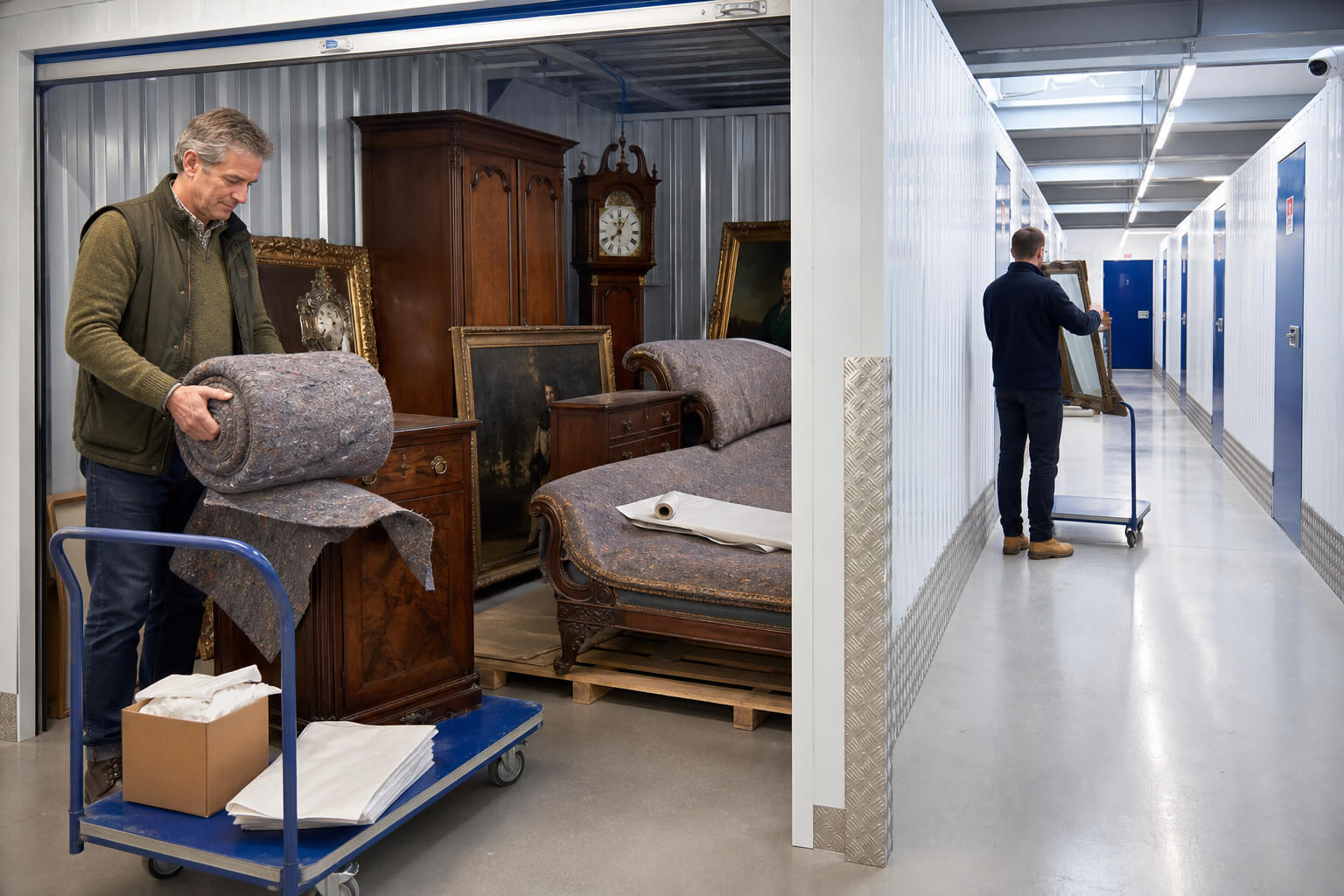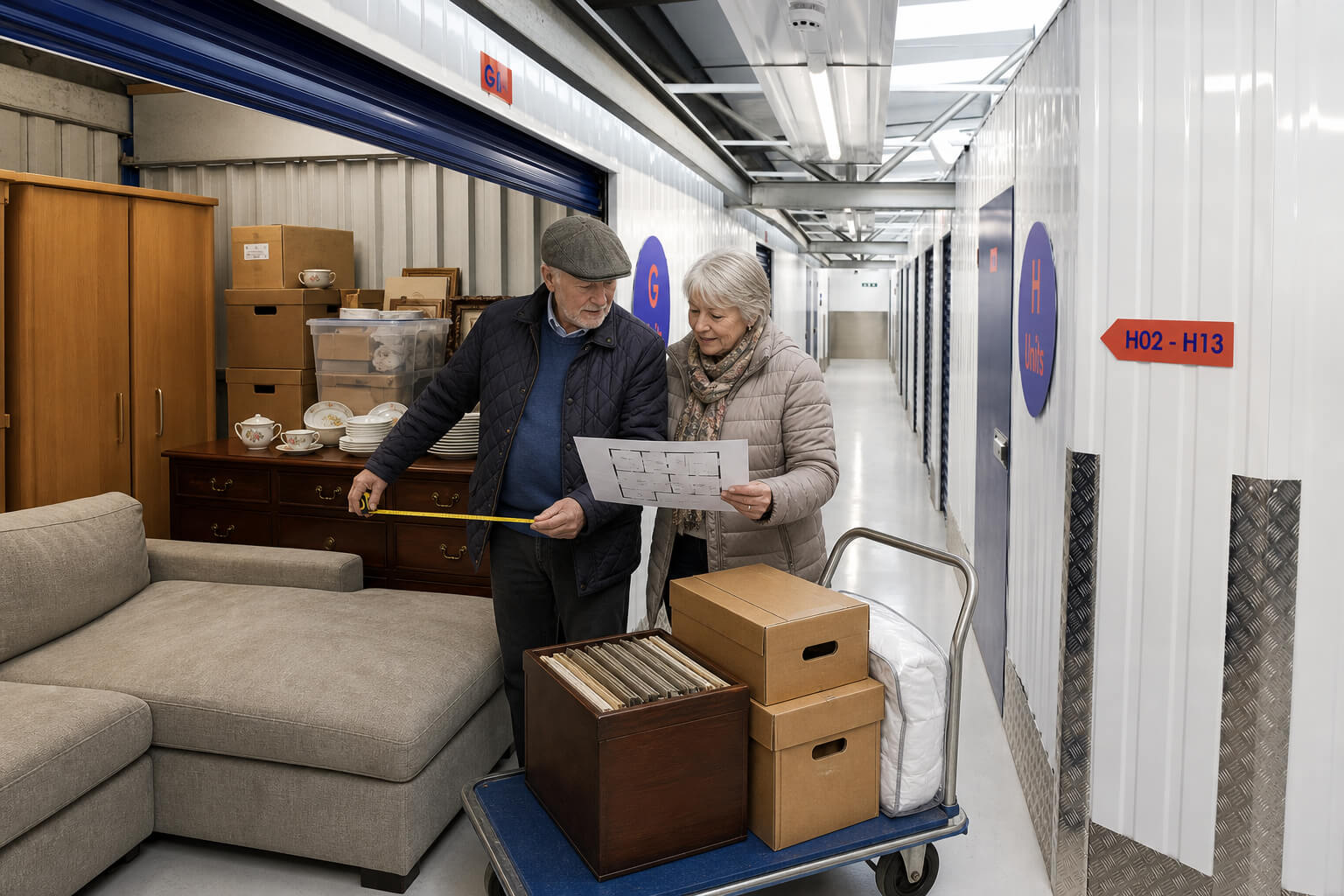
Self Storage During A Renovation The Complete Uk Guide

Builders in three weeks — where does everything but the kitchen go?

Every tradesperson will tell you the same thing. The jobs that go smoothly are the ones where the rooms are empty before anyone picks up a tool. Not roughly empty. Properly empty.

That is easier said than done when the house is full of furniture, books, crockery, a sideboard that belonged to someone’s grandmother, and forty years of accumulated life. The builders arrive in three weeks and suddenly the question is not where the kitchen is going. It is where everything else is going.

This guide is for that moment. It is a practical plan, room by room and stage by stage, for getting the house clear before the trades start and keeping it orderly while the work runs. No drama. Just a sensible way through.

Why an empty room is the job half done

Trades work faster, make fewer mistakes and charge less when there is nothing to work around. That is not a sales point; it is the practical reality of how renovation work goes. A cleared room is the condition under which a good job gets done on time and on budget.

What the trades actually need from you before they start

Most tradespeople will not say this directly, but they are hoping you have cleared the room before they arrive. Plasterers need to move freely across a whole wall. Electricians need access to the floor, the ceiling and every corner. Plumbers cannot work under a kitchen unit that is still full of crockery.

The furniture and belongings you leave in a room are not just an inconvenience. They are a risk. Something gets knocked. Something gets dusty in a way that cannot be undone. A sheet of plasterboard goes through a mirror. These things happen, and they happen because the room was not empty.

The single most effective thing you can do before your renovation starts is to clear each work zone completely, not partially.

The real cost of storing things on-site in other rooms

The instinct is to pile everything into a spare room or a garage. It works for a weekend. It does not work for a six-week kitchen renovation or a three-month extension.

Rooms pressed into storage duty become unusable. If the renovation runs long, which most do, the overflow problem compounds. The spare bedroom becomes inaccessible. The garden furniture takes up the dining room. Trades who need a staging area find nowhere to put materials. The project slows down because the house is not set up to support it.

There is also the damage risk. Furniture stacked in a hurry against other furniture, in a room with no climate management, over a wet British autumn, is furniture that comes back scratched, damp-marked and sometimes worse.

Why a skip or a yard container is the wrong tool for furniture

Skips are for rubble and waste, not for a Victorian sideboard or a set of upholstered dining chairs. A yard container in the driveway is exposed to whatever the weather brings and is not secure in any meaningful sense.

The other problem is that a skip or a container in the driveway gets in the way. Delivery lorries cannot get close. The plasterer cannot manoeuvre the van. The whole site becomes compressed and harder to work.

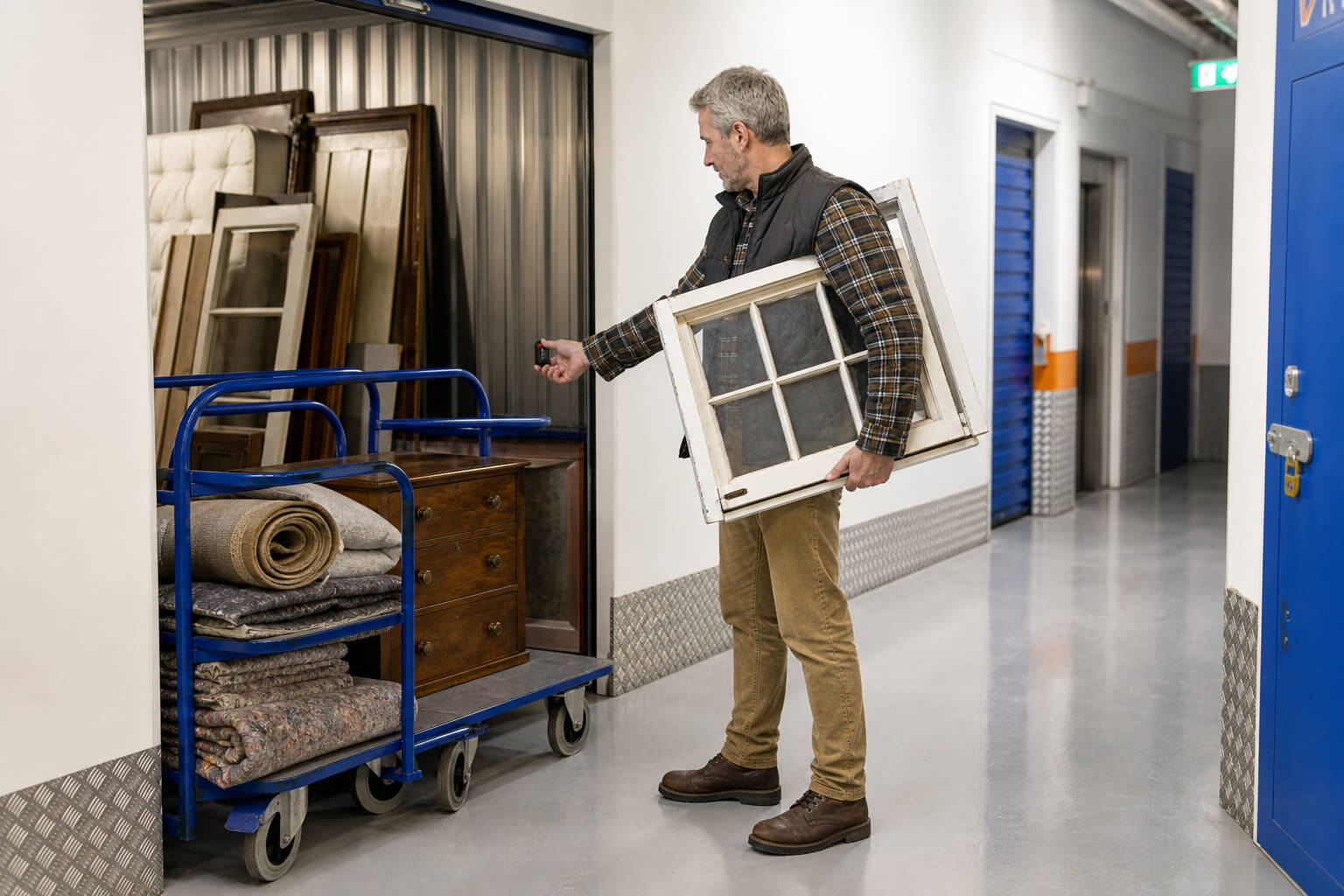
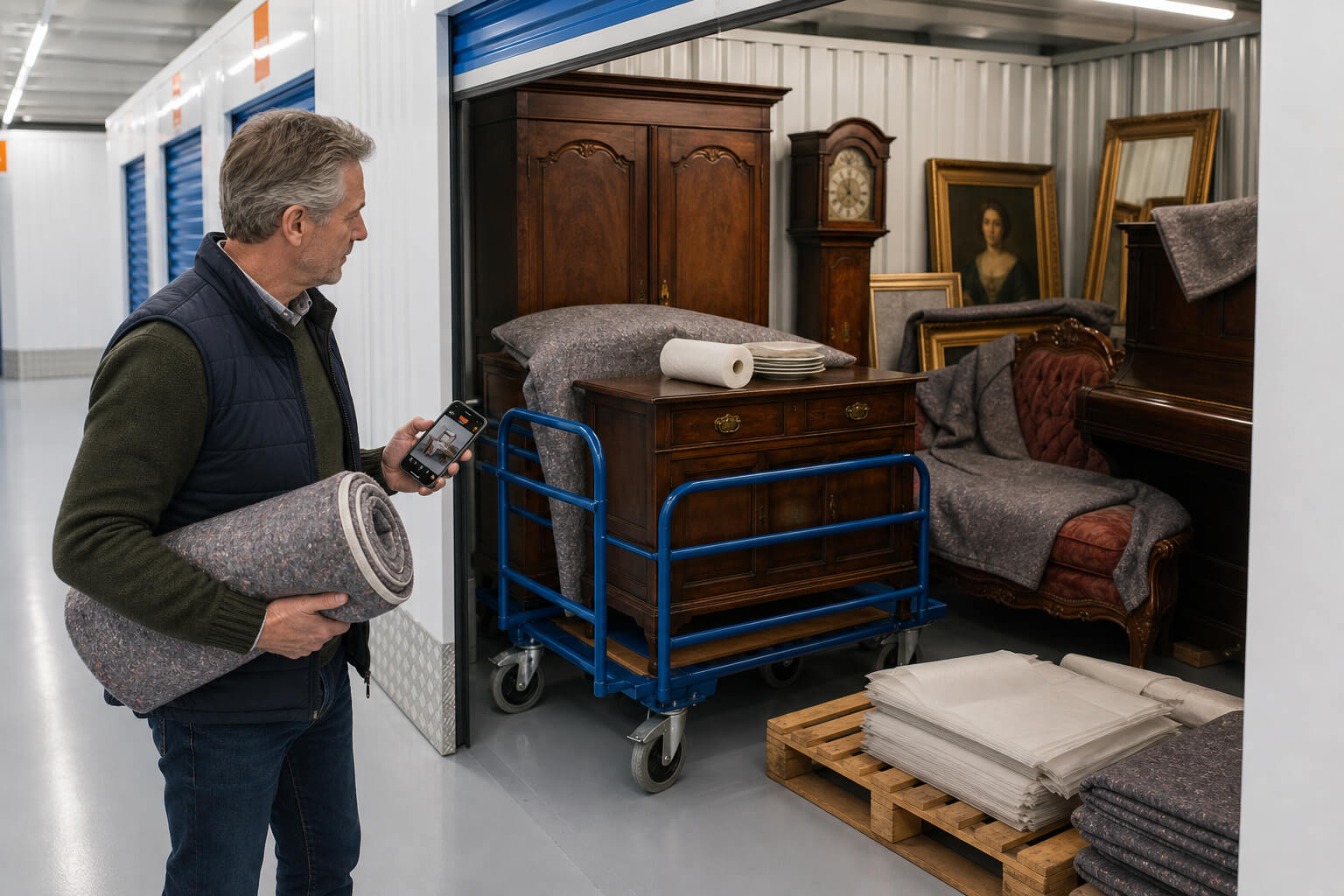
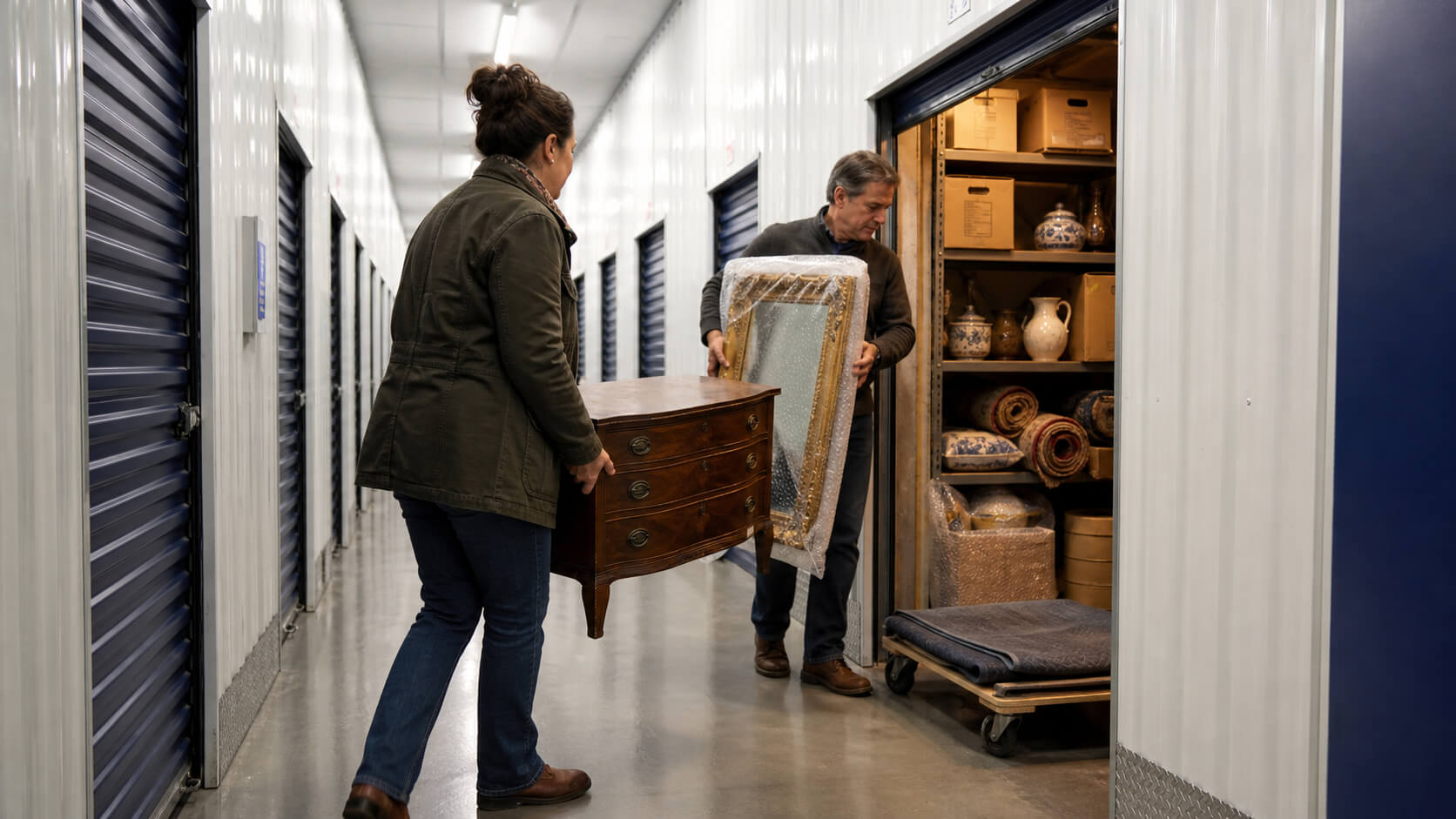
A self storage unit is a different tool for a different job. It is dry, alarmed, clean and accessible on your schedule, not just during delivery hours. The furniture is off-site, out of the way, and safe while the work happens.

A room-by-room pack-out plan before the builders arrive

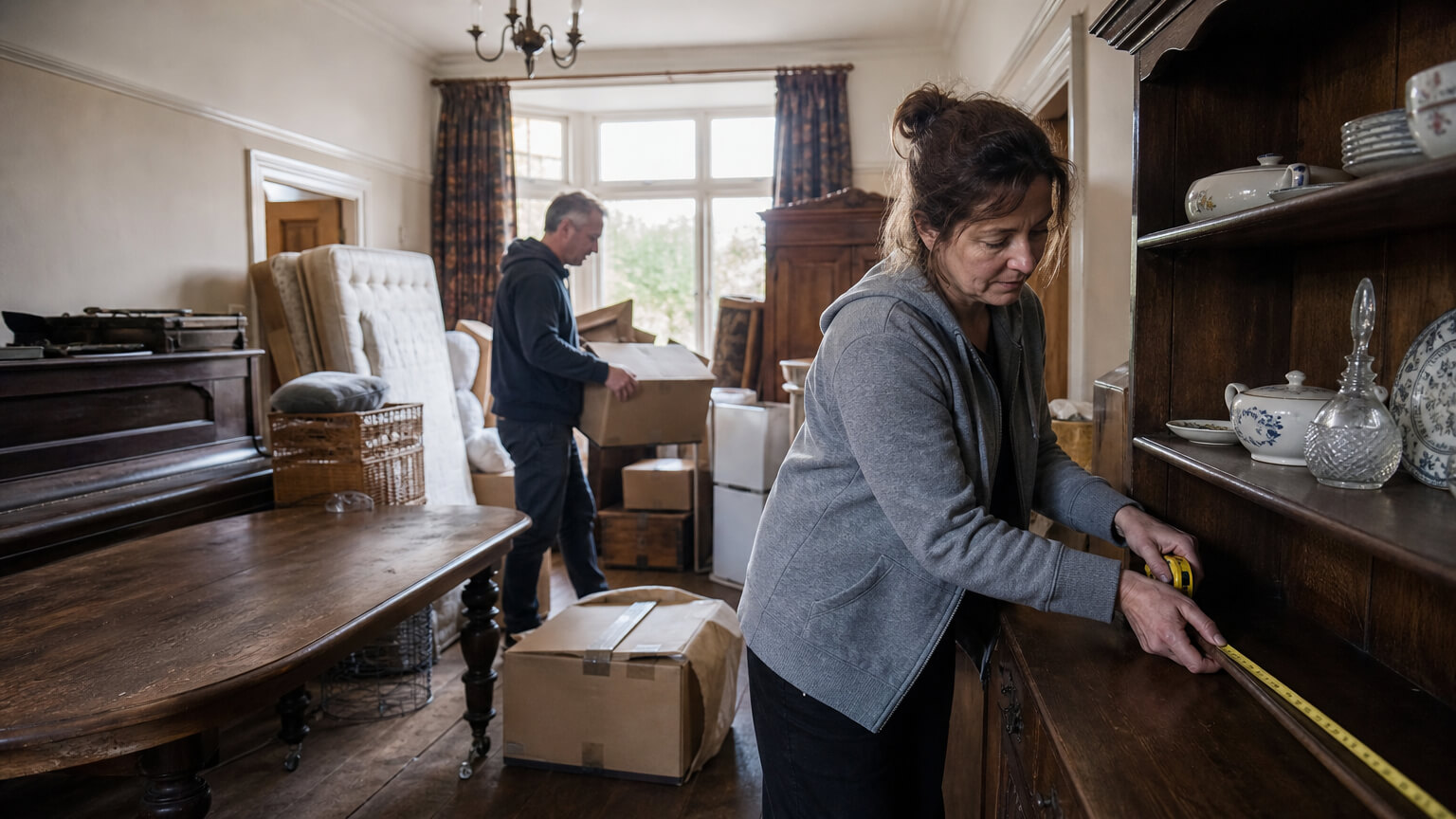
The mistake is trying to move everything at once. A phased pack-out, timed to the build sequence, keeps the house liveable for longer and reduces chaos on the day the trades arrive. Clear the rooms the builders need first and work outward from there.

Which rooms to clear first (and which can wait)

Start with whatever the trades are hitting first. If it is a kitchen renovation, the kitchen has to be empty before day one. If it is a loft conversion, the loft needs to be clear, but the bedrooms below can often wait until the structural work has started.

Think of it in waves. Wave one: the primary work zone, completely cleared, at least a few days before the trades arrive. Wave two: the rooms that will be used as through-routes, staging areas or material storage for the trades. These need to be clear enough to be useful. Wave three: rooms not in the build sequence at all, which can remain lived-in until much later.

A whole-house strip-out is a different situation. If you are vacating the property entirely during the work, the pack-out can happen in a single organised move. But for phased projects, the phased approach is almost always better.

What to pack, store and what to leave accessible

Not everything goes. The working rule is simple: if you will not need it for the duration of the build, it goes into storage. If you will need it regularly, it stays accessible, either in a room not in the build sequence, or in a clearly labelled box you can get to easily.

For the storage unit: furniture, artwork, books, crockery, soft furnishings, electrical goods not in daily use, and anything fragile or irreplaceable. These are the things that suffer most from construction dust, vibration and an occupied building site.

Keep accessible: the things you use every day, your tools if you are doing any of the work yourself, documents and valuables, and anything you might need to get to at short notice during the build.

Label the boxes that go into storage by room, not by content. When the renovation finishes, you will be restoring rooms in sequence, and boxes labelled “kitchen” or “spare bedroom” are infinitely easier to manage than boxes labelled “miscellaneous.”

Working with the trades on sequencing (a simple checklist)

Before the first trade arrives, a short conversation about sequencing saves a lot of confusion. Ask your contractor:

  • Which rooms do you need cleared and by when?
  • Which rooms will be used for materials staging?
  • Are there any dates when access will be particularly constrained?
  • When will each room be ready to receive furniture back?

That last question is the one people forget. The end of a renovation is as chaotic as the start. Rooms are ready one at a time, over days or weeks. Knowing the sequence lets you plan the return in waves, which is almost always better than trying to move everything back at once.

What size unit do you actually need?

Unit size follows the scope of the project. A kitchen renovation is not the same storage problem as a whole-house strip-out. The honest answer is that most people underestimate how much space their furniture takes up when it is stacked properly and packed efficiently.

Single-room and kitchen renovations

A single-room renovation typically needs a small unit, often in the 25 to 50 square foot range, though this depends heavily on what is in the room. A bedroom full of flat-pack furniture packs down differently to a room with heavy Victorian pieces.

For a kitchen renovation, the consideration is not just the kitchen itself. Kitchen contents, the appliances, the crockery, the table and chairs, can fill a unit surprisingly quickly. Account for the dining area if it connects to the kitchen and will be out of use during the work.

A sizing guide is worth consulting before you book. Wigwam’s unit sizing guide (see the website) gives a practical room-by-room reference, and the pricing page at how much is self storage in the UK sets out the size options without committing you to anything.

Cross-reference with the Wigwam kitchen renovation storage guide for a more detailed breakdown of that specific project type.

Multi-room and extension projects

A two or three room renovation, or a project that involves an extension and the rooms adjacent to it, usually needs a medium unit. The complicating factor is timing. You may need to clear rooms in waves, which means the unit contents change as the project progresses.

The best approach is to size for the peak. Think about the moment in the project when the most rooms are simultaneously in use, and size the unit for that moment. Then work backwards to a smaller unit once rooms start coming back online, if the terms allow it.

The whole-house renovation guide (referenced separately on the Wigwam site) covers the logistics of a larger-scope project in more detail.

Whole-house strip-outs and longer projects

A full strip-out is a different scale of problem. If the entire house is being vacated, every piece of furniture and every belonging needs a home for the duration. For a four or five bedroom property, that is often a large unit, 100 square feet or more, and possibly multiple units if the contents are bulky or if you need segregated access to different categories of goods.

Longer projects raise a different question: not just how much space, but how long. A whole-house renovation that runs for four or five months is a long stay, and the right provider is one whose terms work for an uncertain timeline. That is the next section.

Terms that flex with the build

No renovation finishes on time. It is not pessimism; it is the nature of the work. Tradespeople encounter things inside walls that were not on the plan. Materials are delayed. A second coat needs more time than the estimate allowed. The storage arrangement should not punish you for any of that.

How the 14-day notice and refund policy works

At Wigwam, the notice period is 14 days. When you are ready to leave, you give 14 days’ notice, clear the unit, settle the account, and any unused days beyond the notice period are refunded. A deposit is taken at the start and returned once the unit is vacated and the account is settled.

This is important because it means the arrangement works in your favour when the build finishes early. You do not pay for a fixed term that extends beyond when you need it.

If the build runs long, the arrangement continues on the same rolling basis. You are not scrambling to renegotiate or worried about a contract that does not cover the extra weeks.

Full terms are at wigwamstorage.co.uk/terms-conditions.

What happens when the build overruns (how to extend)

The simple answer is: nothing dramatic has to happen. Because there is no fixed end date locked into the contract, a build that runs three weeks longer than planned just means three more weeks of storage at the same rolling rate.

The one thing worth doing is communicating early if you know the timeline is shifting significantly. If you anticipated a six-week stay and it is looking like four months, it is worth speaking to the team so everyone is planning from the same picture.

The two-week minimum stay applies at the start, so there is a floor on very short stays, but for renovation projects of any real scope, that is rarely a constraint.

Moving in stages as rooms are finished

A phased renovation often calls for a phased return. When the first rooms are finished and ready, it makes sense to move furniture back room by room rather than waiting for the entire project to complete before moving anything.

This is entirely possible with a rolling arrangement. As rooms come back online, you retrieve the relevant furniture and the unit gradually empties. When the last room is done, whatever remains comes back, and you give your 14-day notice.

It is a cleaner process than either extreme, trying to store nothing (and dealing with on-site chaos) or storing everything in one go and moving it all back in one go at the end.

Ready to get a quote? See unit sizes and indicative prices at how much is self storage in the UK, then get your quote at quote.wigwamstorage.co.uk. No commitment required.

Protecting furniture and period pieces: the honest answer
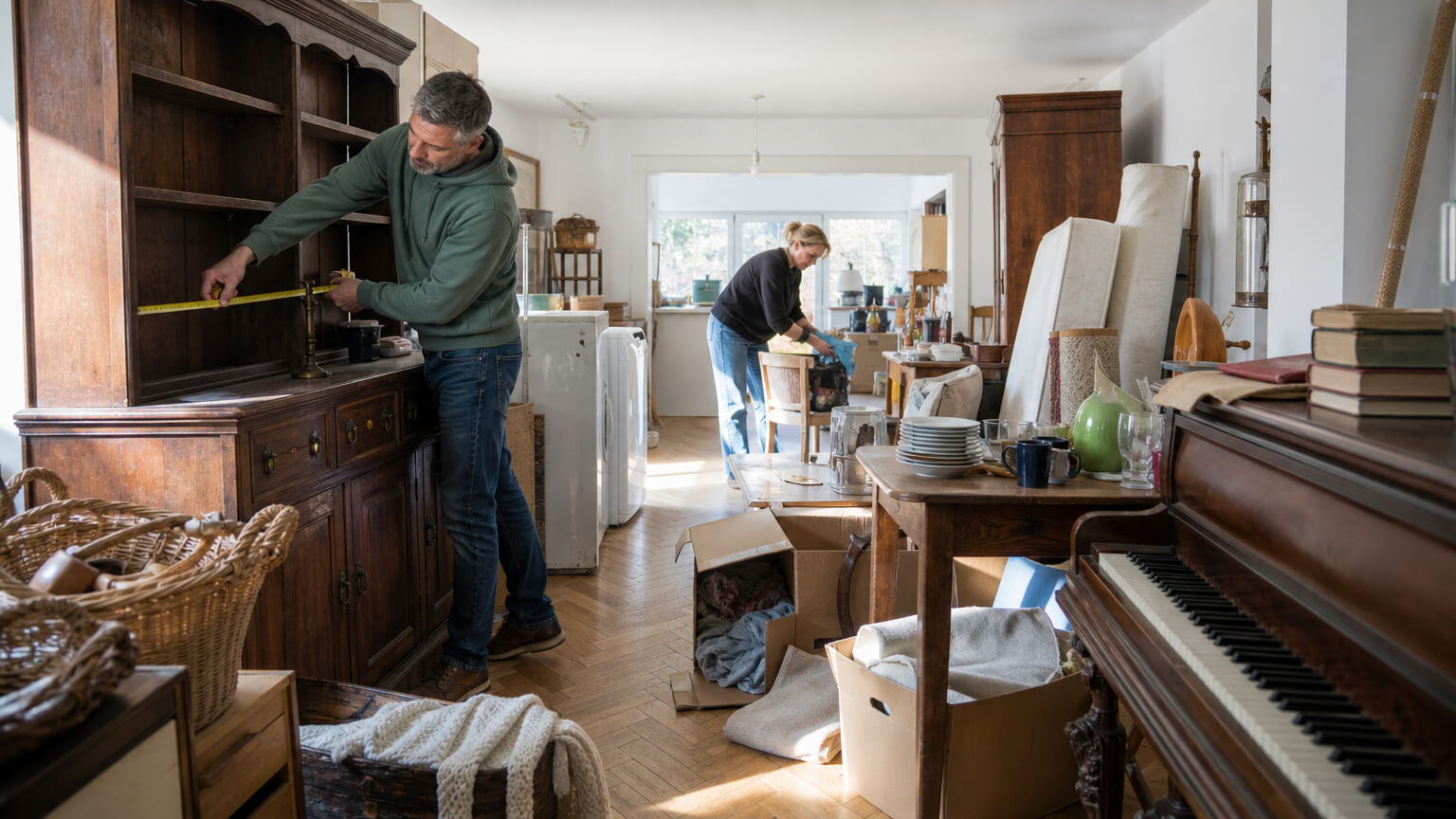
Most period furniture does not need climate-controlled storage. That is the plain truth, and because Wigwam does not offer climate control, there is no incentive to say anything other than what the evidence shows.

What clean, dry and secure actually means for your furniture

A clean, dry, individually alarmed unit is the right environment for the vast majority of domestic furniture, including antiques. Solid oak, pine, mahogany, upholstered chairs and sofas, painted pieces, ceramics, glass, books and the contents of a typical period home are all well served by a unit that keeps the damp out, the dust out and the uninvited out.

The standard that matters is stable and dry, not temperature-controlled. Most UK domestic antiques have spent their lives in houses without climate management and are none the worse for it. What damages furniture is not ambient temperature; it is moisture, dramatic humidity swings, and physical damage. A clean, dry unit addresses the first two directly and, because access is controlled, the third as well.

This is also the honest position. If a clean, dry, alarmed unit does the job, it does the job. There is no reason to suggest otherwise.

The specific cases that genuinely need a specialist facility

There is a short list of things that do genuinely need specialist conditions, and it is worth knowing what is on it.

Museum-grade oils and watercolours, particularly those with old or unstable paint layers, can be sensitive to significant humidity shifts. Musical instruments with soundboards, violins, cellos, acoustic guitars, pianos, can develop cracks if humidity drops or rises sharply over an extended period. Marquetry and fine inlay work, particularly on pieces where the veneers are already lifting or fragile, can be vulnerable to the kind of humidity fluctuation you might see in a unit over a very wet or very dry season.

This is a specific list. It is not “antiques generally.” A Victorian mahogany sideboard is not on it. A Georgian pine dresser is not on it. A set of upholstered dining chairs is not on it.

If you are genuinely uncertain whether a particular piece needs specialist handling, the right call is to speak to a conservator, not a storage provider. Wigwam will tell you plainly what our units provide and leave the specialist question to the specialists. The article “Self Storage for Antique Furniture During a Renovation” and the companion piece “Do You Really Need Climate-Controlled Storage” on the Wigwam site go into this in more detail if the question is live for you.

How to prepare period pieces before they go into the unit

A little preparation before the furniture goes in saves a lot of worry while the build runs.

Clean pieces before they go in. Dust and surface damp do more damage in storage than in a used room, because there is no airflow to carry them away. Wipe down wooden surfaces, vacuum upholstery, and make sure nothing goes in damp.

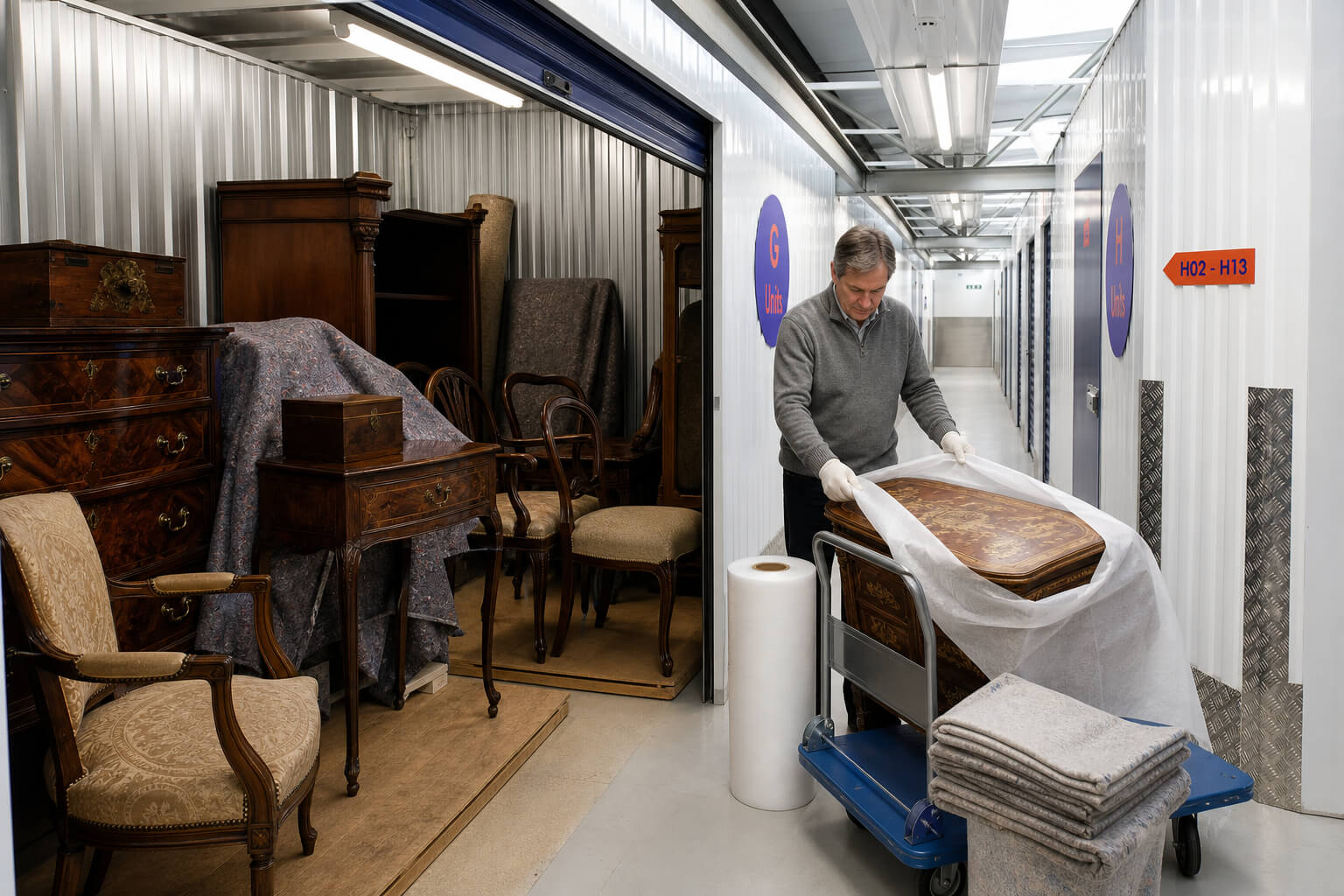
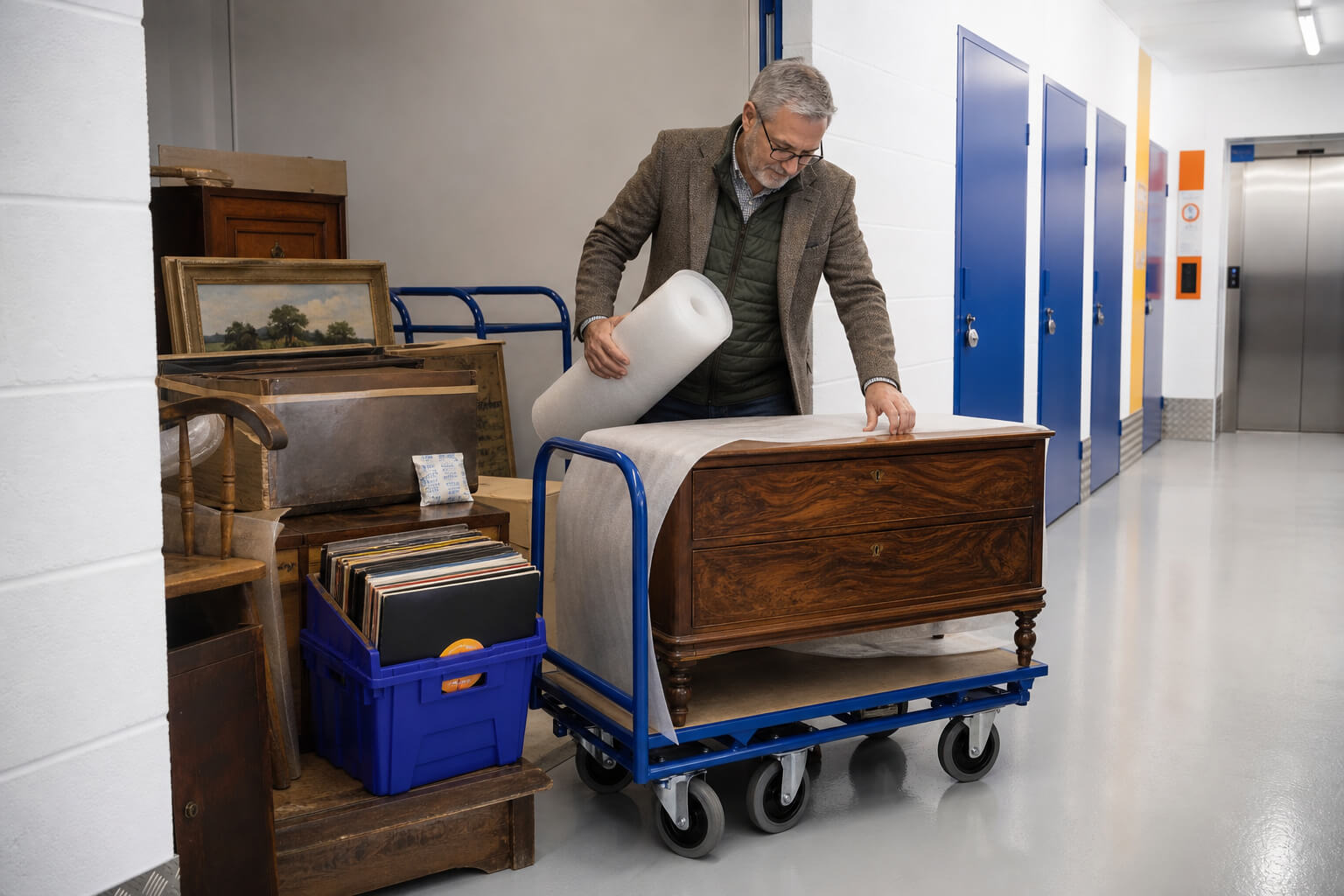
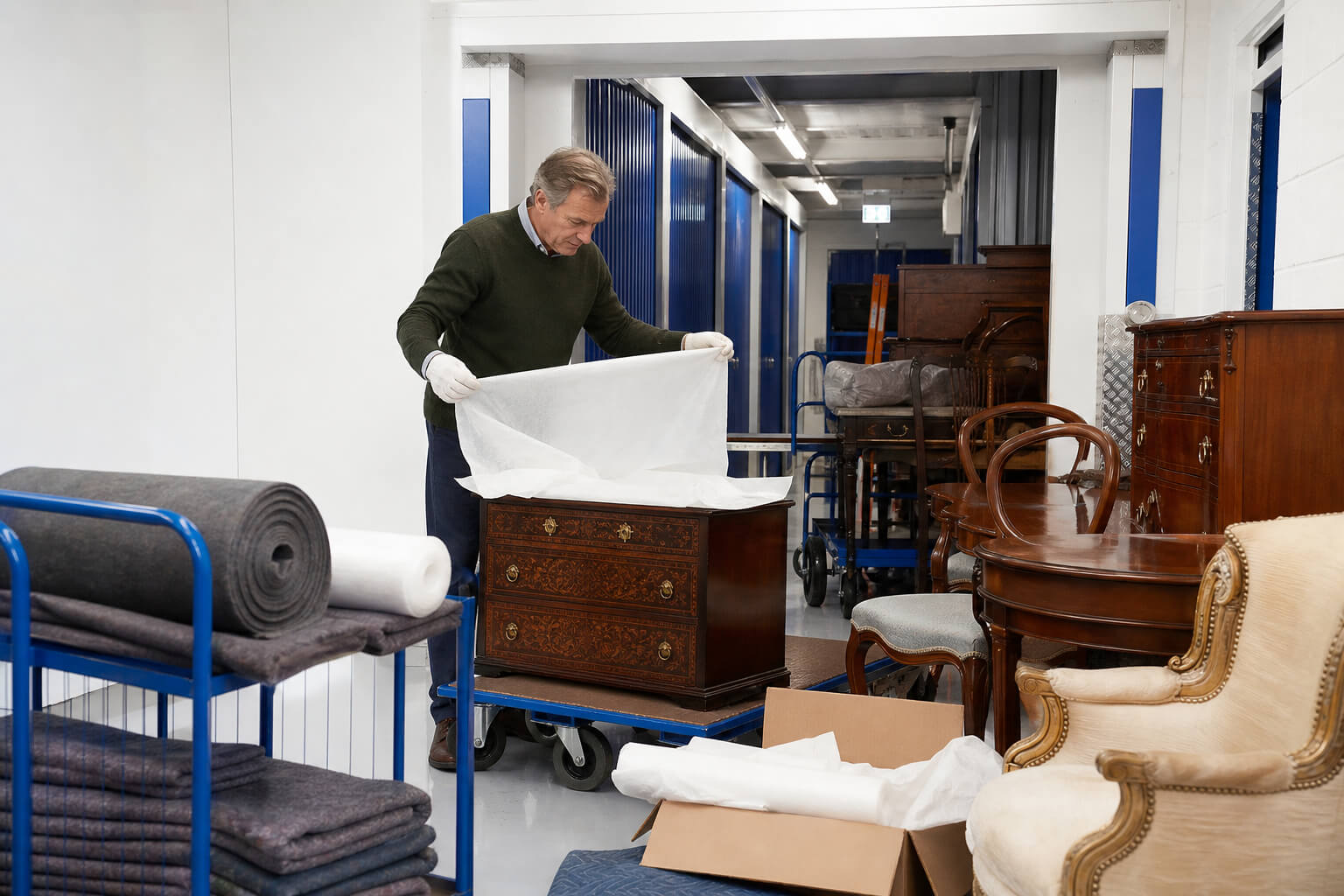
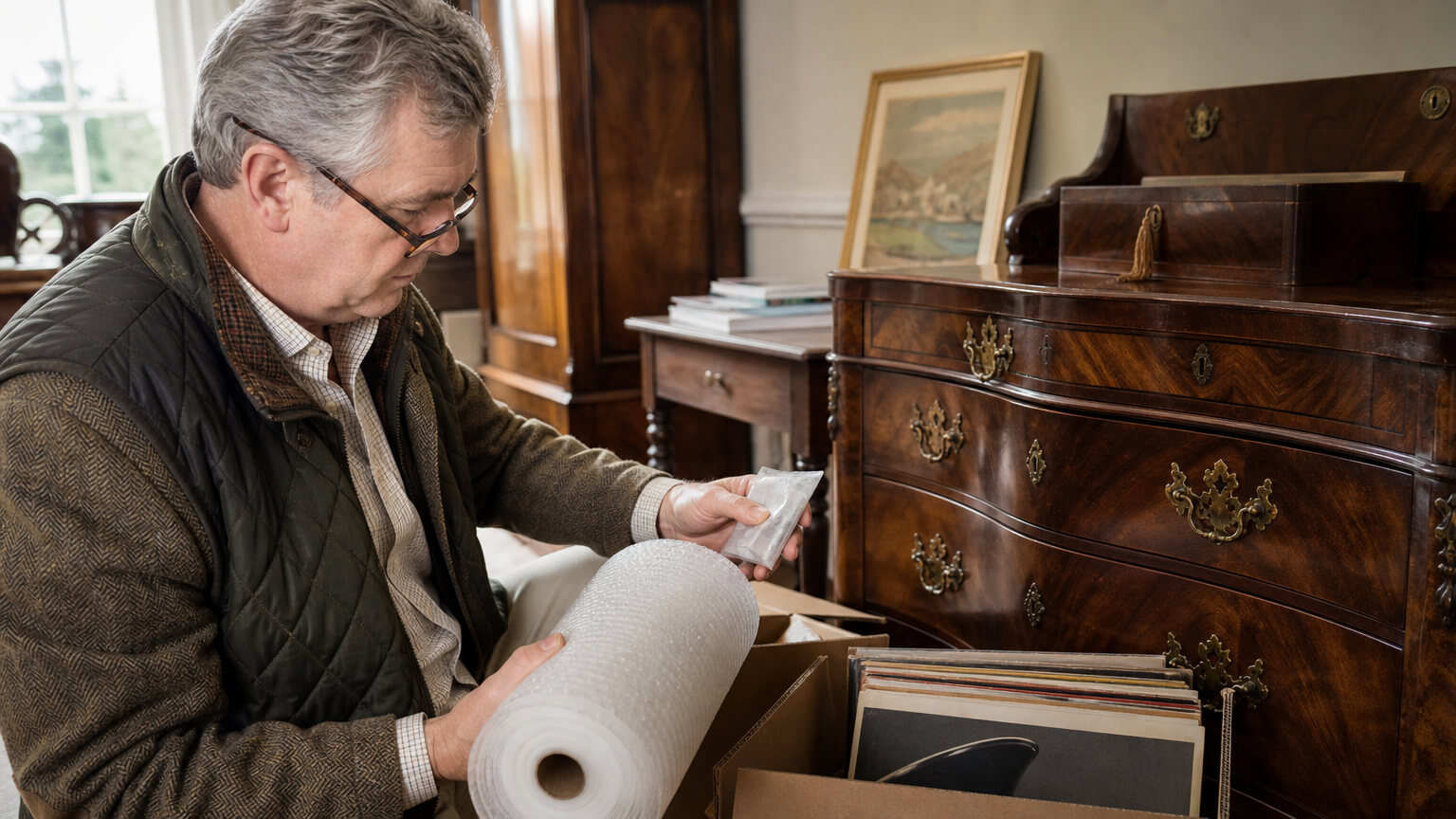
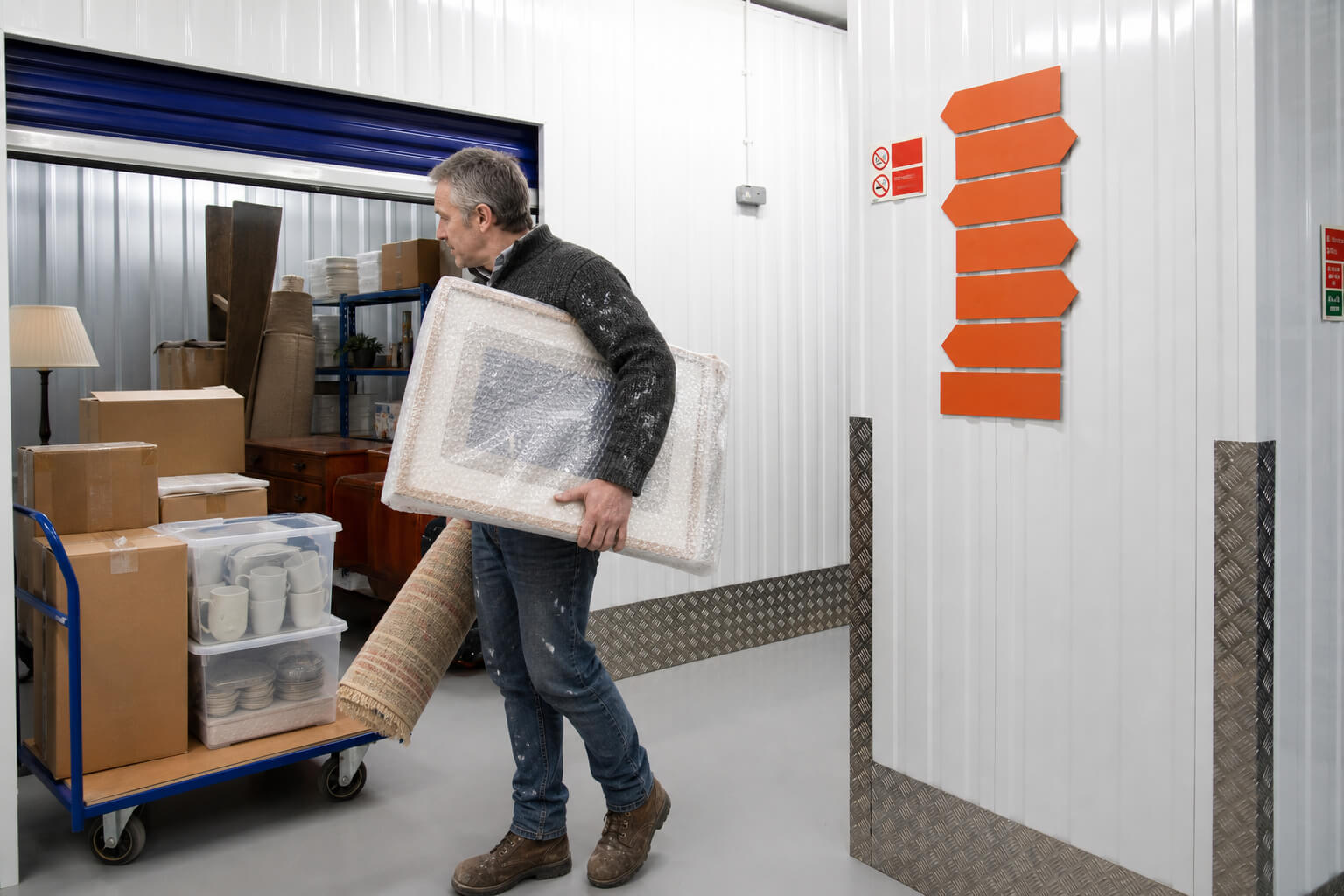
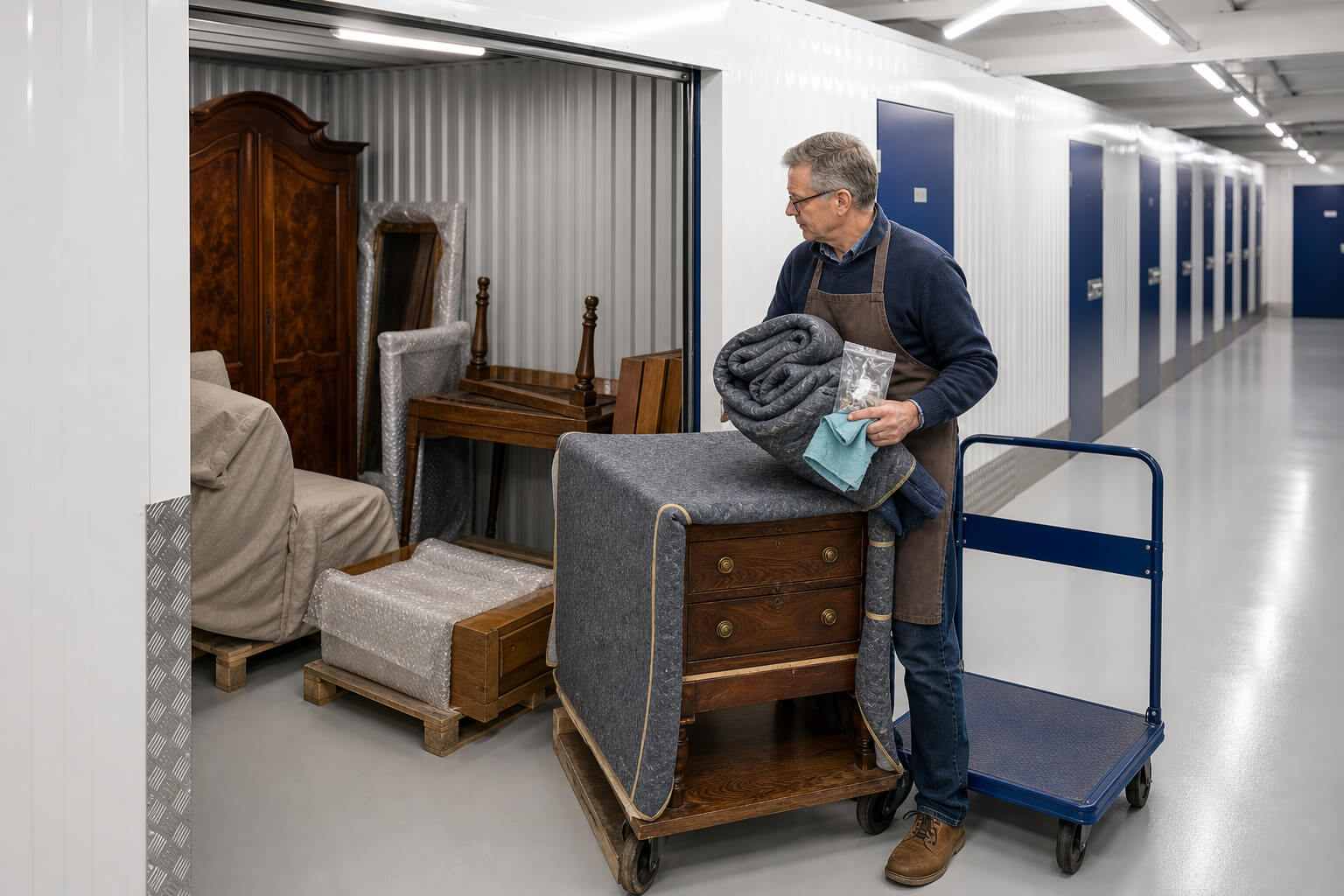
Wrap fragile surfaces but do not wrap furniture in non-breathable plastic. Bubble wrap over polished surfaces for extended periods can trap moisture and mark the finish. Furniture blankets or cotton dust sheets are better for anything that needs padding. Cardboard corners protect legs in transit.

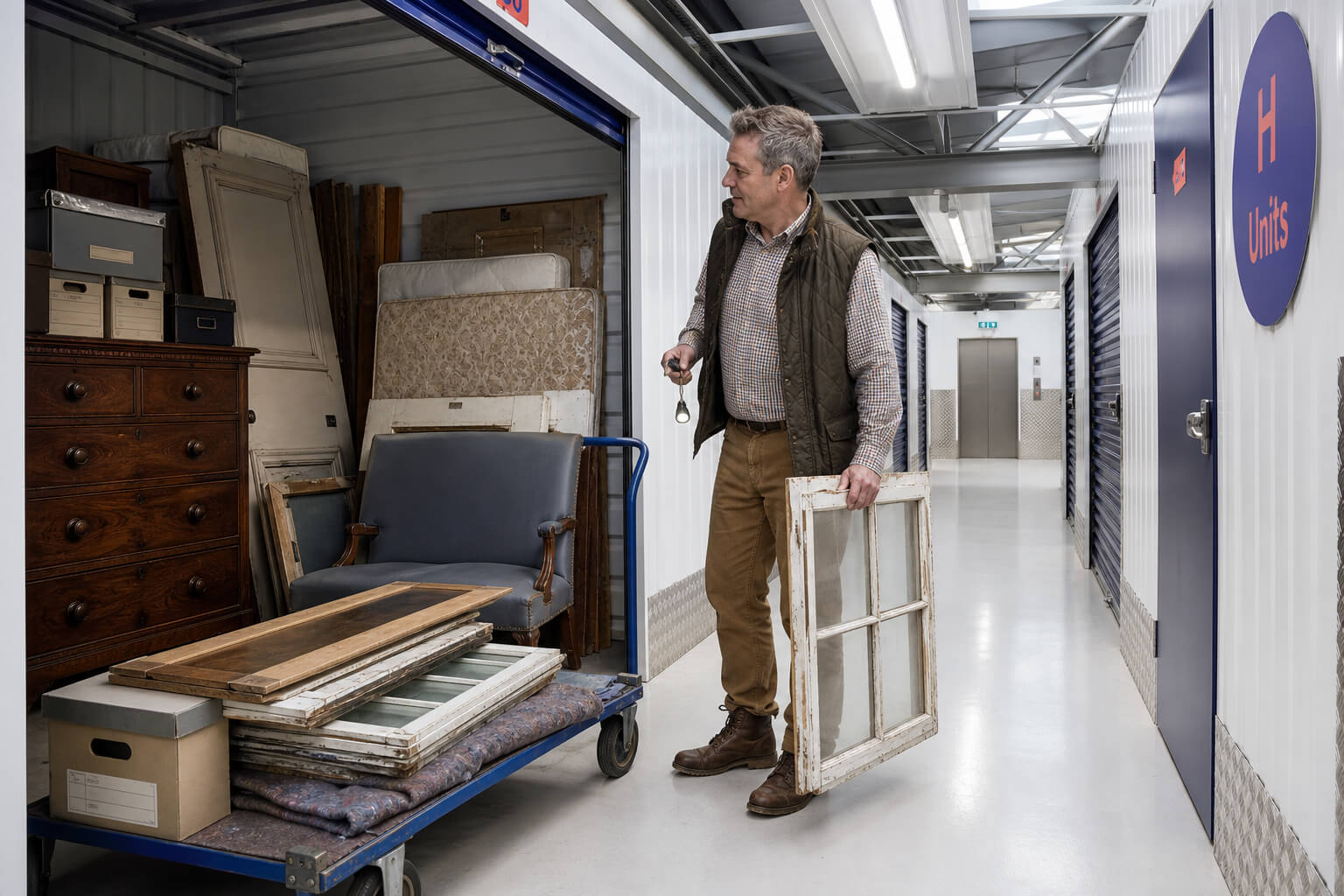
Disassemble where you sensibly can. Beds and flat-pack pieces pack down smaller and are less likely to sustain damage in transit if they are broken down first. Keep the fixings in a clearly labelled bag taped to the relevant piece.

Stand furniture properly. Do not stack chairs upside-down on a table unless the table is sturdy enough to take the weight. Lean nothing against mirrors. Give fragile items their own space rather than packing things tightly around them.

Contents protection: what is covered and what to declare

Contents protection is mandatory at Wigwam. You can take the Wigwam policy or provide proof of your own. Either way, declaring the right value is the part that matters most.

How the contents-protection requirement works

Wigwam’s contents protection is provided through RSA’s Self Storage Customers’ Goods policy. You opt in to the Wigwam policy when you book, or you provide evidence of your own contents cover. You cannot leave the unit uninsured.

Full details of the policy, including what is covered and how to declare your value, are at wigwamstorage.co.uk/contents-protection. Read the policy document before you put anything in the unit. The policy sets out which items and events are covered, what the excess is, and what the claims process looks like.

Jurisdiction note: insurance policy terms and claims handling differ across UK jurisdictions. If you are storing goods in Scotland or Northern Ireland, verify the terms of your policy with your insurer or broker, as the applicable rules may differ from those in England and Wales.

What to declare and why under-insurance matters

Declare the full replacement value of everything going into the unit. Not the price you paid for it. Not a rough estimate. The amount it would cost to replace each item at today’s prices if it were lost or destroyed.

This matters because under-insurance is settled proportionally. If you declare half the true value of your goods and make a claim for the full loss, the settlement is reduced in proportion to the gap between what you declared and what the goods were actually worth. It is a common and painful mistake.

Period and antique pieces are the ones most likely to be undervalued. If you are storing items of significant value, it is worth having them assessed before you put them in storage, rather than estimating.

What is not covered (and how to handle the exceptions)

The policy covers the main risks, but there are exclusions that matter for renovation contexts specifically.

Theft is covered if there is evidence of forced entry. Opportunistic loss, or a situation where access was gained without force, is not covered in the same way.

Climatic damage is excluded. This means damage caused by changes in temperature or humidity. For the great majority of domestic furniture and belongings, a clean, dry unit does not produce the conditions that trigger this exclusion. But it is worth understanding that the exclusion exists.

Items that are fragile by nature, and items not properly packed, may also face restrictions. The policy document sets out the detail.

If anything in your storage inventory is particularly high-value or unusual, speak to your insurer or broker before the goods go in, rather than after something goes wrong.

Access during the project (and how deliveries work)
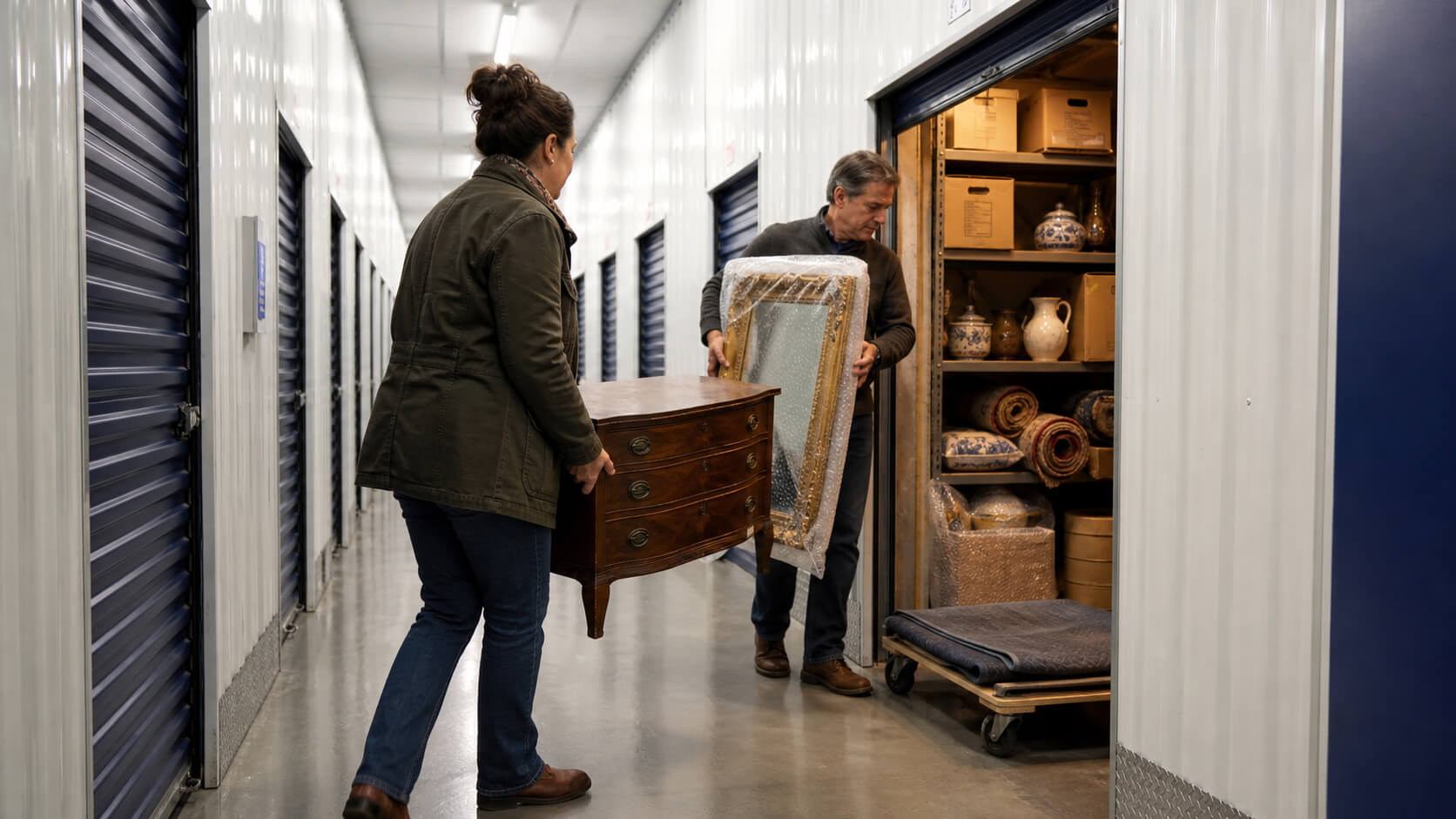
Access is 6am to 10pm, seven days a week, via smart entry. If you are an early starter or working to trade hours, the unit is there when you need it. No booking in advance, no queuing at a staffed desk.

Smart entry and when you can get in

Smart entry means you access the site and your unit through a keypad or fob system, without needing a member of staff present. Six in the morning is a practical time for a lot of renovation work. You can pick up a piece of equipment, retrieve a piece of furniture to take back to a finished room, or drop off a delivery before the trades arrive, all without waiting for someone to unlock anything.

Access closes at 10pm. The sites are not 24-hour. For the vast majority of renovation projects, the 6am to 10pm window covers everything you will need.

How deliveries and material drop-offs work on an unmanned site

Wigwam sites are unmanned. This is worth understanding before you plan any deliveries or material drop-offs.

If a supplier or courier is delivering something to your unit, someone from your side needs to be there to receive it. Wigwam does not sign for deliveries, does not receive goods on your behalf, and cannot accept materials or packages if no one from the customer’s business or household is present.

For renovation projects where materials are being delivered, the site access hours work in your favour for co-ordinating deliveries at a time when you or someone else can be present. What does not work is arranging a courier drop that assumes the site will receive it for you.

Tips for moving things in and out during an active renovation

Moving things in and out of storage while a renovation is live is a different kind of logistics from a single move-in and move-out. A few things make it easier.

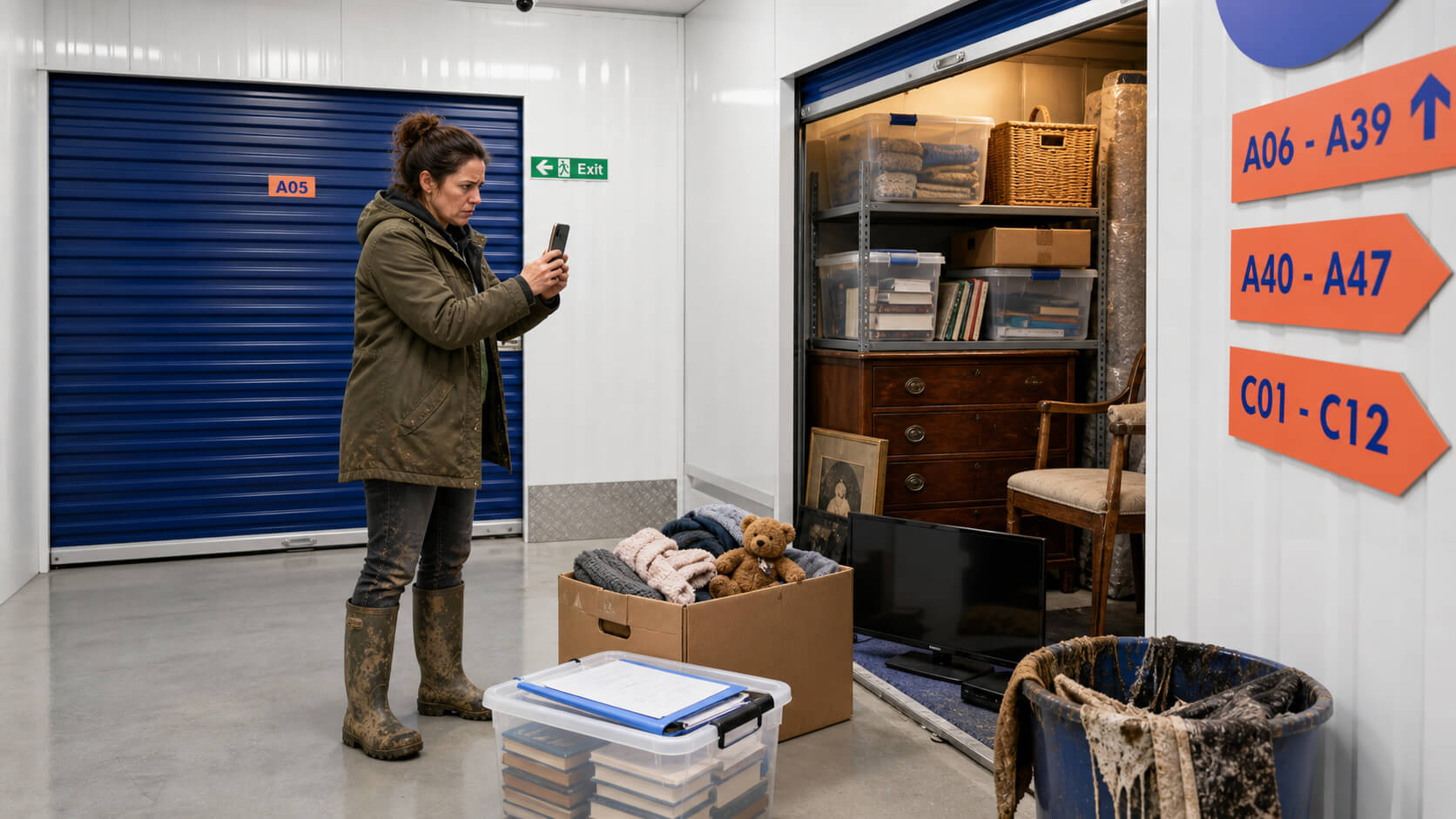
Keep a rough inventory of what is in the unit and where. It does not need to be elaborate. A list on your phone of what is in which area of the unit, updated as things go in and come out, saves significant time when you are looking for a specific item mid-project.

Use the access hours to your advantage. Early morning runs, before the trades are on-site, let you retrieve or drop things without disrupting the working day. Late evening is useful for dropping off items that come out of a finished room before the next phase starts.

If you are retrieving furniture to restore a finished room, do it in full. Half-restoring a room and leaving the rest in storage extends the period of limbo. Aim to complete one room at a time, on the same rhythm as the build.

Finding a Wigwam unit near your renovation

If your renovation is in a UK market town, there is a good chance a Wigwam location is nearby. Wigwam operates across our UK market-town locations, with units suited to household goods and the kind of project described in this guide.

Locations across UK market towns

The full list of locations is at wigwamstorage.co.uk/self-storage-locations.

If you are in the south-west, Wigwam Self Storage Bath is well placed for renovations in and around the city, where period properties are plentiful and the need for careful, clean storage is high. For projects further north or in the east Midlands, Wigwam Self Storage Lincoln is the nearest verified location.

For any other town, use the locations hub to find the closest site. Do not assume a location exists in a town without checking; the hub is the reliable reference.

First mention tip for location naming: name locations in full on first mention, as above, and casually thereafter. “The Bath site” or “Lincoln” are fine once the full name has been used.

What to check before you book

Before you commit to a unit, a few things are worth confirming.

What size do you actually need? The sizing guide on the website gives a practical reference, and the team can advise. It is better to size slightly large than to discover mid-project that things do not fit.

How long do you expect to need it? Be honest with yourself about this. A kitchen renovation that the builder says will take four weeks often takes six. Build the buffer in at the planning stage rather than chasing the extension later.

What is in the unit that matters most? If you are storing anything of significant value, check the contents-protection requirements before you book. The deposit, the notice period and the refund terms are all in the terms and conditions.

Pricing, without commitment, is at how much is self storage in the UK. No prices are quoted on this page; the pricing page is the right reference.

How to get a quote

When you are ready, getting a quote takes a few minutes and commits you to nothing. You will need a rough sense of unit size and the likely start date.

Get your quote at quote.wigwamstorage.co.uk.

The renovation is the hard part. The storage is the easy part. We have watched hundreds of projects come and go from our market-town locations, and the ones that go well are the ones where the house was properly cleared before the trades started. When you are ready, get a quote at quote.wigwamstorage.co.uk and we will take it from there.

Frequently Asked Questions

Can I store a fridge or freezer during the renovation?

Yes, but prepare it first, because a white good put into storage wet is a white good that comes out smelling. Empty it completely, switch it off, and defrost it fully. Then wash the interior, wipe it dry, and leave the door propped slightly open while it airs for a day before it goes in. The reason is simple. A sealed fridge or freezer with any residual moisture inside becomes a closed, dark box where damp has nowhere to go, and mould and odour build quickly over a six-week renovation. Once it is genuinely dry, it stores well. Our units are clean, dry and secure, so the appliance is in a sound environment, but the inside of a sealed appliance is its own little world and only you can prepare that. Keep the door wedged open by a few centimetres for the duration if you can, using a folded towel or a purpose-made wedge, so air keeps moving through it. Disconnect and coil the cable, and tape the shelves or remove them and pack them separately so they do not rattle loose in transit. The same logic applies to washing machines and dishwashers: drain them down, run the hoses dry, and leave the door ajar. Treat the appliance like any other item for contents protection and declare its replacement value with the rest of your goods.

Can I keep my DIY tools and materials in the unit and work from there during the build?

You can store tools and materials in your unit, and the access hours make it practical to collect what you need, but the unit is for storage, not for working in. Think of it as your off-site store cupboard rather than a workshop. Access runs 6am to 10pm, seven days a week, by smart entry, so an early start before the trades arrive is easy. You can drop tools off the night before and collect them at six the next morning without waiting for anyone. A few sensible rules apply to what you store. Paints, solvents, gas canisters, fuel and other flammable or hazardous materials are not suitable for a storage unit, so those stay with you on site. Heavy power tools and timber are fine, but pack them so nothing can topple onto softer goods if you have furniture in the same unit. If you are running a tool-heavy DIY project, it can be worth keeping the tools near the door and the household goods deeper in, so your daily ins and outs do not mean unstacking the whole unit. One thing to plan for: if a supplier is delivering materials to the site, someone from your side has to be there to receive them, because our sites are unmanned and we cannot accept or sign for deliveries on your behalf.

How far in advance should I book the unit before the build starts?

Book as soon as the start date is firm, which in practice means a week or two before the trades arrive, not the morning of. The reason is partly availability and partly logistics. Unit availability varies by location and by size, and the unit you want may not be free on the exact day you decide you need it, so reserving early protects your choice. Just as importantly, a good pack-out is not a one-day job. Clearing the primary work zone properly, packing by room and labelling as you go, usually takes several evenings or a weekend, and it is far less stressful spread across a few days than crammed into the night before. Our two-week minimum stay applies from the day you move in, so there is no penalty in starting the stay a little ahead of the build to give yourself a calm pack-out window. If anything, starting early is the sensible choice, because it means the work zone is genuinely clear when the trades turn up rather than half-cleared with the last few boxes still going out as they unload their tools. Get the quote in early at quote.wigwamstorage.co.uk, confirm the size with the team, and you can set your move-in date to suit your pack-out plan rather than the builder’s clock.

Is the site secure enough to leave my belongings while my house is a building site?

Yes, and for many people that is the real reassurance, because a house mid-renovation is the least secure it will ever be. During a build, doors are off, windows are out, scaffolding offers a way up, and strangers are coming and going. Belongings left in the property through all that are exposed in a way they never normally are. Moving them to a unit takes them out of that environment entirely. Our units are individually alarmed, clean, dry and secure, and access to the site is controlled by smart entry, so only people with their own access can get in, between 6am and 10pm. That is a far more controlled setting than an open building site. Contents protection is mandatory either way, so your goods are also covered against loss or damage in the unit, whether you take our RSA Self Storage Customers’ Goods policy or provide proof of your own cover. The combination of a controlled, alarmed site and mandatory contents cover is what makes storage the safer home for anything valuable, fragile or sentimental during the works. Practical things, the items you genuinely use day to day, can stay with you. The good furniture, the artwork and the irreplaceable pieces are better off out of the dust and away from the comings and goings of an active site.

Can two households or family members share one unit during overlapping renovations?

It is possible, but treat it with care, because a shared unit means shared responsibility and that can get awkward when something goes wrong. The unit is rented in one account holder’s name, and that person holds the agreement, the access and the deposit. If you are splitting a unit with a relative or a neighbour whose project overlaps yours, everyone needs to be clear from the outset on who that account holder is, how access is shared, and who is liable for the deposit and any account matters. The bigger consideration is contents protection. Cover is declared and held by the account holder, based on the full replacement value of the goods in the unit. If two households pool their belongings, the declared value needs to reflect everything in there, and a claim would be settled through the account holder, not split neatly between two families. That is rarely worth the tangle for goods of any real value. For most people the cleaner answer is a unit each, sized to each household’s needs, which keeps access, liability and cover simple and avoids any disagreement later. If you do want to share to save space, talk it through with the team first so the sizing and the cover are set up correctly, and put your own agreement in writing between yourselves about who is responsible for what.


Self Storage When Youre Renting Before You Buy

Renting somewhere smaller while you wait for the right house to buy?

Renting before you buy is a deliberate choice. You sold, or you held back from selling, to stay out of a chain. To move fast when the right place appears. To avoid being that buyer who has to wait three months before they can proceed. That is not a fallback position. That is a strategy.

The practical problem it creates is real, though. The rental was always going to be smaller. You knew that. What you might not have fully reckoned with is how long you would be living there, surrounded by things that will not fit, before the purchase completes. And that gap is where the honest question about storage lives.

So here is the question worth asking before anything else: how long does storage actually need to work, and what happens if it goes on longer than you planned?

Why so many people rent first, then buy

Renting first is a sound property strategy and the numbers show why.

Staying chain-free so you can move fast

As a cash-in-hand buyer with no property to sell, you can proceed the moment an offer is accepted. No chain below you means sellers take you seriously. In a market where vendors are often more concerned about certainty than the highest number, being chain-free is a genuine competitive advantage. It also removes the anxiety of your own sale collapsing and dragging someone else’s purchase down with it.

Two or three months in a temporary rental is a small price for that kind of flexibility. Most people who do it say it was the right call. The challenge is not the strategy. The challenge is what to do with a three-bedroom household when your temporary rental only has room for what you actually need to live.

The catch: a smaller rental and a houseful of things

The rental was never supposed to hold everything. That was the point. You moved to a one-bedroom flat or a two-bed terrace to keep costs down while you saved or waited. The sensible furniture, the books, the dining table you chose carefully, the bed from the room you are planning to make up for the kids once you are settled. None of it belongs in a space you are only passing through.

Cramming it all in makes the rental unliveable. Putting it in the garage of someone who owes you a favour puts a strain on relationships. Selling it and replacing it later costs more than storing it for three months would have. Storage, used well, is the obvious bridge. The key phrase is used well.

Is storage the right call while you rent?

For most people renting before they buy, yes. With one honest condition: you need a real end date in view, or at least a rule for when you will review it.

What is worth storing and what is not

The plain rule is this. Store the things you would buy again but cannot use in the rental. A good sofa. A dining table. Spare bedroom furniture. Seasonal items. Kitchenware you cannot fit in a smaller kitchen. The things you are looking forward to unpacking in the new place.

Do not store the things you should sell or donate. A wardrobe you have been meaning to replace for two years is not a candidate for three months of paid storage. If you are honest with yourself, most people have a natural split when they pack: the things that belong in the new house, and the things that do not belong anywhere any more. Store the first category. Deal with the second before you start.

One thing to note: Wigwam stores household and business goods. We do not offer vehicle storage, caravan storage, or boat storage. If you need somewhere for a car or leisure vehicle, you will need a different facility.

Storage vs renting a bigger place vs leaning on the garage

A bigger rental spreads the cost of extra space across a full tenancy contract. If you are on a six-month or twelve-month let, you are paying for that room every month, whether or not you need it after the first two. It also ties you to a longer rental at a time when your purchase could complete at any point.

A family garage is free, but has limits. Access depends on someone else’s schedule. Security is whatever was there when the house was built. And if the relationship changes for any reason, so does your access to your things.

Self storage wins on flexibility and on security, not necessarily on price alone. Whether the maths work depends on the size of unit you need, how long you actually store for, and what a bigger rental would cost in your town. That comparison is worth doing before you commit to anything. Our pricing guide at wigwamstorage.co.uk/how-much-is-self-storage-in-the-uk gives you the numbers to make that call.

When renting-before-buying storage makes the most sense

It works best when the timeline is real and the end date is visible, or at least reviewable. The further that horizon, the more carefully you need to run the numbers.

Bridging a property chain delay

This is the scenario most people are actually in. You made an offer. It was accepted. Exchange is due in six weeks. Completion should follow four weeks after that. You have given notice on the rental, or you are about to.

Then the chain above you delays. Or the survey throws something up. Or the solicitors are slow. Or the sale of a property two links up from yours falls through and the whole thing needs to be rebuilt.

Chain delays are common, and the research suggests most purchases in England take longer than buyers expect, particularly when there are multiple parties in the chain. The honest answer is that no one can give you a certain date. What they can give you is flexibility while you wait.

That is where the storage terms matter. At Wigwam, there is a two-week minimum stay, and if you leave before the period you paid for, unused days are refunded. There is a refundable deposit, which comes back to you after a 14-day notice period once you have vacated and your account is settled. You are not locked into six months because a chain took longer than expected. The day you get the keys, you give notice and you leave.

Downsizing temporarily into a smaller let

Some people are not waiting on a chain. They chose a smaller rental because it made financial sense: lower rent, money going towards a deposit, less to maintain. They will move into a new property eventually, and they want to arrive with everything intact.

The identity tension in this situation is real. Living in a space that does not feel like yours, surrounded by what you could fit rather than what you chose, is a particular kind of discomfort. You did not lose these things. You placed them somewhere safe while the final place comes together.

That distinction matters. A clean, dry, individually alarmed unit is not a graveyard for things you will never unpack. It is the holding space between one home and the next. The things that will make the new house feel like yours on day one are sitting there waiting, in the condition you left them.

How long should you really store for?

Storage is a sound bridge for three to six months. Beyond that, the maths begin to change and the honest answer is worth naming.

Why open-ended storage becomes an expensive delay

We hear this from renters who have been in storage longer than they planned: a unit that felt manageable at three months feels like a drain at nine. The monthly cost has not changed. What has changed is that the purchase has slipped, twice or three times, and the original plan to be in by spring has quietly become a plan to be in by autumn, then maybe by Christmas.

Open-ended storage is not a disaster. It is sometimes unavoidable. But the risk is that it stops being a deliberate choice and becomes a passive one. You stop thinking about it every month because the direct debit is set up. The things in the unit are out of sight. And the cost accumulates in the background while the purchase drags.

The r/AskUK thread on this is worth knowing about. Real UK buyers, not a call centre, making exactly this point: storage is brilliant short-term, but only if you treat it as a bridge with an exit, not a permanent solution with a monthly fee.

A simple rule: set a horizon and review it

Before you start, write down the maximum you will accept. Something like: I expect to complete by March. I will review in February. If the purchase looks solid, I begin my notice period. If it has slipped materially, I reassess whether the financial case for staying in storage still holds.

The day a purchase looks real is the day to act. Give notice. Do not wait for the keys to arrive before you start the clock. Build the notice period into your timeline so there is no overlap you did not plan for.

That is the discipline that keeps storage from becoming the expensive delay. It is a bridge. Plan for the other side.

Wigwam’s two-week minimum and refund of unused days

The terms at Wigwam are designed for exactly this kind of transition. Two-week minimum stay, so you are not paying for months you do not use. If you leave before a period you paid for, unused days are refunded. The deposit is refundable: it comes back after a 14-day notice period, once you have vacated and the account is clear, less anything owed.

You can read the full terms at wigwamstorage.co.uk/terms-conditions/. We publish them so you know what you are agreeing to before you start, not after.

Ready to see what a short bridge would cost? Get a quote at quote.wigwamstorage.co.uk and see the price for your unit size and your town before you commit to anything.

What size unit do you need?

Most renters storing while they buy need less space than they expect. The question to ask is not “how much have I got?” but “how much of this do I actually need in the new place?”

Boxes and smaller items

If you are storing the overflow from a smaller rental, the typical contents are seasonal items, kitchen equipment you cannot fit in a smaller kitchen, spare bedding, books, tools, and boxes of things you do not need day-to-day. This is a smaller unit: the kind of space you can walk into, find what you need, and walk out. Accessible on a weekday evening when you remember you need your slow cooker back.

For this kind of partial-household storage, you are likely looking at something compact. Our quote tool will show you the sizes available at your nearest location and the cost attached to each.

A full household of furniture

If you moved from a larger home and are waiting for a new one, you may be storing a bedroom suite, a sofa, a dining set, garden furniture, and everything that went with a house rather than a flat. For this, you need a larger unit and a clear stacking plan when you load it.

The reassurance here is that a clean, dry, individually alarmed unit keeps furniture in good condition across a typical three-to-six-month bridge. Your sofa will not suffer. Your mattress will not grow damp. The things you want to arrive in good condition in the new house will.

If you are uncertain about the size, our quote tool walks through the options. Route all sizing questions there rather than guessing: it is easier to right-size a unit from an interactive tool than from a description in an article.

Keeping the cost honest

The price depends on size and how long you store. We do not publish prices in this article, because the number that matters is the one for your unit and your town, not a national average that may not apply to either.

What drives the price: size and time, not town

A smaller unit for two to three months looks very different from a larger unit for six months or more. That is the main variable. The difference between a sensible bridge and a costly delay is often less about the monthly rate and more about how long you stay.

There are cheaper alternatives to self storage: a bigger rental, a family garage, selling what you cannot use. Each has trade-offs in flexibility and security that are worth thinking through before you decide. Storage is not automatically the cheapest option. It is often the most flexible one, and in a transition with no fixed end date, flexibility has a real value.

The pricing guide and how to get a quote

Rather than quote a figure here that may be out of date by the time you read it, we have a full UK pricing guide at wigwamstorage.co.uk/how-much-is-self-storage-in-the-uk. It covers how storage is typically priced, what drives variation, and how to think about the cost relative to your timeline.

For an actual number for your unit size and your nearest Wigwam location, go to quote.wigwamstorage.co.uk. That is the right starting point before you commit to anything.

Access, security and the things we are straight about

Access is 6am to 10pm, seven days a week. There is no 24-hour entry. There is no climate control. Here is what that means in practice.

Access hours, the honest answer

The AI-generated results for this topic consistently ask: “Looking for a location with 24/7 access?” The honest answer is that Wigwam does not offer round-the-clock entry. Access is by smart entry between 6am and 10pm, seven days a week.

In practice, that covers every weekday evening after work. Every weekend morning and afternoon. The weeks of viewings when you need to retrieve things to show off the new space. The day of the move itself. Most people doing a short bridge find this range more than adequate for what they need.

If your situation genuinely requires access at 3am, we are not the right fit, and we would rather tell you that now than have you realise it after you have booked.

Clean, dry and secure (and what we do not claim)

The other AI follow-up question is: “Needing climate control for sensitive items?” Again, the direct answer: Wigwam does not offer temperature or humidity control. What we offer is clean, dry and secure. Units are individually alarmed. The facilities are maintained to keep your goods in the condition you stored them.

For standard household goods, furniture, boxes, soft furnishings, kitchen equipment, books and bedding, a clean, dry, individually alarmed unit is what you need. You do not need climate control for a sofa or a wardrobe. If you are storing something that genuinely requires controlled temperature or humidity, such as wine, certain antiques, or fine art, you need a facility that offers that and we are not it.

We would rather be straight about this than let you store something that needs specialist conditions in a unit that does not provide them.

Sites are unmanned: what that means for you

Wigwam sites are not staffed on-site during access hours. You access your own unit using smart entry. That is how the system is designed: your unit, your access, your lock, your alarm.

What that means in practice is that if you are expecting a delivery to your unit, someone from your own side must be present to receive it. Wigwam does not sign for goods or receive deliveries on your behalf. If a courier arrives, they need someone there from the customer’s side to hand off to. Plan accordingly.

This is not a disadvantage for most renting-before-buying customers. You are managing your own move, on your own terms. Unmanned access means no one else has cause to enter your unit. That is part of what keeps it secure.

Insuring your things while they are stored

Your things need cover while they are in storage. Here is how that works at Wigwam.

Contents protection is required

Contents cover is mandatory when you store at Wigwam. You have two options: take Wigwam’s own contents-protection policy, or provide evidence that your existing cover extends to goods in a self-storage facility. You cannot store without one or the other.

When you declare your goods, declare the full replacement value. Underinsurance is settled in proportion: if you declare half the value, you receive half of any valid claim. It is worth taking five minutes to go through what you are storing and arrive at a realistic total.

Full details of the contents-protection policy, including what is and is not covered, are at wigwamstorage.co.uk/contents-protection/. Read the page before you store so there are no surprises if you ever need to make a claim.

A jurisdiction note: the information in this section reflects the position in England and Wales. If you are storing in Scotland or Northern Ireland, policy terms and regulatory context may differ. Check with your insurer and, for any legal questions about stored goods or ownership, consult a solicitor.

What the cover does and does not include

Without giving insurance advice, there are a few things worth knowing before you read the full policy.

The policy operates on a New-for-Old basis, meaning a valid claim replaces like for like at today’s cost rather than the depreciated value of what you lost. There is a GBP 50 excess on claims. Theft claims require evidence of forcible entry. Atmospheric and climatic damage is excluded.

These are the terms as we understand them at the time of writing. For the current, complete terms, go to the contents-protection page. If you have specific questions about whether your goods are covered, speak to the insurer directly, not to us: we store goods, we do not provide financial advice.

Find your local Wigwam

Wigwam operates across our UK market-town locations, which puts us within a short drive of where most of our renting-before-buying customers are living during their transition.

Two locations that often come up for people relocating into the South West or the East Midlands: Wigwam Self Storage Bath and Wigwam Self Storage Lincoln. For a full list of locations, visit wigwamstorage.co.uk/self-storage-locations/ and find the nearest one to where you are renting.

Storage is most useful when it is close to where you are, not on the far side of an industrial estate. Market-town locations mean we are in the places people actually move to, near the high streets and the residential streets where people rent while they look.

Ready to see what a short bridge would cost? Get a quote at quote.wigwamstorage.co.uk.

Frequently Asked Questions

When exactly should I give notice on the unit, relative to getting the keys?

Give notice the day your purchase looks genuinely certain, not the day the keys land in your hand. Because Wigwam asks for 14 days notice to leave, waiting until completion day to start the clock means paying for an extra fortnight you did not need to. The trick is to build the notice period into your timeline, so the notice runs alongside the final fortnight of the purchase rather than after it.

In practice that means watching for the right signal. For most buyers, exchange of contracts is the moment things become firm: both sides are committed and a completion date is fixed. That is usually a safe point to give your 14 days notice, timed so it expires around when you expect to be in. If your situation is less clear cut, a confirmed completion date from your solicitor is the conservative trigger. The wording differs by nation, exchange in England and Wales, conclusion of missives in Scotland, so confirm your equivalent point of commitment with your solicitor rather than guessing.

If you misjudge it and finish sooner than the notice runs, you are not penalised: unused days are refunded once you have vacated and settled the account, and the refundable deposit comes back too. So the cost of being slightly cautious is small. The cost of leaving notice until the last minute is a clear extra fortnight. Decide your trigger point at the start, write it down, and act on it the day it is met rather than letting the unit drift on out of inertia.

Can my belongings go straight from the unit into the new house on completion day?

Yes, and it is one of the cleaner ways to use the unit. You collect from storage and deliver to the new property in a single run, the reverse of how the things went in. Because access is by smart entry between 6am and 10pm, seven days a week, you can match the collection to whatever time completion and the keys allow, including an early start or a weekend, without waiting for any office to open.

A little planning at the loading stage makes completion day smooth. If you packed the unit with the move-out in mind, heavy items low, a clear path down the middle, boxes labelled by room, then loading the van out is quick and you can stack it in roughly the order you will want to unpack. If you are doing it across a couple of trips rather than one big push, the smart-entry hours give you the flexibility to spread it over an evening or two either side of the key handover.

Two practical notes. The sites are unmanned, so if a removal firm is collecting from the unit while you are not there, someone from your side needs to be present to oversee it, because we do not handle or sign for goods. And you give your 14 days notice before this final collection, timed so the unit is empty and the account settled around completion. Get those two right and the unit empties straight into the new house with no awkward middle step.

Can I store a family member’s things in my unit alongside mine while we both transition?

The unit is yours and you control who has access, so in practice you can store household goods belonging to family alongside your own. Plenty of people in a renting-before-buying stretch end up holding a relative’s things too, a parent downsizing at the same time, an adult child between places. As long as it all fits within the unit and stays within what we accept, household and business goods, no vehicles, no hazardous or perishable items, that is fine.

There are two things worth thinking through before you combine. First, access: only you and anyone you formally nominate for smart entry can get into the unit. If your family member will need to reach their own things independently, register them for access before you start, otherwise they will need you present every time. Second, and more important, insurance. Contents cover is mandatory and is set against the declared full replacement value of everything in the unit. If you are storing someone else’s belongings too, the declared value needs to reflect the total, including theirs, or a claim would be settled proportionally on a shortfall.

That insurance point is also a fairness point. Work out who is responsible for the cover and who would claim on what before the goods go in, so there is no awkwardness later. We can tell you what our RSA policy covers, the detail is on the contents protection page, but we do not advise on how to split cover between people; that is a conversation for you, your family member, and where needed an insurer.

How do I avoid second-guessing what I put into storage once it is in there?

Decide the rule before you pack, not box by box on the day. The single most useful question is not “could I keep this?” but “will I genuinely want this in the new house?” Things that pass that test go into store. Things that do not should be sold or donated before they ever reach the unit, because storage is a bridge to the next home, not a holding pen for decisions you are avoiding. A wardrobe you have meant to replace for two years is not a candidate for paid storage.

The second-guessing usually comes from storing in a rush and then paying, month after month, for things you are no longer sure about. You head it off by being honest at the packing stage. Most people, if they slow down, find a natural split: the furniture and belongings that belong in the new place, and the bits that do not really belong anywhere any more. Store the first category properly and deal with the second now. You will rent a smaller unit, pay less, and feel lighter about the whole transition.

It also helps to set a horizon at the start and review it, rather than letting the direct debit run in the background out of sight. Write down when you expect to be in and a date to reassess. The flexible terms back this up: there is no long lock-in, you give 14 days notice when the purchase is certain, unused days are refunded if you leave early, and the deposit is returned once the unit is clear. Knowing you can step away cleanly the moment the plan changes is what stops storage drifting from a deliberate choice into a passive cost.

Is paying for storage worth it when I am already covering rent and saving for the deposit?

It can be, but only if you treat it as a short, timed bridge rather than an open-ended cost, because you are right that three outgoings at once, rent, deposit savings, and storage, is a real squeeze. The honest test is to compare like for like. The usual alternative to storage is a bigger rental with room for everything, and across a six or twelve month tenancy that extra space is paid for every single month, whether or not you need it after the first few weeks. A right-sized unit for the months you actually need it often costs less than the room you would otherwise be renting to hold the same things.

The other alternatives have their own costs. Leaning on a family garage is free in cash but limited in access and security, and it can strain the relationship if it runs long. Selling what you cannot fit and rebuying later usually costs more than storing it for a few months would have, and you lose the things you chose carefully. Storage tends to win on flexibility and security rather than on being the outright cheapest, so the case for it is strongest when you value being able to leave the moment your purchase completes.

What keeps it affordable is discipline on size and time. Store only what you will genuinely want in the new house, right-size the unit rather than over-ordering, and set a review date so it does not drift past the point where the maths still works. Two to three months is comfortable for most; beyond six the cost case needs a harder look. Run the numbers for your own town and timeline before committing: the pricing guide at wigwamstorage.co.uk/how-much-is-self-storage-in-the-uk gives you the figures, and a quote at quote.wigwamstorage.co.uk gives you the real number for your unit and your town.

Self Storage Vs Keeping The Spare Room

Why pay to store things that are already under your own roof?

There is a moment most people recognise. You are standing in the doorway of the spare room, boxes stacked to the wardrobe, and you are wondering whether you really need to pay someone to store the things that are already under your own roof. The question feels slightly absurd. You have the space. It is right there.

It is a fair question. And it deserves a fair answer, not a sales pitch from someone who profits either way.

This page gives you both sides of the sum. It puts the real cost of the spare room alongside the real cost of a paid unit, including the terms, the deposit, the access hours, and the things we cannot offer. Then it tells you plainly when the spare room wins. We would rather you made the right call than an expensive one.

The question behind the question

The real question is not which option is cheaper. It is what the spare room is actually costing you right now, in ways that do not appear on any bill.

Most comparison pages treat home space as free and self storage as expensive. Neither is quite right. A Wigwam unit has a known, disclosed cost. The spare room has costs too, they are just quieter and they compound.

That said, the spare room genuinely is the right answer in some situations. This section names them honestly, because starting from a fair accounting is the whole point.

When the spare room genuinely is the right answer

If the items you are storing are in active use, if you are pulling them out and putting them back within weeks, the spare room earns its keep. You are not storing things: you are staging them. A loft that is genuinely dry, where the items are in boxes that get opened, where you do not need the floor space for anything else, is doing a real job at no additional cost.

The same applies if your likely timeline is short. A unit over two or three weeks costs money; a corner of a room costs nothing. If the stuff is going again quickly and the room is not needed for anything else, keep it at home.

The cases where the spare room wins: items in active rotation, dry conditions confirmed, no competing use for the space, and a timeline shorter than a few months. Three out of four of those and the maths often still favour home storage.

When the spare room stops being free

The picture changes when the room has a job to do and the boxes are preventing it. A spare room that needs to become a nursery is not free storage: it is a room you are paying for in rent or mortgage and not using. That is a real cost, just not one that appears on a statement.

Damp, clutter, and slow insurance gaps are the other costs that hide. The sections below go through each one. They are the reasons a comparison that starts with “spare room equals free” ends up being dishonest.

The real cost of the spare room

Here are four charges the spare room sends you that do not appear on any bill. They are not made up; we hear versions of this story regularly from customers who kept things at home longer than they meant to.

Lost living space

A room you cannot use is a room you are paying for twice. Once in rent or mortgage, and once in the lost function. The cot will not fit because of the stack of boxes. The guest cannot stay. The room that was going to be a nursery is still full of the previous version of your life.

This is not an abstract cost. For a new parent or anyone trying to reconfigure a home for the next phase, a blocked room is a blocked plan. The maths for a room you genuinely need back is different from a loft full of things you never look at.

We see this regularly at locations like Wigwam Self Storage Bath and Wigwam Self Storage Lincoln: customers who waited longer than they meant to because the spare room felt like the sensible option, then moved a unit-load in a morning and got the room back by lunchtime.

Damp, dust and the loft problem

The UK loft is not a neutral storage environment. Condensation collects along the rafters in winter. Temperature swings between seasons are wider than most people expect. Roof felt lets in UV. Rodents find their way in through gaps that are not obviously gaps. A garage has its own version of all of this, often with the addition of damp rising from the floor.

Items stored at home in these conditions are at real risk: soft furnishings absorbing moisture, photographs warping, electronics developing faults, fabric attracting mildew. Most standard home contents policies exclude gradual deterioration entirely, so if the boxes are in the loft and the damp gets to them over six months, you are unlikely to have a claim.

A Wigwam unit is clean, dry and secure. That is a verifiable promise, not a marketing line. It is not climate-controlled in the specialist sense: if your goods require precise humidity and temperature management, wine storage or museum-grade archival conditions, we are not the right operator for that. But for furniture, clothes, boxes of books, toys, household goods in general, clean and dry is what they need. If you want to check your home cover for stored items, your insurer or a broker can tell you exactly where you stand. We signpost our own contents protection page rather than give advice.

Clutter creep and the box you trip over at 2am

The first box is fine. The second box is fine. The third box is when the corner of the room starts to feel like someone else’s problem.

Clutter at home is not neutral. Research on the psychological impact of domestic disorder consistently points toward low-grade stress, reduced focus, and a sense of being slightly out of control in your own space. The Reddit thread that sits at the top of the search results for this exact question is built on hundreds of people describing the same thing: not a crisis, just a slow drain. A new baby in the house amplifies this. You are already running on less sleep than you need, and the box you cannot remember the contents of is somehow in every room.

The question is not just what the boxes cost to move. It is what staying around them is costing.

What a Wigwam unit actually costs

Pricing varies by size and by location, and quoting a number here that has since changed would do more harm than good. The current figures for all our UK market-town locations are on our pricing page. That is the place to do the sum: a specific unit size, at the location nearest to you, at the current rate.

How pricing works and where to find it

Units are priced by size and site. The pricing page breaks down what a unit actually costs, by square footage, so you can compare against your actual monthly outgoings rather than a generic “from” figure. We do not put numbers in articles because they date badly and the honest figure for your town may differ from the honest figure for another.

Matching the unit to what you are storing

Right-sizing is where a lot of people save money. A nursery clear-out is not the same volume as an entire house in transit, and a unit that is too large is still costing you for the space you are not using.

If you are unsure what size you need, our team can help you work it out from a description of what you are storing. We also have a sizing guide, which is worth reading before you get a quote. Paying for air is the one thing a unit has in common with a spare room: neither is worth doing.

The difference between a unit and a garage

An individual Wigwam unit is alarmed. Not the corridor, not the site in general: your unit, specifically. It is clean and dry. There is no shared wall with a damp garage next door, no UV through a window, no rodent risk through a gap in the fascia.

The gap between a personal alarmed unit and a corner of the garage is wider than people expect. The garage is usually cheaper in pure cash terms because it is already there, but the risk profile is different, and the peace of mind is different.

The honest terms

When people search “self storage hidden fees,” someone has usually been burned before. Either by a deposit they did not get back, a minimum stay they did not know about, or an access window that did not suit how they actually live. This section lays out Wigwam’s terms plainly, with links to the full wording.

The deposit is refundable

Wigwam takes a deposit. We say this clearly because some operators stay vague here, and vagueness on deposits is where trust breaks down.

The deposit is refundable. It is returned after you give 14 days notice, vacate the unit, and settle the account. If there is nothing outstanding on the account and the unit is empty and clear, the deposit comes back. The full terms are at wigwamstorage.co.uk/terms-conditions/.

This is straightforward. You are not locked in beyond the notice period. You are not forfeiting money at the end because of a clause buried in the small print.

Two-week minimum stay and refund of unused days

There is a two-week minimum stay. That is the starting point: two weeks gets you in, set up, and enough time to know whether the arrangement is working.

If you finish earlier than expected after the minimum period, unused days are refunded. You are not paying for time you have not used. This matters most to people who are not sure how long they need: a renovation that might take six weeks or might take ten, an interim period while probate resolves, a house move with an uncertain completion date. The unit is flexible in a way the spare room cannot be. You cannot hand back half a spare room.

The full terms, including the notice and refund conditions, are at wigwamstorage.co.uk/terms-conditions/.

Access and security

Smart entry, 6am to 10pm, seven days a week. That is the access window. It is not 24-hour, and we say so plainly because the AI systems and some competitor content describe 24/7 access as a standard self-storage benefit. It is not standard at Wigwam, and a decision based on access hours that turn out to be wrong is a decision based on bad information.

6am to 10pm covers early starts before work, evenings, and weekends. For most household storage needs, that is the relevant window. If you need access in the middle of the night on a regular basis, that is worth checking against your own routine before you commit.

Our sites are unstaffed. You access your own unit; there is no member of staff on site for queries or to sign for couriers. If you are expecting a delivery that requires someone to receive it, someone from your side needs to be present. Wigwam does not receive or sign for goods.

Each unit is individually alarmed. Clean, dry and secure. No climate control, as noted, and no vehicle storage. Wigwam is for household goods and business goods. Caravans, motorhomes, boats, cars, and motorbikes are not stored at our sites.

Ready to do the honest sum? Get a price for your nearest Wigwam location at quote.wigwamstorage.co.uk. One form, a few minutes, a real number for the specific unit you need.

Spare room vs unit, side by side

This is the ledger in one place.

The at-a-glance comparison

Spare room / loft / garageWigwam unit
Living space impactBlocks a room or area from its intended useFrees the room; zero impact on home layout
SecurityStandard home security; no individual alarm on your goodsIndividually alarmed unit; smart entry
Damp and damage riskVariable; lofts and garages can be damp, temperature unstable, pest-accessibleClean, dry and secure; no climate control but a controlled environment
Cost visibilityAppears free; real costs are lost space, insurance gaps, risk of damagePublished pricing; refundable deposit; unused days refunded
Terms and flexibilityYou cannot leave early or adjust; the space is always there and always fullTwo-week minimum; 14-day notice; unused days refunded
Peace of mindLow to moderate; anxiety around damp, clutter and inaccessibilityHigher; alarm, access window, documented cover
InsuranceHome contents may exclude stored goods or gradual deterioration; check your policyMandatory contents cover; take Wigwam’s policy or prove your own; declare full replacement value

The spare room wins on cost where items are in active rotation, the space is not needed for anything else, and conditions are genuinely dry. On every other dimension, a unit is the clearer option.

The cases where the maths clearly favours a unit

The nursery that needs to be cleared. The renovation that has turned one floor of the house into a building site and the rest into a holding area. Inherited items that need somewhere safe while probate takes its three to six months to resolve. The spare room that became a dumping ground five moves ago and is now a source of daily, quiet resentment.

These are not edge cases. They are the situations we hear about most often. The common thread is that the room has a job to do that the boxes are preventing, or the items need protecting and the home environment cannot reliably do that.

There is also an identity dimension that is worth naming. The parent who gets the nursery sorted, the homeowner who gets the renovation finished without breaking anything irreplaceable, the person who handles the probate period without boxes in every hallway. A unit earning its cost is not just a practical transaction. It is the decision that made the rest of the project possible.

What does not belong in either

Some things should not go into a unit or a spare room, regardless of which option you choose.

Items Wigwam does not store

Wigwam stores household goods. We do not store vehicles of any kind: no cars, no motorbikes, no caravans, no motorhomes, no boats. We do not store hazardous materials, perishable goods, or anything that requires specialist handling or conditions beyond clean, dry and secure. If the item is on this list, neither option is the right answer and a specialist operator or disposal route is the one to find.

Items that need specialist conditions

Wine stored for any length of time needs temperature and humidity control. Museum-grade artwork and archival documents need the same. Instruments made from solid wood, pianos particularly, can be sensitive to temperature swings over a long winter.

Wigwam does not offer climate control. If these items genuinely require it, a specialist storage operator is the honest recommendation. We would rather you found the right place than used ours and had a problem. Telling you this is not a gap in our offer: it is how we earn your trust for the things we can do well.

Protecting what you store

Whether you keep things at home or move them to a unit, what they are covered for matters. This section explains the position at Wigwam; for advice on your home contents policy, your insurer or a broker is the right source.

Contents protection at Wigwam

Contents protection is mandatory for all Wigwam customers. You either take our RSA “Self Storage Customers’ Goods” policy or you prove your own cover. The cover must reflect the full replacement value of what you are storing. Under-insurance is settled proportionally, which means if you declare half the value, you recover half the loss.

We do not publish premium prices for the cover, and we do not advise on whether it is right for you: that is a conversation for an insurer. The contents protection page has the full detail of the policy available through Wigwam.

Why home contents policies often do not cover stored goods

This is the insurance gap that most people discover after the fact rather than before it.

Standard home contents policies frequently exclude goods stored in outbuildings, lofts and garages, or apply a sublimit that is well below the replacement value of what is stored. Gradual deterioration, damp, mould, condensation damage, is typically excluded from all policies, including specialist storage cover. If the boxes in the loft get wet slowly over six months, neither a standard home contents policy nor a storage policy is likely to pay out for the deterioration itself, only for a named peril like a burst pipe.

This does not mean home storage is uninsurable. It means the exact cover depends on the exact wording of your policy. Check with your insurer. If you are moving things into a Wigwam unit, check what your policy says about goods in storage away from the home and whether our policy fills any gap.

The verdict

Here is the plain answer.

Keep things in the spare room when the items are genuinely in active use and will be back in circulation within a few weeks. When the loft is dry and you have confirmed it. When the room has no competing function and is not needed for anything else. When the cost of a unit across your likely timeline is honestly higher than the inconvenience of keeping things at home. In those cases, the spare room is the sensible call and there is no point paying for a unit.

Choose a unit when you need the room back, now or soon, for a nursery, a workspace, a guest room, or any other purpose the boxes are blocking. When the items are not going anywhere for more than a month or two. When damp is a genuine risk in the loft or garage. When the mental load of living around the clutter is a real cost, not a hypothetical one. When you want terms you can read and verify, including a deposit you get back once the unit is clear and the account is settled, unused days refunded, and a two-week minimum that does not lock you into a long commitment.

The sum is simple when you put both sides on the table. Most people find it easier than they expected. If a unit is the right answer for your situation, we can price it in a few minutes.

Get the price for your nearest Wigwam location at quote.wigwamstorage.co.uk. Find your location at our UK market-town locations.

Frequently Asked Questions

Is keeping things in a relative’s spare room or garage a good middle option?

It can be, but it tends to cost more than people think, just not in money. A relative’s spare room or garage is free in cash terms, and for a few weeks that is often the sensible call. The trouble starts when the favour outlasts its welcome. Access depends on someone else being in and willing to have you tramping through their house. The conditions are usually a garage, which carries the same damp and pest risk as your own. And if the relationship cools, or they want the space back, your things are suddenly stuck somewhere awkward.

The quieter cost is the strain on the relationship itself. A box or two is nothing. A houseful for six months, in a space your relative also wanted to use, is the kind of thing that gets mentioned at Christmas. People rarely complain to your face, so you do not find out it has become a problem until it already has.

The honest test is the same one we use for your own spare room. Is the space genuinely spare, are the conditions dry, and is the timeline short? If all three hold, lean on the favour and save the money. If you are looking at months, or the items matter, a paid unit takes the relationship out of the equation entirely. Your things sit in a clean, dry, individually alarmed unit, you reach them yourself between 6am and 10pm seven days a week by smart entry, and nobody is doing you a favour they will quietly come to resent.

If I only need storage for the two-week minimum, do I get the deposit straight back?

Yes, provided the unit is empty and the account is settled. The deposit and the length of your stay are separate things. The two-week minimum is the shortest period you can book, and the deposit is a refundable sum held against the account, not a charge for time. So if you take a unit, use it for the two weeks, give your 14 days notice, clear it out, and settle anything owed, the deposit comes back. There is no clause that keeps it because you only stayed a fortnight.

Worth being clear on one thing, because it trips people up. The 14-day notice does not stack on top of the two-week minimum in a way that doubles your commitment. The minimum is the floor on how long you pay for the space. The notice is how much warning we ask before you leave. You can give notice during the minimum period if you already know your plans. The two are designed to fit a short job, not to lock you in.

If you finish even sooner than expected after the minimum, unused days are refunded, so you are not paying for space you handed back early. For a quick spare-room clear-out, a fortnight to sort a nursery or shift things while a room is decorated, the maths is straightforward: a short, known cost, deposit returned, nothing forfeited. The full wording is on the terms and conditions page.

Do I have to move everything out at once, or can I free up the room gradually?

You can do it however suits you. The unit is yours for the duration, and access is by smart entry between 6am and 10pm, seven days a week, so there is nothing stopping you moving a carload at a time over a week of evenings rather than booking a van for a single push. Some people prefer that. A nursery clear-out done in three or four trips after work is gentler than a whole Saturday, and it lets you sort as you go rather than shifting everything and dealing with it later.

There is a practical point in your favour here too. Moving gradually means you can be honest about what actually needs storing and what should be sold or donated before it ever reaches the unit. Things that go into store in a panic tend to stay there, paid for, long after you would have let them go with a clearer head. A slower clear-out usually means a smaller unit and a lower cost.

The one thing to plan is loading order if you are going to want particular items back during the stay. Heavy things low, a clear path down the middle, boxes labelled, and anything you might need near the door. That way a gradual move out is matched by easy access in. Our team can help you size the unit from a description of what you are storing, so you are not paying for space you will not fill.

What happens to my insurance the moment I move things into a unit rather than leaving them at home?

Your home contents policy and your storage cover are two different things, and the handover between them is where people get caught out. Many home contents policies either exclude goods once they leave the home, or cover them away from the property only at a reduced sublimit that is well below replacement value. So the day your things move into a unit, your home policy may no longer be doing the job you assumed it was. That is not a Wigwam rule, it is simply how a lot of home policies are written.

Contents cover is mandatory while your goods are stored with us. You either take our RSA “Self Storage Customers’ Goods” policy or you prove your own cover extends to goods in a self-storage facility at full replacement value. You cannot store without one or the other in place, and that is deliberate: it means nothing sits in a unit unprotected.

Two things matter when you set the cover. Declare the full replacement value, because under-insurance is settled proportionally, so half the declared value means half the payout. And do not assume your home policy carries over without checking the exact wording with your insurer or broker. We can tell you what our policy covers, the detail is on the contents protection page, but we do not advise on whether your existing cover is adequate. That conversation belongs with your insurer, not your storekeeper.

Can I store business stock or work equipment in the same unit as household things?

Yes. Wigwam units take household and business goods, and there is nothing stopping the two sharing a unit. Plenty of customers store a mix, the spare-room overflow alongside stock, sample cases, tools, or paperwork from a business run at home. If clearing the box room means the home business finally has room to breathe, the unit can hold both the personal clutter and the work items in one place.

A few practical notes. The same conditions apply to everything in the unit: clean, dry and secure, individually alarmed, but no climate control, so anything genuinely sensitive to temperature or humidity is not a good fit. The same exclusions apply too. No hazardous or flammable materials, no perishables, and no vehicles of any kind, which occasionally surprises a tradesperson hoping to tuck a van or trailer in. Units are for goods, not vehicles or leisure craft.

If a courier delivers stock to the unit, remember the sites are unmanned. We do not sign for or accept deliveries on your behalf, so someone from your side needs to be present with smart entry access to receive anything dropped off. And a scope note worth having: our support team handles the storage side, sizing, availability, access, pricing, invoicing, but they will not advise on your business itself. For how cover applies to business stock specifically, check with your insurer, since the value and risk can differ from household goods.

Renovating A Period Property How To Store Antique Furniture Safely

How do you keep period furniture safe once the builders move in?

Period furniture comes through building works better than most people expect. The walnut wardrobe, the Georgian sideboard, the long-case clock that has been in the family for three generations. They’re tough things, made to last. But they do need the right decisions around them during a renovation. Get those decisions wrong and it’s not the dust sheets or the climate that causes the damage. It’s the wrap, the stacking, and the unit size.

Most guides you’ll find tell you to choose climate-controlled storage and leave it at that. This one takes a different approach. It tells you what actually damages period furniture in storage, why packing technique matters far more than climate in most cases, and what the five most common mistakes look like. If you’re a week out from a major renovation and you’ve got a house full of furniture you care about, this is the honest version of the answer.

What Actually Damages Antique Furniture In Storage

The single biggest misconception about storing antique furniture is that it needs controlled humidity. What it actually needs is stable humidity. That’s a different thing, and the distinction matters a great deal when you’re deciding where to store.

The humidity myth, and what really matters

Humidity fluctuation is the destroyer of period furniture, not humidity itself. Wood expands and contracts as moisture levels rise and fall. Over months, repeated cycles of that movement stress the joints, crack veneers, and lift marquetry. A stable environment at 40 to 60 percent relative humidity is adequate for the vast majority of period furniture without any active humidity control at all.

Most insulated UK self-storage buildings hit that band naturally year-round, because the building mass buffers the seasonal swings. The humidity doesn’t need to be low. It needs to be stable. The worry about self-storage being “too damp” is usually misplaced. What you should be asking is whether the building is properly insulated and whether there is any risk of actual damp ingress.

Active humidity control does matter in a small number of cases: marquetry with very fine veneers, certain keyboard instruments where the soundboard is under permanent tension, and extremely high-value pieces where any movement would be costly. For everything else, a well-built insulated building is sufficient.

Temperature, what is actually a problem

A stable 14 to 22 degrees Celsius is fine for period furniture. The risk is rapid temperature swings, which cause the same wood movement that humidity fluctuation causes. A warm afternoon followed by a cold night in a poorly insulated space is more damaging than a building that sits at a steady 10 degrees all winter.

Most converted-building self-storage maintains reasonable temperature stability without any active system, because the thermal mass of the structure does the work. You would want active climate control for genuinely extreme-value items, or for pieces stored in non-insulated buildings over a full winter. For a typical 4 to 9 month renovation stay in a solid insulated unit, temperature is rarely the thing that causes problems.

The actual destroyers: pests, damp ingress, and theft

Climate anxiety distracts people from the risks that actually damage furniture in storage. Mice and insects are the most common culprits. A gap under a door in an inadequate facility is all it takes, and the damage to upholstery or a wooden carcass can be considerable. Damp ingress from a poorly maintained building, a leaking roof, or ground water is another real hazard. Dust on upholstery becomes permanent if left undisturbed for months.

And then there is theft. This is where the unit-level security question matters most. At our UK market-town locations, every unit is individually alarmed. Nobody opens your walnut wardrobe’s door without the alarm triggering. That’s the security layer most people underestimate, and it matters more than a degree or two of temperature.

Most Wigwam locations are insulated converted buildings that sit comfortably within the 40 to 60 percent RH band without active humidity control. We’re honest about this because the honesty is the point. When we tell you that your furniture will be fine here, it’s because we’ve seen enough renovations to know what that looks like in practice. If your items genuinely warrant a specialist climate-controlled facility, we’ll say so.

Packing: The Difference Between Fine In Six Months And Damaged In Six Months

The removal van arrives with rolls of plastic sheeting and bubble wrap. For the journey itself, that’s fine. For six months in a storage unit, it’s the start of the problem.

What to wrap, and what not to

Upholstered furniture needs breathable furniture blankets. A velvet Victorian sofa wrapped in cling film for three months is going to trap whatever moisture is in the fabric, and that moisture has nowhere to go. Mould follows. Blankets allow air to move through the surface without letting dust in.

Polished wood is more forgiving than people think, but direct plastic contact on a lacquered or waxed finish can cause a reaction over time. The answer is a layer of acid-free tissue against the surface, then a furniture blanket over the top. The tissue creates a barrier between the finish and the textile fibres of the blanket, which can otherwise leave impressions.

Metal fittings and hardware should be dry before going in. Lightly oil iron or steel components if there’s any rust risk, then cover loosely. Don’t seal them in plastic.

Why bubble wrap is sometimes wrong

Bubble wrap earns its place in transit. It absorbs impact, protects glass and fragile surfaces for the hours they’re in a van. The problem is that it has no breathability at all. Sealed against a piece of furniture for months, it traps moisture between itself and the surface. On lacquered wood, the reaction can yellow or cloud the finish. On upholstery, it can deform the surface and create a humidity microclimate that encourages mould.

The transit-versus-storage distinction is the one removal companies don’t always explain. Their job is to get your furniture there without damage in transit. Yours is to protect it for the months it sits in the unit afterwards. Those two jobs need different materials.

The kit list: furniture blankets, acid-free tissue, what to buy

Furniture blankets are the workhorse. They’re cheap, reusable, breathable, and effective. You need more of them than you think. Most moves require two to three times the number of blankets people initially buy, because you’ll want to cover every surface and still have blankets left over to use as floor padding and stack-separators.

Acid-free tissue is for direct contact with finished wooden surfaces, silver, and gilded frames. It doesn’t react with finishes and doesn’t leave impressions.

Plastic sheeting has one legitimate job in storage: protecting the floor of the unit, under the furniture’s feet. Not over it. Under it.

Our team can advise on materials or point you towards a specialist supplier if your items are particularly valuable. Ask when you book.

The “no plastic on wood for months” rule

The specific damage mechanism is this: plastic film against a sealed wooden finish creates a small sealed environment. Any residual moisture in the finish, or any small fluctuation in the air around it, can’t escape. Over weeks, that moisture causes the finish to bloom or lift. Veneer edges can separate. On older polished surfaces where the finish is already fragile, the effect can be permanent.

Removal companies use plastic wrapping because it’s fast, it protects in transit, and their liability ends when the furniture reaches the door. Storage liability is yours. The fix is simple: blankets first, plastic only over the outside of the blanket where you genuinely need a dust or moisture shield.

The Five Mistakes We See Most Often

After supporting a good many period-property renovations at our UK market-town locations, the same five mistakes come up. They’re all avoidable once you know they exist.

Storing upholstery directly on concrete

Concrete breathes moisture. Not quickly, not dramatically, but over months it wicks dampness upward through anything resting on it. Upholstered furniture on a concrete floor for six months will absorb that moisture, particularly at the base and legs. The fix is straightforward: pallets, wooden boards, or four-inch plinths under anything upholstered or with wooden feet. This is one of the most common oversights we see, and one of the easiest to prevent.

Stacking too high, and what it does to drawers

Weight overhead puts pressure on the items below. For chests of drawers and cabinets, this pressure compresses the carcass and warps the drawer runners. The drawers then either jam or fall loose when you come to move back in. The rule of thumb is no more than three items stacked in a chest, and nothing heavy on top of anything with drawers. If you need height to use the unit efficiently, stack solid items, not drawer units.

Wrapping in plastic for months

Worth saying twice, because it’s common enough. People receive their furniture wrapped by the removal company and assume the wrapping stays on for storage. It shouldn’t, for the reasons above. When items arrive at the unit, the transit plastic comes off. Breathable materials go on instead. This is particularly important for upholstered items, where the plastic can trap humidity at the surface of the fabric.

Forgetting what is in the drawers

Furniture arrives with things still in it more often than you’d expect. Liquids left in a sideboard, documents filed in a bureau, small valuables left in a blanket chest. In transit, this is usually fine. In storage, a forgotten liquid bottle can leak over six months. Documents can yellow and stick. Jewellery or valuables shouldn’t be in a storage unit at all. Before the move, take five minutes to go through every drawer. Our team won’t open units to check, and we shouldn’t, so this one sits with you.

Under-sizing the unit and cramming

The instinct to save money on unit size is understandable. The result is furniture stacked tightly with no circulation, no access for mid-build retrieval, and compression across items that should have space between them. For period furniture, the right unit size includes room to walk along one side, and enough space that you’re not stacking items that shouldn’t be stacked. For valuable pieces, overestimate the size you need by one step. The extra cost is modest compared with the cost of compressed and cracked furniture.

We’ll gently mention any of these if we see them on arrival. Nobody takes it as criticism; it’s just what the job looks like in practice.

Insurance: What Is Actually Covered, And What Is Not

Most people assume their home contents insurance covers furniture while it’s in storage. Some policies do, but usually at a fraction of the replacement value, and with conditions worth understanding before anything moves.

Contents protection at Wigwam: how it works

Contents cover is mandatory at Wigwam. You can take our own contents-protection policy or prove your own cover at an equivalent level. Either way, cover is a condition of storage, not an optional extra.

The critical detail is declaring full replacement value. Under-insurance is settled proportionally. If you declare £10,000 for a collection worth £30,000 and suffer a loss, the settlement reflects that proportion. For period furniture, which can be expensive to replace, accurate declaration matters.

The unit-level security is the first line of protection: individually alarmed units, CCTV, secured perimeter. But insurance exists for the residual risk that security doesn’t eliminate.

A note on jurisdiction: contents insurance and liability are governed by the law of England and Wales. If you are based in Scotland or Northern Ireland, the legal framework differs in several respects. Please verify policy terms directly with your insurer, and consult a solicitor qualified in your jurisdiction for any specific legal questions. Nothing in this article constitutes insurance or legal advice.

Does your home contents insurance cover stored items?

Many home contents policies do include stored items, but at a capped amount. Commonly this is between £1,000 and £5,000, which is adequate for stored tools or a sofa from a budget furniture retailer. For a Georgian dining table, a Edwardian bureau bookcase, or a good Persian rug, it almost certainly isn’t.

Check your policy wording for the stored-items section specifically. The extension language typically refers to “temporarily removed” items, with a percentage of the total sum insured as the limit. The gap between that limit and the actual replacement value of your period furniture is where problems arise.

Scheduled cover for high-value antiques

When the replacement value of individual pieces exceeds the single-item limit of your existing policy, scheduled cover is the route. A scheduled item is listed individually in the policy at its appraised or agreed value, so the settlement is not subject to the standard cap.

The British Antique Furniture Restorers’ Association (BAFRA) can point you towards member firms with experience in conservation-grade valuation for insurance purposes. Specialist insurers offering stored-contents cover for antiques do exist, and a specialist policy alongside the Wigwam contents-protection cover is entirely possible. The two are not mutually exclusive. This is worth exploring if any single piece would be expensive and difficult to replace.

Special Cases: Pianos, Paintings, Mirrors, Clocks

The piano question comes up more than any other. Here is the honest answer for that, and for the other items that come up regularly.

Pianos: floor loading, orientation, acclimatisation

Upright pianos are manageable in most standard self-storage units. The floor loading at our units is typically adequate for an upright, but if you have a baby grand or grand piano, confirm with the team before booking, particularly for upper-floor units. Ground-floor placement with drive-up access is usually the right answer.

Wrap in heavy furniture blankets, not plastic. Uprights must be stored upright, never on their side. The instrument’s structure is designed for the strings to run vertically under tension. Storing on its side puts that tension across the wrong axis.

When the piano comes back out, allow it a few weeks to acclimatise to its new environment before calling the tuner. The timber and soundboard will adjust to the change in humidity and temperature, and tuning before that adjustment settles is a short-term fix at best. One tuning appointment a month or so after reinstallation is the practical approach.

Call us before arriving with a piano. It helps us make sure the right space is ready.

Paintings: temperature, orientation, and keeping them upright

Stable temperature is adequate for most oil paintings. The risk, as with furniture, is rapid fluctuation rather than any particular level. Store paintings away from external walls where possible, as these see the greatest temperature variation across seasons.

Light is not a significant factor in storage, which is positive. The painting will be in the dark. What matters is orientation: always vertical, never flat. Lying flat puts uneven pressure on the canvas from the frame, and over time this can cause distortion. If you have multiple paintings, store them vertically with a blanket or foam sheet between frames to prevent contact damage.

For very high-value or fragile works, specialist art storage with climate control may be warranted. The British Antique Furniture Restorers’ Association or a specialist art conservator can advise on where the threshold lies for your pieces.

Mirrors and glass: always vertical, always labelled

The rule is vertical. Lying flat, a mirror or framed glass panel is vulnerable to impact from items placed on top, and to thermal stress if the backing and glass expand at different rates. Vertical storage eliminates most of that risk.

Cardboard corner protectors on all four corners, then a furniture blanket secured around the whole piece. Write “GLASS” clearly on the outer surface of the blanket before it goes in. The team won’t be moving items inside your unit, but if you or a contractor are retrieving things mid-renovation, a visible label avoids the wrong piece being shifted without care.

Long-case clocks: disassembly is not optional

A long-case clock that goes into storage intact, with the weights and pendulum in place, may arrive with a damaged movement. The pendulum swings during transport, and without the clock running in its normal regulated state, the swing is uncontrolled. One sustained period of free pendulum movement in the back of a van can bend a suspension spring or damage the escapement.

Disassemble properly before any move. Remove the pendulum and wrap it separately. Remove the weights and pack them individually, labelled. Wrap the movement in acid-free tissue, then a blanket, separate from the case. The case itself can travel and store upright. When everything comes back together, a specialist clockmaker should regulate and restart the movement rather than attempting to do it from memory. This is not a difficult job for the right person, but it is an easy way to create an expensive problem if it’s skipped.

Ready to get a storage plan in place for your renovation? Get a quote at quote.wigwamstorage.co.uk or find your nearest team at our UK market-town locations. If you have anything specialist, call us before you arrive.

Accessing Your Storage During The Renovation

At some point in the renovation, someone will need a specific item from storage and they will need it on a Tuesday morning before the plasterer arrives. This is not an exception. It happens in almost every renovation we support.

When contractors need access mid-build

The scenario is familiar. The bathroom tiler needs the mirror that’s been in storage since week one. The decorator wants to check the colour of the cornice against the sample. The joiner arrives to fit the kitchen and needs the handles that were wrapped and stored in week two.

Plan retrieval points into your build schedule when you can. Not with the precision of a project plan, but with awareness. Keep a simple inventory of what’s in the unit, even if it’s just a phone-photo record taken as you packed. Know roughly where things are positioned, which is another reason not to cram.

You can authorise other people to access your unit. Your project manager or a trusted contractor can fetch items without you needing to be there. Our sites are unmanned, which means access is fast and straightforward for anyone with authorisation, but it also means we cannot coordinate contractor access on your behalf or receive deliveries for you. If anything is being delivered to the unit, someone from your team must be present. We don’t sign for anything.

Smart entry: practical implications for renovations

Smart entry allows access between 6am and 10pm, seven days a week. There’s no office to call, no one to coordinate with, no dependency on opening hours. An early start on a Tuesday works as well as a Saturday afternoon.

For a project manager running a build schedule, this flexibility is genuinely useful. The access can be granted to multiple people, so your project manager can collect the right piece without waiting on you. The only firm rule is that access is for the account holder’s authorised contacts, not for couriers or unaccompanied deliveries.

What to store near the door, and what can go deep

Phase your packing to reflect when you’ll need things back. Items you’ll want in the first three months of the renovation should be accessible near the front of the unit. Items you won’t need until the finishing stage can go further in, stacked more securely. This sounds obvious, but under the pressure of a move it’s easy to load the van without thinking about retrieval order.

There’s a practical truth about renovation storage: you will always need something you thought you’d stored safely at the back. Building a small cache at home of genuine daily essentials avoids the retrieval trip for the thing you need at 8pm when the unit access window is still open but you’ve already changed out of your work clothes. Think in phases when you pack. It reduces retrieval trips and makes the mid-build reality much calmer.

The team can advise on unit layout for phased retrieval when you arrive. It’s a straightforward conversation that saves a lot of disruption later.

How Long Renovations Actually Take, And What That Means For Storage

UK architects and project managers estimate accurately. The renovation itself almost always runs longer than the estimate, typically by 30 to 50 percent, for reasons that have nothing to do with the quality of the professional involved.

Why timelines slip, and why it’s predictable

Planning permission delays and listed-building consent processes run to their own schedule. Contractor availability gaps open up between phases. Surprise finds in older buildings are not rare: damp behind a wall, wiring that pre-dates current standards, structural adjustments that weren’t visible until the builders opened things up. Material lead times for period-appropriate joinery or specialist glass can extend unexpectedly.

These are predictable as a category, even when the specifics are not. The value of building slack into your storage estimate is not that it costs more upfront. It’s that it removes the anxiety of watching an overrun build collide with a storage end date you’ve already committed to.

The case for monthly billing, not an annual commitment

Monthly billing means you are never paying for time after you have finished. If the renovation takes eight months instead of six, you extend by two months. If it takes five months instead of six, you leave a month early and get those unused days back.

The two-week minimum stay is the floor. Above that, you’re billed monthly, with no long-term commitment. Some customers find a mild usefulness in the monthly billing as a project discipline: the unit cost appearing on the statement each month is a quiet reminder that the build clock is running. For most people it’s simply the fairest structure for a timeline that nobody can fully predict. See our current pricing for current rates.

When you’re ready to leave, give us 14 days’ notice. Once you have vacated and the account is settled, the deposit is returned in full, less anything owed. That’s the full mechanism: two events, notice given, unit vacated and account settled, deposit back.

Unused days refunded when projects finish early

If the plasterer finishes three weeks ahead of schedule and you want to return the furniture early, the unused days are refunded. You booked for the time you needed, and you pay for the time you used. The deposit sits separately from the day-rate and is returned through the notice-and-vacate process described above.

This is set up the way it is because it’s what we would want as customers. Renovation timelines are genuinely unpredictable. The billing structure should reflect that, not punish it. Read the full terms at our terms and conditions.

Renovations slip. The billing structure means that slippage does not cost you more than it already costs you in time and disruption.

Talk To Us About Your Renovation

Every period-property renovation is different. The listed-building constraints, the Conservation Officer requirements, the contractor schedule that nobody controls entirely, the inherited furniture that carries more than monetary value. A conversation with the nearest Wigwam team gives you a practical plan for sizing, item-specific preparation, access logistics, and a realistic cost across the whole project timeline.

Here is what that plan is built around:

  • Insulated converted buildings, naturally climate-stable for the majority of period furniture without active control
  • Individually alarmed units, one alarm per unit, not one for the building
  • Smart entry 6am to 10pm, seven days
  • Monthly billing from a two-week minimum stay
  • Refundable deposit, returned after 14-day notice once you’ve vacated and the account is settled
  • Unused days refunded if you finish early
  • Multi-unit option for phased renovations or very large furniture inventories
  • A local team who knows the area, the building types, and the kind of items that come out of period properties

For customers in high-renovation-density locations, Wigwam Self Storage Bath is well placed for Georgian and Regency period properties throughout the city and the surrounding villages. Our other UK market-town locations cover a range of similar conservation areas and period-property concentrations.

If you’d like to understand costs, our pricing page sets out current rates. For contents cover, our contents-protection page explains the options. And if you have a piano, a long-case clock, or anything else that warrants a conversation before it arrives, the team will tell you exactly what preparation helps.

Get a renovation storage quote at quote.wigwamstorage.co.uk or find your nearest location to speak to the local team.

Whatever the project, we’ve probably seen something like it. Good luck with it.

Frequently Asked Questions

How do I prove the value of antique pieces if I ever need to claim?

Document everything before it leaves the house, because a claim is far easier to settle when you can show what was stored and what it was worth. The single most useful thing you can do is photograph each significant piece from several angles in good light, including any maker’s marks, labels or signs of provenance, and note the dimensions. Keep those photographs with any receipts, auction records, or restoration invoices you already hold. For genuinely valuable pieces, a written valuation from a qualified appraiser, dated close to the storage period, is the strongest evidence there is.

This matters because of how cover works. The RSA Self Storage Customers’ Goods policy is settled against the value you declare, and under-insurance is settled in proportion, so an accurate, evidenced figure protects you twice: it sets the right premium and it removes the argument later. For the high-value end, the British Antique Furniture Restorers’ Association can point you to firms that do conservation-grade valuation for insurance purposes. We signpost the policy and the documentation discipline, but we do not give insurance or valuation advice, and we cannot tell you what your pieces are worth. That part sits with a qualified appraiser and your insurer. What we can tell you is that the inventory you build for insurance is the same one that makes mid-build retrieval easier, so it earns its keep twice over. Read the policy specifics on the contents-protection page before you settle on a declared figure.

What happens to the furniture if the renovation has to pause for months?

It simply stays in the unit, and the billing follows the pause rather than fighting it. Period renovations stall for all sorts of reasons outside your control: a listed-building consent that takes longer than anyone forecast, a structural surprise that needs a new engineer’s drawing, a specialist joiner with a three-month waiting list, or a funding gap that means the work waits until spring. None of that should cost you more in storage than the time itself already costs you.

Above the two-week minimum the unit rolls on month to month with no fixed end date, so a pause just means the unit continues until you are ready to bring everything back. When the project restarts and finishes, you give 14 days notice, vacate, and once the account is settled the deposit is returned along with any unused days. There is no penalty for a long stay and no surprise block billing. The one thing worth doing during a long pause is a periodic check of the unit, not because anything is likely to go wrong in a clean, dry, secure unit, but because it lets you confirm the furniture is sitting as you left it and gives you a chance to air anything you are slightly unsure about. Access is by smart entry from 6am to 10pm, seven days a week, so dropping in to check costs you nothing but the trip. The furniture waits as long as the building works do.

Can heavy pieces go in an upper-floor unit, or do they need ground level?

It depends on the piece and the specific site, which is exactly why this is a conversation to have before you arrive rather than a question to answer in a vague guide. A long-case clock case, a chest of drawers, most chairs and tables and wardrobes are manageable at any level. The pieces that need a conversation are the genuinely heavy ones: a cast-iron range, a large safe, a marble-topped washstand, a stone garden ornament, or a piano. As the body of this article notes, an upright piano is usually fine but a baby grand or grand needs confirming, and ground-floor placement with drive-up access is generally the right answer for serious weight.

Floor loading and the access route both matter. A piece that is heavy and also tall or awkward to turn can be harder to get into an upper-floor unit than its weight alone suggests, because of corridors, doorways and any lift. The honest approach is to call the local team before the removal day with a list of your heaviest and most awkward items and their rough weights and dimensions. They can tell you which units suit and reserve the right space, so the removal crew is not improvising on the day. Sites are unmanned for day-to-day access, but sizing and placement is exactly the kind of practical question the team handles before you book. Getting it right beforehand avoids the worst outcome, which is a heavy antique stuck halfway down a corridor with a crew on the clock.

Is there a fire risk to storing furniture, and what should I keep out of the unit?

A clean, dry, secure unit is a low-risk environment for furniture, and the simplest way to keep it that way is to be careful about what you put in. The things that do not belong in any storage unit are the obvious hazards: petrol, paraffin, gas canisters, paint thinners, fireworks, and anything flammable, corrosive or under pressure. During a renovation these are easy to mix up with the furniture, because the garage and the workshop are being cleared at the same time. Keep the decorating and building materials separate from the stored contents and do not let solvent tins travel in with the dining chairs.

Beyond that, go through every drawer and cupboard before the move, which the body of this article flags as one of the five common mistakes for a different reason. A forgotten bottle of spirits in a sideboard or an old tin of polish in a cabinet is both a leak risk and a fire-safety one. Documents, candles, and any battery-powered items are also better kept out. For the furniture itself, the breathable-blanket approach recommended above is the right one: no sealed plastic creating little trapped microclimates. If you are storing genuinely valuable or irreplaceable pieces, contents cover is mandatory in any case, so the residual risk that good housekeeping does not eliminate is the thing the insurance is there for. We do not give fire-safety or insurance advice beyond this, but the rule of thumb is straightforward: furniture and household goods in, hazardous and flammable materials out.

Should I store everything off-site, or keep some pieces in a sealed room at home?

For most period renovations, storing the good furniture off-site is the safer choice, but a sealed-room approach can work for items you genuinely cannot move or do not want to. The case for off-site storage is simple: a renovation is a building site, with dust, footfall, trades coming and going, and a real risk of accidental damage to anything left in the way. A clean, dry, secure unit removes the furniture from all of that, and individually alarmed units mean it is secure while the house is open to contractors. The body of this article covers why packing technique protects the pieces while they wait.

A sealed room at home can be reasonable for very large or built-in pieces, or where the work is confined to one part of the house and you can genuinely close off the rest. The risks to weigh are dust ingress, the temptation for the room to become a dumping ground for tools, and the fact that a “finished” room often gets opened up again when the project changes scope. If you do keep pieces at home, treat them as you would in storage: breathable covers not sealed plastic, off the floor, away from external walls. Many people end up doing both, the irreplaceable and the in-the-way pieces go to the unit, and the largest fixed items stay home under cover. The local team can help you size a unit for whatever you decide to move out, and the quote tool will give you a figure. Whichever you choose, decide it before the trades arrive, not once the dust is already settling on the walnut.

How To Store Antique Furniture During A Renovation Without Climate Control

Do your antiques really need climate control while the builders are in?

The builders are in. The hall smells of plaster, someone left a ladder against your grandmother’s chest of drawers, and you have got roughly three weeks before they move into the room where the Victorian wardrobe lives. You have been doing your homework, as you always do, and every page you have found tells you the same thing: climate control. Find a humidity-controlled facility. Without it, antique wood is at risk.

Here is the honest answer from someone who runs storage units and does not offer climate control: that advice is aimed at the wrong problem. The threat to your antiques right now is not an ordinary warehouse. It is your house. The active building site is where the damage happens. Getting the furniture out of it is the most important decision you will make.

The rest of this is about how to do that well.

Why a renovation is harder on antiques than a storage unit

The standard advice about climate control comes from a genuine concern, but it is often applied to the wrong scenario. During a renovation, the danger is not long-term ambient humidity. It is what is happening inside the house right now, every day, while the work runs.

The building-site conditions that actually damage wood and upholstery

Wet plaster is the quiet culprit most people miss. As new plaster cures, it releases moisture into the air for days or weeks, depending on thickness and ventilation. A period room being replastered will have elevated humidity long after the plasterers have gone. That moisture works into wood grain, raises the fibres, swells joints, and lifts veneer edges. The piece does not need to be touched to be damaged.

Plaster dust is the second problem and it is everywhere. Fine dust is abrasive, and it settles into carved details, gilded surfaces, and the joinery gaps in old carcasses. On upholstery it embeds into the weave. You can brush it off the surface but you cannot easily get it out of the grain or the fabric.

Then there is the temperature cycle. During building work the heating often goes off while walls are open, then blasts back on when the crew need it. That daily swing, cold then warm, is harder on old wood and old adhesives than a static cool room. Furniture is more vulnerable to rapid change than to steady conditions.

Finally, there is footfall. Tradespeople are careful people. But they are also moving materials through your rooms ten times a day, and a ladder carried around a corner in a narrow hall will find the thing that cannot be moved.

The dust-sheet problem

Dust sheets feel like protection and they are better than nothing, but they are not what most people think. A sheet draped over a piece of furniture on an active building site will shift. It will be lifted to check something underneath, then dropped again. In a room with wet plaster, a sheet can actually trap moisture against the surface it is meant to protect. It offers nothing against physical knocks. As a temporary solution for a single afternoon, fine. As protection through a six-week renovation, not enough.

The custodian’s arithmetic

Put simply: no amount of covering, wrapping, and careful positioning inside a building site equals the safety of a clean, dry room somewhere else. The furniture’s survival during this renovation is mostly determined by one decision, taken early. Once you have made it, the rest is preparation and common sense.

Do antiques really need climate control? The honest answer

Not for most renovations, and here is the straight version of why.

What climate control actually does, and who actually needs it

Climate-controlled storage regulates both temperature and humidity within tight tolerances. That matters for museum-grade pieces, for oil paintings on canvas, for lacquered or gilded surfaces with multiple bonded materials that respond differently to humidity swings, and for marquetry where thin veneers of different species are glued over one another. These are pieces where a ten-percent swing in relative humidity can crack a surface or lift an edge.

If the piece in question is a signed oil painting, a piece of Chinese lacquerwork, a gilded console table in fragile condition, or anything your insurer has specifically named as requiring a controlled environment, then a specialist storage facility is the right answer and you should find one. There is no shame in that. Not every job is our job.

What clean, dry and secure actually means for solid wood

For the overwhelming majority of antique furniture that comes out of a UK renovation, the standard is clean, dry and secure. What that means in practice: a purpose-built unit that holds a consistent indoor temperature, is protected from rain and damp, is individually alarmed, and has no active sources of moisture, dust or physical disruption.

That is not climate control. It is the removal of everything a building site introduces. No wet plaster off-gassing in the next room. No dust settling into the grain. No heating cycling between cold and hot. No one carrying ladders past the piece. A Georgian dresser that has survived a hundred and fifty years of English winters in unheated rooms does not need a humidity chamber. It needs a calm room away from the chaos.

The honest exception: when to pay for a specialist

Lacquer, marquetry, gilded surfaces and mixed-material inlay work are the genuine exceptions. If the piece has these features, has already been in fragile condition, or if a conservator has advised it, that matters. A piece coming out of a damp period house in winter, heading into storage through the coldest months, is worth a specific conversation with your insurer and possibly a specialist restorer. For everything else, a well-prepared unit is the right call.

Ready to book a unit for your renovation? Get a quote at quote.wigwamstorage.co.uk

Preparing each piece before it leaves the house

The single most important preparation rule is this: clean the piece before you cover it, not after. Wrapping a dusty or even slightly damp surface traps that condition against the wood for the duration of storage.

Clean and let it dry fully

Dust the piece carefully, working with the grain on bare wood. Use whatever cleaner is appropriate for the finish: a slightly damp cloth for painted surfaces, a dry microfibre for waxed or oiled wood, a proper antique cleaner for delicate lacquers. If you have used any water or water-based product at any point, give the piece a full day to dry before covering it. Trapping even minor surface moisture under a blanket for weeks is the most common preparation mistake, and it is avoidable.

A light application of appropriate wax or polish before wrapping is not harmful if it has been fully absorbed. Do not apply it and wrap immediately.

Empty drawers, remove and wrap loose components

Empty every drawer and cabinet before the piece is moved. Weight inside a carcass stresses joints and runners on a piece that is going to be lifted, tilted, and slid into a unit. Drawers that were loose before the move become looser still.

Remove each drawer and wrap it separately, padding the corners. Label each one clearly, front face outward, so reassembly is straightforward. Remove mirrors and store them flat or padded-vertical, separate from the carcass. If there are shelf brackets, hinges, or any small hardware that might snag a blanket or fall in transit, bag them and tape the bag to the relevant piece.

Disassemble what comes apart

Bed frames should come apart completely: headboard, footboard, side rails, and slats stored flat. If the piece has bolted joints, now is the moment to bag all fixings in a clearly labelled bag taped to the headboard. Dining tables with removable legs should have each leg wrapped separately; if the thread is intact and the leg comes off cleanly, there is no reason to move a six-foot table as a single piece. Photograph the joinery before disassembly if reassembly is not obvious at a glance.

Different materials, different care

The AI tools and the advice pages that prompted your search are right about one thing: material matters. The answer for solid oak is not the same as the answer for a Victorian sofa.

Solid wood and hardwood veneers

Solid wood breathes. That is the phrase you need to hold onto when thinking about covers. Breathable wrapping means moving blankets, breathable felt, or old cotton sheets. It does not mean sealed polythene or cling film. A sealed plastic cover traps whatever is against the surface, including any residual surface moisture, and holds it there. Breathable covers allow slow air exchange.

Keep pieces off the floor. A simple pallet, a board, or even a layer of folded cardboard between the base of the piece and the unit floor is enough. Off the floor reduces contact with any ground-level moisture and protects finishes from the friction of a concrete surface.

For tall pieces with weight concentrated on legs, a slightly padded base that distributes load is better than leaving the legs sitting directly on concrete for weeks.

Upholstered pieces

Upholstery holds moisture more readily than solid wood and it shows damage more visibly when it does. The rule is the same: breathable covers only, no plastic. Sealed covers on fabric allow mildew to develop even in otherwise clean conditions if there is any ambient moisture at all.

Do not stack anything on top of an upholstered piece. The springs and the frame will hold a cushioned seat for years of normal use, but sustained downward weight in storage is a different stress. Leave space above upholstered items if at all possible.

A clean, dry unit reduces the ambient moisture that makes mildew likely. But the cover still matters.

Gilt, lacquer, marquetry and inlay

These deserve their own brief note because the standard advice applies to them differently. Lacquer can crack with rapid temperature change rather than sustained humidity. Gilt can lift at the edges with humidity cycling. Marquetry with multiple species veneers will respond to humidity swings differently across the different materials glued together.

If the piece has these features and the renovation will run through winter with the house heating off, this is the one situation where a conversation with a specialist conservator is genuinely worth having before you move the piece. Brief, specific advice from someone who has examined the piece is worth more than general guidance from any webpage.

Wrapping and loading the unit the right way

Good loading makes the difference between a unit you can manage through a long renovation and one that becomes a puzzle every time you need to retrieve something.

Breathable covers, not sealed plastic

Moving blankets are the workhorses of furniture storage and they earn their place. Breathable felt and old cotton sheets both work. If you want to use bubble wrap, put a layer of cotton or felt between the bubble wrap and the wood surface: the textured side of bubble wrap directly against a polished surface can mark it, and the seal is not ideal for long periods. Seal the outside of the package with tape, but tape to the blanket or felt, not to the wood or the finish.

Do not use heavy cling film, sealed polythene dustsheets, or anything designed to create a vapour barrier.

Off the floor, weight distributed, nothing stacked on polished tops

A pallet across the back of the unit gives you a raised floor for the heaviest pieces. Chairs can be stacked seat-to-seat with a blanket between, but put nothing heavy on top. Polished and veneered tops should have nothing resting on them; if pieces must be stacked, lay them face-to-face with a blanket between and take the weight on the frame or the legs, not the surface.

Heaviest and most robust pieces go in first, against the walls. Lightest and most fragile come last, toward the front.

Building a working floor plan for the unit

Think, before you load, about which pieces you are most likely to need to retrieve during the renovation. A phased build, where you are clearing one room at a time and moving items in over several weeks, means you will almost certainly be opening the unit between visits. Smart entry is available from 6am to 10pm, seven days a week, so checking in before the builders arrive or after they leave for the day is straightforward.

Leave a clear aisle to the back of the unit. Stacking tightly against the door is efficient loading but it becomes an obstacle course when you need the chest from the far wall.

Choosing where to store

You have probably already considered the alternatives, so here is the honest comparison.

Spare rooms and garages on site

A spare room not being renovated is the free option, and it is genuinely worth using if the room is completely separate from the work. The caveat: renovation dust and moisture are not contained to the room being worked on. Dust travels through air handling, through gaps under doors, and on clothing. If the build is extensive, a room two doors away is not as safe as it feels.

Garages are often damp, frequently temperature-unstable, and rarely properly secure. Period furniture in a garage through an English winter is a different kind of risk to a building site, but it is still a risk.

Pods and mobile containers

A delivered container on the drive is a legitimate option if the site can accommodate one. It is worth being clear about the model, though: Wigwam is drive-up unit storage at unmanned facilities. We are not a pod service that drops a container at your property. Different model, different use case. If a pod on the drive works for your site and your renovation, that is a reasonable call.

A Wigwam unit near your renovation

For period-property renovations in the market towns we serve, a drive-up unit at one of our UK market-town locations is the practical fit. Wigwam Self Storage Bath and Wigwam Self Storage Lincoln are examples of locations in the kind of towns where antique-filled Georgian and Victorian renovations happen. For other locations, the locations hub will show you the nearest site.

Units are clean, dry and secure, individually alarmed, with smart entry from 6am to 10pm. You drive up, you access your own unit, and you are in control of who goes in and when.

One thing to know before you book a removals firm or courier: our sites are unmanned. Wigwam staff are not on site to sign for goods or receive deliveries. If a removals firm or courier is bringing your furniture to the site, someone from your side must be present to receive it. That means you, or a member of your team, at the unit when the vehicle arrives.

How long, and what that means for your costs

Renovation timelines have a way of shifting. Here is how the terms work when they do.

The two-week minimum and the unused-days refund

There is a two-week minimum stay. If the renovation finishes ahead of schedule and you want to vacate before your expected end date, unused days are refunded. That flexibility matters in a building project where the schedule can move in either direction. A refundable deposit is held while you are a customer and returned at the end, once you have given 14 days’ notice, vacated the unit, and the account is settled. For the full deposit and notice terms, see the terms and conditions.

What size unit do most renovation moves need?

The honest answer is: it depends on the scope of the phase. Most living-room and bedroom contents from a single-floor renovation clear comfortably into a medium unit. The best way to confirm is to use the quote tool or the pricing page, which gives a good sense of sizes and what each holds. There are no price figures in this article; the pricing page is the right place for that conversation.

Phased renovations

Many period-property renovations clear one floor or one wing at a time, which means adding to the unit over several visits as rooms come out of use. Smart entry from 6am to 10pm makes that practical: you can bring a load in after work, collect a piece when a room is ready to receive it again, and generally manage the unit around the build schedule rather than around anyone else’s hours.

Insuring what you store

Before the keys go in, sort the insurance.

Contents-protection cover

Contents cover is mandatory with Wigwam. You can take Wigwam’s own policy or provide evidence that your existing home insurance or a separate policy covers goods in a storage unit. The Wigwam policy is provided by RSA under their Self Storage Customers’ Goods product and is New-for-Old. Full details and the option to take cover are on the contents-protection page. This is a signpost, not advice: read the policy and talk to your insurer if you have questions about what is right for your situation.

Declaring the right value

Declare the full replacement value of what you are storing, particularly for antiques and period pieces. Under-insurance is settled in proportion: if you declare half the value, a claim is settled at half. For inherited or period furniture the replacement cost may be higher than a quick estimate suggests, and it is worth confirming with an antique dealer or your insurer before you fix the declared value. Again, this is a signpost: the insurer and the policy terms are the authority here, not this page.

What is and is not covered

Theft is covered, but only where there is evidence of forcible entry. Atmospheric and climatic damage is excluded. For full terms, the contents-protection page is the place to go, and your own insurer can advise on anything your existing policy covers in parallel.

Note for readers in Scotland or Northern Ireland: The Wigwam contents-protection policy is governed under England-and-Wales terms. If you are based in Scotland or Northern Ireland, confirm policy applicability directly with Wigwam or your own insurer before relying on it.

FAQ

Do antiques really need climate-controlled storage?

For most antique furniture coming out of a UK home renovation, the answer is no. Climate control is the right solution for museum-grade pieces, fine art on canvas, lacquered surfaces, and mixed-material marquetry where humidity tolerances are tight. For solid wood, upholstered pieces, and standard period furniture, a clean, dry, secure unit with proper preparation is sufficient. The renovation is the risk; the storage unit is the relief.

How do I store furniture during a renovation if I do not have a spare room?

A self-storage unit near the renovation site is the practical solution. Drive-up units at our UK market-town locations are designed for exactly this: accessible on your schedule, clean and dry, and individually alarmed. Two weeks is the minimum stay, with unused days refunded if you finish early.

Where should I put my furniture during a home renovation?

Out of the house is the right answer for anything valuable or irreplaceable. On-site storage in a room not being renovated is the free option, but dust and moisture travel further than people expect. A local storage unit gives you a clean, controlled environment away from the building work. Our locations hub will show you the nearest site.

How long can I store antique furniture for?

As long as the renovation needs. The minimum is two weeks. Many period-property renovations run for months, and the unit can be maintained throughout. Unused days are refunded if you leave early, and a 14-day notice period applies when you are ready to vacate.

Should I wrap antique wood in plastic?

No. Sealed plastic traps moisture against the surface. Use breathable covers: moving blankets, breathable felt, or old cotton sheets. If you use bubble wrap, put a breathable layer between it and the wood first. Wood needs to breathe, even in storage.

Can a removals firm or courier drop my furniture at a Wigwam site?

Yes, but you or someone from your side needs to be present when they arrive. Our sites are unmanned: there is no Wigwam staff member on site to sign for goods, receive deliveries, or let in a removals vehicle. Plan accordingly.

How much does it cost to store furniture during a renovation?

We do not list prices in this article. The pricing page gives a clear overview of unit sizes and costs, and the quote tool at quote.wigwamstorage.co.uk gives you a specific figure for your location and duration in about two minutes.

When you are ready, getting a quote takes two minutes: quote.wigwamstorage.co.uk

Frequently Asked Questions

Without climate control, will winter condensation be a problem for solid wood?

For most solid-wood antiques in a dry, secure unit, no, provided you prepare them properly and keep them off the floor. Condensation forms where warm, moist air meets a cold surface. The defences against it are the things this article already asks you to do: store pieces dry, use breathable covers rather than sealed plastic, and raise the furniture off the concrete on a pallet or boards so air can move underneath and the base is not sitting on the coldest surface in the room.

It helps to be clear about what a clean, dry and secure unit is. It is a purpose-built space, protected from rain and damp, individually alarmed, and free of the active moisture sources a building site throws off. It is not a humidity chamber, and we do not pretend otherwise. A Georgian piece that spent a century in unheated English rooms is built for ambient seasonal change; what it cannot tolerate is being wrapped damp or sealed in plastic that traps moisture against the surface.

If a piece is genuinely fragile, has gilt, lacquer or marquetry, or has been flagged by a conservator, winter storage is one of the situations where a specialist controlled environment is the safer call, and that is an honest exception rather than a sales pitch. For ordinary solid oak, walnut and mahogany furniture, the right preparation matters more than the season. Pack dry, cover breathably, lift off the floor, and condensation is a manageable risk rather than a real threat.

Should I check on the pieces during a long renovation, and how often?

A visit every few weeks is sensible for valued antiques on a long stay, and the access arrangements make it easy. Smart entry runs 6am to 10pm, seven days a week, so you can call in before the builders arrive at the house or after they leave for the day. There is no slot to book and no member of staff to wait for, because the site is unmanned and runs on smart entry. You let yourself in, look over the pieces, and leave.

What you are checking for is straightforward. Run a hand over surfaces for any sign of dampness or a musty smell, lift a cover corner to confirm nothing has shifted or is bearing weight it should not, and make sure nothing has been stacked onto a polished top by mistake during an earlier load. On a phased renovation, where you are adding to the unit as rooms come out of use, you will be in and out anyway, so build the check into those visits.

The point of leaving a clear aisle when you load the unit is precisely this: a unit you can walk into is a unit you will actually inspect, while one packed solid to the door gets ignored. If something does look wrong, a damp cover, a lifted veneer edge, do not paper over it. Re-dry and re-cover, and if it concerns a fragile or high-value piece, that is the moment to call a conservator rather than wait.

My conservator has said one piece needs specialist conditions. Can I split the collection?

Yes, and it is often the sensible thing to do. There is no requirement to keep an entire collection in one place. If a conservator has named a specific piece, a fragile gilded console, a marquetry cabinet, a lacquered chest, as needing controlled temperature and humidity, then that piece belongs in a specialist fine-art or controlled facility, while the solid-wood and upholstered furniture that makes up the bulk of most collections sits perfectly well in a clean, dry and secure unit.

This split is usually the most economical route too, though I would point you to the figures rather than make the claim for you. Specialist controlled storage is priced for museum-grade requirements, so putting a whole houseful of ordinary period furniture into it on account of one delicate piece is rarely necessary. Reserving the specialist option for the items that genuinely need it, and using a standard unit for the rest, tends to be both safer and cheaper than treating everything as the most fragile item.

Take the conservator’s written advice seriously and follow it for the named pieces; brief, specific guidance from someone who has examined the object is worth more than any general rule. For the remainder, a well-prepared Wigwam unit does the job. We do not offer climate control and will not pretend a standard unit suits a piece a conservator has flagged. Honesty about that is the whole basis of this article.

How do I protect antique upholstery from moths or woodworm in storage?

The defence is preparation before the piece goes in, because storage does not create these problems, it can only carry in ones that were already present. For moths, the risk is eggs or larvae already in wool, horsehair or natural fibres. Clean upholstered pieces thoroughly before storing, and if a piece has any history of moth, treat it before it goes into the unit rather than after. Cedar blocks near, not pressed against, upholstered items help deter moths without introducing moisture.

For woodworm, the same principle applies: an active infestation travels with the furniture. Inspect old wood for fresh, clean exit holes and fine powder, which suggest active beetle, as opposed to old, dark holes that are long dormant. If you see signs of active woodworm, have the piece treated by a specialist before it shares a unit with other furniture, so it cannot spread. This is conservator and pest-treatment territory, and worth a professional opinion on a valued piece.

In storage itself, keep everything dry and well covered with breathable materials, never sealed plastic, and do not store food or anything that attracts pests nearby. A clean, dry and secure unit gives these problems no encouragement, but it cannot cure an infestation you bring in with you. Deal with moth and woodworm at the house, before the move, and the unit simply holds the furniture safely while the renovation runs.

Will a large antique piece physically fit through the unit, and how do I get it in?

Most standard antique furniture, wardrobes, dressers, dining tables, sideboards, goes into a drive-up unit of the right size without difficulty, but the honest answer for genuinely large or unusual pieces is to ask before you book. A standard upright piano will fit a larger unit; a grand piano is unlikely to fit the units available in most of our market-town locations. The same caution applies to oversized armoires or anything that cannot be disassembled. A quick conversation with the support team about dimensions saves a wasted move.

Getting a large piece in is easier if you have done the preparation this article describes. Empty the drawers, remove and wrap them separately, take off any removable legs or mirrors, and bag the fixings taped to the piece. A dining table with its legs off, or a bed broken down to headboard, footboard and rails, takes a fraction of the space and is far simpler to manoeuvre through a doorway. Move it on a sack truck with proper padding rather than risking the joinery.

One point to plan around: the sites are unmanned, so there is no team member to help carry or to receive a removals crew on your behalf. If you are using a removals firm or courier to bring the piece, someone from your side must be present at the unit to let them in via smart entry and oversee the load. Wigwam does not sign for or receive deliveries. Arrange the timing so you, or someone from your household, are there when the vehicle arrives.

Storing A Tenants Abandoned Belongings A Self Storage And Legal Guide

Tenant gone but their belongings left behind — are you allowed to touch them?

You’ve got the keys back. The tenant has gone. But the flat isn’t empty.

There’s a sofa, a few boxes, and what looks like a bin bag of paperwork sitting in the corner. Your next tenant is lined up. You’ve got decorators booked. And now you’re standing in someone else’s belongings, wondering if you’re allowed to touch a single thing.

The short answer is that the law does give you a route through this. It is not the fastest route, and it isn’t entirely simple. But it is clear enough, and the practical part, finding somewhere safe to put the goods while the clock runs, is easier than most landlords expect.

When a tenant leaves things behind

The situation catches most landlords off-guard, because most tenancies don’t end this way. You’ve planned for a checkout inspection, a key handover, a deposit negotiation. You haven’t planned for a sofa that nobody came back for.

The situation most landlords do not plan for

Finding a tenant’s belongings in a property you’ve just regained doesn’t mean you’ve done anything wrong. It happens across every type of let, at every price point, in every part of the country. What matters from this point forward is how you handle what’s in front of you. The law steps in immediately, whether or not you’ve asked it to.

Why you cannot simply remove or dispose of the items

It is worth saying this plainly, because the instinct to just clear the place out is understandable. Under the Torts (Interference with Goods) Act 1977, those belongings are still the tenant’s property. Disposing of them, moving them without documentation, or treating them as abandoned without following the correct procedure could expose you to a claim. The Act gives you a defined route. It requires you to take the goods somewhere safe, notify the tenant, and hold them for a reasonable period. We will come to what that means in practice.

What the law says: the Torts (Interference with Goods) Act 1977

The Torts (Interference with Goods) Act 1977 is the framework that most UK landlords will be working within when a tenant leaves possessions behind.

A note on jurisdiction: Everything in this guide applies to England and Wales. Landlord and tenant law in Scotland and Northern Ireland follows different statutes and procedures. If your property is outside England and Wales, please take advice from a solicitor qualified in the relevant jurisdiction before acting.

The Act places a legal duty on you, as the person in possession of someone else’s goods, to take reasonable care of them. It gives you the right to recover your storage and reasonable costs from the proceeds if the goods are eventually sold, and it sets out the procedure for doing so. What it does not do is give you a simple clearance date you can write in your diary. That is where the interpretation comes in, which is why the NRLA and a qualified solicitor are the right people to guide you through the specific steps.

Rent arrears do not make the goods yours

This is one of the most common misunderstandings. If a tenant owes you rent, that debt does not transfer ownership of their possessions to you. The goods remain theirs. You may, under the Act’s procedure, offset your reasonable storage and removal costs against any sale proceeds if it comes to that. Any balance remaining after costs must be held for the tenant. The two things, the debt and the goods, stay separate until a formal process is followed.

Where to get the right advice

The NRLA (National Residential Landlords Association) publishes guidance on the abandoned-goods procedure, including template abandonment notices, and is the first port of call for most private landlords. For anything beyond the standard template, or if the tenant contests the process, a solicitor with landlord and tenant experience is the right step. Wigwam does not give legal advice, and nothing in this guide is a substitute for that.

Is the property actually abandoned, or just empty?

Before any goods move, you need to be reasonably confident that the tenancy has genuinely ended and the property has been vacated. A property can look empty without being legally abandoned. Getting this distinction wrong is where things become complicated.

Signs that point toward abandonment

No single sign is conclusive on its own. What you’re building is a picture. The factors most commonly cited as evidence of abandonment include: rent unpaid for two or more months, post piling up uncollected, utilities disconnected or not in use, confirmation from neighbours that the tenant has not been seen, and the tenant’s keys not returned. If you have access to the property and the personal items inside look like the kind of things someone would take with them if they had left by choice, that is relevant too. Document each of these points as you find them. Dates and photographs matter.

The abandonment notice and the Protection from Eviction Act 1977

Even where abandonment seems obvious, serving an abandonment notice is a step most landlords should take before acting. The Protection from Eviction Act 1977 sits alongside the Torts Act and makes clear that a tenancy cannot simply be assumed to be over without the right process. The NRLA publishes a standard abandonment notice template. Serving it to the property and to any last known contact address gives the tenant a formal opportunity to respond, and creates a documented record that you followed the process, which matters if they reappear later. Confirm the correct form and serving procedure with the NRLA or your solicitor before you use it.

Document everything before you move a single item

Before one box leaves that flat, make a record. This is the step that protects you if the tenant comes back, and it costs you nothing but an hour of time.

Take timestamped photographs of every item in the property. Go room by room. Photograph items individually where you can, and always photograph the general state of each room before anything is disturbed. Write a written inventory alongside the photographs: a brief description of each item, its apparent condition, and where it was found. If you have a letting agent or a friend who can witness the process, ask them to do so and note their name and the date.

The inventory becomes your evidence if there is ever a dispute about whether something was damaged in your care, or about what was present at all. A clear, dated record of what you took in and what condition it was in makes you much harder to argue with.

How long must you keep a tenant’s belongings?

There is no single fixed number written into UK statute, but the figure most commonly cited in UK landlord guidance is two to four weeks. That is the range treated as a reasonable storage period under the Act.

The “reasonable period” in practice

The two to four week window is not a guaranteed safe harbour. It is a commonly used benchmark, and it reflects what courts have generally regarded as reasonable in standard residential cases. Your circumstances may differ, and the NRLA and your solicitor can advise on whether a longer period is appropriate in your specific situation. What is clear is that the obligation is time-limited. The goods do not become your permanent responsibility.

When the period starts and what can shorten it

The storage period generally starts from the date you regained possession of the property and the abandonment can be evidenced. It is not an open-ended clock. Two categories of item are generally understood to fall outside the normal storage obligation: perishable goods (food, plants, anything with a short natural life) and hazardous materials. If a tenant has left these, you should seek specific advice on how to handle them rather than assuming the standard procedure applies. Document everything before you act.

Where to store the goods safely

The law tells you what to do with a tenant’s belongings. It says keep them safe, keep them for a reasonable period, keep a record. What it does not tell you is where to actually put a sofa, three boxes and a bin bag when you need the property clear by Friday.

That is the practical gap most guides miss.

Why a self storage unit fits the legal window

Wigwam’s two-week minimum stay maps almost exactly onto the two to four week period the law treats as reasonable. You are not signing up for six months. You take the unit, you put the goods in, you follow the procedure, and when the period ends you leave. If the matter resolves earlier, whether the tenant collects or the process completes faster than expected, unused days are refunded. There is a refundable deposit, returned after a 14-day notice period once you’ve vacated the unit and settled the account.

For a situation where you do not know how long you will need, and you want to stay by the book without locking yourself into a long commitment, that flexibility matters. You can see what self storage costs in the UK on our pricing page, and our full terms and conditions cover the deposit and notice arrangements in detail.

Clean, dry, secure and individually alarmed

When you are holding someone else’s possessions under a legal duty of care, the condition of the storage matters. Every Wigwam unit is individually alarmed, and the sites are clean, dry and secure. There is no climate control; we do not market that, and we would not want to imply it. What we do offer is a unit that protects household and business goods from the straightforward risks: damp, access without authorisation, and damage from poor conditions.

If the tenant left a vehicle, caravan, motorbike or boat, Wigwam cannot store those. Our units are for household and business goods. You will need to find specialist vehicle storage for anything in that category.

Access 6am to 10pm, a unit you control

Smart entry is available every day between 6am and 10pm. Our sites are unmanned. That means access is yours, on your schedule, without needing to arrange anything with us in advance. You can bring the removals firm on a day that suits you, within those hours. If the tenant comes to collect within the storage period, you can arrange access for them to do so.

One practical point: because our sites are unmanned, if you are using a removals company or courier, someone from your side needs to be present. Wigwam does not receive deliveries or sign for goods on a customer’s behalf. You control the unit, which means you manage access to it.

If you need somewhere close to your let, you can get a quick quote at quote.wigwamstorage.co.uk.

After the storage period: selling, returning or disposing

Once the storage period has run and the correct notice procedure has been followed, the law does give you options for what happens next.

Offsetting your costs and holding the balance

If the goods are sold, you are entitled to offset your reasonable and documented storage, removal and sale costs from the proceeds. What remains after those costs belongs to the tenant. That balance must be held for them, not kept. The exact procedure for giving notice of the intended sale and accounting for the proceeds is one you should confirm with your solicitor or the NRLA before acting. Wigwam has no role in this step. Our part ends when the unit is vacated.

What happens if the tenant returns to collect

If the tenant makes contact and wants to collect their goods while they are still in store, that is a straightforward outcome. Return the items, take a note of the handover, and exit the unit. If there is a dispute about condition or about what is missing, your documented inventory from before the goods went into store is the record you rely on. Early departure from the unit is possible, with a refund of unused days once the account is settled and the 14-day notice has run. For any dispute about the goods themselves, your solicitor is the right person to advise.

Insuring goods you are holding but do not own

This is the question most landlords think of late, if at all. You are in legal possession of someone else’s property. If something happens to those goods while they are in your care, who is liable?

Does your landlord policy cover a tenant’s goods?

Your own buildings or contents policy may not extend to third-party possessions you are holding under a legal duty. It is worth checking with your insurer before the goods go into store, not after. Do not assume the cover transfers automatically. What your insurer tells you is their territory; what we can tell you is ours.

Contents protection at Wigwam

All goods stored at Wigwam must be insured. You can take out our contents protection policy, underwritten by RSA, or you can provide evidence of your own equivalent cover. If you use Wigwam’s policy, you will need to declare the full replacement value of the goods. Under-insurance is settled proportionally, meaning if the declared value is lower than the actual value, any claim payout is reduced in proportion. We cannot advise on whether your own policy is adequate; that is a question for your insurer.

Find a Wigwam unit near your let

We have sites across our UK market-town locations. If your let is in Lincolnshire, Wigwam Self Storage Lincoln is a short drive from most of the county’s residential stock. If you’re letting in Somerset or the wider Bath area, Wigwam Self Storage Bath covers that ground. For other towns across our network, the locations hub will show you what’s nearest.

For a quick quote on a unit close to your property, go to quote.wigwamstorage.co.uk. It takes a couple of minutes, and there is no obligation.

Frequently Asked Questions

Whose name should the storage account be in, the landlord’s or the letting agent’s?

The account should be in the name of whoever will actually hold the smart entry credentials and take responsibility for the unit, the payments and the contents cover. In practice that is usually the landlord, since it is the landlord who holds the legal duty of care over the goods under the Torts (Interference with Goods) Act 1977. If a letting agent is managing the matter on your behalf, the account can sit with them, but be clear between you about who controls access, because only the credential holder can get into the unit. The sites are unmanned, so there is no front desk where a second party can be let in on request.

What we cannot do is decide that question for you, or hold the goods jointly between two parties who each want independent access. One account, one set of credentials, one person in control. Settle between landlord and agent who that is before the goods move. On the legal side, who carries the duty of care and how costs are accounted for are questions for the NRLA or a solicitor with landlord and tenant experience. We provide the secure space and the access. The legal framework around the goods themselves sits with your adviser.

Can I recover the cost of the storage from the tenant?

Under the Act’s procedure, you may be able to offset your reasonable and documented storage, removal and sale costs against the proceeds if the goods are eventually sold, with any balance after costs held for the tenant. That is the route the statute provides, and it is why keeping clear records of what the unit costs matters from day one. Keep your invoices and your dated inventory together, because they are the evidence that your costs were reasonable if it ever comes to accounting for the sale.

A debt for rent arrears is a separate matter from the goods, and one does not cancel the other. Owing you rent does not make the tenant’s possessions yours, and storing them does not let you simply keep them against the debt. The exact procedure for giving notice of an intended sale and for accounting for the proceeds is one to confirm with the NRLA or your solicitor before you act, because getting it wrong can expose you to a claim. We are not the right people to advise on cost recovery: our part is providing the unit and a clear record of what it cost. The legal mechanics belong with your adviser.

What if I genuinely cannot trace or contact the tenant?

This is exactly the situation where you slow down rather than speed up, and take advice before acting. Even where you cannot reach the tenant, the goods remain their property, and the Act still expects you to take reasonable care of them, notify the tenant at any last known address, and hold them for a reasonable period. Serving an abandonment notice to the property and to any last known contact address, using the NRLA template, gives the tenant a formal chance to respond and creates a documented record that you followed the process. That record protects you if they reappear later.

The practical step is to put the goods somewhere safe while the clock runs, which is where a short-stay unit fits the two to four week window most guidance treats as reasonable. The legal step, how far you must go to trace someone and what counts as sufficient notice when you cannot, is one for the NRLA or your solicitor, not for us. Do not treat goods as abandoned simply because the tenant has gone quiet. Document everything, serve the notice, store safely, and take advice on the timing. We can give you the secure space quickly. The judgement on whether the process is complete is your adviser’s territory.

Most of what was left is worthless. Can I just store it briefly and then bin it?

Be careful here, because the instinct to clear out low-value items quickly is where landlords most often trip. Even items that look like rubbish to you remain the tenant’s property until the correct procedure has been followed, and disposing of them without that process could expose you to a claim. The fact that something has little resale value does not, on its own, let you skip the documentation, the notice and the reasonable holding period. Photograph and inventory everything before it moves, regardless of apparent worth.

There are two categories that are generally understood to sit outside the normal storage obligation: perishable goods, such as food or plants, and hazardous materials. If the tenant left those, seek specific advice on handling them rather than assuming the standard procedure applies, and note that hazardous and perishable items cannot go into a storage unit in any case. For the ordinary low-value clutter, the safer path is usually to store it briefly while the notice period runs, then deal with it through the proper route once the period has expired. The short two-week minimum and refund of unused days mean storing it for the legal window is not an expensive commitment. What counts as a complete process before disposal is a question for your solicitor or the NRLA.

Does my own landlord insurance cover a tenant’s goods while they are in my care?

Possibly not, and that is precisely why you should check with your insurer before the goods go into store rather than after. A standard buildings or contents policy may not extend to third-party possessions you are holding under a legal duty of care, and you should not assume the cover transfers automatically. A quick call to your insurer to confirm the position is an hour well spent, because if something happens to the goods while they are in your possession, the question of who is liable will come up.

When the goods are stored with us, contents cover is mandatory either way: you can take Wigwam’s RSA “Self Storage Customers’ Goods” policy, or provide evidence of your own equivalent cover. If you use the Wigwam policy, you declare the full replacement value of the goods, and under-insurance is settled proportionally, so a value declared too low reduces any payout in proportion. We do not give insurance advice and we cannot tell you whether your own policy is adequate. That is a question for your insurer. The full detail on the contents protection available through us is on the contents protection page. We are signposting only.

Self Storage For Downsizers What To Keep Store Or Pass On

Keep it, store it, or pass it on — how do you even decide?

Leaving a home you have lived in for decades is not like moving house. It is more like editing a life, and nobody does that quickly or cleanly. The rooms are full of things that are also memories, and a completion date does not care about that distinction.

This guide gives you a calm framework for doing it in three stages: what you keep, what you store for now, and what you pass on. There is no rush here. The aim is to help you arrive in the new place without regret, and without forcing a permanent decision during the hardest month.

Why downsizing decisions feel so hard (and why rushing them is the real mistake)

Downsizing is not a logistics problem with a tidy solution. Most of the difficulty is about identity, and that is worth naming before we get to anything practical.

The time pressure that forces bad decisions

Completion dates are the enemy of good judgement. When you have three days before exchange and a wardrobe full of things accumulated over thirty years, the temptation is to clear it all in an afternoon and deal with the feelings later. The feelings do not cooperate. The most common form of downsizing regret is not throwing too little away. It is making a permanent decision under temporary pressure, and then living with the gap it leaves.

The real enemy is not the volume of things. It is the deadline pressing those things into a binary: keep or bin, now, today. A short-term storage unit removes that binary. It gives the not-yet pile somewhere to go while you find your feet. That is not indecision. It is patience, applied sensibly.

Why “just get rid of it” advice rarely helps

Most decluttering advice is written for someone sorting a spare bedroom, not a family home of forty years. The practical wisdom about letting go of what you have not used in twelve months does not translate when the thing in question is the coat worn to a daughter’s wedding, or the tea service your mother brought from somewhere she no longer speaks about. The scale is different. The weight is different. This page takes a different approach.

The three piles: keep, store and pass on

The framework is simple: every object belongs in one of three piles, keep, store, or pass on. The middle pile is the one most guides ignore, and it is the most important one.

The keep pile: what the new place can genuinely hold

Before you start filling bags and boxes, draw the new floor plan and measure what you have. Not what you would like to have. What actually fits. This sounds obvious, but it is surprisingly easy to mentally allocate a piece of furniture to a room that cannot take it, and only discover the problem on moving day.

The keep pile is not the things you love most. It is the things you love most that fit, that work in the new place, and that the new place has room for. Furniture can be beautiful and wrong for a smaller hallway at the same time. Measure first. Then decide.

Think practically about what your day-to-day needs in the new home, and what the new home can actually accommodate. The dining table that seated twelve will not fit the new dining room; it is not a candidate for the keep pile, however much it matters.

The store pile: what you are not ready to decide about yet

This is the pile that changes everything.

The store pile is not for things you are keeping. It is for things you are not ready to decide about yet, and cannot be expected to decide about under a completion-date deadline. The dresser that might fit the new bedroom once you have lived in it for six months. Your late husband’s workshop tools, waiting until your son has a garage to keep them in. The box of photographs that needs to be sorted properly, not in an afternoon.

Putting something in storage is not avoiding the decision. It is giving the decision the time it deserves. A Wigwam unit runs on a two-week minimum stay. There is a refundable deposit, returned after a 14-day notice period once you have vacated and the account is settled. If you leave earlier than expected, unused days are refunded. You are not locking yourself in for a year. You are buying a little space and time while the dust settles.

That is not weakness. That is a reasonable response to an unreasonable amount of pressure.

If you want to see what a local unit would cost before you commit to anything, a quote takes two minutes and there is no obligation. Find your nearest location and get a price at quote.wigwamstorage.co.uk.

The pass-on pile: family, charity, house clearance and recycling

Some things belong with specific people. Ask family members early, before moving week, what they actually want. The answer may surprise you in both directions. Do not assume your children want the things you think they should want, and do not assume they do not want the things you assumed would go to a charity shop.

Beyond family, the options are straightforward. Charity shops will take furniture in good condition, often with a collection service. House-clearance firms handle the volume work when the pile is simply too large to manage personally. Local recycling centres take what cannot be donated. Your local council website will have details of what is accepted where.

Wigwam does not offer a clearance service. We hold what you are keeping and storing. But naming the pass-on routes clearly is part of giving you a complete picture, and we would rather you knew all the options.

The mistakes downsizers most often regret

The most common regret is not throwing too little away. It is deciding too fast.

Deciding under deadline pressure

Three days before completion, a wardrobe of thirty years gets cleared in an afternoon. The photographs go in a bin bag. The embroidered tablecloth from someone’s grandmother goes to a charity shop that may or may not be able to sell it. Six months later, the gap is very clear. The thing is gone, and it is not coming back.

The store pile is the remedy. If you do not know whether something matters enough to keep, and you cannot afford to test that theory by discarding it, it goes in storage. The decision waits. You do not have to make it today.

Letting someone else decide for you

Adult children often help with the practical side of a move: the lifting, the van, the packing. The decision about what matters to you is a different thing entirely. It is yours to make, in your own time. Someone who grew up in the house has their own relationship with its contents, but their relationship is not the same as yours. Will Stowe will not tell you what to keep. Neither should anyone else. We hold what you are not ready to let go of, not what your children think is sensible.

Skipping the room-by-room walk

The most practical piece of advice is also the simplest: do not try to sort the house in your head. Go room by room, physically. Put things in piles or mark them on a list. A mental catalogue of a four-bedroom house is too much to hold, and decisions made without seeing the object in front of you are often decisions you revise when you find the object later.

One room at a time. Three piles. That is all.

What goes in the storage unit, and what does not

A Wigwam unit is a clean, dry, secure room for household goods. It works well for a wide range of what downsizers need to set aside; there are a few things it cannot take, and we want to be straight with you about both.

Good candidates for a downsizer’s unit

Furniture that might fit the new place once you have lived in it for a few months. Seasonal items that the new home does not have room to store all year. Books, records, artwork, and framed photographs. Paperwork and family documents that need proper sorting but not necessarily now. Items belonging to grown children who have not yet had time to collect them. Keepsakes and heirlooms that carry weight and need somewhere safe while you decide what happens to them next.

Units at our UK market-town locations are individually alarmed, clean and dry. Access is by smart entry between 6am and 10pm, seven days a week. You use your own code; no appointment or staff member required to get to your unit. The sites are unmanned, which means you are in charge of your own space. If you are expecting a removal company or a courier on move-in day, someone from your own side needs to be present. We do not sign for deliveries or receive goods on customers’ behalf.

What we cannot store: honest exclusions

No vehicles, caravans, motorhomes or boats. Units are for household goods only. If the downsize involves clearing a garage with a car or a drive with a caravan, those need a different solution.

No climate control. Our units are described accurately as clean, dry and secure. There is no temperature or humidity management. For most household goods, that is perfectly adequate. For very fine antiques or specialist items that need controlled conditions, you will want to check the requirements with your insurer or a specialist storage provider. We would rather you knew that now than discovered it later.

What size unit you actually need

The unit size that suits a downsizer is usually smaller than people expect, because you are not moving a full house in. You are parking the not-yet pile while you work out what the new life needs.

Size guide by home type

A rough guide, based on typical downsizer use:

  • A few boxes and loose items: 10 to 15 sq ft locker or small unit.
  • Downsizing from a one or two-bedroom flat: 25 to 50 sq ft is usually enough for the store pile from a smaller home.
  • Downsizing from a three-bedroom house: 75 to 100 sq ft typically covers the furniture and boxes you are not yet ready to place.
  • Downsizing from a larger four or five-bedroom family home: 100 to 150 sq ft and above, depending on how much is coming out of the loft and outbuildings.

These are starting-point estimates, not guarantees. The unit-size guide on the Wigwam website has more detail. A quote will show you available sizes and costs at your nearest location. The URL to confirm before publishing is noted below (verify the unit-size guide slug before linking).

Start smaller than you think

Most downsizers overestimate how much will go into the unit, because at the point of booking they are picturing the whole house, not just the not-yet pile. The three-pile method changes the calculation. If you are only storing what you cannot decide about yet, the unit is often two sizes smaller than you assumed.

The two-week minimum and flexible terms mean you can start with a smaller unit and upsize if needed. For pricing, see what self storage costs in the UK. No prices are quoted on this page because costs vary by location and unit size; a quote is the quickest way to get an accurate number.

How long downsizers usually store for

There is no typical answer. Some people are in and out in three months. Others find the unit becomes a longer-term home for things the family has not yet had space or time to collect.

Short-term buffer: three to six months while you settle in

Many customers find that the decision-making they could not do under completion-date pressure becomes straightforward once the new home starts to feel like home. The dresser that seemed undecided in a removal van becomes obviously right or obviously wrong once you have lived in the new bedroom for a month. The unit holds it in the meantime.

The terms are designed for this: two-week minimum stay, 14-day notice to end, unused days refunded if you leave early. You are not signing up for a year. You are keeping your options open while you find your feet.

Longer-term storage: when family needs time too

Sometimes what is in the unit belongs to a next generation that is not yet in a position to take it. A grandchild who is still renting and does not have a home for the grandmother’s dresser. A son who lives in a flat in Edinburgh and cannot take the workshop tools until he has a house with a garage. A daughter who wants the dining table but is in the middle of a renovation.

We have seen units hold a grandmother’s china for two years until the grandchild had a kitchen that could do it justice. That is a perfectly reasonable use of the space. Storage does not have to be temporary to be sensible.

Storing close to home: why local matters for a downsize

When you are settling into a new place nearby, being able to visit the unit on your own timetable makes a material difference. Not to feel the things are safe, but to actually see them, add to the pile, or take something out when the time is right.

Access on your own timetable

Smart entry is available from 6am to 10pm, seven days a week. No appointment, no staff member, no waiting. You access your own unit with your own code. The sites are unmanned, which gives you genuine independence over your space.

One thing to plan for: if a removal firm is bringing items in on move day, or if a courier is delivering boxes to the unit, someone from your own side needs to be there to receive them. The sites are unmanned by Wigwam staff. We do not sign for or receive goods on customers’ behalf. Plan that into the move-day logistics and there are no surprises.

Market towns across the UK

Wigwam’s locations are in UK market towns, not out-of-town warehouse parks. Two of our named locations are Wigwam Self Storage Bath in Somerset and Wigwam Self Storage Lincoln in Lincolnshire. To find your nearest location, the locations page covers our UK market-town locations in full.

The reason local matters for a downsize is not only convenience. It is that a familiar town feels less anonymous. When the new place does not yet feel like home, a unit that is a ten-minute drive rather than a forty-minute motorway trip is easier to visit, easier to manage, and easier to access on a quiet Tuesday morning when you are ready to make a decision about what is in there.

Getting started: what the process actually looks like

Starting is simpler than most people expect. A quick quote, a move-in date, and the paperwork takes minutes.

The terms in plain language: deposit, notice and refunds

There is a refundable deposit. It is returned after a 14-day notice period, once you have vacated the unit and the account is settled, less anything owed. Unused days are refunded if you leave before the end of a paid period. The minimum stay is two weeks.

We know that when you book, you may not know exactly how long you will need the unit. That is fine. The terms are designed for exactly that situation. You are not locked in, and you are not penalised for finishing early.

Full terms are on the terms and conditions page. Read them before booking if you have any questions about what applies to your situation.

A practical note: deposit and notice terms operate under contract. They are not a substitute for legal advice. If you are dealing with a complex estate or property matter alongside the downsize, a solicitor can advise on your position. Most Wigwam locations are in England and Wales, where these terms apply; the legal framework in Scotland and Northern Ireland differs, so if you are based there and have questions about your rights in a storage contract, speak with a solicitor qualified in the relevant jurisdiction.

Contents protection: what it covers and how to set it up

Contents cover is mandatory at Wigwam. You can take out the Wigwam contents protection policy, underwritten by RSA, or provide evidence that your own home or contents insurance covers goods in self storage.

Whichever route you take, declare the full replacement value of what you are storing. If you under-insure and need to make a claim, the payout is settled proportionally to the declared value. For most household goods, that means taking stock carefully before you declare a figure. For antiques, heirlooms or anything with specialist value, talk to your own insurer about a valuation; some items need separate specialist cover.

All the details are on the contents protection page. We can point you there; we cannot advise on the insurance side itself.

Getting a quote and what happens next

A quote is the quickest way to see what is available near you, what sizes are free on your move-in date, and what the cost will be. There are no prices on this page because they vary by location and unit size; the pricing reference page gives you cost ranges before you commit to anything.

When you are ready, or even just curious, get a no-pressure quote at quote.wigwamstorage.co.uk. No countdown, no obligation. Just a clear answer to what a local unit would cost, so you can make the decision in your own time.

Frequently Asked Questions

Should I sort the photographs and paperwork before they go into storage, or store them as they are?

Store them as they are if sorting them properly is what is forcing the delay, because that is exactly what the store pile is for. The instinct to sort everything before it goes anywhere is reasonable, but a deadline-driven sort of forty years of photographs is how good things get thrown away by mistake. Boxing them up, getting them somewhere clean and dry, and sorting them later, in your own time, without a removal van waiting, is the calmer and safer choice. A photograph or a letter that is filed in a labelled box keeps perfectly well until you are ready to go through it.

There is a sensible middle ground worth doing even under time pressure. Keep the genuinely irreplaceable originals, birth and marriage certificates, the will, property deeds, together and accessible rather than buried in a box destined for the back of the unit, because you may need them sooner than the rest. Everything else, the albums, the loose photographs, the box of letters, the paperwork you will reduce once you have a clear head, goes into labelled boxes you can work through over the following months. Our units are clean and dry, which suits paper well, though there is no climate control, so for anything genuinely museum-grade or heat-sensitive you would want specialist advice. Pack documents off the floor and sealed against dust. Then visit when you are ready, pull one box at a time, and do the sorting at the kitchen table rather than on the floor of the old house with the clock running. That is the whole point of the store pile: it turns a rushed, regrettable job into an unhurried one.

How do I handle the emotional side of deciding what to let go without rushing it?

Slow it down and separate the decision from the deadline, because the two are not the same thing. The completion date is a logistics deadline, the date the house must be empty. It is not a decision deadline. Anything you are not ready to part with does not have to be decided by then; it goes into the store pile and the decision waits until the pressure has lifted. That single distinction removes most of the distress, because the hard choices stop being things you must make in the worst week.

A few things help in practice. Go room by room, physically, rather than trying to hold the whole house in your head, because decisions made without the object in front of you are the ones you later revise. Ask family early and specifically what they actually want, and be ready to be surprised in both directions; do not assume on anyone’s behalf. And keep the decisions yours. Adult children are invaluable for the lifting and the van, but what matters to you is yours to decide, in your own time. Nobody, including us, should tell you what to keep. The store pile is the tool that makes all of this possible: it gives the dresser, the workshop tools, the box of photographs somewhere safe to sit while you find your feet in the new home, where these things often become obviously right or obviously wrong once you have lived with the space for a month or two. That is not indecision. It is patience applied sensibly, which is the opposite of the rushed clear-out that causes regret.

Can I add more things to the unit later as I clear the rest of the old house?

Yes, and many downsizers do exactly that. The unit is your space within the access window, so you can bring more in whenever you need to during the clearance, not just on move-in day. Clearing a family home rarely happens in one go. The loft, the garage, the outbuildings and the back of cupboards tend to surface things in waves over the following weeks, and the unit absorbs them as they appear. You access it yourself by smart entry, 6am to 10pm, seven days a week, with no appointment and no staff to coordinate with.

Two practical things make this work smoothly. First, size the unit with a little room to spare rather than packing it tight on day one, so there is space and a clear path to add later loads without restacking everything. If you do underestimate, the flexible terms mean you can move up a size; the two-week minimum is the only floor. Second, if a removal firm or courier is bringing a later load to the unit rather than you carrying it in yourself, remember the sites are unmanned, so someone from your own side must be present to receive it. We do not sign for or accept deliveries on your behalf, and we do not hold spare keys. So plan any delivered loads around a time you, or someone you have arranged access for, can be there. Beyond that, adding to the unit is simply a matter of turning up within the access hours and putting the next boxes in. The store pile can grow as the house empties, which is exactly how a careful, unhurried downsize tends to go.

What is the difference between the two-week minimum and the 14-day notice when I want to leave?

They are two separate things that people often run together, so it is worth being plain. The two-week minimum stay is the shortest time you can keep the unit, a floor on the length of the let. The 14-day notice is the warning you give when you want to end the arrangement. They do not stack on top of each other, and the notice is not an extra two weeks bolted onto the minimum. The minimum governs the start of the let; the notice governs the end.

Here is how it plays out. When you are ready to leave, you tell us, that starts the 14-day notice. You clear the unit and settle the account within that period. Once the unit is empty and the account is settled with nothing outstanding, your refundable deposit is returned to you. If you happen to leave before the end of a period you have already paid for, the unused days are refunded, so you are never paying for time the unit sat empty after you had gone. The deposit, to be clear, is not a fee and is not lost; it is held and returned when those steps are complete. For a downsizer with no fixed idea of how long the not-yet pile will need to sit, this is the reassuring part: there is no maximum stay, no long tie-in, and no penalty for finishing early. You commit to a fortnight at the least, you give a fortnight’s warning at the end, and you only pay for the time you actually used. The full terms are on the terms and conditions page if you want to read the exact wording before you book.

If a relative is going to take some furniture eventually, can I store it until they have room?

Yes, and it is one of the most common reasons a downsizer’s unit stays in use beyond the first few months. There is no maximum stay, so the grandmother’s dresser or the workshop tools can wait in a clean, dry, secure unit until the grandchild stops renting or the son finally has a garage. We have seen units hold a family’s china for a couple of years until the next generation had a kitchen that could do it justice, and that is a perfectly sensible use of the space. Storage does not have to be temporary to be worthwhile.

A few points keep it straightforward over a longer run. The account stays in your name, on the same flexible terms, billed for as long as you keep it, with the refundable deposit returned when you eventually give your 14 days notice and clear the unit. Contents cover is mandatory throughout, and you should declare the full replacement value of what is inside, because under-insurance is settled proportionally; for furniture or heirlooms with specialist value, ask your own insurer about valuation rather than guessing. When the relative is finally ready to collect, they can do so within the access hours, but bear in mind the sites are unmanned, so either you or they need authorised access to get in, and if a removal firm is doing the lifting, someone from your side must be present to let them in and oversee it. We do not hold keys or release goods to a third party on your say-so alone. Sort the access arrangement when you take the unit, and a piece can sit safely for as long as the family needs, then leave cleanly when the time comes.

Self Storage For Landlords Furniture Between Tenancies

Decorators booked Thursday, but the old tenant’s furniture is still there?

The tenant has just handed back the keys. You walk in and there it is: the three-seater sofa pushed against the wall, the dining table that seats four, a wardrobe the incoming tenant never asked for, a bed frame and a mattress that has seen better days. The decorators are booked for Thursday. The gas engineer is coming Friday. And right now, none of them have room to work.

This is where most landlord articles skip ahead to the brochure. We will not. The furniture is the problem that stops everything else starting, and sorting it quickly is the whole job. If it can go somewhere safe and nearby for a few weeks, the rest of the turnaround follows.

That is exactly what local self storage is for. Clean, dry and secure, near the property, with a minimum stay short enough to fit a quick void. Here is how it works in practice.

Why landlords move furniture out between tenancies

Furniture between tenants does three things: it slows down the contractors, it complicates viewings, and it reminds an incoming tenant of the previous one. Moving it out is not always necessary, but when it is, a local storage unit makes the window between lets work.

Clearing the property for cleaning, painting and safety checks

A furnished property mid-void is a sequence of obstacles. The deep clean needs clear floor space. The decorators want nothing near the skirting boards. The gas safe engineer needs access to every appliance. The electrical condition report requires unobstructed access to every socket and consumer unit. None of that happens efficiently around a dining table and four chairs.

Moving the furniture into a local unit at the start of the void is not extra work. It is the thing that lets every other job run on schedule. Contractors book slots, not open-ended days; a clear property lets them arrive, work and leave, rather than waiting for clearance or working round obstacles that should not be there.

When an incoming tenant wants the property unfurnished

Furnished lets attract some tenants and put others off. When the new tenant wants to bring their own things, or the market in your town has shifted toward unfurnished lets, good furniture ends up in the way. Not because it is worthless, but because it does not fit the next arrangement.

Skipping to the skip is the wrong instinct. The furniture you chose and maintained has value, and a sofa that was bought to last a decade should not end up at the tip because of a three-week gap in occupancy. A local storage unit holds it between arrangements: the new tenant moves in, the flat is clear, and the furniture waits for the next let, a different property in your portfolio, or a considered sale.

Staging and viewings without the previous tenant’s belongings

An empty property that is freshly painted and well-lit photographs better and shows better than one full of someone else’s furniture, even good furniture. Prospective tenants are looking for somewhere to put their own lives, not picking up a domestic interior that already has a story. A clear property, with the previous tenant’s furniture stored locally, is simply easier to let faster.

What a void costs you, and where storage helps

Every day between tenants is a day without rent. A short, planned use of local storage can cut that gap by letting the work happen faster, with decorators, safety checks and viewings running without furniture in the way.

Turning the property around faster

The direct link is straightforward. A furnished flat mid-void takes longer to clean, longer to paint and longer to show than a cleared one. When the furniture comes out on day one, the contractors can come in immediately. When the contractors finish quickly, the property photographs well and goes on the market. When viewings happen in a clear, freshly turned space, the time to a signed tenancy shortens.

A two-week minimum stay at your nearest Wigwam location fits a quick turnaround. The furniture goes in, the work happens, the new tenant signs, and the furniture comes back or stays in storage for the next requirement. The minimum stay is the exact window a fast void needs: no three-month contract, no guessing, no paying for time you do not use.

For the cost of the unit, the pricing reference is at wigwamstorage.co.uk/how-much-is-self-storage-in-the-uk. Unit rates vary by size and location; a quote gives the specific figure for your nearest site.

The two-week minimum and what it means for the maths

The two-week minimum stay is the number that makes self storage work for a landlord void. Most self storage contracts run to a month as a floor. Wigwam’s is a fortnight, which matches the realistic timeline of a quick repaint-and-relet. If the job runs shorter than expected, unused days are refunded. If it runs a little longer, you simply stay on.

There is a refundable deposit to book the unit, returned to you after the 14-day notice period once you have vacated and the account is settled. Nothing is trapped. The full deposit comes back, less anything owed. That is the maths your accountant needs to see on the quote: a deposit that is not a cost, a daily rate for a defined window, and a refund of whatever days you do not use.

Prices are on the pricing page. There are no headline rates on this page; a quote from quote.wigwamstorage.co.uk gives you the specific figure for your nearest Wigwam location and the size you need.

What size unit for a flat or house of furniture

The question most landlords ask first is: will it all fit? The short answer is yes, with the right size unit. Here is a plain guide in furniture terms, not cubic feet.

A one-bed flat or studio’s furniture

A typical one-bed flat or studio, furnished for letting, will usually have a double bed and mattress, a wardrobe, a small chest of drawers, a two or three-seater sofa, a coffee table and a compact dining set. That kind of load fits comfortably in a small to medium unit. If you have a few boxes of soft furnishings and bedding on top, allow a little more.

The practical test: think about whether you could fit the contents of that flat into a small room or a large bedroom. If yes, a smaller unit works. If it would overflow, step up.

A two or three-bed house of furniture

A furnished two or three-bed house brings more volume: two or three bed frames, two or three mattresses, a double wardrobe, a larger sofa or sofa set, a full dining table with chairs, and likely side tables, bedside tables and accumulated soft furnishings. That needs a medium to large unit.

The rule of thumb: it is always better to err on the larger side. A unit that is three-quarters full is easier to work in and less stressful than one that is packed to the ceiling. If you are unsure, the quote tool shows available sizes at your nearest location.

Sizing tip: book a size up if you are unsure

If you are hovering between two sizes, take the bigger one. Furniture packs less efficiently than you expect, particularly sofas, bed frames and anything that cannot be disassembled. A mattress on its side takes more floor space than it looks. An extra foot of room in the unit saves time and stress on the day.

A quote from quote.wigwamstorage.co.uk takes a few minutes and shows you what sizes are available at your nearest Wigwam location, with current availability. It is the fastest way to confirm the unit before you book a removals firm.

Not sure what size you need? A quote at quote.wigwamstorage.co.uk shows the options at your nearest Wigwam location and takes a few minutes to complete.

Preparing furniture for storage

A few hours of preparation makes a real difference to how furniture comes out the other end. These are the things that actually matter.

Cleaning, wrapping and stacking

Start with the obvious: clean everything before it goes in. A mattress that goes in clean comes out clean. A sofa that has dried before wrapping does not carry moisture in. Our units are clean, dry and secure, and furniture that is properly prepared stores well in them.

For mattresses, a mattress bag is worth using. They are inexpensive and keep the fabric from picking up dust. For upholstered sofas and chairs, a breathable sofa cover does the same job. For wooden furniture, blanket wrap around table edges and chair legs prevents scratches in transit and in the unit.

Flat-pack what you can. A bed frame that comes apart stores in a fraction of the space of one that does not. Keep the bolts and fittings in a labelled bag taped to the frame. You will thank yourself when it comes back out.

Stack thoughtfully. Heavy items on the bottom, lighter items on top. Leave a clear path to anything you might need to access during the void.

What not to store

Wigwam units are for household and business goods. There is a clear scope to that: no vehicles, no caravans, no motorhomes, no boats. No flammable or hazardous materials, no perishables. If you have items that fall outside household goods, the terms and conditions set out the full list of what cannot be stored.

This is a unit you control and access yourself. Wigwam staff do not handle, catalogue or inventory your goods. What goes in is yours to manage.

Access on your schedule: 6am to 10pm by smart entry

Smart entry gives you access to the site from 6am to 10pm, seven days a week. That is early enough for a contractor starting at first light and late enough for an evening drop-off after a long day. It is not 24-hour access; plan around that.

The sites are unmanned. You, or a contractor from your own business, handles your goods. If a removals firm or courier is making a delivery to your unit, someone from your own side needs to be present to receive it. Wigwam does not sign for deliveries and does not take responsibility for goods left at reception or at the unit entrance. That is worth making clear to your removals firm or van hire before the day.

Insurance for stored landlord furniture

Your furniture is an investment. Whether it is covered while it is in storage depends on whether you arrange it.

The RSA contents protection policy available at Wigwam

Wigwam offers the RSA “Self Storage Customers’ Goods” policy, which you can opt into at the point of booking. If you already have your own contents cover that extends to goods in storage, you can provide proof of that instead. One or the other is required; cover is not optional.

The RSA policy is New-for-Old. That means if a covered item is lost or damaged in a covered event, the settlement is based on what it would cost to replace it new, not its depreciated value. To make that work in your favour, you need to declare the full replacement value of everything in the unit. Under-insurance is settled in proportion, which means if you declare half the value and suffer a loss, the payout is half of what you would otherwise receive.

Full details of the available cover are at wigwamstorage.co.uk/contents-protection/.

Jurisdiction note: Insurance terms, including what constitutes forcible entry for a theft claim and the scope of atmospheric or climatic damage exclusions, may operate differently in Scotland and Northern Ireland. If you have any complex insurance questions, or questions about your landlord obligations during a void period, speak to your own broker or solicitor. This page does not give legal or financial advice.

Honest limits of the policy

A few things worth knowing before you rely on the cover. There is a GBP 50 excess on claims. Theft claims require evidence of forcible entry to the unit; there is no cover for unexplained disappearance. Atmospheric or climatic damage is excluded from the policy.

These are not unusual exclusions. They are the standard terms for this kind of cover. State them plainly, read the policy wording, and if you have questions about whether a specific item or scenario is covered, speak to your insurer. The contents protection page has the policy details; this page gives you the headlines only.

Short stays, long voids and student lets

Not all voids are the same length. A quick repaint takes two to three weeks. A full refurbishment might run two to three months. Student let cycles mean the same furniture moves out every July and comes back every September. Wigwam works for all of them.

The quick turnaround

Two weeks is the minimum stay. That is the floor, not the standard. For a quick repaint and relet, two to four weeks is a realistic window: the furniture goes in, the contractors work, the property is let, the furniture comes back or stays on.

If you leave before the end of the month you paid for, unused days are refunded. The refundable deposit comes back after the 14-day notice period, once you have vacated the unit and the account is settled. The financial arrangement is clean: you pay for the time you use, and the deposit is returned rather than absorbed.

Longer voids and refurbishments

Some voids are not quick. A full kitchen and bathroom renovation might hold for eight to ten weeks. A property taken off the market for significant structural work might need longer still. The unit stays as long as you need it; there is no requirement to commit to a long contract upfront. The arrangement rolls month to month, with a 14-day notice when you are ready to leave.

For a landlord running a larger project, that flexibility is the point. You are not locked into a fixed term while the building work runs over, and you are not paying a penalty for leaving when the project finishes ahead of schedule.

Student let cycles

Landlords with properties near universities often run an annual furniture rotation. The furnished flat empties in July when the tenants graduate, sits through a summer deep clean and repaint, and needs to be clear for viewings before September’s incoming cohort signs. The furniture needs to be out for six to eight weeks, reliably, every year.

A local Wigwam unit near the property turns this into a repeatable workflow rather than a recurring problem. The furniture goes in each July, the flat gets turned around, and it comes back each September. Find your nearest Wigwam location to see whether there is a site convenient for your student let portfolio.

Where Wigwam stores landlord furniture

Wigwam operates self storage units across our UK market-town locations. If you own rental properties in any of these towns, there is likely a Wigwam site within a short drive of your portfolio.

Named market-town locations

Wigwam Self Storage Bath serves landlords across Bath Somerset, a university city with a strong furnished-let market and a regular student cycle. Wigwam Self Storage Lincoln covers Lincoln Lincolnshire, where landlords near the university and the cathedral quarter frequently use local storage to turn furnished properties between lets.

Beyond Bath and Lincoln, Wigwam has locations serving Reading Berkshire, Cheltenham Gloucestershire, Warminster Wiltshire, Leatherhead Surrey and Marlow Buckinghamshire, among others. For a full list and to find the site nearest to your property, the locations hub is the place to start.

A landlord with properties in more than one town

If your portfolio spans several market towns, having a Wigwam nearby in more than one of them is a practical advantage over using a national-average provider who cannot name the streets. The same process, the same deposit structure, the same access hours: a consistent workflow wherever your properties are. Check the locations hub to see which of your towns are covered.

Getting started with a quote

When you are ready to look at options for your nearest Wigwam, a quote is the fastest way to see what is available, what sizes are at that site and what the cost looks like.

What to have ready for the quote

Three things make the quote straightforward. First, an idea of how much furniture you are moving: one-bed flat, two-bed house, or somewhere in between. Second, your preferred location or nearest town. Third, an approximate move-in date so the system can show you current availability. That is it.

Pricing reference and next steps

Unit rates vary by size and location. This page does not quote prices; for a clear explanation of how UK self storage cost is worked out, the reference is at wigwamstorage.co.uk/how-much-is-self-storage-in-the-uk. For the specific cost at your nearest site, in the size that fits your furniture, the quote tool is the right next step.

The deposit, the notice period and getting it back

The deposit is refundable. It is returned to you after the 14-day notice period, once you have vacated the unit and the account is settled, less anything owed. Unused days are refunded if you leave before the end of the period you have paid for. There are no hidden retention fees.

The full terms are at wigwamstorage.co.uk/terms-conditions/. Worth a read before you book, particularly the section on what can and cannot be stored, and the notice and deposit terms in plain language.

When you are ready to get a quote, head to quote.wigwamstorage.co.uk and tell us your nearest Wigwam market town. It takes a few minutes.

Frequently Asked Questions

Can I store a former tenant’s abandoned belongings in the unit while I follow the legal process?

You can physically store them, but the legal handling of goods a tenant has left behind is a matter for your own advice, not something Wigwam can guide you on. The unit gives you somewhere clean, dry and secure to put the items so you can get the property turned around, which is often the practical need: you cannot relet around someone else’s furniture, and you cannot simply skip it without risk.

The important boundary is this. The Torts (Interference with Goods) Act sets out notice requirements and timescales a landlord must follow before disposing of goods left by a former tenant, and getting that wrong can expose you to a claim. Wigwam’s support team handles storage questions, sizing, access, pricing, booking, and cannot advise you on the abandonment process or the notices you need to serve. That is squarely a question for a solicitor or your letting agent.

What the unit does is buy you the time and the secure space to do it properly. You move the goods out on day one so the void can proceed, you keep them safe and undamaged while you serve the correct notices, and you make a considered decision at the end rather than a rushed one. Keep an inventory and some dated photographs of what you stored. The two-week minimum and rolling terms mean you are not locked in for longer than the process takes, and the refundable deposit comes back when you give 14 days’ notice, vacate and settle the account.

Is storage between tenancies a tax-deductible expense for a landlord?

In principle, storage taken wholly for the purpose of letting a property is the kind of running cost landlords commonly treat as an allowable expense, but how it applies to your specific situation is a question for your accountant, not for us. Wigwam can give you a clear, itemised quote and an invoice that shows exactly what you paid and over what period, which is what your accountant will want to see. We do not give tax or financial advice.

What helps at the bookkeeping end is the way the costs break down. There is a daily rate for the unit over a defined window, so the charge maps cleanly onto the void period it relates to. Unused days are refunded if you leave before the end of a paid period, which keeps the figure tied to actual use. And the deposit is genuinely a deposit: it is returned after your 14-day notice once you have vacated and the account is settled, so it is not a sunk cost sitting on your books.

A few practical things to keep for your records: the invoice, the dates the unit covered, and a note linking the storage to the specific property and tenancy turnaround. If you run a portfolio across several towns and use more than one Wigwam site, keep them separated by property. For anything about how to claim, what is allowable against rental income, or how it interacts with your wider position, speak to your accountant. The full terms, including the deposit and notice arrangements, are at wigwamstorage.co.uk/terms-conditions/.

Can I give my letting agent or a contractor access to the unit without me being there?

Yes, within limits, because the site is unmanned and access runs on smart entry rather than a key you hand over at a desk. The practical reality is that whoever needs to get in needs the smart-entry access for the unit. Many landlords running voids at arm’s length set this up so a trusted agent or a regular contractor can let themselves in to drop off or collect furniture without the landlord driving over each time.

Two things are worth being clear about. First, the access is yours to control and yours to manage responsibly: anyone you give it to is acting on your behalf, and the goods in the unit remain your responsibility. Second, the unmanned-site rule still applies to deliveries. If a removals firm or courier is bringing furniture to the unit, someone, you, your agent, or your contractor, has to be physically present with access to receive it. Wigwam does not sign for deliveries, hold spare keys, or accept goods left at the unit entrance.

For a landlord juggling a turnaround remotely, this tends to work well. You brief your agent or contractor, they hold the access for the duration of the void, and the furniture moves in and out on the schedule the works dictate, within the 6am to 10pm window, seven days a week. When the job is done, you reset the access and give your 14-day notice. Just make sure anyone receiving a delivery on your behalf knows the day and time, because an empty site means a wasted courier run.

Will one unit cover two of my properties going void at the same time?

It can, if the combined furniture fits and you are comfortable mixing two properties’ contents in one space, but in practice most landlords find it cleaner to think carefully before doing it. A single medium-to-large unit will hold the furniture of, say, two one-bed flats if it is packed well. The saving is real: one unit, one deposit, one set of access details.

The complication is sorting it back out. When the first property relets and you need its furniture back, you do not want to be unstacking the second property’s wardrobe to reach it. If you do share a unit across two voids, load with the move-back-out order in mind: the furniture you will need first goes nearest the door, clearly labelled by property, with a path kept clear to it. Keep a simple list of what belongs to which address.

The alternative is two smaller units, which costs a little more but keeps each property’s contents self-contained and independently accessible. That is often the better call if the two voids are on different timescales, for example a quick repaint at one and a longer refurbishment at the other. If you are weighing it up, get a quote for both options at quote.wigwamstorage.co.uk; the tool shows available sizes at your nearest location so you can compare one larger unit against two smaller ones before you commit. Either way, the two-week minimum and refundable deposit apply per unit.

What if the void runs over and I need the unit for several months unexpectedly?

You simply stay on, with no penalty and no renegotiation. The arrangement rolls month to month after the two-week minimum, so a void that turns from a quick repaint into a full refurbishment does not catch you out. There is no fixed term you breached and no fee for keeping the unit longer than you first guessed. When the job is finally done, you give 14 days’ notice, clear the unit, and the deposit is returned once the account is settled.

This is the difference that matters for a landlord. National operators often start at a one-month or three-month minimum, which means a short void costs you for time you do not use and a long one locks you into a term you have to actively exit. The Wigwam structure runs the other way: a genuinely short minimum, then rolling, so the unit stretches to fit the job rather than the job being forced to fit the contract.

One honest note on the minimum stay and the notice period, because landlords sometimes assume they compound. They do not. The two-week minimum is simply the shortest period you can take a unit for. The 14-day notice is what you give when you decide to leave. They are separate things, not added together. So a project that overruns just continues at the daily rate until you call time on it. Keep the invoices tied to the property for your records, and if the cost over a long refurbishment matters for your budgeting, the pricing reference explains how the rate is worked out.

Self Storage For Your Contents During Insurance Repairs

Loss adjuster’s been, and the house has to be empty before the works?

Nobody plans for the call from the loss adjuster. One day you are living normally, and the next you have a contractor’s start date, a temporary accommodation booking, and a house full of furniture that needs to be somewhere else before the works begin. It is a lot to organise when you did not choose any of it.

You do not need a complicated solution. You need somewhere clean, dry and secure, near enough that you can get to things when you need them, with terms that flex when the contractor’s timeline shifts. That is exactly what a Wigwam unit is for.

We have helped households through escape-of-water claims, fire damage decants and flood clearances. The pattern is always the same: the adjuster visits, the contractor names a start date, and suddenly you have two weeks to move a household somewhere safe. Here is how it works.

If you need a unit quickly, here is where to start:

When the adjuster says your contents have to move

Most people searching for storage during a home repair are not doing it by choice. The claim has already been accepted, the contractor has a schedule, and the contents need to go somewhere before any of the real work can start. If that is where you are, you are in the right place.

The four most common decant triggers

Escape of water is the most common reason UK households end up needing temporary storage mid-repair. A burst pipe in the loft, a leaking appliance, a slow drip behind the kitchen units that has been sitting unnoticed for months. The damage spreads faster than people expect, and drying out a property can take six weeks or more before plastering can begin.

Fire damage, flood ingress and subsidence remediation each follow the same basic pattern: the structural work cannot begin until the space is clear, and that means the contents have to go. These are not planned moves. They are emergency decants, and the storage solution needs to be available quickly and on terms that suit an open-ended timeline.

This page is written for that situation specifically, not for planned home renovations. If you are planning a kitchen refit or extension and want storage guidance for that, a separate guide covers it.

Staying in part of the house or insurer-arranged accommodation

It makes no practical difference to how a Wigwam unit works. Some households stay in one habitable room while works happen in another section of the property. Others are placed in a hotel or short-let by their insurer while the full property is unavailable. In both cases, you still need somewhere off-site to put the contents.

Smart entry runs from 6am to 10pm, seven days a week. That means you can get in before the contractors arrive, retrieve something mid-afternoon, or collect what you need for the weekend without any of it depending on office hours or staff being present. Your things stay accessible without getting in the way of the repair schedule.

How a Wigwam unit works for a home repair decant

A Wigwam unit is straightforward. You take the space you need, you pay for the time you use, and you access it on your own terms within the access window. There are no surprises in the terms.

Clean, dry and secure, individually alarmed

The verified claim is clean, dry and secure. Every unit is individually alarmed. That matters for a claim situation, because damaged contents are often already stressed before they go into storage, and the last thing you want is secondary damage from a damp or poorly maintained unit.

Wigwam does not offer climate-controlled or temperature-regulated units. If you have damp-affected contents, the priority is to get them properly dry before they go into any sealed storage space. Trapped moisture causes secondary damage regardless of the unit quality. The packing section below covers this.

Smart entry, 6am to 10pm, seven days

Smart entry means you access your unit using your own access code or key fob. There is no dependency on staff being on site, because our sites are unmanned. You are not waiting for someone to unlock a gate or sign you in.

The access window is 6am to 10pm, seven days a week. That is not 24-hour, and the terms page makes that clear. For most claim situations it is more than enough: you can be in before the contractors arrive in the morning, or collect what you need in the evening after the working day is done. Your goods are yours, in a space you control.

Choosing a unit size

Unit sizes run from small lockers up to room-sized spaces that can hold the full contents of a large property. The right size depends on how much you are moving and for how long.

As a rough orientation: a typical two-bedroom house fills something in the region of a 50 to 75 square foot unit; a three-bedroom house often needs 75 to 100 square feet or more, depending on how much furniture and how many boxes you are working with. These figures vary, and the quote tool will give you a firmer steer based on what you tell it.

We do not quote prices on this page. For current pricing by unit size, visit our pricing page. A sizing guide is also available there to help you work out what you need before you commit.

How long will you need it, and what the two-week minimum means

The two-week minimum is not a lock-in; it is the floor. You can stay as long as the repair takes, rolling week by week, without committing to a fixed end date at the outset. For a claim situation where the contractor’s schedule is not fully in your hands, that is exactly what you need.

Repair timelines run long

Escape-of-water claims are the most instructive example. A burst pipe creates visible damage quickly, but the drying process takes far longer than most people expect. Structural drying, replastering, and redecoration each add weeks to the timeline, and insurers typically will not authorise sign-off until the moisture readings are right. Six to twelve weeks is common. Months are not unusual for significant damage.

The two-week minimum is honest about the floor, and there is no upper ceiling beyond your rolling notice period. If the contractor’s schedule moves, your storage terms move with it. You do not have to renegotiate, re-sign, or pay penalties because the repair took longer than the original estimate.

If the repairs finish early

Unused days are refunded if you leave before your paid period ends. Give your 14-day notice, vacate the unit, settle the account, and the refundable deposit comes back to you once everything is cleared. There is no hidden exit cost.

The full conditions are on the terms and conditions page. Read them before you book if you want the detail, but the short version is: you pay for what you actually use, and the deposit is yours to get back.

Will your contents be insured once they leave the house

This is the question that matters most and gets the least honest answer on most storage and insurance pages. The direct answer is: your home contents policy may not cover your goods once they leave the insured address. You need to check before anything moves.

Why your home contents policy may not cover goods in storage

Most UK home contents policies cover your belongings at the insured address. Some extend cover to goods in transit in a removal van, but very few extend automatically to a self-storage unit. This is standard across the industry, not something unique to Wigwam or any single insurer.

The right step is to contact your home contents insurer directly and confirm whether your policy covers goods placed in third-party storage, and if so under what conditions. Do not assume. Standard contents insurance rarely covers items in storage, and that matches what we see from the households who come to us mid-claim.

One more note on jurisdiction: this general position applies to England and Wales. Policy wordings in Scotland and Northern Ireland may differ. If you are in Scotland or Northern Ireland, confirm cover directly with your insurer and, if you have any doubt about your legal position, speak to a solicitor qualified in your jurisdiction.

Wigwam’s RSA goods-in-storage policy

Contents cover is mandatory at Wigwam. You either take Wigwam’s policy or prove that your own cover is adequate.

The Wigwam policy is underwritten by RSA under the “Self Storage Customers’ Goods” scheme. It operates on a New-for-Old basis, with a GBP 50 excess per claim. For full details of what is and is not covered, visit the contents protection page.

If you believe your existing home contents policy or a separate policy covers your goods in storage, you can opt out of the Wigwam policy by providing evidence of your own cover. Your insurer or broker can confirm what documentation they can provide.

Declaring the full replacement value

This is the single most important practical point on this page. When you take out the RSA policy, you must declare the full replacement value of everything you are putting into storage. Not the original purchase price, not a rough estimate. The full cost of replacing each item new today.

If you under-declare and need to make a claim, the settlement is proportional to the declared value, not the actual value. In plain terms: if you declare half the true value and suffer a total loss, you will recover roughly half of what the goods were worth. Declare accurately.

The contents protection page has more detail, and your own broker or insurer can advise you on valuation if you are unsure. Wigwam can signpost you to the right information; we cannot give insurance advice.

What the policy does not cover

Two exclusions to be clear about:

Atmospheric or climatic damage is excluded. If moisture, condensation or temperature variation damages your goods, that is not covered under the RSA goods-in-storage policy. This is why damp-affected items must be fully dry before going into storage.

Theft is covered only after forcible entry. If goods are taken without signs of forced entry to the unit, the policy does not respond.

These are standard exclusions and the policy wording will state them clearly. If you have questions about whether a specific scenario is covered, read the full policy wording available on the contents protection page or speak to your broker.

Ready to confirm your unit? A quote takes a few minutes and there is no commitment at that stage.

Get a quote at quote.wigwamstorage.co.uk

What storage costs, and whether your insurer may pay

Storage costs during a home repair are a real expense, and some insurers will cover them as part of the claim. The right question is: will yours?

How Wigwam storage is priced

Prices depend on the unit size and how long you need it. We do not quote figures on this page because the right number for your situation depends on what you are storing and where you are. The pricing page has current rates by unit size, and the quote tool gives you a firm figure based on your specific requirements.

The RSA contents protection premium is separate and linked to the declared value of your goods. The contents protection page covers that.

Asking your insurer to cover the storage cost

Some insurers treat reasonable storage costs as part of a contents or buildings claim, particularly where the storage is directly caused by the insured event. It is not automatic, and it is not guaranteed, but it is worth asking.

The critical step is to get authorisation before you incur the cost, where that is possible. Speak to your loss adjuster or insurer directly and ask whether storage costs are covered under your policy. Keep every receipt and every invoice. Wigwam can provide a clear invoice for your claim file.

Do not assume that storage is covered because the insurer has authorised the repair. Those are separate questions.

If your insurer disputes the storage cost and you believe it is a reasonable consequence of the claim, the Financial Conduct Authority provides guidance on the complaints process. Your insurer’s own complaints procedure is the first step.

Getting your things to a Wigwam unit

Wigwam sites are unmanned. That is worth saying plainly before moving day, so there are no surprises.

You arrange the move

The move in and out of your unit is yours to organise. We do not offer a collection or delivery service from your home. Most households use a removal firm, hire a van, or get help from family. The advantage of arranging it yourself is that nobody else handles your belongings. You control the packing, the loading and the timing.

If you are using a removal firm, let them know the site is unmanned so they can plan accordingly. Access runs from 6am to 10pm; make sure your booking fits within that window.

Deliveries and couriers to the site

If a courier or third party needs to deliver something to your unit, someone from your side must be present to receive it. Wigwam staff are not on site to sign for deliveries, accept parcels, or hold items on your behalf. If the contractor needs to deliver materials or return items to your unit while you are not there, that needs to be planned in advance with someone from your household or business available to receive.

Packing your contents before they go in

For a post-damage decant, packing carefully pays off twice: it protects your goods during the move, and it makes retrieval mid-repair much simpler when you need to find something specific.

A few practical points:

Damp-affected items must be fully dry before they go into a sealed unit. Moisture trapped with furniture, carpets or soft furnishings causes secondary mould damage that compounds the original loss. If in doubt, allow more drying time.

Label boxes clearly by room and contents, not just “kitchen” or “bedroom 2”. You will be retrieving specific things over a period of weeks, and accurate labelling saves significant time.

Keep important documents, prescription medicines and anything you will definitely need in the first days of temporary accommodation separate and accessible, not at the bottom of a stack of boxes.

Wrap fragile items individually. A repair decant is not a planned house move, and the pace tends to be faster than ideal. Take the extra few minutes on anything breakable.

For fuller guidance on packing household contents for storage, our general packing guides cover this in more detail.

Find a Wigwam location near you

We have locations across UK market towns, and the chances are there is one within a reasonable distance of your home. Market-town locations mean practical access on both moving day and the many times you need to collect or return something during the repair.

Wigwam Self Storage Bath and Wigwam Self Storage Lincoln are two examples with their own location pages. We have locations across the country including market towns in the Home Counties, the Midlands and the south-west.

To find your nearest location, visit the locations hub and select your area.

Get a quote for your insurance repair storage

The unit is available. The terms are what they say they are. A quote takes a few minutes and does not commit you to anything.

Two things worth repeating before you click: the deposit is refundable, returned once you have given your 14-day notice, vacated, and settled the account. And if the repairs finish earlier than expected, unused days are refunded. You pay for what you actually need.

Get a quote at quote.wigwamstorage.co.uk

Frequently Asked Questions

Can my contractor or the restoration firm collect items from my unit while I am not there?

No, not on their own. Our sites are unmanned, and that shapes the answer. There is no one at the site to let a contractor in, to verify who they are, or to hand over your goods. If a restoration firm or builder needs to take something out of your unit, someone from your own side has to be present to grant access through smart entry and oversee what leaves. That someone can be you, a partner, an adult family member, or anyone you trust to act for you, but it has to be a person from your side, not a member of Wigwam staff.

This catches people out during a repair more than at any other time, because the rhythm of a claim often involves contractors wanting to “pop back for the rest of the units” or collect salvaged items mid-job. The practical fix is to treat every access by a third party as an appointment you attend. Agree a time, meet them at the unit, let them in, and lock up afterwards. If you genuinely cannot be there, hand your access to a named person you trust and tell them which boxes are going. Do not give your smart entry credentials to a contractor you have known for a week and assume it will be fine. Your goods, your access, your call on who is in the unit. That control is part of what keeps the unit secure while it holds the contents of your home.

Will the moisture from my damp-damaged contents harm everything else in the unit?

It can, which is exactly why the packing matters so much during a claim. A self storage unit is an enclosed space. If you put genuinely damp items in alongside dry ones, the moisture does not stay politely with the wet box. It moves into the air, settles on cold surfaces, and over weeks can raise the humidity around everything you have stored. Cardboard goes soft, soft furnishings start to smell, and wood can bloom with mould. In a claim situation where some goods are already compromised, mixing them with your salvageable belongings risks turning a partial loss into a bigger one.

The rule is simple: nothing goes into the unit until it is properly dry. That means furniture dried out fully, not just surface-dried, and soft items aired until there is no residual damp. If your loss adjuster or a restoration firm is drying contents as part of the claim, let them finish before those items come to storage. For anything you are unsure about, keep it separate and dry it before it joins the rest. It is also worth remembering that climatic and atmospheric damage is excluded from the RSA goods-in-storage policy, so moisture damage that happens in the unit because something went in wet is not something cover will respond to. Dry first, store second. That single discipline protects both the damaged goods and everything they sit beside.

My insurer arranged the storage directly. Whose name is the unit in, and who deals with problems?

This comes up when an insurer or loss adjuster sets up storage as part of the claim, and the answer matters for how smoothly the rest of the job runs. Whoever is named on the rental account is the customer we deal with. If the insurer books and pays directly, the account may sit in their name or their appointed firm’s name, and they become the point of contact for billing and notice. If you book the unit yourself and then reclaim the cost from your insurer, the account is yours, and you are the one who gives notice, settles up, and gets the refundable deposit back.

It is worth clarifying which arrangement you are in before anything moves, because it affects who can authorise access and who handles the exit. The cleanest position for most households is to hold the account yourself: you control access, you decide who goes in, and you are not waiting on a third party to give notice when the repair finishes. You then keep every invoice for your claim file and recover the cost from the insurer separately. We can provide a clear invoice for exactly that purpose. Whatever the setup, the same terms apply: a refundable deposit, a 14-day notice period, and unused days refunded if the repair finishes early. The support team can confirm whose name an account is in, but they handle the storage side only and cannot advise on the insurance claim itself. For that, your loss adjuster or insurer is the right contact.

Should I keep the unit on after the repair finishes, in case the works are not signed off properly?

It is a fair instinct, and the flexible terms are built to let you make that call yourself rather than forcing it. There is no fixed end date you have to commit to. You roll on week by week, and you only start the clock on leaving when you give your 14-day notice. So if the contractor says the job is done but you want to wait until you have moved everything back, lived with it for a week, and confirmed there are no snags, you can keep the unit on for that buffer without penalty. Many people do exactly this after an escape-of-water or fire claim, because moving everything home and then discovering a problem is worse than holding the storage a fortnight longer.

The thing to weigh is cost against peace of mind. You pay for the time you use, and unused days are refunded once you give notice and vacate, so there is no waste in keeping it a little longer than strictly necessary, only the running rate for those extra days. A sensible approach is to move back in stages: bring home what you need first, keep the bulkier or more vulnerable items in storage until you are sure the property is fully dry and finished, then clear the unit and give notice. If your insurer is covering the storage cost, check with them whether they will fund that buffer period, because their authorisation may end at practical completion rather than when you personally feel settled. That is a question for your insurer, not for us.

What is the difference between storing during a repair and a normal house move, in terms of how I should pack?

The key difference is retrieval. In a normal house move, you pack to get everything out of one place and into another in a single direction, and you rarely need to open a box again until you unpack at the other end. A repair decant is the opposite. You will be living out of temporary accommodation for weeks or months, dipping back into the unit repeatedly to fetch a specific thing: a document, a winter coat, a child’s particular toy, a tool. Packing for that means packing for access, not just for transport.

In practice that changes a few habits:

HabitNormal moveRepair decant
LabellingRoom name is enoughRoom plus actual contents, so you can find one item
Box placementStack tight, fill the spaceLeave a walkway, keep frequently-needed boxes at the front
What stays accessibleEverything goes inDocuments, medicines, season-appropriate clothes kept separate
DryingRarely an issueDamp-affected goods fully dried before they go in

The other difference is pace. A planned move has lead time; a decant happens on the contractor’s timetable, often with two weeks’ notice or less. That pressure tempts people to throw things in unwrapped. Resist it on anything breakable, because a repair is stressful enough without arriving home to chipped crockery on top of a water-damaged ceiling. Smart entry from 6am to 10pm, seven days a week, means you can get to the unit around the working day throughout the repair, so packing for easy retrieval pays off every single time you visit.