Self Storage For A Garage Conversion Where The Garage Stuff Goes

Converting the garage — where does everything that lived in it go?

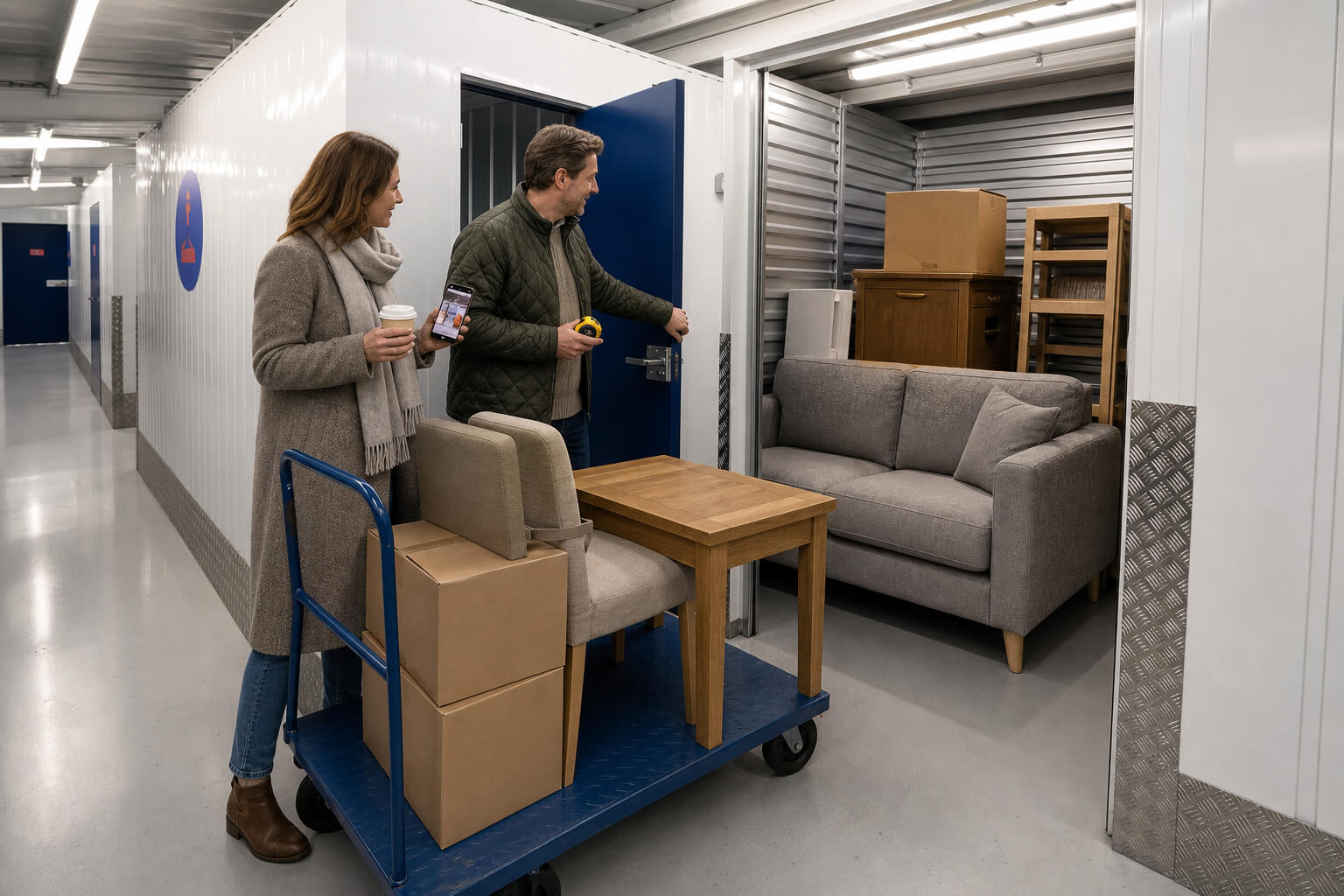
The builder rang, and the job is booked. Now comes the bit nobody put in the original plan: the garage needs to be completely empty before they can start, and the garage is not empty. It never really was a garage, if you are honest. It was the place everything else lived when the house ran out of room.

The bikes are in there. The lawnmower. Three years of camping gear you will definitely use again. A box of things that were going in the loft eventually, and probably another one just like it. None of that can go in the spare room, and none of it can stay in the garage. So where does it go?

That is what this piece answers. Not the build itself, not whether the conversion will add value, not the planning. Just the practical question: where do the contents of the garage live for the six to twelve weeks while the work runs, what size unit do you actually need, and how do you book it so you are not paying for empty weeks once the builder packs up.

Why clear the garage before the build starts

Most builders will tell you they need the space empty, and they mean it. A half-cleared garage with bikes in the corner does not just slow them down. It changes the whole job.

Giving the builder full access (and a faster, tidier job)

A completely empty garage lets the builder move freely from day one. No working around furniture stacked against the wall, no negotiating which boxes they are allowed to shift, no awkward conversation about the thing you definitely could not move in time. The job starts clean, runs cleaner, and finishing on time is a realistic prospect rather than an optimistic one. We see it every spring at Wigwam Self Storage Bath in Somerset and Wigwam Self Storage Lincoln in Lincolnshire: customers who cleared the garage properly before the builder arrived got through the build with far fewer friction points than the ones who left things in the corner and hoped for the best.

There is also a practical point about liability. If your belongings are on a live building site and something gets damaged or goes missing, the situation is complicated. A storage unit removes the question entirely.

Keeping your things out of the dust, paint and footfall

A garage conversion is a building site for the duration. There will be dust. There will be paint. There will be tools on the floor and people moving through the space all day. If you leave boxes in the corner, however neatly stacked, they will not be in the same condition when the work is done.

The things worth keeping safe are the same things that live in a garage: garden furniture with fabric, seasonal clothing in bags, painted or varnished wood, the camping kit you actually use. None of that needs a temperature-controlled environment. It does need to be out of the way of a working builder. A clean, dry, secure unit achieves that without any fuss.

What to store, what to bin, what to keep close

Before you call anyone, do the sort. Not an approximate one. Booking a storage unit is a prompt to actually go through the garage, not a reason to defer it again.

Goes to storage: furniture, boxes, garden gear, off-season kit

The straightforward category. Garden furniture goes. Garden tools that will not be needed during the build go. Seasonal kit (camping, Christmas, winter sports) goes. Boxes of household overflow go. Off-season bikes that nobody is riding in the next few months go. Anything that is worth keeping but not worth working around for six to twelve weeks goes into the unit.

Pack properly. Use solid boxes rather than bin bags for anything breakable or valuable. Wrap furniture legs. Label the boxes on the side, not the top, so you can read them when they are stacked. You will thank yourself when you are retrieving things mid-build.

Bin or recycle now, not later: the “one day” pile

Every garage has a section that does not deserve to be stored. The paint tins from three decorating jobs ago. The exercise equipment that moved from house to house. The things that were definitely going to be sorted “one day.” Now is the day.

This is not a lecture. It is just practical. Self storage costs money, and paying to store something you will never use again is a waste of it. Before you load anything into the van, walk through the garage with a clear head. What goes to the tip? What gets recycled? What could be sold in the ten minutes it takes to list it? Anything you would be embarrassed to unpack at the other end does not need to make the journey.

Being the person who got the logistics sorted means getting the sort-out right too.

Keep accessible: anything you still need during the build

Some things cannot go into storage, because the build will run into summer and you will need them. The lawnmower, if the grass is still growing. A bike that gets used for commuting. Tools you will reach for during the project itself. Think it through before you load up.

If you do put things in the unit that you will need during the build, that is fine. Access is 6am to 10pm, seven days a week by smart entry, so nipping in to collect the mower before the weekend is not a problem. The sites are unmanned; you access your own goods directly. Keep that in mind when you are deciding what to store and what to leave close to hand.

What size unit you need for a garage clear-out

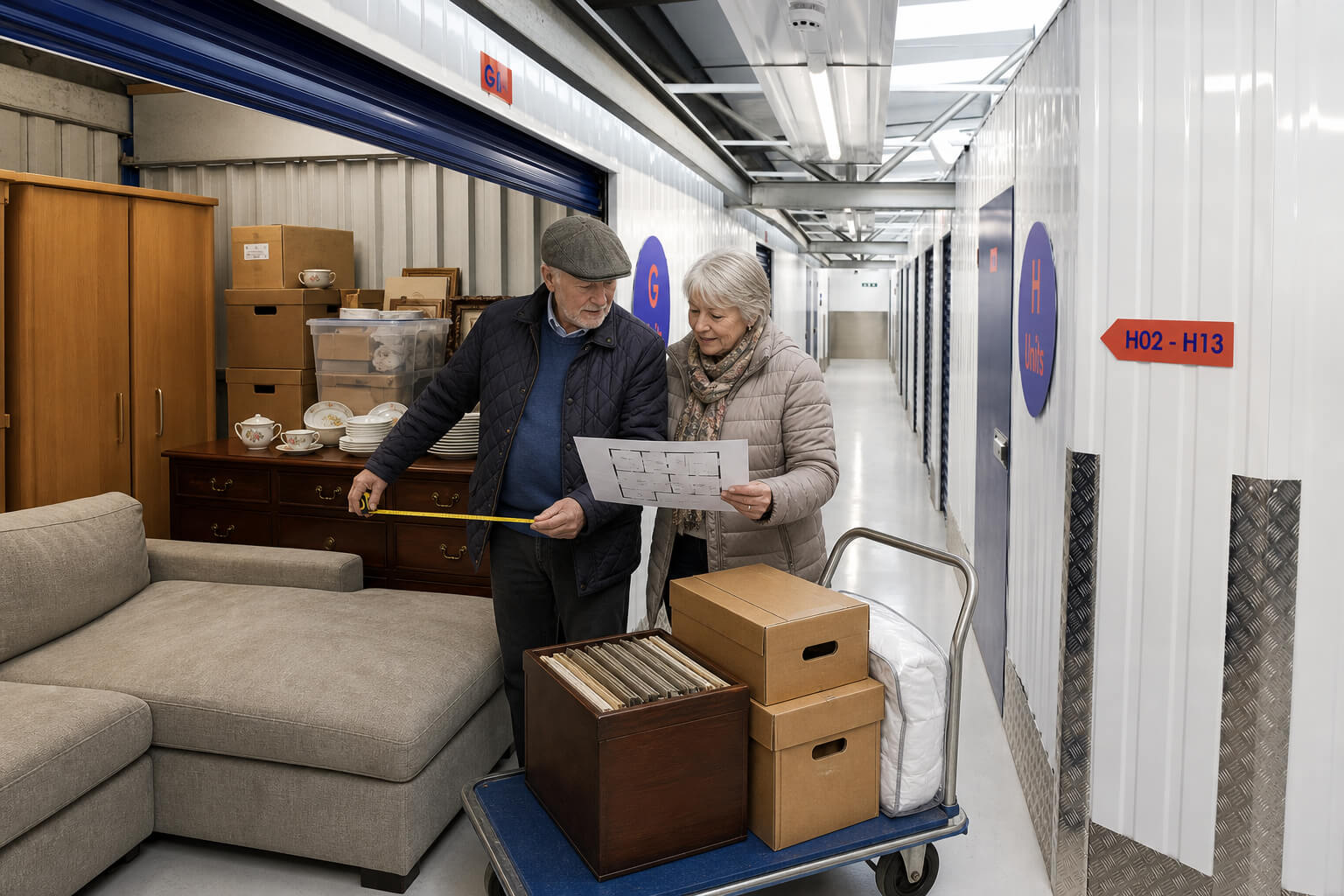
The sizing decision puts most people off before they have even started, because they assume they need to know the cubic footage of every box. You do not. A rough guide based on what a standard garage holds is enough to get you to a quote, and the quote will confirm the detail.

A single garage’s worth (rough guide)

A single garage, the one-car size most common in UK terrace and semi-detached properties, typically covers around 18 to 22 square metres of floor space. When you are storing the contents rather than the space itself, you are looking at the volume of what was living in there: garden tools, a bike or two, shelving contents, boxes, furniture.

For most single-garage clear-outs, a small to medium self-storage unit covers it comfortably, particularly if you stack and pack efficiently. The Wigwam unit size guide (see the unit size guide on the website) gives you the dimensions of each unit size and a rough guide to what fits in each one; worth a look before you commit to a size.

If the garage also doubles as a secondary storeroom for the house and has been accumulating things for years, be honest about the volume before you book. It is common to underestimate.

A double garage or a garage plus loft overflow

A double garage, or a single garage that has been accumulating loft overflow as well as its own contents, needs more room. The volume can surprise people who have not actually looked at everything laid out flat before packing it. A medium or large unit is usually the right starting point for this category.

If you are unsure, book slightly up. The refund-of-unused-days term applies to the time after you vacate, not to unused floor space, so there is no rebate for taking a unit that turns out to be bigger than you needed. Getting the size right at the start avoids a second trip or a second booking. The unit size guide on the website walks you through the options clearly.

If you want a quick sense of what a unit near you would cost, you can get a quote at quote.wigwamstorage.co.uk.

How long a garage conversion takes, and how long to book

The timeline is the thing most people get wrong, either by under-booking and then scrambling to extend, or by over-booking and paying for empty weeks at the end. The honest answer is that build times vary, but the range is knowable.

Typical build timelines and the two-week minimum stay

A standard single garage conversion, non-structural and within permitted development, typically runs four to eight weeks from start to finish once the builder is on site. A double garage or one requiring structural work will usually take longer, sometimes up to twelve weeks or more. These are operational estimates based on what we see customers booking for; for a precise timeline, your builder or architect is the right source.

Wigwam’s minimum stay is two weeks. For a garage conversion, you will almost always need more than that, but it means you are not locked into anything longer than the build requires.

Booking to the build, not beyond it (refund of unused days)

Here is the thing most people do not know when they first look at self storage: if your builder finishes early, you do not pay for the weeks after you vacate. Wigwam refunds unused days once you give notice and clear the unit, with the standard 14-day notice period. The refundable deposit is returned after that notice period, once you have vacated and your account is settled.

What that means in practice is that you can book to the outer edge of the likely build timeline and not worry about it. If the builder finishes in six weeks and you booked for eight, you give your 14 days’ notice and the remaining days come back to you. There is no penalty for finishing early.

The full terms, including how the deposit and notice period work, are at wigwamstorage.co.uk/terms-conditions/.

What it costs (and where to check current prices)

The honest answer is that storage prices depend on the unit size, the town you are in, and how long you need it for. There is no single figure that applies to everyone, and giving you one would not help you. What we can tell you is how the pricing works and where to find the current rates.

How market-town self storage is priced

Storage is priced by unit size and location. A small unit in a market town near you will cost less than an equivalent unit in a city centre. Duration affects the total cost, not usually the weekly or monthly rate. No hidden fees. Current rates across our UK market-town locations are on the pricing page at wigwamstorage.co.uk/how-much-is-self-storage-in-the-uk.

The refundable deposit and 14-day notice explained plainly

When you start with Wigwam, you pay a refundable deposit. That deposit comes back to you after the 14-day notice period, once you have vacated the unit and your account is settled. The two-week minimum stay means you are with us for at least a fortnight, which for a garage conversion is rarely the limiting factor. If you leave before the end of a paid period, you get the unused days back.

No surprises. No small print that changes the story. If you want to read it in full, the terms are at wigwamstorage.co.uk/terms-conditions/.

Protecting the contents: what you need to know about cover

Contents cover is not optional. Wigwam requires that your stored goods are insured for their full replacement value. You have two options: take Wigwam’s policy through RSA (the Self Storage Customers’ Goods policy, New-for-Old basis), or provide evidence of your own cover. Either way, you need to declare the full replacement value of what you are storing. If you declare less and need to claim, any payout will be reduced in proportion to the underinsurance.

The policy covers theft by forced entry. Climatic damage is excluded, which is worth knowing if you are storing anything sensitive to temperature or humidity, though our units are clean, dry and secure and that is not typically a concern for standard household goods from a garage clear-out.

We signpost, we do not advise. The details of the contents protection options are at wigwamstorage.co.uk/contents-protection/. If you have questions about your own policy, your insurer is the right person to ask.

What Wigwam’s units are (and what they are not)

The units are clean, dry and secure. They are individually alarmed. They are not climate-controlled, and we do not claim otherwise. For garden furniture, seasonal kit, boxes, bikes and garden tools, a clean dry space is what you need. We offer exactly that.

Storing it near you: Wigwam in your market town

The whole point of a local storage company is that the unit is close enough to be useful. Fifteen minutes from home, not forty-five minutes on the ring road.

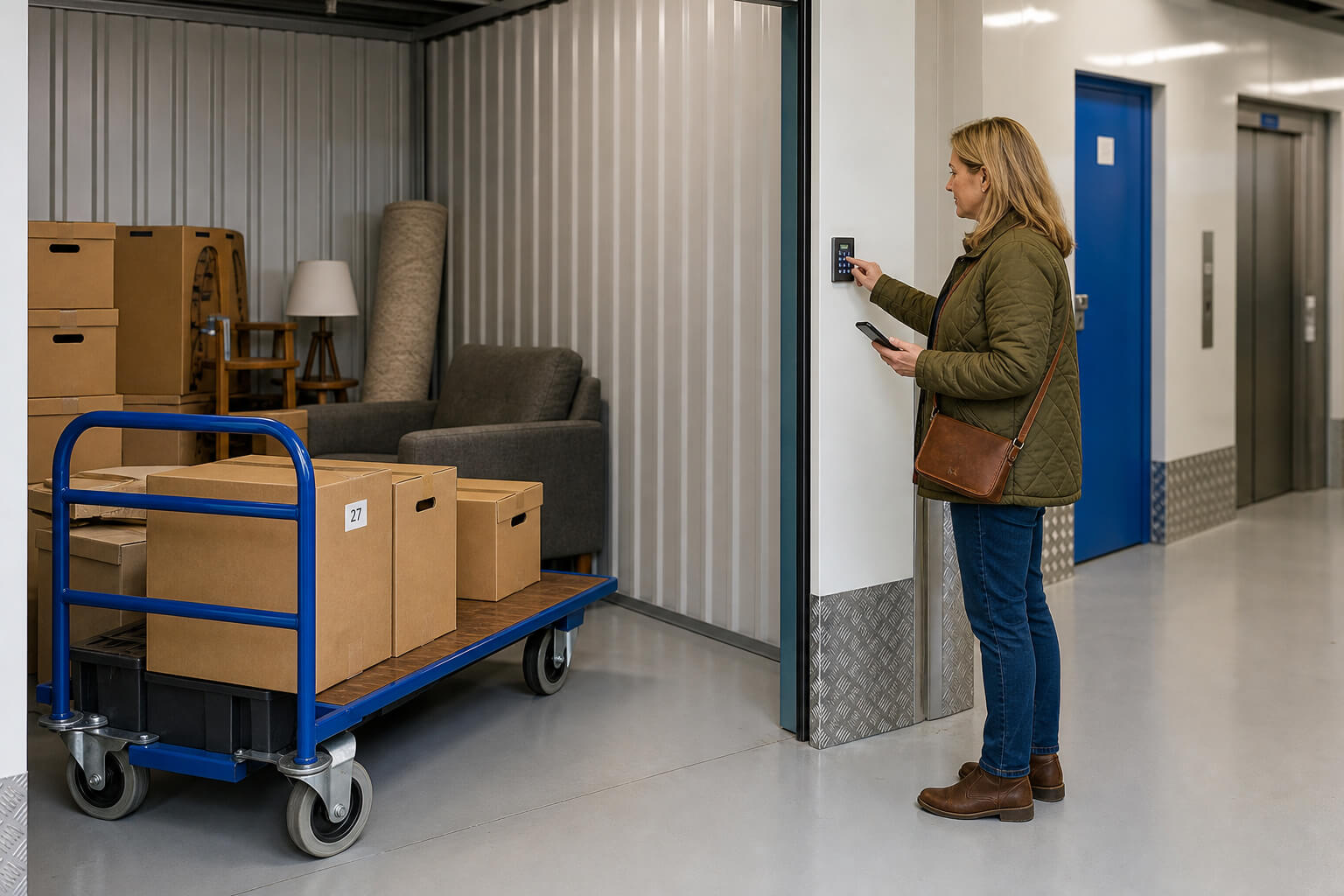
Access on your schedule, 6am to 10pm by smart entry

Access is 6am to 10pm, seven days a week, by smart entry. No booking ahead, no waiting for someone to let you in. You come when you need to, load or collect what you need, and leave. The sites are unmanned; you access your own goods directly.

One practical note for anyone expecting deliveries during the build: if new flooring, fittings or anything else is being sent to the unit while the garage conversion is running, someone from your household needs to be there to receive it. Wigwam does not sign for couriers or receive goods on your behalf.

Clean, dry, secure and individually alarmed

Every unit is individually alarmed. The sites are secure. The spaces are clean and dry. That is the honest description of what you are getting, without the language that suggests otherwise.

Wigwam Self Storage Bath and Wigwam Self Storage Lincoln are good examples of what a market-town Wigwam site looks like in practice. Both serve local homeowners who need storage close to home during exactly this kind of project.

Finding your nearest Wigwam location

You can see all our UK market-town locations at wigwamstorage.co.uk/self-storage-locations/. Find your nearest site, check the address, and then get a quote. The whole process takes a few minutes.

A quick word on planning permission

Whether you need planning permission for a garage conversion depends on your property, the work involved, and your local planning authority. That is the builder’s and architect’s territory, not ours. The Planning Portal has straightforward guidance on garage conversions and permitted development rules. For your specific situation, your architect or local planning authority is the right starting point.

We are the storage end of the equation. Once the permission question is settled and the build is booked, we are here to solve the bit the planning guides leave out.

When the builder is done and the unit is empty, you will get the unused days back and the deposit returned once your 14-day notice has run and your account is settled. You will not have paid for time you did not use. The stuff will have been where you could reach it, when you needed it, from 6am to 10pm any day of the week.

If you want to see what a unit near you would cost, there is no obligation in getting a quote. You can start at quote.wigwamstorage.co.uk. Have the rough dimensions of your garage contents in mind, or just describe what you are clearing, and we will work from there.

Frequently Asked Questions

What do I do with the paint, fuel and chemicals that live in the garage?

Those do not go into a storage unit, so plan a separate route for them before the build starts. Garages tend to collect exactly the things a storage unit cannot take: half-used paint tins, white spirit, petrol or two-stroke fuel for the mower, weedkiller, gas canisters for the barbecue, propane bottles. Anything flammable, combustible or hazardous is not suitable for storage, for the obvious safety reasons, so it stays out of the unit. The good news is that a garage conversion is the perfect prompt to deal with this pile honestly. Usable paint and chemicals can come with you and live in a ventilated outbuilding, a shed or somewhere safe at home. The rest should go to your local household waste recycling centre, which will have a dedicated point for paint, oils and hazardous materials. Do not pour solvents or fuel down a drain, and do not bag them up with general waste. Most councils take small quantities of household hazardous waste free of charge, but check your own council’s website for what they accept and whether you need to book a slot. Fuel for the mower can usually be run down by using it up before the build, or decanted into an approved container and stored safely. Getting this sorted early means the only things heading to your unit are the clean, dry, storable items, which is exactly what the unit is built for.

Can I store a chest freezer or second fridge from the garage?

Yes, but empty it, defrost it fully and dry it out first, because a sealed appliance put away damp is the one thing that will not store well. Lots of garages hold a chest freezer or a spare fridge, and people often forget about it until the day the builder is due. Give it a proper run-down instead. Empty the contents, switch it off, and let it defrost completely, which can take longer than you expect for a well-iced chest freezer, so start a day or two ahead. Once the ice is gone, wash the interior, wipe it bone dry, and leave the lid or door propped open to air for a day before it travels. The reason matters: a closed appliance with any trapped moisture becomes a dark, sealed box where damp and odour build over the weeks of a conversion. Stored dry, with the lid wedged open by a few centimetres for the duration using a folded towel or a wedge, it keeps perfectly well in a clean, dry, secure unit. Coil and tape the cable so it does not catch, and remove or secure any loose baskets. Declare its replacement value with the rest of your goods for contents protection. When the build is done and the freezer comes back, give it time to settle upright before you switch it on, especially if it was tilted in transit.

Will my bikes and garden tools be alright in storage for the duration?

They will, provided you spend ten minutes preparing them before they go in. Bikes and garden tools are textbook garage contents and store perfectly well in a clean, dry, secure unit, but a little prep stops them coming back tired. For bikes, give the frame and chain a wipe, and a light coat of oil on the chain and any bare metal keeps surface rust off over a damp British autumn. Pump the tyres up rather than leaving them soft, which avoids flat spots if the bike is standing for weeks, and if you can hang the bike or stand it on a board rather than directly on the floor, all the better. For garden tools, clean the soil off spades, forks and mower blades before storing, because caked-on damp soil is what starts the rust. A wipe of oil on metal blades and moving parts does the same job as it does on the bike. Bag up smaller hand tools so they stay together and do not scatter. Pack everything so nothing heavy can topple onto softer goods, and keep anything you might still need during the build, a commuting bike or the mower if the grass is still growing, near the front of the unit. Access runs 6am to 10pm, seven days a week by smart entry, so collecting the mower before the weekend is no trouble.

A structural conversion is taking longer than planned. How does extending the storage work?

Nothing dramatic has to happen, because the arrangement is built to flex with a build that overruns. Structural garage conversions, the ones involving foundations, new openings or significant building work, can run to twelve weeks or well beyond, and timelines slip for all the usual reasons: a delivery is late, the weather turns, something unexpected appears once the work opens up. Your storage is not on a fixed term that ends abruptly, so an overrun simply means more weeks at the same rate. There is nothing to renegotiate and no new contract to sign. When the build finally finishes and you are ready to clear the unit, you give 14 days’ notice, move your belongings out, settle the account, and any unused days you have already paid for are refunded. The refundable deposit comes back after the notice period once you have vacated and the account is settled. The only floor on the arrangement is the two-week minimum stay, which a garage conversion comfortably exceeds anyway, so it is rarely a factor. The one thing worth doing is letting the team know if your timeline has shifted a long way from your original plan, so everyone is working from the same picture, but mechanically the rolling arrangement just carries on for as long as the build needs.

Where does the stuff go when the garage is gone for good?

This is the question worth facing before you start, because a converted garage is no longer a place to put things back, so some of what comes out is not going home. That is not a problem to dread, it is a chance to deal with it properly. Walk the garage with a clear head before you book, and sort honestly into three piles: things that have a genuine home elsewhere in the house, things that can be sold, donated, recycled or taken to the tip now, and the smaller core of things worth keeping that simply need a new long-term home. Storage covers the gap while you build, but it is not meant to become a permanent overflow garage by another name, because paying month after month to store things you will not use again adds up. So use the conversion as the prompt to be ruthless: the paint tins from old jobs, the exercise bike that has not moved in years, the “one day” pile that never had a day. For the genuine keepers that the new layout has no room for, you have options once the build ends. Some people downsize to a smaller, cheaper long-term unit and keep it deliberately. Most find that an honest sort-out means most things find a home and the unit empties when the build does. Either way, you give notice, take back what you are keeping, and only pay for the time you used.

Storing Event And Craft Fair Stock In Self Storage Between Dates

Packed down the craft-fair stall with three weeks till the next one?

Sunday afternoon. The last box goes in the boot. The trestle table is strapped to the roof. You drive away from the village hall car park and the weekend is done. The next fair is three weeks out, and somewhere between now and then, all of this has to live.

For a lot of independent traders and makers, that somewhere is the spare room. Or the hallway. Or whatever floor space the garage still has. It works, after a fashion, right up until it doesn’t. The morning you spend half an hour hunting for the banner poles before you can load the car is the morning you start wondering whether there is a better way.

There is. And it is simpler than most people expect.

Trading happens in dates, not around the clock

A weekend trader is not running a 24-hour warehouse. The real rhythm is load on Friday, sell across Saturday and Sunday, pack down Sunday afternoon, then wait until the next date comes around. That is the pattern, and a self storage unit works with it rather than against it.

You do not need access at 3am. You need stock that is safe when the stall is packed away. You need a unit that is ready at 6am on Saturday morning when you want an early start, and still open at 9pm on a Sunday when you are finishing the pack-down later than planned. That is the actual job. Everything else is secondary.

The weekend-market and craft-fair rhythm

Most of the industry talks about “round-the-clock access” and “drive-up convenience” because those are easy things to say. The reality for a maker or market trader is more straightforward. You work to a calendar of dates, not a continuous operating cycle. Between those dates, the stock needs to be somewhere that is not your living room.

The loading run might be Friday evening. Saturday it is all set up and on the stall. Sunday it comes back down, gets packed, and the van or car gets loaded. Then the unit door closes, the alarm kicks in, and you go home. Three weeks later you open it again and do the same thing in reverse. The unit earns its keep not in the hours the stall is up, but in the quiet gaps between.

Why “between dates” is the part that actually matters

This is the half of a trader’s operation that tends to get overlooked, both by the trader and by every website that writes about storage for businesses. The event itself gets the attention. The gap between events is where a lot of the real work sits.

Unsold stock, packaging, banners, branded bags, display stands, spare price tags and the general accumulation of a season of trading all needs a home. At home it creates friction with the rest of your life. In a secure, clean, dry unit it simply waits. The difference is not dramatic on any given day, but across a season, having one reliable place where everything lives makes the loading runs faster, the pack-downs less stressful and the whole operation feel more like a proper business.

How traders use a unit between dates

The practical reality of using a unit for event stock is fairly consistent across different types of trading. You build a system once and it repeats. A regular here is a good description of how that looks in practice.

Stock, banners, trestle covers, packaging and display kit in one place

Everything that goes with the stall lives in the unit. Boxed stock, of course. But also the things that surround it: the banners and signs you reuse at every fair, the trestle covers and table skirts, the bags and tissue paper, the card reader and its charger, the branded bags and the float tin. Display stands that would take up half the spare room. Hanging rails. Sample cases.

All of it, in one place, stacked and labelled the way you want it. The unit is clean, dry and secure. Individually alarmed. So when you come to load on Friday evening, you are not assembling the fair from three different rooms of the house; you are loading from one room that was built for exactly this.

A quick note on what the space is: clean, dry and secure covers a wide range of goods, but it is not climate-controlled. There is no temperature or humidity regulation. For most stock, that is fine. For goods that are sensitive to temperature swings or damp, such as certain candles, some textiles or anything where the packaging matters as much as the product, it is worth thinking carefully about whether the storage conditions are right. Be honest with yourself about what your stock needs.

Loading and collecting around the 6am to 10pm smart-entry window

Smart entry runs from 6am to 10pm, seven days a week. That window covers every realistic loading and pack-down moment in a trading week without any drama.

Friday evening load-up, six o’clock: fine. Saturday morning early start, six-thirty: fine. Sunday evening pack-down running later than expected, half past nine: fine. The window is designed for people who live and trade in the real world, not people who need to restock at 2am. Access is by smart entry, not staffed; you use the system to get in and out under your own steam.

Sites are unmanned, and what that means for you

Every Wigwam site is unmanned. You access your own goods; there is no one on site to help you in or out. That is straightforward once you know it, and it changes nothing about how you use the unit day to day.

Where it matters is deliveries. If a supplier is dropping stock at the unit, or a courier is collecting an order, someone from your business needs to be present. Wigwam does not sign for deliveries and does not accept goods on your behalf. Plan your delivery and collection runs around that: be there yourself, or have someone from your team there. It is a simple constraint and it is easy to work around once you have built it into your routine.

Ready to see what a unit near you would cost for your stall stock? Get a quote at quote.wigwamstorage.co.uk

What you can (and cannot) store here

Being straight about what works and what does not is more useful than a list of features. Here is the honest version.

What fits well: boxed stock, display materials, dry goods, event equipment

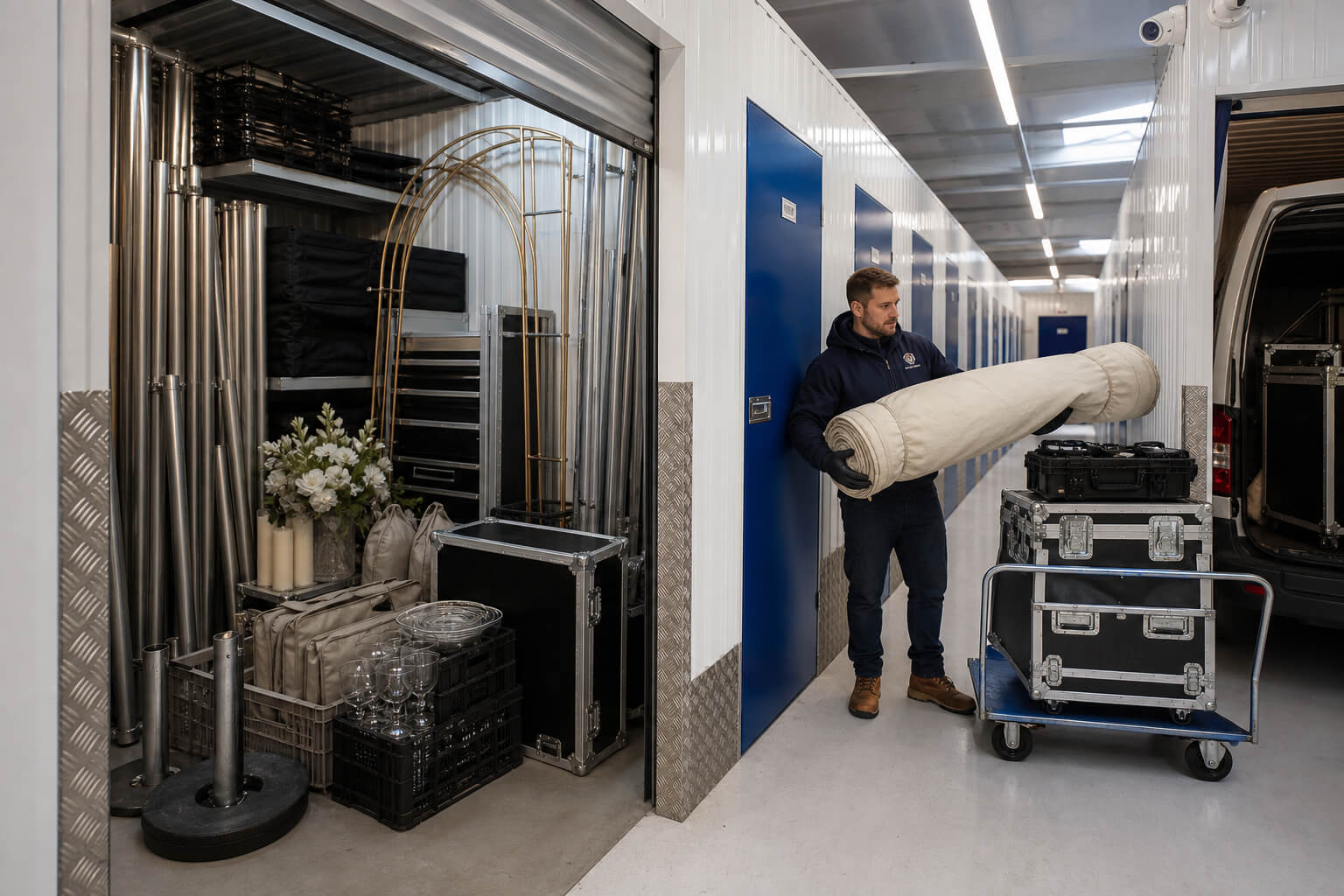
The unit suits everything that a typical market trader or craft-fair seller carries. Boxed or bagged stock. Display stands, frames, easels and rails. Banners, signs and printed material. Packaging supplies: tissue paper, ribbon, bags, boxes, bubble wrap. Seasonal inventory that is not in active rotation. Trestle tables and covers. Hanging rails. Sample cases and presentation boxes.

All of it is in an individually alarmed unit, in a clean, dry, secure building. The stock is yours and only you can access it.

For wedding fair exhibitors and events-circuit suppliers, the unit handles larger kit too: fabric drapes, display boards, hanging garments, prop boxes and the kind of bulky equipment that does not fit comfortably in anyone’s spare bedroom.

What does not belong here, and why being straight about it matters

Some things are not suitable, and it is better to say so clearly than to have you discover it after you have moved stock in.

No perishables. If you sell food, fresh flowers or anything with a shelf life, self storage is not the right home for it.

No goods that need climate control. The unit is clean, dry and secure, but there is no temperature or humidity regulation. If your stock is sensitive to heat, cold or moisture, assess your product range honestly before you commit.

No vehicles, vans, trailers or gazebo trailers. Units are for goods and equipment, not for parking.

The short test: if your stock is non-perishable, does not require specific temperature conditions, and fits through a unit door, it is almost certainly fine. If any of those conditions is in doubt, get in touch before you book.

Stockroom yes, shop no: what a unit is for

The answer to “can I run my business from the unit” is: it depends what you mean. Store, load and collect, yes. Use the unit as a retail space, meeting room or workshop, no.

Storing, loading and collecting: what the unit is designed for

The unit is a stockroom. It is the place where the business lives between events. You can come in and out of it as often as you like within the access hours, load your car or van, drop off unsold stock, reorganise your shelving, repack boxes and generally run your stock operation in a way that makes sense. That is exactly what it is for.

What it is not for is serving customers from. No retail sales from the unit. No card readers taking payments at the door. No conducting client meetings in the space. The unit is a storage room in a storage facility, and it works brilliantly for everything that falls within that definition.

Contents protection and insuring your stock

This matters more for a trader than for someone storing household furniture, because your stock has commercial value and it is the raw material of your livelihood.

Contents cover is mandatory at Wigwam. You either take Wigwam’s policy, which is the RSA “Self Storage Customers’ Goods” product, or you provide evidence of your own equivalent cover. There is no third option.

If you take Wigwam’s policy, declare the full replacement value of what you are storing. Under-insurance is settled in proportion, meaning if you insure for half the value and make a claim for the full amount, you receive half. Declare accurately. The cover is New-for-Old. There is a £50 excess. Theft cover applies after forcible entry. Atmospheric and climatic damage is excluded.

This is a signpost, not advice. For guidance on whether the policy meets your business’s specific needs, speak to your own broker or insurer. Full details are on the contents protection page.

A brief note on jurisdiction: Wigwam’s terms and insurance product apply in England and Wales. If you are storing from Scotland or Northern Ireland, conditions and legal treatment may differ in certain respects. Speak to your own solicitor or broker if you have specific questions.

Picking a size for stock and display kit

Sizing is something people tend to overcomplicate. The straightforward version is: start smaller than you think you need, because the unit will get organised quickly once you have a system, and you can always move up if the season demands it.

From a few boxes of stock to a full season of kit

A small unit handles a few dozen boxes of stock, some packaging supplies and a couple of folding tables. A mid-size unit takes a full set of display materials, banners, a hanging rail, multiple product lines and the kind of deep stock you carry across a busy quarter. A larger unit covers everything above plus the bulkier items: display boards, fabric drapes, multiple units of shelving, a full season of event equipment.

The way to think about it is not square footage in the abstract, but kit list in practice. Write down everything that would go in the unit. That list tells you more than any floor-plan diagram. There is a size guide on the website that maps kit lists to unit types; use that as your starting point rather than guessing.

Signpost the size guide in your research before you book, but do not let sizing anxiety delay you. The team can advise, and the terms are flexible enough that you are not locked in if you get it slightly wrong.

Seasonal scaling: taking a larger unit for peak season

The flexibility here is genuinely useful for traders who have a clear peak. Christmas market season, summer festival circuit, spring wedding fairs: if your stock volume doubles between October and December, you can take a larger unit for that period and scale back when the season ends.

The two-week minimum and the 14-day notice period mean you are not signing anything that commits you beyond the season. Full detail on the terms is at wigwamstorage.co.uk/terms-conditions/.

What it costs and how the terms work

Start with the terms, because they are the thing that makes the cost calculation work for a seasonal trader. The price is only useful in the context of what you are getting and what you are committing to.

Two-week minimum stay and refund of unused days

The minimum stay is two weeks. That is short. Genuinely short. If you need storage for a six-week run of markets in October and November, you take the unit for that period and you are not paying for January.

If you finish early, the unused days come back to you. You give notice, you vacate, and the days you did not use are refunded. That is the kind of term that makes sense for a seasonal business operating in short bursts.

The deposit and the notice period, in plain terms

There is a refundable deposit. It is held while the unit is active and returned once you have given 14 days’ notice, vacated the unit and settled the account, less anything owed. It is not lost; it comes back.

The notice period is 14 days. Give your notice, clear the unit, settle the account: the deposit returns. That is the full sequence. Read the terms and conditions for the complete detail before you sign, as you would with any contract.

Where to find current prices

Prices vary by size, location and season, so quoting a figure here would not serve you well. The current rates for all unit sizes are at wigwamstorage.co.uk/how-much-is-self-storage-in-the-uk. Use that page to run the numbers against your season before you get a quote.

Find your nearest market-town location

The closer the unit is to where you live and trade, the more useful it becomes. A unit across town is a unit you use less often. A unit two minutes from the van is a unit you load and unload without thinking about it.

Storing near where you live and trade

Wigwam’s UK market-town locations are designed for exactly this: traders and makers who want a stockroom in their own town, not on a distant industrial estate with a long drive each way.

Wigwam Self Storage Bath covers the Bath, Somerset area, which includes a strong craft-fair and artisan market circuit. Bath is well placed for traders who work the south-west event calendar. Wigwam Self Storage Lincoln serves Lincoln, Lincolnshire and the surrounding area, including traders who work the city’s market and the wider East Midlands fair circuit.

For all other towns, the locations hub shows the full list. Find the one nearest to your home or your regular trading patch and check what is available.

What to look for when choosing your site

Proximity to home or your main fair circuit is the first test. After that: can you get in and out easily with a loaded car or van? Is there parking close to the unit for a quick load? The access window is 6am to 10pm at every site, which covers every realistic loading and pack-down moment, so that part is consistent.

A practical tip: plan your first loading visit as if you were doing a real market run. Drive there at the time you would actually load on a Friday evening. See how long it takes. If it works on a tired Friday, it works every time.

Is a small seasonal unit worth it for a trader

This is the honest question, and it deserves an honest answer rather than a promotional one.

The hidden cost of storing at home

The spare room costs nothing in rent, which is the obvious point. The less obvious costs add up quietly. Thirty minutes hunting for the tablecloth before every market. The constant reorganisation of a house that was not designed to hold a stock room. The weekend you had to leave stock in the car because there was nowhere to put it. The friction it creates with everyone else who lives in the house.

Then there is the opportunity cost of disorganised stock. The order you could not fulfil because you did not know how much you had. The display pieces that got damaged because they were stacked badly in the hallway.

A unit trades the zero-cash-cost of the spare room for a small monthly outlay and a significant reduction in all of those hidden costs. Whether the trade is worth it depends on how much those hidden costs are weighing on you. For many traders, the tipping point comes sooner than expected. Full pricing is at wigwamstorage.co.uk/how-much-is-self-storage-in-the-uk if you want to run the numbers.

When it makes sense to start, and when to stop

The terms make the risk low. Two-week minimum. Fourteen days’ notice on exit, then you are out and the deposit returns. A trader can take a unit a week before the season’s first fair and give notice after the last one. The financial commitment is bounded by the season.

“When to start” is often a simpler question than it looks. The moment the spare room is not working, the moment you lose half an hour before every event to loading chaos, the moment your partner says something, start. “When to stop” is when the season ends and you have given notice. It is not a permanent commitment; it is a seasonal tool. Use it when the season needs it, end it when the season does.

If you are ready to see what a unit would cost for your stall stock or fair kit, get a quote at your nearest market-town location: quote.wigwamstorage.co.uk

The stock is there. The next date is coming. Between now and then, it deserves somewhere proper to wait.

Frequently Asked Questions

I sell candles and scented products. Are those allowed?

Finished candles and most scented products sold ready for retail are generally fine to store, because they are not the kind of flammable or reactive substance the rules exclude. What is not allowed is anything flammable in the raw sense: solvents, fuels, gas, aerosols containing flammables, or any liquid that can ignite or give off fumes. So a boxed stock of poured, set candles is one thing; drums of fragrance oil, wax-melting solvents or anything with a flammable safety data sheet is another, and those cannot go in. The sites are unmanned, so a fire or chemical risk in one unit affects every unit in the block, which is why the line is firm.

There is a second point for candles specifically, and it is about quality rather than safety. The unit is clean, dry and secure, but it is not climate-controlled. There is no temperature or humidity regulation. Wax and some scented products can soften, sweat or lose fragrance throw if they sit through a hot spell, so think honestly about whether the conditions suit your particular stock before you commit. For most boxed candle inventory between fairs, clean and dry is fine. If your range is heat-sensitive, factor that in. If you are unsure whether a particular product is permitted, get in touch before you book rather than after you have moved it in.

Can another trader or a friend collect my stock if I can’t make it to the unit?

Not on your behalf while you are absent. Only the account holder holds the smart entry credentials, and only they can access the unit. The sites are unmanned, so there is no one here to let a friend in, hand stock over, or release anything to a third party on request. If a fellow trader is helping you cover a fair, the practical route is for you to meet them at the unit and load together within the 6am to 10pm window, or to load the car yourself in advance.

The same rule covers deliveries and collections. If a supplier is dropping stock or a courier is collecting an order, someone from your business has to be present, because we do not sign for or accept goods on anyone’s behalf. None of this gets in the way once you know it; it just means access runs through you. Plan the loading and collection runs around when you, or someone you arrange to be there in person, can actually be at the site. For a weekend trader working to a calendar of dates, that planning is second nature, and the window is wide enough to make it easy.

Can I take a bigger unit for my peak season and scale back afterwards?

Yes, and it is one of the genuinely useful things about the flexible terms for a seasonal trader. If your stock volume doubles for the Christmas market run or the summer festival circuit, you can take a larger unit for that period and move back down when the season ends. The two-week minimum and the 14-day notice mean you are never signing anything that commits you beyond the season itself. You take the space when the season needs it and give notice when it is over.

The mechanics are simple. Moving up or down a size is a matter of availability at your site, so talk to our support team about what is free when you want to scale, rather than assuming the next size up is always there on demand at peak. Plan the change a little ahead of the busy run. When you scale back, you give 14 days’ notice on the larger unit, clear it, and any unused days beyond the minimum are refunded, with the deposit returned once the account is settled. The full detail is in the terms and conditions. Our team can advise on sizing and availability, though questions about your own trading forecasts and growth plans are for you, not for us.

How does invoicing work, and can I claim the unit as a business cost?

We can talk you through invoicing for the unit itself: how the billing works, what is included, and getting an invoice for your records. That is squarely within what our support team handles, alongside sizing, availability, access and pricing. What we cannot do is advise on whether the cost is deductible against your trading income, how to treat it for VAT, or how it fits your tax position, because that is accountancy, not storage, and it depends on how your business is set up.

For most traders running stock storage as part of a genuine trading operation, a storage cost is the kind of business expense an accountant will recognise, but the right person to confirm that for your specific circumstances is your accountant or a qualified adviser, not us. Keep your invoices filed as you go, so the record is there when you need it. If you need anything from us for your bookkeeping, ask the support team and we will sort the paperwork on the storage side. The tax treatment of that paperwork is then a conversation for your accountant. We keep our advice to storage; we do not stray into financial guidance.

I have a trailer and a gazebo for fairs. Can both go in the unit?

The gazebo, once it is broken down into its frame and canvas and packed, is goods and equipment, so that stores fine alongside your banners, trestles and display kit. The trailer does not. Units are for goods and equipment, not for parking, and we do not store vehicles, vans, trailers or gazebo trailers of any kind. There is no exception to that, so a trailer needs a different home, whether that is your own drive, a yard, or specialist vehicle storage elsewhere.

It is a distinction worth getting straight before you book, because traders sometimes hope to keep the whole rig in one place. The honest split is: anything that packs down into boxes, bags, frames and flat kit is welcome, and the unit is built for exactly that load, the drapes, the display boards, the prop boxes, the folding tables and the packed gazebo. Anything on wheels that you tow or park is not. If you are unsure whether a particular item counts as equipment or as a vehicle, the simple test is whether it fits through the unit door as packed goods. If it does, it is fine. If it rolls in on its own wheels to be parked, it is not. Get in touch if you want to check a specific item before moving it.

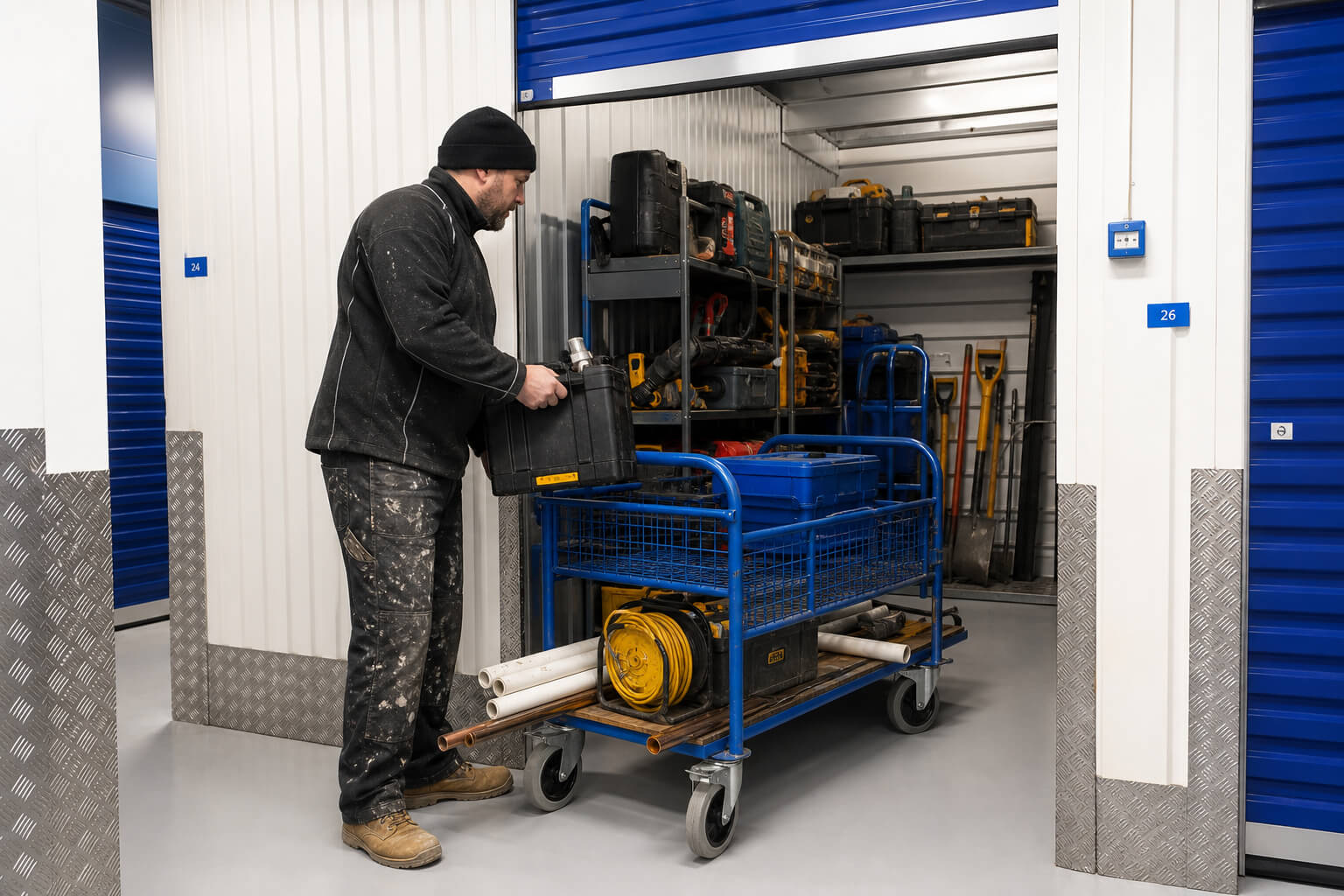
Secure Tool Storage Protecting A Tradespersons Kit

First thing you do each morning is check the van’s still full?

It is quarter to six in the morning and you are already thinking about it. Not the job. Not the drive. Whether the van is still in one piece.

Most tradespeople know the feeling. You have parked on a street you do not know, in a town you are only in for the week, with a full kit in the back. A good drill, a decent set of chisels, cable runs you have had for years. You wake up and the first thing you do is look out of the window. Most mornings it is fine. And then, one morning, it is not.

This piece will not oversell anything. What it will do is give you a straight answer on whether a self-storage unit is a sensible place for your kit, what security you can actually expect, what access looks like at 6am, and what the terms cost you. If it is not the right answer for your situation, we will say so.

Why the van is the weak point

The van is the default tool store for most sole traders. It is convenient, it is mobile, and it is already there. The problem is that convenience cuts both ways. Every thief in the country knows where the tools are, because the van is on the road every day and parked on a street every night.

What van tools cover usually will not pay out

Van insurance does not always cover the tools inside it, and when it does, the conditions can be more restrictive than most tradespeople realise until they need to make a claim.

Common exclusions include tools left in an unattended vehicle, tools that were visible through the windows, and situations where there is no evidence of forced entry. The gap between what a tradesperson assumes is covered and what an insurer will actually pay is often where the real cost of van theft lands.

This is not insurance advice, and policy terms vary. If you are in England or Wales, your policy wording is the definitive guide. Readers in Scotland and Northern Ireland should be aware that insurance law and policy interpretation can differ in those jurisdictions, and consulting your own broker or insurer is always the right step.

What matters for this piece is this: tools stored in a dedicated self-storage unit are covered under a separate goods-in-storage policy rather than your van insurance. If you want to know more about how that works for Wigwam customers, the contents protection page explains the detail.

The overnight problem most trades know too well

Van break-ins happen across the country every week. You do not need a statistic to know it. Most tradespeople either know it from their own experience or from a colleague who has stood in an empty car park at half seven in the morning wondering how they are going to replace three grand of kit before the next job.

The cash-flow hit is the immediate problem. But there is a quieter cost underneath it: the cancelled day, the customer you have to call, the job you cannot deliver on. The tools are not just equipment. They are the reason you can show up and keep your word. When they are gone, you are not just out of pocket. You are out of work until you fix it.

We are not naming the dread to alarm you. We are naming it because it is real, and because there is a practical answer.

Storage unit versus lock-up garage versus site container

There are three realistic alternatives to leaving tools in a van overnight, and each one suits a different situation. A self-storage unit is not automatically the right answer for every tradesperson, and this section will give you an honest comparison.

Security, cost and access compared honestly

A self-storage unit offers individually alarmed units, smart entry on set hours, and a clean, dry and secure environment that is off the road and not visible from a street. A lock-up garage offers a locked door and not much else: no individual alarms, variable condition, and in most areas they are scarce and keenly priced when they do come up. A site container is secure enough on an active site but is tied to one location and goes back when the contract ends.

The costs differ too. Pricing for Wigwam units varies by unit size and location and we do not list rates on this page, but our experience is that tradespeople are often surprised that a self-storage unit costs less than they expected, and more than a lock-up if you can find one. For an honest comparison, look at what the lock-up actually gives you in security before you assume it is the cheaper option.

Where a fixed unit fits, and where it does not

A fixed storage unit works well when your base of operations is within fifteen to twenty minutes of a Wigwam site, when you are running the same territory regularly, or when your kit splits naturally between everyday carry in the van and a project cache you top up or rotate between jobs. It also works well for a second set of tools: the ones you do not need every day but cannot afford to lose.

Where it suits less well is if you are moving between sites in different towns every day and need the complete kit with you at every stop. In that situation, adding a storage leg to an already long day may not make sense. Be honest with yourself about how you actually work. If the unit would be a daily round trip that adds an hour you do not have, it may not be the right fit. If it would be a two-minute detour on your way to the job, it probably is.

How secure is a Wigwam unit

Each Wigwam unit has its own individual alarm, not just a site-wide perimeter system. You access your own unit directly. Nobody else can open it, and nobody shares a corridor with uncontrolled access to your door.

Individually alarmed units and smart entry

The security case for a Wigwam unit rests on a simple point: the alarm is on your unit, not on the front gate. If someone attempts to get into your space, the alarm on that unit triggers. The site is not a shared open shed with a padlock on the entrance. It is a structure of individually secured units where your door is your door.

Smart entry means you access your unit independently. No member of staff needs to let you in or out. You arrive, you go to your unit, and you leave. For a tradesperson, that matters because the rhythm of trade life does not always fit nine-to-five staffed hours. Smart entry runs from 6am to 10pm, seven days a week. That is early enough for the first job of the day and late enough for a site that has run over.

The condition of every unit is clean, dry and secure. That is the verified claim, and it is the one we stand behind.

Ready to see what a unit near you costs? Get a quote at quote.wigwamstorage.co.uk

An honest note on what Wigwam does not offer

Wigwam units are not climate controlled. There is no temperature regulation and no humidity management. The condition is clean, dry and secure, and that is the accurate description.

For most hand tools and power tools, a clean, dry unit is sufficient. The practical steps to manage rust and moisture without a climate-controlled environment are covered in the packing section below.

Atmospheric and climatic damage is excluded from the goods insurance policy, so you should factor that into how you store sensitive equipment. The contents protection page and the terms and conditions set out the exclusions clearly.

This is not an apology. It is information you need before you decide.

Getting to your kit before the job

Early starts are not an edge case in the trades. They are Tuesday. The access question is one of the first things tradespeople ask, and the answer is straightforward.

Smart entry from 6am to 10pm, every day

Access runs from 6am to 10pm, seven days. That covers a very early site start and it covers an end-of-day materials run that overruns. We never claim 24-hour access because that is not what we offer. Some competitors do. We are not one of them.

At 6am, you arrive at the site, access your unit using smart entry, load what you need, and you are on the road. No waiting for staff to arrive. No phoning ahead. The unit is yours for those hours, every day of the week.

Smart entry is the term we use. We do not describe it as app-based.

Why the sites are unmanned, and what that means for deliveries

Wigwam sites operate without on-site staff. That is a deliberate part of the model, and it keeps costs lower than managed facilities. It also means something you should know clearly before you commit: Wigwam does not sign for couriers, does not take in deliveries on your behalf, and cannot hold goods for you.

If you need materials delivered to your unit, someone from your own business must be present to receive them. That might be you, a colleague, or a labourer on your payroll. What it cannot be is the Wigwam site team, because there is none on site.

For some tradespeople, that settles the unit into a tool store rather than a materials hub. For others, it is workable because they can plan a delivery around their own schedule. Know which one you are before you sign up.

What size unit do tradespeople usually need

The right size depends on the kit and how you use the unit. A sole-trader electrician with a van pack of hand tools, a couple of power tools and cable runs needs considerably less space than a carpenter carrying bench equipment and sheet materials.

From a small locker for hand tools to a larger unit for plant and materials

A compact unit suits a tradesperson whose everyday kit is mostly hand tools and a power tool set. They might use it to keep a second kit, seasonal equipment, or the tools they do not need on every job but cannot afford to lose if the van is broken into.

A mid-sized unit suits the tradesperson who wants to split the kit: daily carry stays in the van, project cache lives in the unit and is rotated between jobs. A larger unit works for a small trade team needing shared access to plant, materials or bulkier equipment.

Rather than quoting specific dimensions here, we would point you to Wigwam’s unit size guide for a practical breakdown, because the right size depends on what you are storing and how you will access it. Ask at your nearest location and the team can talk you through the options. The size guide is the right place to start.

What it costs and how the terms work

The costs vary by unit size and location, and we do not quote prices on this page. What we can do is tell you exactly how the terms work so there are no surprises.

Refundable deposit, two-week minimum, 14-day notice and refund of unused days

The terms are these. A refundable deposit is required when you start. There is a two-week minimum stay. When you are ready to leave, you give 14 days’ notice. Once you have vacated and your account is settled, the deposit is returned, less anything owed. Any unused days after you vacate are refunded.


Those four points are the commercial structure. There is no catch in them, but they are the honest terms and you should know them before you sign.

For current pricing, the pricing reference page is the right place to look. For the full terms, terms and conditions has the detail.

Packing and protecting your tools in storage

A clean, dry unit is the right environment for most tools. A few simple steps will keep the kit in good order between visits, without relying on temperature or humidity control.

Beating rust and damp

Metal tools benefit from a light wipe-down before they go into storage. A thin film of machine oil on drill bits, blades, and chucks costs almost nothing and significantly slows any surface oxidation. Silica gel packets in your toolboxes absorb any residual moisture in the air around the tools and are cheap to replace when they are saturated.

Keep tools off the concrete floor. A pallet, a shelf, or even a sheet of plywood gives clearance from any condensation that might form on a cold surface. If you have abrasives, sandpaper, or other moisture-sensitive consumables, a sealed plastic tote is the easiest way to protect them.

Organising for a fast grab-and-go

A 6am start is not the time to hunt for a specific bit. Organise the unit once, consistently, and you will not have to think about it again. Shelving with labelled boxes or cases means you can load what you need without turning the unit over. Keep the most-used kit at the front, seasonal or specialist tools at the back.

A consistent layout also means a colleague or labourer can access the unit and find what they need without a guided tour. If you share the unit across a small team, a simple sketch of where things live, kept in the unit itself, saves more time than it costs.

Insuring your tools in storage

This section signposts rather than advises. Insurance decisions depend on your own policy, your kit, and your circumstances, and a broker is the right person to help you weigh them.

The contents-protection option and declaring full replacement value

When you store with Wigwam, contents cover is mandatory. You can take Wigwam’s own RSA Self Storage Customers’ Goods policy, or you can provide proof that your own existing contents cover is equivalent. What you cannot do is store without cover in place.

The RSA policy operates on a New-for-Old basis with a GBP 50 excess. Theft is covered after evidence of forced entry. Atmospheric and climatic damage is excluded. The single most important step you can take is declaring the full replacement value of your kit. Under-insurance is settled proportionally: if you declare half the value, a claim is settled at half the cost of replacement.

For tradespeople with expensive kit, that maths matters. A GBP 5,000 SDS drill, impact driver, levels and cable set is not unusual. Declare what it would actually cost to replace, not what you paid for it four years ago.

We are not advising you on which policy is right for your situation. That is a conversation for your own broker or insurer. Readers in Scotland and Northern Ireland should also be aware that insurance law and policy interpretation may differ from England and Wales, and local advice applies.

Full detail is on the contents protection page.

Find tool storage near you

Wigwam sites are in UK market towns, positioned for trades and businesses that operate across a local patch rather than from a city centre industrial estate.

Our UK market-town locations

Wigwam Self Storage Lincoln in Lincolnshire and Wigwam Self Storage Bath in Somerset are two of our named locations. Bath and Lincoln are good examples of the kind of market town we are built around: enough local trades activity to make a unit genuinely useful, close enough to the residential and commercial patches where tradespeople work to make a morning detour worth it.

For the full list of our UK market-town locations, the locations hub is the right place. Select the town nearest to your base of operations and you will find opening information and the option to get a quote.

If you are not sure which location makes most sense for how you work, or whether a unit would suit the split between van carry and project cache, get in touch through the quote form and one of the team can talk it through with you.

Ready to find a unit near you? Get a quote at quote.wigwamstorage.co.uk

Frequently Asked Questions

Can I store fuel, gas bottles or a petrol generator in the unit?

No. Fuel, gas canisters and anything flammable or under pressure do not belong in a storage unit, and that is a firm line, not a guideline. Plenty of a tradesperson’s kit stores perfectly well: hand tools, power tools, cable, fixings, dry materials and the like. But the volatile end of the van load is different. Petrol and diesel, jerry cans, propane and butane bottles for heaters or blowtorches, gas-powered nail guns’ fuel cells, aerosols and solvent-based products are all things to keep out.

The reason is straightforward safety, for your kit and for everyone else’s in the building. A petrol generator can be stored only once it is completely drained of fuel and the carburettor is run dry, and even then the fuel itself has to be kept elsewhere. The simplest approach is to treat the unit as the home for the tools and the dry materials, and to keep fuel, gas and chemicals in whatever arrangement you already use for those on a working site. If you are not sure whether a specific item counts, the test is whether it is a stable solid tool or material, or a volatile liquid, gas or pressurised product. The first is fine; the second is not. It is also worth knowing that climatic and atmospheric damage is excluded from the goods policy, so the unit is the place for the durable kit, not for anything that needs special handling. Keep the hazardous items out and the clean, dry, secure unit does its job for everything else.

Can my apprentice or labourer collect tools from the unit without me?

Yes, if they are set up as an authorised person on the account, which is exactly how a small trade team is meant to use a unit. The body of this article touches on sharing a unit across a small team; the mechanism behind that is that access runs on the account holder’s authorised contacts, using smart entry from 6am to 10pm, seven days a week. So an apprentice can swing by at 6am, grab the SDS drill and the consumables for the day, and get to site without you having to be there to open up.

A few sensible cautions come with that. The people who can access the unit are the ones you have authorised, not anyone they happen to bring along, and certainly not couriers or unaccompanied deliveries; if materials are being dropped at the unit, someone from your side has to be present to receive them, because the site is unmanned and no one here signs for goods. It is also worth being clear among the team about who is responsible for locking up and for the kit, because as far as the account goes there is one account holder carrying that responsibility. The practical tip from the body of this piece stands: keep a consistent layout and a simple sketch of where things live in the unit itself, so a labourer can find what they need without ringing you. Set up your authorised people when you open the account, brief them on the access rules, and the unit works as a shared tool base for the whole crew.

How does the unit alarm actually respond if someone tries to break in?

Each unit has its own individual alarm rather than a single system covering the whole building, so an attempt on your door triggers the alarm on that specific unit. That is the core of the security case made earlier in this article: the alarm is on your unit, not just on the front gate, so your space is monitored as its own zone. Combined with smart-entry access control, that means the site is not a shared open shed where anyone past the entrance has a clear run at every door.

What you should not do is treat the alarm as a guarantee that nothing can ever happen, because no security setup is absolute, and that is precisely why contents cover is mandatory. The two work together: the individual alarm and access control are the first line that deters and detects, and the insurance covers the residual risk that security does not eliminate. On that point, the goods policy covers theft where there is evidence of forced entry, which is the usual standard for storage cover, so a clean break-in to your unit is the kind of loss the policy is designed for, unlike tools quietly lifted from an unlocked van with no sign of force. If you ever did need to claim, you would follow the process set out by the insurer, and the alarm and access records form part of the picture. For the exact terms of what triggers a payout and what is excluded, the contents protection page and the terms and conditions are the documents that govern it, and your own broker is the right person for advice on a claim.

Can I charge tool batteries or run power inside the unit?

Treat a storage unit as a place to keep tools, not as a workshop or a charging station, and do not leave batteries on charge unattended in there. The unit is space you rent to store your kit securely; it is not set up as a place of work, and running equipment or leaving chargers going inside it is not what it is for. Lithium tool batteries on charge are a recognised fire risk anywhere, and an unattended charge in a storage unit is exactly the kind of thing to avoid for the safety of your kit and everyone else’s.

The sensible routine is to charge your batteries overnight at home or at your base, where you can keep an eye on them, and to use the unit purely as the secure home for the tools between jobs. Pull the kit you need within the 6am to 10pm access window, take it to site, and bring it back. If you are storing spare batteries, store them charged sensibly and stable, not on a charger left running. This also keeps you on the right side of how the unit is meant to be used: the body of this article makes the point that the unit is a tool store rather than a materials hub or a place to operate from, and the same logic applies to charging and powering equipment. Keep the working activity at your base and let the unit be what it does best, which is a clean, dry, secure place to keep the kit safe off the road and out of the van overnight.

Does the contents cover still apply if my tools are in and out of the unit every day?

The cover applies to the goods while they are in the unit, so the moment tools are out with you on a job, they are not covered by the storage policy, and that gap is the thing to plan around. A goods-in-storage policy does what its name says: it protects the kit that is stored, not the kit that is in the van or on site that day. So a tradesperson who keeps a project cache in the unit and rotates tools in and out has cover on whatever is sitting in the unit at any moment, but the tools travelling and working that day need to be covered some other way, typically your own tools-in-transit or van cover.

This is worth thinking through honestly when you decide how to use the unit. If the value of the kit is mostly in a second set or a project cache that lives in the unit, the storage cover is doing real work for you. If most of the value is in the everyday tools that are out with you all day, the storage policy only protects them at night when they are back in the unit. The body of this article explains why van cover often disappoints, with exclusions around unattended vehicles, no forced entry and tools visible through windows, so the two policies together, storage cover for what is in the unit and appropriate transit or van cover for what is out, are how you close the gap. We signpost the storage policy and explain how it works; we do not advise on the right mix for your situation. That is a conversation for your own broker, who can look at how your kit actually moves and tell you where the cover needs to sit.

When To Move From Spare Room To Storage The 5K Month E Commerce Tipping Point

Has the business finally outgrown the spare room?

Most UK e-commerce founders we work with start in a spare room and hit a wall around £5,000 to £8,000 in monthly revenue. That’s when stock volume, returns, and packaging finally outgrow the space the rest of the household is willing to give. Here’s what’s actually happening at that tipping point, and the maths that justifies moving to self storage rather than jumping straight to a warehouse lease.

There is a very specific version of this moment. It’s a Sunday. You’re at the kitchen table with a coffee, Q4 somewhere on the horizon, surrounded by packaging and a returns pile that has been there since Tuesday. Your partner has stopped offering to help because there is nowhere useful to stand. You are not failing. You are growing. But the house has quietly started to lose.

This article is for founders at that exact moment. Not the ones who are ready to sign a three-year warehouse lease, and not the ones who are just starting out. The ones in the middle, building something real, who need to know whether now is the time to move, and where to move to.

The £5k Tipping Point: What We Keep Seeing

Across the e-commerce businesses that use our locations, the same pattern comes up repeatedly. At around £5,000 to £8,000 a month in revenue, home stops working as a fulfilment base. Not “could do with more space.” Stops working.

The pattern across dozens of growing brands

We have watched this play out many times. A business that started on one table, in one room, gradually colonises the landing, then a second bedroom, then the living room. The stock count grows. The SKU rotation gets complicated. Returns arrive and don’t leave quickly. Packing essentials spread into shared spaces.

The pattern isn’t random. It tracks revenue, because revenue tracks volume, and volume tracks cubic feet. The businesses that start to struggle are the ones where the operation has genuinely outgrown the building. Not every founder notices the revenue number. Almost every founder notices the space.

What Wigwam offers is not a particularly radical observation. It’s just that we’ve seen it from the other side often enough to recognise the shape of it.

Why £5k: the revenue-to-space maths

The £5,000 number isn’t arbitrary. Here is roughly what it represents.

A typical UK e-commerce order runs around £35. At £5,000 monthly revenue, that’s around 140 orders a month. With a modest SKU count of 200 to 300 product variants, and standard stock rotation, you’re turning over significant volume every month. Each of those orders needs somewhere to live before it ships: a pick location, a packing surface, and space for the returned version if it comes back.

At that volume, the amount of physical space required to run the operation starts to exceed what a typical spare room can hold without the room serving exclusively that purpose. Most spare rooms are not exclusively that purpose. Most spare rooms also contain a bed, a desk, a wardrobe, and a family member’s goodwill.

These are illustrative figures and will vary considerably depending on your product type, returns rate, and average order size. The principle is consistent: around £5k to £8k monthly revenue, the maths starts to tip.

The four signals you have hit it (even if the revenue number says you haven’t)

Revenue is not always the clearest signal. Sometimes the business is there before the number confirms it. If three of these four sound familiar, keep reading:

  1. Stock has moved from one room to two.
  2. Returns are arriving in the kitchen.
  3. Your partner has stopped making jokes about it.
  4. You have started apologising when people visit.

The last one is the one founders remember most clearly when they describe the moment they decided to act. “I was apologising to my own mother about the hallway” is a sentence we have heard more than once.

Why Your Spare Room Stopped Working

The spare room is not getting full. It has already lost. The real question is how much of the rest of the house goes with it before something changes.

The kitchen-table packing problem

Picture the actual logistics. You finish dinner, clear a space, bring in the packing supplies, process the day’s orders, seal the boxes, and then clear everything away before the table can be used again in the morning. That setup and clear-down takes time. Across a week of trading, that can account to thirty to forty-five minutes a day of work that has nothing to do with actually building a business.

Over a quarter, that’s a working week. A full working week, spent assembling a packing station from scratch and dismantling it again. The business is losing that time to the friction of not having a dedicated space, and the cost never appears on any spreadsheet.

A storage unit with a dedicated packing area doesn’t require setup. You open the door, you work, you leave. The packing station stays ready. The kitchen table stays a kitchen table.

The returns pile that ate the living room

Returns are the volume most founders underestimate, and they’re harder to deal with than outbound stock. An item that comes back is not done. It needs assessment, a condition decision, re-packaging if it’s sellable, a restock decision, and then a physical location. A returned item that arrives on Thursday doesn’t leave until you have had time to deal with all four of those steps.

In a spare room that is already operating at capacity, returned items stack up because there is no dedicated triage space. The pile grows. The pile moves to the living room. The living room becomes part of the operation.

The relationship cost: the one that doesn’t go on a spreadsheet

This is the variable most founders don’t mention when they describe their decision to move. They talk about space. They talk about the maths. They don’t always talk about the fact that the business has been quietly taking up more of the household’s tolerance than its square footage.

Every founder who has made the move to storage has at some point told us some version of the same thing: “I should have done this six months earlier.” Not for business reasons, for domestic ones.

The spare room doesn’t just hold stock. It holds a negotiation. And that negotiation has a finite amount of patience in it. The relationship cost is the variable that usually makes the decision obvious, even before the maths does.

Why A Warehouse Lease Is Usually The Wrong Next Step

The most common thing founders at the £5k point tell themselves is: “I should just get a warehouse.” Most of them should not. Here is why.

The minimum-term problem

Most UK commercial warehouse leases run three to five years as a minimum. Some shorter-term arrangements exist, but they tend to come at a premium, and the more flexible the exit, the higher the rate.

At £5,000 to £15,000 in monthly revenue, consider what a three-year commitment actually requires. Can you project your business trajectory confidently for three years? What happens if growth stalls for six months? What if you pivot into a different product category that needs less space, or more? What if a 3PL arrangement starts to make more sense at scale?

For many founders at this stage, the honest answer is that a three-year lease represents a level of certainty about the future that the business has not yet earned. The downside is not just inconvenient. A lease you cannot exit on a business that has stalled is a financial liability that continues regardless of what the business is doing.

The hidden costs of a warehouse

The headline rate per square foot is rarely the real cost. The actual cost of a warehouse space in the UK includes business rates, which typically add around 30 to 40 per cent to the net rent. It includes fit-out costs: shelving, lighting, security systems, and basic infrastructure, which can add significant one-off expenditure before you have moved a single box in. It includes utilities, broadband, insurance, and potentially separate office space if you need anywhere to work that isn’t a concrete floor.

These figures reflect England and Wales; business rates structures, reliefs, and administrative arrangements differ in Scotland and Northern Ireland. Founders in Scotland or Northern Ireland should verify costs and eligibility with their local authority or a business adviser before making any comparison.

The practical result is that the cost per usable square foot is often substantially higher than the headline quoted rate. What looks like a straightforward comparison against self storage becomes considerably more complicated when the full cost stack is assembled.

When a warehouse is actually right

This section matters, because the honest answer is that warehouses are sometimes exactly right, and a piece that ignored that would be doing founders a disservice.

The signals that genuinely point toward a warehouse include: predictable monthly revenue above roughly £25,000 to £30,000, a growing team with specific operational needs, volume that justifies the infrastructure of a dedicated pick-and-pack facility, and a business trajectory you can forecast with reasonable confidence over three or more years.

For most founders at the £5,000 to £15,000 monthly revenue stage, those conditions are not yet met. The business is real and it is growing, but it has not yet reached the point where the infrastructure cost of a warehouse is proportionate to the certainty of the return.

For most businesses at the £5k to £15k stage, there is a more proportionate option.

The Self-Storage Middle Path: How E-Commerce Brands Actually Use It

Self storage for e-commerce is not self storage as most people picture it: a unit full of furniture from a house move, sealed and forgotten. It is a working fulfilment space. Here is what that looks like in practice.

What founders actually do in their units

The operation runs like a small warehouse, without the lease, the business rates, or the fit-out bill. Stock sits on shelves that you put up. Orders come in through Shopify, WooCommerce, or whichever platform you’re using. You drive to the unit, open the roller door, pick the order, pack it on the worktable inside, and leave the door open for the courier collection window.

Returns come back to the unit address, handled during a dedicated triage session rather than spread across a kitchen that also needs to function as a kitchen. Q4 scaling is handled by taking an additional unit for November and December, then releasing it when the peak passes. Multi-channel sellers on Etsy, eBay, or multiple Shopify stores run the same stock from the same space without any of the channels knowing the difference.

The unit stays set up between visits. You don’t break it down. You don’t apologise for it. It’s a business space.

Multi-unit scaling: start with one, expand as the business needs it

One of the constraints of a warehouse lease is that you commit to a fixed size. You’re in 2,000 square feet for three years, whether your stock needs 800 or 2,400 of it.

Self storage doesn’t work that way. You start with a unit that fits what you have now, typically 50 to 100 square feet for a business at the £5k to £8k revenue point. As stock grows, you take an adjacent unit. As the business scales further, you add a third. You’re not renegotiating a lease or moving premises. You’re adding a unit.

Multi-unit arrangements are available across our UK market-town locations. Speak to the business team about what’s possible for your specific operation.

The features that matter for e-commerce, and what they actually mean

Drive-up access, where available, means you back up to the door and unload. No corridor, no lift, no carrying boxes through a shared building. It is not a small thing when you are moving stock regularly.

Smart entry, available from 6am to 10pm seven days a week, means your packing runs fit around your actual schedule rather than a landlord’s office hours. You are not locked out of your own operation because it’s a bank holiday.

The two-week minimum stay means you can test a unit before committing your whole operation. Move the slow-moving stock in. See how the access works. Run a pack-and-ship. Then commit to the longer term once you’ve seen it work.

VAT invoicing is standard. Your accountant will find the paperwork straightforward.

Units are individually alarmed and your goods are kept clean and dry. No climate control is offered or implied: the units are built for standard stock, not specialist goods with temperature or humidity requirements.

The deposit is refundable. It’s returned after your 14-day notice period, once you’ve vacated and your account is settled. Full details are in the terms and conditions.

A note on couriers: Wigwam sites are unmanned. For any courier collection or drop at your unit, someone from your business needs to be present. The sites operate on smart entry, not staffed reception, so Wigwam cannot sign for or receive deliveries on your behalf. Plan your collection windows accordingly, and brief your courier accounts with your access schedule.

Contents cover is mandatory for all Wigwam customers. You can take Wigwam’s own policy or demonstrate equivalent cover from your own insurer. Whichever route you take, declare the full replacement value of your stock. Under-insurance is settled in proportion. Full details at the contents protection page.

Ready to look at options for your operation? The right unit size and location for your fulfilment geography is something our team works out with you. It usually takes around 15 minutes. Start at quote.wigwamstorage.co.uk.

The Maths: Storage vs Warehouse vs Staying Home

The question most founders want answered is: what does it actually cost? Here is a comparison across three options at three approximate revenue points. These are illustrative ranges only; treat them as a framework rather than a quote.

Monthly cost comparison

Monthly revenueApprox. stock SKUsSpace neededSelf storage (indicative)Warehouse lease (indicative, England and Wales)Staying home
£5,000~200~150 cu ftAround £75/week (50 sq ft)Typically uneconomic at this scaleTime cost + relationship cost
£10,000~500~400 cu ftAround £150/week (100 sq ft)£1,500 to £2,000/month, including indicative ratesStrained
£20,000~1,200~900 cu ftAround £300 to £400/week (200 sq ft, multi-unit)£2,500 to £3,500/month, including indicative ratesBreaking

All storage figures are illustrative only. For actual pricing at our UK market-town locations, see the self-storage pricing page. Warehouse cost estimates reflect England and Wales and do not include fit-out, utilities, or broadband; verify with a commercial agent for your area.

The hidden cost of home-based fulfilment

The “staying home” column in the table above carries four costs that don’t appear in a simple rate comparison.

Time: that daily setup and clear-down adds up to roughly a working week per quarter at the volumes this article describes.

Space: a room that functions as a fulfilment space cannot function as anything else. That room has a rental or mortgage equivalent that the business is occupying without paying for it explicitly.

Relationship: finite and real, as described earlier.

Professional presentation: at some point, suppliers, wholesale buyers, or collaborators may visit or ask about your operation. “I run it from my spare room” is not a problem in itself, but it can become one when you are trying to establish the kind of business relationships that require credibility.

When storage starts to pay for itself

The break-even point is not the same for every business, but the pattern is consistent. For most founders at the £5,000 to £8,000 monthly revenue range, the combined time cost, relationship cost, and opportunity cost of staying home starts to exceed the monthly cost of a storage unit. Most founders who work through this with our team find that the maths have actually been pointing toward a move for two to four months before they ran the numbers.

If you want to run this maths against your own situation, our team will do it with you.

How To Plan The Move Without Disrupting Trade

Moving stock to a storage unit while keeping orders flowing is manageable if you sequence it correctly. Here is what tends to work.

When to move

The lowest-risk windows are Q1, roughly January to February, and Q3, July to August. Order volumes are lower in both periods. A packing mistake or a missed collection during transition costs proportionally less when you are not at peak volume.

Avoid moving during Q4 if you can help it. The cost of any disruption during peak season is disproportionate to the benefit of getting into a unit a few weeks earlier. If the tipping point has arrived in October, the pragmatic answer is often to plan the move for January and use that time to get the unit set up and ready.

What to move first

Start with slow-moving stock: lines that sell steadily but are not urgently needed in the next forty-eight hours. Leave fast-moving stock and packing essentials at home for the first week as a fallback while you settle into the unit.

Set the unit up properly before you move the main operation in. Shelving, a logical layout by SKU, clear labels. Do a dry-run pack-and-ship from the unit before committing. Find out where the natural packing position is, how the light falls, where you’ll put the tape gun. Small things, but they matter when you are trying to maintain pace on a working trading day.

How to keep fulfilment running during the transition

Stage the move over two to three weekends. Run home and the unit in parallel for the first week: if something is urgently needed and hasn’t made it to the unit yet, you still have a fallback. Most founders who try to do the move in a single weekend find it more stressful than necessary.

Brief your courier accounts well in advance. Give them the new collection address, your access schedule, and the contact number for whoever will be present for the collection. Remember: someone from your business needs to be at the unit for any courier collection or delivery. Smart entry means the site is unmanned, so couriers cannot be left to collect unattended.

Once the dry-run pack-and-ship from the unit has worked, commit. The home fallback has served its purpose.

What Happens When It Works: The Pattern We See At Wigwam Bath

Wigwam Self Storage Bath has become a natural home for a number of e-commerce businesses, including product brands that started exactly where this article describes: stock on a kitchen table, a spare room that had given up the fight, a growing order count and nowhere clean to process returns.

The moment the spare room loses

The shape of the story is consistent across the businesses that have made this move. At a specific point in growth, the signals from the earlier section of this article all land at once. The SKU count reaches a level where a single room cannot hold the logic of the operation. Returns start arriving faster than they can be triaged. The domestic truce that has been holding since the business started finally breaks.

The decision to move is rarely made on a spreadsheet. It is made on a Sunday afternoon, looking at what the house has become, and deciding that the business deserves a proper space.

What founders almost always say afterward

The most consistent thing we hear from founders who have made the move, regardless of the specific business or location, is some version of the same sentence: “I should have done this six months earlier.” Not because the earlier arrangement was unworkable in a logistical sense. Because the domestic cost of waiting was higher than they had admitted to themselves.

The six months earlier point is almost always identifiable in retrospect. The four signals from earlier in this article had been present for a while. The revenue maths had tipped. The relationship cost was real. The move had been the right call before the founder made it.

What the operation looks like once it’s settled

Within a month of the transition, the pattern tends to look the same. A working unit: shelves by SKU, a packing station that stays set up, a clear triage area for returns. Orders shipped on schedule. The kitchen table used for meals again. Access from 6am when an early dispatch window is needed, or an evening packing run when the day’s orders have come in.

The business hasn’t changed. The space it occupies has. That separation is the thing most founders say they underestimated. When the operation is in a unit, it belongs to the business. When it’s at home, it belongs to the house.

If your business is at that point, the same conversation our team has had with founders who’ve made this move is available to you.

Talk To Our Team: A 15-Minute Conversation, Not A Sales Call

The £5,000 tipping point is not a precise number. It is a pattern, and only you can tell where your business sits within it. If this article has landed, if you recognised the four signals, the returns pile in the kitchen, the partner who has gone quiet, the warehouse hesitation, then the proportionate next step is a 15-minute conversation with someone who has helped many e-commerce brands through exactly this stage.

What the call covers

The call is specific. Where your business actually sits right now: revenue, SKU count, and the cubic footage that implies. Which of our UK market-town locations suits your fulfilment geography. Realistic cost projections at your current revenue and at the next likely growth point. A specific recommendation, including, if the evidence points that way, an honest “a warehouse is probably the better fit for you at this stage.” That honesty is not a problem. It is the point.

It is not a sales call. We are not trying to put every founder in a storage unit. We are trying to give you a clear-eyed view of your options, from people who have watched many businesses make this decision.

What Wigwam offers for e-commerce businesses

For the right business at the right stage, here is what is available:

  • Two-week minimum stay: test the unit before you commit the whole operation
  • Multi-unit option: start with one unit, add capacity as your stock grows without moving premises or renegotiating anything
  • Drive-up access at available locations: back up, unload, and get on with the day
  • Smart entry from 6am to 10pm, seven days: access that fits around packing runs, not office hours
  • VAT invoicing: straightforward for business accounts
  • Refundable deposit: returned after your 14-day notice period, once you have vacated and your account is settled
  • Individually alarmed units, kept clean and dry
  • Contents protection: mandatory for all customers; take Wigwam’s policy or demonstrate your own cover. Full details at contents protection

No prices on this page: storage costs vary by location, unit size, and current availability. For accurate figures, use the self-storage pricing page.

Find our UK market-town locations to see which site suits your fulfilment geography.

How to start

Whatever you decide, even if it’s another six months at home while you track the numbers, we hope this helped you think it through clearly.

Book a 15-minute consultation at quote.wigwamstorage.co.uk. Tell the team where you are with the business and what you’re working out. They will help you think it through.

Frequently Asked Questions

Can I use my storage unit’s address as my registered business address?

That is a question for the team and your own admin setup rather than something I would assume yes to. A storage unit is built to be a working stock and fulfilment space, not a registered office or a trading address in the way a serviced office is, and how you can use it for correspondence depends on the specifics. Before you put the unit address on Companies House, your invoices or your courier accounts, ask the support team what is and is not appropriate for your site.

What the unit genuinely does well is the operational side: somewhere to hold stock, pick and pack orders, and run returns triage. Where people get into trouble is treating it as a manned premises it is not. The site is unmanned, so post and parcels are not received on your behalf, and there is no reception to take a delivery while you are elsewhere. If you list the unit as the delivery address for courier collections of your own outbound orders, that works because you are there to hand them over within the access window. Using it as a passive receiving address does not, because no one from Wigwam signs for anything.

So the honest steer is: ask the team about address use for your specific situation, and keep the distinction clear in your head between an operational space you actively work from and a registered or receiving address that implies someone is there to act on your behalf. For the legal and tax side of where your business is registered, your accountant is the right adviser, not a storage company.

What happens to my stock if I am away and an order needs shipping?

Nothing ships unless someone from your business is at the unit to do it, so this is worth planning for before it bites. The site is unmanned and runs on smart entry, which means access is yours and no one else picks, packs or hands goods to a courier on your behalf. If you are on holiday or off sick, the unit does not run itself, and a courier cannot be left to collect unattended.

The realistic answers are about cover, not about the unit. Most founders at this stage either build a short pause into their dispatch promise around known absences, or give a trusted person, a partner, a part-time helper, their own smart entry arrangement so orders keep moving while they are away. Some hold a small buffer of fast-moving stock and packing materials at home as a fallback for exactly these gaps, which is also useful during the first week of a move into the unit. The point is that the operation is still person-dependent: the unit removes the space problem, not the staffing one.

This is one of the honest differences between a storage unit and a full 3PL arrangement. A fulfilment provider ships in your absence because that is their job; a unit is your own working space that runs when you or your people are in it during the 6am to 10pm window. For most founders at the five to fifteen thousand a month stage that trade-off is the right one, because the flexibility and cost suit the stage. But plan your absences around it rather than assuming the unit covers them.

How quickly can I add a second unit when a seasonal peak hits?

Quickly in principle, but it depends on what is available at your site when you ask, so the practical advice is to flag a peak before it arrives rather than the week it lands. Multi-unit arrangements are available across our market-town locations, and the model is designed to let you add capacity for November and December and release it afterwards, without renegotiating a lease or moving premises. That flexibility is one of the main reasons the storage route beats a fixed warehouse for a seasonal business.

The constraint is simply stock of units. At a busy site heading into Q4, an adjacent unit may already be taken, so the founder who tells the team in September that they expect to need a second unit for the peak is in a far better position than the one who calls in late November. The team can talk through whether an adjacent unit, a second unit elsewhere on the site, or a single larger unit is the cleaner answer for how you actually pick and pack. Bring them your expected peak volume and they will work the options.

There is no penalty built into scaling up and down: the two-week minimum and the refund of unused days mean a unit taken for the peak and released afterwards costs you the time you use, not a long commitment. The thing to manage is timing and availability, not contract risk. Treat the second unit as something you reserve ahead of the curve, the same way you would forecast stock, and the peak handles itself.

Is a storage unit suitable if my products need a stable temperature, like certain cosmetics or food-adjacent goods?

If your stock genuinely needs a controlled temperature or humidity, a standard unit is not the right home for it, and I would rather say that plainly than have you assume otherwise. We do not offer climate control and we do not imply it. The honest description of what a unit gives you is clean, dry and secure, which is the right environment for the large majority of e-commerce stock, packaging and equipment, but not for goods with specific conditioning requirements.

The grey area is worth thinking through carefully. Plenty of products that sound sensitive are actually fine in a clean, dry space: most homewares, textiles, hard goods, sealed dry stock. Where you need to be cautious is anything with a manufacturer-stated storage temperature, certain cosmetics and skincare, supplements, anything food-adjacent with a shelf life affected by warmth, or items that degrade in humidity. For those, the controlling factor is your supplier’s storage guidance and any regulatory requirement on your category, not what is convenient for your fulfilment.

So the steer is: check your product’s stated storage conditions first. If it is happy in an ordinary dry room, a unit suits it and the access, cost and flexibility all work in your favour. If it has a defined temperature or humidity window, you need a specialist facility for that line, even if the rest of your range stores with us perfectly well. And remember the support team handle storage questions, not your product compliance or your business decisions; for what your specific goods require, your supplier and your own regulatory checks are the right sources.

How is storing business stock different from a house move when it comes to insurance?

The principle is the same, contents cover is mandatory and you declare the full replacement value, but the valuation is more dynamic for a business, so it needs active management rather than a one-off figure. With a house move you declare the value once and it sits largely static. With trading stock, the value in the unit rises and falls as you buy in, sell through and hit seasonal peaks, and your declared value needs to reflect that, because under-insurance is settled in proportion.

Here is the practical consequence. If you declare the value of your stock in January and then triple your holding for a Q4 peak without updating the figure, a claim during that peak could be settled against the lower January declaration, leaving you recovering a fraction of the loss. So for a business unit, treat the declared replacement value as something you review when your stock level changes materially, not as a number you set once and forget. You can take the RSA “Self Storage Customers’ Goods” policy we offer or demonstrate your own equivalent business cover; either is acceptable, but the goods must be covered before they go in.

I will signpost the contents-protection detail and stop there, because the choice of cover and the right level for a trading business is a conversation for your insurer or broker, not for a storage company. What I can be clear on is the discipline: declare honestly, update as your stock grows, and check whether your existing business policy already extends to goods held off-site in a storage unit, because many do not without a specific endorsement. Get that right and the insurance side of running stock from a unit is straightforward.

The Marlow Commuters Guide To Self Storage Where When How Much

Catching the 7:12 from Marlow — is any storage even open when you are?

Wigwam Marlow serves Marlow, Bourne End, Cookham, and surrounding commuter villages. Last reviewed: June 2026.

Most storage facilities in this part of the Thames Valley open at nine and close at five. That works if your day does too. But if you are catching the 7:12 from Marlow station or getting back from Paddington at half past nine, that window is no use to you at all.

This is a common problem for Marlow residents. The move is in progress, or the renovation is running over, or the spare room has quietly become a storage problem and you need to do something about it. The question is not whether to use storage. It is where, when, and what it actually costs.

This guide answers all three. No filler.

Quick answers for Marlow customers

  • Where: Wigwam Marlow, on the main route between Marlow and Bourne End (address and directions on our locations hub)
  • Hours: Smart entry 6am to 10pm, seven days
  • Minimum stay: Two weeks; unused days refunded if you leave early
  • Get a quote: quote.wigwamstorage.co.uk

Where Wigwam Marlow Is, And Why It Sits On Your Route

The site is on the corridor between Marlow and Bourne End, which means it is on the road most customers in this cluster already travel. You are not making a separate trip. You are stopping on the way.

Address and directions from Marlow town centre and the A404

The full address and postcode for sat-nav are available on our UK market-town locations hub. The Marlow location page carries the confirmed address, map link, and specific directions.

The main approach routes are from Marlow Bridge via the A4155, from the A404 interchange coming up from High Wycombe, and from the Bourne End direction along the riverside road. All three bring you past the site rather than out of your way.

Parking and drive-up access

You drive up to your unit. There is no lift to wait for, no long corridor to navigate. Pull up, load, lock, leave. For a time-pressed customer this matters more than it sounds: you can shift a car-load in the time between getting home and sitting down to dinner, without it feeling like an expedition.

Parking is on-site.

Journey times from surrounding villages

Approximate drive times from the surrounding area:

  • Marlow town centre: 5 to 8 minutes
  • Bourne End: 8 to 12 minutes via the A4155
  • Cookham: 10 to 15 minutes
  • Marlow Bottom: 8 to 12 minutes
  • Henley-on-Thames: 18 to 25 minutes via the A4130

None of these requires a motorway. All are straightforward commuter-area roads. The site is genuinely local, not a facility you think of as “over in Maidenhead.”

When Marlow Professionals Actually Need Storage

The situations below are the ones that bring most Marlow customers through the door. You will probably recognise your own.

House moves and the commuter chain timing gap

Marlow’s property market sits at a price bracket where chains run long and dates slip. Completion on your sale happens one week; keys on the purchase land ten days later; the solicitors are still exchanging documents while the removal company is outside your door. This gap is the most common reason Marlow customers come to us.

A two-week minimum with a refund on unused days is built for exactly this. You are not committing to a month because the chain says two weeks. If you clear out faster than expected, you get the unused days back. A sizing guide for a house move is worth reading before you book if you are unsure what you need.

Renovation storage for Victorian and Edwardian stock

Marlow’s period housing is one of its best features and one of its more demanding practical realities. Strip out a kitchen in a 1905 terrace and you have nowhere to put the furniture while the work runs. Push into the loft and the builder is tripping over it. Send it to storage and the room is clear, the crew can work, and the timeline stops slipping.

Wigwam units are clean, dry and secure. That is the relevant promise for renovation storage: no dust infiltration from the building site, no damp from an unreliable outbuilding. What you put in comes out in the same condition it went in. There is no climate control at our sites, which is not what most renovation customers need. What they need is a dry, secure unit they can access when the tradespeople have finished for the day. That is what we offer. A storage during renovation article goes into more detail on planning the room-by-room sequence.

Downsizing after the children leave

The post-children reconfiguration of a Marlow family home takes longer than it looks at the start. The beds, the archive boxes, the furniture that does not fit the new layout, the inherited pieces that nobody is ready to make a decision about yet. Storage gives you the space to make those decisions without pressure. This is the L2 situation: you know what the house should look like eventually; you are not in a hurry to get there, but you need the physical space cleared now. Downsizing storage articles can help you think through what to keep close and what to hold further out.

Overflow as the home office expands

The post-2020 shift is visible in the Marlow enquiry pattern. A second bedroom that became a home office now has the children’s old wardrobes in it, a pile of sports equipment, and the garden furniture that does not fit in the shed. The answer is a small unit for a few months while the house reorganises itself. The two-week minimum suits this pattern well: commit to a short term, extend month by month if you need to.

What Wigwam Marlow Costs

Pricing at Wigwam is by unit size: smaller units cost less, larger units cost more, and the exact figure for your specific size and start date comes from the quote tool rather than a price table on this page. Here is why that matters.

How Wigwam prices its units

We do not publish a price table here because storage pricing moves with availability and we want you to see the current figure, not an outdated one. The current unit prices page shows what is available and at what rate. A quote for your specific size and duration takes five minutes at quote.wigwamstorage.co.uk.

What affects your monthly cost

Size is the main lever. Most customers undersize on the first enquiry, particularly during a house move, and end up needing more space than they thought. Two smaller units are almost never cheaper than one larger unit, and they are always more inconvenient. When you are estimating, go one size up from your instinct. The pricing section below will help.

How the minimum term and refund policy work

Two weeks is the minimum stay. If you leave before your expected end date, unused days are refunded. The deposit is refundable: it is returned after you give 14 days’ notice, vacate the unit, and settle the account. Nothing owed, deposit returned. The deposit and the unused-days refund are two separate things: you can receive both if the situation calls for it.

Full contractual detail is at the terms and conditions page. Read them before you book rather than after.

Choosing Your Unit Size

The right size is usually one category larger than you think. Here is a quick decision framework.

Locker and small units (up to 10 sqft)

Good for overflow that does not justify clearing a full room. Seasonal sporting equipment (skis, golf clubs, camping gear), a few archive boxes, a handful of suitcases, a small chest of drawers. Not suited to furniture moves or renovation clearance. The overflow customer with a home-office problem often starts here and stays.

Medium units (25 to 50 sqft)

Twenty-five square feet holds the contents of a single furnished room: a bed, a wardrobe, a chest of drawers, and a few boxes. Fifty square feet takes two rooms or the full contents of a one-bedroom flat. Most renovation customers clearing one or two rooms land in this range. Most house-move customers bridging a two-week chain gap start here and move up.

Larger units (75 to 100 sqft and above)

One hundred square feet is the working estimate for the main contents of a three to four-bedroom house, excluding bulky items like large sofas and super-king beds. Above one hundred square feet for full household contents including the big pieces. If you are unsure, go up a size: the cost difference is smaller than the cost of a second trip, and the difference between a unit that fits and one that does not is a problem you want to solve before moving day, not during it.

The quote tool at quote.wigwamstorage.co.uk will give you a size recommendation alongside the price.

Access Hours Built Around The Commuter Day

Smart entry runs from 6am to 10pm, seven days a week. That is the access window, and it is designed for the Marlow commuter pattern rather than around our staffing schedule.

Smart entry 6am to 10pm, seven days

Your own access code. No staff coordination required. Six in the morning before the 7:12 to Paddington. Ten at night after the Elizabeth Line back from Paddington. Saturday morning for the actual move. Bank holidays included. You do not phone ahead, you do not wait, and you do not rearrange your day around anyone else’s opening hours.

This is the practical difference between Wigwam and most of the other options in this area. The independent facilities typically close at five or six. The large urban facilities are open longer but they are a longer drive, particularly from Marlow proper.

The access window is 6am to 10pm. It is not 24 hours. That distinction is worth being clear on at booking.

What unmanned access means in practice

Sites are unmanned. Smart entry gives you access to your own goods. Wigwam staff do not handle your belongings. That means for deliveries, someone from your side must be present: a colleague, a partner, a removal company representative. Wigwam does not sign for or accept deliveries on your behalf. If you are co-ordinating a furniture delivery directly to the unit, make sure there is someone there from your side to receive it.

Each unit is individually alarmed. Clean and dry. That is the security model: your unit, your alarm, your code. Not a shared floor where any access-code holder walks past your door.

Planning the access pattern for a move or renovation

For a renovation: stage furniture out of the room being worked on in the evening once the tradespeople have left. Return it when the work is signed off. You can access as many times as you like during the tenure, with no restriction on visit frequency.

For a house move: the typical pattern is several loads over a few days during the gap between completions. The access window means you are not limited to the hours when a removal company is available. You can shift a carload at seven in the morning or drop something off on the way back from Paddington at nine.

If the hours and location fit, a quote takes five minutes. Get yours at quote.wigwamstorage.co.uk.

Browse our UK market-town locations if you are looking at options beyond Marlow.

Wigwam Marlow Versus The Alternatives

The comparison question is worth answering directly, because you are probably already comparing.

Compared to large urban storage facilities

The nearest large urban facilities are in Maidenhead and High Wycombe. They are larger, better known, and heavily marketed. They also require a longer drive from Marlow and Bourne End, typically involve lift-access units rather than drive-up loading, and are designed for high volume rather than local service. For a commuter who wants to shift a car-load before the 7am train, they are the wrong shape for the job.

The honest trade-off: large urban facilities may offer climate control and a wider range of ancillary services. Wigwam Marlow does not offer climate control. The promise is clean, dry and secure, which is what the majority of household storage needs. Wigwam also does not store vehicles, caravans, boats, or leisure items. If that is part of what you need, Wigwam is not the right option.

Compared to traditional independent storage

Older independent facilities in the Marlow and Wycombe area typically operate staffed hours, often nine to five or nine to six. No smart entry, no individual alarms. The buildings are often older. Some are fine for low-access needs where you load once and collect once. If you need the 6am or the 9pm window, they will not work for you.

The difference is not about size or price. It is about whether the facility is designed for the commuter access pattern. Most traditional independents are not.

The local team

There is a named team at Wigwam Marlow. Contact details and the store lead are on the locations hub and on the Marlow location page. What the team handles: enquiries before you book, access issues during your stay, account questions. What they do not handle: they do not receive deliveries on your behalf, and they do not discuss your storage arrangements with third parties. If something goes sideways, there is a person to contact who knows the site. That is the difference between a local named team and a call-centre number.

What Marlow Customers Are Typically Storing

These patterns come from the Marlow enquiry flow. They are not case studies with named individuals. They are the situations we see most often.

The between-houses customer

The most common pattern: the sale has completed, the purchase is delayed. Two weeks in storage, sometimes extended to four or six. The two-week minimum with a refund on unused days fits this precisely. No pressure to rush the purchase because the storage is costing money you cannot recover. If you leave early, you get the days back.

The renovation customer

Room by room, usually four to twelve weeks. The furniture leaves one room at a time and comes back when the work is done. The individually alarmed, clean and dry conditions matter here because a renovation site is a dusty environment. The unit is not. Furniture and contents come back in the same state they went in.

The long-term overflow customer

Some Marlow customers stay for six to eighteen months. The post-downsize reconfiguration takes longer than expected; the inherited furniture does not have a home yet; the home office has not quite settled. The rolling monthly arrangement with 14-day notice and a refund on unused days means there is no pressure to rush the emptying process. You stop when you are ready.

One practical note for longer stays: contents protection is required for all customers. You can take Wigwam’s policy or provide proof of your own cover. Declare the full replacement value of what you are storing: if you declare less than the full value and need to make a claim, it is settled in proportion to what you declared. Full details are at the contents protection page. Wigwam does not advise on which policy to choose. That is a question for your insurer or broker.

If your storage relates to a legal process such as probate, a divorce settlement, or business records retention, seek independent legal advice. Rules differ across England and Wales, Scotland, and Northern Ireland. Wigwam cannot advise on your legal obligations and this article does not constitute legal guidance.

Get A Marlow Quote

The quote process removes the last uncertainty. Here is what it looks like before you start.

What the quote process looks like

Online, five minutes. Enter the unit size you need (use the sizing guide above if you are unsure), your start date, and how long you expect to need it. The tool returns a confirmed price and availability. No obligation to book from the quote. If you have questions before you quote, the Marlow team contact details are on the locations hub.

Quote tool: quote.wigwamstorage.co.uk

What to have ready before you quote

You need three things: a rough estimate of the unit size (the sizing section above gives you the framework); an approximate start date; and a decision on contents protection, which is whether you will take Wigwam’s policy or provide proof of your own. That is all. No site visit is required in advance. The smart entry process and unmanned access details are explained at booking.

Contents protection: what you need to know before booking

Every Wigwam customer must have contents protection in place before storing. The options are Wigwam’s own policy, which is the RSA Self Storage Customers’ Goods policy, or proof of your own equivalent cover. Declare the full replacement value of what you are storing. Under-insurance is settled proportionally: if you declare half the value and lose everything, you recover half. The contents protection page explains the options. Your insurer or broker is the right person to advise on which covers your specific situation.

Jurisdiction note: Insurance rules, claim processes, and ombudsman access differ between England and Wales, Scotland, and Northern Ireland. If you are uncertain about your position, seek independent advice for your jurisdiction. This article applies to England and Wales; rules may differ in Scotland and Northern Ireland.

Get your Marlow quote at quote.wigwamstorage.co.uk.

Read the full terms at wigwamstorage.co.uk/terms-conditions.

Browse all Wigwam UK market-town locations at wigwamstorage.co.uk/self-storage-locations.

We are on the main route between Marlow and Bourne End. The quote takes five minutes. The rest sorts itself out.

Frequently Asked Questions

My completion and purchase dates are still moving. Can I book Wigwam Marlow before I know the exact dates?

Yes, and for a Thames Valley chain that is usually the sensible play, because the alternative is scrambling on the day completion finally lands. You can book a unit and start it from your expected completion date, knowing the arrangement flexes both ways if the dates move. The two-week minimum is the only fixed floor, and a chain gap comfortably clears that. If completion slips later than you booked, you simply start using the unit when you actually need it and continue month to month; there is no penalty for the date drifting. If the chain moves faster and you clear out early, unused days are refunded once you give the fourteen-day notice, vacate, and settle the account. The practical advice for a Marlow move is to book slightly ahead of your best-guess completion date rather than behind it, so the unit is ready the moment the removal van is at the door rather than you waiting on a booking while furniture sits in the drive. Size to the larger end of your estimate too, because most house-move customers undersize on the first enquiry. The quote at quote.wigwamstorage.co.uk takes five minutes and gives you a confirmed price and availability, and there is no obligation to book from it, so you can lock in a plan early and adjust the start date as the solicitors firm things up. Booking early removes one variable from a process that already has too many.

Can I coordinate the removal company or a furniture delivery directly to the unit if I am stuck at work or on the train?

Only if someone from your side is physically at the unit to receive it, because the site is unmanned and Wigwam does not sign for or accept deliveries on anyone’s behalf. This catches out commuters in particular, because the instinct is to have the removal firm or a furniture delivery meet the goods at the unit while you are at Paddington. That will not work on its own. Smart entry gives access to your own goods, but there is no member of staff to let a third party in, supervise them, or take goods into safe keeping. So the workable approach is to nominate someone, a partner, a colleague, a family member, or a representative from the removal company who has been given access, to be there with smart entry at the agreed time. Plan it around the access window of 6am to 10pm, seven days, which is wide enough that an early-morning or evening slot around your commute is usually feasible. For a removal company doing the actual move, the simplest arrangement is that you or your nominated person meets them at the unit and lets them in, rather than expecting them to be admitted independently. If you genuinely cannot get anyone to the unit at the delivery time, redirect the delivery to an address where someone can take it, then move it to the unit yourself later. The rule is firm because the security model depends on it: your unit, your alarm, your access, nobody admitted without your side present.

What is the difference between the deposit refund and the unused-days refund, and could I get both on a Marlow move?

They are two separate refunds, and on a typical Marlow chain move you may well receive both. The deposit is a sum held for the duration of your stay; it is returned after you give the fourteen-day notice, vacate the unit, and settle the account with nothing owed. The unused-days refund is different: if you leave before the end of a billing period you have already paid for, the days you did not use are refunded. So picture the common scenario where your purchase completes sooner than the chain feared. You give notice, clear the unit ahead of the period you had paid through, and settle up. At that point the unused days from the paid period come back to you, and separately the deposit is returned. One relates to time you paid for but did not use; the other is your security sum coming home. Neither cancels the other out, which is why we say plainly that you can receive both if the situation calls for it. This matters for a move where dates are genuinely unpredictable, because it means there is no financial penalty for the chain moving faster than expected, you are never paying for an empty unit, and your deposit is not at risk on a clean exit. The full contractual detail sits on the terms and conditions page, and it is worth reading before you book rather than after, so the numbers hold no surprises at the end.

My period property is being renovated. Will a clean, dry unit actually keep Victorian or Edwardian furniture safe over several months?

For ordinary period furniture, yes, and a dry secure unit is markedly kinder to it than the building site it is leaving. The relevant promise for renovation storage is exactly clean, dry and secure: no dust infiltration from the works, no damp from an unreliable outbuilding, and the pieces come out in the condition they went in. There is no climate control, meaning no managed temperature or humidity, but that is not what most period furniture needs over a renovation; it needs to be away from plaster dust, damp, and tradespeople tripping over it. A few sensible steps protect older pieces over a multi-month hold. Make sure wood is clean and dry before it goes in, and wrap it in breathable cotton dust sheets rather than plastic, which can trap moisture against the surface. Lift pieces off the bare floor on a pallet or timber to remove any ground-level damp contact. Where joints allow, take larger items down to reduce stress over a longer hold. The honest exceptions are genuinely humidity-sensitive antiques, marquetry, veneers, or anything a restorer has flagged as delicate, which benefit from a higher archival standard of wrapping or specialist advice before storage. For the everyday contents of a period Marlow home, though, a dry, secure, individually alarmed unit you can access in the evening once the trades have gone is exactly the right environment, and the access window means you can stage furniture out of a room and back in as the work moves through the house.

I work unusual hours. Is there any way to get into the unit outside 6am to 10pm, and what if I am locked out late?

No, access genuinely ends at 10pm and resumes at 6am, and it is better to plan around that than to be caught out by it. The access window is 6am to 10pm, seven days a week, by smart entry on your own code, and it is not 24-hour, whatever some competitors imply about self storage generally. For the Marlow commuter pattern it is deliberately wide: six in the morning before an early train, ten at night after the line back from Paddington, the full weekend for the actual move, bank holidays included. But it is a real cap, not a soft one. If your work regularly takes you out past ten or before six and you genuinely need the unit in those hours, it is honest to say a unit may not suit that particular need, and you should weigh that before booking rather than discover it on a late night. There is no member of staff to call for an out-of-hours let-in, because the site is unmanned; the smart entry system is the access, and it runs to the stated window. The practical workaround for most people is simply to fold unit visits into the wide window that does exist, which covers almost every commuter routine, you very rarely need the unit between ten at night and six in the morning if you plan the load or collection into the evening or early morning instead. If reliable round-the-clock access is essential to how you work, that is a real requirement worth being clear about, and a unit with stated hours is not the product for it.

The unit is shared between Marlow and Bourne End. Does it matter which town I am “in” for billing, terms or contact?

No, the terms, the deposit, the notice, the refund of unused days and the access hours are identical regardless of which surrounding town you live in, because they are the same at every Wigwam site, not set per village. Wigwam Marlow sits on the corridor between Marlow and Bourne End and serves the wider cluster, Marlow, Bourne End, Cookham, Marlow Bottom and the surrounding commuter villages, so where you happen to live within that area changes your drive time, not your contract. Cookham is roughly ten to fifteen minutes away, Bourne End eight to twelve via the A4155, Marlow town centre five to eight; none of those distances alter the rate, which is driven by unit size and current availability rather than your home address. For contact, there is a named team at Wigwam Marlow whose details sit on the locations hub and the Marlow location page, and they handle enquiries, access questions and account matters for the whole catchment. What they handle is storage: sizing, availability, access, pricing, invoicing and booking. What they do not do is receive deliveries on your behalf, discuss your arrangements with third parties, or advise on anything beyond the storage itself. So whether you think of yourself as a Marlow, Bourne End or Cookham customer, you are dealing with the same site, the same team and the same plainly stated terms; the only practical difference is how far you drive to the door, and the site is positioned to be on the route most of the cluster already travels rather than out of anyone’s way.

Storing Furniture In Self Storage While You Sort A Divorce Settlement

Whose is the sofa — and where does it go while you work that out?

Nobody warns you about the furniture. There are solicitors, court dates, conversations you have been putting off for months. And then, quietly, someone has to figure out what to do with a dining table, a sofa, a bed frame, and a dozen boxes of things that belong to one of you but have nowhere to go yet.

Putting those things in storage is not running away from the problem. It is managing one part of it sensibly while everything else gets sorted. What you need is somewhere that is yours and yours alone: somewhere only you can get to, that you can leave cleanly when it is time.

This is a practical guide to doing that. No legal advice. No judgement. Just the things that actually matter when you are trying to get furniture out of a difficult situation and somewhere safe.

If you need to act quickly:

  • What you need right now: a secure unit that only you can access, on flexible rolling terms with no long lock-in.
  • How to get started: check locations near you at Wigwam’s UK market-town locations or get a quote at quote.wigwamstorage.co.uk.
  • England and Wales note: if you are not sure which items you can legally remove and store, speak to your solicitor before anything is moved. Scotland and Northern Ireland law differs.

Why furniture ends up in storage during a settlement

Putting furniture in storage during a divorce is not unusual, and it is not a dramatic gesture. It is simply the practical answer to a practical problem: the settlement is not signed, neither home is ready to absorb everything, and something has to go somewhere.

The gap between leaving and settling

Most financial settlements take months. Some take longer. That means there is often a period when one person has left the family home, or is about to, and the new place is not yet ready, too small, or simply not the right time to move everything in. The furniture has to go somewhere in the meantime.

A short-term storage unit is a bridge, not a long-term decision. It keeps things safe and out of the way while the paperwork catches up with life. That is all it needs to be.

A neutral place that is not either home

There is something particular about a storage unit in this situation. It is not at the family home, where things might get tangled up in arguments about access. It is not at a parent’s house, where the arrangement feels precarious. It is a room that belongs to the account holder and to nobody else. The one stable, controlled point in a period when very little is.

That is worth something beyond the practical. It means the furniture is out of reach of anyone who might want to interfere, and it means you can access it on your own terms.

When both parties agree items need to go somewhere safe

Sometimes the arrangement is straightforward: both sides agree on which furniture belongs to whom, and both sides want it moved somewhere secure so the family home can be cleared and sold. In that case, storage is simply the sensible answer.

If you are in this situation, note down what has been agreed, when it was agreed, and that both parties accepted it. That note is worth keeping. Your solicitor can advise on what matters legally; Wigwam is not the right place to ask. But putting an arrangement in writing before anything moves protects everyone involved.

This guidance applies to England and Wales. The legal position on shared assets differs in Scotland and under Northern Ireland law. Speak to your solicitor before moving any items if there is any doubt.

What to agree and document before you move anything

Before a single chair goes in a van, write down what it is. This is not bureaucracy for its own sake; it is the kind of record that prevents a disagreement later from becoming expensive. The time to do it is before the move, not after.

A simple itemised list, dated and kept by both parties

Go through the items you are planning to store and list each one: what it is, a brief description, its condition at the time it was moved, and the date. Keep a copy. Give a copy to your solicitor if that is appropriate. The list does not have to be elaborate. “Oak dining table, six chairs, good condition, moved 14 June 2026” is enough.

If there are items of significant value, note that value too. This matters for the contents cover you will need to arrange when the items go in.

Photograph every piece before it goes in

Spend twenty minutes taking photographs before the van is loaded. Every piece of furniture, every box you are storing. This is quick to do and expensive to skip. If there is later a dispute about the condition in which something went into storage, a dated photograph is difficult to argue with.

Use your phone and let it timestamp the images. Store them somewhere you will be able to find them in six months: a cloud folder, an email to yourself, a shared drive.

England and Wales: what you can and cannot move

What counts as a shared matrimonial asset, what you can legally remove from the family home, and what effect putting items in storage has on the settlement are all legal questions. Wigwam does not give legal or financial advice, and this article is not a substitute for speaking to a solicitor.

What we can tell you is this: only store items that both sides have agreed are yours, or that both sides agree should be in neutral storage. Do not remove items unilaterally if there is doubt about ownership. Get advice first.

This applies to England and Wales. Scots law and Northern Ireland law differ. Your solicitor will know the relevant rules for where you are.

Where to store: near you, near the new place, or midway

There is no universal right answer on location, and the honest answer is: pick the place that makes the practical logistics simplest for you.

Wigwam’s UK market-town locations

Wigwam Self Storage operates across our UK market-town locations, which means there is likely a site reasonably close to you or to where you are heading. If you are in Somerset, for example, Wigwam Self Storage Bath covers that area. In Lincolnshire, Wigwam Self Storage Lincoln is the nearest option. For other towns across the network, the locations hub has the full list.

The team at each site can help you set up your account and get access arranged. The unit itself is yours to access directly by smart entry once you are set up.

Choosing a location that works for both of you

One thing worth being clear about: the unit is yours and only yours. Your ex does not have access to it, and that does not change depending on where the site is. So “midway between two homes” is not about shared access. It is about making the eventual move easier: if the furniture is going to end up in a new property at the other end of the county, storing it closer to that destination saves you a long journey later.

Think about where the items are most likely to go when the settlement is finalised, and choose accordingly.

What size unit you need and how long you might need it for

The size question feels complicated but it usually is not. As a rough guide, the furniture from a one-bedroom flat, including a bed, a sofa, some boxes, and a small dining set, will typically fill a small to medium unit. Add a bedroom’s worth and you move up from there.

A unit-size guide would give you a more precise steer; check the Wigwam website for a sizing tool or contact the team at your nearest location, who can talk through what you are planning to store.

Two-week minimum and rolling terms

The detail that matters most for this situation is the contract flexibility. At Wigwam, the minimum stay is two weeks. After that, you roll month to month. When you are ready to leave, you give 14 days’ notice, vacate, and settle the account. Your deposit is refunded, and any unused days are returned to you.

That structure suits a settlement timeline almost perfectly. You are not signing a six-month lease while a court takes its time. You are in when you need to be and out when you are ready, with a clean financial exit at the end.

See the terms and conditions for the full picture.

Access, security and your privacy

The most important thing to say about security in this situation is the thing that competitors do not usually make explicit: only you hold the smart-entry credentials for your unit. Nobody else can reach it. Not an ex-partner. Not anyone who calls up and asks. Not Wigwam on a third party’s request.

Smart entry that only you control

Access to your unit works via smart entry, which means your access credentials belong to you and to the account you hold. You can get to your unit between 6am and 10pm, seven days a week. Outside those hours, the unit is locked.

The account is yours. The access is yours. The locked room is yours and yours alone, and that is what matters most during a period when much else is in dispute.

Individually alarmed units, clean, dry and secure

Each unit at Wigwam is individually alarmed. The sites are clean, dry and secure. We do not offer climate control or temperature-managed storage; what we offer is a solid, well-maintained unit where your furniture will be protected from the things that actually cause damage: damp, dirt, and access by people who should not have it.

Sites are unmanned: what that means for deliveries

Wigwam sites are unmanned. Customers access their own goods directly using smart entry; there is no staff member on site to supervise access or sign for deliveries.

If you are arranging for a removals firm or courier to bring items to the unit, someone from your own side must be present at the site. Wigwam does not accept deliveries or sign for parcels on your behalf. Plan for this when you are booking the removals van: you or someone you arrange will need to be there to let things in.

What you can and cannot store

The good news is that most standard household furniture is exactly what self storage is designed for.

Household furniture, white goods and boxed contents

Sofas, beds, dining tables and chairs, wardrobes, chest of drawers, flat-pack units, appliances: all of these go in without any issue. Boxes of kitchenware, books, clothes, linen: the same. If it came out of a house, it will almost certainly fit the unit.

White goods such as washing machines and fridges are fine. Make sure appliances are clean and dry before they go in, particularly anything that has had water in it recently.

What Wigwam does not take

Vehicles, caravans, motorhomes and boats are not stored at Wigwam. There is no exception to this.

Wigwam does not offer climate-controlled storage. The AI Overview generated by Google on this search topic explicitly recommends climate-controlled units for antiques and electronics. We are not going to pretend to offer something we do not. What we offer is clean, dry and secure storage. For the vast majority of furniture, that is sufficient, and the preparation section below explains how to make it work well. If you have items that genuinely require managed temperature and humidity, Wigwam is not the right choice for those particular pieces.

Preparing furniture before it goes in

A small amount of preparation before the items go into the unit is the best protection you can give them. The unit keeps things clean, dry and secure; what you put in is what you get out.

Clean before you store

Wipe down surfaces. Check upholstery for any damp or moisture, particularly on sofas that have been near exterior walls. Dust wooden furniture before it is wrapped. Anything that goes in damp tends to stay damp, and damp causes the problems that storage is meant to prevent.

This takes an hour with the right supplies. It is worth it.

Wrapping and protecting wood and fabric

For wooden furniture, use removal blankets or furniture pads. They protect corners and surfaces during transit and in storage, and they are reusable. Good blankets are inexpensive and widely available; most removals companies sell or hire them.

For upholstered items, sofas especially, use breathable fabric covers rather than sealed plastic sheeting. Plastic traps moisture against the fabric and can encourage mildew. A breathable cover lets the piece breathe while keeping dust off.

Solid wood tables and chairs tend to fare well in storage when they are properly wrapped. Particleboard and MDF furniture is more sensitive to any fluctuation in humidity; wipe it down, dry it thoroughly, and wrap it well.

Costs, deposit and how the exit works

When the settlement is done and you are ready to move on, the process of leaving storage should be straightforward. It is: you give 14 days’ notice, you vacate and settle the account, and your deposit is returned. Any unused days are refunded.

How the refundable deposit works

There is a deposit when you take out a unit at Wigwam. It is refundable. When you are ready to leave, give 14 days’ notice, clear the unit, and settle the account. Once the account is closed and everything has been squared off, the deposit is returned and any unused days in the period you have paid for are refunded.

This is the clean exit the situation calls for. No deposit that quietly disappears. No financial loose ends when you want to move on.

See the terms and conditions for the full detail on notice periods and deposit return.

Where to find pricing and get a quote

Prices vary by location and unit size, and they change, so we do not quote them here. The pricing page gives an honest, current picture of what to expect across the network.

To get a quote for your specific situation, go straight to the quote tool.

Get a quote at quote.wigwamstorage.co.uk. No commitment required. The pricing page gives an honest picture of what to expect.

Contents protection for stored furniture

Contents cover is mandatory when you store at Wigwam. You can take out Wigwam’s RSA Self Storage Customers’ Goods policy, or you can prove that your existing home contents insurance covers goods in storage. Either is acceptable.

When you declare a value, declare the full replacement cost of what you are storing, not a rough guess. Under-insurance is settled proportionally: if you declare half the value, a claim pays out at half the loss. For furniture that has agreed value in a divorce settlement, this is particularly worth getting right.

Wigwam does not give insurance advice. The contents protection page sets out the options and what the policy covers.

When the settlement is done

When the agreement is signed and you are finally through it, the only thing left to sort is the unit. Give 14 days’ notice. Clear everything out. Settle the account. Your deposit is returned once you have vacated and the account is closed, with any unused days refunded. You take your things and you go.

That is how it should end: quietly, cleanly, with your furniture intact and the last of the paperwork behind you.

When you are ready, get a quote at quote.wigwamstorage.co.uk or find your nearest location at wigwamstorage.co.uk/self-storage-locations.

Frequently Asked Questions

What happens if my ex disputes the ownership of items after they’re already in the unit?

The storage account does not settle ownership, and we cannot arbitrate a dispute about who owns what. The account holder controls access and is responsible for the unit, the payments and the contents cover, but holding the goods in your name does not make you their legal owner if that is contested. If your ex disputes ownership of items that are already stored, that is a matter for the solicitors on both sides, and if it comes to it, for the court, not something we resolve at the unit door.

This is exactly why the documentation step before the move matters so much. A dated, itemised list of what went in, with photographs and a note of anything that was agreed between you, is the record you rely on if a disagreement surfaces later. “Oak dining table, six chairs, good condition, moved 14 June 2026” with a timestamped photo is hard to argue against. We do not give legal or financial advice, and this is not a substitute for a solicitor. The honest guidance is the same as in the body of this guide: only store items you are clear are yours, or that both sides have agreed should sit in neutral storage, and get advice before moving anything where ownership is in doubt. England and Wales differ from Scotland and Northern Ireland; your solicitor knows the rules where you are.

Who pays for the unit, and is it counted in the settlement?

Whoever holds the account pays for the unit, and how that cost is treated within a financial settlement is a legal and financial question for your solicitor, not for us. Storage during a separation is often a shared practical cost, sometimes split, sometimes covered by one side and accounted for later, but how it is apportioned and whether it features in the settlement depends on your circumstances and the advice you are getting. We provide the unit and a clear invoice for what it costs. The rest is between you, your ex and your respective advisers.

What we would say plainly is keep the paperwork. Hold on to your invoices and the dated record of what is stored, because a clear account of the cost and the contents is useful if the storage becomes part of a wider financial conversation. Our support team can help with the storage side, sizing, availability, access, pricing and invoicing, but they are not the people to advise on how the cost sits within a divorce settlement or on your finances generally. For that, your solicitor or financial adviser is the right person. We keep our advice to storage.

Can I name someone else, like a new partner or a family member, on the unit?

Access is tied to the account and the smart entry credentials issued for it, and during a settlement most people deliberately keep that access to themselves alone. That is often the quiet reason storage helps here: the unit is a neutral, locked space that only you can reach, not the family home and not a relative’s spare room, both of which can become flashpoints. Your ex cannot access it, cannot be let in on request, and we do not hold spare keys or release goods to anyone who is not on the account.

If you genuinely want a trusted person to be able to help, the right step is to speak to our support team at your site about how access is set up on your account, rather than passing your own credentials around informally. The sites are unmanned, so whoever opens the unit is someone authorised on the account, because there is no front desk to check anyone in. Think carefully before widening access during a contested period, though. The value of the arrangement is precisely that the locked room is yours and yours alone at a time when little else is settled. For most people in this situation, sole access is the point, not a limitation.

Could the unit or its contents be drawn into the court proceedings?

Possibly, in the sense that the existence and contents of a storage unit can be relevant to financial disclosure in divorce proceedings, where both sides are generally expected to be open about assets. How disclosure works, what you must declare, and how stored furniture fits into the financial picture are legal questions for your solicitor, and not something we can advise on. We do not volunteer information about your account to third parties, and we will not give your ex access or details on request. But your own legal obligations of disclosure are between you and the court, on your solicitor’s advice.

This is another reason the itemised, dated and photographed record is worth keeping. If the stored items become part of the financial conversation, a clear list of what is there and its condition supports an honest account and protects you from later argument. We are a storage provider, not a party to your proceedings. Our role is to hold the goods securely and keep the access tied to your account. The legal handling of disclosure, valuation and how the furniture features in the settlement all sit with your solicitor. Take that advice early, before items move, so the storage supports the process rather than complicating it.

Can I store a piano, antiques or other specialist items as part of the furniture?

Standard furniture, pianos included as a physical object, will fit and store, but there is an honest caveat about conditions. We offer clean, dry and secure storage, individually alarmed. We do not offer climate control or temperature and humidity management, and we will not pretend to. For the vast majority of household furniture, clean and dry is exactly what is needed, and the preparation section in this guide, clean before storing, wrap in breathable covers rather than sealed plastic, keep particleboard and MDF items dry, applies just as much to better pieces.

Where you should pause is with items that genuinely require managed environmental conditions to be safe over time. Some antiques, certain musical instruments and pieces with delicate veneers or finishes can be sensitive to humidity swings in a way a clean, dry unit does not regulate. If a particular item truly needs controlled temperature and humidity, a specialist facility is the right home for that piece, and we would rather tell you that than oversell what we provide. For furniture with agreed value in a settlement, there is also the insurance angle: declare the full replacement value, because under-insurance is settled in proportion to the shortfall. The detail is on the contents protection page. We are signposting, not advising; check the specifics with your insurer.

For Estate Agents And Solicitors When To Recommend Self Storage To A Client In Transition

When a client’s chain collapses on a Thursday, what name do you give them?

The phone rings on a Thursday afternoon. A client is in tears. Completion was supposed to be Friday. The chain above them has collapsed, the removal lorry is booked, and they need to be out of their current home by the weekend. Where do the contents of a three-bedroom house go?

You are the person they call first. Not a storage company, not a removals firm. You. And in that moment, sympathy gets them nowhere. A name does.

This guide is written for estate agents, conveyancing solicitors, and removals coordinators who want a plain decision rule they can use on every transaction. Four scenarios when self storage is the right call. What to tell your client. What Wigwam is, and what we are not. So when the chain wobbles, you already have the answer.

Why clients ask you about storage and not a storage company

You are in the room when the chain wobbles

When a transaction runs smoothly, clients rarely think about storage at all. But when a chain slips, when completion moves by a fortnight, when a probate sale needs the house emptied before contracts exchange – your client turns to you. Not because you run a storage business, but because you are the professional who has been with them through the whole process. You know the timeline. You know what went wrong. And you are the one person they trust to tell them what to do next.

That is a position of real responsibility. It is also an opportunity. A professional who can say “I know exactly who to call” in the middle of a client’s panic becomes the person who held it together when the move fell apart. That is the kind of service clients talk about for years.

A specific recommendation beats sympathy

Generic advice – “have you thought about storage?” – does not give a frightened client what they need. A specific referral does. A named firm, in their town, that you have already vetted. One you can describe in a sentence: what the minimum term is, whether they get their money back, what hours they can access the site.

Professionals protect their reputation by being precise. A referral you can stand behind is one built on honest, checkable facts. The pages that follow give you those facts.

The four moments to recommend self storage

There are four clear scenarios where self storage is the right call for a client in transition. Give the professional reader the decision rule first: if any of these four situations applies, storage is almost certainly worth considering.

Scenario 1: the chain breaks or completion slips

This is the scenario we see most often at our UK market-town locations. A completion date that was fixed becomes fluid. One week, two weeks, sometimes three. The contents of one house have nowhere to go.

Short-term self storage is built for exactly this gap. A two-week minimum stay means a client does not need to commit to a month when they might only need a fortnight. And if the chain resolves faster than expected and they vacate the unit early, unused days are refunded. That flexibility is what a delayed-chain client actually needs: not a long lease, not a container on the driveway, just a secure room in town where their belongings can sit until the dates align.

A note on jurisdiction: conveyancing chain law in England and Wales differs substantially from the Scottish system, where missives are the binding mechanism and a chain break carries different legal implications. This guidance covers England and Wales transactions. Professionals handling Scottish or Northern Irish transactions should confirm the relevant process with their own solicitor.

Scenario 2: renovation and bridging the in-between

The buyer wants to rewire and replaster before moving in. The vendor needs to be out before the works begin. Completion happens, but there is a gap of weeks between the keys changing hands and the property being liveable.

Storage is the bridge here. Contents go into a unit while the trades work through the house. The client moves in when the rooms are ready, not when a lease or a family sofa dictates. This scenario is clean and practical. Keep it brief when you recommend it: “Put the contents in storage while the works are done, move in properly when it’s ready.”

Scenario 3: downsizing and probate, emptying a home before contracts exchange

For downsizing clients, the challenge is often volume. They are moving from a four-bedroom house to a two-bedroom flat, and the arithmetic does not work until decisions are made about what stays and what goes. Storage gives them time to make those decisions without a removal deadline forcing the issue.

For probate solicitors and estate agents handling the sale of a deceased person’s home, the pressure is different but the solution is the same. The property often needs to be cleared before contracts can exchange, but the beneficiaries are not yet in a position to divide or dispose of the contents. A storage unit allows the home to be presented and sold while the estate is administered.

These situations carry real emotional weight for the families involved. Plain, practical information is what they need – a clear option and a straightforward next step.

A note on jurisdiction: probate law in England and Wales (grant of probate) differs from Scotland, where confirmation is the equivalent process, and from Northern Ireland. Professionals handling Scottish or Northern Irish estates should take their own legal advice on the correct process.

Scenario 4: staging a home for viewings

Estate agents recommending this scenario will recognise it immediately. A vendor’s home has too much in it. The second bedroom is full of boxes, the lounge has a sofa too many, the hallway reads narrow on a phone screen. Moving surplus furniture and belongings into storage for the duration of the marketing campaign creates space, light, and better photographs.

This is one of the most practical uses of the two-week minimum stay. A client who clears the house for viewings and sells within a month has only ever paid for the time they actually needed. No long commitment. The contents come back once completion is done.

A simple decision rule you can use on the phone

When storage helps, and when it does not

Here is a plain filter for every transaction. Storage is worth recommending when any of the following applies:

  • The chain has slipped and there is a gap between the client leaving one property and entering another.
  • Renovation or remedial works mean the client cannot occupy immediately after completion.
  • A probate or downsizing situation requires the property to be cleared before contracts exchange.
  • The vendor needs to declutter for viewings and photographs.

Storage is not needed for a straightforward same-day move where the client goes directly from one property to another. And Wigwam cannot help with every request. We do not offer climate-controlled storage, vehicle or leisure storage, or 24-hour access. If any of those is a hard requirement, the client needs a different provider. Being clear about that upfront is the professional thing to do.

What to actually tell your client

A short, honest referral is worth more than a long explanation. Something along these lines works well:

“I’d suggest looking at Wigwam Self Storage. They have a site near you. The minimum is two weeks and you only pay for what you use. They’ll give you a quote, tell you what size unit you need, and explain how the deposit works. You can get a quote at quote.wigwamstorage.co.uk.”

That is enough. It tells the client there is a local option, gives them a starting point, and sets honest expectations. It does not overpromise. And it lets Wigwam do the rest.

Ready to get a quote for your client? Visit quote.wigwamstorage.co.uk – it takes a few minutes and gives your client a real number to work with.

How a Wigwam unit works, so you can answer the first question

Size: what fits in a unit

The most common question from a client who has never used storage before is: how big a unit do I need? The honest answer is that it depends on the size of the property being emptied and how much of it is going into storage.

As a rough guide: a small unit handles a few boxes and a wardrobe. A medium unit takes the contents of a one-bedroom flat. A larger unit, around 100 square feet, holds the equivalent of a lounge plus a bedroom. For a full three or four-bedroom house, clients typically need multiple units or one of our larger options.

For accurate guidance, the pricing page at wigwamstorage.co.uk/how-much-is-self-storage-in-the-uk sets out unit sizes alongside current pricing. Our team at each location can advise on the right fit once the client knows roughly what they are moving. We do not quote a price here because unit costs vary by location and duration.

Duration and flexibility: two-week minimum, unused days refunded

The minimum stay at Wigwam is two weeks. That is it. A client does not need to take a unit for a month if the chain resolves in a fortnight. And if things move faster than expected and they vacate the unit before their paid period ends, the unused days are refunded.

For a client in a chain-break situation, that flexibility is exactly the point. They are not committing to an open-ended lease. They are buying a bridge, and the bridge only needs to last as long as the gap.

The deposit, and why it comes back

There is a refundable deposit when a client starts a unit with Wigwam. It is not a fee. It comes back. Once the client gives the required 14-day notice, vacates the unit, and settles the account, the deposit is returned less anything owed.

That is the full picture. No money left behind at the end of a short stay. You can see the detail in our terms and conditions.

Access: smart entry, 6am to 10pm, seven days

Clients access their Wigwam unit using smart entry. Sites are open 6am to 10pm, seven days a week. That covers most working days, school runs, and weekend slots comfortably.

Access is not 24 hours. Searches for “self storage 24-hour access” are common, and we understand the question, but Wigwam does not offer 24-hour access. If a client has a genuine requirement for overnight or round-the-clock entry, they will need to look elsewhere. For the vast majority of clients managing a move or a bridging gap, 6am to 10pm is more than sufficient.

Security: individually alarmed, clean, dry and secure

Each Wigwam unit is individually alarmed. The sites are clean, dry and secure. For a client storing household goods during a chain delay or a probate clearance, that is what matters: their belongings are safe, protected, and in good condition when they return.

Wigwam units are not temperature or humidity controlled. They are not designed for wine collections, sensitive electronics, or fine art requiring controlled conditions. For those items, the client needs a specialist provider. For the ordinary contents of a family home, clean, dry and secure is the right standard.

What it costs your client, and where to send them

Prices vary by location and unit size, so we do not quote a figure here. What we can tell you is that the cost of a short-term storage unit for a chain delay is typically a fraction of the cost of delaying a purchase or extending a rental. It is a practical expense with a clear end date.

Send your client to wigwamstorage.co.uk/how-much-is-self-storage-in-the-uk for current pricing by unit size. For an actual quote, the fastest route is quote.wigwamstorage.co.uk. The process is straightforward and gives a real number without a site visit.

What self storage is not, so you never oversell it

A referral you can make with confidence is one built on honest limits. These are ours.

No climate-controlled storage

Wigwam units are clean, dry and secure. They are not temperature controlled and not humidity controlled. That is the honest claim, and it is sufficient for almost all household goods.

If a client has wine, antiques requiring stable conditions, pharmaceutical goods, or materials that need a controlled environment, Wigwam is not the right fit. Telling a client that upfront protects your referral and their belongings. Point them towards a specialist provider.

No vehicle or leisure storage

Wigwam does not store vehicles, caravans, motorhomes, boats or any leisure equipment of that kind. The answer to “can my client store their car while they are between properties?” is a plain no. Household goods only.

Unmanned sites: deliveries and couriers

Our sites are unmanned. Clients access their own unit using smart entry. Wigwam staff are not on-site to sign for deliveries or receive couriers on a client’s behalf.

If a client is planning to have furniture or goods delivered directly to their storage unit by a courier or removals firm, someone from the client’s own household or business must be present to receive the delivery. Wigwam will not be there. This is a practical point worth raising with clients before they make logistics plans that rely on site staff who do not exist.

A word on contents protection

Wigwam requires all customers to hold contents protection for goods stored with us. A client can take Wigwam’s own policy, which is underwritten by RSA under their “Self Storage Customers’ Goods” scheme, or they can provide evidence of equivalent cover from their own insurer.

The policy operates on a New-for-Old basis. Clients must declare the full replacement value of the goods they store. If goods are underinsured and a claim is made, the settlement is proportional to the declared value. The practical advice: declare accurately and in full.

For the detail, including policy terms and what is and is not covered, see our contents protection page. This is a signpost, not insurance advice. Professionals should direct their clients to read the policy schedule themselves. Clients who have questions about whether their own policy provides equivalent cover should check with their insurer. This guidance applies to England and Wales; policy terms may be subject to review for Scottish and Northern Irish customers.

The towns we cover

Wigwam operates from market-town locations across England, which is part of what makes it a practical referral for agents and solicitors working outside the major cities. Rather than a national warehouse brand, your client gets a local site they can reach easily.

Current locations include Wigwam Self Storage Bath in Somerset, Wigwam Self Storage Lincoln in Lincolnshire, and sites in Cheltenham, Reading, Dorking, Leatherhead, Marlow, Bromsgrove, Burton upon Trent, Tewkesbury, Warminster and others. For the full list and to find the nearest site to your client, see our locations page.

The team at each site can advise on unit sizes and availability. There is no central call centre to navigate. Your client calls or visits the local site and speaks to the team there.

Frequently Asked Questions

Can I book a unit on a client’s behalf, or does the client have to do it themselves?

The cleanest arrangement is for the client to hold their own account, even if you make the introduction. The reason is straightforward: the account holder is the person responsible for the unit, for the contents cover, and for the goods inside. If you book in your own name for a client, you take on that responsibility, including the requirement to declare the full replacement value of belongings that are not yours and the liability that goes with it. For an estate agent or solicitor, that is a position you almost never want to be in.

What works well in practice is a warm handover rather than a booking on their behalf. You give the client the name, point them at the quote tool, and let them complete the booking and arrange their own cover. They get a real quote, they own the contract, and your role stays as the trusted professional who knew exactly who to call. The referral wording in this article is built for precisely that: enough detail to be useful, no commitment you have to stand behind financially.

There are edge cases, particularly in probate, where an executor or administrator with authority over an estate may legitimately set up storage for the estate’s contents. Even then, it is the executor acting in their capacity, not you. If you are a solicitor administering an estate, that is a decision for your own compliance judgement. Our support team can talk a client through booking and sizing, but they handle the storage side only and will not take on a booking in a way that shifts responsibility onto a professional adviser who is simply making the recommendation.

Who is legally responsible for a client’s goods once they are in storage?

The account holder is, and Wigwam is the landlord rather than the custodian of the goods. This is the single most important thing to be clear about when you make a referral. Self storage is the rental of a private, lockable space: the client holds the only key, the site is unmanned, and Wigwam does not handle, inspect, or take charge of what is inside the unit. That means responsibility for the goods sits with whoever rents the unit, not with us, which is why contents cover is mandatory and why accurate declaration of value matters.

For a professional making the recommendation, this is reassuring rather than alarming. You are not signing your client up to a service that holds their belongings; you are pointing them to a secure room they control. Their goods, their key, their cover. The individually alarmed units and the secure site give the belongings strong physical protection, but the legal responsibility for them is the client’s own.

It also shapes how you frame the referral. You are recommending a place, not vouching for an outcome, and the honest limits in this article (no climate control, no vehicle storage, no 24-hour access) are part of making a referral you can stand behind. If a client asks you who is liable if something goes wrong, the accurate answer is that they hold the cover and the responsibility, Wigwam provides the secure space and the building-level security, and the specifics of any claim run through the contents policy. For questions about their own policy or their own liability, the client should speak to their insurer. We are not able to give insurance or legal advice, only to set out how the arrangement is structured.

What size unit should I suggest for a client only clearing part of a home?

For a partial clearance, size to the volume actually being moved out, not the size of the house. A client staging for viewings or clearing one or two rooms needs far less space than a full house clearance, and steering them to the right size keeps the cost proportionate. As a rough guide for a partial move: a small unit takes a few boxes and a wardrobe; a medium unit handles the contents of a room or two; around 100 square feet holds roughly a lounge plus a bedroom. A surplus sofa, a spare chest of drawers and a stack of boxes from a decluttering exercise will usually sit comfortably in a smaller unit than the client expects.

The honest advice to pass on is to err slightly larger rather than cram. A unit that is a touch roomy costs a little more; one that is too small means a second trip or a second booking, which is more disruptive than the saving is worth. Encourage the client to think in terms of what is physically leaving the property, listed out, rather than guessing from bedroom count.

You do not need to nail the size yourself. The quote tool and the team at the local site can size it accurately once the client describes what they are moving, and the pricing guide sets out the sizes alongside current rates. Because the two-week minimum and the refund of unused days mean the client only pays for the time they actually use, a short staging clearance does not lock them into a long commitment. Point them to the quote tool with a rough inventory in mind and the sizing falls into place.

How does my client pay, and can they get an invoice for the storage?

The client pays Wigwam directly, and invoices are provided as standard. This keeps the arrangement clean from your side: there is no need for you to handle money, process a payment, or sit in the middle of the billing. The client books, pays the refundable deposit and the rental, and Wigwam invoices them. For an estate agent or solicitor, that separation is exactly what you want, because it means the storage is the client’s own arrangement and not something running through your accounts.

For probate and estate work this matters in a particular way. Where an executor is administering an estate, storage costs are typically a legitimate expense of the estate, and proper invoices give the executor or the administering solicitor a clean record for the estate accounts. The deposit is refundable and returns to the estate when the unit is vacated and the account settled, so it is not money lost. You can reassure an executor that the cost is documented and the deposit comes back.

What we will not do is advise on how the cost should be treated in estate accounts, a client’s tax position, or a firm’s billing: those are matters for the solicitor, the executor, or an accountant. Our support team handles the storage, sizing, access and the invoice itself. If a client needs the paperwork structured a particular way for an estate or a business, they should raise that with their own adviser, and the team can supply standard invoices to support it. Send the client to the quote tool to get started and the billing follows from there.

A client’s transaction is in Scotland or Northern Ireland. Does any of this still apply?

The storage itself is the same wherever the client is, but the legal framework around their transaction is not, and that is the part to flag. Wigwam’s units, terms and access work identically regardless of where the client’s property sale or estate sits. What differs is the law governing the move: conveyancing in Scotland runs on missives rather than the England and Wales chain system, probate in Scotland is handled through confirmation rather than a grant of probate, and Northern Ireland follows its own procedures again. The scenarios in this article, the chain break, the probate clearance, the renovation gap, are framed for England and Wales.

For you as the professional, the practical point is to keep the storage recommendation and the legal advice separate. The storage referral is safe to make anywhere there is a unit within reach: a secure room, two-week minimum, refundable deposit, unused days refunded. The legal implications of a chain break or an estate timeline, though, depend on the jurisdiction, and a client in Scotland or Northern Ireland should take advice from a solicitor qualified there. If you are the solicitor, you will know this already; if you are an estate agent referring on, it is worth being clear that you are recommending storage, not commenting on the legal process.

On contents cover, the same caution applies. The RSA Self Storage Customers’ Goods policy and Wigwam’s terms are written around the England and Wales position, and insurance regulation and consumer protection can differ in Scotland and Northern Ireland. A client based outside England and Wales should confirm the position with their own insurer or broker before relying on any general description of the cover. We signpost the policy; we do not advise on it, and we certainly do not advise on cross-border legal matters. Point the client to a quote for the storage and to their own qualified adviser for the rest.

Ready to refer a client? Send them to quote.wigwamstorage.co.uk for a quote, or browse our UK market-town locations to find the nearest site.

Wigwam Self Storage operates from UK market-town locations including Wigwam Self Storage Bath and Wigwam Self Storage Lincoln. For a full list of sites, see the locations hub.