What You Can And Cant Store In Self Storage The Uk Prohibited Items List

Worried something in your boxes will get you turned away at the unit?

Most people come to us with the same worry. They have a van to fill, a moving date approaching, and a nagging feeling there might be something in there that will cause a problem. It is a reasonable worry. The last thing you need, after weeks of packing, is to be turned away at the unit.

So let me say this plainly: the list of things you actually cannot store is short. If you are moving house and your boxes contain the usual mix of furniture, clothes, kitchen gear and loft things, almost all of it will be fine. The rules exist because a small number of items genuinely threaten the safety and condition of the unit, for you and for the people storing next to you. Once you see why those items are on the list, the list stops looking like a trap and starts making sense.

What follows is the plain version. The short list of what is banned, the items that quietly catch people out on moving day, and the much longer list of what stores well. If you finish reading and you are still not sure about one specific thing, ask before you load.

The short list of what you cannot store

The list has four categories. If your things do not fall into any of them, they are almost certainly fine. The Self Storage Association UK frames these four buckets, and you will see variations on the same list at every reputable operator in the country, because the reasoning behind each category is the same.

No living things

No pets. No animals of any kind. No plants, however small or easy to care for. This is a hard rule with no exceptions. A storage unit is not a suitable environment for a living creature, and no conscientious operator will make an exception here.

Plants left in a unit will die and decay. That creates moisture, then mould, then a problem that spreads to your other belongings and potentially to your neighbours’ goods. The rule protects your things as much as anything else.

Nothing that can leak, ignite or give off fumes

Petrol, diesel, LPG, paint, solvents, pesticides, herbicides, fireworks, gas cylinders, aerosols under pressure. All banned, no discussion required. One spill or slow leak in an enclosed unit can contaminate an entire corridor. One ignition source near stored fuel is an emergency. The clean, dry and secure environment that keeps your grandmother’s armchair in good condition for six months depends on keeping every unit free from anything combustible or corrosive.

The practical application of this rule trips people up, and I will come back to it in the next section.

No food, perishables or waste

Opened or unsealed food, anything that will decay, household waste, compost. The reason is straightforward: scent attracts pests, and pests do not respect the walls between units. A bag of dog food you forgot to clear out of a kitchen box can bring in mice that work through your belongings and your neighbour’s before anyone notices.

A note on sealed tins: they are not formally banned, but pests can track the scent of food even through intact packaging. If you are clearing the kitchen before a move, the better option is to use what you have, donate what you cannot, or run it to a food bank. Do not put groceries in a storage unit.

Nothing illegal, stolen or counterfeit

This one needs no elaboration. Prohibited substances, illegal weapons, counterfeit goods, stolen items. None of it belongs in storage, and none of it will be accepted.

The items that quietly trip people up
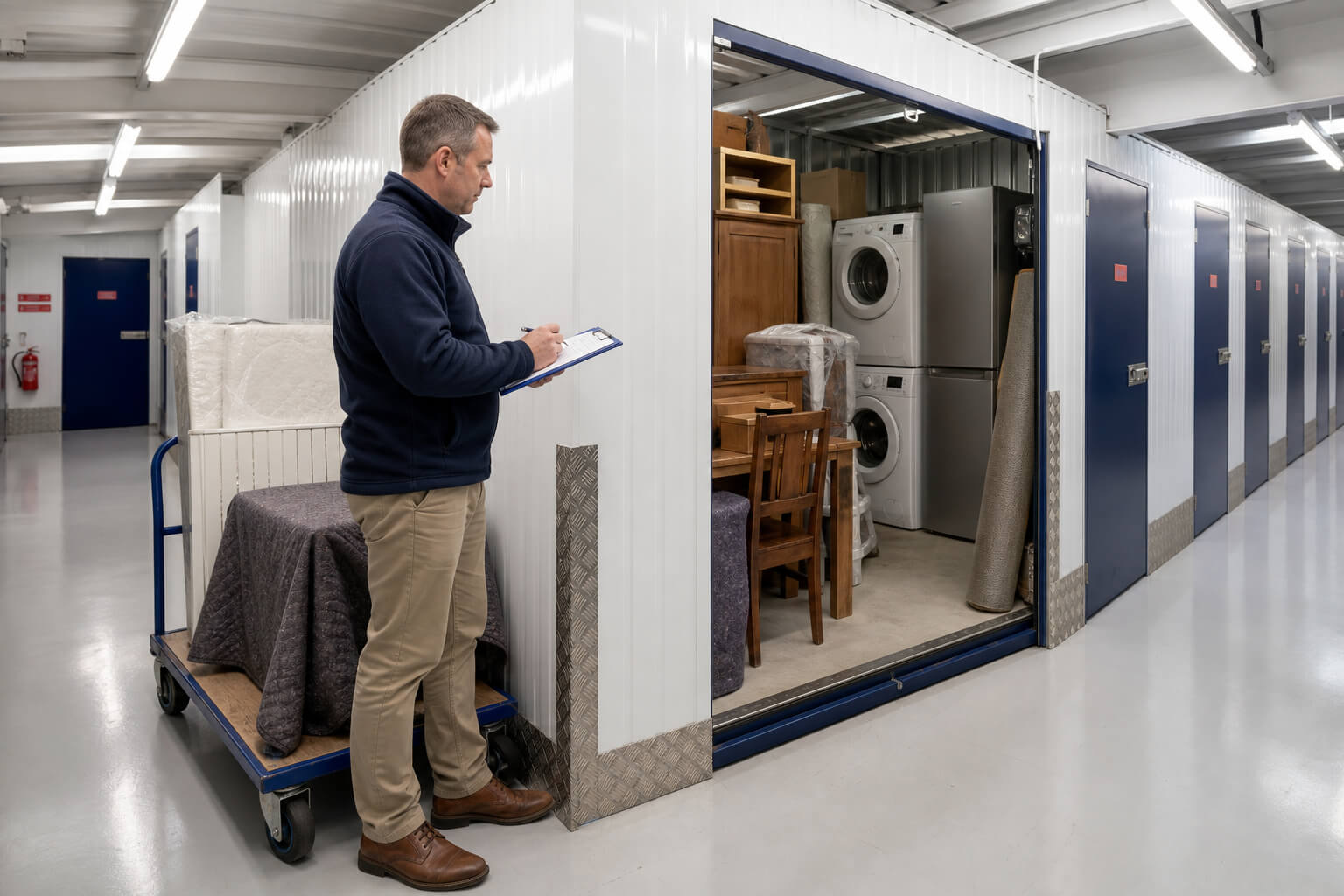
These are not on the obvious banned list, but in our experience running sites across the country, they are the ones that cause real difficulty on moving day. Most are easy to deal with if you know about them in advance.

The damp trap: dry everything before it goes in

The rule here is simple and the consequences of ignoring it are slow and nasty. Anything that goes into a unit damp will stay damp, and then become mouldier.

Think about the garden chest that has been sitting in the garage all winter. The set of garden chairs stored under a tarpaulin. The boxes you carried to the van in the rain and stacked straight in. The chest of drawers from the outbuilding that never quite dried out after last autumn. None of these items are banned outright. The problem is what they do inside an enclosed unit.

Our units are clean, dry and secure. That promise holds because every customer puts dry goods in. Moisture from one damp item creates condensation that spreads to wooden furniture, soft furnishings and cardboard boxes stored nearby. It does not stay in your unit. It finds a way to your neighbour’s things as well.

The solution is not complicated. Dry everything properly before it goes in. Leave garden furniture in the sun for a day. Air out a chest of drawers. Let anything that got wet in the move dry off before it goes into storage. It is worth the extra time.

Do not be tempted to assume a damp item will dry out once inside. There is no climate control in a self-storage unit. The protection comes from what you put in, not from what we regulate inside. Bring dry things, and they stay dry.

Batteries and fuel: the modern catch-out

This is the one that has become significantly more common in recent years. The petrol mower with a little fuel still in the tank and carburettor. The e-bike in the garden shed. The e-scooter bought during lockdown and barely used since. The lithium battery pack that is bolted into the frame and will not come out.

Petrol-powered equipment must be run completely dry before storage. That means the tank emptied and the carburettor run clear. A small residue of petrol is still petrol. This rule applies to lawnmowers, generators, chainsaws, pressure washers, anything with a combustion engine. Run it dry, then bring it in.

Lithium batteries present a different issue. A lithium battery that can be removed from the item should be removed and kept elsewhere. A lithium battery that is permanently fixed and cannot be removed makes the item itself a fire risk. If the battery cannot come out, the item cannot come in. This applies to e-bikes and e-scooters with non-removable battery packs.

The same logic applies to propane tanks, camping gas canisters and anything pressurised. Run the equipment dry, detach what can be detached, and if in doubt, ask before you load.

High-value items: cash, deeds, fine jewellery and where they really belong

A unit at one of our sites is individually alarmed, clean, dry and secure, and it is space only you can access. It is not a managed vault, and it is not a records archive. That honest distinction matters for certain categories of items.

Cash belongs in a bank. Title deeds and wills belong with your solicitor. Fine jewellery and items of serious monetary or sentimental value are better housed in a bank safety deposit box.

For items that do go into storage but carry real value, contents protection matters. Cover is mandatory at Wigwam: you can take our RSA Self Storage Customers’ Goods policy, or you can demonstrate equivalent cover of your own. Either way, declare the full replacement value. Under-insurance is settled proportionally, not in your favour. New-for-Old replacement means a genuine claim pays out at today’s replacement cost, not the original purchase price. Theft cover requires evidence of forced entry.

More detail on the policy, and what you need to declare, is on our contents protection page. We signpost it because it matters; we do not advise you on it because that is your insurer’s job.

Jurisdiction note: for legal documents such as title deeds, wills, or Powers of Attorney, storage requirements and access rights can differ under Scottish law and Northern Irish law compared to England and Wales. If you are storing legal documents and are based outside England and Wales, consult your solicitor. The guidance on this page reflects the position in England and Wales.

Why we do not store vehicles, caravans or tyres

Our units are for goods, not for vehicles. We do not store cars, caravans, motorhomes, boats, trailers, tyres or leisure transport. No exceptions, and this is not a conversation worth having in advance to see if we will make one.

If you are looking for vehicle or caravan storage, you need a different kind of operator. We are a market-town goods-storage business, and our units are sized and designed for that.

What you can store with confidence

The ban list is genuinely short. Here is the much longer, more reassuring half of the picture.

Household furniture and belongings between homes

Furniture, boxed household belongings, white goods that are clean and fully defrosted, bicycles (standard, pedal-powered), seasonal items, garden tools that are fuel-free, clothing and textiles, sporting equipment, musical instruments, books, pictures, mirrors and anything else from a home that does not fall into one of the four banned categories.

Smart entry runs from 6am to 10pm, seven days a week. If you pack the unit in a hurry and realise two weeks later you cannot find the box of things you needed, you can pop back on a Sunday morning to retrieve it. You are not locked to office hours.

Business stock, equipment and trade goods

Boxed stock, retail displays, non-petrol tools and equipment, office furniture and equipment, sample sets, seasonal overflow for an e-commerce business. A storage unit makes a practical short-term or long-term stockroom for a growing business.

One thing worth being clear about here: our sites are unmanned. Smart entry means you come and go without needing a member of staff present. If a courier is delivering to your unit, someone from your own business must be there to receive them. Wigwam does not sign for parcels, accept deliveries or hold items on your behalf. If a delivery arrives when no one from your business is there, it cannot come in. Plan your deliveries accordingly.

A future article will cover the business-storage and e-commerce angle in more detail. For now, if you are a sole trader with non-petrol tools and trade equipment, the unit works well.

Documents and records you need kept safe

Boxed paper records, archive files, business ledgers, family documents accumulated over decades. A self-storage unit is secure space that only you can access. It is not a managed records service: we do not catalogue, retrieve or manage the files inside. Access is yours; the organisation inside is yours.

For documents with legal status, title deeds, wills and court orders, see the guidance above in the high-value section and consult your solicitor if you are unsure about what applies in your jurisdiction.

How size and how long affect what you bring
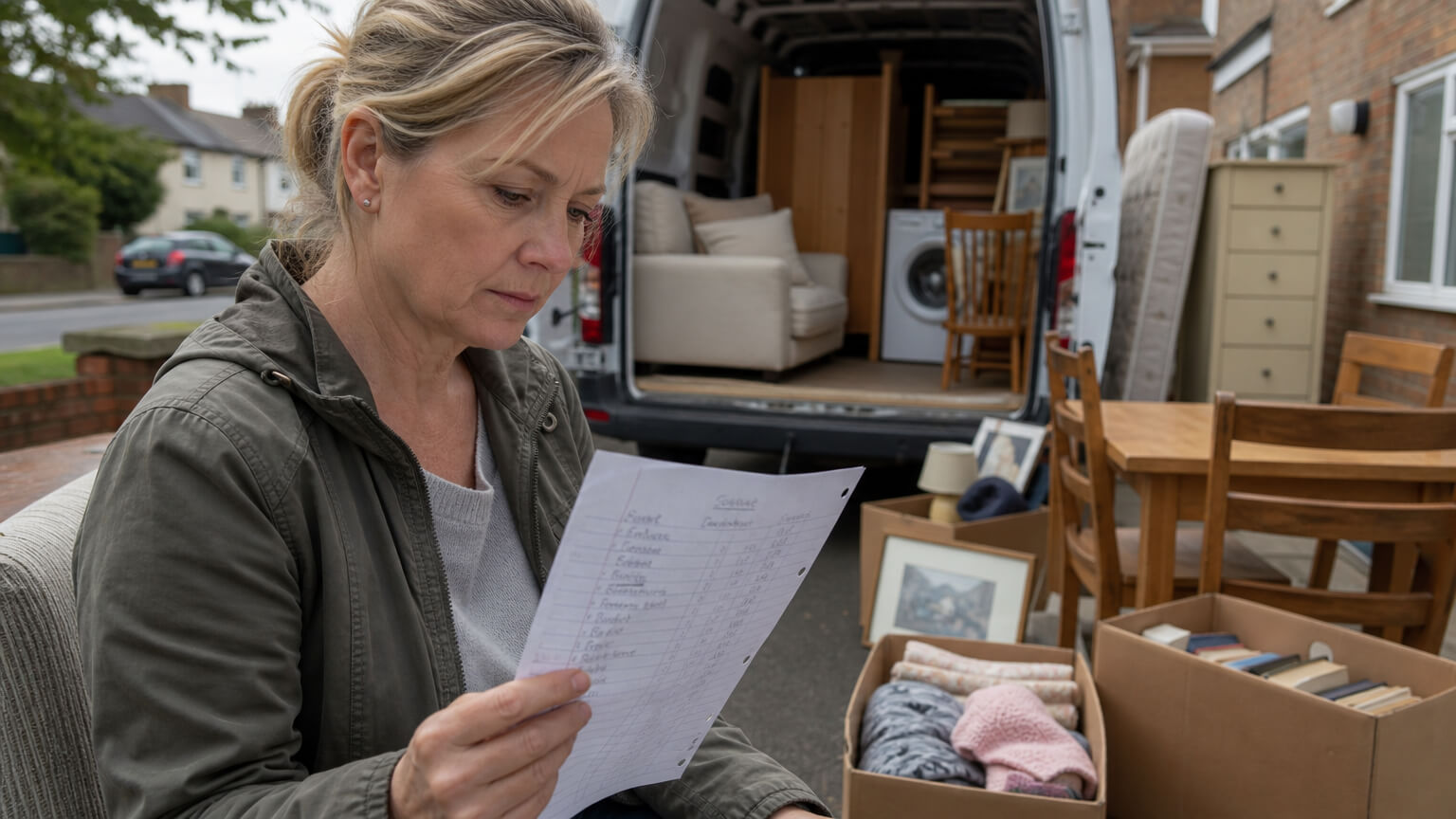
Knowing roughly what you plan to store makes choosing the right unit straightforward. Our pricing and unit-sizing guide walks through the options and helps you match the volume of what you have to the unit that suits it. There are no prices on this page; the guide covers that.

Two points worth knowing before you book. The minimum stay is two weeks, and if you leave before your time is up, unused days are refunded. That makes short awkward-period storage workable, the fortnight between keys where you have nowhere to put things, the month between a sale completing and a purchase going through.

Smart-entry access runs from 6am to 10pm, every day of the week. You are not relying on office hours or a site manager being available. If you want to add something to the unit on a Saturday evening or retrieve something early on a weekday morning, you can.

What to do if you are unsure about one item

If you have read through the sections above and you are still not sure whether one specific thing is allowed, ask before you load the van.

That is a genuine offer, not a formality. Tell us what the item is, and we will give you a straight answer. Not a policy document. Not a referral to the terms. An actual answer about your actual item, from a person at your local site.

Ready to check your items and get a price?
Head to quote.wigwamstorage.co.uk and add your question in the quote request. We will come back to you with a plain answer and a unit option that works. No commitment required to ask.

You can find your nearest site on our locations page. Our UK market-town locations include Wigwam Self Storage Bath in Somerset and Wigwam Self Storage Lincoln in Lincolnshire, among others across the country.

Keeping your goods covered: contents protection

A unit with an individual alarm is secure space. Contents protection adds the financial layer on top.

Cover is mandatory when you store with us. You can take the RSA Self Storage Customers’ Goods policy that we offer, or you can show us you have equivalent cover of your own in place. What matters is that the cover exists and that you have declared the full replacement value of what you are storing. Under-insurance is not corrected in your favour at claim time: if you declare half the value, you recover half of any loss.

The RSA policy runs on a New-for-Old basis and requires evidence of forced entry for a theft claim. Climatic damage is excluded.

For the detail of what the policy covers and what you need to do before you move in, visit our contents protection page. This is a signpost, not advice. Your insurer is the right person to advise you on whether your existing home or business policy extends to goods in storage and what its limits are.

Jurisdiction note: insurance requirements and cover rules for goods stored in self storage can differ between England and Wales, Scotland, and Northern Ireland. If you are storing in Scotland or Northern Ireland, or if you have a claim query, confirm the position with your insurer and, where legal documents are involved, with your solicitor.

The rules, the terms and where to read them

The four categories above align to standard UK self-storage practice as the Self Storage Association UK recognises it. Wigwam’s full terms and conditions set out the complete picture: your rights, our rights, and the specific prohibited-items list that applies to every one of our sites.

You can read them at wigwamstorage.co.uk/terms-conditions/.

On deposit: when you book, a deposit is taken. It is refundable. Once you have given your 14 days’ notice, vacated the unit, and settled the account, the deposit is returned to you, less anything owed. That is the full picture.

There is no fine print designed to catch you out. If you read the terms and you have a question about what something means, ask. That is what we are here for.

Ready to check your list against a real site?

You have seen what is allowed and what is not. If your things pass the test, the next step is finding the right unit and getting a price.

Get a quote and, if you have a question about a specific item, add it in: quote.wigwamstorage.co.uk. We will give you a plain answer and a unit option that suits what you have.

Find your nearest location at wigwamstorage.co.uk/self-storage-locations/. For unit sizes and what they cost, the guide is at wigwamstorage.co.uk/how-much-is-self-storage-in-the-uk.

Frequently Asked Questions

Can I store paint, weedkiller or a half-full gas bottle if I seal it really well?

No, and sealing it tighter does not make it allowed. Anything that can leak, ignite or give off fumes is banned regardless of how well you think you have contained it, because the risk is not really about your packaging. It is about what happens in a sealed unit over weeks and months, and what one container failing would do to a whole corridor of other people’s belongings.

The category is broad on purpose: paint and solvents, weedkiller and pesticides, petrol and diesel, LPG and camping gas, aerosols under pressure, fireworks. A seal that holds today can fail in heat or with age, and a slow leak in an enclosed space contaminates the air and the goods around it. A gas bottle, even one you believe is empty, can retain enough residual pressure to be a genuine hazard. None of this is us being awkward; it is the same rule you will find at every reputable operator, and it is the reason a clean, dry, secure unit stays that way.

So the practical answer is to deal with these items before the move rather than trying to store them. Use up the paint or take it to a household waste site that accepts it. Return or properly dispose of gas bottles through the supplier. Empty fuel from equipment. If you are genuinely unsure whether a specific product counts, describe it when you ask, and we will give you a straight yes or no before you load it rather than turn you away at the unit.

Where exactly is the line between “household goods” and “a vehicle” for things like a ride-on mower or a trailer?

The line is whether the thing is, in effect, a vehicle or leisure transport, and a couple of the awkward cases fall on the no side. We store household and business goods, not vehicles, and that exclusion covers cars, motorbikes, caravans, motorhomes, boats, trailers and tyres. A ride-on mower sits in the difficult middle, and the deciding factors are that it is engine-powered and that it carries fuel, both of which push it toward the prohibited side rather than the ordinary-goods side.

Here is the cleaner way to think about it. A push mower or a hand tool with no engine and no fuel is ordinary garden equipment and stores fine once it is clean and dry. A petrol mower has to be run completely dry of fuel before it could even be considered, because residual petrol falls under the hazardous-items rule, and a ride-on adds the question of whether it is really a small vehicle. A trailer is excluded outright as leisure or transport equipment, regardless of what you would tow it with. Tyres are out too, on their own, because of how they behave in storage.

If you are clearing a garage that contains a mix, the boxed tools, the shelving and the garden bits are welcome; the engine-driven, fuelled or wheeled-transport items are the ones to query or rule out. Rather than guess, list the borderline items when you request a quote and we will tell you which side of the line each one falls. It saves a wasted trip with something in the van that was never going to be allowed in.

Who is responsible if something I stored damages a neighbouring unit, like a leak or pest problem?

The responsibility sits with the person who stored the item that caused it, which is exactly why the rules on damp, food and hazardous goods exist. The units share an environment to a degree, so a problem that starts in one unit, mould from a damp chest, mice drawn to a forgotten bag of food, a leak from something that should never have been stored, does not always stay politely within its own walls. The rules are there to stop that happening, and following them is how you protect both your own goods and everyone else’s.

This is the practical reason behind advice that can otherwise sound fussy. Drying everything before it goes in is not about the unit being damp; it is about one wet item creating condensation that can travel. Keeping food out is not pedantry; it is because scent attracts pests that do not respect the boundary between units. The hazardous-items ban protects the whole corridor from one container failing. When everyone puts in dry, clean, permitted goods, the shared environment stays clean, dry and secure for all of it.

Contents protection is the financial backstop, and it is mandatory for that reason. Your own cover, whether the RSA policy we offer or your own proven cover, protects your goods. It is not a substitute for following the rules, though. The honest summary is: store what is permitted, in the condition the rules require, and you are very unlikely to be the cause of a neighbour’s problem or the victim of one. If you ever spot something amiss, a smell, a damp patch, signs of pests, tell us, so it can be dealt with before it spreads.

Can I store opened food or drink for a short stay, like a week or two?

No, and the short stay does not really change the answer. Opened or unsealed food, anything perishable, and household waste are out regardless of how long they will be in the unit, because the issue is scent and decay, and both can start working within days, not months. A week is plenty of time for a forgotten box of kitchen goods to attract attention you do not want.

The reasoning is the pest one. Mice and insects track the scent of food, and they do not distinguish between a fortnight and a year; they simply follow the smell to its source. Once they are in, they work through your belongings and can move to a neighbour’s before anyone notices. That is why this rule is firm even for a short overlap between homes. Sealed tins are not formally banned, but I would still keep them out, because pests can detect food even through intact packaging, and a few tins are not worth the risk to a whole unit of furniture.

If you are clearing a kitchen ahead of a move, the better routes are to use up what you can, donate unopened, in-date items to a food bank, and dispose of the rest properly before moving day. Pack the kettle, the mugs and the empty, clean kitchen equipment, all of which store perfectly well, and leave the actual food behind. If you are unsure about a specific item, a sealed bottle of oil, say, ask before you load and we will give you a plain answer.

If an item I want to store is borderline, who actually decides, and how fast can I get an answer?

You ask the support team and they give you a straight answer, usually quickly, before you ever load the van. The decision rests on the rules, the four banned categories plus the no-vehicles exclusion, applied to your specific item, and the team are there precisely to apply them to real cases rather than leave you guessing from a list. It is a genuine offer, not a formality: tell them what the item is and you get an actual answer about that actual item.

The fastest way to get that answer is to fold the question into your quote request. Head to the quote tool, describe the borderline item in plain terms, and the team comes back with a yes or no and, where it is a yes-with-conditions, what those conditions are. For example, a petrol tool can come in once it is run completely dry; a battery item is fine if the battery is removable and removed, but not if the pack is fixed in. You get the reasoning, not just the verdict, so you know how to prepare the item.

One boundary worth setting: the team decide on storage questions, not on anything outside their lane. They will tell you whether your item can be stored and how to prepare it. They will not advise you on insurance choices, legal documents or how to run a business; those get signposted to the right professional. For the question that matters here, “can I store this thing”, they are exactly the right people, and asking first is always cheaper than turning up with something that was never going to be allowed in.

Self Storage For Market Traders And Pop Up Retail

Will the unit be open when your market pitch starts at dawn?

The load is done by seven on a Friday evening. The van is packed: the gazebo, the trestle tables, the crates of stock, the signage and the bags of tissue wrap. Everything is in order. The one question left is whether the storage unit will be open when the market starts.

That is not a small question. A market pitch starts early. Set-up time is before most people have had breakfast. If the unit is not open, or if getting in requires a phone call or a key-holder, the whole morning falls apart.

This page gives you a straight answer to that question, and explains exactly what a Wigwam unit can do for a market trader or pop-up retailer, and what it cannot.

Storage built around your trading week

Wigwam units work with the rhythm of a market week, not against it. The Friday-night load, the Saturday-morning pull-out, the quiet spell in January: the way a unit is set up here is designed to fit around a trader’s schedule, not the other way round.

The Friday-night load and the Saturday-morning pull-out

You can access your unit from 6am to 10pm, seven days a week, by smart entry. No key-holder to call. No waiting for a member of staff. You are in the system; the unit is yours to open when you need it.

In practice, that means you can load the van on Thursday or Friday evening, drive straight home, and pull back in before 6:15am on a Saturday to pick up the last few boxes before you head to the pitch. It fits around a market schedule the way a lock-up does when it works, without the scarcity and the uncertainty that come with finding a good one.

The access window runs right through the trading week. If you run a Sunday car-boot alongside a Saturday market, you are not restricted to one early morning. Seven days means seven days.

Why a unit beats a lock-up or a long commercial lease

A commercial lease is written for a business that knows it will be in the same place for twelve months or more. A market trader testing a new pitch, or running a seasonal Christmas-market circuit, does not know that. The commitment is the wrong size, the cost is the wrong scale, and the exit is rarely clean.

A Wigwam unit starts from a two-week minimum. There is no twelve-month lease to sign, no long-form commercial agreement, no landlord who needs thirty days’ notice in a specific form. The deposit is refundable. When you give 14 days’ notice, vacate the unit and settle the account, the deposit comes back. That is a different financial proposition to a non-returnable premium on a long-lease lock-up.

Lock-ups, where they exist, are also scarce in most market towns. They tend to be in industrial estates a drive away from the pitch, and the availability is rarely predictable. A Wigwam unit is booked online and ready when you need it.

Testing a new pitch without overcommitting

A new pitch is always a risk. The footfall might be wrong. The mix of traders might not suit your product. December might be brilliant and January empty. The two-week minimum means you can take a seasonal run or try a new location without locking yourself into a contract that runs past the point where you know whether it is working.

If you clear the unit before the paid period ends, unused days are refunded. That matters in practice: if the Christmas-market run ends early, or the pitch does not work out, you are not paying for space you are not using. Full conditions are on the terms and conditions page.

Access hours: the honest answer

The market starts early. Here is exactly what the access hours are, stated plainly without dressing them up.

6am to 10pm by smart entry, seven days

Several storage providers in the UK market themselves on 24-hour access. Wigwam does not. The access window is 6am to 10pm by smart entry, seven days a week. If you need a unit you can open before 6am, that is worth knowing before you sign up.

For most market traders, 6am is not a limitation. It is an honest answer that actually lines up with how early a Saturday market allows set-up. If the market opens at 9am and you need to arrive at 7:30am to secure your pitch, unload and get the gazebo up, being in the unit at 6am gives you all the time you need.

The reason we say this plainly is not because 24-hour access is not possible anywhere. It is because a claim that does not hold up on the morning it matters is worse than a clear boundary that you can plan around. You know the window. Plan your week around it. It works.

How early access fits a market or car-boot start

Put it in practical terms. You are in the unit at 6am. The van is loaded by 6:20am. The unit is locked. You drive 40 minutes to the market. You are at your pitch before 7am with time to spare. The scenario works at the standard Wigwam window without needing a 24-hour service.

For a Sunday car-boot, the same calculation holds. Most car-boot sites open to sellers at 6am or later. Smart entry at 6am covers that. The 10pm close means you can return stock to the unit after a long Saturday session and be back out for Sunday with no additional steps.

Smart entry means you come and go with your own credentials. No queue. No waiting. No one to let you in or out.

What traders and pop-ups actually store with us

Stock, kit and seasonal lines. Here is what goes in a unit, and what does not.

Stock, packaging and seasonal lines

Boxed stock is the obvious one: whatever you sell, the unit becomes the place you hold the lines you are not carrying to the next market and the overflow from a busy order week. Alongside the stock itself, there is all the packaging: retail bags, tissue wrap, ribbon, bubble wrap, gift boxes and labels. These take up more space than most traders expect until they are not in the spare bedroom or the back seat of the car.

Seasonal lines work well in a unit. You can hold your Christmas stock from October and pull it down in batches as the season progresses, without filling your home with things that are not yet selling. After the season, the unit holds the leftovers until the next year.

Units at Wigwam are clean, dry and secure. That matters for stock: damp damages packaging before it damages the goods inside, and damp-damaged packaging is a sale lost. What Wigwam units do not have is climate control. There is no temperature or humidity management system. If you are storing goods that are sensitive to atmospheric or climatic change, a Wigwam unit is not the right solution and climatic damage is not covered under the contents-protection policy.

Gazebos, trestle tables, rails and signage

The physical kit of a market stall is bulky and awkward. A gazebo in its bag takes up the boot of a car or the back corner of a van and leaves it unusable for the rest of the week. Trestle tables stack, but you still need somewhere to stack them. Display rails take up floor space. Signage is usually too large to store flat in a domestic property without risking damage.

A single unit handles all of it. The gazebo goes along one wall. The tables stack against the back. The rails stand in a corner. The signage lies flat on top of the tables or leans against the wall. When Friday evening comes and the van is ready, everything is in one place and already organised for the next morning’s pull-out.

What cannot go in

Vehicles of any kind cannot be stored in a Wigwam unit. That includes vans, trailers, cars and any leisure vehicles. If you use a transit or a horse-box trailer for your pitch, the vehicle parks elsewhere; what goes in the unit is the goods it carries.

Goods that require climate or temperature control are not suited to a Wigwam unit, and climatic damage is excluded from the contents-protection policy. Hazardous materials and other prohibited items are listed on the terms and conditions page.

The right size for your stall and stock

A rough guide to unit size, from a few boxes to a full-van load. No prices on this page: for current pricing, the Wigwam pricing page gives you the numbers.

A guide from a few boxes to a full van load

If you are storing a small number of product lines, a few boxes, a fold-up table and some display materials, a small unit is usually enough. It gives you a place to keep the overflow and the packaging without the square footage of a larger space you are paying for but not filling.

If you are adding a gazebo, a full set of trestle tables, display rails and a couple of trolley-loads of boxed stock, you are looking at a medium unit. That is roughly the contents of a standard transit van: the van holds it to drive to the pitch, and the unit holds the same volume when the van is back home.

A larger operation, running several product categories, holding seasonal stock year-round, or serving both a physical market circuit and an online business from the same unit, will need a larger unit. If you are planning a Christmas-market season with a significant stock build, it is worth thinking ahead: a unit that fits a September stock level may be too small by the first week of December.

A Wigwam team member can talk through what size suits your setup. A unit size guide is also available if you want to work it out before you call.

Stacking and shelving your own unit

You control the layout. No one from Wigwam moves, sorts or reorganises what is in your unit. That is a feature, not a gap: you know your stock, you know which lines move fastest, and you can set up the unit to match the pull-out sequence for a Saturday morning.

Bring your own shelving if it helps. Most traders with a regular unit put heavy items on the floor, lighter packaging on shelves at mid-height, and fast-moving lines closest to the door. A clear pull-out path from the unit door to the van makes a 6am start considerably less stressful. The unit is yours to organise exactly as you need it.

Running stock through a unit, and where the line is

You access your own goods, on your schedule. Here is what that means in practice, and where the boundary is.

You are in control of your unit

You open the unit when you need it. You load what you need. You lock it again when you are done. Wigwam staff are not on site to manage goods, sort orders, or hand anything over. That is not a limitation: most traders prefer it that way. The stock is yours, the unit is yours, and the schedule is yours to set.

If you sell online alongside your market trading, you can use the unit as a stock-holding point you access yourself. You can pick lines from the unit at a time that suits your dispatch schedule. What Wigwam is not is a managed fulfilment or pick-and-pack service. There is no one on site to select items, pack them, print labels or hand parcels to a courier. It is a secure, individually alarmed unit you access on your own terms.

Deliveries and couriers: the unmanned-site rule

Wigwam sites are unmanned. That means there is no member of staff present during access hours to take deliveries, sign for parcels or receive goods on your behalf.

If you want a supplier or courier to deliver stock to your unit, someone from your own business must be there to receive it. You cannot arrange for a courier to deliver to the site when you are not present and expect the goods to be received. They will not be. The site is secure, the unit is locked, and no one from Wigwam is there to accept anything.

This is worth knowing in advance. If your restocking depends on regular courier deliveries, plan those deliveries for times when you or a colleague can be at the unit to meet the driver.

What it costs and the minimum stay

No prices on this page. The minimum commitment is short, the deposit comes back, and the full pricing is one click away.

Two-week minimum and a refundable deposit

The minimum stay is two weeks. You are not signing a six-month agreement or a twelve-month lease. Two weeks is the floor, and from there the arrangement runs flexibly.

A deposit is taken when you start. It is refundable. When you give 14 days’ notice, vacate the unit and settle the account, less anything owed, the deposit is returned. This is not a premium that disappears on signing. It is a deposit in the ordinary sense: held while you are a customer and returned when the account is clear.

For a trader who is testing a new pitch, running a seasonal circuit or operating in quiet months, this is a different kind of financial exposure to a long-lease lock-up. The cash comes back. The two-week minimum means the commitment is short enough to take without certainty about how long you will need the unit.

Refund of unused days if you clear early

If you clear the unit before the end of a paid period, unused days are refunded. A quiet January that ends sooner than you expected, a season that closes early, a pitch that did not work out: you are not paying for days you are not using the space for.

The pricing page has the current figures and the calculator to work out what a unit costs for your setup. It is worth doing that before you call, so you have the size and the time period clear in your mind.

Ready to check what is available near you? Get a quote at quote.wigwamstorage.co.uk

Keeping stock clean, dry and secure

The unit is individually alarmed and the site is secure. Here is what that covers, and what to have in place for your contents.

Individually alarmed units and smart entry

Each unit has its own alarm. The site is secure. Smart entry means the access system tracks who comes and goes, which adds a further layer of security beyond a padlocked door.

Units are clean, dry and secure. That is the Wigwam commitment on the condition of the space. There is no climate control. Temperature and humidity are not managed. If your stock requires a controlled environment, a Wigwam unit is not the right fit, and goods that suffer climatic damage are not covered under the contents-protection policy.

For most market-trader stock, including clothing, homeware, gifts, craft goods, seasonal lines and packaged food items that do not require refrigeration, a clean, dry and secure unit is the right environment.

Insuring your stock

Contents protection is mandatory. You have two options: take Wigwam’s RSA “Self Storage Customers’ Goods” policy, or prove your own cover is in place.

Wigwam’s policy is New-for-Old cover arranged through RSA. If you take it, declare the full replacement value of everything in the unit. If you declare less than the full value and need to make a claim, the payout is reduced in proportion. Under-insurance is not covered in full.

Theft claims require evidence of forced entry. Climatic damage is excluded. Do not take these as the full terms: the contents-protection page sets out what is and is not covered.

If you have your own business-insurance policy that covers goods in storage, check the policy wording carefully and be ready to provide proof to Wigwam. Not all commercial insurance policies extend to off-site storage.

Insurance law and consumer-protection rights differ in Scotland and Northern Ireland. If you are based in either jurisdiction, confirm your position with your insurer or a solicitor.

Storage in your market town

Wigwam is based in the UK market towns where traders trade. The locations are not on retail parks or out-of-town industrial estates chosen for volume. They are in the towns themselves.

Find your nearest Wigwam location

Wigwam Self Storage Bath in Somerset and Wigwam Self Storage Lincoln in Lincolnshire are two of our UK market-town locations. We also have units in Reading, Cheltenham, Burton upon Trent, Dorking, Bromsgrove, Tewkesbury, Warminster, Leatherhead and Marlow, among others. The full list is on the locations page.

If you run a circuit of markets across several towns, it is worth knowing which Wigwam locations sit closest to each pitch. A unit in the same town as the Saturday market means a shorter drive on Friday night and on Saturday morning.

What to bring and what to expect on your first visit

When you start with Wigwam, bring your payment details and your contents-protection documents. If you are using Wigwam’s RSA policy, that will be arranged as part of the sign-up. If you are proving your own cover, have the policy details or insurer confirmation ready.

Smart entry means you use your own access credentials at the site. There is no key to collect from a member of staff and no code to request. The system is set up when you start and from that point you come and go on your own schedule.

The site is unmanned. That is exactly what most traders want: a secure unit they can access without coordinating with anyone. It is also what it means in practice for deliveries, as described above. Come when you need to, load or unload, lock up and leave. That is the experience, straightforwardly.

Get a quote

If your stock needs a home near the market, we will show you what is available in your town. The quote covers the unit size, the location and the current pricing, with no obligation.

Get a quote at quote.wigwamstorage.co.uk

Frequently Asked Questions

Can I use my Wigwam unit as a business address or have business rates apply to it?

No on the business address, and business rates are not something you arrange or pay through us. The unit is for storing your stock and kit and for your own access to it. It is not a registered office, a trading address, or a place you can list as your business location for Companies House, HMRC or your customers. If you need a registered or correspondence address, that is a separate service from a different kind of provider.

On rates: a self-storage unit is part of a storage facility, and the way it is rated sits with the operator and the wider site, not with you as a customer renting space inside it. You are paying a storage charge for the unit, not taking on a commercial tenancy with its own rateable value. If you are trying to work out the rates position for your business as a whole, that is a question for your accountant or your local authority, not for the Wigwam support team, who handle storage matters only: sizing, availability, access, pricing, invoicing and booking.

What you can do with the unit is straightforward and useful: hold your stock and packaging there, run your dispatch around your own access from 6am to 10pm, and keep your home clear of the trade. What you cannot do is treat it as the legal or trading address of the business. Keep those two things separate and the arrangement is clean. For the booking and cost side, the pricing page and a quote will give you the figures.

What happens to my stock in the unit overnight and on the days I am not trading?

It stays exactly where you left it, in an individually alarmed unit on a secure site, untouched by anyone. That is the quiet value of a unit for a trader: on the days between pitches, your stock is off your floor, out of your van, and in a space you do not have to think about. Each unit has its own alarm, separate from every other unit, and smart entry means the access system tracks who comes and goes, so there is a record of entry rather than an open door.

Nobody from Wigwam goes into your unit. Staff do not handle, move, count or reorganise your goods. The site is unmanned, which means there is no one wandering the corridors and no one with a master key to your space. Your stock is yours alone to access, and only you and anyone you have given your access to can get in.

Two honest points worth holding in mind. First, the unit is clean, dry and secure, but it has no climate control, so anything genuinely sensitive to temperature or humidity is not suited to it and climatic damage is excluded from the contents-protection policy. For ordinary market stock, clothing, homeware, gifts, crafts, packaged non-perishable goods, dry and secure is the right environment. Second, security cover is why contents protection is mandatory: you either take Wigwam’s RSA policy or prove your own, and theft claims require evidence of forced entry. Declare the full replacement value of the stock you hold, because under-insurance is settled in proportion.

Can I share a unit with another trader to split the cost?

You can, in the sense that the unit is your space to use as you see fit, but it brings practical and insurance complications that most traders are better off avoiding. The account, the access and the contents protection all sit with the named customer. If you let another trader keep their stock in your unit, their goods are in a space booked in your name, accessed on your credentials, and that tangles up two things that are cleaner kept separate.

The insurance point is the one to take seriously. Contents protection is mandatory and is arranged against the declared replacement value of the goods in the unit. If a second trader’s stock is in there and something happens, whose declaration covers it, and who claims? Mixing two businesses’ stock under one declaration is the kind of arrangement that causes disputes at exactly the wrong moment. The honest answer is that a shared unit is rarely worth the saving once you think it through.

If two of you genuinely want to split storage to save money, the cleaner route is usually two smaller units, each in its own name, each with its own access and its own cover. You still get sites in the same market town, the same short two-week minimum, and the same refundable deposit on each. Get a quote for the sizes you each need at quote.wigwamstorage.co.uk and compare that against one shared space before you decide. For most traders, keeping the businesses separate is worth a little more on the monthly cost.

My stock outgrows the unit at Christmas and shrinks in January. Can I change unit size through the year?

Yes, and this is one of the things the terms are built for. A seasonal trader’s footprint is not constant: you build stock through the autumn for a December peak, then shed it in the quiet new year. Rather than paying year-round for the space you only need in December, you can size up when the season demands it and size back down when it passes, subject to what is available at your nearest location at the time.

The mechanics are simple. Moving to a different unit is a matter of taking the new size and clearing the old one. The two-week minimum applies, and the refundable deposit and 14-day notice work per unit, so when you leave the larger unit you give notice, vacate, and the deposit comes back once the account is settled, with unused days refunded if you leave a paid period early. There is no long lease tying you to a peak-season footprint through a dead January.

The practical tip is to plan the build ahead. A unit that comfortably holds your September stock level can be tight by the first week of December once the seasonal lines land, so it is worth thinking about your peak when you choose the size, or booking the step-up before the stock arrives rather than after it is sitting in your hallway. Availability does vary by site and by season, so check early. A quick quote at quote.wigwamstorage.co.uk shows what sizes are free at your location, and the local team can talk through the timing if you tell them roughly when your peak falls.

If my packaging or stock gets damp-damaged in the unit, am I covered?

It depends entirely on the cause, and this is worth understanding before you store anything that matters. Wigwam units are clean, dry and secure, which for ordinary market stock is the right environment and means damp should not be an issue in normal use. But the contents-protection policy excludes atmospheric and climatic damage, so damage caused by humidity or condensation rather than by an insured event is not something you can claim for.

That makes the practical prevention more important than the cover. A few things keep stock and packaging in good condition:

  • Bring stock in dry, and do not pack damp boxes or fabric into the unit.
  • Keep boxes off the floor on a pallet or shelving rather than directly on the slab.
  • Do not overpack so tightly that air cannot move around the stacks.
  • Store anything genuinely sensitive to temperature or humidity elsewhere, because the unit has no climate control and is not the right home for it.

For the things a trader most worries about, water ingress, theft, the policy works on the usual terms: theft claims require evidence of forced entry, and you must have declared the full replacement value, because under-insurance is settled in proportion. If you are holding high-value stock, read the cover properly at the contents-protection page, and if your own business policy already extends to goods in storage, check the wording and be ready to prove it rather than assuming it carries over. This is a signpost to the policy, not insurance advice; for anything specific to your stock, speak to your insurer.

Moving House With Children Using Self Storage For What You Cant Sort Mid Move

Moving with children and no time to sort what goes where?

It is the week before completion. Three rooms are still unpacked. One child thinks the move means leaving the cat behind; another is upset because you put their Lego in a box labelled “misc.” The removal firm is booked for eight o’clock Thursday morning, and somewhere between now and then you are supposed to have decided what to do with the spare-room furniture, the boxed keepsakes from your parents’ house, and approximately six bags of children’s clothing that might fit next year or might not.

Nobody tells you that a family move is not a single event with a clean end. It is a sequence of decisions, most of which are impossible to make in the middle of the chaos. The things you cannot sort right now are not a failure. They are just things that need somewhere calm to wait while you do the most important job first: get the children settled into the new house.

That is what this page is for. Not a list of box sizes. Not a monthly price comparison. Just a plain answer to the question parents actually ask mid-move: can I store what I cannot sort, and how does that actually work?

Three things to know before you read on:

Why a family move never sorts itself neatly

Family moves do not end on moving day. The sorting, the deciding, the things the children are not ready to lose: these take longer than the removal van, longer than the keys, longer than anyone plans for.

The “decide later” pile and why it always grows

The pile starts small. A few things from the spare room that you are not sure about. Your mother’s writing desk. The bunk beds your youngest has outgrown but your eldest is not ready to part with yet.

Then life keeps moving while the move is still underway. Work deadlines do not pause for packing. The children still need feeding, bathing, reassuring. And every time you open the spare-room door, you close it again because deciding what to do with its contents is a whole afternoon you do not have.

This is not disorganisation. It is just the reality of moving a family. The pile grows because the decisions inside it are real ones, and real decisions take time. The point of a storage unit is not to put your failures in it. It is to give the pile somewhere safe to sit while you buy yourself the time to think.

When the chain slips or completion moves

Even the best-planned moves face delays. A buyer’s survey comes back with a query. A solicitor needs another week. The completion date shifts by a fortnight and suddenly your removal slot no longer fits.

When that happens, a storage unit converts a crisis into a buffer. Instead of negotiating desperately with the removal firm or leaving everything in the van, you can move what you have packed to a local unit and pick up the rest when the chain is ready. Selina and the teams at our local sites are used to this. They have helped families time their start date around exactly these kinds of slips, more times than they can count.

If you are moving in England or Wales, the conveyancing chain works differently from Scotland and Northern Ireland. If you are moving to or from either, speak to your solicitor about how timings may vary.

How storage takes the pressure off

Store the overflow now. Move the children into the new house first. Come back for the rest when you are ready. That is the sequence, and it works because it turns moving day into one job instead of three.

Move in first, sort after

The job on moving day is getting the children into the new house with what they need: their beds, their school bags, the things that make the new place feel like home by bedtime. Everything else is secondary.

A storage unit near your old address or your new one means the secondary pile does not have to be resolved on the same day. The unit holds what cannot be decided. The house holds what the children need tonight. That sequencing is the whole point. You are not avoiding the decisions; you are giving them the right conditions.

The first-night box, and the boxes that can wait in storage

There is a practical habit that experienced movers swear by: pack a first-night box for every person in the house and keep it out of the removal van entirely.

For the children, that means their bedding, their current favourite toy or comfort item, their pyjamas, their school uniform for Monday. For adults: kettle, mugs, tea, phone chargers, medications, a change of clothes, the broadband router. Anything that would mean a crisis if it ended up buried under a mattress in a van.

Everything that does not make that list is a candidate for the storage unit. The children’s things they are not ready to sort. The kitchen boxes that can wait until the new kitchen is actually ready. The spare-room furniture that has no obvious home yet. These are not clutter. They are the second wave, and they can arrive when the dust has settled.

What to put in storage, and what to keep with you

A simple rule: if you do not need it in the first two weeks of the new house, it can go in the unit. Apply that filter to every room and the decisions get much easier.

Furniture and the spare-room overflow

Spare-room furniture is almost always a candidate. The double bed that was a guest bed but no longer has a room. The chest of drawers that might go into a child’s room eventually, once you have worked out whose room is whose. The seasonal items, the third sofa, the garden furniture that does not fit the new garden.

These are not problems. They are things that have not found their moment yet. A unit holds them cleanly and gives you the room to make the decision properly, without half a removal van parked outside.

Keepsakes and the things the children are not ready to lose

This is where the emotional weight of a family move tends to sit. The things that belong to your parents. The children’s artwork from infant school. The outgrown baby equipment that you are not quite ready to part with. The boxes labelled in your own handwriting from the last move, still sealed.

These are not clutter to be thrown away in the chaos. They are your family’s continuity. They deserve care, not a bin bag in a hurry.

Each Wigwam unit is clean, dry and individually alarmed. These things are not abandoned in storage. They are looked after while you get the house straight. The honest description of our units is exactly that: clean, dry and secure. We do not offer climate-controlled storage, and we will not pretend otherwise. For most household keepsakes stored over the course of a move, clean, dry and secure is what matters.

What we cannot store

Wigwam stores household goods. We do not offer storage for vehicles, caravans, motorhomes or boats. There are no climate-controlled units. If you are unsure whether something qualifies, the straightforward answer is: if it lives in your house, it almost certainly does.

How much space and how long you will need it

Most families moving from a two or three-bedroom house need less space than they expect. And they usually need it for less time than they fear.

Rough sizing by property

A rough guide: a one-bedroom flat overflow might need a small unit of around 25 to 50 square feet. A two or three-bedroom house partial move often needs somewhere between 50 and 100 square feet, depending on how much furniture is involved. A four-bedroom house with a full spare-room overflow can run higher.

These are starting points, not quotations. Our pricing page gives you a clearer picture of costs by unit size. When you request a quote, we can help you work out what you actually need. Property size is a reasonable proxy to start with; we will refine it from there.

Two-week minimum, and unused days refunded if you finish early

The minimum stay is two weeks. That is it. There is no pressure to commit to months of billing when you only need a fortnight’s buffer.

If you finish earlier than expected and give 14 days’ notice, unused days are refunded. The deposit is refundable too: it comes back to you once you have vacated the unit and the account is settled, less anything owed. These are the terms as they stand, and they are there in full on our terms and conditions page.

This matters because the national storage chains tend to bill monthly, whether you use the month or not. The two-week minimum and refund of unused days are the honest alternative for a family who might finish the move faster than they expected.

Ready to get a quote? Tell us your town and roughly how much you need to store. We will come back with a number.
quote.wigwamstorage.co.uk

How it works at your local Wigwam

There are no complicated sign-ups. You book a unit, you access it on your own timetable, and the terms are written in plain English. Here is what to expect.

Smart entry, 6am to 10pm, seven days

Access is by smart entry, seven days a week, from 6am to 10pm. Our sites are unmanned: you use your own secure access to reach your own unit. Nobody is waiting to let you in, and nobody is waiting to lock up after you.

If you are using a removals firm, or a friend with a van, they can drive to the site and help you move things in. But someone from your side needs to be present. Wigwam does not sign for deliveries, and we do not accept goods on your behalf. Plan for a person from your household or team to be there when goods arrive.

Access runs until 10pm, not midnight, not around the clock. If you need an early-morning start on moving day, 6am is available. But please do not plan around 24-hour access; it is not available.

Refundable deposit and 14-day notice, in plain terms

When you book, a deposit is taken. It is refundable: once you give 14 days’ notice, vacate the unit and settle the account, the deposit is returned to you less anything outstanding.


The 14-day notice period and the deposit refund are separate things. The notice is what you give to end your contract. The deposit is what comes back when everything is clear. Both are covered in full on our terms and conditions page.

Individually alarmed units, clean, dry and secure

Each unit at every Wigwam site has its own individual alarm. The site itself is clean, dry and secure. These are the conditions your furniture, your keepsakes and your children’s things will be kept in. We describe them exactly as they are. No temperature-controlled marketing, no humidity claims. Clean. Dry. Secure. That is the honest promise.

Contents cover

Contents cover is mandatory at Wigwam. You can take our RSA Self Storage Customers’ Goods policy, or you can provide evidence of your own sufficient cover.

If you take the Wigwam policy, it is important to declare your goods at full replacement value. If you under-declare, any claim is settled in proportion to what you declared. For your keepsakes, your furniture and your children’s things, declare the full cost of replacing them as new.

If you are relying on a home-contents policy, check with your insurer that it extends to goods in commercial storage. Not all do.

We will not advise you on which option to choose: that is for you and your insurer to work through. What we will do is make sure you have access to the right information. Full details are on our contents protection page.

Packing for a family move when not everything is going at once

Pack in two rounds, not one. The first round is everything going directly into the new house. The second round is everything going into the unit. If you try to pack both at once, you will spend three days repacking boxes that went into the wrong van.

Labelling for a two-destination move

A simple system works better than a complex one. Use two colours of label, or two consistent written tags: one for “new house” and one for “Wigwam unit.” Apply the label to the top and one side of each box, so it is visible however the box is stacked.

Room labels matter too. “Kids’ room, Wigwam” tells the removal team exactly where a box is going even before it leaves the old house. Keep the labelling brief and consistent. The chaos of moving day is not the moment to introduce a colour-coded spreadsheet.

What goes in last, and comes out first

The children’s rooms are usually the hardest to pack. Not because there is more there, but because the decisions are the most loaded. What goes with them on day one, what waits in the unit, what they are ready to say goodbye to: these are questions that cannot always be answered quickly, and certainly not in the last week before completion.

Give yourself permission to put the undecided children’s things in the unit. They are not lost. They are nearby, accessible from 6am, and you can go through them properly once the new house has its own rhythm. The unit is the pause button. The new house is where the children land first.

Find your nearest Wigwam

Wigwam has market-town locations across the UK. Find the one nearest to your new or old address, and you can use that site for as long as the move takes.

Our UK market-town locations

We are in market towns across England. Wigwam Self Storage Bath in Somerset and Wigwam Self Storage Lincoln in Lincolnshire are two of our verified locations. For the full list of our UK market-town locations, the locations hub is the right place to start. Search by town or postcode and it will show you what is nearest.

We do not operate in every town, but our market-town network is designed to put local, accessible storage within reach of the kinds of communities where family moves actually happen.

If your move is between two of our towns

Some families find they need storage at both ends: one unit near the old house while they clear it, and another near the new house while they settle in. Both sites can be used independently, with their own contracts, their own access and their own terms. The locations hub will show you what is available at each end of your move.

Get a quote for your family move

You do not need to have everything figured out. Tell us your town and roughly what you need to store. We will come back with a quote. That is genuinely all it takes to get started.

What to have ready when you request a quote

Three things are enough: the town where you need storage, a rough sense of how much you need to store (property size works as a starting point), and when you need to begin. You do not need to have sorted the boxes, labelled every item or made every decision. The quote is the first step, not the last.

Pricing and terms

Costs depend on unit size and location. Our pricing page gives you the full picture without the need to speak to anyone first. The terms and conditions page covers the deposit, the notice period, and everything else in plain language.

The short version: two-week minimum, refundable deposit, unused days refunded if you leave early. No hidden traps. No months-long commitments if you do not need them.

Ready when you are. Tell us your town and we will sort the rest.
quote.wigwamstorage.co.uk

Frequently Asked Questions

Can my children come into the storage unit with me?

Yes, your children can come into the unit with you, as long as you keep them close and supervised at all times. The sites are unmanned, which means there is no staff member on hand and no separate play area or waiting room. You let yourself in by smart entry and access your own unit directly, so anyone with you, including children, is your responsibility throughout the visit.

A few practical notes for a family visit. Storage corridors can have trolleys, other customers moving heavy items, and roller doors that are not toddler-friendly, so it is sensible to hold little ones close rather than let them roam. If you are doing a proper load-in or sorting session, it is often calmer to bring another adult so one of you can keep an eye on the children while the other shifts boxes. For older children, the unit can actually be useful, letting them help carry their own things and see that their belongings are safe and nearby rather than gone, which is reassuring during a move.

Access runs from 6am to 10pm, seven days a week, so you can pick a time that suits the family rhythm, an early start before nursery, or a calmer evening visit. There is no need to book a slot. Just bear in mind that because the site is self-access and unmanned, supervision is entirely down to you, and a working site is not a playground. Plan the visit around that and bringing the children along is perfectly fine.

How do I explain storage to a child who thinks we’re getting rid of their things?

Tell them plainly that their things are not gone, they are being kept safe nearby, and where possible, show them. The fear under “are we throwing my things away” is usually about losing something that matters and not being consulted. The fix is honesty and a little involvement. Explain that the unit is a room with a door that only your family opens, that their things are clean, dry and safe inside, and that you can go and get them whenever you need to.

Concrete reassurance works better than words alone. Let the child choose which of their things go in the first-night box and which can wait in the unit. Label a box with their name in their own handwriting. If they are old enough and it suits the day, take them along on a visit so they can see their things sitting safely in the unit rather than imagining them gone. Because the unit is close to home and access runs 6am to 10pm, that visit is easy to arrange.

It also helps to give a rough timeline a child can hold onto: “your bunk bed is in the unit for a few weeks while we sort your new room, then we will bring it through.” That turns storage from a loss into a plan with their things at the end of it. The emotional weight of a family move often sits exactly here, in the children’s sense of control. Involving them in what stays close and what waits nearby is usually enough to turn the worry into cooperation.

What if we finish the move faster than two weeks? Do we still pay the full two weeks?

Yes, the two-week minimum is the floor you commit to, but if you finish faster you are not penalised beyond that, because unused days beyond the period you use are refunded. The minimum stay means you are booking at least a fortnight. For a family move that is usually a comfortable fit anyway, since settling children into a new home and sorting the overflow rarely wraps up in a few days. But moves do sometimes resolve quickly, and the terms are built so a fast finish does not cost you.

Here is how it fits together, because two separate things often get confused:

TermWhat it means
Two-week minimumThe shortest period you can book; you commit to at least this.
14-day noticeWhat you give when you decide to leave, to close the account.
Unused days refundedOnce you have vacated and the account is settled, days paid but not used come back.
Refundable depositReturned after you vacate and settle, less anything owed.

The key point for a family worried about over-committing: the minimum does not compound with the notice. They are not stacked on top of each other into a long lock-in. You book your fortnight, give your notice when ready, clear the unit, and what you did not use is refunded. Full detail is on the terms and conditions page. For a move that might finish ahead of schedule, this is the honest alternative to a national chain billing you a full month regardless.

Should I use one unit near the old house or one near the new one?

Pick the end of the move where you will be doing the most lifting and visiting, which for most families is the new house. The job on moving day is getting the children settled into the new home, and the overflow you store is usually what could not go in yet, things you will bring through over the following weeks as rooms get sorted. If that is the pattern, a unit near the new house means short, easy trips to fetch the next thing rather than a drive back to the old town every time.

There are sensible exceptions. If you are clearing the old house gradually, perhaps it is being prepared for sale, or completion on the new place is delayed, a unit near the old address can make more sense while that end is the active one. And some families genuinely need both: one unit near the old house while they clear it, another near the new one while they settle. Both sites run as independent contracts with their own access and terms, so that is entirely workable.

Because the sites are in market towns rather than ring-road industrial estates, a local unit is usually a genuinely short hop from home, which is what makes the “store the overflow, fetch it as you go” approach practical. Use the locations hub to see what is nearest each end of your move, then choose the site closest to where the day-to-day sorting will actually happen. For most families, that is the new home.

How do I keep track of what’s in storage versus what came to the new house?

Use a simple two-destination labelling system and a written list, and you will avoid the most common mid-move headache: not knowing where something is. During a family move things get split across two places, the new house and the unit, and the boxes that vanish are always the ones nobody labelled clearly. A little structure at packing time saves hours of searching later.

The method that works under moving-day pressure is deliberately basic:

  • Two clear destinations only: “new house” or “Wigwam unit.” Mark every box with one or the other.
  • Add the room and, for children’s things, the child’s name: “Ellie’s room, Wigwam unit.”
  • Put the label on the top and one side of each box so it is readable however boxes end up stacked.
  • Keep one master list, even just notes on your phone, of roughly what is in the unit so you know what to come back for.

Because the unit is local and access runs 6am to 10pm, seven days a week, retrieving something you find you need is a quick errand, not a crisis, but only if you know it is in the unit and roughly where. The children’s things especially benefit from this: when a child asks where a particular toy or item is, being able to say “it is safe in the unit, we will fetch it this weekend” turns a potential upset into a plan. Keep the system simple and consistent, resist the urge to over-engineer it on the day, and the split between house and unit stays manageable from start to finish.

Self Storage For Garden Furniture When And How To Pack It Away For Winter

Is it time the garden furniture came in before the weather turns?

There is a moment every autumn when you look at the patio table and chairs and realise the season is done. The garden has given you everything it is going to give this year. The cushions have had their last airing. And now the question is what to do with it all before the weather turns.

Most people leave it a little too late. October arrives, the first proper wet weekend comes, and suddenly there is a scramble for covers, old towels and places to stack chair legs. It does not have to be like that. If you think about it now, while a dry weekend in late September is still possible, the whole thing becomes a twenty-minute job rather than a damp, rushed one.

This is an honest guide. It covers the timing, the prep by material, the difference between covering and properly storing, and what to do when the garage is already full. That last part is the bit most guides skip. We will not.

When to Pack It Away

The honest answer is: before the first proper frost. In most of England that means keeping an eye on the forecast from late October. In the Midlands and the North it can come earlier, sometimes mid-October in a sharp year. In the South, including places like Bath and Cheltenham, you may have until early November. But the first frost is not the only signal. Sustained wet is just as damaging to furniture frames and cushions as freezing temperatures, and Britain does sustained wet very well.

Watch the First Frost: Late October into November in Most of England

Pack it away before the frost, not after. Frost does two things to garden furniture. It forces moisture into any tiny crack or joint and then expands it. That is how rattan splits and painted steel lifts. And it locks condensation under any cover you have put on, which creates exactly the damp environment you were trying to avoid. The window is late October in the Midlands and North, and creeping into November as you head south. Watch the forecast, pick a dry weekend, and move early.

The other reason to move early is that you have choices. Late October gives you time to sort, clean and decide. November, in a wet year, gives you a scrambling panic and nothing drying properly.

The End-of-Season Clean While the Weather Is Still Dry

Before any furniture goes into storage, it needs to be clean and fully dry. A sunny weekend in late September or early October is ideal for this. Cleaning damp furniture in November rain is unpleasant and, more importantly, damp furniture stored anywhere will develop mould. It does not matter whether it goes into your shed or a unit. Moisture in means mould.

A scrub with warm soapy water, a rinse, and a full day in decent sun is the standard. For wooden furniture, check whether a coat of teak oil or hardwood treatment is due. If it is, do it now, let it cure, then store. You are putting furniture away in good condition so it comes back in good condition.

How to Prep Furniture by Material So It Stores Well

Different materials need slightly different attention before they go away. The general principle is always the same: clean, dry, protect. The detail varies.

Rattan and Wicker

Rattan is more vulnerable than people realise. It looks robust, and in summer it is. But repeated freeze-thaw cycles and sustained British damp will split the fibres and crack the weave over a full winter outdoors. Bring it in. Before you do, brush out any trapped debris from the weave, wipe the frame with a damp cloth, and let it dry completely. Store it flat or stacked where possible to avoid distorting the shape. A dry, enclosed space is the right home for rattan from October to March.

Wood: Teak, Eucalyptus and Other Hardwoods

Hardwood furniture can handle more than rattan, but it still repays care. The most important rule is never to seal moisture in. Make sure the wood is genuinely dry before any treatment or storage. If a coat of teak oil or hardwood feed is due, apply it while the sun is still warm enough to let it cure, then store. In a unit or a garage, keep flat pieces horizontal and chairs stacked if you can, with something protective between them if the finish matters to you.

For particularly treasured pieces, a breathable cover inside the unit adds an extra layer of protection against any dust. Not waterproofing. Just a layer of care.

Metal: Steel, Aluminium and Cast Iron

Aluminium is the most forgiving. It does not rust, and a season in a dry space will not trouble it. Powder-coated steel is robust too, but any chip or scratch where bare metal is exposed needs touching up with a matched paint before it goes away for winter. Water finds that chip and starts working. Cast iron needs the driest conditions of the three. If you have cast iron chairs or a bistro table, a dry unit is genuinely the best option.

A quick wipe of all metal frames with a clean cloth before storage removes any residual salts or moisture. For articulated or folding pieces, a light oil on the pivot points keeps them moving freely in spring.

Cushions, Parasols and Soft Furnishings

Cushions are the thing people get wrong most often. They go away slightly damp, into a sealed plastic bag, and come out in March smelling of mould. The rules are simple and they matter.

Cushions must be fully dry before they are packed. Not damp-dry. Properly dry. Leave them in sun for a full afternoon if you can. Then pack them in breathable bags, not sealed plastic. Woven storage bags or breathable fabric sacks are right. Plastic traps moisture that was not obvious when you packed them.

Parasols should be dried, then either put back in their carry case or wrapped in breathable cloth and stored upright or flat. A case that fits is the right answer for most parasols. Avoid folding them down hard at the ribs if you can. The hinge points weaken with repeated tight folding.

Clean, Dry and Sealed: What Proper Prep Looks Like Before Anything Goes Away

The whole prep process has one priority above all others: nothing goes away damp. That is the rule. If it is damp when it goes in, it will be mouldy when it comes out. This applies in a shed, a garage, a purpose-built unit, anywhere. Storage protects against the outside world. It cannot fix moisture you packed in yourself.

The Drying Rule That Matters Most

After cleaning, give everything a full dry day in good air before it goes anywhere. If the day is borderline, a second day costs nothing. For cushions especially, run your hand through the filling if you can. Foam holds moisture even when the surface feels dry. Better to wait than to pack something that will spend five months doing exactly what you were trying to prevent.

Labelling, Stacking and Protecting in Transit

A little organisation now saves twenty minutes of confusion in March. Stack chairs in pairs with the seats facing in if you can, and put folded fabric between them to protect painted or powder-coated surfaces. Label cushion bags by the piece they belong to: you will thank yourself when you reassemble in spring. Protect glass table tops with a blanket or bubble wrap on each face. Nothing spectacular, just the obvious care.

Cover It or Store It Properly: The Honest Comparison

Covers have their place. They are not the whole answer.

What a Breathable Cover Actually Protects Against (and What It Does Not)

A good breathable furniture cover does a real job. It keeps the surface clean, blocks UV, protects against bird mess and surface rain, and keeps leaves out of crevices. If you are covering furniture that is staying outside in a sheltered spot, a breathable cover is the right choice. Not a tarp. A purpose-made breathable cover.

What a cover cannot do is stop condensation forming underneath it. Warm furniture cooling through a cold night draws moisture from the air and deposits it on every surface. A cover sits on top of that process, not outside it. After a month of British autumn nights, the underside of most covers is wet. The furniture underneath has been cycling through damp and dry, damp and dry.

Why a Tarp on the Lawn Is Not Enough

A tarp is worse than a breathable cover, not better. The plastic traps moisture underneath rather than letting it escape. Wind catches the edges and creates gaps, so rain gets under too. By November a tarp-covered patio set on a lawn is sitting in a warm, wet, enclosed environment. That is what mould needs. The only thing a tarp definitively protects against is direct rain on the top surface, and even that assumes it does not blow off.

If you are choosing between a tarp and a breathable purpose-made cover, choose the cover. If you are choosing between either of those and a dry enclosed space, choose the dry enclosed space.

When Bringing It Indoors Is Simply Not an Option

Here is the honest part most guides skip. A full garden set takes up real space. A six-seat rattan sofa set with a coffee table, a parasol and a set of cushions will fill most of a single garage. If that garage already has bikes, a pram, flat-pack boxes from a house move and two decades of things that were going to be sorted out eventually, there is nowhere to put the furniture. And a shed is usually smaller, often damper, and frequently full too.

That is the gap. Not a moral failing, just a practical reality. And it is the reason a short-term self storage unit makes sense as a seasonal tool.

If your garage is already full, there is a clean, dry answer. A seasonal unit at Wigwam Self Storage gives your furniture a proper winter home you control on your own schedule. Get a quote at quote.wigwamstorage.co.uk.

Where to Put It When the Garage Is Full

A seasonal self storage unit is not a last resort. For a lot of people with a good patio set and a full garage, it is the most sensible option. Clean, dry, individually alarmed, and taken only for the months you need.

What Size Unit a Typical Patio Set Actually Needs

Size is where people worry unnecessarily. A standard six-seat patio set, with a table, six chairs, a parasol and a bag of cushions, fits comfortably in a small unit once the chairs are stacked. Stack chairs two or three high, nest them if the legs allow, and you reclaim a lot of floor space. A four-seat bistro-style set with a compact table needs very little room at all.

The right approach is to measure what you have and ask when you enquire. For running cost guidance, the pricing page gives you a reference point without a quote commitment.

How Long You Actually Need It (The Seasonal Minimum)

The two-week minimum stay is important to understand. You are not signing up for a year. A typical garden furniture season runs from October to March, somewhere around five months. If you pack it in on a dry weekend in late October and collect it on a dry weekend in late March, that is the length of it.

If the weather surprises you, and a mild March arrives early, you can collect early. Unused days are refunded if you leave before your contracted end date. There is a refundable deposit involved, which is returned after a 14-day notice period once you have vacated and the account is settled. It is the normal practical arrangement for a short seasonal let, and it means you are not penalised for being organised.

Clean, Dry and Secure: What a Seasonal Unit Actually Gives You

The phrase clean, dry and secure is not a brochure line. It is the answer to a specific worry.

The worry is leaving a good garden set, possibly an expensive one, possibly one that carries a lot of family summers, somewhere unfamiliar for five months. Will it be damp? Will anything get to it? Will it come back in the same condition?

Wigwam units are individually alarmed. Each unit has its own alarm, not a shared perimeter alarm. The sites are clean and dry. That means your furniture is not in a damp shipping container on a muddy lot. It is in a clean, dry, purpose-built unit that you open and close yourself.

There is no climate control. The promise is dry and secure, not temperature-regulated. That is the right promise for garden furniture. What damages patio sets is damp, not cool temperatures. A dry unit at ambient temperature is exactly the right environment.

Contents cover is mandatory with any Wigwam let. You can take Wigwam’s RSA Self Storage Customers’ Goods policy or prove your own cover. Declare the full replacement value of what you are storing. Under-insurance is settled proportionally, which matters if you have a quality set worth several hundred or several thousand pounds. Note that climatic damage is excluded under the policy, which is consistent with the dry-not-conditioned framing above. Read the full policy detail on the contents protection page and the terms and conditions. If you have questions about how your insurance position differs in Scotland or Northern Ireland, or about any jurisdiction-specific detail on the policy, speak to your insurer or solicitor. Insurance arrangements differ between England and Wales, Scotland, and Northern Ireland.

Access, Timing and Getting It Home in Spring

Smart Entry on Your Own Timetable

Sites are open for access 6am to 10pm, seven days a week, via smart entry. That covers a Saturday morning in late October and a Sunday afternoon in late March, which is when most people will want to move furniture. You do not need to book a slot. You go when it suits you.

The sites are unmanned. You access your own unit directly. If you have arranged for something to be delivered to the unit, someone from your household needs to be present for that. Wigwam does not receive or sign for deliveries on customers’ behalf.

Getting It Home in Spring (and What to Check Before You Do)

March is when most people bring the furniture home, though the right moment is when you are confident the hard frost risk has passed and you have a dry stretch ahead. Check a five-day forecast before you go to collect.

When you bring it home, give everything a quick wipe before it goes out onto the patio. Five months in storage is not five months of damage, but a light surface dust is normal. Five minutes with a cloth before you set up means the garden is ready for the season straight away.

A practical note on timing: the 14-day notice period applies at the end of your let. If you are planning to collect in late March, give your notice two weeks before. The deposit is returned once you have vacated and the account is settled. It is worth planning that sequence in advance so the timing is comfortable.

Wigwam Locations Near You

Market-Town Sites Across England

Wigwam Self Storage operates across our UK market-town locations, close enough to be practical and familiar enough to feel like the right sort of place to leave something you care about.

Wigwam Self Storage Bath in Somerset and Wigwam Self Storage Lincoln in Lincolnshire are two of the sites. For a full list of all locations, the locations hub shows everything with maps and contact details so you can find the one nearest to you. If you are in Cheltenham, Reading, Burton upon Trent, Dorking or somewhere nearby, there is likely a site that makes the drive straightforward.

Contents Protection: Take Wigwam’s Policy or Prove Your Own

Before anything goes into a unit, you will need to confirm your contents cover. The options are Wigwam’s RSA Self Storage Customers’ Goods policy, which you can take out as part of the letting process, or your own existing cover provided you can evidence it.

The key things to understand: declare the full replacement value of what you are storing. If you declare less and need to make a claim, the settlement is proportional to the under-declared amount. For a quality garden set, it is worth getting the valuation right. Climatic damage is excluded under the policy, consistent with the unit environment being dry rather than climate-controlled.

All the detail is on the contents protection page and in the terms and conditions. This is a signpost, not insurance advice. If your situation involves specific questions about cover in Scotland or Northern Ireland, where insurance arrangements differ from England and Wales, speak to your insurer or solicitor for guidance that applies to your circumstances.

Pack It Away Properly This Autumn

The English garden has a rhythm. Furniture out in April when the frosts are done. Long evenings through the summer. And then the quiet task of putting it away properly before the cold arrives, so it comes back in spring exactly as it went in.

For a lot of people that rhythm has a gap in the middle. The garage filled up. The shed was never quite right for the job. The choice until now was a cover on the lawn or nothing. That gap is a practical problem with a practical answer: a clean, dry, individually alarmed seasonal unit taken just for the months you need it, accessed on your own schedule, and handed back in spring.

Find your nearest location at wigwamstorage.co.uk/self-storage-locations or go straight to a quote at quote.wigwamstorage.co.uk. If you want to understand running costs first, the pricing page gives you a clear reference point.

Your furniture looked after this summer. Look after it this winter.

Frequently Asked Questions

Can I store the same unit’s worth of furniture every winter and skip it in summer?

Yes, and that seasonal pattern is one of the most sensible ways to use a unit. There is no obligation to keep a unit running year round. You take it for the months the furniture needs a home, October to March in most cases, give your notice in spring, and come back to it the following autumn. Each winter is a fresh let on the same flexible terms, so you are only ever paying for the months the set is actually in store.

A few practical points make the yearly rhythm smooth. The two-week minimum is the only floor, so a five-month seasonal stay sits comfortably within it. When you collect in spring, give your 14 days notice first, clear the unit, settle the account, and the refundable deposit comes back; the deposit is not a fee, it is held and returned once those steps are done. The following autumn you simply get a fresh quote and take a unit again. One thing worth knowing: the same specific unit will not necessarily be reserved for you across the gap, since once you give it up it becomes available to others, so each season you book whatever is free at the time. If you would rather guarantee continuity and the cost of holding it over the quieter months stacks up favourably for you, you can keep a unit running through summer instead, but most people with a purely seasonal need prefer to pay only for the winter. Either way, get a quote when autumn comes round and the arrangement is quick to set up again.

How do I get a large patio set from the garden into the unit without damaging it in transit?

Answer first: dismantle what comes apart, pad every contact point, and lift rather than drag, because most transit damage happens in the handling, not the storage. A six-seat set is awkward and heavy, and the marks people find in spring are usually knocks picked up on the way in, not anything that happened over winter. A little care loading the van or car pays off.

The order of work that protects a set:

  • Clean and fully dry everything first, because nothing should go into transit or storage damp, and a wet frame in a cold van invites exactly the mould you are trying to avoid.
  • Take off and bag the cushions separately in breathable bags, so they are not crushed under furniture and not trapped in plastic.
  • Stack chairs in pairs or threes with folded fabric between them, protecting painted or powder-coated surfaces from rubbing.
  • Wrap glass table tops with a blanket or bubble wrap on each face and carry them flat or on edge, never loose.
  • Protect carved or vulnerable corners and feet with padding before they go in the vehicle.
  • Lift, do not drag, particularly cast iron and heavy hardwood, which chip and scratch the moment a leg catches.

At the unit, lift everything off the floor onto a pallet or boards, leave a little air around the pieces rather than cramming them tight, and put the cushions where nothing presses on them. Remember the sites are unmanned, so if you have arranged for someone to deliver the set to the unit rather than carrying it in yourself, someone from your household needs to be there to receive it; we do not sign for or accept deliveries on your behalf. Access runs 6am to 10pm, seven days a week, so you can pick a dry slot that suits. Handle it with that bit of care and it comes out in spring exactly as it went in.

Should I store garden cushions separately from the furniture frames?

Yes, and it is one of the few rules genuinely worth following to the letter, because cushions are the single thing people most often ruin. Frames, whether rattan, hardwood or metal, tolerate winter storage well once they are clean and dry. Cushions are far less forgiving: pack them slightly damp or seal them in plastic and they come out in March smelling of mould, and that smell rarely comes out. Treating them as a separate job, with their own preparation, is what prevents that.

The method is simple. Dry the cushions properly before anything else, a full afternoon in sun if you can get it, and run your hand through the filling to check, because foam holds moisture even when the surface feels dry. Then pack them in breathable bags, woven storage sacks or breathable fabric, never sealed plastic, which traps the very moisture you are trying to keep out. Label each bag by the piece it belongs to, so reassembly in spring is quick. In the unit, keep the bagged cushions off the floor and positioned where nothing heavy rests on them, since a stack of chairs or a table edge pressing on a cushion for five months leaves a mark. Storing them separately from the frames also means you are not forced to leave cushions strapped to chairs that then have to be stacked, which is how they get squashed and damp at once. The unit is clean and dry, which is the right environment, but it is not climate-controlled, so the protection comes from packing dry and breathable rather than from any temperature regulation. Get the cushions right and the rest of the set looks after itself.

Do I need to clean garden furniture again when I collect it in spring, even though it has been in a dry unit?

A quick wipe is all it needs, not a full clean, because five months in a clean, dry unit is not five months of damage. The unit protects against the weather, the damp and the leaf litter that would have got to the furniture outside, so what you collect in spring is essentially what you put away in autumn, give or take a light surface dust. That is normal and takes five minutes to deal with, rather than the proper end-of-season scrub the furniture had before it went in.

The real cleaning effort belongs at the autumn end, before storage, not the spring end, after it. Everything should go into the unit already clean, dry and, where due, treated, so it sits the winter in good condition. Come spring, the job is just a freshening up: a cloth over the frames to lift any settled dust, a check of the cushions as you unbag them, and a glance over metal pivot points, where a touch of light oil keeps folding pieces moving freely. Before you go to collect, check a five-day forecast and pick a dry stretch with the hard-frost risk behind you, so the furniture goes straight back out rather than sitting around again. On the timing, remember the 14-day notice applies at the end of the let, so if you plan to collect in late March, give your notice a fortnight before, clear the unit, settle the account, and the deposit is returned. Plan that sequence in advance and collection is relaxed. The furniture comes out ready for the season after little more than a wipe, which is the whole reward for having stored it properly in the first place.

Is storing garden furniture in a unit better value than buying expensive winter covers every year?

It depends on the furniture and your situation, but for a good set with nowhere dry to go, a seasonal unit often works out the better protection and sometimes the better value too. The honest comparison is not unit versus cover in the abstract; it is what each actually protects against. A breathable cover keeps surface dust, leaves and direct rain off a set left outside, but it cannot stop condensation forming underneath as the furniture cools through cold nights, so after a wet British winter the underside of most covers, and the furniture beneath, has been cycling through damp and dry for months. A dry, enclosed unit removes that problem entirely.

So the value question turns on three things. First, the worth of the set: protecting a quality rattan or hardwood suite that would cost several hundred or several thousand pounds to replace justifies more than protecting a cheap aluminium bistro set that shrugs off a winter outdoors. Second, whether you have a genuine dry alternative; if the garage or shed has room, that is the free answer, and a unit only earns its place when those are full or damp. Third, the recurring cost of covers themselves, since a good breathable cover is not cheap and often needs replacing every couple of seasons as it weathers. Set the annual cost of replacement covers against a five-month seasonal let, with its two-week minimum, refundable deposit and refund of unused days if a mild March lets you collect early, and for a treasured set the unit frequently compares well. The pricing page gives you running-cost guidance to do the sum for your own set. For furniture you care about with no dry home of its own, the unit usually wins on protection, and often on cost over time.

How Self Storage Notice Periods Work And Why Ours Is Just 14 Days

What’s really hiding in the clause about how you’re allowed to leave?

Most of the small print in a storage agreement is about what happens while you are storing. The notice period is about what happens when you are ready to leave. It is, in a way, the clause that tells you the most about a company. A long or complicated one is a small trap waiting to spring at the worst possible moment.

If you are mid-move, juggling solicitors and removal vans and completion dates that keep shifting, you do not need another thing to worry about. You need to know the number of days, know how to give notice, and know your money is coming back. Here is how ours works.

What a notice period actually is

A notice period is the number of days’ warning you give a storage company before you move out. It sits in your licence agreement and it sets the date your charges stop. Get it right and you leave cleanly. Miss it and, at many providers, you roll into a fresh billing period you did not intend to pay for.

Why storage runs on rolling periods, not fixed leases

Self-storage in the UK works on a rolling contract, not a fixed term. That is a deliberate feature, not a default. A fixed lease ties you in for six months or a year and charges you whether your circumstances change or not. A rolling contract means you are never locked in beyond the current period. The notice period is the only exit mechanic you need to understand. Give the required notice and the clock stops. There is no lease-break fee, no penalty, no negotiation.

The difference between the notice period and the minimum stay

These are two different clauses and they do not compound. At Wigwam, the minimum stay is two weeks. That is the shortest time you can store with us before moving out. The notice period is 14 days and it runs from the moment you inform us you are leaving. In practice, if you know on day one that you will be here for three weeks, you can give notice at the start of week two and leave at the start of week three. The two clauses sit side by side on the timeline; they do not stack on top of each other.

How notice periods vary across UK self-storage providers

UK self-storage notice periods run from 14 days to one calendar month. Where you land depends on the provider, the contract type, and sometimes the size of your unit or whether you hold a domestic or business account.

Why some providers ask for 28 days or a full calendar month

The range exists for a few reasons. Larger operators running high-occupancy facilities need more runway to plan for an empty unit. Some providers treat domestic and business accounts under different terms, with business customers typically on a longer notice period of 28 days or more. Others apply different clauses depending on the size of the unit: a large business bay might attract a longer notice period than a small household locker. The AI summaries you will find in a Google search are right that the range is 14 to 28 days across the UK market. What they cannot tell you is which specific number applies to your specific provider and account type. That requires reading your licence, or asking.

What the AI overview and comparison sites actually tell you

If you typed a version of this question into Google recently, you likely found an AI-generated answer that summarised the range correctly but could not resolve it to a single number for you. It cited several UK providers, gave 7 to 14 days for domestic accounts and 28 days for business accounts as typical figures, and told you to check your signed licence. That is good general advice. It is also, by design, incomplete. Here, on this page, for Wigwam, the answer is 14 days, flat, no conditions.

How notice works at Wigwam: a flat 14 days

At Wigwam, you give 14 days’ notice. That applies whether you are in a small unit or a large one, whether you are storing household goods or business archive, and whether you have been with us for a fortnight or two years.

The same terms across every one of our UK market-town locations

The 14-day notice period is the same at every Wigwam site. It is not a policy that varies by town or by unit size. Wigwam Self Storage Bath and Wigwam Self Storage Lincoln run on the same terms as every other site in our UK market-town locations. There is no tier of terms. There is no regional variation. You can plan your move-out with the same number whether you are at Bath, Lincoln, or anywhere else we operate.

No domestic-versus-business split

Some providers apply a longer notice period to business accounts. Wigwam does not. Whether you are a household in the middle of a move or a small business archiving documents, you are on the same 14-day notice. One clause, every customer. Stuart, who runs a small business and has heard rumours about business accounts facing worse terms elsewhere, does not need to worry about that here. The rule is the same for everyone.

How to give notice: the practical steps

Giving notice at Wigwam is a short, straightforward process. Here is what you do and when.

Who to contact and when to start the clock

Contact our team to confirm your intended move-out date. The 14-day notice period starts from that contact. You do not need to send a formal letter or complete a complex form. You inform us, we log the date, and the clock begins. It is worth doing this as early as you know your date, because the clock does not start until we have received the notice. If you give notice a day late, your move-out date moves a day too. Acting early gives you the buffer.

For the full contractual position, the terms and conditions set out your licence agreement in detail.

What happens on move-out day at an unmanned, smart-entry site

Our sites are unmanned. There is no reception desk and no member of staff on site during your visit. Access is by smart entry between 6am and 10pm, seven days a week. On move-out day, you come to the site yourself, clear the unit, and take your own padlock with you when you leave. The padlock is yours; do not leave it behind.

If you are using a removals firm, that is fine. If you are arranging a courier to collect goods from your unit, someone from your own party must be present to receive them. We cannot sign for deliveries and we do not accept goods on your behalf. Plan for that when you book your removals or courier slot, so there are no surprises on the day.

Leave the unit empty and clean. Once we have confirmed it is clear and your account is settled, the refund process begins.

What happens to your money when you leave

When you leave Wigwam correctly, you get two things back: your deposit and any days you have already paid for but will not use.

Your refundable deposit is returned

Wigwam takes a deposit when you start storing. It is refundable. Once you have completed your 14-day notice, vacated the unit, and your account is fully settled, it comes back to you. There are no arbitrary deductions for normal use. If your account is clear and the unit is empty, the deposit is returned. The deposit is real and it is yours. It is held against your account while you store with us; it is not a fee.

Unused days are refunded

If you leave partway through a billing period, Wigwam refunds the unused days. You pay only for the days you actually store with us. This directly removes one of the most common anxieties about leaving a storage unit: the fear that a rolling contract means you pay for a full month even if you leave on day three. You do not. The refund covers the gap between your move-out date and the end of the period you have already paid for.

A worked example of a clean exit

Margaret gives notice on a Monday. Her 14-day notice period runs to a Sunday two weeks later. That Sunday is her confirmed move-out date. She has already paid to the end of the calendar month, which runs for another ten days beyond that Sunday. On the day she clears the unit, the billing clock stops. Wigwam refunds those ten remaining days to her account once everything is confirmed clear.

She knows the date the door closes. She can see the number. She can plan around it.

For the specific cost figure to plug into this calculation, the pricing page shows what storage costs at Wigwam so you can work out your own numbers.

Ready to see what storage costs? Get a quote at quote.wigwamstorage.co.uk.

What if you miss the notice window or need to extend

Life does not always run to schedule. If your move-out date shifts, here is what to do.

If your move date slips

Completion dates move. Removal firms cancel. It happens. If your circumstances change after you have given notice, contact us as soon as you know. The earlier you tell us, the more we can help. Do not wait and hope the date sorts itself out. Acting early is almost always better than acting late, and the team is there to work through it with you.

The contractual position on notice variations is set out in your licence agreement and terms. We are not in a position to promise specific outcomes here because every situation is different, but contacting us promptly gives us the best chance to find a sensible solution.

Extending your stay

If your plans change and you need to stay longer, a rolling contract makes extending simple. You simply do not give notice yet. There is no penalty for staying, no fee for an extension, and no conversation required beyond keeping your account current. The two-week minimum is the only floor. Above it, the rolling contract keeps ticking until you tell us you are leaving.

How Wigwam’s 14 days compares across the UK market

Across UK self-storage, notice periods range from two weeks to a full calendar month. Here is where that range comes from and where Wigwam sits.

Why a short notice period matters more than it looks

The difference between 14 days and 28 days is not just a number. In a house move, where completion dates shift at short notice and removal vans book up weeks ahead, a 28-day notice period means your move-out planning has to start a full month before you intend to leave. If your completion date slips by even a week after you have already given notice, you may find yourself committed to a second full month of storage charges. With a 14-day notice, the window is halved. The maths is simple and the relief is real.

Why some business accounts face longer notice periods at other providers

Some UK self-storage operators apply longer notice terms to business accounts, particularly for larger units or volume contracts. The reasoning is usually operational: larger units need more time to re-let, and business customers are often seen as more predictable in their planning than households in mid-move. Wigwam does not apply this distinction. The 14-day notice is the same whether you are a family between houses or a small company clearing out archive boxes. One policy, one number, across the board.

A few things worth knowing before you store

A couple of practical points that affect how you plan your move-out, and your storage stay overall.

Access hours and how the site works

Sites are open via smart entry from 6am to 10pm, seven days a week. Access is not 24-hour. Plan your move-out day with that window in mind, and factor it in when booking removals or couriers. Sites are unmanned, and your unit is individually alarmed. The storage is clean, dry and secure. There is no climate control at Wigwam sites, so if you are storing items that require temperature or humidity management, this is something to plan for separately.

We do not offer vehicle, caravan or leisure storage. Our units are for household and business goods.

Contents protection and what you need to declare

Contents cover is mandatory at Wigwam. You can take our own policy, underwritten by RSA for self-storage customers’ goods, or you can provide evidence of your own existing cover. Either way, cover must be in place before you start storing. When you declare the value of your goods, declare the full replacement value. If you under-insure and need to make a claim, it is settled in proportion to the declared value, not the full replacement cost.

Theft claims require evidence of forced entry. Climatic damage is excluded under standard contents-protection terms. We are not in a position to advise on insurance; for full details, see the contents protection page.

When you are ready, get a quote at quote.wigwamstorage.co.uk.

Frequently Asked Questions

Can I give notice on the day I move in, or do I have to wait?

You can tell us your planned move-out date whenever you like, including the day you start storing. Giving notice early costs you nothing and it does not shorten your stay below the two-week minimum. The minimum stay is the floor: it is the shortest period you can store with us, and it stands whether or not you have given notice. The 14-day notice is simply the warning you give before you leave. The two work together rather than against each other.

In practice, if you already know you only need storage for a fortnight, say so on day one. We note your intended departure and you leave at the end of the minimum term without paying for a day more. If your plans are open-ended, there is no need to give notice at all until you can see your move-out date roughly two weeks ahead. There is no advantage in keeping us guessing and no penalty for telling us early. The only thing that costs you money is giving notice late, because the 14 days runs from the day we receive it, not from the day you hoped to leave. When you are unsure, tell us sooner rather than later. It keeps your options open and your refund clean.

Can someone else give notice or clear my unit for me?

Yes, within reason, and it is worth setting up before you need it. The account holder is the person we deal with by default, so if you want a partner, a family member, a business colleague or a removals firm to act for you, let us know in advance and tell us who they are. That way there is no hold-up on the day if you are away, working abroad, or simply cannot be there yourself.

A few practical points keep it clean. Whoever clears the unit needs your padlock key or code, because our sites are unmanned and we do not hold spare keys or open units for you. They also need to remove your own padlock and take it with them once the unit is empty. If you are sending a courier rather than a trusted person to act for you, remember that someone from your own side must be present to release or receive goods, because the site is unstaffed and we cannot sign for or hand over anything on your behalf. Giving notice itself can be done by whoever holds the account or by an authorised contact you have named with us. Set the permissions up early and the move-out runs smoothly even when you cannot be in two places at once.

What happens if my unit is not completely empty by my move-out date?

Your move-out date is the day the billing clock stops, but only once the unit is genuinely empty and we have confirmed it. If you have given your 14 days and then run short of time on the day, the simplest thing is to tell us as soon as you realise. We would always rather know than find a half-cleared unit.

If goods are still in the unit past your stated move-out date, storage has not really ended, so charges can continue until it is clear. The rolling contract keeps ticking until the unit is empty and your account is settled. That is also the point at which your refundable deposit is returned and any unused days are refunded, so an overstay delays your money coming back as well as adding to what you owe. None of this is a trap. It simply means that “moved out” is defined by the unit being empty, the padlock off and gone, and nothing left for us to look after.

If you can see in advance that you will not finish in time, the better move is to keep the unit a little longer on purpose rather than rush. Because the contract is rolling and notice is short, extending by a few days is straightforward, and you only ever pay for the days you actually use.

Is a self storage agreement a tenancy, and does that change anything when I leave?

No. When you store with us you sign a storage licence, not a tenancy, and that distinction is the reason leaving is so much simpler than ending a rental. A tenancy gives you exclusive legal possession of a property and comes wrapped in housing law, fixed terms and formal notice rules. A storage licence gives you the right to use a unit to keep your goods, while the building and the land stay ours to manage. You hold the only padlock and we do not enter your unit without good reason, but the legal relationship is a licence to store, not a let.

In plain terms, that is good news at the exit. There is no tenancy-style notice to serve, no deposit protection scheme to navigate, and no fixed term to break. You give your 14 days, clear the unit, and your refundable deposit and any unused days come back once the account is settled. The agreement simply ends.

We are not able to give legal advice, and if your situation is unusual it is always worth reading the document you signed or taking your own advice. The full contractual position is set out in our terms and conditions. For most people, though, the headline is the reassuring part: this is a licence, it is short, and it is built to be easy to walk away from.

Will I get written confirmation of my notice and final bill?

Yes. When you contact us to give notice, we log the date you got in touch and the move-out date that follows 14 days later, and you can ask us to confirm both back to you in writing so you have a record. We would always encourage that, because a move has enough moving parts without anyone relying on memory. Having the dates in an email also means you can plan removals or van hire around a fixed point rather than a rough idea.

The same applies to money. Once you have cleared the unit and we have confirmed it is empty and your account is settled, we can set out what is being returned: your refundable deposit, and a refund of any days you paid for but did not use. You are only ever paying for the days you actually store with us, so the final position should hold no surprises. If anything looks off, that written summary is the thing to query against.

If you prefer to deal with us by phone, that is fine too, but ask for the key dates and figures to be put in writing afterwards. Our team handles storage questions like sizing, availability, access and billing, so this is exactly the kind of thing they can confirm quickly. A clear paper trail is the simplest way to leave with nothing hanging over you.

How does the 14-day notice line up with my payment date, so I know what I will be refunded?

The notice period and your payment date are two separate clocks, and the refund is simply the gap between them. The 14 days runs from when you tell us you are leaving. Your payments cover set periods in advance. Whenever your confirmed move-out date falls inside a period you have already paid for, the days between moving out and the end of that paid period are refunded to you. You do not lose them.

It helps to see it laid out:

SituationWhat happens
You move out mid-way through a paid periodThe unused days from move-out to the end of that period are refunded
Your move-out date lands exactly at the end of a paid periodNothing to refund; you leave with no overlap
You clear the unit a few days before your stated dateBilling stops once the unit is confirmed empty, so you are not charged beyond that

Two things keep this in your favour: you only pay for days you actually use, and your refundable deposit comes back on top once the account is settled. The single thing that affects the figure is when you give notice, because a late notice pushes your move-out date later and shortens the refunded gap. Give notice as soon as you know your date and the maths stays simple.

Document Storage For Business Secure Compliant Records

Paying office rent to house boxes nobody’s allowed to throw away?

Most practices reach the same point eventually. A corridor stacked with archive boxes. A filing room that was supposed to be a meeting room. Files nobody can throw away, because the rules say so, quietly consuming floor space the practice is paying rent on. It is not a crisis. It is just a slow, familiar squeeze.

We speak to a lot of office managers and practice partners in this position. They are not looking for a records-management company to take over their archive. They know what the files contain. They know the retention rules. They just need somewhere secure to put the boxes that is not costing them prime office space, and where they can get to a file themselves if they need it.

This page explains the self-storage route for business documents: what it includes, what it does not, and whether it fits your situation. If you need managed retrieval, indexing or secure shredding, we will say so plainly and point you somewhere better. If you need a secure, private, locked unit you control, read on.

Why practices keep boxes they cannot simply throw away

The decision to keep files long after a matter closes is not overcaution. For regulated professions it is a legal obligation, and the periods are longer than most people expect.

Retention rules vary by profession, and the periods are longer than most people expect

Solicitors operating under SRA rules typically retain client files for six years from the end of a matter, and much longer for property, wills, or anything involving a minor. Accountants regulated by ICAEW or HMRC generally hold client records for six years from the end of the relevant tax year, with some categories going further. GP surgeries and dental practices work under NHS and CQC guidance, which extends to ten years or more for adult patient records and until a patient’s 25th birthday for childhood records.

These are indicative figures only. The rules change, they differ by file type, and they differ if a claim has been raised. The SRA, ICAEW, and CQC publish current guidance for their respective professions.

Note on jurisdiction: the retention rules mentioned above apply in England and Wales. Scotland and Northern Ireland operate under different regulatory frameworks, with different professional bodies and different NHS governance. If your practice is based in Scotland or Northern Ireland, check with your own professional regulator or a solicitor qualified in your jurisdiction.

Our article on Records Retention for Solicitors and Accountants goes into more detail on specific periods by profession, when the counting starts, and what triggers an extension. The point here is simpler: for most practices, the archive is not going anywhere for years, and that is not a problem to solve. It is just a logistics question.

The office is not free: what archive boxes really cost

A standard archive box takes up about 0.05 square metres of floor space. That sounds small until you stack sixty of them in a room that was meant to be used for something else, and realise you are paying office rent on storage that earns nothing and retrieves rarely.

The cost is not just the floor space. It is the partner or receptionist time spent hunting for a file in a room with no system. It is the risk of misfiling in a space that is too full to organise properly. And it is the quiet administrative overhead of a filing room that nobody quite manages because it is not anyone’s job.

We do not publish storage pricing in this article because the right unit size depends on your volume and how it grows. You can see current sizes and costs at our pricing page. The comparison point is the rent per square foot you are paying for the space the archive is currently occupying.

When a managed records service is right, and when it is not

A managed records company collects your archive, holds it in their warehouse, and returns files on request. For some practices that is the right tool. If you need same-day courier retrieval of individual files, formal chain-of-custody documentation, indexed scanning, or secure shredding at the end of the retention period, a managed service is built for that.

Self storage is not. There is no retrieval team, no indexing, no shredding. What there is instead: a private, locked, individually alarmed unit that only you can open, at a fraction of the cost of managed records for sealed archives that you access occasionally yourself. If that fits the shape of your archive, the rest of this page is relevant. If it does not, a managed records service is the honest answer.

What Wigwam offers and what it does not

Before anything else: a clear statement of what is on the table, and what is not.

A secure, private, individually alarmed unit you control

Your unit is yours alone. No shared access, no shared floor space. The only way in is your smart-entry code. Every access is recorded digitally, so you have a log of who entered and when. That is your audit trail, held by you.

Each unit is individually alarmed. If the alarm activates on your unit, it triggers on your unit, not on a whole corridor. Access is available between 6am and 10pm, seven days a week. Units are clean, dry and secure.

There is no Wigwam staff member who holds a copy of your access code. Nobody from the Wigwam team can open your unit without your knowledge or consent. For a practice manager who is responsible for client confidentiality, that matters.

What is not included: managed records, retrieval, indexing, shredding, climate control

This is a self-access storage unit. Wigwam does not retrieve files, does not index your archive, does not provide shredding, and does not operate a chain-of-custody service.

Units are not climate-controlled. For most sealed business paper in archive boxes, that is not a problem. Paper held in a clean, dry, secure environment stores well for decades. Climate control is designed for humidity-sensitive materials like photographs, artwork, or certain electronic media. Standard office files in bankers boxes do not need it.

If a managed records service told you climate control was essential for paper archives, it is worth asking whether that is a feature of the product they sell rather than a requirement of the material you are storing.

We say this plainly because it is what we do not offer that earns trust here. No managed records, no retrieval, no indexing, no shredding, no climate control. For practices that need those things, a specialist managed service is the right route. For practices that need a secure, private, affordable place to hold a sealed archive they access themselves, Wigwam is worth considering.

Is self storage suitable for confidential files?

The short answer is yes, with the right understanding of what you are controlling.

Your unit is accessed only by you, via your smart-entry code. The digital access log records every entry. Wigwam does not hold a key to your unit. No third party has access to your files unless you give them your code.

Under GDPR, you remain the data controller for the personal data in your archive. Storing files off-premises in a unit you control does not transfer that responsibility to Wigwam. The ICO publishes guidance on data controller obligations for keeping personal data secure, and it applies whether your files are in your office, a managed records warehouse, or a self-storage unit.

We are not a compliance advisory service and this is not legal advice. If you have specific GDPR obligations or concerns about your firm’s data processing arrangements, your own data protection officer or a solicitor is the right person to speak to. What we can say is that the model itself, a private alarmed unit with recorded access and no third-party key holder, is a reasonable physical arrangement for sealed archives. Whether it meets your specific regulatory requirements is a question for your professional advisers.

Security and access: your own lock, your own log

The practical security picture is worth describing concretely, because “secure storage” means different things to different providers.

Smart entry and the recorded access log

Wigwam uses smart-entry technology. There is no physical padlock to cut, no key to lose, no code shared among site staff. You access your unit with your own code, and every entry is logged.

For a practice manager or compliance partner, that log is useful. If a regulatory query ever asks who accessed the archive files and when, you have a record. It is not a managed chain-of-custody system, but for a practice that accesses its own files on an occasional and controlled basis, the access log is a practical audit trail.

Access hours are 6am to 10pm, seven days a week. This is not a 24-hour facility. Plan your archive visits accordingly.

Individual alarms and site security

Each unit at a Wigwam site is individually alarmed. That means an incident on your unit triggers your alarm, not a site-wide alert that covers a hundred different tenants. The alarm is on your space.

Sites are enclosed and secured. We do not make fireproofing claims, because we do not offer a fireproof unit. Paper in a clean, dry environment in a secure building carries the same fire risk as paper in any other building. If fireproof document storage is a specific regulatory requirement for your profession, a specialist vault or managed records service with accredited fireproof storage is the right route.

Contents protection: what you need to have in place

Contents protection is mandatory when you store with Wigwam. You can take the Wigwam contents protection policy, or prove that your own business insurance covers goods stored off-premises.

Either way, declare the full replacement value of what you are storing. If you under-insure and make a claim, the settlement will be proportional to the declared value, not the actual value. For a practice archive, the value is probably not the paper itself. It may be the cost of reconstructing records, the professional liability exposure if files cannot be produced, or the regulatory consequence of losing a retention-compliant archive. Your insurer is the right person to help you place that value accurately.

You can find details of the contents protection options at wigwamstorage.co.uk/contents-protection/.

Note on jurisdiction: contents protection requirements and the legal interpretation of insurance obligations differ between England and Wales, Scotland, and Northern Ireland. Check the policy terms and speak to your insurer if you are in any doubt.

Access on your own schedule, no retrieval fees

The managed-records model charges you for access to your own files. Every retrieval is a transaction. That is fine when files are retrieved constantly. For a sealed archive that a practice visits twice a year, it is a premium you pay for a service you rarely use.

What it looks like in practice: pulling a file when you need it

A partner needs a client file from six years ago. With a managed records service, that means a phone call, a retrieval request, a wait for courier delivery, and a fee. With a Wigwam unit, it means driving to the site, entering your code, pulling the box, and leaving. Same morning. No charge beyond the unit you are already paying for.

That is the practical difference. Not every practice needs it. But for practices that visit their archive unpredictably, where a file might be needed for a complaint, an audit query, or a follow-on instruction, having direct access on your own schedule is worth more than the retrieval-fee arithmetic suggests.

Flexible terms: how the notice period and refund work

There is no long-term contract. Storage runs on flexible terms: give 14 days’ notice and your storage ends when you move out and settle the account. Unused days are refunded once you have vacated and cleared the balance.

A refundable deposit is required at the start. This is returned after the 14-day notice period once you have vacated and the account is settled. The terms and conditions set out the full detail, and it is worth reading them before you start.

There is no lock-in beyond the notice period. If a practice changes size, moves premises, or digitises its archive, exit is straightforward.

Sizing: how much space does a business archive need?

A standard archive box is roughly 40cm x 30cm x 30cm. A 25 cubic foot unit holds approximately 40 to 50 standard boxes. A 50 cubic foot unit holds closer to 90 to 100. These are working estimates; how you stack and how much aisle space you leave affects the real number.

Most practices starting with a corridor’s worth of archive begin with a small to medium unit and increase if needed. Because terms are flexible, sizing up or down as the archive grows is straightforward.

No pricing appears in this article because it changes and varies by location. For current unit sizes and costs at the location nearest you, use the pricing page.

Ready to see what is available near your practice? Check unit sizes and get a quote at quote.wigwamstorage.co.uk. For a full list of sites, see our UK market-town locations.

How Wigwam compares to a managed records service

The comparison is worth making directly, because the two options serve different needs and the marketing of managed records services sometimes obscures that.

Cost comparison: per-box retrieval versus a flat unit fee

Managed records services typically charge in three ways: storage by volume, retrieval by box, and destruction by box. The storage cost is often lower than you expect. The retrieval cost is where practices get surprised, especially if a complaint or an audit generates a run of file requests.

Wigwam is a flat monthly unit cost. No retrieval fee. No destruction charge. No minimum order on access. The pricing page shows current costs. The comparison with your current managed records spend is a calculation worth doing before you dismiss self storage on price.

Control comparison: who holds the key

In a managed records warehouse, your files are in a facility you cannot enter. Retrieval is mediated by staff. The provider holds custody. That is a deliberate service model for high-volume managed archives, and it works well when the practice genuinely needs that infrastructure.

At Wigwam, you hold the only access code. Nobody from the Wigwam team enters your unit. The digital access log records every entry. If a regulatory body, an auditor, or a court asks who has had access to your files, you have a clean answer: you and anyone you have authorised.

For a practice manager who has personal accountability for client file security, the control model matters as much as the price.

When managed records is genuinely the better choice

There are situations where a managed records service is the right answer, and we will say so plainly.

If your practice needs same-day courier retrieval of files from a warehouse across the country, a managed service can do that. If you need your archive indexed so that individual documents can be retrieved without pulling an entire box, a managed service does that. If you need secure shredding with a certificate of destruction at the end of the retention period, a managed service provides it. If your profession requires formal chain-of-custody documentation on every file movement, a managed records contract is built for that.

Self storage does not do any of those things. If your archive access is occasional, self-managed, and the files go back and forth in boxes you carry yourself, the managed-records infrastructure is overhead you are paying for but not using. That is the gap self storage fills.

Finding a Wigwam unit near your practice

Wigwam operates across our UK market-town locations, chosen for exactly the kind of practice that carries a document archive: solicitors, accountants, GP surgeries, dental practices, and small professional firms in the towns and high streets where most regulated practices are based.

Our UK market-town locations

You can find the full list of sites at the locations hub. If your practice is in or near Bath, Wigwam Self Storage Bath is the nearest site. For practices in and around Lincolnshire, Wigwam Self Storage Lincoln covers that area. For all other towns, the locations hub will show which site is closest to you.

The drive time to a site is worth thinking about. Most practices access their archive unit a handful of times a year. A 20-minute drive to retrieve a file yourself is rarely a burden compared to the weekly cost of per-box retrieval fees on a managed contract.

Sites are unmanned: what this means for a practice

Wigwam sites are unmanned. There is no site office, no reception, and no on-site staff during access hours. You enter your unit using your smart-entry code, collect or deposit what you need, and leave.

This is relevant for practices that send deliveries to a storage address. Wigwam cannot sign for or receive deliveries on your behalf. If a courier is delivering archive boxes to your unit, someone from your practice must be present to accept them. Do not arrange deliveries to a Wigwam site expecting staff to receive them. The site is access-controlled, not staffed.

Starting your storage: what to expect

The process is practical and there is no long setup. Use the quote tool at quote.wigwamstorage.co.uk to choose a location, see available unit sizes, and get a cost. Read the terms and conditions before you start. A refundable deposit is required at the outset.

Once the unit is confirmed, you move the archive in at your own pace. There is no Wigwam induction or onboarding process. You have a code, you have a unit, you have access from 6am to 10pm, seven days a week.

Questions we hear from practice managers

The specifics vary, but the questions that come up most often are about retention obligations, security, what we do not offer, and what happens to your contents cover when files go off-site. The FAQ section below covers all of these. If your question is not there, the most direct route is to use the quote form, which gives you the option to ask before you commit to anything.

What to do next

The next step is straightforward: find out whether there is a Wigwam location close enough to your practice to be practical, and see what a unit of the size you need costs.

Get a quote for your practice’s document archive

Use quote.wigwamstorage.co.uk to choose a location, check available unit sizes, and get a cost. There is no obligation and no call required. If you know roughly how many archive boxes you need to move, you will be able to narrow the unit size in the quote tool.

No pricing is published in this article because it varies by location and unit size, and because the right comparison for most practices is against their current managed-records contract or the cost of the office space the archive is occupying. The pricing page gives current figures by site.

Still not sure whether self storage is right for your situation?

If the archive is sealed, access is occasional, and cost control matters, self storage at Wigwam is worth a look. If retrieval is frequent, if individual documents need indexing, or if secure shredding is part of your obligation, a managed records service is the more appropriate tool. There is no hard sell here. The purpose of this page is to give you enough to make the decision yourself.

If you are a practice manager in a profession with specific retention duties and you have not checked the relevant regulator’s current guidance recently, that is worth doing before you design any storage arrangement. The SRA, ICAEW, CQC, and the relevant NHS bodies all publish current retention schedules. For Scotland and Northern Ireland, check the guidance from your equivalent professional body.

Related reading

Our article on Records Retention for Solicitors and Accountants covers the specific periods by profession in detail. The Business Storage section of the Wigwam site covers other common business uses alongside document archiving. Details of contents protection options are at wigwamstorage.co.uk/contents-protection/.

Ready to reclaim your filing room? Get a quote at quote.wigwamstorage.co.uk

Frequently Asked Questions

How should I organise the archive in the unit so I can actually find a file without an index?

Since there is no managed indexing, the organising work is yours to do, but a small amount of discipline up front makes a self-access archive perfectly workable. The mistake to avoid is treating the unit as a place to stack boxes in the order they came off the shelf. The fix is a simple, consistent labelling scheme combined with a one-page location map you keep at the office, not in the unit. Most practices already number or date their archive boxes; the unit just needs that scheme carried through into how the boxes are physically placed.

A practical setup looks like this. Label every box on the side facing the aisle, not the top, because top labels vanish once boxes are stacked. Record on each box a unique reference, the date range, and the broad category. Then keep a master list at the office, ideally a spreadsheet, that maps each box reference to its rough position in the unit, for example “bay 2, third row, second from top”. Leave a central aisle so you can reach the back without unstacking the front, and put the boxes you are most likely to need, the most recent and the most claim-relevant, nearest the door. With that in place, retrieving a six-year-old file becomes a five-minute job rather than an afternoon of hunting. This is the trade-off of self storage over a managed service: you do the indexing, but you also avoid the per-retrieval fee every time you need something back.

What happens at the end of the retention period, since Wigwam does not offer shredding?

You arrange the destruction yourself or through a specialist, because the unit is purely a storage space and we do not provide shredding or certificates of destruction. This is one of the genuine limits of the self-storage route, and it is worth planning for from the start rather than discovering at the end. When a file or a batch of files reaches the end of its retention period and you are satisfied, having checked the current regulatory guidance, that it can be destroyed, you have a few options. You can take the boxes to a commercial confidential-shredding service and receive a certificate of destruction from them. Some shredding firms will collect from a site by arrangement, though remember that the site is unmanned, so you would need to be present to hand the boxes over.

The important point is that destruction of records carrying personal data is itself a GDPR-relevant act, and you remain the data controller throughout. A casual trip to the tip with confidential client files is not appropriate; secure, documented destruction with a certificate is. If certified destruction at the end of retention is a frequent and significant part of your workflow, that is precisely the kind of need a managed records service is built around, and it may tip the balance for you. For a practice whose archive is largely dormant and whose destruction events are occasional and predictable, handling it yourself through a confidential-shredding specialist is straightforward and far cheaper than paying for a managed contract you otherwise rarely use. We can hold the archive securely up to the point of destruction; the destruction step itself is yours to arrange.

If my firm merges, relocates or closes, what happens to the archive in storage?

The archive stays exactly where it is, under your control, until you decide to move or transfer it, and the flexible terms make any of those changes simple to manage. There is no long lock-in beyond the 14-day notice period, so a merger, relocation or wind-down does not leave you trapped in a storage contract. If the firm relocates, you can simply keep the existing unit if it remains conveniently placed, or give notice and move the archive to a unit nearer the new premises. If the firm merges, the practical question is which entity becomes responsible for the records and the data-controller obligations attached to them, and that is a matter for the firms’ own advisers to settle, not for us.

A few sensible steps make these transitions clean. Keep the account details and the master box list somewhere accessible to whoever is managing the change, so the archive is not orphaned if a single individual leaves. Make sure the responsibility for the retention obligations and the eventual destruction is explicitly assigned in any merger or closure arrangement, because those duties do not disappear when a firm changes shape. When you do move or close the unit, you give 14 days’ notice, vacate, settle the account, and the refundable deposit and any unused days are returned. What we cannot advise on is the regulatory side of who inherits the records and the data-protection duties; that sits with your professional advisers and, where relevant, your regulator. Our part is to keep the archive secure and accessible throughout, and to make exit or transfer easy when the time comes.

Should I be digitising the archive instead of storing the paper, and can the unit hold a mix?

That is a strategic decision for the practice, not one we can make for you, but a unit copes equally well with a shrinking paper archive as you digitise, and many firms run both in parallel for a period. Digitising has real attractions: searchable files, no physical bulk, and easier retrieval. It also carries its own considerations, including the cost of scanning, the need to ensure scanned copies meet any evidential or regulatory standard your profession requires, and the data-protection care needed during the scanning process itself. Whether a digital copy can replace the original, or whether you must retain certain originals on paper, depends on your profession’s rules, so that is a question for your regulator and your own advisers.

Where storage fits is as the flexible holding space while you work through it. Because the terms let you size up or down with 14 days’ notice, you can take a unit sized for the current paper archive and reduce to a smaller one as digitised batches are destroyed and the physical volume falls. There is no penalty for shrinking the footprint over time; that is exactly the kind of phased change the flexible terms are designed for. A unit can hold a mix without difficulty, the original paper you are still required to keep, the boxes awaiting scanning, and the batches cleared for destruction, all clearly labelled and separated by your own scheme. The honest summary is that self storage and digitisation are not competing choices; storage is the affordable, flexible home for the paper while you decide how far and how fast to digitise.

Can I authorise a colleague to access the unit, and what happens when staff change?

Access is controlled by the smart-entry credentials on the account, and managing who holds access as staff come and go is part of your own data-governance responsibility. The account holder controls who can enter the unit. If you want a trusted colleague, a partner, a practice manager or a designated records-handler, to be able to retrieve files independently, that access can be arranged so they can come in within the 6am to 10pm window, seven days a week, without coordinating with anyone, because the sites are unmanned. Every entry is logged digitally, which gives you a record of who accessed the archive and when, useful evidence of controlled access if a regulatory query ever arises.

Staff turnover is the point to stay on top of. When someone with access leaves the practice, their access should be removed promptly, exactly as you would revoke their access to your case-management system or the office itself. Leaving a former employee with the means to enter an archive of confidential client files is a clear governance weakness, and because you remain the data controller, keeping the access list current is your responsibility, not ours. A simple internal habit covers it: review who holds unit access whenever there is a joiner or leaver, and keep that review alongside your other offboarding steps. If you ever need to change the access arrangements on the account, that is a straightforward request. The model is designed so that access is always limited, recorded, and within your control, but it relies on you keeping the authorised list accurate as your team changes.

Moving To Bath Storage Schools And The Best Bits Of The City

Moving to Bath and after the honest version, not the brochure?

By Selina Burns, Customer Service Lead, Wigwam Self Storage Bath.
Selina has lived in Bath for eight years. She runs Wigwam Self Storage Bath and has helped over 1,200 Bath movers settle their things since 2022.
Last reviewed: June 2026 · 12 min read · For anyone moving to Bath, or thinking about it.

Moving to Bath usually means navigating Georgian terraces, the school catchment puzzle, parking permits, and tracking down the bits of the city that never make the brochure. I have lived in Bath for eight years and run Wigwam Bath for four of them. This is the relocator’s guide I would give a friend. Honest, specific, and yes, the storage piece is in here too, but only where it actually fits.

Bath gets written about in one of two ways: the tourist-board version (beautiful, timeless, effortlessly English) or the estate-agent version (aspirational, competitive, inevitably priced up). Neither is much use when you are trying to decide whether this is actually a good place to raise children or commute from on a wet Tuesday. So I am going to tell you what I tell anyone who asks.

There is a lot to love here. There are also a few things you will not find out until you have already moved. Let’s get those out of the way first.

The Bath Relocator’s Reality Check

Most people who move to Bath know it from a visit or two. That version of Bath is real, but it is not the whole picture. Here is the version that comes with a weekly shop and a school run.

Bath Is Smaller Than It Feels

Bath has a population of around 95,000. That makes it a large market town, not quite a small city, even if the architecture gives it a grander impression. The upside of that scale is genuine: almost everywhere you need is within a 15-minute walk of the centre. Appointments, the station, the good bakery, the park, the supermarket. You can run most of your life on foot, which is something that takes about a month to fully appreciate.

The downside is that Bath does not have the depth of a larger city. There is one main hospital. The restaurant scene is good but not enormous. You will cycle through the independent shops fairly quickly. Some people find the scale cosy; others find it limiting within a year or two. Worth knowing before you commit.

The Georgian-Terrace Surprise

The properties in Bath are genuinely beautiful. The Georgian terraces, the crescents, the wide stone staircases in the grander buildings. What the property portals do not always make plain is that the rooms themselves can be surprisingly small. High ceilings create a sense of volume that the floor plan does not always support. Narrow staircases mean that a standard three-seater sofa can become a removal-day problem. Listed-building status restricts what you can change without consent, which affects everything from the colour of your front door to whether you can fit a modern boiler neatly.

None of this is a reason not to move here. It is a reason to measure your furniture before exchange day and to budget a little time for the things you assumed would be straightforward and are not.

Tourism: The Locals’ Bath Versus Visitors’ Bath

Bath draws around six million visitors a year. From roughly May through September, the high street, Pulteney Bridge, and the area around the Roman Baths can feel like a theme park. If you are arriving from a quiet market town, the summer foot traffic takes some adjusting to.

The thing is, locals mostly do not go to those places on a Saturday afternoon in August. There is a parallel Bath, the one on the residential side streets, the Saturday farmers’ market, the canal towpath, the pubs that do not have menus in five languages. You find your way to it gradually. Most movers feel the shift at some point in their first year, a walk they take without thinking, a route they know. That version of Bath is genuinely excellent to live in.

Areas Of Bath: Where Actually To Live

Bath is compact enough that the area you choose shapes your daily life more than in a larger city. The difference between Lansdown and Bear Flat is real. Here is an honest breakdown.

Central Bath: Walcot, Pulteney, The Flat Bits

The centre gives you maximum walkability. Everything is close. The station is close. The cafes, the independent shops, the weekly market. If you do not have a car and are not going to need one, central Bath is close to ideal for a professional couple without children.

The trade-offs are real, though. Central property tends to command a premium. Tourist traffic is a genuine part of daily life in summer. On-street parking is either permit-controlled or metered. If you have a car and need to use it regularly, the centre is a friction point rather than an advantage. Right for professionals who live by foot and do not mind paying for the privilege.

Upper Town: Lansdown And Camden

Lansdown and the Camden side of Bath offer Georgian character with considerably less tourist pressure. The streets are quieter. The architecture is, if anything, even more striking. Some of the most sought-after state primary catchment areas sit in this part of the city, which is one reason families with children look here first.

The honest caveat: there is a hill. A real one. Walking up to Lansdown from the centre is not a casual stroll and cycling it requires a level of commitment some people discover they do not have in their first week. That said, for families who want character, quiet streets, and proximity to good schools, this part of Bath is hard to beat.

Outer Areas: Bear Flat, Combe Down, Oldfield Park

These three areas represent the more affordable end of Bath within the city boundary, and each has its own distinct feel. Bear Flat has a village-within-a-city quality, with a high street of independent shops and a community that looks out for itself. Combe Down sits on higher ground and has a slightly more suburban character, better parking, and a noticeably quieter pace. Oldfield Park is the most affordable of the three, popular with younger professionals and growing families, with good bus links and its own neighbourhood rhythm.

If you want to be within Bath without paying central Bath prices, and particularly if you have children or need to park a car somewhere sensible, these three areas are worth spending time in before you make any offers.

Outside The City: Saltford, Keynsham, Bathampton

Some of the best value within commuting reach of Bath is in the villages to the east and west. Saltford and Keynsham both sit on the Bristol to Bath railway line. Keynsham is larger, with its own town centre and schools. Saltford is smaller and very pretty. Both give you a genuinely different quality of life, more space, better parking, green surroundings, at significantly lower prices than equivalent Bath city properties.

Bathampton is closer in, just outside the city boundary, with canal walking on your doorstep and a genuine village feel. The trade-off across all three is that you are living a village life, not a city one. That is exactly what some people want, and entirely the wrong choice for others. Be honest with yourself about which you are before you commit.

Schools In Bath: The Catchment Puzzle

The most important thing I can tell any family moving to Bath with children is this: the postcode you choose determines the school your child can realistically attend, often more than the school’s reputation does. Sort the catchment before you finalise the street.

State Primary Catchments

Bath and North East Somerset Council (BANES) operates the local authority admissions process for state primaries in the area. The most popular primaries have tight catchment areas that can shift year to year depending on demand and sibling places. A road that sat inside a catchment last year may not be inside it this year.

The single most practical thing you can do is check the BANES admissions website before you exchange. Not before you make an offer. Before you exchange. Some streets that look close to a well-regarded school are outside its catchment by a distance that looks trivial on a map and is anything but on admissions day. This is not a criticism of the system; it is just how it works, and knowing it early saves real distress later.

State Secondaries

The secondary picture in Bath is broadly positive. Beechen Cliff (boys), Hayesfield (girls), and Ralph Allen (mixed) are the three most discussed secondaries in the city. All are well-regarded, all oversubscribed to varying degrees, and all subject to the same catchment reality as the primaries. Reputation will not get your child a place; the postcode will.

Worth knowing: if you are moving from an area where secondary school choice felt more open, the Bath secondary picture can feel more constrained. That is not unique to Bath, but the geographic compactness of the city means catchments are genuinely tight.

Independent Options

Bath has a long-established independent school sector. King Edward’s (boys, with sixth-form provision), Royal High (girls), and Kingswood are the names that come up most often. Fees are substantial across all three. Bursary provision varies, and the availability of means-tested support is worth investigating directly with each school’s admissions office.

None of this is an endorsement of any particular school. The landscape here is for orientation only. Visit open days. Ask each school directly about admissions and financial support. Do not rely on what you have read or heard second-hand, including here.

Practical Bits: Parking, Transport, And The Broadband Surprise

These are the things that do not come up until you are already living here, so I will tell you now.

Resident Parking Permits

Bath’s permit zone system covers most of the central and inner residential areas. If you are renting or buying in any street within a mile or so of the centre, you will almost certainly be in a permit zone. Annual resident permits are not prohibitively expensive, but the important thing to understand is that some streets in more central zones have waiting lists for permits. That means you can move in and spend weeks relying on short-stay car parks while your permit processes.

Budget for this as a known cost rather than a surprise, and confirm the permit situation on any specific street before you commit. Your solicitor or the council’s parking team can tell you the zone status.

Bath Spa Station And Onward Links

Bath Spa has good direct rail links. GWR services to London Paddington typically run around one hour and twenty minutes. Bristol Temple Meads is under twenty minutes, which makes Bristol’s job market and airport genuinely accessible. There are services toward Cardiff and the west too.

The station sits comfortably within walking distance of most central areas. If you are commuting to London regularly, Bath is one of the more bearable places to do it from.

Cycling And Walking

The centre of Bath is walkable in a way that few comparably-sized towns are. Most daily errands, most social engagements, most of what you need, can be done on foot without much thought. Walking is genuinely the best way to navigate the central areas.

Cycling is more complicated. Bath is hilly in a way that catches people out. The canal towpath and the two-rivers cycle network are excellent for leisure and for gentler commutes into the centre from the flat approach. Cycling from Lansdown or Combe Down into town on a weekday morning is a different matter, and requires either good fitness or an e-bike. Be realistic about which one you have before you count cycling as part of your commute plan.

Broadband And Listed Buildings

This one trips up people regularly. Some of Bath’s older properties, particularly those with listed status, have restrictions on running physical fibre infrastructure into or through the building. This is a manageable problem in most cases, but it can mean a longer installation timeline, additional permissions, or a different technical solution than you expected.

The practical advice: before you exchange on any older Bath property, confirm with your preferred broadband provider what is actually possible at that address. Do not assume that because full-fibre is available nearby it is available to that specific building. Find out first. The answer is usually fine, but occasionally it is not, and better to know before you are trying to work from home on a moving-day connection.

The Best Of Bath, The Locals’ Version

These are not the things on the tourism website. These are the things you find out through living here, or through someone telling you. Consider this the shortcut.

Three Pubs Worth Knowing

The Raven on Queen Street is the first one I tell people about. It is warm, unpretentious, and consistently good. No bells and whistles. The Star Inn on Vineyards is a proper old pub, one of the few remaining tied houses in the country, and drinks are served without ceremony in the way they should be. The Garrick’s Head on St John’s Place, beside the Theatre Royal, is the one I would take a visiting friend to without hesitation. Real atmosphere without performing it.

These are three genuine recommendations, not a list assembled from a review site. Verify that they match your own taste when you get here.

Markets And Food Worth Knowing

The Bath Farmers’ Market at Green Park Station runs on Saturday mornings and is one of the better ones in the South West. It is not enormous, but the quality is consistently high and it has the kind of character that makes a Saturday morning in a new city feel like home faster than almost anything else. Worth making a habit of from week one.

There are a handful of independent food shops and delicatessens in the centre that reward knowing about them. The specifics change over time, so I will not list them here in a way that dates, but if you enjoy cooking, take a Saturday morning in your first month and walk the streets between the market and Walcot Street. You will find them.

Outdoor Spaces That Are Not Royal Crescent

Henrietta Park, on the Bathwick side of the river, is the locals’ park. Quieter than the parks on the tourist route, properly green, and easy to reach from the centre on foot. Sydney Gardens, behind the Holburne Museum, has the feel of a secret, despite being entirely public. Alexandra Park, up on Beechen Cliff, has the best view of the city there is. Go on a clear morning and you will understand immediately why people stay here.

Weekend Walks Within Twenty Minutes Of The Centre

The Skyline Walk is the one I recommend to every new arrival. It circuits the hills above Bath and gives you the whole city from above. You will feel proprietary about it within the first time you have done it, which is exactly the right feeling. The walk from Bath to Bathampton along the canal is the easier, flatter option, good for families, good for any day when you want pleasant without effort. Both are on your doorstep from the moment you move in.

When You Will Actually Need Short-Term Storage

Most Bath movers do not plan to need storage. In four years of helping people through Bath moves, I can tell you that most of them end up needing it anyway. Here is why.

Chain Delays

Property chains in Bath move slowly, and they collapse more often than most buyers expect. The gap between where you are leaving and where you are arriving can open up at very short notice. You need somewhere for your things to go while the chain sorts itself out, and you need the flexibility to leave when it resolves, not when a fixed contract says you can.

Wigwam Bath has a two-week minimum stay. If your chain resolves faster than expected and you are ready to move into your new place, any unused days are refunded once you have vacated and settled the account, provided you have given 14 days’ notice. That is not a generous marketing line; it is the practical policy that makes short-term storage work for movers. You can see the full details in our terms and conditions.

Renovation At The New Place

The majority of Bath buyers do some work before they move in. Even if it is only redecorating, the combination of paint, tradespeople, and your furniture in the same rooms does not work. A few weeks in storage gives you a clear site to work with and protects your things while the dust settles. We see this regularly. It tends to shorten the renovation timeline because you are not working around boxes.

If you want a clear site to work with and protection for your things while the dust settles, it is worth a conversation before your move date.

Downsizing Into A Smaller Bath Property

Moving from a larger family home in the Cotswolds, Somerset, or Wiltshire into a Bath flat or smaller terrace is a very specific kind of move. The emotional dimension is real, particularly if you are selling the family home. The practical dimension is that the new property will not hold everything at once, and that is normal. It is not a planning failure.

Storage gives you time to make decisions about what comes with you and what finds a new home, without making all of those decisions on moving day when you have neither the time nor the energy. That breathing room tends to make the decisions better and the move less pressured.

The Georgian-Terrace Overflow

Bath’s housing stock is beautiful and frequently short on storage space. There are no utility rooms in most Georgian terraces. Loft access is often limited or restricted. The rooms that photographed beautifully on the portal are smaller in person, and the narrow staircase means some pieces of furniture do not make it past the front door.

None of this is a personal failing. It is the architectural character of the city. Storage at Wigwam Bath is three or four minutes from most of central Bath, which makes it genuinely practical as an extension of a flat or terrace that cannot quite hold everything. All customers are required to have contents cover for their goods while in storage. You can take Wigwam’s policy or prove your own. The details are on our contents protection page.

If any of those situations sounds like where you are heading, a quick conversation with the Wigwam Bath team costs nothing. Get a quote at quote.wigwamstorage.co.uk and we can work out what you need.

Wigwam Self Storage Bath: Where We Are And How It Works

Wigwam Self Storage Bath is at 4 York Place, London Road, Bath, BA1 6AE. That puts us about a four-minute drive or a twelve-minute walk from Bath Spa station, and well within reach of all the central and inner residential areas.

Location, Parking, And Access

There is free customer parking on site. Access is via smart entry, available 6am to 10pm, seven days a week. Our sites are unmanned. Customers access their own units directly. If you are expecting a delivery, someone from your side needs to be present to receive it; we do not sign for or handle goods on customers’ behalf.

Sizes And What They Suit

We have units from small (a few boxes and a bicycle) through to large (contents of a three or four bedroom house). The right size depends entirely on your specific situation, which is why we do not quote a generic size online without understanding what you are working with. Prices vary by size and duration; the full picture is on our pricing page.

The two-week minimum applies. If you leave early after giving 14 days’ notice, once you have vacated and settled the account, any unused days are refunded. A refundable deposit is taken at the start; it is returned after the notice period once you have vacated and the account is clear of anything owed.

What People Say About Wigwam Bath

We have a 4.9-star rating from 77 Google reviews at time of writing. A number of those reviews mention the team by name, which is the kind of feedback I am most proud of. Customers are not just rating the facility; they are noting that someone helped them think through a difficult move. That is what we are here for.

We are part of Wigwam’s network of UK market-town locations. Bath is one location among many, but each location has a local team who know their town. That is the point.

Get In Touch, Or Just Have The Conversation

Moving to Bath is one of the better decisions you can make. It involves a lot of small puzzles, and some of them you will not see coming until you are mid-move. That is entirely normal, and it is nothing the Wigwam Bath team has not seen before.

If storage is part of what you need, we can help you work out what size, how long, and whether it actually makes sense for your situation. If it is not what you need, we will tell you that. We have been helping Bath movers since 2022, and the most common piece of feedback I get is that the conversation was more useful than expected.

Here is what Wigwam Bath offers:

  • Central Bath location, London Road, easy to reach from every part of the city
  • Smart entry 6am to 10pm, seven days
  • Two-week minimum stay, unused days refunded on early departure with 14-day notice
  • Refundable deposit, returned after you vacate and settle the account
  • Named local team, not a call centre
  • 4.9 stars from 77 Bath customers

Get a Wigwam Bath quote: quote.wigwamstorage.co.uk

See the Bath location page: Wigwam Self Storage Bath

Welcome to Bath. When you get here, you know where we are.

Frequently Asked Questions

Can I park a removal van or large vehicle near the Wigwam Bath site to load and unload?

Yes, there is free customer parking on site at our York Place location, which makes loading and unloading straightforward in a city where parking is otherwise a genuine headache. That on-site parking is one of the practical advantages of using us during a Bath move, because finding space for a removal van anywhere central in Bath is famously difficult, with permit zones, narrow streets and tourist traffic all working against you.

A couple of things worth planning for. If you are bringing a large removal lorry rather than a transit van, it is worth a quick call to the team beforehand to talk through access and the best approach, since the London Road area carries traffic and you will want to time your arrival sensibly. Within our access hours of 6am to 10pm, an early start often means a clearer run into the site before the day’s traffic builds, which is exactly why that 6am option exists.

Remember the sites are unmanned, so when your removal firm arrives, someone from your side needs to be present to direct them and access the unit by smart entry. We do not have staff to receive goods or sign anything on your behalf. For most Bath moves this is simple: you or a family member meets the van, lets everyone in, and the on-site parking takes the usual Bath parking stress out of the equation. If you are coordinating a tight schedule, the team can talk you through timing when you book.

Is a ground-floor unit available, given how many Bath properties have those narrow staircases?

It is worth asking the team directly about ground-floor units and how units are accessed, because the Bath property quirk you have read about, narrow Georgian staircases and rooms that are smaller than they photograph, often means people arrive with furniture that was a struggle to get out and want it to be easy to get in. Access arrangements vary, so the honest answer is to describe what you are storing when you get a quote and let the team advise on the most practical unit for it.

This connects to a point worth making for Bath movers specifically. If a piece of furniture barely made it down your terrace staircase, think about whether it should go into storage assembled or whether disassembling it first will make both the move and any future retrieval far easier. Beds, wardrobes and large tables that come apart are much simpler to handle, take up less space, and are less likely to be damaged in transit through tight doorways.

When you request a quote at quote.wigwamstorage.co.uk, tell the team about any particularly large or awkward items, especially if you are moving from or into a listed property with restricted access. They can then recommend a unit and an access route that suits, rather than you discovering a problem on the day. The team knows Bath’s housing stock well, so this is exactly the kind of local detail they can help with before you commit.

My Bath move is delayed and I’ve already booked a unit. Can I change my start date?

Yes, contact the Wigwam Bath team as soon as your dates shift and they will work with you, because chain delays are completely routine in Bath and the team handles them constantly. As this article notes, Bath chains move slowly and collapse more often than buyers expect, so a moving date sliding by a week or two is something the team has helped people through many times. They would much rather you tell them early than worry about it.

The terms are built to absorb exactly this kind of uncertainty. The two-week minimum is short enough that you are not committing to a long block of time you may not need, and if your move ultimately completes faster than expected, unused days are refunded once you have vacated and settled the account, provided you have given 14 days notice. So a delay at one end or a quick finish at the other does not leave you trapped or out of pocket.

The practical step is simply communication: as soon as you know your start date has moved, call the team and they will adjust the plan with you. Because this is a local team rather than a call centre, you are talking to people who understand how a Bath move actually unfolds. For the full detail on notice, the deposit and refunds, see the terms and conditions. The short version: dates moving is normal, the team expects it, and the terms flex around it.

I’m moving to one of the villages like Saltford or Keynsham, not Bath itself. Is the Bath site still convenient?

For most of the villages within commuting reach of Bath, the York Place site is genuinely convenient, but the right answer depends on exactly where you are landing. Saltford, Keynsham and Bathampton all sit close enough to Bath that the London Road site is a reasonable drive, and with free on-site parking and access from 6am to 10pm seven days a week, fitting a storage trip around a commute or a settling-in week is straightforward.

The honest way to decide is to think about where you will actually be travelling from and how often you expect to visit the unit during your move. If you are bridging a gap and will mostly load once and collect once, a few extra minutes drive barely matters. If you expect to dip in and out frequently while you sort a downsizing move, you might weigh the distance more carefully.

It is also worth checking the wider network, because we have 15 market-town locations across the UK and another site may sit closer to a particular village depending on which direction you are coming from. The locations hub lets you search by town or postcode to see what is nearest. For Saltford, Keynsham and Bathampton specifically, Bath is usually the natural choice, but a quick look at the locations page confirms it for your exact spot. If in doubt, the team can advise when you get a quote.

Do you offer climate-controlled storage for antiques or artwork from a period Bath property?

No, we do not offer climate-controlled storage, and we would rather tell you that plainly than let you store something unsuitable. Our units are clean, dry and secure, individually alarmed, and that is the honest description of the environment. For the overwhelming majority of what comes out of a Bath property during a move, furniture, boxes, clothing, kitchen equipment, ordinary household contents, clean, dry and secure is exactly the right standard and nothing more is needed.

Where it matters is the genuinely specialist item. If you are moving from a period property and have something that truly needs regulated temperature or humidity, certain antiques, original artworks, fine instruments, archive-quality documents, a standard unit is not the right home for it, and a specialist climate-controlled facility is. A useful rule of thumb: if you would happily keep it in a clean, dry room at normal household temperature, our units suit it. If it is more delicate than that, it belongs somewhere specialist.

This honesty also has an insurance dimension worth knowing. Contents cover is mandatory, and the RSA policy excludes damage caused by atmospheric or climatic conditions, which is another reason genuinely climate-sensitive items belong in specialist storage rather than a standard unit. If you are unsure about a specific piece, describe it to the team when you get a quote and they will tell you honestly whether a standard unit is appropriate. We will not pretend our units are something they are not just to win the business.

Self Storage For A Kitchen Renovation Where Everything Goes For Six Weeks

New kitchen booked — where does the old one live for six weeks?

You confirm the start date with the kitchen fitter on a Tuesday afternoon. The excitement lasts about twenty minutes. Then you walk back into the kitchen, look at the fridge, the dresser full of your grandmother’s crockery, the dining table that seats six, the slow cooker, the stand mixer, the contents of every cupboard, and you think: where does all of this actually go?

That is the moment this article is for. Not the choosing of tiles, not the worktop decision. The practical question nobody warns you about: where does it all live while your kitchen is a building site, and how do you arrange it without spending a fortune or losing your mind?

The answer is usually a self storage unit. This is how to make it work.

Why a Kitchen Renovation Needs More Than a Spare Room

Most renovating homeowners start with the same instinct: shove it in the spare room, stack it in the garage, pile it in the hall. Three problems arrive quickly.

The spare room fills up faster than you expect. A fridge, a dishwasher, a stand mixer, four dining chairs and a folded-down table take up more floor space than you think when they are all in a ten-by-ten bedroom. The garage is often damp, which means your dry crockery becomes clammy crockery, and your furniture absorbs the kind of moisture that warps joints and lifts veneer. The hall becomes a safety hazard the day the plasterer arrives with a wheelbarrow.

The Dust and Damage Problem Builders Actually Create

What a kitchen rip-out does to the air in your house is something most people underestimate until the plaster dust settles on everything in a three-room radius. Paint, plaster, sawdust and brick dust travel through gaps you didn’t know existed. They land on fabric, on crockery that wasn’t wrapped, on the felt padding on the underside of furniture legs, on the veneer of a sideboard you have been careful with for twenty years.

Moving your kitchen contents into a clean, dry, secure unit before the first skip arrives means none of that reaches them. The unit is not a dust-proof vacuum, but it is an enclosed space with no builders in it, and that matters.

Why Fitters Need the Room Completely Clear

There is a practical reason your kitchen fitter will thank you for it too. A room that is fully cleared from day one lets tradespeople work without stepping around stacked chairs and shuffling the bread bin from counter to counter. When they are not choreographing around your belongings, they work faster. When they work faster, the job runs to time. When the job runs to time, the bill does not creep.

A half-cleared kitchen is genuinely one of the things that stretches a six-week job into an eight-week one. Giving them the whole room on day one is one of the better project-management decisions you can make.

A Unit, Not a Pod on the Drive

It is worth saying what a Wigwam unit actually is, because there is a lot of confusion in this space. We are not a container dropped on your driveway. We are not a portable storage pod that sits outside your front door while the builders step around it. Our units are indoor, purpose-built spaces in a secure facility that you drive to. Clean, dry, and individually alarmed.

That distinction matters. An on-site container sits in the English weather for six weeks and accumulates whatever the weather brings. An indoor unit does not.

The Six-Week Timeline (and What to Do When It Slips)

Here is the part nobody writes down for you. Most kitchen renovation guides skip from “choose your units” to “enjoy your new kitchen” without mentioning the six or eight weeks in between. Let us put it on the envelope.

What a Typical Kitchen Job Looks Like, Week by Week

This is the honest version of what happens once the fitter starts:

Week one: Rip-out. The old units come out, the old worktops come off, the first fix plumbing and electrics begin. The room is a shell. Your stuff needs to already be elsewhere.

Weeks two and three: First fix continues. Plaster goes on where walls have been disturbed. This is the slow part. Plaster needs to dry properly before you can tile or paint. Depending on the weather and the ventilation, this takes longer than the quote says.

Weeks three and four: Tiling, painting, and the new units going in. This is where delays pile up: wrong tile delivery, a unit that arrives damaged, a worktop template that has to be remade.

Week five: Worktops measured, templated, and fitted. For stone or composite, the template to installation gap is usually seven to ten working days. This is where a five-week job reliably becomes a six-week job.

Week six (sometimes week eight): Second fix electrics and plumbing, appliances reconnected, snagging. Snagging rarely takes a day. It takes a week.

That is six to eight weeks, routinely. Not a pessimistic estimate. A realistic one.

The Two-Week Minimum and Why It Fits the Kitchen Calendar

Wigwam has a two-week minimum stay. If you have just done the arithmetic above, you will notice something: six weeks is exactly three two-week minimums. The minimum stay was not designed to penalise a short job. For a kitchen renovation, it is simply the natural unit of time. One minimum for the rip-out and plaster. One for the units and worktops. One for the second fix and snag.

Our advice is to book the unit a few days before the skip arrives, and book it out a week past the fitter’s “finished” estimate. That week of cushion is not pessimism. It is the week you will need for the snagging, the re-plumb, the worktop that needs a slight adjustment, and the afternoon you realise the extractor still has not been connected.

When the Builders Run Late

They will, sometimes. Not always, but often enough that building it into the plan is sense, not worry. The good news is that Wigwam’s terms are built for this. If the job runs long, you simply continue in the unit. If the job finishes early and you vacate before your booked period is up, unused days are refunded.

That means the financially sensible move is to book a generous amount of time rather than a tight one. You will not be punished for finishing early. You give 14 days notice, vacate once the account is settled, and any unused days come back to you. The details are in our full terms and conditions.

What to Put into Storage, and How to Pack It

The right way to approach this is in two piles: what goes into the unit, and what stays at home in your survival kit. Start with the survival kit, because it is smaller.

Appliances: Fridge, Dishwasher and the White Goods

The fridge is the one that catches people out. A fridge that goes into storage still running, or that goes in while it is still wet inside after defrosting, is a fridge that comes out smelling of mould. Defrost it completely, dry the interior thoroughly, tape the doors shut so they stay slightly ajar (this prevents the seal from moulding), and then store it upright.

The same principle applies to the dishwasher: drain it, dry it, leave the door slightly open if you can arrange it. For a range cooker, give the interior a proper clean and make sure the gas connection is handled by a registered engineer before disconnection.

One thing to say plainly: our units are clean and dry, but they are not climate-controlled. There is no temperature or humidity regulation. This is exactly right for defrosted, dry appliances and properly dried crockery. It is not a fix for already-damp equipment. The unit is “clean, dry and secure.” Bring it in dry, and it will stay that way.

Crockery, Glassware and the Dining Furniture

Wrap glass and crockery in plain white packing paper, not newspaper. The ink from newspaper transfers onto glazed surfaces and is a nuisance to remove from fine china. Box by room and by category: all the glasses in one box, labelled clearly at the side as well as the top (because you will stack boxes and only the side label will be readable).

For the dining table, disassemble where possible. Legs off, tabletop wrapped in moving blankets or furniture pads. Stack the chairs rather than leaving them free-standing, and put the heaviest items on the floor with lighter boxes on top. Use the vertical space in the unit; that is what it is there for.

What Stays at Home: The Survival Kit

Set aside one box before you pack anything else. It does not go into storage. It goes into a corner of the bedroom or the living room, and it keeps daily life running for six weeks.

In it: a kettle, a microwave, a handful of plates, mugs and cutlery, a slow cooker (your most useful appliance for the duration), a can opener, and a couple of good sharp knives. A portable induction hob if you have one. A small chopping board. A cafetiere or travel mug if coffee is non-negotiable in the mornings, which it probably is.

Six weeks without a kitchen is liveable. People do it while camping. The survival kit just needs to be assembled thoughtfully before you pack the rest.

What Size Unit Do You Need for One Kitchen?

The honest answer is: a kitchen plus the dining furniture usually fills a small-to-mid room-sized unit. Think somewhere between a large walk-in wardrobe and a small single bedroom.

Rough Guide to Sizing a Kitchen Renovation Unit

A compact modern kitchen with standard appliances and a four-seater dining set will generally fit in a unit at the smaller end of the range. A Victorian kitchen with a larder fridge, a range cooker, a six-seater extending table, a dresser, and twenty years of accumulated crockery and cookware is a different calculation.

The best approach is to walk through the kitchen and make a list of the largest items: the fridge-freezer, the oven or range, the dining table (dimensions, not just “dining table”), and the number of chairs. Everything else, boxed, is almost always less than you expect. It is the big items that drive the size decision.

What Changes the Size Calculation

A few things to flag. An American-style fridge-freezer is significantly larger than a standard one, and it cannot be laid on its side. A range cooker occupies more floor space than it looks. If you have a larder cupboard full of tinned goods, that is another set of boxes. Garden furniture that was already living in the kitchen during winter does not need to go into storage unless you are putting it back; consider whether the garden shed has room.

When you are not sure, the right move is to size up rather than down. If you leave early, unused days are refunded. If you try to cram too much into a small unit and damage something in the squeeze, that is not refundable.

Get a quote for your kitchen renovation dates at quote.wigwamstorage.co.uk. Tell us the rough list of what you are storing and your renovation start date, and we will size a unit with you.

What It Costs, and How the Deposit and Refund Work

The cost of a storage unit for a kitchen renovation is not a fixed number. It depends on where you are, what size you need, and how long you take. We do not quote prices on this page because the honest figure comes from your specific situation.

How Pricing Works

You can see how our pricing is structured at our pricing page. The quote tool gives you a personalised figure based on your size, location, and dates. That is the number to work from for your renovation budget.

The Refundable Deposit and 14-Day Notice

There is a deposit. We say this plainly because some storage providers obscure it, and obscuring it helps no one. The deposit is refundable. You pay it at the start; it comes back to you at the end, once you have given 14 days notice, vacated the unit, and the account is settled with nothing outstanding. Nothing complicated about it.

What this means for your renovation planning: when you decide the kitchen is done and you want to bring everything back, give the 14-day notice at the same time. That gives you a fortnight to transport things back in manageable runs rather than a single frantic moving day. By the time the notice period expires, the last boxes are home and the unit is empty.

Full details are in our terms and conditions.

Refund of Unused Days

If the kitchen finishes early, you are not trapped paying for time you do not need. Unused days are refunded when you leave early, after giving the 14-day notice. This makes the sensible strategy a generous booking rather than a tight one. Book enough time to cover the realistic worst case. If it goes smoothly, you get the days back.

Getting to Your Unit While the Renovation Is On

Six weeks is a long time. You will forget something. Everyone does. That casserole dish you use every Sunday. The tin opener that went into a box that got labelled “misc kitchen.” The extra set of keys that somehow ended up in the junk drawer, which is now in storage.

Smart Entry, 6am to 10pm, Seven Days

Our sites use smart entry, which means you can get in from 6am to 10pm, seven days a week. Not 24-hour access, and we say that plainly because accuracy matters. But 6am means before work if you want to collect something on the way, and 10pm means after a full renovation day if you need to drop off a box that could not go on the first run.

For a six-week renovation, this window is genuinely useful. Pop in on a Sunday morning to retrieve the pasta bowls. Go in on a Wednesday evening to pick up the slow cooker because you have decided the microwave alone is not enough.

Individually Alarmed Units and What Secure Means for a Kitchen

Each unit is individually alarmed. The facility is secure. The units themselves are clean and dry.

Clean and dry is what matters for kitchen goods. Dry crockery and properly defrosted appliances will come out in exactly the condition they went in. The units are not a climate-controlled environment, and we do not claim they are. What they are is enclosed, dry and alarmed, which is the right environment for everything a kitchen normally contains.

Sites Are Unmanned: What This Means for Deliveries

Our sites are unmanned. There is no on-site team to receive things on your behalf. If you are using a removals company to bring your kitchen contents to the unit, someone from your household needs to be there to meet them and let them in. We cannot sign for deliveries, and we cannot receive goods on your behalf.

This is worth knowing before you book a removals firm. The slot you book with the removals company needs to be a slot where you, or someone you trust, can be present at the facility.

Finding a Unit Near Your Market-Town Home

The value of a local unit over a national warehouse on the edge of a city is the same as the value of a local tradesperson over a firm that drives an hour each way. You are not making a round trip of thirty miles every time you need the bread knife.

Why Market-Town Locations Suit the Renovation Customer

Wigwam’s UK market-town locations are positioned to be a short drive from the homes they serve. During a renovation, when you are already managing fitters, deliveries, decisions about grout colours and late-afternoon visits from the plumber, adding a forty-minute drive each way to retrieve something you forgot is not a reasonable ask.

A unit that is ten or fifteen minutes from home means you can call in on the way back from the builders’ merchant. You can drop off the final boxes on a Tuesday evening. You can collect the stand mixer the day before the worktops go on, because you know the kitchen is nearly done.

Where to Find Your Nearest Wigwam

Wigwam Self Storage Bath in Somerset and Wigwam Self Storage Lincoln in Lincolnshire are two of our locations. For all of our UK market-town locations, the full list is at wigwamstorage.co.uk/self-storage-locations/.

Contents Protection While Your Kitchen Is in Storage

A self storage unit is not the same as home insurance cover extended to off-site belongings. It is worth checking your own policy, but most home insurance does not automatically extend to goods stored away from the home.

Why Contents Protection Matters for Kitchen Goods

Your kitchen contains things that are genuinely expensive to replace. A range cooker, a good stand mixer, a dresser full of crockery, a dining table and chairs. These are not items you want to discover are uninsured after something unexpected happens.

Opt-In Cover or Prove Your Own

Contents protection is mandatory when you store with Wigwam. You either take our policy or demonstrate that your own insurance covers goods in a storage facility. You declare the full replacement value of what you are storing. If you under-declare and a claim is needed, it is settled in proportion to the declared value. That is standard insurance practice, but it catches people who estimate low because it feels more comfortable.

We are not insurance advisers. We signpost, we do not advise. The details of our policy are at our contents protection page. For questions about whether your existing home insurance extends to stored goods, talk to your insurer or broker directly.

The sketch on the back of the envelope ends here. A confirmed start date, a list of what goes, a unit booked with a week’s cushion at each end, and a survival kit assembled before the skip arrives. Storage becomes the settled part of a complicated project, and the kitchen that comes back will come back in the same condition it left.

Get a quote for your kitchen renovation storage at quote.wigwamstorage.co.uk. Tell us your start date and what you are storing and we will find the right size.

Frequently Asked Questions

What do I do with the freezer food while the kitchen is out of action?

Plan the freezer down before the rip-out, because food is the one thing that cannot go into a storage unit. Storage is for the appliance, not its contents, so the freezer needs to be empty, defrosted and dry before it travels, and that means dealing with what is inside first. The simplest route is to run the freezer down in the weeks before the build. Stop restocking a month out, and start working through what is in there so it is as empty as possible by the start date. For whatever is left, you have a few options:

  • Eat it down in the final fortnight by planning meals around the contents.
  • Move the essentials into a cool box or a small spare freezer in the garage or utility for the duration, if you have one.
  • Ask a neighbour, friend or relative nearby to take a drawer of your freezer space for six weeks. Most are happy to help and it is easily repaid.

What you should not do is leave food in the freezer and store it switched off, or try to keep an appliance running in a unit. Units are not powered for customer appliances, and a freezer of food left off will spoil. Once the freezer is empty, defrost it fully, dry it out, and store it with the door wedged slightly open so the seal does not mould. Your survival-kit plan and your freezer plan should be made together, a few weeks before the skip arrives, not on the morning of.

Who disconnects the gas and electric appliances, and when should that happen?

A registered engineer disconnects anything connected to gas, and competent electrical disconnection should be done properly too, ideally folded into your fitter’s schedule rather than left to the day of the move. This is a safety matter, not a corner to cut. A gas hob, a gas range or a gas oven must be disconnected by a Gas Safe registered engineer, and reconnected by one at the other end. Do not attempt to uncouple a gas appliance yourself. For electrics, a freestanding cooker on its own circuit, or hardwired appliances, should be isolated and disconnected safely, which usually means your electrician or kitchen fitter as part of first-fix. The timing matters for your storage plan. You want appliances disconnected, cleaned and dried in the day or two before your removals slot, not still plugged in when the van arrives. Build a short gap into the schedule: engineer disconnects, you clean and dry the appliance, then it goes to the unit. Coordinate the date with your fitter when you book, because a missed disconnection is exactly the kind of thing that turns a tidy move-out into a scramble. Keep any certificates or paperwork from the gas engineer, both for the disconnection and the later reconnection, in your survival-kit box rather than in a stored carton, so they are to hand when the kitchen goes back in.

Should I store integrated appliances or leave them in place?

Most integrated appliances stay where they are if the carcass around them is staying, but in a full rip-out they come out and need the same handling as freestanding ones. The answer depends on the job. If you are keeping the existing units and only changing worktops, doors or tiling, the integrated oven, hob, dishwasher and fridge often stay built in and simply get protected in place by the fitter, in which case they are not your storage problem at all. If it is a full kitchen replacement, the old integrated appliances either go to the tip, get sold or donated, or, if they are newish and going back into the new kitchen, come out and need storing like any other appliance. Treat a stored integrated appliance exactly as you would a freestanding one: disconnect it safely (gas by a registered engineer), clean and dry the interior, tape the door slightly ajar, and store it upright. The complication with integrated units is that they often arrive without their original housing or fixings, so bag and label any brackets, screws and trim that come out with them and tape that bag to the appliance. A photo on your phone of how it was fitted before removal saves a great deal of guesswork when the new kitchen goes in. If in doubt about whether an appliance is worth storing and refitting versus replacing, the fitter is the right person to advise, since the labour to refit can sometimes outweigh the value of an older unit.

What about the old units and worktops being ripped out: can those go in the unit?

No, the old kitchen carcasses, worktops and rip-out waste are not storage items, they are waste, and they need a skip or a removal plan of their own. It is a common mix-up, so worth saying plainly: a storage unit is for the things you are keeping and bringing back, not for the debris of the old kitchen. Old units, broken worktops, ripped-out tiling and packaging from the new kitchen all go to a skip, to the tip, or out with the fitter if waste removal is part of their quote. Check that point when you book the fitter, because skip hire and waste disposal are sometimes included and sometimes not, and it changes your plan either way. If any of the old kitchen is still good, an old but serviceable freestanding cooker, a dresser you are not putting back, units someone could reuse, that is worth selling or donating rather than skipping, and it can leave the house before the build rather than cluttering it during. The only things that belong in your storage unit are the keepers: the dining furniture, the crockery, the good appliances going back in, the things you have carefully boxed and labelled. Keep that distinction clean in your head when you are packing, because paying to store something destined for the tip is money straight down the drain, and unit space you could have used for the things that matter.

How do I bring everything back so the kitchen goes back together smoothly?

Bring things back in reverse order of how the kitchen comes together, and use your 14-day notice as the window to do it in calm runs rather than one frantic day. The end of a kitchen job is staged: worktops go on, then appliances reconnect, then the room is decorated and snagged. Your belongings should return on the same rhythm. There is no need to empty the unit the moment the fitter says “done,” because snagging always takes longer than expected, and a half-finished kitchen full of boxes just gets in the way. Instead, when you can see the genuine finish line, give your 14-day notice. That gives you a fortnight to move things back in manageable trips, using the 6am to 10pm access seven days a week to fit runs around work. Bring the appliances back first, once the fitter confirms the services are ready for reconnection (gas by a registered engineer again). Then the dining furniture once the floor and decorating are done. Crockery and the contents of cupboards come last, when the units are in and clean, so they go straight into their new homes rather than sitting in boxes on the new floor. This is exactly where labelling by room and category earns its keep: a box marked “glasses” on the side goes straight to the right cupboard. By the time the notice period ends, the last boxes are home, the unit is empty, and you give it back with the account settled and the deposit returned.

Student Self Storage From Halls To A House Share

Halls end in June, the house-share starts in September — what about the summer?

The halls licence ends in June. The house-share tenancy starts in September. Somewhere in between sits a whole room of belongings with nowhere to live for eight to ten weeks.

It happens to almost every student at some point. The two contracts simply do not line up, and nobody warns you in advance. One minute you are packing up your room at the end of term. The next you are staring at a bedframe, a small fridge, two dozen boxes and a bike, wondering what on earth you do with all of it for the summer.

There is a third option, and it is quieter than it sounds. A small, clean, alarmed unit in the same market town as your new house. Booked for the summer. Sorted.

The gap between contracts, and why it catches students out

This is not a planning failure. It is just how student accommodation works in the UK. Halls licences typically run to mid-June. House-share tenancies typically start in late September or early October. The eight to ten weeks in between are structural, not unusual, and they catch students out every year at every university town we operate in.

When halls end and a tenancy starts (the summer hole)

The gap exists because halls providers clear rooms for summer maintenance, and landlords set September start dates to catch the incoming year’s intake. The student in the middle is not doing anything wrong. They are caught in a calendar that was never designed with their belongings in mind.

Most students discover this gap about two weeks before halls clearance day, when the stress of deadlines and exams finally clears and they look up from their desk to realise nobody has sorted the move. If that is where you are right now, that is fine. Two weeks is enough time.

Why dragging it all home is the expensive option

The maths on taking everything home looks different once you write it down. A hire van for a day runs to a hundred pounds or more. Petrol for a 150-mile round trip, twice, at current pump prices adds up quickly. Then there is the time: a full weekend in the car, helping to carry boxes up narrow stairs, and doing it again in September when the tenancy starts.

For a parent driving from more than an hour away, two round trips over a summer can easily cost more than two months of local self storage. And that is before you account for the items that will not fit in the family home in the first place: the desk, the fridge, the boxes of textbooks nobody needs until October.

The local unit option is not just easier. For many families it is simply cheaper.

How much space one room of student kit really needs

A typical student room fills a unit in the 16 to 25 square foot range. That is a useful working estimate, not a guarantee, and the right size for you depends on what you actually have.

A rough sizing guide for one room of student belongings

Think through what you are storing. Clothes, bedding and pillows pack down well. Books take up more space than students expect. A small desk or chair, a dorm fridge, a bike (pedal bikes are fine inside a unit), a television, some kitchen kit: stacked carefully, most students find a compact unit handles it all without wasted space.

The honest answer is that sizing is personal, and a quote will give you a more accurate picture than any guide. Head to our pricing page to check current rates and unit sizes. If you are not sure, book a quote and ask: our team have seen this move hundreds of times and can steer you right.

What we do not offer is climate control. Our units are clean, dry and secure, which is the honest claim. That is enough for clothes, books, bedding, furniture and the everyday contents of a student room. It is not a wine cellar or a document archive. Just your stuff, safe and dry until September.

Sharing a unit with a housemate to split the cost

If you and a housemate are both moving out of halls and into the same new house, sharing a unit between two of you is worth considering. One unit handles both rooms, and you split a single monthly cost down the middle.

The practical question is whose name the contract sits under. One person holds the agreement, and they are responsible for the account. Both of you access the unit. How you divide the cost between yourselves is up to you. For the full terms of who can access a unit and how the contract works, see our terms and conditions. We are not in a position to give contractual advice, so if there are questions about responsibility between the two of you, read the terms and satisfy yourselves before booking.

How long you store for, and the terms that matter

The minimum stay is two weeks. For a student storing over the summer, that minimum is easy to exceed. Eight weeks between a June clearance and a September tenancy is four times the minimum. The terms here are designed for flexibility, not to catch you out.

The two-week minimum stay and storing across the summer

Two weeks is the shortest you can book. For most students, the summer gap is eight to twelve weeks, so the minimum is reassuring rather than restrictive: you are not paying for a full quarter if your move-in date falls earlier. And you are not being asked to commit to months in advance.

If you know your dates, book around them. If you are not quite sure when the house share starts, the notice period gives you the exit route you need.

The refundable deposit and the 14-day notice period, in plain English

There is a refundable deposit when you book. We want to be straight about that, because some providers are not. The deposit is there as security, and it is returned after you have vacated the unit and settled your account, following 14 days’ notice.

That means when you are ready to move into the house share, you give your 14 days’ notice, you clear the unit, you settle any outstanding balance, and the deposit comes back to you. There are no clever deductions, no admin fees buried in the small print. The deposit is yours and it returns to you.

For full details on how the deposit and notice period work in practice, see our terms and conditions.

Refund of unused days when you move out early

House shares sometimes start ahead of schedule. A landlord brings the start date forward. A room becomes available early. Whatever the reason, if your tenancy starts earlier than you planned and you clear your unit before your paid period ends, the unused days are refunded.

That means you are not penalised for things going right. If the new house is ready in mid-August and you wanted to move in right away, you can. Sort your unit, give your notice, and the days you did not use come back to you.

Ready to sort your summer storage?
Once you know your halls clearance date, locking in a unit takes a few minutes.
Get a quote at quote.wigwamstorage.co.uk

What it costs (and the truth about student discounts)

Pricing is not something we publish on this page, and that is deliberate. Rates vary by unit size, location and time of year, and quoting a number here would mislead more people than it helps.

How storage is priced and where to check rates

The fastest way to get an accurate figure is to check our pricing page, which shows current rates for each location. From there, you can move to a quote in a couple of steps.

On student discounts: we do not run time-limited discount gimmicks. What we offer instead is straightforward pricing, a two-week minimum stay, and a refund of unused days if you leave early. For most students those practical flexibilities are worth more than a “50% off for eight weeks” headline that turns out to have conditions attached. If you have questions about pricing for your specific situation, a quote is the right place to start.

Getting your belongings there without a van

There is no manned desk to report to and no key to collect from a member of staff. You book online, you get smart entry, and you come and go as you need to.

Access by smart entry, 6am to 10pm, seven days a week

Our sites use smart entry. That means no queuing, no appointment, no waiting for someone to unlock a gate. You arrive, you enter, you access your unit. The sites are unmanned, which for most students is the point: you manage your own goods, in your own time, without needing anyone’s help.

A word on hours, because this question comes up often. Access is 6am to 10pm, seven days a week. It is not 24 hours. We know some competitors and some generative AI results describe self storage as 24-hour access, and we want to be plain: that is not what we offer. 6am to 10pm is a long window, plenty for a student with a flexible schedule, but it is worth knowing before you book.

A note for parents helping with the move

If you are helping your son or daughter move their things in, you can come and go as part of the process. The site is unmanned: there is no one to ask for help, no one to sign forms, no staff on hand. That is what unmanned means, and it is worth knowing ahead of the visit so you are not caught out.

For deliveries, the same principle applies. If you are planning to have anything delivered directly to the storage site, someone from your own party needs to be present to receive it. Wigwam does not sign for courier deliveries, and unmanned sites cannot accept them on your behalf. For a straightforward student move, this usually does not come up: students carry their own things in and out. But if you are planning to have anything shipped, plan for someone to be there.

Storing near your next address, not your old halls

The practical logic of student storage is simple: store near the house you are moving into, not the halls you are leaving.

Our market-town locations close to UK universities

When move-in day comes in September, the sequence is one trip. You go to the unit, you load the car, you drive to the new house. If the unit is near your new address, that journey is short. If it is near your old halls on the other side of town, or at a depot miles away, you have added a step you did not need.

That is why we think the location matters as much as the price. We are a market-town operation, which means our branches sit in the kind of towns where students actually live, not in city-centre warehouses designed for business customers.

For students in Lincoln, Wigwam Self Storage Lincoln is the local option. For students in Bath, Wigwam Self Storage Bath is a short drive from the city’s student areas. For all our other UK market-town locations, including Reading, Cheltenham, Burton upon Trent and more, see the locations hub to find your nearest branch.

Keeping your things safe while you are away for summer

Each unit is individually alarmed, clean and dry. Whatever you store in June will be waiting for you in September in the same condition you left it.

Clean, dry, secure and individually alarmed units

The individual alarm on every unit means your unit is protected independently, not just by a single site-level system. If someone interferes with your unit specifically, the alarm responds to your unit specifically. That matters when you will not be checking in for two months.

The sites are clean and dry. That is the honest claim, and it is the right one. We do not offer temperature or humidity control, and we would not tell you we do. What we can tell you is that the units are kept in good order, and the vast majority of what students store: clothes, bedding, books, furniture, small appliances, does not need anything more than a clean, dry, secure space.

Frame your summer peace of mind around what we actually provide: alarmed, dry, secure. That is what is real.

Cover for your goods: insurance, opt in or prove your own

Contents cover is required for all customers. You have two options: take out Wigwam’s RSA Self Storage Customers’ Goods policy, or provide proof of your own cover.

Whichever you choose, declare the full replacement value of what you are storing. Insurance policies, including ours, settle claims in proportion to the declared value. Under-insure by a third, and any payout is reduced by a third. It is worth taking the time to estimate what everything would actually cost to replace.

The RSA policy is New-for-Old, which means replacement at current values rather than depreciated ones. For a student laptop, a bike, or a television, that can make a significant difference.

For theft claims, forced entry to the unit is typically required. For a full explanation of what the cover includes and excludes, see our contents protection page. This is signpost information, not advice: for guidance on your specific situation, speak to your own insurer or adviser.

A note on insurance regulations: the details above describe the Wigwam RSA policy as it applies to customers in England and Wales. Insurance regulations in Scotland and Northern Ireland differ in some respects. If you are storing with us from a Scottish or Northern Irish address, or if you have questions about your own policy’s applicability, we recommend checking directly with your insurer or a qualified adviser.

What to store, and what we cannot store

Student room contents are exactly what we are set up for. Clothes, bedding, books, boxed kitchen kit, furniture, a desk, a small fridge, a television, a pedal bike inside the unit: all of that is straightforward.

What we cannot store: vehicles of any kind. No cars, motorbikes, caravans, motorhomes or boats. No hazardous materials. No perishables. If you are thinking about what to bring, the test is simple: if it came out of a student room and it is not a vehicle or something that spoils, it belongs here.

A quick note on bikes: a pedal bike inside a unit is fine. If you are thinking about a motorbike, we cannot help with that.

Ready to sort your summer storage?
Get a quote at quote.wigwamstorage.co.uk and know where you stand before halls clearance day arrives.

Frequently Asked Questions

What happens to my stuff if my house-share start date gets pushed back past my booking?

You simply keep the unit running, and you only pay for the extra days you actually use. The rental is not a fixed season booked in advance; it rolls on month to month until you end it. So if your landlord pushes the September move-in to October, you do not lose your storage or scramble for a new arrangement, you just stay where you are. There is no need to rebook, and no penalty for the change of plan. When the new date finally lands, you give fourteen days’ notice, clear the unit, settle the account, and your refundable deposit comes back. The same flexibility works the other way too: if the house comes good earlier than expected, you can leave early and unused days are refunded. The only fixed floor is the two-week minimum stay, which a summer gap comfortably clears. One thing worth knowing: the fourteen-day notice does not stack on top of that two-week minimum in some compounding way. The minimum is simply the shortest period you can book; the notice is how you end the rental once you are past it. For a student whose dates are genuinely uncertain, this is the right shape, because you are never committing to a length you cannot predict. Book around your best guess and adjust as the real date firms up.

If I share a unit with a housemate, what happens when one of us wants out before the other?

The cleanest way to think about it is this: the contract sits in one person’s name, and that person is responsible for the account regardless of what you agree privately between you. The other housemate has access, but the named holder carries the rental. So if one of you wants to pull belongings out and stop contributing before the other is ready to leave, the unit itself does not end, the account holder keeps it running until they give fourteen days’ notice and vacate. What you split between yourselves, and how you handle one person leaving early, is a private arrangement we are not able to mediate or advise on. That is worth being honest about before you sign. Our suggestion is to agree the basics in writing between yourselves first: whose name the contract is in, how the monthly cost is divided, and what happens if one of you moves out or stops paying. Keep it simple and keep a copy. The terms and conditions set out who can access a unit and how the account works, so read those and satisfy yourselves before booking. If there is any real doubt about responsibility between the two of you, sort it between yourselves at the start. A unit is easy to share when the rules are clear and uncomfortable when they are not.

Can my parents access the unit or sort things out if I am away or abroad over summer?

Only if they have access set up properly, and only within the normal terms. Access to a unit runs through smart entry, and it belongs to whoever the account is set up for. If your parents are going to be the ones loading, checking on, or eventually clearing the unit while you are travelling or working away, the sensible thing is to arrange that access at the point of booking rather than assuming it can be bolted on later. The sites are unmanned, so there is no member of staff who can let someone in, hand over a key, or sort out a problem on your behalf. That cuts both ways: it means access is genuinely controlled and yours, but it also means whoever needs to get in must have their own smart entry sorted. If a parent is helping with the physical move, they come and go as part of that, but there is nobody on site to ask for help. The same applies to anything delivered to the unit: someone from your side must be present to receive it, because the site cannot sign for or accept couriered goods. The practical answer is to have an honest conversation before you book about who is actually going to be handling the unit over the summer, and set the access up to match.

Are bikes, mini-fridges and electricals genuinely fine in a non-climate-controlled unit over a whole summer?

Yes, for the everyday student versions of these things. The units are clean, dry and secure, and that is exactly the environment a pedal bike, a dorm fridge, a television, a laptop or a games console needs for a couple of months. They are not climate controlled, meaning there is no managed temperature or humidity, but the ordinary contents of a student room do not need that. A few sensible steps make the difference. Defrost and dry a mini-fridge fully before it goes in, and leave the door slightly ajar so it does not develop a stale or musty smell shut up for weeks; a rolled-up towel wedged in the door works. Make sure electricals are clean and dry when packed, and box them rather than leaving them loose. A pedal bike is fine standing inside the unit; giving the chain a quick wipe and light oil before storage stops surface rust forming over a damp British summer. What the units are not suited to is genuinely sensitive kit, a vintage instrument, anything that actively needs a fixed humidity, but a student laptop and a supermarket kettle are nowhere near that line. One thing the units cannot take at all is a motorbike or any vehicle; a pedal bike inside the unit is household goods and perfectly fine, a motorbike is not something we can store.

What is the smart move for getting everything there if I do not have a car?

Plan a single loaded trip, and pick the unit location to make that trip as short as possible. The biggest practical mistake students make is storing near their old halls on one side of town, then facing a long cross-town drag on move-in day in September. Store near your next address instead, so when the house share is ready the sequence is one short hop: unit, car or van, new house. If you are hiring a van for the day, that choice can save you a second hire and a tank of fuel. The access hours give you room to work: smart entry runs from 6am to 10pm, seven days a week, so you are not squeezed into a narrow office-hours window and can load early or late around a van hire slot. If a friend with a car is helping, the same logic applies, fewer miles, fewer trips. It is worth being clear that this is self-drive storage: you bring the things in and load the unit yourselves, there is no collection service from your halls and no staff to carry boxes. For most students that is the point, you keep control of your own things. If you genuinely have only a handful of boxes and no way to move them, a by-the-box courier service is a different model worth comparing, but for a full room a local unit near the new house is usually both cheaper and simpler.

Does my student contents insurance from halls cover my belongings while they are in storage?

Often it does not, which is exactly why contents cover at the unit is a requirement rather than an optional extra. Many student or halls-based contents policies only cover your belongings while they are at your term-time or home address, and stop the moment the items go into a storage unit. Do not assume your existing policy follows your things into storage; check the wording with your insurer first. At the unit, cover is mandatory for everyone, and you have two routes: take Wigwam’s RSA Self Storage Customers’ Goods policy, or provide proof that you have your own cover that genuinely extends to goods stored off-site. Whichever you choose, the most important thing is to declare the full replacement value of what you are storing, because claims are settled in proportion to the value you declare. Under-declare by a third and any payout is cut by a third. For a student that usually means adding up the laptop, the bike, the television and the rest at what they would actually cost to replace today, not a vague guess. The Wigwam policy settles on a New-for-Old basis, which matters for kit like a laptop or a bike that would be expensive to replace. We give information and signpost the policy only; we cannot advise on whether your own cover is adequate. For that, speak to your insurer or your parents’ insurer directly before you store.