
Home /
The job is done. The materials that were left over are sitting in the corner of a site that is no longer yours. The next contract starts in three weeks. Your van is already rammed, the garage at home has not seen a car in two years, and you are not about to sign a five-year lease on a depot for one project’s worth of kit.
Most contractors are not looking for a warehouse. They are looking for somewhere that is local, secure and theirs until they do not need it anymore. Somewhere to put tools and staging stock without a rates bill attached. A yard between jobs.
That is what a Wigwam self storage unit is. It is not a manned depot and it is not a managed stores service. What it is, and what it is not, is worth being clear about before you decide.
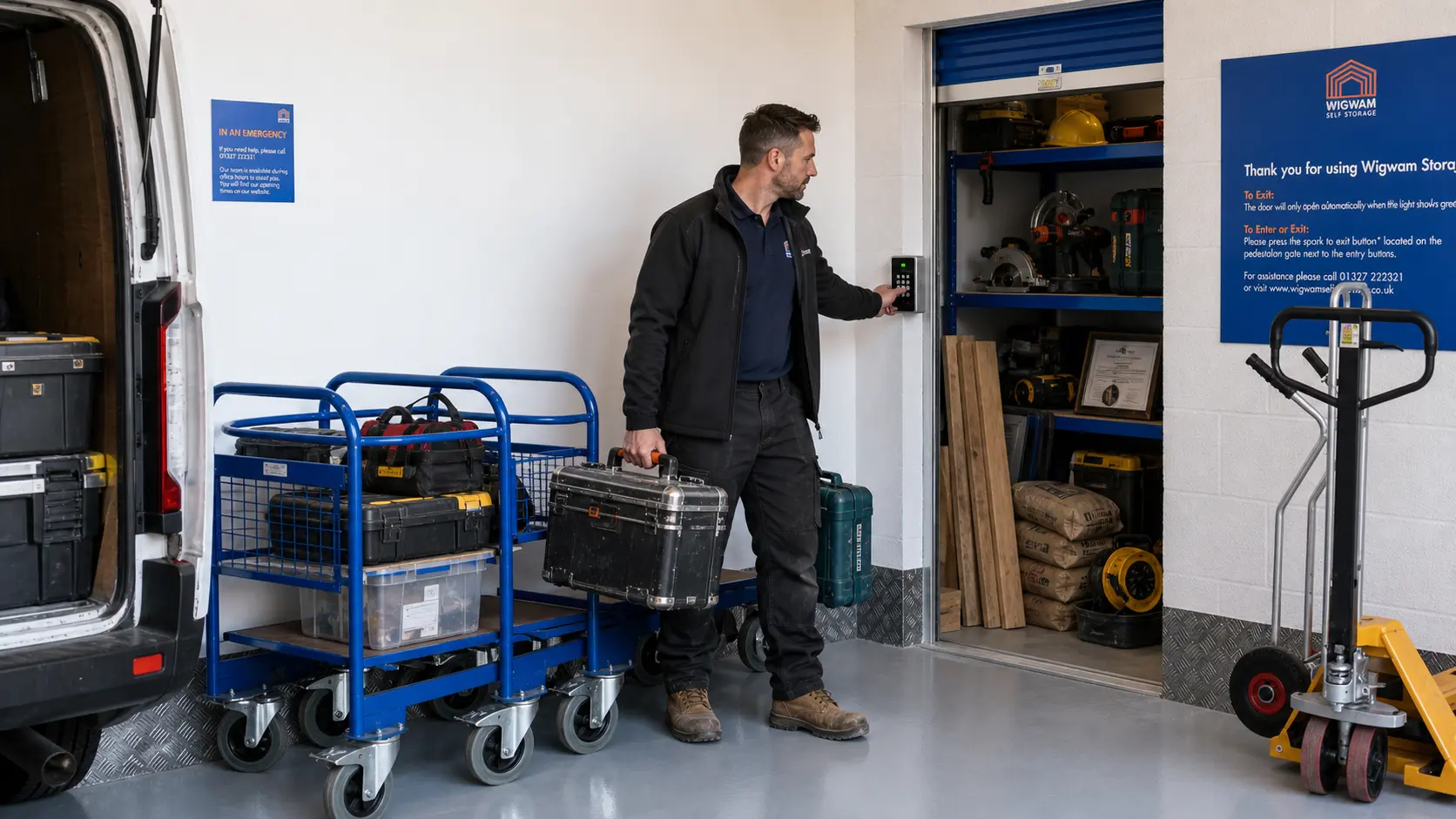
When a Contractor Needs Space but Not a Depot
Self storage makes sense for a contractor when the van is full, the home is being used as overflow, and the cost of a commercial lease does not stack up against the actual duration of the work ahead. That is the honest starting point.
The In-Between Firm: Too Big for the Van, Too Cautious for a Lease
A commercial depot on an industrial estate solves certain problems. It also brings a lease, business rates, a dilapidations clause at the end, and a deposit sized to match. For a firm with one or two fit-outs running at any given time, or a sole trader between projects, that structure works against you. The overhead runs whether the work does or not.
A Wigwam unit turns the commitment the other way round. You take it on when the job demands it. You hand it back on a rolling two-week term when it does not. No lease. No rates bill. No clause at the end requiring you to return a cold, damp concrete unit to a condition it never achieved in the first place.
What Kinds of Contractors Use a Wigwam Unit?
Fit-out firms, general builders, electricians, plumbers, joiners and painters have all used a unit as a depot substitute. Sole traders who need secure overnight storage for expensive kit they cannot responsibly leave in a van. Small firms staging materials for an upcoming contract. Builders merchants’ overflow. The common thread is a contractor who has outgrown ad hoc storage and is not yet in the market for a full commercial unit.
If your team is two to ten people, your kit is worth protecting, and your workload moves between sites, a Wigwam unit fits the gap.
When Self Storage Is Not the Answer
It is worth being direct here. A Wigwam unit is a secure space you control. It is not a workshop, a depot with a receiving bay, or a registered business address. The site is unmanned, so you cannot run business operations from it or use it as a workshop.
You also cannot store vehicles, works vans, trailers or plant trucks at Wigwam. We store goods, not vehicles. If that is what you need, a Wigwam unit is not right for you, and it is better to know that now.
What Contractors Actually Keep in a Self Storage Unit
Contractors use units for three broad categories of goods: tools and kit, staged materials and job-lot stock, and the business paperwork that needs to stay dry and accessible.
Tools, Plant and Small Kit
The most common use is the one that makes the most sense: take the expensive hand tools, power tools and small plant out of the van at the end of the day and put them somewhere individually alarmed. A Wigwam unit is clean, dry and secure. There is no climate control, so it is not designed for humidity-sensitive electronics or specialist conservation work. What it does well is give you a fixed, alarmed space where the kit you depend on is not sitting overnight in a vehicle on a residential street.
For a sole trader, that is often the main reason for taking a unit. The overnight theft anxiety comes down considerably when the tools are behind a door that has its own alarm.
Materials and Job-Lot Stock Between Projects
For a fit-out firm or builder, staging is the other big use case. Buy the materials when the price is right, store them securely until the contract starts, and then load the van from the unit on day one rather than scrambling for supply at short notice. A Wigwam unit lets you hold stock between projects without it cluttering a family home or sitting on a previous client’s site.
The image to hold is simple: a unit you can walk into, load from, and lock up. That is the working reality for most contractor customers.
Records, Certificates and Paperwork You Need to Keep Dry
Contractors accumulate paper that has to be kept: insurance certificates, building control documents, electrical certification, training records. A damp garage is not a reliable archive. A secure, dry unit that you control is. This is not a managed records or archive service; Wigwam stores what you put in and secures it. But for the practical need of keeping important documents away from damp and clutter, a unit works.
Self Storage vs a Depot, a Lock-Up and a Container
Self storage beats a commercial depot on flexibility and cost structure for most contractors who are not running a large, permanent operation. That is the honest comparison. The detail matters.
Cost and Commitment, Side by Side
A commercial depot on an industrial estate typically means a lease of at least twelve months, often three to five years, plus a deposit, business rates and a service charge. You are paying for space that exists regardless of whether your workload fills it.
A lock-up garage is cheaper but comes with no individual alarm, no smart entry, and usually no flexibility on the size or the term. A shipping container on a yard you do not control means you depend on the landlord’s access arrangements and the security of a site that is not designed for your kit.
Self storage sits in a different position. There is no commercial lease. There are no business rates on the unit. The deposit is refundable. The term rolls on a two-week minimum. For what self storage costs in the UK, you get a unit sized to what you need now, with the ability to upsize, downsize or leave on short notice.
We are not in the business of making competitors look bad. The honest answer is that for most contractors at the depot-consideration stage, the comparison comes down to how long you need the space and how certain you are about that. If you need a large, permanent base with a loading dock and a receiving bay, a depot is probably right. If you need a secure, local unit that moves with the job, self storage usually makes more sense on the numbers.
The Two Things a Depot Does That a Wigwam Unit Does Not
There are two real differences worth naming plainly, because a contractor who does not know them in advance will be caught out.
The first is deliveries. The Wigwam sites are unmanned. Wigwam does not sign for deliveries and does not receive goods on your behalf. If a supplier is dropping materials at your unit, someone from your own business needs to be present. Plan deliveries for when you or a colleague will be on site loading or unloading anyway. It is a reasonable workaround once you are used to it, but it is a planning consideration, not an afterthought.
The second is access hours. Smart entry runs from 6am to 10pm, seven days. Not around the clock. For most contractors, 6am is early enough to load the van before a 7am site start, which is the more common morning constraint. But if you need access at midnight or in the small hours, a Wigwam unit is not built for that.
These are not apologetic admissions. They are what the product is. Knowing them upfront means you can plan around them sensibly.
Ready to price a unit for your next job? Get a quote at quote.wigwamstorage.co.uk
Sizing Your Unit as the Workload Moves
The right unit is the one that matches what you actually need to store right now, not the one that accounts for every possible future project. That is the whole point of a rolling term.
From One Shelf of Hand Tools to a Full Bay of Materials
A sole-trader electrician or plumber staging overnight tool storage needs a very different unit to a fit-out firm holding two pallets of materials between contracts. Both are valid uses. The pricing page shows unit sizes and what they translate to in practical terms. As a rough guide, a smaller unit works well for a tradesperson’s tools and personal protective equipment; a larger unit suits a firm holding staged materials, bagged goods or equipment for a multi-week job. For the specific sizing options and rates, the pricing page is the right starting point.
Scaling Up or Down as Contracts Change
The two-week rolling minimum means you are not anchored to a unit that no longer fits the workload. If a large contract ends and the next one is smaller, you move to a smaller unit. If you take on a bigger job than usual and need more staging space, you scale up. Unused days are refunded if you vacate before the end of a period. The flexibility is not a marketing line; it is the practical structure of the rental.

Security, Access and Your Working Routine
Security is where contractors either trust the decision or do not. The honest answer on Wigwam is straightforward.
Individually Alarmed Units, Clean, Dry and Secure
Every unit has its own individual alarm. That is not a site-wide alarm on a timer; it is your unit’s alarm, on your unit. The space is clean, dry and secure. There is no climate control, which is worth saying clearly: Wigwam does not market temperature or humidity regulation, and you should not assume it. For tools, materials, bagged goods and most contractor stock, clean and dry is exactly what is needed.
The comparison with a lock-up garage matters here. A lock-up is typically one padlock and a shared site. An individually alarmed unit is a different level of security, and the overnight theft anxiety that comes with an unattended van goes down noticeably once the kit is behind that door.
Smart Entry, 6am to 10pm, Seven Days
Entry is by smart entry, seven days a week, from 6am to 10pm. That covers the full contractor working day: early enough for a pre-7am load-up, late enough for a post-site drop-off in summer and winter. Smart entry means no waiting for a keyholder, no restricted office hours, no site manager to track down. You access your unit on your own schedule within those hours.
Access is not 24-hour. That is stated plainly in the terms and conditions, and it is worth factoring into your planning.
What Unmanned Means in Practice
Unmanned is a word that can be read two ways. It could sound like neglect. It is not. It means that Wigwam does not station a member of staff at the site to manage daily comings and goings. You access your unit independently. That is the model.
For deliveries, the practical consequence is clear: no one at the site can receive goods on your behalf. If a supplier or courier is coming to your unit, you or a colleague from your business needs to be there. The easiest way to handle this is to align deliveries with a time you are already planning to be at the unit, whether loading, unloading or checking stock. It takes one scheduling call to your supplier and it becomes routine.
Terms, the Refundable Deposit and Notice
The minimum stay is two weeks, on a rolling basis. There is a deposit, which is refundable. Those two facts cover most of what contractors need to know about the financial commitment.
The deposit is returned after a 14-day notice period, once you have vacated the unit and the account is settled, less anything owed. It is not lost. It is not withheld unless there is something owed. If you leave before the end of a paid period, unused days are refunded. The full conditions are set out in the terms and conditions, which is the right place to check the detail before you sign up.
There is no long-term commitment, no lease to sign, and no business rates on the unit. The deposit gives Wigwam security; the refund policy gives you confidence that it comes back. Neither point should be a surprise when you read the paperwork.
What You Can and Cannot Do from a Wigwam Unit
Self storage for a contractor sits in a specific lane. It is worth mapping it clearly.
You can use the unit to store tools, materials, staging stock, business paperwork, equipment and goods. You can come and go during access hours, run your van from the unit, and scale the unit up or down as the work changes.
You cannot use it as a workshop. The unit is for storing goods, not carrying out work. You cannot use it as a registered business address; it is a storage unit, not a commercial premises. You cannot store vehicles, works vans, trailers or plant trucks. Wigwam stores goods, not vehicles, and that applies to all unit types across all locations.
You also cannot operate from it as a manned depot: no one from Wigwam will receive deliveries, manage stock or handle goods on your behalf. If that is what you need, it is better to be honest that a self storage unit serves a different purpose.
None of this makes a unit less useful for what it does well. It just means you should go in knowing what the product is.
Protecting Your Stock: Contents Cover in Plain Terms
Contractors store expensive kit. That means the insurance question matters before anything goes in the unit, not after something goes wrong.
How Wigwam’s Contents-Protection Option Works
Wigwam offers an opt-in contents-protection policy through RSA (“Self Storage Customers’ Goods”). The cover is New-for-Old replacement, which means a stolen or damaged item is replaced with an equivalent new item, not a depreciated value. The excess is GBP 50. You declare the full replacement value of everything in the unit; if you under-declare and need to claim, the settlement is proportional to the shortfall. Theft is covered after forcible entry to the unit. Climatic damage, meaning damage from temperature or atmospheric conditions, is not covered.
Premium prices are not published here; Wigwam’s contents-protection page has the full policy terms. Read the policy before you decide. Do not assume the cover; check what you are getting and what it costs.
Bringing Your Own Cover
Wigwam allows contractors to prove their own contents cover instead of opting into the RSA policy. If you already carry a tools-in-transit or all-risks policy through your trade insurer, it may extend to goods held in a third-party storage unit. It may not. The key word is verify. Check with your insurer or broker that the policy specifically covers goods in a self storage unit you rent from a third party. Do not assume it does because it covers goods on site or in transit.
A note on jurisdiction: Insurance policy terms and the right to claim under a policy are governed by the law of England and Wales for most Wigwam locations. Contractors in Scotland or Northern Ireland should verify coverage terms and claims rights with their broker, as the legal frameworks differ.
Find Your Nearest Wigwam Yard
Wigwam operates across our UK market-town locations, from Somerset to Lincolnshire. The locations are in places contractors already work: towns with active build and fit-out activity, not out-of-the-way industrial zones.
Market-Town Locations Across the UK
Two good examples of the kind of location we operate in: Wigwam Self Storage Bath serves contractors across the Bath and North East Somerset area, where renovation and fit-out work is consistent and depot options are limited in the city centre. Wigwam Self Storage Lincoln serves the Lincolnshire market, including firms working across the county’s towns and rural build programme.
For all other locations, our UK market-town locations page lists every site with contact details. Find the one closest to where you are working, not just where you are based. That is often the more useful way to think about it: the unit serves the job, not the office.
Getting a Quote
Two-week minimum stay. Refundable deposit. Smart entry from 6am. No commercial lease. If those terms fit what your next job needs, the next step is straightforward.
Get a quote at quote.wigwamstorage.co.uk and have a unit ready before your next job starts.
Frequently Asked Questions
Can I store fuel, gas bottles or a generator with petrol in it?
No, and this one is worth knowing before you load the van. Fuel, gas bottles, paint, solvents, and anything flammable or hazardous cannot go into a Wigwam unit, the same as at any reputable self storage site. That includes petrol and diesel cans, propane and butane cylinders, oxy-acetylene kit, and the like. The reason is simple: an enclosed unit on a shared site is the wrong place for anything that can leak, give off vapour or catch, and the contents-cover terms would not stand behind it anyway.
A generator itself is fine to store, but it has to be empty of fuel, with the tank drained and no fuel cans alongside it. The same goes for petrol strimmers, cut-off saws, plate compactors and similar two-stroke or petrol kit: store the tool, not the fuel. Drain it before it goes in. This is standard practice across the storage industry rather than a Wigwam quirk, and most contractors are already used to it from site fuel rules.
For the kit you can store, the unit does well: hand tools, power tools, bagged materials, staging stock, and dry goods all sit happily in a clean, dry, individually alarmed unit. If you are not sure whether a specific item is allowed, ask the local team before clearance day rather than turning up with a van you cannot fully unload. They can tell you yes or no on the storage side. Where to dispose of or store fuel and chemicals safely is a question for a licensed disposal route or a specialist, not for us.
Can two of us, or two separate firms, share one unit to split the cost?
You can share a unit informally, but go in with your eyes open about how it actually works, because a unit has one account holder, not two equal partners. The person who signs the agreement is the contracting party, controls the access, and is responsible for the payment and the contents cover. If you and a colleague split the cost between yourselves, that is a private arrangement between the two of you; from our side there is still one named account holder carrying the responsibility.
Access is the practical sticking point. Smart entry means whoever holds the access can get in, and the sites are unmanned, so we do not let a second person in on the account holder’s say-so unless that access has been set up deliberately with the local team. We do not hold spare keys and we cannot admit someone who turns up claiming they share the unit. If you genuinely want two people to have independent access, sort that at the start rather than assuming it.
The bigger thing to think through is the contents cover and the kit itself. The declared value needs to cover everything in the unit, and if two firms’ tools are mixed in together, a claim after a theft or loss gets complicated fast: whose tools, whose value, whose policy. For most contractors who care about their kit, the cleaner answer is a small unit each, sized to what you actually hold. The two-week rolling minimum and the modest step between the smallest sizes usually make that more sensible than sharing and untangling it later.
Does my tools-in-transit insurance cover kit left in a storage unit overnight?
Often not, and this is the gap that catches contractors out, so check it before you rely on it. Many tools-in-transit and goods-in-transit policies cover kit while it is on you, on a job, or being carried in the van, and specifically exclude or limit goods once they are static in a third-party storage unit. Some policies cover it; some cover it only if the van is alarmed and locked; some exclude storage entirely. The only way to know is to read your own schedule or ask your broker the direct question: does this policy cover my tools while they are kept in a self storage unit I rent.
This matters because contents cover is mandatory for anything in a Wigwam unit. You have two routes. You can take Wigwam’s RSA “Self Storage Customers’ Goods” cover, which is New-for-Old replacement with a fifty pound excess and covers theft following forcible entry to the unit, with climatic damage excluded. Or you can prove your own cover, which means showing that your existing trade policy genuinely extends to goods in third-party storage. What you cannot do is leave it uncovered and assume your van policy stretches to it.
The honest planning point is that “I’m insured for my tools” is not the same as “my tools are insured in storage”. Verify the specific wording. If your trade policy does extend, great, prove it and you are set. If it does not, the Wigwam option is there. We signpost, we do not advise: for what your own policy actually covers, your insurer or broker is the right person, and the Wigwam policy detail is at wigwamstorage.co.uk/contents-protection/.
Is a storage unit a tax-deductible business expense for a contractor?
For most contractors storing genuine business kit, storage is treated as a normal business cost, but the detail is your accountant’s call rather than ours, so take this as a signpost, not advice. In broad terms, the cost of renting a unit used wholly for business, to hold tools, materials and stock, is the kind of running cost that businesses commonly account for as an allowable expense. Self storage is generally standard-rated for VAT, so if you are VAT-registered there will be VAT on the invoice that you would handle in the usual way.
Where it gets specific to your circumstances is the mix of use and your business structure. A sole trader and a limited company account for costs differently, and a unit used partly for personal storage and partly for the business is not the same as one used solely for work. How you record it, what you can reclaim, and how it sits against your CIS position if you work under the Construction Industry Scheme are all matters for your accountant, who knows your full picture.
The practical advice is simple. Keep the invoices, keep the use of the unit genuinely business-related if you want to treat it as a business cost, and put the question to your accountant or check directly with HMRC for an answer that fits your setup. We provide the unit and a clear invoice. We do not give tax advice and we will not quote rules at you, because getting it wrong on a guess from a storage operator is the last thing you need at year end.
What actually happens if someone tries to break into my unit when no one is around?
The individual alarm responds, and that is the point of it. Every Wigwam unit is individually alarmed, not just the site perimeter, so an attempt on your specific unit triggers a response tied to that unit rather than relying on someone noticing a breach of the outer building. Combined with smart-entry access control, which logs who comes and goes, and CCTV across the sites, that is a meaningfully different security level from a lock-up garage with a single padlock on a shared gate.
The sites being unmanned does not mean unmonitored. There is no reception desk during your visit, but the security setup does not depend on a person being physically present. That is the part contractors sometimes get the wrong way round: a manned gatehouse during office hours can actually be less use overnight than an alarmed unit and access control that work at three in the morning regardless of who is on site. The overnight theft anxiety that comes with kit sitting in a van on a residential street is exactly what the alarmed unit is designed to take away.
On the practical side, if there is ever an incident affecting your unit, the contents-cover position is that theft is covered following forcible entry, with the claim settled New-for-Old up to your declared value and a fifty pound excess, which is why declaring the full replacement value of your kit matters. The security reduces the chance of a loss; the cover handles the consequence if one happens anyway. The detail of how the system responds at a specific site is something the local team can talk through, and the cover terms are at wigwamstorage.co.uk/contents-protection/.
Simon Fothergill, Managing Director, Wigwam Self Storage.
Customer Reviews

Once contract in place very easy app use to access site and unit, very clear easy to follow instructions. Very happy and would definitely recommend


Very easy access with parking right outside the door.
Plenty of trolleys, so no need for muscles ! It maybe a little more expensive than some others, BUT the cleanliness & ease of use perfect.
The staff are VERY patient, explaining how each unit works.
It is great to know the manned office hours & how to make contact if not.
Plenty of accessible hours too.
Ps.... they do like a biscuit or 2 in the office I hear !


Units were good and secure.
only critisms - lights turned off automatically too quickly and no onsite toilet.

I Highly recommended this company.

Also the girls in the office who are extremely helpful with a cracking sense of humour,
Unit was superb, extremely clean,
So easy to access, completely idiot proof
Will definitely use them again

