
Home /
The call comes in April, sometimes March. Your son or daughter mentions, almost in passing, that the halls need to be cleared by the last Friday of term. The tenancy on the shared house ends in June. There is nowhere for their things to go between now and September, and they are in the middle of exams.
You sit at the kitchen table and start searching. The results come back full of student discount banners and deals aimed at a 19-year-old who already knows what they are doing. You are not that person. You are the one who will actually fill in the form, sign the contract and pay the bill, from a different county, against a deadline, for a child who is too busy revising to sort this themselves.
This guide is written for you. It explains how the booking works in your name, what the deposit and notice period mean, how collection day works at an unmanned site, and what to do about insurance. Nothing complicated. Just the answers you actually need.
Why the Parent Usually Books, and Why That Is Completely Fine
Most student storage contracts are signed by the parent, not the student. That is not a loophole or a workaround. It is simply how self storage is designed to work when the account-holder is the adult who pays the bill.
Under-18s and the Contract: Why It Goes in Your Name
If your child is under 18, the position in English and Welsh law is straightforward: a minor cannot enter a binding contract. That means a self-storage agreement signed by someone under 18 would not be enforceable, and most operators will not accept it. The practical answer is that you, the parent or guardian, sign as the account-holder.
The position described here reflects the law in England and Wales. Contract law differs in Scotland and Northern Ireland. If your specific situation raises any questions, speak to a solicitor.
Over-18s Who Would Simply Rather You Handled It
Many students who are 18 or 19 are quietly grateful that someone else is taking care of this particular piece of admin. The contract sits in your name, the payment comes from your card, and your child is the authorised user who can access the unit. There is nothing unusual about that arrangement. You are the account-holder; they are the person whose boxes are inside. Both positions are perfectly ordinary.

How to Book in Your Own Name, Step by Step
Here is the sequence from getting a quote to having a unit confirmed. It takes less time than you might expect, and you can do the whole thing from home.
What You Need Before You Start the Quote
Before you go to quote.wigwamstorage.co.uk, it helps to have a few things to hand: the move-out date, a rough sense of how much there is to store (just boxes and bags, or a room of furniture too), and the town where the unit needs to be. You will set the account up in your name and your contact details. Your child can be added as an authorised user, so they can access the unit when you cannot be there.
The quote shows you what is available at the relevant location, the unit sizes and the dates. You are not committed to anything until the deposit is paid.
For pricing, the rates vary by location and unit size. You will not find a published price list here, and that is deliberate: the quote tool gives you the actual rate for the specific location, size and dates you need. The pricing page has more context on how our pricing works.
The Deposit and the 14-Day Notice: What They Mean in Practice
There is a refundable deposit when you book. It comes back to you when three things have happened: you have given 14 days’ notice, the unit has been vacated and cleared, and the account is settled. The deposit is not lost; it is held and returned once everything is done properly.
If your child moves out earlier than expected after the minimum stay, unused days from that point are refunded. That makes a short between-terms let genuinely workable, not something you pay for on paper while the unit sits empty.
The full terms, including the deposit and notice conditions, are on the terms and conditions page. Worth a read before you confirm the booking.
Ready to check availability and get a price? Visit quote.wigwamstorage.co.uk to see what is available near your student’s campus.
What Size Unit Your Student Actually Needs
The right unit size depends on one question: are they storing boxes, bags and a bike, or are they clearing out an entire room of furniture?
Just Boxes, a Bike and a Few Bags
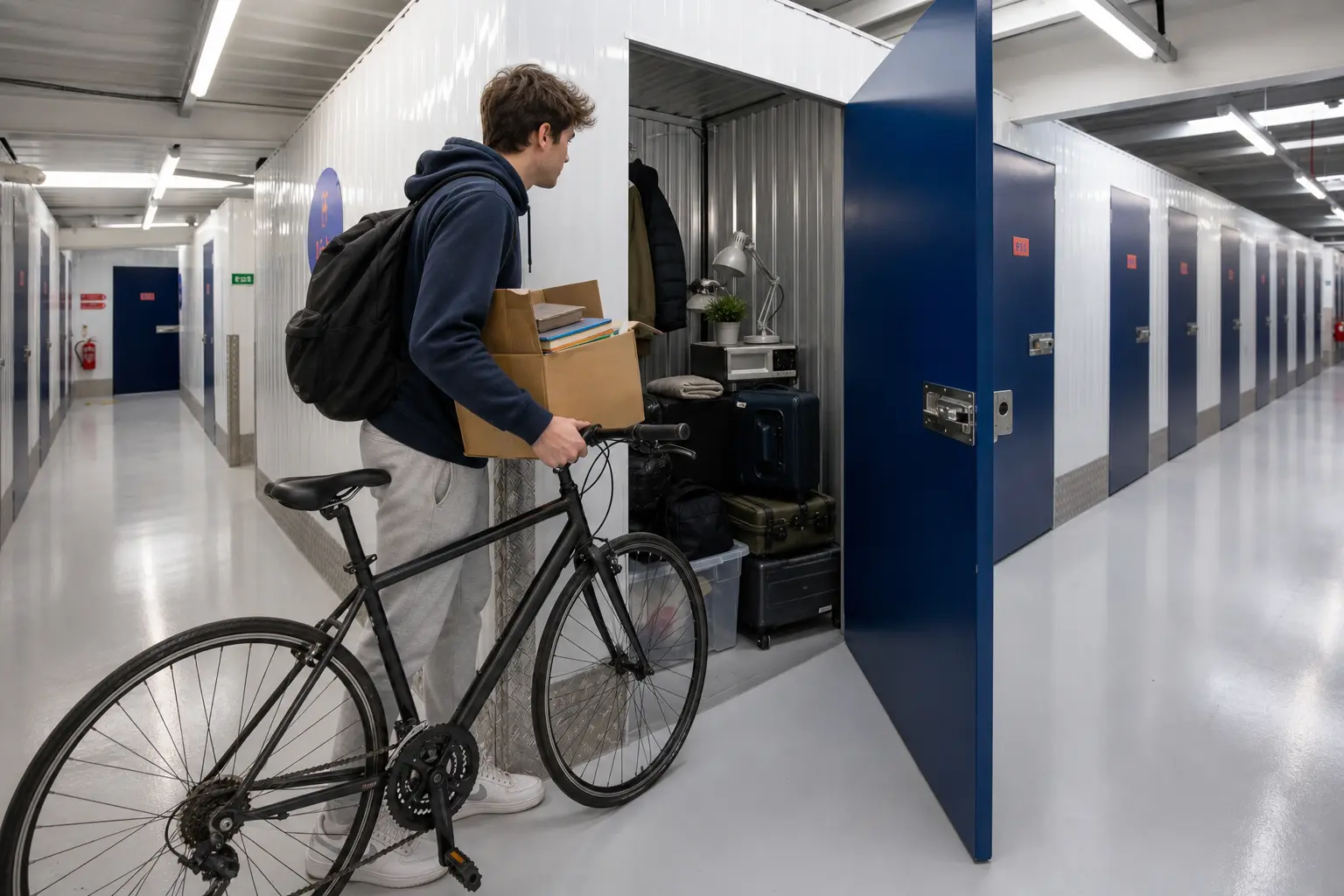
This is the most common end-of-term situation, particularly for first-year students in halls. A small unit easily handles a few boxes of books, a suitcase or two of clothes, a desk lamp, a kettle and a bicycle. Think of it as the size of a large wardrobe or a small garden shed. Most freshers clearing halls for the summer need nothing bigger.
The quote tool will show you the exact dimensions so you can compare them against what your child has described. If you are not sure, err slightly larger; the cost difference between the smallest sizes is modest, and you will not be trying to Tetris everything in on the day.
When They Are Bringing a Room of Furniture
By second or third year, when a student is clearing a shared house rather than halls, the volume is often greater. A desk, a chest of drawers, a single bed frame, a mattress: that is a different conversation. A medium unit handles that kind of load.
It is worth noting that our units are for household goods. We do not have vehicle or leisure storage, so a bicycle is fine but a motorbike or a car is not. If you are unsure whether something falls within the household goods category, the quote process is the right place to ask.
What It Costs and How Early to Book
Cost is usually the first question. The honest answer is that the price depends on location, unit size and dates, and the clearest way to get a number is through the quote tool rather than a price list.
Where to Find Pricing and Why We Do Not List Rates Here
Rates vary between our UK market-town locations and change based on availability, particularly during the summer peak. Publishing a price list would either mislead you with a number that does not apply to your dates or lock us into rates we cannot always honour.
The pricing page explains how our pricing works and what affects the rate. The quote tool gives you the actual figure for your location and dates, without any commitment until you decide to proceed.
There is no public student discount scheme. The rate you get from the quote tool is the rate.
The Two-Week Minimum and Refund of Unused Days
The minimum stay is two weeks. For most students storing between terms, that is not a constraint: the gap between the end of one term and the start of the next is almost always longer than that.
If your child moves out and collects their things before the summer is up, any unused days beyond the two-week minimum are refunded. You are not paying for empty space you no longer need.
Timing the Booking: The Summer Rush and How Early Is Early Enough
Availability near university towns runs short faster than most people expect. The window from May to September is when demand peaks, and the sites closest to campuses feel it first.
When to Book for the May to September Peak
The practical advice is to book as soon as you know the move-out date. That might be April, or even March if the tenancy end-date is fixed early. Getting a quote early does not commit you to anything; you confirm when you are ready. But securing a unit early means you are not chasing availability in the final week of term when everyone else is doing the same thing.
The closer you are to the end of term, the more compressed the options become. Booking early is not about panic; it is about having a choice rather than taking what is left.
Last-Minute Bookings: What Is Still Possible
If you are already in the crunch, the honest answer is that availability depends on location and timing. Some sites will have units free at short notice; others will not. The quote tool shows real-time availability, so the quickest way to know is to check at quote.wigwamstorage.co.uk. If a particular location is full, the locations hub at wigwamstorage.co.uk/self-storage-locations shows all our sites so you can check the next nearest option.
Collection Day When Nobody Local Will Be There
This is the part that worries parents most. You are booking a unit in a town three hours away, for a child who may or may not have transport, and you cannot necessarily be there in person when the van arrives. Here is how it actually works.
How Smart Entry Works at Our Unmanned Sites
Our sites use smart entry. Access runs from 6am to 10pm, seven days a week. That window suits a parent doing a weekday morning lift: you can be there at seven, have everything loaded by ten, and be on the road before the traffic builds.
The sites are unmanned. That is not a gap in our service; it is how the model works. You, or a person you authorise, holds access to the unit. You do not need to coordinate with staff on the day, and there is no key handover to arrange.
One thing to be clear about: Wigwam does not sign for couriers or receive deliveries on a customer’s behalf. If a courier is delivering anything to the site, someone from your own side needs to be present to accept it. The site will not take in a parcel and hold it for you.
Who Can Access the Unit: You, the Student or Someone You Nominate
Because the account is in your name, you control who has access. That might be you and your child. It might also be a trusted third party: a friend with a car, a flatmate’s parent who has offered to help with the lift, or anyone else you want to authorise. The terms and conditions page covers how authorised access is set up, and the quote process is the place to ask if you have specific questions about arrangements.
Keeping Their Things Safe Over the Long Break
Three months is a long time to leave things you cannot check on. The reassurance here is straightforward, and we will give it to you plainly.
What Individually Alarmed Units Actually Mean
Every unit at Wigwam is individually alarmed. That means the alarm is on your unit specifically, not just on the building or the site perimeter. The units are clean, dry and secure. Standard household goods, laptop, textbooks, clothes, kitchen kit, a bicycle: all of that stores well over a summer.
A few things worth noting. We do not offer or market climate control. The condition claim is clean, dry and secure, and that is what we can honestly stand behind. For most student goods, that is more than adequate. Perishables, plants and hazardous materials are excluded, as they are at any reputable self-storage site.
Contents Protection: Your Student’s Belongings Need to Be Covered
This is the part that catches people by surprise, so we mention it early. Contents cover is required when you store with Wigwam. You have two options: take out Wigwam’s own RSA Self Storage Customers’ Goods policy, or demonstrate that your existing home contents insurance or other cover extends to goods in self storage.
If you take the RSA policy: it is New-for-Old cover, with a GBP 50 excess. You declare the full replacement value of everything stored; if you understate the value and need to claim, any payout is calculated proportionally to the declared value. Theft is covered, but only where there has been forcible entry. Atmospheric and climatic damage is excluded.
We are not giving you financial or insurance advice here; that is not our place. What we are doing is laying out the facts so you are not caught short. Full details are at wigwamstorage.co.uk/contents-protection/, and if you have questions about whether your existing home contents policy extends to self storage, your insurer is the right person to ask.
Where to Store Near Your Student’s Campus: Our UK Market Towns
Wigwam’s sites are in UK market towns, which puts us close to student populations where some of the large national chains are thinly represented or entirely absent. If your child is studying in or near one of these towns, it is worth checking our availability before assuming you need to use one of the big-name brands in the nearest city.
Lincoln and Bath: Two of Our Student-Town Sites
Wigwam Self Storage Lincoln sits in Lincolnshire, close to the University of Lincoln and Bishop Grosseteste University. Lincoln is a market town where national chain coverage is patchy, and summer demand from students is real.
Wigwam Self Storage Bath is in Somerset, convenient for the University of Bath and Bath Spa University. Bath fills quickly in the summer peak, so booking early matters here more than most places.
Both Lincoln and Bath are verified live locations. If your child is at one of those universities, either of those pages will give you the local detail.
Reading, Cheltenham and Beyond
For students near Reading, Cheltenham or our other UK market-town locations, the starting point is the locations hub. It shows every Wigwam site with links to the individual location pages, so you can find the one closest to campus without guessing.
We use the phrase “our UK market-town locations” deliberately. We are not a national chain with a site in every city. We are in the towns, which is often exactly where students are.
Find your nearest Wigwam location and get a quote at quote.wigwamstorage.co.uk. Availability is live, and there is no commitment until you decide to go ahead.
Frequently Asked Questions
My child is an international student flying home for the summer. Can things stay longer than one summer?
Yes. There is no upper limit on how long a unit can be held, so an international student who flies home for the long vacation, or even for a full year abroad on a placement, can leave their belongings in the unit for as long as they need. The two-week minimum is the only fixed boundary at the start; after that the unit simply continues. For a family managing a child who cannot easily fly back to clear a unit, that open-ended flexibility is often the whole reason a unit makes sense over scrambling to ship or dispose of things at term’s end.
Two things need to stay current while nobody is visiting, and they are easy to set up so they look after themselves. The periodic payment continues for as long as the unit is held, so arrange it so it will not lapse while your child is out of the country. And contents cover must stay in place throughout, with the declared value still matching what is stored. Because the account is in your name as the parent, you can manage both from home regardless of where your child is.
The reassurance for a long absence is the security. The unit is individually alarmed, access is logged through smart entry, and the unit is clean, dry and secure, so the protection does not depend on anyone visiting to check on things. One honest note: we do not offer or market climate control, so for a long store, pack sensibly, electronics, books and clothes do well in a clean, dry unit, but do not leave anything perishable or anything that minds being left untouched for months. Set the payment and cover to run quietly in the background, and the things can simply wait until your child is back.
What happens if my child graduates and never gets round to collecting their things?
The unit keeps running and keeps charging until someone gives notice and clears it, so the practical advice is to put a date in the diary rather than let it drift. There is no automatic end point when term finishes or a course ends; a storage unit is a rolling arrangement, not something tied to the academic calendar. If a graduate moves to a new city, starts a job, and the boxes in storage slip down the priority list, the periodic payment simply continues coming out, because the unit is still held.
Because the account is in your name, you are in control of ending it, which is the useful part of having booked it yourself. When the time comes, you give 14 days’ notice, arrange for the unit to be cleared, either by your child, by you, or by someone you authorise, and once it is vacated and the account settled, the refundable deposit comes back and any unused days are refunded. The thing to avoid is letting payments run on for a unit nobody is using, which is easily prevented with a simple conversation at graduation about what is actually worth keeping.
If money ever gets tight or the situation changes, talk to the local team early rather than letting arrears build, because storage operators do have a legal route to recover unpaid charges that can ultimately involve selling stored goods, set out in the terms. That is a last resort that follows proper notice, and it is entirely avoidable. The far better outcome is the graduate either collecting their things or you giving notice and clearing the unit cleanly. Decide what stays and what goes at the point the course ends, and the unit closes on your terms.
At what point can my child just book and manage the unit themselves?
Once they are 18, they can be the account holder in their own right, and the move from parent-booked to student-managed is genuinely simple. The reason the parent usually books, covered earlier in this guide, is partly that an under-18 cannot enter a binding contract in England and Wales, and partly that the parent is the one paying. At 18 that legal barrier is gone, so an older student can sign the agreement, control the access, and run the unit themselves if that suits the family better.
In practice, plenty of families land somewhere in between, and that is fine. A common arrangement is that you, the parent, hold the account and pay, while your child is set up as the authorised user who actually accesses the unit day to day. That gives your child practical control of getting in and out, within the 6am to 10pm smart-entry window, while you keep oversight of the payment and the contents cover. The access has to be set up deliberately with the local team, since the sites are unmanned and nobody gets in on a say-so, but once it is arranged your child can come and go independently.
The honest planning point is to decide who carries the responsibility, not just who turns the key. Whoever holds the account is responsible for the payment and for declaring the full replacement value of the contents for cover. If your student is organised and earning, handing them the account at 18 is straightforward. If you would rather keep the bill and the cover under your eye while they manage access, that works too. Either way, the legal position is clear: 18 is the point at which they can hold it in their own name.
Does our home contents insurance already cover the things in storage, or do we need the Wigwam policy?
Do not assume your home policy stretches to a storage unit; check it before you rely on it, because this is exactly the gap that catches families out. Some home contents policies do extend cover to belongings temporarily held away from the home, sometimes under a “contents temporarily removed” clause, but the limits, conditions and time periods vary enormously, and many exclude or cap goods in a commercial storage unit. A student’s belongings are also often the parent’s policy thinking about the family home, not a unit in a town three hours away, which is precisely where the cover may stop.
This matters because contents cover is mandatory for anything stored with us, so there is no uninsured route. You have two clean options. You can take Wigwam’s own RSA “Self Storage Customers’ Goods” policy, which is New-for-Old cover with a fifty pound excess, with theft covered following forcible entry and climatic damage excluded. Or you can demonstrate that your existing home contents insurance genuinely extends to goods in self storage. The key word is demonstrate: “we have home insurance” is not the same as “our home insurance covers a student’s goods in a storage unit”, and the difference is where an uninsured loss would sit.
So the sequence is simple. Ring your home insurer and ask the direct question: does our policy cover our child’s belongings while they are kept in a self storage unit they or we rent, and up to what value. If it does, prove it and you need not take the Wigwam cover. If it does not, or only partly, the Wigwam RSA policy is there to fill the gap. We signpost, we do not advise: for what your own policy covers, your insurer is the right person, and the Wigwam policy detail is at wigwamstorage.co.uk/contents-protection/.
Is a unit better than leaving things in the landlord’s loft or a university storage scheme?
It usually comes down to security, certainty and control, and a unit tends to win on all three, though each option has its place. Leaving boxes in a landlord’s loft or a friend’s spare room is free, which is its only real advantage. Against that, the goods are not alarmed, not covered by any cover you control, and entirely dependent on goodwill and the property staying available; if the tenancy ends, the landlord sells, or the friendship cools, the things can become a problem at the worst moment. There is also no clean way to insure them or to guarantee access.
University and student-scheme storage can be convenient and is sometimes well priced, but it varies a great deal between providers, often runs only to specific dates tied to the academic year, and may have limits on what and how much you can store. Where it fits the dates and the volume, it can be perfectly sensible. The constraints to check are whether the dates match your child’s actual move-out and move-in, whether there is proper security and cover, and what happens if plans change, because student timetables rarely run exactly to plan.
A self storage unit trades a modest cost for things the informal options cannot offer: an individually alarmed, clean, dry, secure unit; mandatory contents cover, either the Wigwam policy or your own proven cover; smart-entry access from 6am to 10pm seven days; and a rolling term with no fixed academic-calendar end, so it flexes if dates slip or the store needs to run longer. For most families weighing reassurance against a few pounds a week, the certainty is the deciding factor. If budget is the overriding concern and you have a genuinely reliable loft to use, the informal route can work; if you want the things definitely safe and definitely accessible, a unit is the cleaner answer.
Customer Reviews
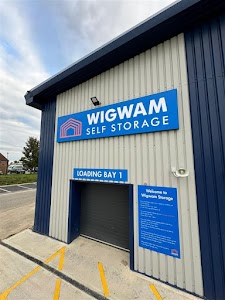

Once contract in place very easy app use to access site and unit, very clear easy to follow instructions. Very happy and would definitely recommend


Very easy access with parking right outside the door.
Plenty of trolleys, so no need for muscles ! It maybe a little more expensive than some others, BUT the cleanliness & ease of use perfect.
The staff are VERY patient, explaining how each unit works.
It is great to know the manned office hours & how to make contact if not.
Plenty of accessible hours too.
Ps.... they do like a biscuit or 2 in the office I hear !


Units were good and secure.
only critisms - lights turned off automatically too quickly and no onsite toilet.

I Highly recommended this company.

Also the girls in the office who are extremely helpful with a cracking sense of humour,
Unit was superb, extremely clean,
So easy to access, completely idiot proof
Will definitely use them again

