
Home /
There is a particular moment most sole traders recognise. You are parked up for the night, the van is loaded, and before you lock it you run the same quiet calculation: how much is in there, and how solid is that lock, really. It does not take a break-in to make the thought unpleasant. Just knowing the risk is there is enough to take the edge off the evening.
Getting the tools off the van is simpler than most traders expect. A small, alarmed unit ten minutes from home, accessible from six in the morning, and flexible enough to give up when the work slows down. No lease, no rates, no commitment to a building you do not own. This guide explains how it works, what it costs, and what to check before you sign.
This is a guide to renting a self-storage unit for tools and equipment, not a guide to workshop racks or van organisers. If you have been thinking about whether a unit is the right call for your trade, read on.
Why the van and the spare room stop working
Keeping tools in a van or spread across the house feels like a temporary arrangement. For most sole traders it becomes a permanent one. The van gets more loaded, the spare room gets less spare, and the workaround starts to cost more than the fix would.
The daily cost of keeping tools in your van
A van full of kit is a van full of risk. Tools left overnight on a residential street are a target; power tools in particular have a resale value that makes them worth the effort to a thief. The cost of a break-in is not just the gear. It is the lost morning, the claim, the excess, the wait for replacements, and the job you cannot do in the meantime. For a sole trader with no employed backup, a slashed van lock on a Monday morning is a direct hit to income.
There is also the quieter daily cost. Time spent loading and unloading the van, rearranging to find what you need, carrying gear up stairs or through the house. None of it is dramatic. All of it adds up across a working week.
The honest arithmetic: a small storage unit often costs less per month than the excess on a single tools claim. That calculation is worth doing before the event, not after.
When the spare room and the garage reach their limit
At some point the spare room becomes the materials room. The garage fills with kit you cannot fit in the van. The partner mentions it, not for the first time. The house has absorbed the business as far as it can, and the arrangement stops being convenient for anyone.
There is nothing complicated about this. The business has grown past what a domestic space can hold. A separate unit does not need to be large; it just needs to exist somewhere other than the house. Getting the overflow out of the spare room is one of those changes that feels minor until you have done it.
Why a small self-storage unit suits a sole trader
A self-storage unit is not a warehouse. For a sole trader it is closer to a second fixed base: a place to pick up what you need for the day, drop off what you do not, and keep the overflow dry and secure. The unit does not need to be large. It needs to be local, accessible early, and easy to leave when the work changes.
A fixed second base for a one-van business
The appeal is practical. A small unit near home means the van carries only what the day’s jobs require. Materials that do not fit in the van can live in the unit. Seasonal tools that are not in regular use are out of the way without being inaccessible. The van becomes a vehicle again rather than a moving storeroom.
Wigwam’s UK market-town locations are built around this idea. A plumber working out of Wigwam Self Storage Lincoln or a decorator based near Wigwam Self Storage Bath is typically within ten minutes of a unit. That proximity is the difference between a unit you use every day and one you visit once a week. You can find your nearest location at the Wigwam locations hub.
For the day you are ordering materials from a builders’ merchant, a unit gives you somewhere to direct a delivery rather than a domestic address, provided someone from your own business is there to receive it. More on that in the deliveries section below.
Storage that flexes when the work does
A sole trader’s workload is not steady. Contracts come and go. A quiet patch in January is not the time to be locked into six months of storage rent.
Wigwam’s minimum stay is two weeks. If you need the unit for a single large job and then want to close it, you give the required notice and the unused days are refunded. There is a refundable deposit, returned after a 14-day notice period once you have vacated and your account is settled. That is the catch that turns out not to be much of a catch.
For a business that grows in seasons or by contract, that flexibility is worth more than a slightly lower fixed rate from a provider who wants a 12-month commitment.
What size unit do you actually need
Most sole traders need less space than they think. A unit is not a second garage; it is a supplement to the van. The honest answer to the sizing question depends on what you are storing and how often you need to get to it.
Hand tools and a few power tools: the small locker
For a domestic electrician or decorator with one set of regular kit, a small locker unit is usually sufficient. Think roughly the size of a large wardrobe: enough for drills, a site box, angle grinders, seasonal hand tools, and the bits and pieces that do not need to be in the van every day. It is not a large space, but for tools that are not in daily rotation it does the job.
If you are weighing up whether a small unit would be enough, the Wigwam pricing page shows current rates by size for each location. Start there rather than guessing.
A full van’s worth plus materials: mid-size units
A plumber, groundworker, or joiner with sheet materials, pipe stock, or heavy plant will need more room. A mid-size unit handles the van overflow as well as materials that are tied to a longer contract: tile stock, timber runs, cable drums that you are working through over several weeks.
Wigwam units are accessed on foot. You carry or trolley your gear from the unit to the van. This is not a drive-up facility in all cases, so if you are moving very heavy equipment regularly it is worth asking about access at your specific location before you book. The pricing page covers unit sizes and current rates; no prices are listed on this page as they vary by location.
What it costs, and the honest answer to “can I do it cheaper”
Cost is usually the first question and the right one. Self storage is not free, and a sole trader thinking about whether it makes sense to pay for it deserves a straight comparison rather than a sales pitch.
Small locker vs a lock-up garage vs a new shed
Lock-up garages are sometimes cheaper per month, and some traders find one locally and make it work. The limitations are real: availability in market towns is patchy, most lock-ups have no individual alarm, access depends on the landlord’s arrangements, and if the tenancy ends you are out with short notice. There is no contents cover built in and no monitoring.
A new garden shed has an upfront capital cost, often between five hundred and fifteen hundred pounds depending on size, and depending on your property may require planning permission or a conservation area check. A shed does not have an alarm. It is also a target if it is visible from the road.
Self storage has a lower barrier to entry, a known security standard, and a contract that ends when you say it does. It is not always cheaper per month than a local lock-up, but the comparison is not just price per month. It is access hours, security, flexibility and the cost of getting it wrong.
For current rates at your nearest Wigwam location, see the pricing page. No prices appear on this page because they vary by location and unit size.
How the deposit and notice period actually work
The deposit is refundable. When you are ready to leave, give the required 14-day notice. Once you have vacated and your account is settled, the deposit comes back less anything owed. There is no scenario where you do the right thing and lose the deposit; it is designed to return.
The minimum stay is two weeks. If you leave before the end of a paid period, unused days are refunded. If you are worried about being locked in, you are not. The terms are at wigwamstorage.co.uk/terms-conditions/ if you want to read them before you sign.
Ready to see what a unit costs for your nearest town? Get a tailored quote at quote.wigwamstorage.co.uk.
Access hours and early starts: the honest version
The first question most tradespeople ask about access is whether they can get in before the first job. The short answer is yes, from six in the morning. Here is the longer version.
Smart entry, 6am to 10pm, seven days
Smart entry opens from 6am and closes at 10pm, seven days a week. That covers a 7am start with time to spare, and an evening return after a late finish. It is not round-the-clock. Some competitors lead with 24/7 access; Wigwam does not offer it and does not claim it. What the 6am to 10pm window gives a working tradesperson is genuinely useful: early access before any reception or lettings office opens, and a long evening window for drop-offs. For most sole traders running day jobs, that range covers the working day entirely.
The access is by smart entry. You do not need to wait for a member of staff or call ahead. You arrive, you get in.
Getting heavy gear in and out
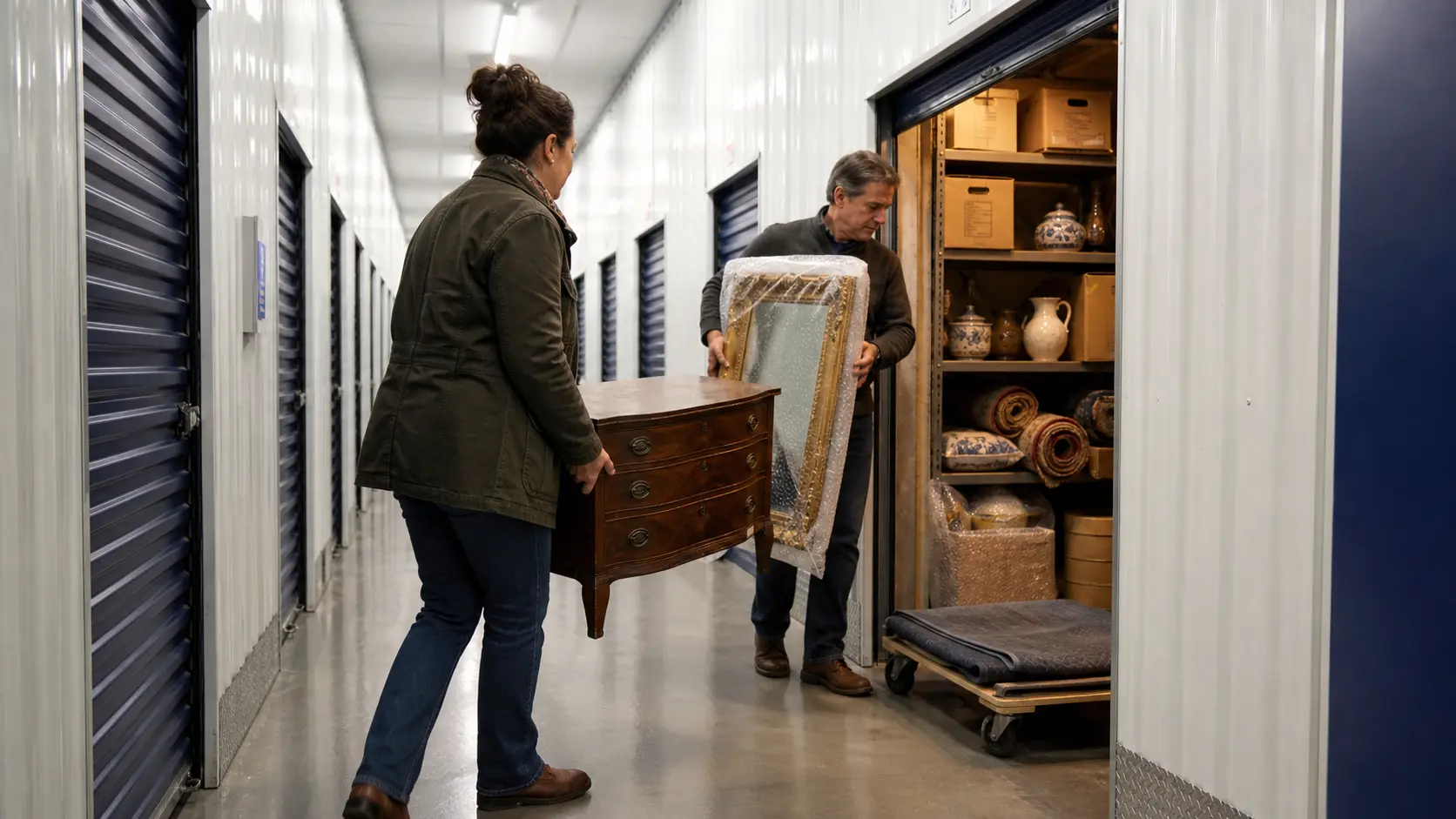
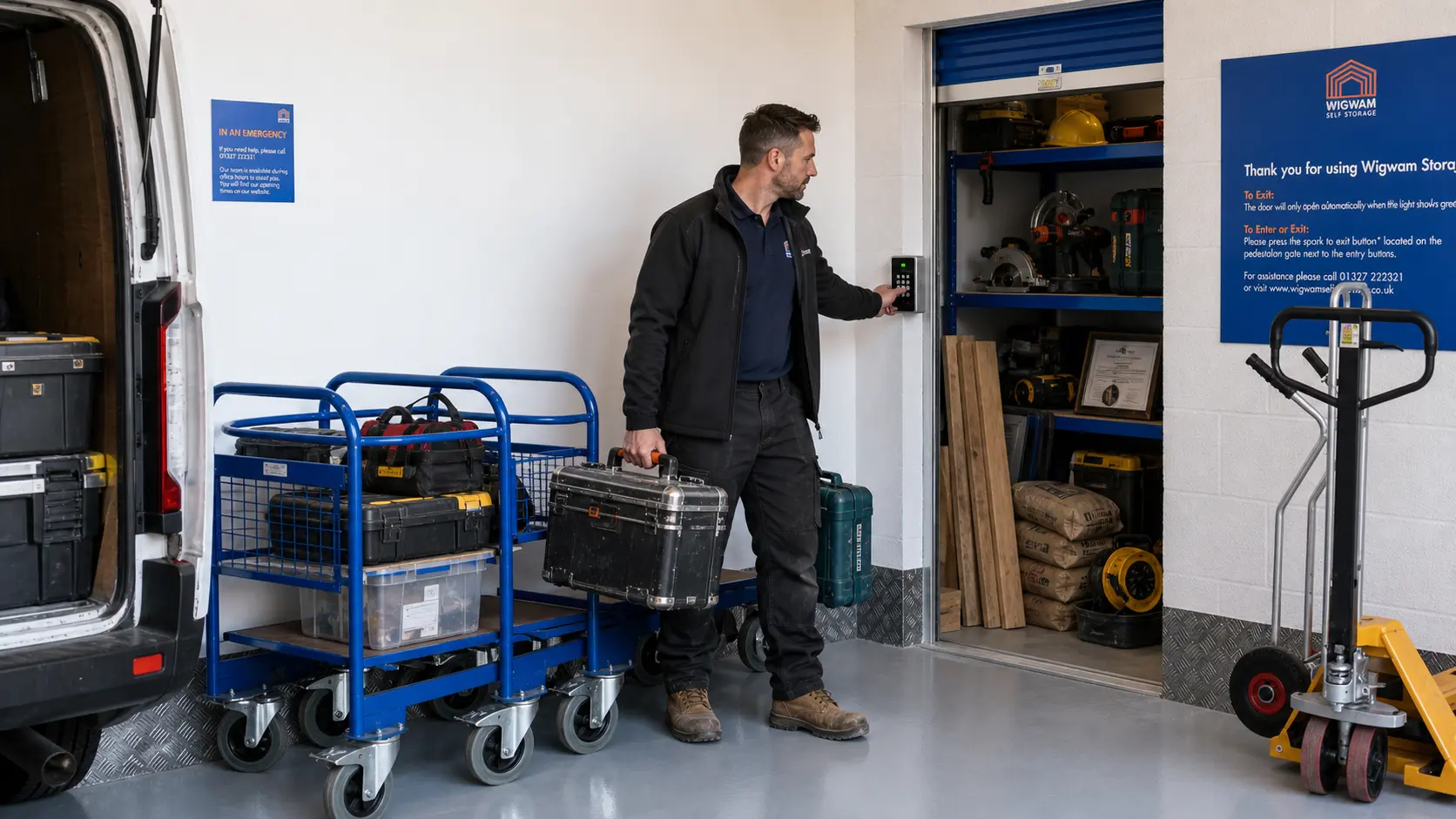
Wigwam units are accessed on foot from the building entrance. You load and carry to and from the van by hand or with a trolley. This is not a drive-up facility in all cases, meaning you cannot reverse the van to the unit door at every location. If you are regularly moving heavy equipment, a sack truck or platform trolley makes the difference, and it is worth asking about trolley availability and site layout at your nearest location before you book.
One thing to note: the unit is for tools, equipment and materials. Work vehicles, vans, trailers, and site vehicles cannot be stored inside a Wigwam unit. The unit is for goods, not for the vehicle.
Will tools rust? The damp question, plainly answered
Rust is the practical concern behind most questions about tool storage. If the unit is damp, the tools suffer. Here is what Wigwam’s units actually offer, stated plainly.
Clean, dry and secure: what that means in practice
Wigwam units are clean, dry and secure. That is the accurate description, and it is the description Wigwam uses. It means internal units protected from the weather, housed in a proper building rather than an open-air yard or an unlined container. It does not mean climate control. Wigwam does not claim temperature or humidity management, and you should not expect it.
What “clean, dry and secure” delivers in practice for tool storage: cordless kit will not be sitting in standing water or frost overnight. The environment is consistent and sheltered. For the overwhelming majority of tools a sole trader stores, that is sufficient.
Some competitor pages lead with “climate control against rust” as a reason to choose their units. Wigwam does not offer climate control and does not make that claim. If you are storing precision instruments or items with strict humidity tolerances, it is worth asking your unit provider directly about their environmental conditions. For standard trade tools, a clean, dry and secure internal unit is the relevant benchmark.
Preparing tools before they go into storage
Tools that go into storage clean last longer than tools that go in dirty. This is basic trade knowledge rather than a storage pitch, but it is worth saying.
Clean tools before storing them. Mud, cement, plaster and cutting fluid all accelerate corrosion if they are left on metal over time. Blades benefit from a light coat of oil before storage. Saw blades, chisels, and plane irons kept oiled store well; the same tools stored with residue on them do not.
Battery-powered tools have a specific consideration. Lithium-ion batteries should not be stored fully flat or fully charged for extended periods. Most manufacturers recommend storing at a partial charge rather than at either extreme. Check the documentation for your specific brand; the principle is consistent across most current tools.
Nothing here is proprietary advice. It is the kind of thing a tradesperson who looks after his kit already knows, and it is worth writing down for the ones who have not thought about it yet.
Security: what “secure” actually means for a unit of tools
The security of a storage unit is not just the lock on the door. It is everything between someone deciding to try their luck and them getting to your gear. Here is what Wigwam’s security setup looks like in practice.
Individually alarmed units and smart entry
Each Wigwam unit is individually alarmed, not just the building perimeter. That is the practical difference between a monitored facility and a storage shed with a padlock on the gate. If someone forces your unit, the alarm responds to that unit, not just to a breach of the outer building.
Smart entry controls who comes in and when. Access is logged. CCTV covers the sites. Wigwam sites are unmanned for daily access, meaning there is no reception desk during your visit, but the monitoring does not depend on someone being physically present at all times.
For a tradesperson whose tools are his livelihood, individually alarmed units are the relevant security standard. The low-grade dread of leaving expensive kit somewhere unmonitored is a different thing from leaving it somewhere that responds specifically if someone tries to get to it.
Covering your goods: the insurance question
Contents cover is mandatory at Wigwam. You either take out Wigwam’s RSA Self Storage Customers’ Goods policy, or you prove that your own existing policy covers goods held in a storage unit. You cannot leave it uncovered.
When you sign up, declare the full replacement value of your tools. Under-insurance is settled in proportion: if you insure for half the value and lose the lot, you recover half. The policy has an excess. Theft cover requires evidence of forced entry.
Premium rates are not published here; see the contents protection page for what is covered and how to arrange it. If you have questions about whether your existing trade tools policy extends to off-site storage, speak to your insurer or a broker directly. This page does not give insurance advice.
Jurisdiction note: insurance contract terms are governed by English law. If you are based in Scotland or Northern Ireland, legal conditions may differ. Check with your insurer for jurisdiction-specific guidance.
Deliveries to your unit: read this before you order materials
If you are planning to have tools or materials delivered directly to your storage unit, there is one thing you need to know before you arrange it.
Wigwam sites are unmanned. There is no staff member on site during your access hours to receive a delivery on your behalf. A courier arriving at a Wigwam site will not be met by Wigwam staff, and the delivery will not be accepted by the facility.
If you want a delivery sent to your unit’s address, someone from your own business must be physically present on site to accept it. That means you, or a member of your team, at the site at the time the courier arrives. You cannot arrange a delivery and expect it to wait or be held.
This is not a drawback to work around; it is the honest operational reality of an unmanned site with individual access. Plan deliveries around a time you are already going to be at the unit, or arrange delivery to another address and bring materials to the unit yourself. Most sole traders find the second option is simply how they already work.
Setting up tool storage with Wigwam in your market town
Getting started is straightforward. Choose your nearest location, get a quote, and the unit is typically ready to access within a day or two of signing.
Start at quote.wigwamstorage.co.uk for a tailored quote based on your location and the size of unit you need. If you want to see which market towns Wigwam covers before you get a quote, the full list is at the locations hub. Verified locations include Wigwam Self Storage Lincoln in Lincolnshire and Wigwam Self Storage Bath in Somerset. For other towns, the locations hub has the complete listing.
The terms, including how the deposit, notice period, and unused-day refunds work, are at wigwamstorage.co.uk/terms-conditions/. It is worth a read before you sign.
Two-week minimum. Refundable deposit, returned after notice once you have vacated and the account is settled. Unused days refunded if you leave early. After that, the van is a vehicle again.
Get a quote at quote.wigwamstorage.co.uk
Frequently Asked Questions
Can my apprentice or an employee access the unit, or only me?
Only the people you set up for access can get in, and that has to be arranged deliberately rather than assumed, because the sites are unmanned and run on smart entry. The account holder, you, controls who has access. If you want an apprentice, a labourer or a business partner to be able to reach the unit when you are on another job, that needs to be set up with the local team at your location at the start, not sorted out on the day someone turns up needing a tool.
The reason it works this way is the same reason the security holds up. We do not hold spare keys, we do not open units for people, and nobody on site will let a person in on your say-so over the phone. That is exactly what stops someone talking their way into your kit. The flip side is that genuine access for your own people has to be the deliberate kind, granted through the smart-entry system rather than improvised.
The practical advice for a one-van business that occasionally puts on a second pair of hands: decide early whether anyone other than you needs independent access, and if so, get them set up when you book. If it is only ever you, the single-access setup is the simplest and the most secure. Either way, treat the access list the way you treat the van keys, because that is effectively what it is. The local team can talk through how to add or remove an authorised person if your setup changes.
Is the cost of a storage unit tax-deductible for a sole trader?
If the unit is used genuinely for your trade, the cost is the kind of running expense sole traders commonly account for, but the detail is your accountant’s call, so take this as a signpost rather than advice. Renting a small unit to hold tools, materials and stock for the business is a recognisable business cost, and self storage is generally standard-rated for VAT, so if you are VAT-registered there will be VAT on the invoice to handle in the usual way. Keep the invoices and keep the use of the unit genuinely work-related if you intend to treat it as a business expense.
Where it gets specific is mixed use. A unit that holds your trade tools and also the family’s old furniture is not the same, for tax purposes, as one used solely for the business, and how you apportion that is exactly the kind of thing an accountant exists to get right. The same goes for whether you are a sole trader or have incorporated, which changes how costs are treated.
We provide the unit and a clear invoice; we do not give tax advice and will not quote rules at you, because a guess from a storage operator is worth nothing at year end. Put the question to your accountant or check directly with HMRC for an answer that fits your situation. The honest version is simple: if it is a genuine business cost, it is the sort of thing that is usually claimable, but confirm it with someone who can see your whole picture before you rely on it.
What happens if my smart-entry phone or fob fails when I am stood outside the unit?
You contact the local team and they sort the access out, but the honest planning point is that there is no one physically on site to wave you through in that moment, because the sites are unmanned. Smart entry is reliable, but phones run flat, fobs get left in other jackets, and signal can be patchy. The fix is to know in advance who to call at your location and to have that number saved, so a failed entry is a five-minute phone call rather than a wasted trip before a job.
The thing not to do is try to work around it, because the security that protects your kit is the same thing standing between you and the door when your phone is dead. We do not hold spare keys to let you in, and nobody on site can override the access for you on the spot. That can feel inconvenient at 6am with a job to get to, but it is the exact mechanism that stops anyone else getting into your unit either. The trade-off is deliberate.
Two practical habits save the morning. First, keep your phone charged or carry the fob as a backup if your site uses one, so you are not relying on a single point of failure before an early start. Second, save the local team’s contact details from your location page when you set up, so you can reach them quickly if access does not work. Smart entry within the 6am to 10pm window is genuinely convenient most of the time; the small discipline is having a plan for the rare morning it is not.
Does my trade tools-in-transit policy cover the kit once it is sat in the unit?
Often not, and assuming it does is the mistake that bites after a loss, so check the wording before you rely on it. A lot of tools-in-transit and goods-in-transit policies cover your kit while it is on you, on a job, or locked in the van, and then either exclude or sharply limit cover once the tools are static in a third-party storage unit. Some policies extend to storage; some only if certain security conditions are met; some stop at the van door. The only way to know is to read your schedule or ask your broker the plain question: does this cover my tools while they are kept in a self storage unit I rent.
This matters because contents cover is mandatory for anything in a Wigwam unit, the body of this guide has already covered that you either take the RSA “Self Storage Customers’ Goods” policy or prove your own. The point here is the proving. “I’m insured for my tools” is not the same as “my tools are insured in storage”, and the gap between those two sentences is exactly where an uninsured loss lives.
So the sequence is: check whether your existing trade policy genuinely extends to third-party storage. If it does, prove it and you are set, with no need to take the Wigwam cover. If it does not, the Wigwam RSA option is there, New-for-Old with a fifty pound excess, theft covered following forcible entry, climatic damage excluded. We signpost, we do not advise: for what your own policy actually covers, your insurer or broker is the right person, and the Wigwam policy detail is at wigwamstorage.co.uk/contents-protection/.
Can I leave my kit in the unit while I am away on a long job or holiday?
Yes, and it is one of the quiet advantages of a unit over a van for a sole trader who travels for work. There is no requirement to visit, check in or use the unit regularly. The two-week minimum is the only floor; after that the unit simply holds your tools, alarmed and dry, for as long as you want it, whether you are working away for a month or taking the family abroad for a fortnight. The kit is not sitting in a van on a street advertising itself while you are gone.
Two things to keep current while you are away. The periodic payment continues for as long as the unit is held, so make sure that will not lapse while you are out of contact, ideally set up so it does not depend on you doing anything mid-trip. And the contents cover needs to stay in place throughout, with the declared value still matching what is inside. Neither needs attention day to day; they just need to be in good standing before you go.
The security position is the reassuring part for being away. The unit is individually alarmed, access is logged through smart entry, and CCTV covers the site, so the protection does not depend on you being around to keep an eye on things. That is the whole difference from leaving everything in the van. If your work pattern means long spells away, a unit is arguably a better fit than a van precisely because it does not need you present to stay secure. Set the payment and cover so they look after themselves, and you can leave the kit and forget about it until you are back.
Customer Reviews

Once contract in place very easy app use to access site and unit, very clear easy to follow instructions. Very happy and would definitely recommend


Very easy access with parking right outside the door.
Plenty of trolleys, so no need for muscles ! It maybe a little more expensive than some others, BUT the cleanliness & ease of use perfect.
The staff are VERY patient, explaining how each unit works.
It is great to know the manned office hours & how to make contact if not.
Plenty of accessible hours too.
Ps.... they do like a biscuit or 2 in the office I hear !


Units were good and secure.
only critisms - lights turned off automatically too quickly and no onsite toilet.

I Highly recommended this company.

Also the girls in the office who are extremely helpful with a cracking sense of humour,
Unit was superb, extremely clean,
So easy to access, completely idiot proof
Will definitely use them again

